
Francoise J.-P., Naber G.L., Tsun T.S. (editors) Encyclopedia of Mathematical Physics
Подождите немного. Документ загружается.


separable systems of Jacobi. To this end, the
article is organized in four sections, of which the
first three clarify the above-mentioned concepts. In
the s ec t ion ‘‘!N manifol d s, ’’ the i de a o f !N
manifolds is explained from the viewpoint of bi-
Ham iltonian geom etry. The section ‘‘Cotangent
bundles’’ show s that cotangent bundles provide a
large class of !N manifolds, proving that such
manifolds are not rare. Next, two basic examples
of cycl ic syst em s of Levi-Civita are presented.
Finally, the relation between cyclic systems of
Levi-Civita and separable systems of Jacobi is
explained briefly.
!N Manifolds
Let us consider a symplectic manifold (S, !) with its
Hamiltonian vector fields X
h
defined by
!ðX
h
; Þ ¼ dh
and with the Poisson bracket
ff ; gg¼!ðX
f
; X
g
Þ
Both the Hamiltonian vector fields and the functions
on S form a Lie algebra, and these algebras are
homomorphic, since
½X
f
; X
g
¼X
ff ;gg
The bi-Hamiltonian geometry is the study of the
deformations of the Lie algebras which preserve the
above morphism.
We start from the deformations of the Poisson
algebra of functions, by replacing the bracket {f , g}
with the linear pencil
ff ; gg
¼ff ; ggþff ; gg
0
;2 R
The problem is to find {f , g}
0
in such a way that the
linear pencil satisfies the Jacobi identity for any
value of the parameter . To solve this problem it
is convenient to represent the bracket {f , g}
0
in
the form
ff ; gg
0
¼ !
0
ðX
f
; X
g
Þ
(which is analogous to the standard representation
of the Poisson bracket of S) and then to notice that
there exists a unique (1, 1) tensor field N : TS ! TS
such that
!
0
ðX
f
; X
g
Þ¼!ðNX
f
; X
g
Þ
Due to the skew-symmetry of !
0
, the tensor field N
must satisfy the condition
!ðNX
f
; X
g
Þ¼!ðX
f
; NX
g
Þ
To the first order in , the Jacobi identity on {f , g}
gives
fff ; gg; hg
0
þfff ; gg
0
; hgþcyclic permutation s ¼ 0
This condition entails a constraint on !
0
. One can
readily check that !
0
must be a closed 2-form:
d!
0
¼ 0
In turn, this constraint imposes a condition on N.
The translation of the closure of !
0
on N is
½NX
f
; X
g
þ½X
f
; NX
g
N½X
f
; X
g
¼X
ff ;gg
0
To the second order in , the Jacobi identity on
{f , g}
gives
fff ; gg
0
; hg
0
þ cyclic permutations ¼ 0
entailing the condition
½NX
f
; NX
g
¼NX
ff ;gg
0
on N. Thus , the Jacobi identity is satisfied at any
order in if and only if N is torsion free and !
0
is a
closed 2-form. Hence, according to the definition
given in the ‘‘Introduction,’’ the manifold S is an !N
manifold.
It may be of interest to notice that the bracket
½X; Y
N
¼½NX; Yþ½X; NYN½X; Y
is a new (deformed) commutator on vector fields,
since the torsion of N vanishes. The same is also
true for
½X; Y
¼½X; Yþ½X; Y
N
since the torsion of (Id þ N) vanishes too. There-
fore, one can write
½X
f
; X
g
¼ X
ff ;gg
This formula shows that this process of deformation
is rigid. For each change of the Poisson bracket,
there is a deformation of the commutator of vector
fields such that the basic correspondence between
functions and Hamiltonian vector fields, established
by the symplectic form !, remains a Lie algebra
morphism.
The same phenomenon can be observed in
connection with the definition of Hamiltonian
vector field. If one introduces the pencil of 2-forms
!
¼ ! þ !
0
and the pencil of derivations
d
¼ d þ d
N
where d
N
is the derivati on of type d and degree 1
canonically associat ed with N according to the
372 Recursion Operators in Classical Mechanics

theory of graded derivations of Fr o¨ licher and
Nijenhuis, one can prove that
d
2
¼ 0; d
!
¼ 0
and that
!
ðX
h
; Þ ¼ d
h
This means that, on an !N manifold, the symplectic
form ! and the de Rham differential d are deformed
in such a way that the basic relation between
functions and Hamiltonian vector fields established
by ! holds true.
Cotangent Bundles
Cotangent bundles are a source of examples of !N
manifolds. The construction begins on the
base manifol d Q. For any (1, 1) tensor field
L : TQ ! TQ with vanishing Nijenhuis torsion,
one constructs the deformed Liouville 1-form
0
¼
X
n
i¼1
y
i
L
ðdx
i
Þ
and its exterior derivative
!
0
¼ d
0
It can be proved that !
0
satisfies the conditions
explained in the previous section, and conclude
that T
Q, endowed with the pencil of 2-form
!
= ! þ
!
0
,isan!N manifold.
A subclass of these structures merits attention. It
is related to the polynomials
sðÞ¼
n
s
1
n1
þ s
2
n2
þþs
n
the coefficients of which are functions on Q
satisfying the condition
ds
1
^ ds
2
^^ ds
n
6¼ 0
(almost) everywhere on Q. Moreover, it is con-
venient to assume that the roots (
1
,
2
, ...,
n
)of
s() are distinct and real, so that they are
functionally independent and can be used as
coordinates on Q. Therefore, the choice of s()is
equivalent to fix a special system of coordinates on
Q, as it happens in R
3
when one introduces the
elliptical coordinates as the roots of the
polynomial
sðÞ¼ð aÞð bÞð c Þ
1 þ
x
2
a
þ
y
2
b
þ
z
2
c
The peculiarity of this situation is that there exists
a unique recursion o perator L : TQ ! TQ wh ose
characteristic polynomial is s(). Thus, the choice
of s() also determines an !N structure on T
Q
according to the previous prescription. The con-
clusion is that there is a relation between pencils
of Poisson brackets on T
Q and coor dinate
systems on Q.Thisrelationistheclueto
understand the geometry of separable systems of
Jacobi.
Cyclic Systems of Levi-Civita
The systems of coupled harmonic oscillators are the
first example of cyclic systems of Levi-Civita. Let us
consider, for simplicity, a system formed by only
two particles, with mass es m
1
and m
2
, moving on a
line under the action of an internal elastic force. The
Lagrangian of the system is
L ¼
1
2
m
1
_
x
2
1
þ m
2
_
x
2
2
1
2
kðx
1
x
2
Þ
2
and the equations of motion are
M
€
x þ Kx ¼ 0; x ¼
x
1
x
2
where
M ¼
m
1
0
0 m
2
; K ¼
k k
kk
Under a change of coordinates, the entries of the
matrices M and K obey the transformation law of
the components of a second-order covariant tensor.
Therefore, the entries of the matrix L = M
1
K are
the compone nts of a tensor field of type (1, 1) on R
2
.
The defining equations of the associated endo-
morphism L : TR
2
! R
2
are
L
ðdx
1
Þ¼!
2
1
ðdx
2
dx
1
Þ
L
ðdx
2
Þ¼!
2
2
ðdx
1
dx
2
Þ
if !
2
1
= k=m
1
and !
2
2
= k=m
2
, and these equations
clearly show that L is torsion free . The same
argument holds for any system of coupled harmonic
oscillators. Therefore, the cotangent bundle asso-
ciated with any system of coupled harmonic
oscillators is an !N manifold.
To compute the tensor field N in our example,
one has to follow the prescription, passing from
0
¼ !
2
1
y
1
!
2
2
y
2
ðdx
2
dx
1
Þ
to
!
0
¼ !
2
1
dy
1
!
2
2
dy
2
^ðdx
2
dx
1
Þ
Recursion Operators in Classical Mechanics 373

and to
N
@
@x
1
¼ !
2
1
@
@x
1
!
2
2
@
@x
2
N
@
@x
2
¼!
2
1
@
@x
1
þ !
2
2
@
@x
2
N
@
@y
1
¼ !
2
1
@
@y
1
@
@y
2
N
@
@y
2
¼ !
2
2
@
@y
1
þ
@
@y
2
The Levi-Civita distribution D
h
is therefore spanned
by the vector fields
X
h
¼ k
y
1
!
2
1
@
@x
1
þ
y
2
!
2
2
@
@x
2
þðx
2
x
1
Þ
@
@y
1
@
@y
2
NX
h
¼ ky
1
!
2
1
!
2
2
y
2
@
@x
1
þ y
2
!
2
2
!
2
1
y
1
@
@x
2
þ !
2
1
þ !
2
2
ðx
2
x
1
Þ
@
@y
1
@
@y
2
related to the Hamiltonian
h ¼
y
2
1
2m
1
þ
y
2
2
2m
2
þ
1
2
kðx
1
x
2
Þ
2
of the system of coupled oscillators. Since
[X
h
, NX
h
] = 0, the distribution is integrable; there-
fore, the system is a cyclic system of Levi-Civita.
This property holds for any system of coupled
harmonic oscillators. It will be apparent at the end
of this article that this result is due to the
eigenvectors of L defining the separation coordi-
nates of the coupled oscillators .
The second and final example of cyclic systems of
Levi-Civita is the Neumann system, that is, the
anisotropic harmonic oscillator on the sphere S
2
,
whose Lagrangian is
L ¼
1
2
m
_
x
2
1
þ
_
x
2
2
þ
_
x
2
3
1
2
a
1
x
2
1
þ a
2
x
2
2
þ a
3
x
2
3
with the constraint
x
2
1
þ x
2
2
þ x
2
3
¼ 1
This constraint can be avoided by using the first two
Cartesian coordinates (x
1
, x
2
) as local coordinates
on S
2
. The Hamiltonian of the system can then be
written in the form
h ¼
1
2
1 þ x
2
1
y
2
1
x
1
x
2
y
1
y
2
þ
1
2
1 þ x
2
2
y
2
2
þ
1
2
ða
1
a
3
Þx
2
1
þ
1
2
ða
2
a
3
Þx
2
2
where, for simplicity, m = 1. Formally one is back in
R
2
as in the previous example, but the nonlinearity
of the equations of motion hinders us to readily see
the appropriate recursion operator L : TR
2
!TR
2
to be used to construct the !N structure on T
R
2
.
Let us however recall that according to Neumann,
the system is separa ble in elliptical spherical (also
called spheroconical) coordinates, defined as the
roots of the restriction to S
2
of the polynomial
sðÞ¼ð aÞð bÞð cÞ
x
2
1
a
þ
x
2
2
b
þ
x
2
3
c
¼
2
ðs
1
þ s
2
Þ
Let us, therefore, use this polynomial to construct
the unique recur sion operator L having s() as its
characteristic polynomial. It is given by
L
ðds
1
Þ¼ds
2
þ s
1
ds
1
L
ðds
2
Þ¼s
2
ds
1
or, after a brief computation, by
L
ðdx
1
Þ¼a
1
dx
1
x
1
d
1
2
ða
1
a
3
Þx
2
1
þ
1
2
ða
2
a
3
Þx
2
2
L
ðdx
2
Þ¼a
2
dx
2
x
2
d
1
2
ða
1
a
3
Þx
2
1
þ
1
2
ða
2
a
3
Þx
2
2
The situation stays the same as in the previous
example. Accordingly, the recursion operator N on
T
R
2
is now given by
N
dx
1
¼ a
1
dx
1
x
1
df
N
dx
2
¼ a
2
dx
2
x
2
df
N
dy
1
¼ a
1
dy
1
ða
1
a
3
Þx
1
dg þ y
1
df
N
dy
2
¼ a
2
dy
2
ða
2
a
3
Þx
2
dg þ y
2
df
where the shorthand notations
f ¼
1
2
ða
1
a
3
Þx
2
1
þ
1
2
ða
2
a
3
Þx
2
2
g ¼ x
1
y
1
þ x
2
y
2
have been used. The derivation d
N
, associated with
N, is accordingly defined by
d
N
x
1
¼N
dx
1
¼ a
1
þða
3
a
1
Þx
2
1
dx
1
þða
3
a
2
Þx
1
x
2
dx
2
d
N
x
2
¼N
dx
2
¼ða
3
a
1
Þx
1
x
2
dx
1
þ a
2
þða
3
a
2
Þx
2
2
dx
2
d
N
y
1
¼N
dy
1
¼ða
3
a
1
Þx
1
y
2
ða
3
a
2
Þx
2
y
1
½dx
2
þ a
1
þða
3
a
1
Þx
2
1
dy
1
þða
3
a
1
Þx
1
x
2
dy
2
d
N
y
2
¼N
dy
2
¼ða
3
a
2
Þx
2
y
1
ða
3
a
1
Þx
1
y
2
½dx
1
þða
3
a
2
Þx
1
x
2
dy
1
þ a
2
þða
3
a
2
Þx
2
2
dy
2
on the coordinate functions. Recalling that d
N
anticommutes with d, one can then easily check the
condition
dd
N
h ¼ ds
1
^ dh
374 Recursion Operators in Classical Mechanics

where s
1
is the first coefficient of the polynomial
defining the elliptical spherical coordinates, and h is
the Hamiltonian of the Neumann system. By the
Frobenius theorem, this equation alone entails the
integrability of the distribution D
h
, without the need
of computing X
h
, NX
h
, and their commutator
[X
h
, NX
h
]. Thus, it can be concluded that the
Neumann system too is a cyclic system of Levi-
Civita, and that the recursion operator N, generat-
ing the distribution D
h
, is closely related to the
polynomial defining the separati on coordinates of
the Neumann system.
Separable System of Jacobi
In 1838, Jacobi noticed that the Hamilton–Jacobi
equation
hx
1
; x
2
; ...; x
n
;
@W
@x
1
; ...;
@W
@x
n
¼ e
of many Hamiltonian systems splits owing to an
appropriate choice of coordinates in a set of
ordinary differential equations. On account of
this property, these s ystems have been called
separable. In 1904, Levi-Civita gave a first partial
characterization of separable Hamiltonians by
means o f his separability conditions. In a letter
addressed to Sta¨ ckel, he proved that h is separ-
able in a preassigned system of canonical coordi-
nates if and only if the conditions
@
2
h
@x
j
@x
k
@h
@y
j
@h
@y
k
@
2
h
@x
j
@y
k
@h
@y
j
@h
@x
k
@
2
h
@y
j
@x
k
@h
@x
j
@h
@y
k
þ
@
2
h
@y
j
@y
k
@h
@x
j
@h
@x
k
¼ 0
are satisfied by h. One must notice the nontensorial
character of these conditions; they hold only in a
specific coordinate system, and if the coordinates are
changed, it is not possible to reconstruct the form of
the separability conditions in the new coordinates.
The nontensorial character is the major drawback of
the separability conditions of Levi-Civita, making
them practically useless in the search of separation
coordinates.
The contact between the theory of separab le
system of Jacobi and the theory of cyclic systems
of Levi-Civita rests on two occurrences. The first is
the form of the integrability conditions of the
distribution D
h
generated by any vector field X
h
on an !N manifold. Exploiting the Frobenius
integrability conditions and the properties of the
differential operator d
N
associated with the recur-
sion operator N, it can be proved that D
h
is
integrable if and only if the 2-form dd
N
h vanishes
on D
h
:
dd
N
h ¼ 0on D
h
Suppose now that the dimension of D
h
is maximal,
that is, equal to n = (1=2) dim S. Then D
h
is spanned
by the n vector fields (X
h
, NX
h
, ...,N
n1
X
h
), and
the vanishing condition of dd
N
h on D
h
turns out to
be equivalent to
dd
N
hðN
j
X
h
; N
k
X
h
Þ¼0
for any value of j and k from 0 to n 1. Thus, the
number of separability conditions of h and the
number of integrability conditions of D
h
are equal.
This circumstance strongly suggests that the two sets
of conditions are related. The nont ensorial character
of the Levi-Civita conditions, compared with the
tensorial character of the integrability conditions of
D
h
, further suggests that the former should be the
evaluation of the latter in a specific system of
coordinates. These coordinates are the ‘‘normal
coordinates’’ of an !N manifold, that will be
introduced in the following.
Assume that the minimal polynomial of N has
real and distinct roots (l
1
, ..., l
n
). In this c ase , the
!N manifold is said to be semisimple. A two-
dimensional eigenspace is associated with each
root l
k
. Let us consider the distribution E
k
spanned
by all the eigenvectors of N,exceptthose
associated with l
k
.SinceN is torsion free, each
distribution E
k
is integrable. Let us fix the
attention on one of these distributions. It turns
out that its leaves are symplectic submanifolds of
codimension 2. So they are the level surfaces of a
pair of (local) functions which are not in involu-
tion. By collecting together the pairs of functions
associated with the n distributions (E
1
, ..., E
n
),
one obtains, at the end, a coordinate system
(
1
,
1
,
2
,
2
, ...,
n
,
n
)onS.Moreover,these
functions can be chosen in such a way to form a
system of canonical coordinates. The final result is
that, on a semisimple !N manifold, one can
construct a coordinate system such that
! ¼
X
n
j¼1
d
j
^ d
j
and
N
ðd
j
Þ¼l
j
d
j
N
ðd
j
Þ¼l
j
d
j
These coordinates are called the normal coordinates
(or sometimes, the Darboux–Nijenhuis coordinates) of
the !N manifold. One can prove that the separability
conditions of Levi-Civita are the integrability
Recursion Operators in Classical Mechanics 375

conditions of D
h
, written in normal coordinates. This
result allows us to claim that the cyclic systems of Levi-
Civita on semisimple !N manifolds are all separable.
The reverse is also true. As has already been
shown in the example of the Neumann system, a
given separable system of Jacobi can be associated
with a recursion operator N in such a way that its
phase space (with the possible exclusion of a
singular locus) becomes an !N manifold, and the
Hamiltonian vector field X
h
becomes a cyclic system
of Levi-C ivita. A new interpretation of the process
of separation of variables follows from this result.
Indeed, to find separation coordinates for a given
system on a symplectic manifold S is equivalent to
deforming the Poisson bracket of S into a pe ncil
ff ; gg
¼ff ; ggþff ; gg
0
in such a way that the recursion operator N defining
the pencil {f , g}
generates, with X
h
,anintegrable
distribution D
h
. Therefore, classical mechanics is
deeply entangled with the theory of recursion opera-
tors, even if the insistence on the use of separation
coordinates has hidden this factor for a long time.
See also: Bi-Hamiltonian Methods in Soliton Theory;
Classical r-Matrices, Lie Bialgebras, and Poisson Lie
Groups; Integrable Systems and Algebraic Geometry;
Integrable Systems and Recursion Operators on
Symplectic and Jacobi Manifolds; Integrable Systems:
Overview; Multi-Hamiltonian Systems; Separation of
Variables for Differential Equations; Solitons and
Kac–Moody Lie Algebras.
Further Reading
Dubrovin BA, Krichever IM, and Novikov SP (2001) Integrable
systems I. In: Arnol’d VI (ed.) Encyclopaedia of Mathematical
Sciences. Dynamical Systems IV, pp. 177–332. Berlin: Springer.
Jacobi CGJ (1996) Vorlesungen ber analytische Mechanik,
Deutsche Mathematiker Vereinigung, Freiburg. Braunschweig:
Friedrich Vieweg and Sohn.
Ivan K, Michor PW, and Slova´k J (1993) Natural Operations in
Differential Geometry. Berlin: Springer.
Kalnins EG (1986) Separation of Variables for Riemannian
Spaces of Constant Curvature. New York: Wiley.
Krasilshchik IS and Kersten PHM (2000) Symmetries and
Recursion Operators for Classical and Supersymmetric Differ-
ential Equations. Dordrecht: Kluwer.
Magri F, Falqui G, and Pedroni M (2003) The method of Poisson
pairs in the theory of nonlinear PDEs. In: Conte R, Magri F,
Musette M, Satsuma J, and Winternitz P (eds.) Direct and
Inverse Methods in Nonlinear Evolution Equations, Lecture
Notes in Physics, vol. 632, pp. 85–136. Berlin: Springer.
Miller W (1977) Symmetry and Separation of Variables. Reading,
MA–London–Amsterdam: Addison-Wesley.
Olver PJ (1993) Applications of Lie Groups to Differential
Equations, 2nd edn. New York: Springer.
Pars LA (1965) A Treatise on Analytical Dynamics. London:
Heinemann.
Vaisman I (1994) Lectures on the Geometry of Poisson Mani-
folds. Basel: Birkha¨user.
Vilasi G (2001) Hamiltonian Dynamics. River Edge, NJ: World
Scientific.
Yano K and Ishihara S (1973) Tangent and Cotangent Bundles:
Differential Geometry. New York: Dekker.
Reflection Positivity and Phase Transitions
Y Kondratiev, Universita
¨
t Bielefeld, Bielefeld,
Germany
Y Kozitsky, Uniwersytet Marii Curie-Sklodowskiej,
Lublin, Poland
ª 2006 Elsevier Ltd. All rights reserved.
Phase Transitions in Lattice Systems
Introduction
Phase transitions are among the main objects of
equilibrium statistical mechanics, both classical and
quantum. There exist several approaches to the descrip-
tion of these phenomena. Their common point is that
the macroscopic behavior of a statistical mechanical
model can be different at the same values of the model
parameters. This corresponds to the multiplicity of
equilibrium phases, each of which has its own proper-
ties. In the mathematical formulation, models are
defined by interaction potentials and equilibrium phases
appear as states – positive linear functionals on algebras
of observables. In the classical case the states are defined
by means of the probability measures which satisfy
equilibrium conditions, formulated in terms of the
interaction potentials. Such measures are called Gibbs
measures and the corresponding states are called Gibbs
states. The observables are then integrable functions. In
the quantum case the states mostly are introduced by
means of the Kubo–Martin–Schwinger condition – a
quantum analog of the equilibrium conditions used for
classical models. The quantum observables constitute
noncommutative von Neumann algebras.
Infinite systems of particles studied in statistical
mechanics fall into two main groups. These are
continuous systems and lattice systems. In the latter
case, particles are attached to the points of various
crystalline lattices. In view of the specifics of our subject,
in this article we will deal with lattice systems only.
376 Reflection Positivity and Phase Transitions

One of the main problems of the mathematical
theory of phase transitions is to prove that the Gibbs
states of a given model can be multiple, that is, that
this model undergoes a phase transition. To solve
this proble m one has to elaborate corresponding
mathematical tools. Typically, at high temperatures
(equivalently, for weak interactions), a model, which
undergoes a phase transition, has only one Gibbs
state. This state inherits all the symmetries possessed
by the interaction potentials. At low tem peratures
this model has multiple Gibbs states, which may lose
the symmetries. In this case the phase transition is
accompanied by a symmetry breaking. Among the
symmetries important in the theory of lattice
systems, there is the invariance with respect to the
lattice translations. If the Gibbs state of a translation
invariant lattice model is unique, it ought to be
ergodic with respect to the group of lattice transla-
tions. This means in particular that the spacial
correlations in this state decay to zero at long
distances. Therefore, the lack of the latter property
may indicate a phase transition. In a number of
lattice models, phase transitions can be established
by means of their special property – reflection
positivity. The most important consequence of
reflection positivity are chessboard (another name
checkerboard) estimates, being extended versions of
Ho¨ lder’s inequalities. The proof of a phase transi-
tion is then performed either by means of a
combination of such estimates and contour methods,
or by means of infrared estimates obtained from the
chessboard estimates.
In this article we show how to prove phase
transitions by means of the infrared estimates for
some simple reflection positive models, both classi-
cal and quantum. The details on the reflection
positivity method in all its versions may be found
in the literature listed at the end of the article. There
we also provide short bibliographic comments.
Nonergodicity and Infrared Estimates
The following heuristic arguments should give an idea
how to establish the nonergodicity of a Gibbs state by
means of infrared estimates. Let us consider a classical
ferromagnetic translation-invariant model. (Of
course, we assume that it possesses Gibbs states,
which for models with unbounded spins is a
nontrivial property. A particular case of this model
is descr ibed in more detail in the subsec tion ‘‘Gaus-
sian dominati on.’’) This model descr ibes the system
of interacting N-dimensional spins x
‘
2 R
N
, indexed
by the elements ‘ 2 Z
d
of the d-dimensional simple
cubic lattice. The interaction is pairwise, attractive,
nearest-neighbor, and invariant with respe ct to the
rotations in R
N
. Consider a translation-invariant
Gibbs state of this model, which always exists. Let
K(‘, ‘
0
), ‘, ‘
0
2 Z
d
, be the expectation of the scalar
product (x
‘
, x
‘
0
) of spins in this state. Then K(‘, ‘
0
)is
also translation invariant and hence may be written as
Kð‘;‘
0
Þ¼
1
ð2Þ
d
Z
ð;
d
b
KðpÞe
iðp;‘‘
0
Þ
dp; i ¼
ffiffiffiffiffiffiffi
1
p
½1
where the generalized function
b
K is defined by the
Fourier series
b
KðpÞ¼
X
‘
0
2Z
d
Kð‘; ‘
0
Þe
iðp;‘‘
0
Þ
; p 2ð;
d
½2
As the model is ferromagnetic, K(‘, ‘
0
) 0. The
Gibbs state is nonergodic if K(‘, ‘
0
) does not tend to
zero as j‘ ‘
0
j!1. In this case
b
K should be
singular at p = 0. Set
b
KðpÞ¼ð2Þ
d
ðpÞþg ðpÞ½3
where (p) is the Dirac -function and g(p) is regular
at p = 0. Then the Gibbs state is nonergodic if 6¼ 0.
Suppose we know that g(p) 0 and that the
following two estimates hold. The first one is
gðpÞ=Jjpj
2
; p 6¼ 0 ½4
where >0 is a constant and J > 0 is the interaction
intensity multiplied by the inverse temperature .
This is the infrared estimate. The second estimate is
Kð‘; ‘ÞK > 0 ½5
where K is independent of J. By these estimates and
[1], [2], we get
K
ð2Þ
d
J
Z
ð;
d
dp
jpj
2
½6
For d 3, the latter integral exists; hence, >0 for
J large enough, which means that the state we
consider is nonergodic.
The quantum case is more involved. The infrared
bounds are obtained not for functions like
b
K(p) but
for the so-called Duhamel two-point functions. Then
one has to prove a number of additional statements,
which finally lead to the pr oof of the result desired.
In the section on reflection positivity in quantum
systems we indicate how to do this for a simple
quantum spin model.
Reflection Positivity and Phase
Transitions in Classical Systems
We begin by studying reflection positive (RP)
functionals. Gibbs states of RP models are such
functionals.
Reflection Positivity and Phase Transitions 377

Reflection Positive Functionals
Let be a finite set of indices consisting of an
even number jj of elements, which label real
variables x
‘
, ‘ 2 . For
0
,wewrite
x
0
= (x
‘
)
‘2
0
2 R
j
0
j
. Suppose we a re given a bijec-
tion : !, = id, s uch that the set falls
into two disjoint parts
with the property
:
þ
!
.Therefore,j
þ
j= j
j,andthemap
may be regarded as a reflection. For x
2 R
jj
,we
set (x
) = (x
(‘)
)
‘2
.NowletA be an algebra of
functions A : R
jj
! R. Then we define the map
# : A!Aby setting
#ðAÞðx
Þ¼Aððx
ÞÞ ½7
Clearly, for all A, B 2Aand , 2 R,
#ðA þ B Þ¼#ðAÞþ#ðBÞ
#ðA BÞ¼#ðAÞ#ðBÞ
½8
By A
þ
(respectively, A
), we denote the sub-
algebra of A consisting of functions dependent
on x
þ
(respectively, x
). Then #(A
þ
) = A
and
# # = id.
Definition 1 A linear functional : A!R is called
RP with respect to the maps and #,if
8A 2A
þ
: ½A#ðAÞ 0 ½9
Example 2 Let be a Borel measure on the real
line (not necessarily positive), with respect to which
all real polynomials are integrable. Let also A be the
algebra of all real-valued polynomials on R
jj
, jj
being even. Finally, let and # be any of the maps
with the properties described above. Then the
functional
ðAÞ¼
Z
R
jj
Aðx
Þd
ðx
Þ
d
ðx
Þ¼
Y
‘2
dðx
‘
Þ
½10
is RP. Indeed, let F : R
jj=2
!R be such that
A(x
) = F(x
þ
). Then
½A#ðAÞ¼
Z
Fðx
þ
Þ
Y
‘2
þ
dðx
‘
Þ
Z
Fðx
Þ
Y
‘2
dðx
‘
Þ
¼
Z
Fðx
þ
Þ
Y
‘2
þ
dðx
‘
Þ
"#
2
0
In the above example the multiplicative structure of
the measure
is crucial. It results in the positivity
of with respect to all reflections. If one has just
one such reflection, the measure which defines
may be decomposable onto two measures only. Let
,A,, and # be as above. Consider a Borel measure
on R
jj=2
such that every real-valued polynomial
on R
jj=2
is -integrable.
Proposition 3 The functional
ðAÞ¼
Z
R
jj
Aðx
Þdð x
þ
Þdð x
Þ½11
is RP.
In both these examples the states are symmetric,
that is,
½A#ðBÞ ¼ ½B#ðAÞ; for all A; B 2A
þ
½12
In the sequel we shall suppose that all RP functionals
possess this property. Therefore, RP functionals obey
a Cauchy–Schwarz type inequality.
Lemma 4 If is RP, then for any A, B 2A
þ
,
f½A#ðBÞg
2
½A# ðAÞ ½B#ðBÞ ½13
Proof For 2 R,by[8] we have
½ðA þ BÞ#ðA þ BÞ
¼ ½ðA þ BÞð#ð AÞþ#ðBÞÞ 0
Since is linear, the latter can be written as a
3-nomial, whose positivity for all 2 R is equivalent
to [13].
&
Now let an RP functional be such that for
A; B; C
1
; ...; C
m
; D
1
; ...; D
m
2A
þ
there exists
exp A þ #ðB Þþ
X
m
i¼1
C
i
#ðD
i
Þ
!"#
and that the series
X
1
n
1
;...;n
m
¼0
1
n
1
!n
m
!
f½C
1
#ðC
1
Þ
n
1
½C
m
#ðC
m
Þ
n
m
exp½A þ#ðBÞg ½14
as well as the one with all C
i
s replaced by D
i
s
converge absolutely.
Lemma 5 Let the functional and the functions
A, B, C
i
, D
i
, i = 1, ..., m, be as above. Then
exp A þ #ðBÞþ
X
m
i¼1
C
i
#ðD
i
Þ
!"#()
2
exp A þ #ðAÞþ
X
m
i¼1
C
i
#ðC
i
Þ
!"#
exp B þ #ðBÞþ
X
m
i¼1
D
i
#ðD
i
Þ
!"#
½15
378 Reflection Positivity and Phase Transitions

Proof By the above assumptions
exp A þ #ðBÞþ
X
m
i¼1
C
i
#ðD
i
Þ
!"#
¼ F#ðGÞexp
X
m
i¼1
C
i
#ðD
i
Þ
!"#
¼
X
1
n
1
;...;n
m
¼0
1
n
1
! n
m
!
½F#ðGÞ½C
1
#ðD
1
Þ
n
1
½C
m
#ðD
m
Þ
n
m
½16
where F = e
A
, G = e
B
. Then by [13] and the Cauchy–
Schwarz inequality for sums we get
RHS½16
X
1
n
1
;...;n
m
¼0
1
n
1
!n
m
!
½F#ðFÞ½C
1
#ðC
1
Þ
n
1
½C
m
#ðC
m
Þ
n
m
1=2
1
n
1
!n
m
!
½G#ðGÞ½D
1
#ðD
1
Þ
n
1
½D
m
#ðD
m
Þ
n
m
1=2
X
1
n
1
;...;n
m
¼0
1
n
1
!n
m
!
½F#ðFÞ½C
1
#ðC
1
Þ
n
1
½C
m
#ðC
m
Þ
n
m
()
1=2
X
1
n
1
;...;n
m
¼0
1
n
1
!n
m
!
½G#ðGÞ½D
1
#ðD
1
Þ
n
1
½D
m
#ðD
m
Þ
n
m
()
1=2
¼ exp A þ#ðAÞþ
X
m
i¼1
C
i
#ðC
i
Þ
!"#()
1=2
exp B þ#ðBÞþ
X
m
i¼1
D
i
#ðD
i
Þ
!"#()
1=2
which yields [15].
&
Main Estimate
Let be a finite set and
0
be its nonempty subset.
Let also and be finite Borel measu res on
R
N jj
, N 2 N. For vectors b, c 2 R
N
,by(b, c) and
jbj, jcj we denote their scalar product
P
N
k = 1
b
(k)
c
(k)
and the corresponding norms, respectively. By x
we denote (x
‘
)
‘2
, x
‘
2 R
N
; hence, x
2 R
Njj
.
Lemma 6 Let the sets ,
0
and the measures , be
as above. Then for every (a
‘
)
‘2
0
2 R
N j
0
j
and J 0,
Z
R
2Njj
exp
J
2
X
‘2
0
jx
‘
y
‘
a
‘
j
2
!
dðx
Þdðy
Þ
"#
2
Z
R
2Njj
exp
J
2
X
‘2
0
jx
‘
y
‘
j
2
!
dðx
Þdðy
Þ
Z
R
2Njj
exp
J
2
X
‘2
0
jx
‘
y
‘
j
2
!
dðx
Þdðy
Þ½17
Proof Take two copies of and denote them by
. Furthermore, by
0
we denote the subsets
consisting of the elements of
0
. For an ‘ 2
þ
,
by (‘) we denote its counterpart in
. Then is a
reflection and (
0
þ
) =
0
. Let =
þ
[
,
0
=
0
þ
[
0
, and A be the algebra of all polynomials
of (x
0
, y
0
) 2 R
2Nj
0
j
. Note that x
0
may be regarded
as the pair (x
0
þ
, x
0
). Let A
þ
(respectively, A
)be
the subalgebra of A consisting of the polynomials
which depend on x
0
þ
, y
0
þ
(respectively, x
0
, y
0
)
only. Introduce the measures
d
~
ðx
Þ¼exp
J
2
X
‘2
0
jx
‘
j
2
!
dðx
Þ
d
~
ðx
Þ¼exp
J
2
X
‘2
0
jxj
2
‘
!
dðx
Þ
and define the following functional on A:
ðFÞ¼
Z
R
2Njj
Fðx
0
; y
0
Þd
~
ðx
þ
Þ
d
~
ðy
þ
Þd
~
ðx
Þd
~
ðy
Þ½18
It has the same structure as the one described by
Proposition 3, hence is RP with respect to the map #
defined by the reflection . Set
¼
Z
R
Njj
d
~
ðx
Þ;
¼
Z
R
Njj
d
~
ðy
Þ½19
and
A 0; B ¼J
X
‘2
0
þ
1
2
ja
‘
j
2
þða
‘
; y
‘
Þ
C
ðkÞ
‘
¼
ffiffi
J
p
x
ðkÞ
‘
; D
ðkÞ
‘
¼
ffiffi
J
p
y
ðkÞ
‘
þ a
ðkÞ
‘
‘ 2
0
þ
; k ¼ 1; ...; N
½20
Then the left-hand side of [17] is
LHS ½17
¼
1
ð
Þ
2
"
exp
A þ #ðBÞ
þ
X
‘2
0
þ
X
N
k¼1
C
ðkÞ
‘
#
D
ðkÞ
‘
!#
2
½21
with given by [18]. Applying [15] and taking into
account [19], we arrive at
LHS ½17
1
ð
Þ
2
Z
R
2Njj
exp J
X
‘2
0
þ
x
‘
x
ð‘Þ
0
@
1
A
d
~
ðx
þ
Þd
~
ðx
Þd
~
ðy
þ
Þd
~
ðy
Þ
Z
R
2Njj
exp J
X
‘2
0
þ
y
‘
y
ð‘Þ
0
@
1
A
d
~
ðx
þ
Þd
~
ðx
Þd
~
ðy
þ
Þd
~
ðy
Þ¼RHS ½17
which completes the proof.
&
Reflection Positivity and Phase Transitions 379
Gaussian Domination
Let be a finite set, jj even, and E be a set of
unordered pairs of elements of , such that the
graph (, E) is connected. If e 2 E connects given
‘, ‘
0
2 , we write e = h‘, ‘
0
i. We suppose that E
contains no loops h‘, ‘i. With each ‘ 2 we
associate a random N-component vector x
‘
, called
spin. The joint probability distribution of the spins
(x
‘
)
‘2
is defined by means of the local Gibbs
measure
d
ðx
Þ¼
1
Z
exp
J
2
X
h‘;‘
0
i2E
jx
‘
x
‘
0
j
2
0
@
1
A
d
ðx
Þ;
x
2 R
Njj
½22
Here the measure
d
ðx
Þ¼
Y
‘2
dðx
‘
Þ½23
describes the system if the interaction intensity
J equals zero. In general, J 0, that is, the model
[22], [23] is ferromagnetic. The single-spin measure
is a probability measure on R
N
and
Z
¼
Z
R
Njj
exp
J
2
X
h‘;‘
0
i2E
jx
‘
x
‘
0
j
2
0
@
1
A
d
ðx
Þ½24
is the partition function. Set
Z
ðhÞ¼
Z
R
Njj
exp
J
2
X
h‘;‘
0
i2E
jx
‘
x
‘
0
h
‘‘
0
j
2
0
@
1
A
d
ðx
Þ½25
where h
‘‘
0
= h
‘
0
‘
2 R
N
, h‘, ‘
0
i2E.
Definition 7 The model [22]–[23] admits Gaussian
domination if for all h = (h
‘‘
0
)
h‘, ‘
0
i2E
,
Z
ðhÞZ
ð0Þ½26
We prove that our model admits Gaussian domina-
tion if the graph satisfies the following:
Assumption 8 The set of edges E can be
decomposed
E ¼
[
m
n¼1
E
n
; E
n
\
E
n
0
¼;; if n 6¼ n
0
½27
in such a way that for every n = 1, ..., m, the graph
(, EnE
n
) is disconnected and falls into two con-
nected components, (
(n)
þ
, E
(n)
þ
) and (
(n)
, E
(n)
), which
are isomorphic. This means that there exists a
bijection
n
: !,
n
n
= id, such that
n
(
(n)
þ
) =
(n)
and h
n
(‘),
n
(‘
0
)i2E
(n)
whenever
h‘, ‘
0
i2E
(n)
þ
. Finally, we assume that if h‘, ‘
0
i2E
n
and ‘ 2
(n)
þ
, then
n
(‘) = ‘
0
.
By this assumption if h‘, ‘
0
i2E
n
,thennoother
elements of E
n
can be of the form h‘, ‘
00
i or h‘
00
, ‘
0
i.
Thebasicexamplehereisthetoruswhichoneobtains
from a rectangular box Z
d
, jj even, by imposing
periodic conditions on its boundaries. The set of edges
is E = {h‘, ‘
0
ijj‘ ‘
0
j
= 1}, where j‘ ‘
0
j
is the
periodic distance on (see the next subsection).
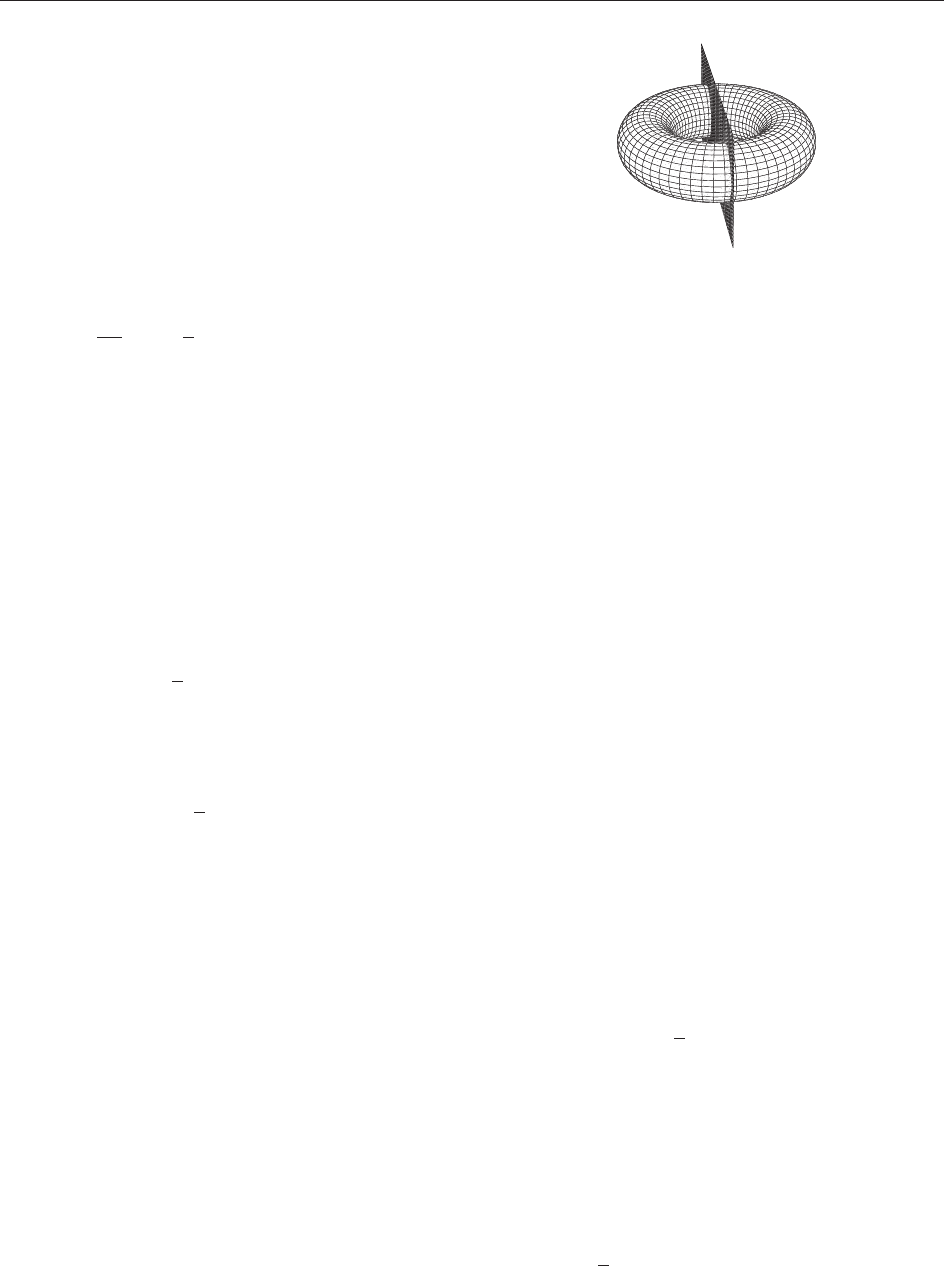
Then every plane which contains the center of the
torus a nd its axis cuts it out along a family of
edges onto two subgraphs with the property
desired (see Figure 1).
Theorem 9 The model [22]–[23] defined on the
graph obeying Assumption 8 admits Gaussian
domination.
Proof For = 1, h = (h
‘‘
0
)
h‘, ‘
0
i2E
,andn = 1, ..., m,
we define the map
T
n
h
‘‘
0
¼
h
‘‘
0
; if h‘; ‘
0
i2E
ðnÞ
h
n
ð‘Þ
n
ð‘
0
Þ
; if h‘; ‘
0
i2E
ðnÞ
0; if h‘; ‘
0
i2E
n
8
>
<
>
:
½28
According to Assumption 8
Z
ðhÞ¼
Z
R
Njj
exp
J
2
X
h‘;‘
0
i2E
1
jx
‘
x
‘
0
h
‘‘
0
j
2
0
@
1
A
d
þ
ð1Þ
þ
x
ð1Þ
þ
d
ð1Þ
x
ð1Þ
½29
where
d
ð1Þ
x
ð1Þ
¼exp
J
2
X
h‘;‘
0
i2E
ð1Þ
jx
‘
x
‘
0
h
‘‘
0
j
2
0
@
1
A
d
ð1Þ
x
ð1Þ
;
¼1
Figure 1 The torus.
380 Reflection Positivity and Phase Transitions

Set
d
ð1Þ
þ
ðx
ð1Þ
þ
Þ¼exp
J
2
X
h‘;‘
0
i2E
ð1Þ
þ
jx
‘
x
‘
0
h
ð‘Þð‘
0
Þ
j
2
0
B
@
1
C
A
d
ð1Þ
þ
ðx
ð1Þ
þ
Þ
d
þ
ð1Þ
x
ð1Þ
¼ exp
J
2
X
h‘;‘
0
i2E
ð1Þ
þ
jx
ð‘Þ
x
ð‘
0
Þ
h
‘‘
0
j
2
0
B
@
1
C
A
d
ð1Þ
ðx
ð1Þ
Þ
Then we apply here Lemma 6, with
0
þ
= {‘ 2
(1)
þ
jh‘, ‘
0
i2E
1
}, and obtain
½Z
ðhÞ
2
Z
R
Njj
exp
J
2
X
h‘;‘
0
i2E
1
jx
‘
x
‘
0
j
2
0
@
1
A
d
þ
ð1Þ
þ
x
ð1Þ
þ
d
þ
ð1Þ
x
ð1Þ
Z
R
Njj
exp
J
2
X
h‘;‘
0
i2E
1
jx
‘
x
‘
0
j
2
0
@
1
A
d
ð1Þ
x
ð1Þ
d
ð1Þ
þ
x
ð1Þ
þ
¼ Z
ðT
þ
1
hÞZ
ðT
1
hÞ
Next we estimate both Z
(T
1
h) employing E
2
and
T
2
. Repeating this procedure due times we finally
get
½Z
ðhÞ
2
m
Y
1
;...;
m
¼1
Z
ðT
m
m
T
1
1
hÞ¼½Z
ð0Þ
2
m
½30
Note that T
m
m
T
1
1
h=0 for any h 2R
N jEj
and any
sequence
1
,...,
m
= 1, which follows from [27]
and [28].
&
As might be clear from the proof given above, the
local Gibbs state
ðAÞ¼
Z
R
Njj
Aðx
Þd
ðx
Þ½31
defined by means of the measure [22],isRP
with respect to all reflections
n
, n = 1, ..., m.
Indeed, the functional defined by the product
measure
d
~
ðx
Þ¼
def
exp
J
2
X
‘2
jx
‘
j
2
!
d
ðx
Þ½32
is RP (see Example 2). The Gibbs measure [22] can
be written as
d
ðx
Þ¼
1
Z
ð0Þ
exp
X
m
n¼1
X
N
k¼1
X
‘2
0
þ;n
C
ðkÞ
‘
#
n
C
ðkÞ
‘
0
@
1
A
d
~
ðx
Þ½33
where C
(k)
‘
, k = 1, ..., N, are the same as in [20] and
0
þ,n
=
def
{‘ 2
(n)
þ
jh‘, ‘
0
i2E
n
}. Then the reflection
positivity of the Gibbs state [31] can be obtained
along the line of arguments used for proving Lemma
6. It appears that this is the only possible way to
construct an RP functional from another RP
functional.
Repeated application of the estimate [15] also
yields
Y
‘2
F
‘
ðx
‘
Þ
!
Y
‘2
Y
‘
0
2
F
‘
ðx
‘
0
Þ
!"#
1=jj
½34
which holds for any family of functions
{F
‘
: R
N
![0, þ1)}
‘2
, for which the ab ove
expressions make sense. The estimate [34] is a
chessboard estimate, which is a very important
element of the theory of phase transitions in
RP models. The estimate [2 6] may be obtained
from [34].
Infrared Bound
Let us show no w how to derive th e infrared
estimates from the Gaussian domination [26].
Consider the system of N-dimensional spins
indexed by the elements of Z
d
with the nearest-
neighbor ferromagnetic interaction and the sin-
gle-spin measure . To construct the periodic
local Gibbs measure of this s ystem, we take the
box
¼ðL; L
d
\
Z
d
; L 2 N ½35
and impose periodic conditions on its boundaries.
This defines the periodic dista nce
j‘ ‘
0
j
¼
X
d
j¼1
j‘
j
‘
0
j
j
2
L
"#
1=2
;‘;‘
0
2
j‘
j
‘
0
j
j
L
¼ minfj‘
j
‘
0
j
j; L j‘
j
‘
0
j
jg
½36
and hence the set of edges E, being unordered
pairs h‘, ‘
0
i such that j‘ ‘
0
j
= 1. Thus, we have
the graph (, E)andthemeasure[22].Thisisthe
periodic local Gibbs measure of our model. By
[31] it defines the periodic local Gibbs state
.
We have included the inverse temperature into J
Reflection Positivity and Phase Transitions 381