
Francoise J.-P., Naber G.L., Tsun T.S. (editors) Encyclopedia of Mathematical Physics
Подождите немного. Документ загружается.

Point Symmetry in Quasiperiodic
Systems
Quasiperiodic systems with noncrystallographic
point symmetry provide the structure theory and
physics of quasicrystals. We illustrate the general
scheme (qp)ofeqn [12] by examples of 5-fold and
icosahedral point symmetry. For generalizations, see
Janssen (1986).
Example 2: 5-Fold Point Symmetry from
the Root Lattice A
4
The A
4
root lattice basis in E
4
may be derived (Baake
et al. 1990) from five orthonormal unit vectors
(e
1
, e
2
, e
3
, e
4
, e
5
)inE
5
as
B ¼ðb
1
; b
2
; b
3
; b
4
Þ
:¼ðe
1
e
2
; e
2
e
3
; e
3
e
4
; e
4
e
5
Þ½16
As the generator of the cyclic group C
5
of 5-fold
rotations, we take the cyclic permutation (12345) in
cycle notation acting on the vectors (e
1
, e
2
, e
3
, e
4
, e
5
).
A possible choice of the basis for eqn [12] is the
irrational matrix
B ¼ðb
1
; b
2
; b
3
; b
4
Þ
¼
1 cc
0
c
0
c
0 ss
0
s
0
s
1 c
0
ccc
0
0 s
0
sss
0
2
6
6
6
4
3
7
7
7
5
1000
1100
0 110
0011
0001
2
6
6
6
6
6
6
4
3
7
7
7
7
7
7
5
c ¼ cos
2
5
¼
1
2
; s ¼ sin
2
5
¼
ffiffiffiffiffiffiffiffiffiffiffi
þ2
p
2
c
0
¼ cos
4
5
¼
2
; s
0
¼ sin
4
5
¼
ffiffiffiffiffiffiffiffiffiffiffi
3
p
2
½17
Equation [12] for the representa tion of the generator
(12345) of the cyclic group C
5
becomes
c s 00
sc00
00c
0
s
0
00s
0
c
0
2
6
6
6
4
3
7
7
7
5
ðb
1
; b
2
; b
3
; b
4
Þ
¼ðb
1
; b
2
; b
3
; b
4
Þ
0001
1001
0101
0011
2
6
6
6
4
3
7
7
7
5
½18
The left of eqn [18] generates two 2D inequivalent
representations of 5-fold planar rotations which are
incompatible with any 2D lattice.
The lattice A
4
in addition has a scaling symmetry
with a factor . The scaling transformation may be
expressed in terms of the basis (eqn [16]) and an
element h 2 Gl(4, Z)as
00 0
0 00
00
1
0
000
1
2
6
6
6
4
3
7
7
7
5
ðb
1
; b
2
; b
3
; b
4
Þ
¼ðb
1
; b
2
; b
3
; b
4
Þ
0 101
0 1 11
1 1 10
1010
2
6
6
4
3
7
7
5
½19
It is easily verified that the operations of scaling and
of 5-fold rotation (eqns [19] and [18]) commute
with one another.
V
⊥
A
B
B
A
D
b
2
b
1
X
1
X
1
x
⊥
x
X
i
*
X
i
*
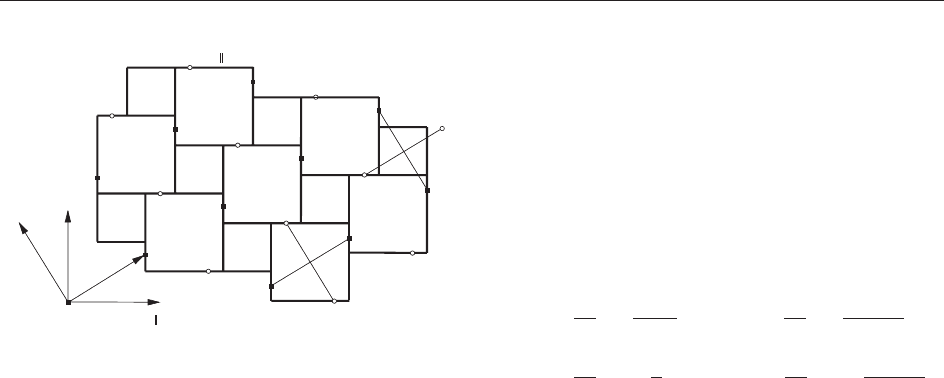
Figure 1 The square lattice with Fibonacci scaling. Lattice
points are black squares, holes white circles. The vectors
(b
1
, b
2
) indicate the lattice basis. The directions x
k
, x
?
of
scalings by
1
, run horizontally and vertically, respectively.
Perpendicular and parallel projections V
?
of Voronoi and D
k
of
Delone cells are attached to the lattice and hole points,
respectively. Two different pairs of dual 1-boundaries X
1
, X
1
of
Voronoi and Delone squares are marked on the right. The
product polytopes X
1, k
X
1, ?
of their projections form two
squares A, B and yield a periodic tiling of E
2
. A single pair A, B
forms a fundamental domain of the lattice. The characteristic
functions on A, B are windows for the tiles. A general
quasiperiodic function f
qp
(x
k
) is the restriction of a periodic
function f
p
(x), defined on A, B, to its values on a horizontal line
x = x
k
þ c
?
. If the periodic function f
p
(x)onA, B takes only
values independent of x
?
, its quasiperiodic restriction f
qp
(x
k
) :=
f
p
(x
k
þ c
?
) to this line repeats its values on the long and short
tiles A
k
, B
k
, respectively, of the standard Fibonacci tiling. Then
A
k
, B
k
form a fundamental domain for quasiperiodic functions
compatible with the tiling.
312 Quasiperiodic Systems

Example 3: Icosahedral Point Symmetry from
Lattices =Z
6
, D
6
The icosahedral group G = H
3
has two inequivalent
3D noncrystallographic representations. H
3
allows
for an induced embedding representation D: H
3
!
Gl(6, Z), (Kramer and Neri 1984, Kramer et al.
1992, Kramer and Papadopolos 1997) into a
hypercubic lattice =Z
6
. This representation
reduces into two 3D orthogonal inequivalent irre-
ducible noncrystallographic representations D
k
:
H
3
!O(3, R), D
?
: H
3
!O(3, R). The irrational
basis matrix of eqn [12] for =Z
6
becomes
(Kramer et al. 1992, p. 185, eqn (7))
B ¼ðb
1
; b
2
; b
3
; b
4
; b
5
; b
6
Þ
¼
ffiffiffiffiffiffiffiffiffiffiffiffiffiffiffiffiffiffi
1
2ð þ 2Þ
s
01
1 0
1 0
10
001 1
0
101
1 10 0
100 1
2
6
6
6
6
6
6
6
6
4
3
7
7
7
7
7
7
7
7
5
½20
with
= , 1 = 1. The six basis vectors with
components in the upper three rows span the so-
called primitive icosahedral Z-module associated
with D
k
in E
3
k
in the sense of eqn [11]. In this
space they point along the directions of six 5-fold
axes of the icosahedron.
A second lattice in E
6
which admits icosahedral
point symmetry is the root lattice D
6
. The basis of
this root lattice, often denoted as the P-lattice, is
obtained from eqn [20] by a centeri ng matrix
given in Kramer et al. (1992, p. 185, eqn (8)). The
corresponding Z-module is inequivalent to the
module projected from eqn [20]. The third
lattice of icosahedral point symmetry in E
6
is
=I := P
reciprocal to the root lattice D
6
. All
three icosahedral modules admit (powers of)
-scaling.
Quasiperiodic Tilings and Their Windows
Quasiperiodic sets of points arise from the general
scheme (qp)(eqn [12]) by choosing particular
periodic functions in the embedding space E
n
, called
the ‘‘windows,’’ whose intersections with E
k
are the
quasiperiodic sets of points.
The window for the construction of a discrete
quasiperiodic point set based on eqn [12] is given by
the characteristic function (x
?
) on the projection
V
?
(x
?
):=
?
(V(b)) of the Voronoi cell (eqn [5]),
attached to any lattice point b 2 .
Example 4: The Quasiperiodic Fibonacci Point Set
If in the Fibonacci system (Figure 1), one attaches to
any point b of the square lattice as a window the
characteristic function of the perpendicular pro-
jection V
?
(b) of the unit square attached to b, the
function f
qp
(x
k
) becomes the standard quasiperiodic
Fibonacci sequence of points .
The dual cell geometry of Voronoi and Delone
cells and their dual boundaries (eqns [5] and [6])
allows us to construct dual canonical quasiperiodic
tilings ( T , ), (T
, )(Kramer and Schlottmann
1989). To this end one constructs from local projec-
tions of pairs of dual boundaries X
m, k
, X
(nm), ?
or
X
m, k
, X
(nm), ?
the direct product polytopes X
m, k
X
(nm), ?
or X
k
X
?
called ‘‘klotz polytopes.’’ The
characteristic functions on these polytopes form the
windows for the tiles X
m, k
, X
(nm), k
,respectively.
Example 5: The Quasiperiodic Fibonacci Tiling
The Voronoi cells V of the square lattice are squares
centered at lattice points, the Delone cells D are
squares centered at the vertices of Voronoi squares.
The product polytopes X
1, ?
X
1, k
from projections
of dual 1-boundaries X
1
, X
1
of Delone and Voronoi
squares (cf. Figure 1) become the two types of square
windows A, B. If a parallel line section x = x
k
þ c
?
crosses one of these squares, the tile A
k
or B
k
is
formed. The standard Fibonacci tiling results.
Example 6: Canonical Tilings from the Root
Lattices A
4
,D
6
The two rhombus tiles of the planar quasiperiodic
Penrose pattern (Penrose 1974)(T , A
4
) are the projec-
tions of 2-boundaries of the Voronoi complex of the
root lattice A
4
2 E
4
(Baake et al. 1990). The triangle
tiles of the dual tiling (T
, A
4
) are shown in Figure 2.
They are projections of 2-boundaries from the
Delone complex of the same lattice. A full analysis
of dual Voronoi and Delone boundaries of the root
lattice D
6
is given in Kramer et al. (1992). It leads to
icosahedral tilings (T , D
6
)and(T
, D
6
)ofE
3
,(Kramer
et al. 1992, Kramer and Papadopolos 1997, Kramer
and Schlottmann 1989) and to models of icosahedral
quasicrystals.
Fundamental Domains for Quasiperiodic
Tilings
Canonical tilings allow us to construct quasiperiodic
functions equipped with a qua siperiodic counterpart
of fundamental domains or cells in crystals: assume
that the tiles of a tiling (T , ) all are translates in E
m
of a finite minimal set of prototiles (X
1
, ..., X
r
).
Consider the class of quasiperiodic functions which
Quasiperiodic Systems 313
take identical values on an y translate of a prototile.
These values are prescribed on the finite set of
prototiles in E
m
which define a fundamental domain
for this class of quasiperiodic functions. Only this
class of quasiperiodic functions is compatible with
the tiling. It can be characterized in the scheme (qp)
(eqn [12])by-periodic functions on E
n
whose
values on the tile windows of the previous section
are independent of the perpendicular coordinate. A
fundamental domain for the triangle tiling ( T
, A
4
)
is given by the shaded parts in Figure 2. The
fundamental domain property appears in relation
with the theory of covering of quasiperiodic sets (see
Kramer and Papadopolos (2000)).
Example 7: Fundamental Domain
for the Fibonacci Tiling
Attach to the squares A, B in Figure 1 a periodic
function f
p
(x) with functional values independent of
the perpendicular coordinate x
?
within the two
squares. Consider the functional values f
qp
(x
k
) =
f
p
(x
k
þ c
?
) picked up on a parallel line. Clearly,
these values become independent of the perpendi-
cular coordinate of any intersection with a square
A, B. The general prescription of values on a
fundamental domain of 2 E
2
needed for a
quasiperiodic function reduces to a prescription of
its functional values in E
k
on the fundamental
domain formed by the two prototiles A
k
, B
k
.
Conclusion
For quasiperiodic systems, the general construction
was introduced in the section ‘‘Quasiperiodic point
sets and functions’’, and illustrations were given in
four subsequent sections. Further reading resources are
provided by the references given at the end. Here, we
mention some of the many possible generalizations.
Bohr (1925) considers quasiperiodic as special
cases of almost periodic systems. The module of an
almost periodic function has a countable basis.
Moody (1997) discusses the notion of Meyer sets.
These describe discrete sets on locally compact
abelian groups and as particular cases encompass
quasiperiodic systems.
Lagarias (2000) studies aperiodic sets character-
ized by the following properties, shared with
periodic and quasiperiodic sets:
(ap1): inequivalent patches of points are volume
bounded,
(ap2): pure point Fourier spectrum,
(ap3): linear repetitivity of patches, and
(ap4): self-similarity.
See also: Compact Groups and Their Representations;
Finite Group Symmetry Breaking; Lie Groups: General
Theory; Localization for Quasiperiodic Potentials;
Symmetries and Conservation Laws; Symmetry and
Symmetry Breaking in Dynamical Systems.
Further Reading
Baake M, Kramer P, Schlottmann M, and Zeidler D (1990)
Planar patterns with fivefold symmetry as sections of periodic
structures in 4-space. International Journal of Modern Physics
B 4: 2217–2268.
Bohr H (1925) Zur Theorie der fastperiodischen Funktionen. I.
Acta Mathematicae 45: 29–127.
Bohr H (1925) Zur Theorie der fastperiodischen Funktionen. II.
Acta Mathematicae 46: 101–214.
Brown R, Bu¨ low R, Neubu¨ ser J, Wondratschek H, and
Zassenhaus H (1978) Crystallographic Groups of Four-
Dimensional Space. New York: Wiley.
de Bruijn NG (1981) Algebraic theory of Penrose’s non-periodic
tilings of the plane. I. Proceedings Koninklijke Nederlandse
Akademie van Wetenschappen 84: 39–52.
de Bruijn NG (1981) Algebraic theory of Penrose’s non-periodic
tilings of the plane. II. Proceedings Koninklijke Nederlandse
Akademie van Wetenschappen 84: 53–66.
Janssen T (1986) Crystallography of quasicrystals. Acta Crystal-
lographica A 42: 261–71.
Kramer P and Neri R (1984) On periodic and non-periodic space
fillings of E
n
obtained by projection. Acta Crystallographica A
40: 580–587.
Kramer P and Papadopolos Z (1997) Symmetry concepts for
quasicrystals and non-commutative crystallography. In:
Moody RV (ed.) The Mathematics of Long-Range Aperiodic
Order, pp. 307–330. Dordrecht: Kluwer.
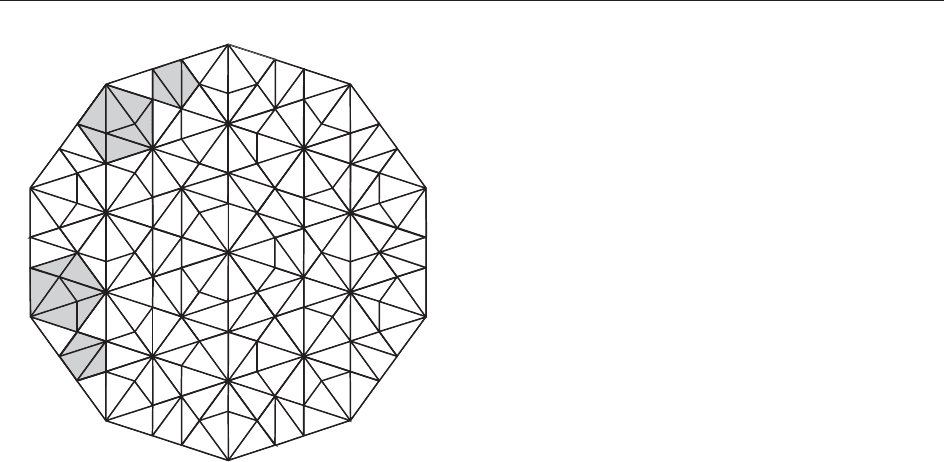
Figure 2 A patch of the planar quasiperiodic triangle tiling
(T
, A
4
) obtained from the root lattice A
4
2 E
4
. The tiles are two
triangles, projections of 2-boundaries from the Delone cells of
A
4
. The vertices are projections of lattice points. The 20 shaded
triangles form a set of prototiles such that any other tile is a
translate of one of them. The shaded set forms a fundamental
domain for the tiling.
314 Quasiperiodic Systems

Kramer P and Papadopolos Z (eds.) (2000) Coverings of Discrete
Quasiperiodic Sets, Theory and Applications to Quasicrystals.
New York: Springer.
Kramer P, Papadopolos Z, and Zeidler D (1992) The root lattice D
6
and icosahedral quasicrystals. In: Frank A, Seligman TH, and Wolf
KB (eds.) Group Theory in Physics, American Institute of Physics
Conference Proceedings, vol. 266, pp. 179–200. New York.
Kramer P and Schlottmann M (1989) Dualization of Voronoi
domains and klotz construction: a general method for the
generation of proper space filling. Journal of Physics A:
Mathematical and General 22: L1097–L1102.
Lagarias J (2000) The impact of aperiodic order on mathematics.
Material Science Engineering A 294–296: 186–191.
Moody RV (1997) Meyer sets and their duals. In: Moody RV
(ed.) The Mathematics of Long-Range Aperiodic Order,
pp. 403–4 41. Do rdrech t: Kluw er.
Penrose R (1974) The role of aesthetics in pure and applied
mathematical research. Bulletin of the Institute of Mathe-
matics and its Applications 10: 266–71.
Schwarzenberger RLE (1980) N-Dimensional Crystallography.
San Francisco: Pitman.
Shechtman D, Blech I, Gratias D, and Cahn JW (1984) Metallic
phase with long-range orientational order and no translational
symmetry. Physical Review Letters 53: 1951–1953.
Quillen Determinant
S Scott, King’s College London, London, UK
ª 2006 Elsevier Ltd. All rights reserved.
Determinants in Finite Dimensions
The determinant of a linear transformation
A : V ! W actin g between finite-dimensional com-
plex vector spaces is an element det A of a complex
line L
A
. The abstract element det A is called the
Quillen determinant of A, an d the complex line L
A
is called the determinant line of A. A choice of
(linear) isomorphism
: L
A
! C ½1
associates to det A the complex num ber
det
A :¼ ðdet AÞ2C ½2
which can equivalently be written as the ratio
det
A ¼
det A
1
ð1Þ
½3
taken in the one-dimensional complex vector space
L
A
relative to the canonical generator
1
(1). It is
not necessarily the case that det A determines a
generator for L
A
; specifically, if dim V = m and
dim W = n, then det A = 0ifm 6¼ n (by ‘‘fiat’’), while
if m = n, then det A = 0 precisely when A is not
invertible. For the moment, set m = n.
For k 2 {0, 1, ..., n} the kth exterior power opera-
tor is defined by
^
k
A : ^
k
V ! ^
k
W
^
k
Aðv
1
^v
2
^^v
k
Þ:¼Av
1
^Av
2
^^Av
k
½4
where v
1
,...,v
k
2V and ^
0
V := C and ^
0
A:= 1.
When k = n, DetV := ^
n
V and DetW := ^
n
W are
complex lines and the determinant line of A is
L
A
:¼ Det V
Det W ½5
while for any basis {e
1
, ..., e
n
} for V, with dual basis
{e
1
, ..., e
n
} for V
,
det A :¼ e
1
^^e
n
ð^
n
AÞðe
1
^^e
n
Þ2L
A
½6
There is a canonical isomorphism for A 2 Hom(V, W),
B 2 Hom(U, V)
L
AB
ffi L
A
L
B
½7
coming from the isomorphism
Det V
Det V ! C ½8
defined by the canonical pairing Det V
Det V !C,
and this preserves the determinant elements
det ðABÞ !det A det B ½9
The Classical Determinant
When V = W these constructions take on a more
familiar form. Then can be chosen to be the
canonical isomorphism [8] and evaluation on
det A 2 L
A
outputs the classical determinant
det
C
A ¼
X
ð1Þ
a
1;ð1Þ
a
n;ðnÞ
½10
where the sum is over permutations of {1, ..., n}and
(a
i, j
) is the matrix of A with respect to any basis of V –
changing the basis may change the summands on the
right-hand side of [10], but not their sum. It is
fundamental that when V = W the classical determi-
nant is an intrinsic invariant of the operator A,inde-
pendent of the choice of basis for V;whenV 6¼ W that
is no longer so since there is then no canonical bilinear
pairing Det V
Det W ! C; the choice of a non-
degenerate pairing is equivalent to a choice of in [1].
The identification of [10] from [6] and [8]
amounts to the identity in Det V
ð^
n
AÞðe
1
^^e
n
Þ¼det
C
A : e
1
^^e
n
½11
Quillen Determinant 315

Since ^
n
(AB) = ^
n
A ^
n
B, [11] in turn implies the
characterizing multiplicativity property of the classical
determinant
det
C
ðABÞ¼det
C
A . det
C
B ½12
for A, B 2 End( V), specializing the general fact in
[7]. Similarly, the group Gl(V, C) of invertible
elements of End(V) is identified with those A with
det
C
A 6¼ 0.
The classical determinant can also be thought of
in the following ways. First, the direct sum of the
operators defined in [4] yields the total exterior
power operator ^A : ^V ! ^ V on the exterior
algebra ^V =
n
k = 0
^
k
V and this has trace
tr ð^AÞ¼det
C
ðI þ AÞ½13
where I is the identity. Alternatively, one can do
something a little more sophisticated and use the
holomorphic functional calculus to define the
logarithm log
B of B 2 End(V)by
log
B ¼
i
2
Z
log
ðB IÞ
1
d ½14
Here log
is the branch of the complex logarithm
defined by 2<arg() and
is a positively
oriented contour enclosing spec(B) but not any point
of the spectral cut R
= {re
i
jr 0}. Then, if B is
invertible,
tr ðlog
BÞ¼log
det
C
B ½15
The Fredholm Determinant
The advantage of the constructions [13] and [15] is
that they extend to a restricted class of bounded linear
operators on infinite-dimensional Hilbert spaces. This
is consequent on the fact that both of the formulas [13]
and [15] are computed as operator traces.
(Recall that a trace on a Banach algebra B is a
linear functional : B!C which has the property
([a, b]) = 0 for all a, b in B, where [a, b]:= ab ba
is defined by the product structure on B. Since one
can define the logarithm log
b of an element b of B
with spectral cut R
by the formula [14], one in this
case obtains a determinant det
,
(b) on such
elements by setting
log
det
;
ðbÞ¼ðlog
bÞ½16
If a, b, ab 2Bhave common spectral cuts , the trace
property of translates into the multiplicativity
property det
,
(ab) = det
,
(a)det
,
(b) via a version
of the Campbell–Hausdorff formula.)
The operator trace arises as follow s. Let H be a
complex separable Hilbert space with inner product
<, > , let C(H) be the algebra of compact operators
on H, and let
L
1
¼ A 2CðHÞjkAk
2
1
:¼
X
1
i¼1
i
ðA
AÞ < 1
()
½17
be the ideal of trace-class operators, where the sum
is over the real discrete eigenvalues
i
(A
A) &þ0of
the compact self-adjoint operator A
A. For any
orthonormal basis {
j
}ofH the map
tr : L
1
! C; A 7!tr ðAÞ :¼
X
j
<
j
; A
j
>
is a trace functional on L
1
(H), independent of the
choice of basis. Lidskii’s theorem states that
tr ðAÞ¼
X
2specðAÞ
½18
with the sum over the eigenvalues of A counted up
to algebraic multiplicity; for general trace-class
operators this equality is highly nontrivial.
If A is trace class, then for each non-negative
integer k so is each of the exterior power operators
^
k
A : ^
k
H !^
k
H, defined as in [4]. Following
[13], a determinant can therefore be defined on the
semigroup I þ L
1
:= {I þ A jA 2 L
1
} of determinant-
class operators by the absolutely convergent sum
det
F
ðI þ AÞ:¼ tr ð^AÞ¼1 þ
X
1
k¼1
tr ð^
k
AÞ½19
On the other hand, since tr is tracial and log
(I þ A)
defined by [14] is trace class, then according to [16],
there is a determinant given on invertible determinant-
class operators by
log
det
F
ðI þ AÞ¼tr ðlog
ðI þ AÞÞ ½20
which, as the left-hand side already suggests,
coincides with the Fredholm determinant.
The Fredholm determinant retains the character-
izing properties of the classical determinant in finite
dimensions, that det
F
: I þ L
1
! C is multiplicative,
det
F
ðI þ AÞðI þ BÞðÞ¼det
F
ðI þ AÞdet
F
ðI þ BÞ;
A; B 2 L
1
½21
and det
F
(I þ A) 6¼ 0ifandonlyifI þ A is invertible.
It is, moreover, essentially unique; any other multi-
plicative functional on I þ L
1
is equal to some power
of the Fredholm determinant, or, equivalently, any
trace on L
1
is a constant multiple of the operator
trace. The trace property, the operator trace, and the
multiplicativity of the Fredholm determinant do not,
however, persist to any functional extension of the
operator trace (resp. Fredholm determinant) on the
316 Quillen Determinant

space of pseudodifferential operators of any real
order acting on function spaces (fields over space-
time). In quantum physics, this is a primary cause of
anomalies. More precisely, determinants of differen-
tial operators arise in quantum field theories (QFTs)
and string theory through the formal evaluation of
their defining Feynman path integrals and the
calculation of certain stable quantum numbers,
which are in some sense ‘‘topological.’’
From the latter perspective, it is instructive to be
aware also of the following, third, construction of the
Fredholm determinant, which equates the existence
of a nontrivial determinant to the existence of
nontrivial topology of the general linear group.
First, in a surprising contrast to Gl(n, C), the general
linear group Gl(H) of an infinite-dimensional Hilbert
space H with the norm topology is contractible, and
hence topologically trivial. By transgression proper-
ties in cohomology, this implies any vector bundle
with structure group Gl(H) is isomorphic to the
trivial bundle. In order to recapture some topology
(and hence, in applications, some physics), it is
necessary to reduce to certain infinite-dimensional
subgroups of Gl(H). The most obvious one is the
group Gl(1) of of invertible operators differing from
the identity by an operator of finite rank. As the
inductive limit of the Gl(n, C), the cohomology and
homotopy groups of Gl(1)areastableversionof
those of Gl(n, C). Precisely, Gl(1) is torsion free and
its cohomology ring is an exterior algebra with odd
degree generators, while Bott (1959) periodicity
identifies
k
(Gl(1)) to be isomorphic to Z if k is
odd and trivial if k is even. Topologically, it is
preferable to consider the closure of Gl(1)inGl(H),
which yields the group Gl
cpt
(H) of operators differing
from the identity by a compact operator, but this is
now a little ‘‘too large’’ for analysis and differential
geometry. Given our earlier comments, there is an
intermediate natural choice of the Banach Lie group
Gl
1
(H) of operators differing from the identity by a
trace-class operator (in fact, there is a tower of such
Schatten class groups). Moreover, the inclusions
Gl(1) Gl
1
(H) Gl
cpt
(H) are homotopy equiva-
lences, and so the cohomology of Gl
1
(H)isjustthe
exterior algebra mentioned above
H
ðGl
1
ðHÞÞ ¼ ^ð!
1
;!
3
;!
5
; ...Þ;
deg!
j
¼ 2j 1 ½22
The advantage of considering Gl
1
(H) is that precise
analytical representatives for the classes !
j
can be
written down:
!
j
¼
i
2
j
ðj 1Þ!
ð2j 1Þ!
2j1
where
¼ tr ðZ
1
dZÞ½23
is the 1-form on Gl
1
(H).
This equation makes sense because the derivative
dZ is trace class, and hence so is Z
1
dZ. Now,
locally =d log det
F
(Z), so that the 1-form !
1
pulled back by a path : S
1
!Gl
1
(H) is precisely the
winding number of the curve traced out in C
by the
function det
F
(). In fact, this is just a special case of
the Bott periodicity theorem, which tells us that the
stable homotopy group
2j1
(Gl
1
(H)) is isomorphic to
Z and an isomorphism is defined by assigning to a map
f : S
2j1
!Gl
1
(H) the integer
R
S
2j1
f
!
j
2 Z (it is not
obvious a priori that it is an integer).
Notice that it was not necessary to have mentioned
the Fredholm determinant of Z at this point. Indeed,
the third definition of the Fredholm determinant is to
see it as the integral of the 1-form ,define
log
det
F
ðI þ AÞ :¼
Z
½24
where : [0, 1] !Gl
1
(H) is any path with (0) = I
and (1) = I þ A; this uses the connectedness of
Gl
1
(H) and independence of the choice of ,as
guaranteed by Bott periodicity.
Interestingly, this is closely tied in with the
Atiyah–Singer index theorem for elliptic pseudodif-
ferential operators (which in full generality uses the
Bott periodicity theorem). Here, there is the follow-
ing simple but quintessential version of that theorem
which links it to the winding number of the
determinant of the symbol of a differential operator
D ¼
X
jm
a
ðxÞD
x
½25
on Euclidean space R
n
with = (
1
, ...,
n
) a multi-
index of non-negative integers, jj=
1
þþ
n
,
and D
x
= i@=@x
i
. Here D acts on C
1
(R
n
, V) with V
a finite-dimensional complex vector space and
the coefficients of D are matrices varying smoothly
with x which are required to decay suitably fast,
D
x
a
(x)
= O(jxj
jj
)asjxj!1. If the symbol
D
of D, defined by
D
ðx;Þ¼
X
jm
a
ðxÞ
½26
with = (
1
, ...,
n
) 2 R
n
, satisfies the ellipticity
condition of being invertible on the 2n 1 sphere
S
2n1
in (x, ) space, then D is a Fredholm operator.
The index theorem then states
index ðDÞ¼
Z
S
2j1
D
ð!
n
Þ
Quillen Determinant 317

the higher-dimensional analog of the winding
number of the determinant.
Fredholm Operators and Determinant
Line Bundles
The operators whose determinants are considered in
this article are all Fredholm operators. Recall that a
linear operator A : H
1
!H
2
between Hilbert spaces
is Fredholm if it is invertible modulo compact
operators; that is, there is a ‘‘parametrix’’
Q : H
2
!H
1
such that QA I and AQ I are
compact operators on H
1
and H
2
, respectively.
Equivalently, the range A(H
1
)ofA is closed in H
2
,
and the kernel Ker(A) = { 2 H
1
jA = 0} and
cokernel Coker(A) = H
2
=A(H
1
)ofA are finite
dimensional. (This is equally true for Banach and
Frechet spaces, we restrict our attention to Hilbert
spaces for brevity.) The space Fred of all such
Fredholm operators with the norm topology has the
homotopy type of the classifying space Z BGl(1).
The first factor parametrizes the connected compo-
nents of Fred , two Fredholm operators are in the
same component if and only if they have the same
index
index ðAÞ¼dim KerðAÞdim CokerðAÞ
Mostly we restrict our attention to the connected
component Fred
0
of operators of index zero. The
cohomology of Fred
0
BGl(1) is a polynomial
ring
H
ðFred
0
Þ¼R½ch
1
; ch
2
; ch
3
; ...
whose generators may be formally realized as the
even degree components of the Chern character of
an infinite-dimensional bundle over Fred
0
. In fact,
the generators !
2j1
of H
(Gl
1
(H)) are related to the
ch
j
through transgression, see Chern and Simons
(1974). We shall be interested here in the first
generator ch
1
, a transgression of the Fredholm
determinant ‘‘winding number 1-form’’ !
1
, which
coincides with the real Chern class of a canonical
complex line bundle DET
0
!Fred
0
. The fiber of
DET
0
at A 2 Fred
0
is the determinant line Det(A)of
the Fredholm operator A, which is defined as
follows (Segal 2004).
Just as for finite-rank operators (see the subsec-
tion ‘‘Determ inant s in finite dimensi ons’’), the
determinant of a Fredholm operator A : H
1
!H
2
exists abstractly not as a number but as an element
detA of a complex line Det(A). For simplicity, we
suppose that index (A ) = 0. Elements of the
determinant line Det( A) are equivalence classes
[E, ] of pairs (E, ), where E : H
1
!H
2
such that
A E is trace class and relative to the equivalence
relation (Eq, ) (E, det
F
(q)) for q : H
1
!H
1
of
determinant class and where det
F
(q) is the Fredholm
determinant of q. Complex multiplication on Det(A)
is defined by [A, ] = [A, ]. The abstract, or
Quillen, determinant of A is the preferred element
det A := [A, 1] in Det(A).
Here are some essential properties of the determi-
nant line. First, det A is nonzero if and only if A is
invertible. Next, quotients of abstract determinants
in Det(A) are give n by Fredholm determinants; for if
A
1
: H
1
!H
2
, A
2
: H
1
!H
2
are Fredholm operators
such that A
i
A are trace class, then if A
2
is
invertible we see that A
1
2
A
1
is determinant class
and hence from the definition that
detðA
1
Þ
detðA
2
Þ
¼ det
F
ðA
1
2
A
1
Þ½27
where the quotie nt on the left-hand side is taken in
Det(A). The principal functorial property of the
determinant line is that given a commutative
diagram with exact rows and Fredholm columns
0 ! H
1
! H
0
1
! H
00
1
! 0
#A #A
0
#A
00
0 ! H
2
! H
0
2
! H
00
2
! 0
½28
then there is canonical isomorphism of complex
lines
DetðA
0
ÞffiDetðAÞDetðA
00
Þ½29
preserving the Quillen determinants det (A
0
) $
det (A) det (A
00
). A consequence of this property is
that given Fredholm operators A : H
2
!H
3
and
B : H
1
!H
2
, then
DetðABÞffiDetðAÞDetðBÞ
with det (AB) $det (A) det (B), generalizing the
elementary property [9].
The principal context of interest for studying
determinant lines is the case where one has a
family A= {A
x
jx 2 B} of Fredholm operators
parametrized by a manifold B, satisfying sui table
continuity properties, and one aims to make sense
of the determinant as a function A!C.Itisthen
of no difficulty to show that the corresponding
family of determ inant lines DET(A) = [Det(A
x
)
defines a complex line bundle over B endowed
with a canonical section det : B ! DET(A)
318 Quillen Determinant

assigning to x 2 B the Quillen determinant
det (A
x
) 2 Det(A
x
)(Quillen 1985, Segal 2004). To
identify the Quillen determinant section with a
function on A, we need to identify a triviali zation
of the line bundle DET(A), giving a global basis
for the fibers. This is the same thing as giving a
non(or never)vanishing section : B !DET(A),
with respect to which we have the regularized
determinant function (cf. [3]):
x 7!det
ðA
x
Þ:¼
det ðA
x
Þ
ðxÞ
½30
If A is trivializable, so a nonzero section exists, there
will be many such sections and some extra data is
needed to fix a natural choice of .
Each of the properties mentioned above for
determinant lines carries forward to determinant
line bundles in a natural way. In particular, one
easily deduces from [28], or from the exact
sequence
0 ! KerA
x
! H
1;x
!
A
x
H
2;x
! CokerA
x
! 0
that if the kernels KerA
x
have constant dimension as
x varies, then there is a canonical isomorphism
DetðAÞ ffi ^
max
KerðAÞ
^
max
CokerðAÞ ½31
where Ker(A) is the finite-rank complex vector
bundle over B with fiber KerA
x
, a nd Coker(A)
similarly. The interesting feature here is that it
shows the determinant bundle to be the top
exterior power of the index bundle Ind(A) =
[Ker(A)] [Coker(A)] 2 K(B)intheevenK-theory
of B, and in this sense determinant theory may be
seen as a particular aspect of index theory –
understood is the very broadest sense; in fact,
the computation of determinants is usually a
considerably more complex and difficult task than
computing an index.
Determinant Bundles for Differential
Operators over Manifolds
The Quillen determinant has been of particular
interest in the case of families of Dirac operators.
Such a family is associated to a C
1
fibration
: M ! B of closed boundaryless finite-dimensional
Riemannian manifolds of even dimension. If there is
a graded Hermitian vector bundle E = E
þ
E
!M
of Clifford modules, then from the Riemannian
structure one can construct a Levi-Civita connection
on the vertical tangent bundle T(M=B) which can be
lifted to a Clifford connection on E; for exampl e, the
spinor connection if we have a family of spin
manifolds. This data yields a smooth family of
first-order elliptic differential operators D = {D
x
:
C
1
(M
x
; E
þ
x
) ! C
1
(M
x
; E
x
) jx 2 B} of chiral Dirac-
type, with D
x
a Dirac-type operator acting over the
manifold M
x
=
1
(x) parametrized by the fibration,
along with a determinant line bundle DET(D) !B
endowed with a canonical section x 7!det (D
x
).
There are various contexts in mathematics and
physics in which one would like to assign to the
determinant section a naturally associated smooth
function (a regularized determinant) det
reg
: B ! C,
which can, for example, then be integrated. As
discussed in the previous section, this depends on
identifying a trivializing (nonzero) section of
DET(D). For such a section to exist, the first Chern
class c
1
(DET(D) 2 H
2
(B) must vanish, and this in
turn can be computed as a term in the Atiyah–Singer
(1984) index theorem for families. Indeed, this is
clear from the formal identification [31] which here
takes on a precise meaning.
The following simple example, which is the basic
topological anomaly computation in string theory,
may help to explain the type of computation. Let
M
x
be a copy of a compact Riemann surface, so
that M is a family of surfaces parametrized by B.
Let T = [T
x
be the vertical complex tangent line
bundle on M, where T
x
is the complex tangent line
bundle to M
x
. Each fiber has an associated
@-operator @
x
which we couple to the Hermitian
bundle E
x
:= T
m
x
for m a non-negative integer. In
this way, we get a family D
of @-operators coupled
to E = T
m
whose index bundle is the element
Ind(D
) = f
!
(T
m
) 2 K(B). The Atiyah–Singer index
theorem for families in this situation coincides with
the Grothendieck–Riemann–Roch theorem and this
says that
chðf
!
ðT
m
ÞÞ ¼ f
ðchðT
m
ÞToddðTÞÞ
where ch is the Chern character class and Todd(T)is
the Todd class defined for a vector bundle F whose
first few terms are
ToddðFÞ¼1 þ
1
2
c
1
ðFÞþ
1
12
c
1
ðFÞ
2
þ
and where f
: H
i
(M) !H
i1
(B) is integration over
the fibers. That is, with = c
1
(T),
chðf
!
ðT
m
ÞÞ ¼ f
1 þ m þ
1
2
m
2
2
þ
1 þ
1
2
þ
1
12
2
þ
¼ f
1 þ m þ
1
2
þ
1
12
m
2
þ m þ
1
6
2
þ
So we have
c
1
ðf
!
ðT
m
ÞÞ ¼
1
12
ð6m
2
þ6m þ1Þf
ð
2
Þ2H
2
ðBÞ½32
Quillen Determinant 319

But for any element of K-theory, c
1
(E) =
c
1
(DET(E)), and so the left-hand side of [32] is the
first Chern class of the determinant line bundle
DET(D
). If we take, in particular, B = Conf(), the
space of conformal classes of metrics on (or
compact subsets of this space), and couple the
family D
to a background trivial real bundle of
rank d=2, or its negative in K -theory, then taking
m = 1 [32] is easily seen to be modified to
c
1
ðD
;d=2
Þ¼
ðd 26Þ
24
f
ð
2
Þ
It follows for this topological anomaly to vanish
one must have background spacetime of dimension
d = 26. The idea here is that Conf ()isa
configuration s pace for bosonic strings in R
d
with the requirement that the determinant section
of the determinant line bundle be conformally
invariant, corresponding to t he classical invariance
of the string Lagrangian defining the string path
integral from which the determinant arises. That
is, in order to evaluate the path integ ral on the
reduced configuration space, one requires a trivia-
lization of the determinant line bundle which
defines a conformally invariant regularized deter-
minant function. The above calculation says that
there is a topological obstruction to this occurring
when the background space dimension differs
from 26.
This is the most basic example of determinant
anomaly computations, which have acquired
considerably more sophisticated constructions in
modern versions of string theory and QFT. One
immediate deficiency in the approach explained so
far is that not all anomalies are topological and so
even though the first Chern class of the determinant
line bundle may vanish, there may still be local and
global obs tructions to the existence of a determi-
nant function with the correct symmetry properties.
To be more precise, one needs to say not just that a
trivialization of the deter minant line bundle for-
mally exists, but to actually be able to construct a
specific preferred trivialization. For this more
refined objective, one needs to know more about
the differential geometry of the determinant line.
One approach is to fix a canonical choice of
connection and, if the determinant bundle is
topologically trivial, to construct a determinant
section (up to phase) using the parallel transport
of the connection.
The principal contribution to such a theory was
made in a remarkable four page paper by Quillen
(1985) in which using zeta-function regularization
he presented a construction of a metric and
connection on the determinant line bundle for a
family of
@-operators over a Riemann surface
coupled to a holomorphic vector bundle. (This is
the first paper one should read on determinant line
bundles; Quillen’s motivation, in fact, did not come
from physics but from a problem in number
theory.)
To outline this construction, which was extended
to general families of Dirac-type operators in Bismut
and Freed (1986), first we recall that if is
an invertible Laplacian-type second-order elliptic
differential operator acting on the space of sections
of a vector bundle over a compact manifold of
dimension n, then it has a spectrum consisting of
real discrete eigenvalues {} forming an unbounded
subset of the positive real line. The zeta function
of is defined in the complex half-plane Re(s) >
n=2by
ð; sÞ¼tr ð
s
Þ¼
X
s
; ReðsÞ >
n
2
and extends to a meromorphi c function of s on the
whole complex plane. It turns out that the extension
has no pole at s = 0 and this means that we may
define the zeta-function regularized determinant of
by
det
ðÞ: ¼ exp
d
ds
js¼0
ð; sÞ
since (d=ds)j
s = 0
s
= log this formally represents a
regularized product of the eigenvalues of .A
metric is now defined on the deter minant line
bundle DET(D) by defining the norm square of the
element det (D
x
) 2 Det(D
x
)by
kdetðD
x
Þk
2
:¼ det
ðD
x
D
x
Þ
over the subset B
0
of x 2 B where D
x
is inver tible.
Elsewhere in B, one includes a factor defined by the
induced L
2
metric in the kernel and cokernel. See
Quillen (1985) and Bismut and Freed (1986) for full
details.
A connection is defined by similarly constructing
a regularized version of the connection we would
define if we were working with finite-rank bundles.
First, one includes in the data associated to the
fibration : M !B defining the family of opera-
tors D a splitting of the tangent bundle
TM = T(M=B)
(TB). This assumption and the
Riemannian geometry of the fibration yield a
connection r
()
defined along the fibers of the
fibration. The connection form over B
0
is then
defined by
!ðxÞ¼tr
ðD
1
x
r
ðÞ
D
x
Þ
320 Quillen Determinant

where the zeta-regularized trace tr
is defined on a
vertical bundle endomorphism-valued 1 form x 7!A
x
on M by
tr
ðA
x
Þ:¼ fp
s¼0
tr ðA
x
D
x
D
x
s
Þj
mer
where the superscript indicates we are considering the
meromorphically extended form, and fp
s = 0
(G(s))
means the finite part of a meromorphic function G
on C; that is, the constant term in the Laurent
expansion of G(s)nears = 0.
A theorem of Bismut and Freed, generalizing
Quillen’s original computation, computes the curva-
ture
(DET(D))
of this connection to be the 2-form
component in the local Atiyah–Singer families index
density. This is a refined version of the topological
version of that theorem which we utilized earlier; it
expresses the characteristic classes on B in terms of
specific canonical differential forms constructed by
integrating, along the fibers of the fibration,
canonically defined vertical characteristic forms.
More precisely, they prove the formula (Bismut
and Freed 1986 and Berline et al. 1992)
ðDETðDÞÞ
¼ð2iÞ
n=2
Z
M=B
b
AðM=BÞchðEÞ
!
½2
½33
where ()
[2]
2
2
(B) means the 2-form component
of a differential form on B. Here
b
A(M=B) =
det
1=2
((R
M=B
=2)= sinh (R
M=B
=2)) is the vertical
b
A-genus differential form, while ch(E) is the vertical
Chern character form associated to the curvature
form of the bundle E.
This theory seems a long way from the classical
theory of stable characteristic classes and the
Fredholm determinant discussed in earlier sections.
There are, however, interesting parallels which
may guide the search for an understanding of the
geometry of families of elliptic operators, of which
determinants form a com ponent. The prototypical
situation where determinants arise in the quantiza-
tion of gauge theory is the following. Consider the
infinite-dimensional affine space A of connections
on a complex vector bundle E with structure
group G sitting over S
n
the n-sphere. The Lie
group G is assumed to be compact. For each
connection A 2A, we consider a Dirac operator
D
A
: C
1
(S
n
, S
þ
E) ! C
1
(S
n
, S
E), whe re E is
a Hermitian vector bundle coupled to the spinor
bundles S
. The group G of based gauge transfor-
mations acts on A and symmetry properties of
conservation laws lead one to be interested in
constructing a determinant function on the quo-
tient space A=G. More precisely, g 2Gtransforms
D
A
to D
g.A
and by equivariance the Quillen
determinant section pushes down t o a section of
a reduced determinant line bundle over A=G.As
seen earlier, the t opological obstruction to realiz-
ing this determinant section as a function on A=G
can be computed from the Atiyah–Singer index
theorem for families applied to the corresponding
index bundle Ind(D
A=G
)intheK(A=G) by picking
out the degree-2 component in H
2
(A=G)ofthe
Chern character ch(Ind(D
A=G
)). On the other hand,
it turns out that this characteristic class is the
transgression of the element of H
1
(G, Z)definedby
the ze ta-determ inant trace
:¼tr
D
A
D
g:A
1
d
G
D
A
D
g:A
:¼fp
s¼0
tr D
A
D
g:A
1
d
G
D
A
D
g:A
D
A
D
g:A
s
Þj
mer
which counts the winding number of the zeta
determinant G!C
defined by det
(D
A
D
g.A
). This
provides an interesting parallel of the classical
theory descr ibed in the section ‘‘The Fredho lm
determi nant.’’ For more details of this and more
advanced ideas take a look at Singer (1985).(A
similar parallel holds between the topological
derivation of the conformal anomaly outlin ed at
the beginning of this section and what it called the
Polyakov multiplicative anomal y formula for the
zeta determinant of the Laplacian with respect to
conformal changes in the metri c on the surface.)
Aspects of more recent work in this direction have
been the extension of the theory to manifolds with
boundary, and how it encodes into the structures of
topological and conformal field theories, see Segal
(2004) and Mickelsson and Scott (2001), and more
generally into M-theory (Freed and Moore 2004).
See also: Anomalies; Feynman Path Integrals;
Index Theorems; Regularization for Dynamical
-Functions.
Further Reading
Alvarez O and Singer IM (1984) Gravitational anomalies and the
families index theorem. Communications in Mathematical
Physics 96: 409–417.
Atiyah MF and Singer IM (1984) Dirac operators coupled to
vector potentials. Proceedings of the National Academy of
Sciences of the USA 81: 2597–2600.
Bott R (1959) The stable homotopy of the classical groups.
Annals of Mathematics 70: 313–337.
Berline N, Getzler E, and Vergne M (1992) Heat Kernels and Dirac
Operators, Grundlehren der Mathematischen Wissenschaften,
vol. 298. Berlin: Springer.
Bismut J-M and Freed DS (1986) The analysis of elliptic families I.
Communications in Mathematical Physics 106: 159–176.
Chern SS and Simons J (1974) Characteristic forms and geometric
invariants. Annals of Mathematics 99: 48–69.
Quillen Determinant 321