
Francoise J.-P., Naber G.L., Tsun T.S. (editors) Encyclopedia of Mathematical Physics
Подождите немного. Документ загружается.


interaction. The counter-terms are expanded in
powers of , and then all graphs involving counter-
term vertices at the chosen order in are added to the
calculation. The counter-terms are arranged to cancel
all the divergences, so that the UV regulator can be
removed, with m and held fixed. The counter-terms
cancel the parts of the basic Feynman graphs asso-
ciated with large loop momenta. An algorithmic
specification of the otherwise arbitrary finite parts of
the counter-terms is called a renormalization prescrip-
tion or a renormalization scheme. Thus, it gives a
definite relation between the renormalized and bare
parameters, and hence a definite specification of the
partitioning of L into its three parts.
It has been proved that this procedure works to all
orders in , with corresponding results for other
theories. Even in the absence of fully rigorous
nonperturbative proofs, it appears clear that the results
extend beyond perturbation theory, at least in asymp-
totically free theories like QCD: see the discussion on
Wilsonian RG (see Exact Renormalization Group).
Dimensional Regularization
and Minimal Subtraction
The final result for renormalized graphs does not
depend on the particular regularization procedure.
A particularly convenient procedure, especially in
QCD, is dimensional regularization, where diver-
gences are removed by going to a low spacetime
dimension n. To make a useful regularization method,
n is treated as a continuous variable, n = 4 2.
Great advantages of the method are that it
preserves Poincare´ invariance and many other
symmetries (inc luding the gauge symmetry of
QCD), and that Feynman graph calcu lations are
minimally more complicated than for finite graphs
at n = 4, parti cularly when all the lines are massless,
as in many QCD calculations.
Although there is no such object as a genuine
vector space of finite noninteger dimension, it is
possible to construct an operation that behaves as if
it were an integration over such a space. The
operation was proved unique by Wilson, and
explicit constructions have been made, so that
consistency is assured at the level of all Feynman
graphs. Whether a satisfactory definition beyond
perturbation theory exists remains to be determined.
It is convenient to arrange that the renormalized
coupling is dimensionless in the regulated theory.
This is done by changing the normalization of with
the aid of an extra parameter, the unit of mass :
0
¼
2
þ counter-termsðÞ½15
with and being held fixed when !0. (Thus,
the basic interaction in eqn [13] is changed to
2
4
=4!.) Then for the one-loop graph of eqn [2],
dimensionally regularized Feynman parameter meth-
ods give
i
2
Iðp; m;Þ¼
i
2
32
2
ð4Þ
ðÞ
Z
1
0
dx
m
2
p
2
xð1 xÞi0
2
½16
A natural renormalization procedure is to subtract
the pole at = 0, but it is convenient to accompany
this with other factors to remove some universally
occurring finite terms. So
MS renormalization
(‘‘modified minimal subtraction’’) is defined by
using the counter-term
iAðÞ
2
¼i
2
S
32
2
½17
where S
=
def
(4 e
E
)
, with
E
= 0.5772 ... being the
Euler constant. This gives a renormalized integral (at
= 0)
i
2
32
2
Z
1
0
dx ln
m
2
p
2
xð1 xÞ
2
½18
which can be evaluated easily. A particularly simple
result is obtained at m = 0:
i
2
32
2
ln
p
2
2
þ 2
½19
This formula symptomizes important and very
useful algorithmic simplifications in the higher-
order massless calculations common in QCD.
The
MS scheme amou nts to a de facto standard
for QCD. At higher orders a factor of S
L
is used in
the counter-terms, with L being the number of
loops.
Coordinate Space
Quantum fields are written as if they are functions
of x, but they are in fact distributions or generalized
functions, with quantum-mechanical operator
values. This indicates that using products of fields
is dangerous and in need of careful definition. The
relation with ordinary distribution theory is simplest
in the coordinate-space version of Feynman graphs.
Indeed in the 1950s, Bogoliubov and Shirkov
formulated renormalization as a problem of
defining products of the singular numeric-valued
distributions in coordinate-space Feynman graphs;
theirs was perhaps the best treatment of renormali-
zation in that era.
402 Renormalization: General Theory
For example, the coordinate-space version of
eqn [5] is
2
lim
a!0
Z
d
4
x d
4
yfðx; yÞ
1
2
~
Sðx y; m; aÞ
2
þ iAðaÞ
ð4Þ
ðx yÞ
hi
½20
where x and y are the coordinates for the interaction
vertices, f (x, y) is the product of external-line free
propagators, and
~
S(x y; m, a) is the coordinate-
space free propagator, which at a = 0 has a
singularity
1
4
2
½ðx yÞ
2
þ i0
½21
as (x y)
2
!0. We see in eqn [20] a version of the
Hadamard finite part of a divergent integral, and
renormalization theory generalizes this to particular
kinds of arbitrarily high-dimension integrals. The
physical realization and justification of the use of
the finite-part procedure is in terms of renormaliza-
tion of parameters in the Lagrangian; this also gives
the procedure a significance that goes beyond the
integrals them selves and involves the full nonpertur-
bative formulation of QFT.
General Counter-Term Formulation
We have written L as a basic Lagrangian density
plus counter-terms, and have seen in an example
how to cancel divergences at one-loop order. In this
section, we will see how the procedure works to all
orders. The central mathematical tool is Bogoliubov’s
R-operation. Here the counter-terms are expanded
as a sum of terms, one for each basic one-particle
irreducible (1PI) graph with a non-negative degree
of divergence. To each basic graph for a Green
function is added a set of counter-term graphs
associated with divergences for subgraphs. The
central theorem of renormalization is that this
procedure does in fact remove all the UV diver-
gences, with the form of the coun ter-terms being
determined by the simple computation of the degree
of divergence for 1PI graphs.
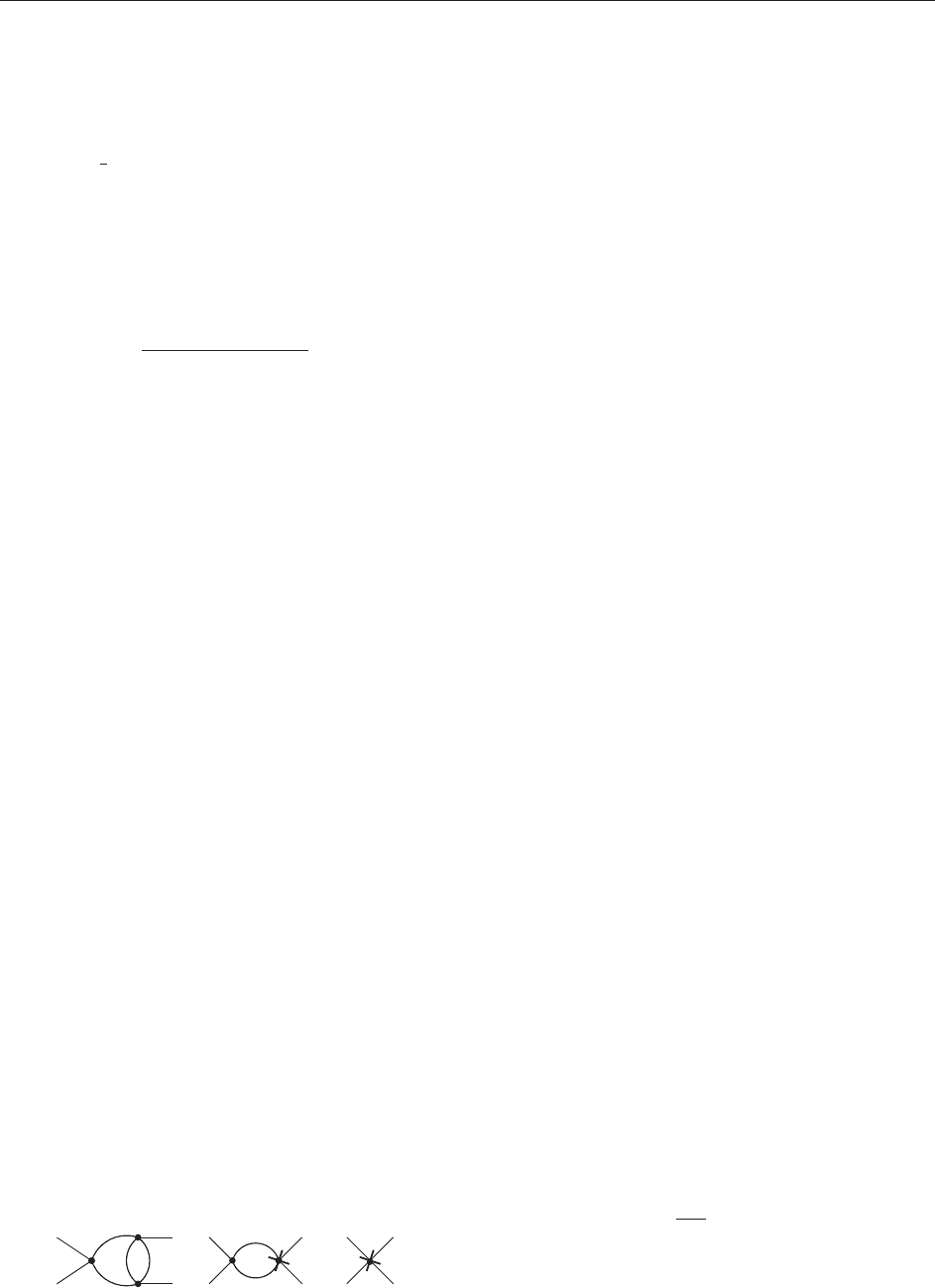
To see the essential difficulty to be solved, consider
a two-loop graph like the first one in Figure 3.Its
divergence is not a polynomial in external momenta,
and is therefore not canceled by an allowed counter-
term. This is shown by differentiation with respect to
external momenta, which does not produce a finite
result because of the divergent one-loop subgraph.
But for consistency of the theory, the one-loop
counter-terms already computed must be themselves
put into loop graphs. Among others, this gives the
second graph of Figure 3, where the cross denotes
that a counter-term contribution is used. The
contribution used here is actually 2/3 of the total
one-loop counter-term, for reasons of symmetry
factors that are not fully evident at first sight. The
remainder of the one-loop coupling renormalization
cancels a subdivergence in another two-loop graph.
It is readily shown that the divergence of the sum of
the first two graphs in Figure 3 is momentum
independent, and thus can be canceled by a vertex
counter-term.
This method is fully general, and is formalized in
the Bogoliubov R-operation, which gives a recursive
specification of the renormalized value R(G)ofa
graph G:
RðGÞ¼
def
G þ
X
f
1
;...;
n
g
G
j
i
!Cð
i
Þ
½22
The sum is over all sets of nonintersecting 1PI
subgraphs of G, and the notation Gj
i
!C(
i
)
denotes
G with all the subgraphs
i
replaced by associated
counter-terms C(
i
). The counter-term C()ofa1PI
graph has the form
CðÞ¼
def
T þ counter-te rmsð
for subdivergencesÞ½23
Here T is an operation that extracts the divergent
part of its argument and whose precise definition
gives the renormalization scheme. For example, in
minimal subtraction we define
TðÞ¼pole part at ¼ 0of ½24
We formalize the term inside parentheses in eqn
[23] as
RðÞ¼
def
þ counterterms for subdivergences
¼ þ
X
f
1
;...;
n
g
0
G
j
i
!Cð
i
Þ
½25
where the prime on the
P
0
denotes that we sum over
all sets of nonintersecting 1PI subgraphs except for
the case that there is a single
i
equal to the whole
graph (i.e., the term with n = 1and
1
= is
omitted).
Note that, for the
MS scheme, we define the T
operation to be applied to a factor of constant
dimension obtained by taking the appropriate power
of
outside of the pole-part operation. Moreover,
it is not a strict pole-part operation; instead each
2A
B
++
Figure 3 A two-loop graph and its counter-terms. The label B
indicates that it is the two-loop overall counter-term for this graph.
Renormalization: General Theory 403

pole is to be multiplied by S
L
, where L is the
number of loops, and S
is defined after eqn [17].
Equations [22]–[25] give a recursive construction
of the renormalization of an arbitrary graph. The
recursion starts on one-loop graphs, since they have
no subdivergences, that is, C() = T() for a one-
loop 1PI graph.
Each counter-term C() is implemented as a
contribution to the counter-term Lagrangian. The
Feynman rules ensure that once C() has been
computed, it appears as a vertex in bigger graphs
in such a way as to give exactly the counter-terms
for subdivergences used in the R-operation. It has
been proved that the R-operation does in fact give
finite results for Feynman graphs, and that basic
power counting in exactly the same fashion as at
one-loop determines the relevant operators.
In early treatments of renormalization, a pro blem
was caused by graphs like Figure 4. This graph has
three divergent subgraphs which overlap, rather
than being nested. Within the R-operation approach,
such cases are no harder to deal with than merely
nested divergences.
The recursive specification of R-operation can be
converted to a nonrecursive formulation by the
forest formula of Zavyalov and Stepanov, later
rediscovered by Zimmerman. It is normally the
recursive formulation that is suited to all-orders
proofs.
Whether these results, proved to all orders of
perturbation theory, genuinely extend to the com-
plete theory is not so easy to answer, certainly in a
realistic four-dimensional QFT. One illuminating
case is of a nonrelativistic quantum mechanics
model with a delta-function potential in a two-
dimensional space. Renormalizati on can be applied
just as in field theory, but the model can also be
treated exactly, and it has been shown that the
results agree with perturbation theory.
Perturbation series in relativistic QFTs can at best
be expected to be asymptotic, not convergent. So
instead of a radius of convergence, we should talk
about a region of applicability of a weak-coupling
expansion. In a direct calculation of counter-terms,
etc., the radius of a pplicability shrinks to zero as the
regulator is removed. However, we can deduce the
expansion for a renormalized quantity, whose
expansion is expected to have a nonzero range of
applicability. We can therefore appeal to the
uniqueness of power series expansions to allow the
calculation, at intermediate stages, to use bare
quantities that are divergent as the regulator is
removed.
Renormalizability, Non-Renormalizability,
and Super-Renormalizability
The basic power-counting method shows that if a
theory with conventional fields (at n = 4) has only
operators of dimension 4 or less in its L, then the
necessary counter-term operators are also of dimen-
sion 4 or less. So if we start with a Lagrangian with
all possible such operators, given the field content,
then the theory is renormalizable. This is not the
whole story, as we will see in the discu ssion of gauge
theories.
If we start with a Lagrangian containing operators
of dimension higher than 4, then renormalization
requires operators of ever higher dimension as
counter-terms when one goes to higher orders in
perturbation theory. Therefore, such a theory is said
to be perturbatively non-renormalizable. Some very
powerful methods of cancelation or some nonper-
turbative effects are needed to evade this result.
In the case of dimension-4 interactions, there is
only a finite set of operators given the set of basic
fields, but divergences occur at arbitrarily high
orders in perturbation theory. If, instead, all the
operators have at most dimension 3, then only a
finite number of graphs need counter-terms. Such
theories are called super-renormalizable. The diver-
gent graphs also occur as subgraphs inside bigger
graphs, of course. There is only one such theory in a
four-dimensional spacetime:
3
theory, which suf-
fers from an energy density that is unbounded from
below, so it is not physical. In lower spacetime
dimension, where the requirements on operator
dimension are different, there are many more
known super-renormalizable theories, some with a
very rigorous proof of existence.
All the above characterizat ions rely primarily on
perturbative analysis, so they are subject to being
not quite accurate in an exact theory, but they form
a guide to the relevant issues.
Renormalization and Symmetries:
Gauge Theories
In most physical applications, we are interested in
QFTs whose Lagrangian is restricted to obey certain
symmetry requirements. Are these symmetries pre-
served by renormalization? That is, is the Lagran-
gian with all necessary counter-terms still invariant
under the symmetry?
Figure 4 Graph with overlapping divergent subgraphs.
404 Renormalization: General Theory

We first discuss nonchiral symmet ries; these are
symmetries in which the left-handed and right-
handed parts of Dirac fields transform identically.
For Poincare´ invariance and simple global internal
symmetries, it is simplest to use a regulator, like
dimensional regularization, which respects the sym-
metries. Then it is easily shown that the symmetries
are preserved under renormalization. This holds
even if the internal symmetries are spontaneously
broken (as happens with a ‘‘wrong-sign mass term,’’
e.g., negative m
2
in eqn [1]).
The case of local gauge symmetries is harder. But
their preservation is more important, because gauge
theories contain vector fields which, without a gauge
symmetry, generally give unphysical features to the
theory. For perturbation theory, BRST quantization
is usually used, in which, instead of gauge symme-
try, there is a BRST supersymmetry. This is
manifested at the Green function level by Slavnov–
Taylor identities that are more complicated, in
general, than the Ward identities for simple global
symmetries and for abelian local symmetries.
Dimensional regularization preserves these
symmetries and the Slavnov–Taylor identities. More-
over, the R-operation still produces finite results with
local counter-terms, but cancelations and relations
occur between divergences for different graphs in
order to preserve the symmetry. A simple example is
QED, which has an abelian U(1) gauge symmetry, and
whose gauge-invariant Lagrangian is
L¼
1
4
@
A
ð0Þ
@
A
ð0Þ
2
þ
0
i
@
e
0
A
ð0Þ
m
0
0
½26
At the level of individual divergent 1PI graphs,
we get counter-terms proportional to A
2
and to
(A
2
)
2
, operators not present in the gauge-invariant
Lagrangian. The Ward identities and Slavnov–Taylor
identities show that these counter-terms cancel when
they are summed over all graphs at a given order of
renormalized perturbation theory. Moreover, the
renormalization of coupling and the gauge field are
inverse, so that e
0
A
(0)
equals the corresponding
object with renormalized quantities,
eA
. Natu-
rally, sums of contributions to a counter-term in
L can only be quantified with use of a regulator.
In nonabelian theories, the gauge-invariance proper-
ties are not just the absence of certain terms in L but
quantitative relations between the coefficients of terms
with different numbers of fields. Even so, the argument
with Slavnov–Taylor identities generalizes appropri-
ately and proves renormalizability of QCD, for
example. But note that the relation concerning the
product of the coupling and the gauge field does not
generally hold; the form of the gauge transformation is
itself renormalized, in a certain sense.
Anomalies
Chiral symmetries, as in the weak-in teraction part of
the gauge symmetry of the standard model, are
much harder to dea l with. Chiral symmetries are
ones for which the left-handed and right-handed
components of Dirac field transform independently
under different components of the symmetry group,
local or global as the case may be. Occasionally,
some or other of the left-handed or right-handed
components may not even be present.
In general, chiral symmetries are not preserved by
regularization, at least not without some other
pathology. At best one can adjust the finite parts of
counter-terms such that in the limit of the removal of
the regulator, the Ward or Slavnov–Taylor identities
hold. But in general, this cannot be done consistently,
and the theory is said to suffer from an anomaly. In
the case of chiral gauge theories, the presence of an
anomaly prevents the (candidate) theory from being
valid. A dramatic and nontrivial result (Adler–
Bardeen theorem and some nontrivial generaliza-
tions) is that if chiral anomalies cancel at the
one-loop level, then they cancel at all orders.
Similar results, but more difficult ones, hold for
supersymmetries.
The anomaly cancelation conditions in the standard
model lead to constraints that relate the lepton content
to the quark content in each generation. For example,
given the existence of the b quark, and the and
leptons (of masses around 4.5 GeV, 1.8 GeV, and zero
respectively), it was strongly predicted on the grounds
of anomaly cancelation that there must be a t quark
partner of the b to complete the third generation of
quark doublets. This prediction was much later
vindicated by the discovery of the much heavier top
quark with m
t
’ 175 GeV.
Renormalization Schemes
A precise definition of the counter-terms entails
a specification of the renormalization prescription
(or scheme), so that the finite parts of the counter-
terms are determined. This apparently induces extra
arbitrariness in the results. However, in the
4
Lagrangian (for example), there are really only two
independent parameters. (A scaling of the field does
not affect any observables, so we do not count Z as
a parameter here.) Thus, at fixed regulator para-
meter a or , renormalization actually just gives a
reparametrization of a two-parameter collection of
theories. A renormalization prescription gives the
Renormalization: General Theory 405

change of variables between bare and renormalized
parameters, a rather singular transformation when
the regulator is removed. If we have two different
prescriptions, we can deduce a transformation
between the renormalized parameters in the two
schemes. The renormalized mass and coupling m
1
and
1
in one scheme can be obtained as functions
of their values m
2
and
2
in the other scheme, with
the bare parameters, and hence the physics, being
the same in both schemes. Since these are renorma-
lized parameters, the removal of the regulator leaves
the transformation well behaved.
Generalization to all renormalizable theori es is
immediate.
Renormalization Group and Applications
and Generalizations
One part of the choice of renormalization scheme is
that of a scale parameter such as the unit of mass of
the
MS scheme. The physical predictions of the theory
are invariant if a change of is accompanied by a
suitable change of the renormalized parameters, now
considered as -dependent parameters ()andm().
These are called the effective, or running, coupling and
mass. The transformation of the parametrization of
the theory is called an RG transformation.
The bare coupling and mass
0
and m
0
are RG
invariant, and this can be used to obtain equations
for the RG evolution of the effective parameters
from the perturbatively computed counter-terms.
For example, in
4
theory, we have (in the
renormalized theory after removal of the regulator)
d
dln
2
¼ ðÞ½27
with () = 3
2
=(16
2
) þ O(
3
). As exemplified in
eqns. [18] and [19], Feynman diagrams depend
logarithmically on . By choosing to be comparable
to the physical external momentum scale, we remove
possible large logarithms in this and higher orders.
Thus, provided that the effective coupling at this scale
is weak, we get an effective perturbation expansion.
This is a basic technique for exploiting perturba-
tion theory in QCD, for the strong interact ions,
where the interactions are not automatically weak.
In this theory the RG function is negative so that
the coupling decreases to zero as !1; this is the
asymptotic freedom of QCD.
A closely related method is that associated with
the Callan–Symanzik equation, which is a formula-
tion of a Ward identity for anomalously broken
scale invariance. However, RG methods are the
actually used ones, normally, even if sometimes an
RG equation is incorrectly labeled as a Callan–
Symanzik equation.
The elementary use of the RG is not sufficient for
most interesting processes, which involve a set of
widely different scales. Then more powerful theo-
rems come into play. Typical are the factorization
theorems of QCD (see Quantum Chromodynamics).
These express differential cross sections for certain
important reactions as a product of quantities that
involve a single scale:
d ¼CQ;;ðÞðÞfm;;ðÞðÞ
þ small correction ½28
The product is typically a matrix or a convolution
product. The factors obey nontrivial RG equations,
and these enable different values of to be used in
the diff erent factors. Predictions arise because some
factors and the kernels of the RG equation are
perturbatively calculable, with a weak effective
coupling. Other factors, such as f in eqn [28], are
not perturbative. These are quantities with names
like ‘‘parton distribution functions,’’ and they are
universal between many different processes. Thus,
the nonpe rturbative functions can be measu red in a
limited set of reactions and used to predict cross
sections for many other reactions with the aid of
calculations of the perturbative factors.
Ultimately, this whole area depends on physical
phenomena associated with renormalization.
Concluding Remarks
The actual ability to remove the divergences in
certain QFTs to produce consistent, finite, and
nontrivial theories is a quite dramatic result. More-
over, associated with the integrals that give the
divergences is behavior of the kind that is analyzed
with RG methods and generalizations. So the
properties of QFTs associated with renormalization
get tightly coupled to many interesting consequences
of the theories, most notably in QCD.
QFTs are actually very abstruse and difficult
theories; only certain aspects currently lend them-
selves to practical calculations. So the reader should
not assume that all aspects of their rigorous
mathematical treatment are perfect. Experience,
both within the theories and in their comparison
with experiment, indicates, nevertheless, that we
have a good approximation to the truth.
When one examines the mathematics associated
with the R-operation and its generalizations with
factorization theorems, there are clearly present
some interesting mathematical structures that are
not yet formulated in their most general terms. Some
406 Renormalization: General Theory

indications of this can be seen in the work by
Connes and Kreim er (see Hopf Algebra Structure of
Renormalizable Quantum Field Theory), where it is
seen that renormalization is associated with a Hopf
algebra structure for Feynman graphs.
With such a deep subject, it is not surprising that
it lends itself to other approaches, notably the
Connes–Kreimer one and the Wilsonian one (see
Exact Renormalization Group). Readers new to the
subject should not be surprised if it is difficult to get
a fully unified view of these differen t approaches.
Notes on Bibliography
Reliable textbo oks on quantum field theory
are Sterman (1993) and Weinberg (1995). A clear
account of the foundations of perturbative QCD
methods is given by Sterman (1996).
A pedagogical account of renormalization and
related subjects may be found in Collins (1984).
The best account of renormalization theory before
the 1970s is given by Bogoliubov and Shirkov
(1959); the viewpoint is very modern, including a
coordinate-space distribution-theoretic view. A
full account of the Wilsonian method as applied
to renormalization is given by Polchinski (1984).
Manuel and Tarrach (1994) give an excellent account
of renormalization for a theory with a non-relativistic
delta-function potential in 2 space dimensions, which
provides a fully tractable model.
Tkachov (1994) reviews a systematic application
of distribution theoretic methods to asymptotic
problems in QFT. Finally, Weinzierl (1999) provides
a construction of dimensional regularization with the
aid of K-theory using an underlying vector space of
the physical integer dimension. Other constructions,
referred to in this paper, follow Wilson and use an
infinite-dimensional underlying space.
Acknowledgments
The author would like to thank Professor K Goeke
for hospitality and support at the Ruhr-Universita¨t-
Bochum. This work was also supported by the US DOE.
See also: Anomalies; BRST Quantization; Effective
Field Theories; Electroweak Theory; Euclidean Field
Theory; Exact Renormalization Group; High T
c
Superconductor Theory; Holomorphic Dynamics; Hopf
Algebra Structure of Renormalizable Quantum Field
Theory; Lattice Gauge Theory; Operator Product
Expansion in Quantum Field Theory; Perturbation Theory
and its Techniques; Perturbative Renormalization Theory
and BRST; Quantum Chromodynamics; Quantum Field
Theory: A Brief Introduction; Singularities of the Ricci
Flow; Standard Model of Particle Physics; Supergravity.
Further Reading
Bogoliubov NN and Shirkov DV (1959) Introduction to the
Theory of Quantized Fields. New York: Wiley-Interscience.
Collins JC (1984) Renormalization. Cambridge: Cambridge
University Press.
Kraus E (1998) Renormalization of the electroweak standard
model to all orders. Annals of Physics 262: 155–259.
Manuel C and Tarrach R (1994) Perturbative renormalization in
quantum mechanics. Physics Letters B 328: 113–118.
Polchinski J (1984) Renormalization and effective Lagrangians.
Nuclear Physics B 231: 269–295.
Sterman G (1993) An Introduction to Quantum Field Theory.
Cambridge: Cambridge University Press.
Sterman G (1996) Partons, factorization and resummation. In:
Soper DE (ed.) QCD and Beyond, pp. 327–406. (hep-ph/
9606312). Singapore: World Scientific.
Tkachov FV (1994) Theory of asymptotic operation. A summary of
basic principles. Soviet Journal of Particles and Nuclei 25: 649.
Weinberg S (1995) The Quantum Theory of Fields, Vol. I.
Foundations. Cambridge: Cambridge University Press.
Weinzierl S (1999) Equivariant dimensional regularization, hep-
ph/9903380.
Zavyalov OI (1990) Renormalized Quantum Field Theory.
Dordrecht: Kluwer.
Renormalization: Statistical Mechanics and Condensed Matter
M Salmhofer, Universita
¨
t Leipzig, Leipzig, Germany
ª 2006 Elsevier Ltd. All rights reserved.
Renormalization Group
and Condensed Matter
Statistical mechanical systems at critical points
exhibit scaling laws of order parameters, susceptibi-
lities, and other observables. The exponents of these
laws are universal, that is, independent of most
details of the system. For example, the liquid–gas
transition for real gases has the same exponents as
the magnetization transition in the three-dimensional
Ising model.
The renormalization group (RG) was developed
by Kadanoff, Wilson, and Wegner, to understand
these critical phenomena (Domb and G reen 1976).
The central idea is that the system becomes scale
invariant at the critical point, which makes it
natural to average over degrees of freedom on
increasing length scales successively in the
Renormalization: Statistical Mechanics and Condensed Matter 407

calculation of the partition function. This leads to a
map between effective interactions associated to
different length scales. Thus, the focus shifts from
the analysis of a single interaction to that o f a flow
on a space of interactions. This space is in general
much larger than the original formulation of the
model would suggest: the description of long-
distance or low-energy properties may be in terms
of variables that were not even present in the
original formulation of the system. Phenomeno-
logically, this corresponds to the emergence of
collective degrees of freedom.
Condensed matter theory is itself already an
effective theory, and its ‘‘microscopic’’ formulation
gets inputs from the underlying theories, which
determine in particular the statistics of the particles
and their interactions at the scale of atomic energies.
At much lower-energy scales, which are relevant for
low-temperature phenomena in condensed matter,
collective excitations of different, sometimes exotic,
statistics may emerge, but the starting point is given
naturally in terms of fermionic and bosonic parti-
cles. For this reason, the discussion given below will
be split in these two cases.
A major difference between high-energy and
condensed matter systems is that the latter have a
well-defined Hamiltonian which can be used to
define the finite-volume ensembles of quantum
statistical mechanic s and which determines the time
evolution, as well as various analyticity properties.
The relevant spatial dimensions in condensed
matter are d 3, but some results in higher
dimensions relevant for the development of the
method will also be discussed below. The cases
d = 1 and d = 2 have always been of mathematical
interest but in recent years have become important
for the theory of new materials.
Some interesting topics cannot be covered here
due to space restrictions, notably the application of
renormalization methods to membrane theory (see
Wiese (2001)) and renormalization methods for
operators (see Bach et al. (1998)).
The Renormalization Group
In this section we briefly describe the setup of two
important versions of the RG, namely the block spin
RG and the RG based on scale decompositions of
singular covariances.
Block spin RG
Let be a finite lattice, for example, a finite subset
of Z
d
. For the following, it is convenient to take
to be a cube of side-length L
K
for L > 1 and some
large K. Let T be a set and
= { : !T } be the
set of spin configurations. Common examples for
the target space T are T = {1, 1} for the Ising
model, T = S
N1
for the O(N) model, and T = R
n
for unbounded spins. Let S
:
!R, 7!S
()be
an interaction and
Zð; S
Þ¼
Z
Y
x2
dðxÞe
S
ðÞ
½1
In the unbounded case, S
is assumed to grow
sufficiently fast for jj!1, so that Z exists; for the
case of a finite set T, the integral is replaced by a
sum. Denote the corresponding Boltzmann factor by
(, S
),
ð; S
ÞðÞ¼
1
Zð; S
Þ
e
S
ðÞ
½2
The block spin transformation consists of an
integration step and a rescaling step. Divide the
lattice into cubic blocks of side-length L and define
a new lattice
0
by associating one lattice site of the
new lattice to each L-block of the old lattice. For
any
0
:
0
!T, let
0
ð
0
Þ¼
Z
Y
x2
dðxÞPð
0
;Þe
S
ðÞ
½3
where P(
0
, ) 0 and
R
Q
x
0
2
0
d
0
(x
0
)P(
0
, ) = 1
for all , so that
0
remains a probability distribu-
tion. Since
0
is positive, one defines
S
0
0
ð
0
Þ¼log
0
ð
0
Þ½4
By construction, the partition function is invariant:
Z(
0
, S
0
0
) = Z(, S
). The new lattice
0
has spacing L;
now rescale to make it a unit lattice. This completes
the RG step in finite volume.
In an algorithmic sense, the ‘‘blocking rule’’
P(
0
, ) can be viewed as a transition probability of
a configuration to a configuration
0
. P may be
deterministic, that is, simply fix
0
as a function
of . From the intuition of averaging over local
fluctuations,
0
is often taken to be some average of
(x)atx in a block around x
0
, hence the name.
Obviously, the thus defined RG transformation
often cannot be iterated arbitrarily, since in every
application, the number of points of the lattice shrinks
byafactorL
d
,sothatafterK iterations, a lattice with
only a single point is left over. It is necessary to take the
infinite-volume limit L !1 to obtain a map that
operates from a space to itself. However, [4] can
become problematic in that limit: Gibbs measures
can map to measures
0
whose large-deviation proper-
ties differ from those of Gibbs measures. The discus-
sion of this problem and its solution is reviewed in
Bricmont and Kupiainen (2001). The problem can be
408 Renormalization: Statistical Mechanics and Condensed Matter

solved in different ways, relaxing conditions on Gibbs
measures or, in the Ising model, changing the descrip-
tion from the spins to the contours. The crucial point is
that the difficulties arise only because [4] is applied
globally, that is, to every
0
.Thesetofbad
0
has very
small probability.
Block spin methods have been used in mathema-
tical construction of quantum field theories, for
example, in the work of Gawedzki and Kupiainen
(1985) and Balaban (1988) (see the subsection
‘‘Field theory and statistical mechanics’’). The
above-mentioned problem was avoided there by
not taking a logarithm in the so-called large-field
region (which has very small probab ility).
Scale Decomposition RG
The generating functionals of quantum field theory
and quantum statistical mechanics can be cast into
the form
ZðC; V;Þ¼
Z
d
C
ð
0
Þe
Vð
0
þÞ
½5
Here d
C
denotes the Gaussian measure with covar-
iance C,andV is the two-body interaction between the
particles. The field variables are real or complex for
bosons and Grassmann-valued for fermions. Differ-
entiating log Z with respect to the external field
generates the connected amputated correlation func-
tions. The covariance determines the free propagation
of particles; the interaction their collisions.
In most cases, such functional integrals are a priori
ill-defined, even if V is small (and bounded from
below) because the covariance C is singular. That is,
the integral kernel C(X, X
0
)oftheoperatorC either
diverges as jx x
0
j!0 (ultraviolet (UV) problem) or
C(X, X
0
) has a slow decay as jx x
0
j!1 (infrared
(IR) problem). In our notational convention, X may,
in addition to the configuration variable x,also
contain discrete indices of the fields, such as a spin or
color index. The dependence of C on x and x
0
is
assumed to be of the form x x
0
. A typical example
is the massless Gaussian field in d dimensions, where
C is the inverse Fourier transform of
^
C(k) = 1=k
2
,
k 2 R
d
, which has both a UV and an IR problem, or
its lattice analog,
^
DðkÞ¼
2
a
2
X
d
i¼1
ð1 cosðak
i
Þ
!
1
with a the lattice constant, which has only an IR
problem. A typical interaction is of the type
VðÞ¼
Z
dX dY
ðXÞðXÞvðX; YÞ
ðYÞðYÞ½6
Again, we assume that the potential v depends on x
and y only via x y, so that translation invariance
holds. In both UV and IR cases, naive perturbation
theory fails even as a formal power series. That is,
writing V = V
0
, with a coupling constant which is
treated as a formal expansion parameter, the singu-
larity of C leads to termwise divergences in the series.
The theory is called perturbatively renormalizable if
all divergences can be removed by posing counter-
terms of certain types, which are fixed by physically
sensible renormalization conditions. Identifying the
UV renormalizable theories was a breakthrough in
high-energy physics. The IR renormalization problem
is different, and in some respects harder, because
there is almost no freedom to put counter-terms: the
microscopic model is given from the start. This will
be discussed in more detail below for an example.
A much more ambitious, and largely open, project
is to do this renormalization nonperturbatively, that
is, to treat as a real (typically, small) parameter.
Some results will be discussed below.
The RG is set up by a scale decomposition
C =
P
j
C
j
. In the example of the massless Gaussian
field, one would take each
^
C
j
to be a C
1
function
supported in the region {k 2 R
d
: M
j
k
2
M
jþ1
},
where M > 1 is a fixed constant, a nd the summation
over j runs over Z.
The scale decomposition of C leads to a represen-
tation of [5] by an iteration of Gaussian convolution
integrals with covariances C
j
, hence a sequence of
effective interactions V
j
, defined recursively by
e
V
j
ðÞ
¼
Z
d
C
jþ1
ð
0
Þe
V
jþ1
ð
0
þÞ
; V
0
¼ V ½7
For a singular covariance, the scale decomposition is
an infinite sum. A formal object like [5] is now
regularized by starting with a finite sum, that is,
imposing a UV and IR cutoff, which is mathemati-
cally well defined, and then taking limits of the thus
defined objects. Again, in condensed matter applica-
tions, imposing an IR cutoff is an operation that
needs to be justified, for example, by showing that
taking the limit as the cutoff is removed commutes
with the infinite-volume limit.
Note that the RG map, which is the iteration
V
j
7!V
j1
, goes to lower and lower j, corresponding
to longer and longer length scales. The convention
that the iteration starts at some fixed j, for example,
j = 0, is appropriate for IR problems. In UV
problems, the iteration would start at some large
J
UV
, which defines a UV cutoff and is taken to
infinity, to remove the cutoff, at the end.
A variant using a continuous scale decomposition,
C =
R
ds
_
C
s
, originally due to Wegner and Hought on,
became very popular after Polchinski (1984) used it
Renormalization: Statistical Mechanics and Condensed Matter 409

to give a short argument for perturbative renorma-
lizability. Polchinski’s equation, the analog of the
recursion [7], reads
@V
@s
¼
1
2
e
V
_
C
s
e
V
¼
1
2
_
C
s
V
1
2
V
;
_
C
s
V
½8
Here
C
¼
; C
denotes the Laplacian in field space associated to the
covariance C. Polchinski’s argument has been devel-
oped into a mathematical tool that applies to many
models. For an introduction to perturbative renor-
malization using this method, see Salmhofer (1998).
Equations of the type [8] have also been very useful
beyond perturbation theory: much work has been
done based on the beautiful representation of Mayer
expansions found in Bryd ges and Kennedy (1987)
using RG equations.
Mathematical Structure and Difficulties
The RG flow is thus, depending on the implementa-
tion, either a sequence or a continuous flow of
interactions. Setting up this flow in mathematical
terms is not easy and indeed part of the mathema-
tical RG analysis is to find a suitable space of
interactions that is left invariant by the succe ssive
convolutions, and then to control the RG iteration.
A serious problem is the proliferation of interac-
tions: already a single application of the RG
transformation [7] maps a simple interaction, such
as [6], to a nonlocal functional of the fields,
V
j
ðÞ¼
X
m0
Z
dX
1
dX
m
v
ðjÞ
m
ðX
1
; ...; X
m
ÞðX
1
ÞðX
m
Þ½9
Already for perturbative renormalization, one needs
to extra ct local terms, calculate their flow more
explicitly, and control the power counting of the
remainder. The convergence of the series is not an
issue in formal perturbation theory because in every
finite order r in , the sum over m is finite.
For nonperturbative renormalization, however,
the problem is much more serious. For bosonic
systems, the expansion in powers of the fields in
[9] is divergent, and one needs a split into small-
field and large-field regions and cluster expansions
to obtain a well-defined sequence of effective
actions (Gawedzki and Kupiainen 1985, Feldman
et al. 1987, Rivassean 1993). That is, the local
parts are extracted and treated explicitly only in
the small-field region, and this is combined with
estimates on t he rareness of large-field regions
using cluster expansions. For fermions, the expan-
sion in powers of the fields can be proved to
converge for regular, summable c ovariances, which
leads to substantial technical simplifications.
The spatial proliferation of interactions is absent
only in certain one-dimensional and in specially
constructed higher-dimensional models, the so-
called ‘‘hierarchical models.’’ In these models, the
search for an RG fixed point is still a nonlinear
fixed-point problem, whose treatment leads to
interesting mathematical results.
This article will be restricted t o the mathema-
tical use of the R G both in perturbative and
nonperturbative quantum field theory of con-
densed matter systems. Many nonrigorous but
very interesting applications have also come out
of this method, showing that it also works well in
practice, but they will not be reviewed here. Before
discussing condensed matter systems, the pioneer-
ing works done on the mathematical RG, which
were largely motivated by high-energy physics,
will be reviewed briefly, as they laid the founda-
tion of much of the technique used later in the
condensed matter case.
Field Theory and Statistical Mechanics
Because of the close connection between quantum
field theory and statistical mechanics given by
formulas of the Feynman–Kac type, a significant
amount of work on the mathematical RG focused
on models of classical statistical mechanics in
connection with field theories and gauge theories.
Here we mention some of the pioneering results in
that field.
The scale decomposition method was developed
in a mathematical form and applied to perturbative
UV renormalization of scalar field theories, as well
as nonperturbative analysis of some models, by
Gallavotti and Nicolo`(Gallavotti 1985).
Infrared
4
theory in four dimensions was
constructed using block spin methods (Gawedzki
and Kupiainen 1985) and scale decomposition RG
(Feldman et al. 1987). An essential feature of the
4
4
model is its IR asymptotic freedom, meaning that
the local part of the effective quartic interaction
tends to zero in the IR limit.
Block spin methods were used by Balaban (1988)
to construct gauge theories in three and four
dimensions. For gauge theories, the block spin RG
has the major advantage that it allows to define a
gauge-invariant RG flow. The scale decomposition
violates gauge invariance, which creates substantial
technical problems (Rivass eau 1993).
410 Renormalization: Statistical Mechanics and Condensed Matter

Condensed Matter: Fermions
Starting with the seminal work of Feldman and
Trubowitz (1990, 1991) and Benfatto and
Gallavotti (1995), this field has become one of the
most successful applications of the mathematical
RG. We use this example to discuss the scale
decomposition method in a bit more detail.
We shall mainly focus on models in d 2
dimensions (the case d = 1 is described in detail in
Benfatto and Gallavotti (1995)). The system is put
into a finite (very large) box of side-length L. For
simplicity we take periodic boundary conditions.
The Hilbert space for spin-1/2 electrons is the
fermionic Fock space F =
L
n0
V
n
L
2
(, C
2
). The
grand canonical ensemble in finite volume is given
by the density operator = Z
1
e
(HN)
, with the
Hamiltonian H and the number operator N,inthe
usual second quantized form. The parameter
= T
1
is the inverse temperature and the chemical
potential is an auxiliary parameter used to fix the
average particle number.
The grand canonical trace defining the ensemble
can be rewritten in functional-integral form. It takes
the form [5], but now d
C
stands for a Grassmann
Gaussian ‘‘measure,’’ which is really only a linear
functional (for definitions, see, e.g., Salmhofer
(1998, chapter 4 and appendix B)). A two-body
interaction corresponds to a quartic interaction
polynomial V,asin[6]. The covariance is (in the
infinite-volume limit L !1)
Cð;xÞ¼
1
X
!2M
F
Z
dk
ð2Þ
d
e
iðkx!Þ
^
Cð!; kÞ
^
Cð!; kÞ¼
1
i! eðkÞ
½10
where 2 (0, ] is a Euclidian time v ariable and k
is the spatial momentum. The summation over !
runs over the set of fermionic Matsubara frequen-
cies M
F
= T(2Z þ 1). The function e(k) = "(k) ,
where "(k) is the band function given by the single-
particle term in the Hamiltoni an. For a lattice
system, k 2B
d
, the momentum space torus (e.g.,
for the lattice Z
d
, B
d
= R
d
=2Z
d
); for a continuous
system, k 2 R
d
, hence there is a spatial UV
problem. Electrons in a crystal have a natural
spatial UV cutoff (see Salmhofer (1998, chapter 4)
for a discussion) so we assume in the following
that there is either a UV cutof f or that the system is
on a lattice. A nonperturbative definition of the
functional integral involves a limit from discrete
times (by the Trotter product formula); see, for
example, Salmhofer (1998) or Feldman et al.
(2003, 2004).
Perturbative Renormalization
Renormalization of the Fermi surface at zero
temperature In the limit T !0, the Matsubara
frequency ! becomes a real variable, hence the
propagator has a singulari ty at ! = 0 and k 2 S,
where S = {k : e(k) = 0}, a codimension-1 subset of
B
d
, is the Fermi surface. The existence of a Fermi
surface which does not degenerate to a point is a
characteristic feature of systems showing metallic
behavior.
The singularity implies that
^
C 62 L
p
(R B
d
) for
any p 2. Because terms of the type
Z
d!
Z
dkFð!; kÞ
^
Cð!; kÞ
Y
p1
i¼1
T
i
ð!; kÞ
^
Cð!; kÞ
½11
appear for all p 1 in the formal perturbation
expansion, with functions T
i
and F that do not
vanish on the singularity set of C, the perturbation
expansion for observables is termwise divergent.
The deeper reason for these problems is that the
interaction shifts the Fermi su rface so that the true
propagator has a singularity of the form
G(!, k) = (i! e(k) (!, k))
1
. If the self-energy
is a sufficiently regular function, G has the same
integrability properties as C, but the singularity of G
is on the set
~
S = {k : e(k) þ (0, k) = 0} (the singular-
ity in ! remains at ! = 0).
Let 1 =
P
j0
j
(!, k)beaC
1
partition of unity
such that
for j < 0 supp
j
fð!; kÞ:
0
M
j2
ji! eðkÞj
0
M
j
g½12
where M > 1 and
0
is a fixed constant (an energy
scale determined by the global properties of the
function e; see Salmhofer (1998, chapter 4)). The
corresponding covariances
^
C
j
=
^
C
j
have the prop-
erties that for j < 0, k
^
C
j
k
1
const.M
j
and k
^
C
j
k
1
const.M
j
. Using these bounds and expanding
v
(j)
m
=
P
r1
v
(j)
m, r
r
, one can derive estimates for the
coefficient functions v
(j)
m, r
.
Of course, the scale decomposition by itself does
not solve the problem of the moving singularity. It
only allows us to pinpoint the proble matic terms in
the expansion. To construct the self-energy ,as
well as all higher Green functions, a two-step
method is used (Feldman and Trubowitz 1990,
1991, Feldman et al. 1996, 2000). First, a counter-
term function K which modifies e is introduced, so
that all two-point insertions T
i
get subtracted on
the Fermi surface, hence replaced by
~
T
i
(!, k) =
T
i
(!, k) T
i
(0, k
0
), with k
0
obtained from k by a
Renormalization: Statistical Mechanics and Condensed Matter 411