
Francoise J.-P., Naber G.L., Tsun T.S. (editors) Encyclopedia of Mathematical Physics
Подождите немного. Документ загружается.


have the same structure, if s > 0. Therefore, most of
the equations dealt with in this article are formulated
for spinor fields. (Strictly speaking, the exclusive use of
2-spinors restricts the relativistic invariance to the
proper Lorentz group SO
þ
(1, 3). However, all the
results presented here can be ‘‘translated back’’ into
tensor or bispinor form, respectively (Illge 1993).)
Relativistic wave equations for free fields with arbi-
trary spin s > 0 in Minkowski spacetime are discussed
in the section ‘‘Higher spin in Minkowski spac etime’’;
they were first given by Dirac (1936).
In the subsequent section, we explain how the field
theorycanbeextendedtocurvedspacetimes.Ifa
Lagrangian is known, then there exists a well-known
mathematical procedure (‘‘Lagran ge formalism’’) to
obtain the field equations, the energy–momentum
te ns or , e tc. A ll fie l d eq u at i on s fo r ‘‘lo w’’ s pin s 1
arise from an action principle. Consequently, they can
be extended to curved spacetime by simply replacing the
flat metric and connection with their curved versions.
If s > 1, then the wave equations do not follow from
a variation principle without supplementary conditions.
Nevertheless, one can try to generalize the equations of
the section ‘‘Higher spin in Minkowski spacetime’’ to
curved spacetime by the ‘‘principle of minimal cou-
pling,’’ too. However, the arising equations are not
satisfactory, since there is an algebraic consistency
condition in curved space if s > 1 (Buchdahl 1962), and
another for charged fields in the presence of electro-
magnetism if s > 1=2 (Fierz and Pauli 1939).
There have been numerous attempts to avoid these
inconsistencies. As a rule, the alternative theories
require an extended spacetime structure or additional
new fields or they give up some important principle. An
extensive literature is devoted to just this problem –
unfortunately, a survey article or book is missing.
Finally, we present a possibility to describe fields
with arbitrary spin s > 0 within the framework of
Einstein’s general relativity without any auxiliary
fields and subsidiary conditions in a uniform manner.
The approach is based on irreducible representations
of type D(s, 0) and D(s 1=2, 1=2) instead of
D(s=2, s=2) in the Fierz theory for bosons and
D(s=2 þ 1=4, s=2 1=4) in the Rarita–Schwinger
theory for fermions. It was first pointed out
by Buchdahl (1982) that this type of field equations
can be generalized to a curved spacetime if the mass is
positive. After a short time Wu¨ nsch (1985) simplified
them to their fina l form:
5
A
P
0
’
AB...E
þ m
1
B...EP
0
¼ 0
r
P
0
ðA
B...EÞP
0
m
2
’
AB...E
¼ 0
½1
This system contains the well-known wave equa-
tions for low spin s = 1=2 and s = 1 as special cases.
By iteration we obtain second-order wave equations
of nor mal hyperbolic type. Further, Cauchy’s initial-
value problem is well posed and a Lagrangian is
known. For zero mass, we state the wave equations
r
A
ðA
0
jAjB
0
...E
0
Þ
¼ 0 ½2
which are just the curved versions of the equations
for the potential of a massless field. They are
consistent in curved spacetime, too, and the Cauchy
problem is well posed (Illge 1988).
Last but not least, let us mention the esthetic
aspect. Equations [1] and [2] satisfy Dirac’s demand:
‘‘Physical laws should have mathematical beauty.’’
In the following, we assume that the spacetime
and all the spinor and tensor fields are of class C
1
.
All considerations are purely local. We will call a
symmetric (‘‘irreducible’’) spinor to be of type (n, k)
if and only if it has n unprimed and k primed indices
(irrespective of their position). Moreover, we use the
notations and conventions of Penrose and Rindler
(1984), especially for the curvature spinors
ABCD
and
ABA
0
B
0
.
Wave Equations for Low Spin
in Minkowski Spacetime
The spin (or intrinsic angular momentum) of a
particle is found to be quantized. Its projection on
any fixed direction is an integer or half-integer
multiple of Planck’s constant h; the only possible
values are
sh; ðs þ 1Þh; ...; ðs 1Þh; sh
The spin quantum number s so defined can have one
of the values s = 0, 1=2, 1, 3=2, 2, ... and is a
characteristic for all elementary particles along
with their mass m and electric charge e. The
particles with integer s are called ‘‘bosons,’’ those
with half-integer s ‘‘fermions.’’ The three numbers
s = 0, 1=2, and 1 are referre d to as ‘‘low’’ spin; they
are sufficient for the greater part of physics.
The principle of first quantization associates a type
of field and a field equation to each type of elementary
particles. Massive particles, with rest mass m > 0, and
massless particles, with rest mass m = 0, are to be
distinguished. Accordingly, we obtain six linear wave
equations for s 1, which read as follows in units
such that c =h = 1(seeTable 1):
For the sake of simplicity, we consider only free
fields in Table 1; no source terms or interaction terms
appear here. The associated ‘‘free’’ Lagrangians are
given in Table 2.
Since the electromagnetic field tensor F
ab
satisfies the
first part of Maxwell’s equations @
[c
F
ab]
= 0, it follows
392 Relativistic Wave Equations Including Higher Spin Fields
that a vector field A
a
exists such that F
ab
= @
a
A
b
@
b
A
a
. This vector field is called the ‘‘electromagnetic
4-potential.’’ It is not uniquely determined by the field
F
ab
; the freedom in A
a
is A
a
! A
a
þ @
a
where
= (x) is a real-valued function. This gauge transfor-
mation of A
a
canbeused,forexample,toobtainthe
Lorentz gauge condition @
a
A
a
= 0.
The wave equations listed in Table 1 look rather
different, but this formal disadvantage can be over-
come. To begin with, we remark that fermions
require spinors for their description. The Dirac and
Weyl equations are not describable by linear equa-
tions for tensor fields. On the other hand, bosons can
be described by spinors as well. All tensor equations
can be ‘‘translated’’ into spinor form using the mixed
spinor–tensor
a
AA
0
. We will demonstrate this proce-
dure for the Proca field in some detail.
The (possibly complex) skew-symmetric tensor
H
ab
and the vector U
a
have the spinor equivalents
H
ab
a
AA
0
b
BB
0
¼ ’
AB
"
A
0
B
0
þ
A
0
B
0
"
AB
U
a
a
AA
0
¼
AA
0
where ’ and are both symmetric spinors:
’
AB
= ’
(AB)
,
A
0
B
0
=
(A
0
B
0
)
. After a straightforward
calculation the Proca equation yields
@
C
0
ðA
BÞC
0
þ ’
AB
¼ 0;@
C
0
ðA
0
B
0
ÞC
þ
A
0
B
0
¼ 0
@
C
A
0
’
CA
þ @
C
0
A
C
0
A
0
þ m
2
AA
0
¼ 0
Further, from the equation @
[c
H
ab]
= 0, we obtain
@
C
0
A
A
0
C
0
= @
C
A
0
’
AC
; thus, the first and second summand
in the third equation are equal. Consequently, we find
the following spinor form of the Proca equations:
@
C
A
0
’
CA
þ
m
2
2
AA
0
¼ 0;@
C
0
ðA
BÞC
0
þ ’
AB
¼ 0
@
C
0
A
C
0
A
0
þ
m
2
2
AA
0
¼ 0;@
C
0
ðA
0
B
0
ÞC
þ
A
0
B
0
¼ 0
½3
If the tensor fields H and U are real, then we have
A
0
B
0
=
’
A
0
B
0
,
AA
0
=
AA
0
, and the second pair of equa-
tions is just the complex conjugate of the first.
Now it is readily seen that the Dirac and Proca
equations have the same structure. They are coupled
first-order systems of differential equations for pairs
of spinor fields. The only decisive difference is that
the spinors have one index if s = 1=2 and two indices
if s = 1.
We obtain a similar result for Maxwell fields. The
real tensor F
ab
has the spinor equivalent
F
ab
a
AA
0
b
BB
0
¼ ’
AB
"
A
0
B
0
þ
’
A
0
B
0
"
AB
with a symmetric spinor ’
AB
. The spinor form of
Maxwell’s equations is (Penrose and Rindler 1984)
@
A
A
0
’
AB
¼ 0 ½4
and has the same structure as the Weyl equation.
Here we found an example for the power and utility
of spinor techniques since they allow the formulation
of the wave equations for bosons and fermions in a
uniform manner. Only the cases m > 0andm = 0are
to be distinguished. Moreover, the above results
suggest the way for generalizing the wave equations
to higher spin. Therefore, we can already end the
discussion of the fields with low spin and take them as
special cases of those with arbitrary spin.
Higher Spin in Minkowski Spacetime
Massive Fields
Relativistic wave equations for particles with arbi-
trary spin were first considered by Dirac (1936). His
equations read
@
A
P
0
’
AB...DQ
0
...T
0
þ m
1
B...DP
0
Q
0
...T
0
¼ 0
@
P
0
A
B...DP
0
Q
0
...T
0
m
2
’
AB...DQ
0
...T
0
¼ 0
½5
Table 1 Relativistic wave equations for low spin s = 0, 1=2, and 1
Spin, mass Wave equation Associated particles
s = 0, m > 0 Klein–Gordon eqn. Scalar mesons
(& þ m
2
)u = 0 , , K , ...
s = 0, m = 0 D’Alembert eqn. –
&u = 0
s = 1=2, m > 0 Dirac eqn. Leptons e, ,
@
A
A
0
’
A
þ
im
ffiffi
2
p
A
0
= 0 Baryons p, n, , , , ...
@
A
0
A
A
0
im
ffiffi
2
p
’
A
= 0
s = 1=2, m = 0 Weyl eqn. Massless(?) neutrinos
@
A
A
0
A
= 0
e
,
,
s = 1, m > 0 Proca eqn. Vector mesons
H
ab
= @
a
U
b
@
b
U
a
, !, , , ...
@
c
H
ca
þ m
2
U
a
= 0
s = 1, m = 0 Maxwell eqn. Photon
@
½a
F
bc
= 0
@
a
F
ab
= 0
Table 2 The Lagrangian densities for free (i.e., noninteracting)
fields with low spin
Field Lagrangian density
Scalar field L =
1
2
f(@
a
u)(@
a
u) m
2
u
2
g
Dirac field L =
i
ffiffi
2
p
(
A
@
AA
0
A
0
þ ’
B
0
@
BB
0
’
B
’
B
@
BB
0
’
B
0
A
0
@
AA
0
A
) þ m(
A
’
A
þ
’
A
0
A
0
)
Weyl field L =
i
ffiffi
2
p
(
A
0
@
AA
0
A
A
@
AA
0
A
0
)
Proca field L =
1
4
H
ab
H
ab
H
ab
@
½a
U
b
þ
m
2
2
U
a
U
a
Maxwell field L =
1
4
F
ab
F
ab
= (@
½a
A
b
(@
½a
A
b
)
Relativistic Wave Equations Including Higher Spin Fields 393
where the spinors ’ and a re of type (n, k) and
(n 1, k þ 1), respectively (corresponding to irredu-
cible representations of the restricted Lorentz group
SO
þ
(1, 3)). The constants m
1
and m
2
are mass
parameters (m
2
= 2m
1
m
2
) and the spin s is one
half of the total number of indices of each spinor,
s = (1=2)(n þ k). As in the preceding section, we
assume that electromagnetism and other interactions
are absent. We should mention that equations for
higher spin were not motivated by observations or
empirical facts in that period of time, because only a
few elementary particles were known (proton,
neutron, electron, positron, and photon), and all of
them have low spin (see Table 1). Since that time,
particles with s > 1 were found in nature, for
example, resonances in scattering experiments.
The system [5] allows a uniform description of free
fields with arbitrary spin s > 0, including Dirac and
Proca fields, as we know from the preceding section.
(Remark: The symmetrization in eqns [3] can be
omitted since the vector field U is divergence-free
as a consequence of the second Proca equation.)
Various other field equations proposed subsequently
can be comprehended as its special cases (Corson
1953). Examples are the Rarita–Schwinger equations
for fermions: if they are written in terms of 2-spinors,
then one obtains just the system [5] where the spinor
’ is of type (s þ 1=2, s 1=2) and the spinor is of
type (s 1=2, s þ 1=2).
If we apply @
P
0
E
to the first of the equations in [5]
and use the second, we obtain
ð& þ m
2
Þ’
AB...DQ
0
...T
0
¼ 0 ½6a
since the second derivatives commute in flat space-
times. Similarly,
ð& þ m
2
Þ
B...DP
0
Q
0
...T
0
¼ 0 ½6b
so both fields ’ and satisfy a Klein–Gordon type
equation. Moreover, eqns [5] imply that each of ’
and is divergence-free
@
AQ
0
’
AB...DQ
0
...T
0
¼ 0 ¼ @
BP
0
B...DP
0
Q
0
...T
0
½7
if they have at least one index of each kind.
In a sense, this procedure can be reversed. Let a
symmetric spinor field ’ be given that satisfies [6a]
and [7]. (Remark: A significant example is the Fierz
system
ð& þ m
2
ÞU
ab...d
¼ 0;@
a
U
ab...d
¼ 0
for a symmetric, tracefree tensor field U, since the
spinor equivalent of U is of type (k, k).)
Define
B...DP
0
Q
0
...T
0
:¼ @
A
P
0
’
AB...DQ
0
...T
0
Then is symmetric in all its indices since ’ is
divergence-free. Further, we obtain
@
P
0
E
B...DP
0
Q
0
...T
0
¼ @
P
0
E
@
A
P
0
’
AB...DQ
0
...T
0
1
2
&’
EB...DQ
0
...T
0
¼
m
2
2
’
EB...DQ
0
...T
0
since ’ satisfies the Klein–Gordon equation [6a].
Consequently, the pair (’, ) satisfies a system [5].
Obviously, this procedure can be continued: define
C...DO
0
P
0
Q
0
...T
0
:¼ @
B
O
0
B...DP
0
Q
0
...T
0
etc. We obtain a sequence of spinors of type
(0, 2s), (1, 2s 1), ...,(2s, 0) each of which is
obtainable from its immediate neighbors by a
differentiation contracted on one index. Together,
these spinors form an invariant exact set (Penrose
and Rindler 1984).
The just given arguments show that there is an
ambiguity in the system [5]. The spin s fixes only
the total number of indices of ’ and . However,
their partition into primed and unprimed ones is
not a priori fixed. Therefore, we can choose a
‘‘convenient’’ partition for the respective needs.
Massless Fields
If m = 0, then the Dirac system [5] is decoupled.
Therefore, we have to state a singl e equation for a
single field. Let ’ be a spinor field of type (n, 0). The
massless free-field equation for spin (1/2)n is then
taken to be
@
A
A
0
’
AB...E
¼ 0 ½8
More precisely, the solutions of [8] represent left-
handed massless particles with helicity (1=2)nh,
whereas the solutions of the complex-conjugate
form of this equation are right-handed particles
(helicity þ(1=2) nh). Recall that the Weyl equation
(n = 1) and the source-free Maxwell equation (n = 2)
have this form. (Remark: The Bianchi identity in
Einstein spaces also falls in this category, with the
Weyl spinor
ABCD
taking the place of ’....
Moreover, we may think of [8] with n = 4 as the
gauge-invariant equation for the weak vacuum
gravitational field.)
The massless field equation [8] can be solved
using methods of twistor geometry. Moreover, there
is an explicit integral formula for representing
massless free fields in terms of arbitrarily chosen
null data on a light cone (Penrose and Rindle r 1984,
1986, Ward and Wells 1990). We do not discuss
eqns [8] in detail since they are generally incon-
sistent in curved spacetimes if n > 2 (see the next
394 Relativistic Wave Equations Including Higher Spin Fields

section). We only indicate that each solution of [8]
satisfies the second-order wave equation
&
’
AB...E
¼ 0
Maxwell’s equations imply the existence of an
electr omagne tic potent ial (cf. section ‘‘Wav e equa-
tions for low spin in Minkow ski spacetim e’’). This
concept can be generalized to higher spin.
A ‘‘potential’’ for a spinor field ’
AB...E
of type
(n, 0) is a spinor field
AB
0
...E
0
of type (1, n 1) such
that
@
A
ðA
0
jAjB
0
...E
0
Þ
¼ 0 ½9
and
’
AB...E
¼ @
B
0
ðB
@
E
0
E
AÞB
0
...E
0
½10
One can check in a straightforward manner that a
spinor field ’ that is given by [9] and [10] satisfies
the massless equation [8].Ifn > 1, there is a gauge
freedom in these potentials; it turns out to be
AB
0
...E
0
!
AB
0
...E
0
þ @
AðB
0
!
C
0
...E
0
Þ
for any spinor field ! of type (0, n 2). Further-
more, the general massless field ’ can locally be
expressed in this way (Penrose and Rindler 1986).
Wave Equations in Curved Spacetimes,
Consistency Conditions
First of all we emphasize that Hamilton’s principle
of stationary action is extremely important in field
theories (see, e.g., Schmutzer (1968)). Assume that
the Lagrangian L contains at most first derivatives
of a field
: L = L(
(x), @
a
(x)). ‘‘Special rela-
tivity’’ states that L is invariant under Lorentz
transformations. The Euler–Lagrange equations
with respect to variation of
read
@L
@
@
a
@L
@ð@
a
Þ
¼ 0 ½11
and these are the field equations that
is required to
satisfy.
In ‘‘general relativity,’’ the Lagrangian L has to be
generally covariant. So we have L = L(
(x),
r
a
(x)) and the Euler–Lagrange equations
@L
@
r
a
@L
@ðr
a
Þ
¼ 0 ½12
emerge. If we assume that the Lagrangian L does
not contain the curvature tensors and their deriva-
tives explicitly and compare [11] and [12], then it is
easily seen how the wave equations in curved
spacetime can be obtained: by simply replacing the
flat metric and connection with their curved
versions. This procedure is called the ‘‘principle of
minimal coupling.’’
All equations for low spin in Minkowski
spacetime are the Euler–Lagrange equations of a
variation principle (see Table 2). Consequently, they
can be extended to curved spacetime by simply using
the principle of minimal coupling. The arising
equations are perfectly acceptable. No complica tions
arise, and so we do not repeat them in this section.
If s > 1, then neither the massive nor the massless
wave equations follow from a variation principle
without supplementary conditions. Nevertheless, we
can try to generalize the equations of the previous
section to a curved spacetime by formally replacing
the flat metric and connection with their curved
versions, too. However, serious problems arise:
Let us first consider massless fields of helicity
(1=2)nh. The princ iple of minimal coupling yields
r
A
A
0
’
AB...E
¼ 0 ½13
If we apply r
A
0
F
to this equation, we obtain
r
A
0
F
r
A
A
0
’
AB...E
¼ 0
Since the covariant derivatives do not commute
with each other, the term on the left-hand side is not
completely symmetric in the unprimed indices.
Therefore, this equation can be decomposed into
two nontrivial irreducible parts if n > 1: symmetri-
zation yields the covariant D’Alembert equation
r
a
r
a
’
B...EF
¼ 0
as required, while antisymmetrization yields by use
of the spinor Ricci identities
ðn 2Þ
KLM
ðC
’
D...EÞKLM
¼ 0 ½14
where
ABCD
is the Weyl spinor. If n > 2 and the
spacetime is not conformally flat, then this algebraic
consistency condition effectively renders eqn [13]
useless as physical field equations.
If m > 0, the situation is not better. In somewhat
similar way, we obtain the algebraic consistency
conditions
ðn 2Þ
KLM
ðC
’
D...EÞKLMQ
0
P
0
...T
0
þk
KLX
0
ðQ
0
’
jKLC...EjP
0
...T
0
ÞX
0
¼ 0 ðn > 1Þ
ðk 1Þ
X
0
Y
0
Z
0
ðS
0
jB...DX
0
Y
0
Z
0
jT
0
...U
0
Þ
þðn 1Þ
ðB
KX
0
Y
0
C...DÞKX
0
Y
0
S
0
T
0
...U
0
¼ 0 ðk > 0Þ
½15
if the spinor field ’ is of type (n, k)(Buchdahl 1962).
We remark that similar consistency conditions
occur if we have no gravitation, but an interaction
with an electromagnetic field. Then the partial
Relativistic Wave Equations Including Higher Spin Fields 395
derivative is to be replaced by D
a
= @
a
ieA
a
and
we obtain consistency conditions like [14] and
[15], where the curvature spinors are to be
replaced by the electromagnetic spinor (Fierz and
Pauli 1939).
So far one is left with the problem: ‘‘Find the
‘correct’ laws for arbitrary spin, that means field
equations which coincide with the well-known
approved ones for low spin and which remain
consistent even for higher spin when electromagnet-
ism and/or gravitation is coupled!’’
An extensive literature is devoted to just this
problem. Let us briefly sketch some means by which
the authors tried to solve it:
derivation of the desired field equations from a
variation principle where the original spinor fields
are supplemented by auxiliary fields;
extension of the four-dimensional spacetime geome-
try to a richer one: higher number of dimensions,
complexification, addition of torsion, nonmetrical
connection, ...;
replacement of the algebra of spinors by some
richer algebra;
disclaim of the principle of minimal coupling; and
supergravity theories.
Some of these attempts are able to solve the problem,
at least partially. But, as a rule, they pay a price of
new difficulties. In the next section, we offer ‘‘good’’
equations for arbitrary s > 0 within the conventional
framework of the minimal coupling principle and of
a curved spacetime background.
Wave Equations for Arbitrary Spin
without Consistency Conditions
Massive Fields
The ansatz which leads to the desired result is
surprisingly simple. We avoid the ambiguity in the
Dirac system [5] that has been discussed earlier as
well as any consistency condition if we state the
wave equations
r
A
P
0
’
AB...E
þ m
1
B...EP
0
¼ 0
r
P
0
ðA
B...EÞP
0
m
2
’
AB...E
¼ 0
½16
This system was first proposed by Wu¨ nsch (1985);
it is equivalent to a pair of equations given by
Buchdahl (1982) which contains the Weyl spinor
explicitly. As before, ’ and are symmetric spinor
fields, ’ has n unprimed indices (and no one els e!)
and the constants m
1
, m
2
are mass parameters
(m
2
= 2m
1
m
2
). We assume m
1
6¼ 0 in this section.
Obviously, the Dirac and Proca equations are
special cases of [16], choose n = 1 and n = 2,
respectively. (Remark: An electromagnetic field can
be included in [16] by r
a
! D
a
= r
a
ieA
a
, and
the equations remain consistent (Illge 1993).)
First of all, we remark that eqns [16] are the Euler–
Lagrange equations of an action princ iple. The
existence of a Lagrangian is plausible since the
number of equations and the number of degrees of
freedom are equal. We do not state the La grangian,
the energy–momentum tensor, and the current vector
in this article and refer the reader to Illge (1993).
If n > 1, we can apply r
BP
0
to the first equation of
[16] and obtain using the spinor Ricci ident ities:
r
BP
0
BC...EP
0
¼
1
m
1
r
BP
0
r
A
P
0
’
ABC...E
¼
n 2
m
1
KLM
ðC
’
D...EÞKLM
½17
Hence the divergence of vanishes if n = 2 or if the
spacetime is conformally flat. These are exactly the
cases where the symmetrization in the second
equation of [16] can be omitted.
Now we are going to derive the second-order
equations for ’ and . Substituting
BC...EP
0
¼
1
m
1
r
A
P
0
’
AB...E
½18
into the second equation of [16], we obtain, after a
bit of algebra,
r
a
r
a
’
AB...E
2ðn 1Þ
KL
ðAB
’
C...EÞKL
þ
n þ 2
12
R þ m
2
’
AB...E
¼ 0 ½19
This is a linear second-order equation of normal
hyperbolic type for the spinor field ’. It can be used
to solve Cauchy’s problem for the system [16].
Similarily, we get a second-order equation for :
r
a
r
a
B...EP
0
2ðn 1Þ
KW
0
ðBP
0
C...EÞKW
0
þ
R
4
þ m
2
B...EP
0
¼ 2
n 1
n
r
ðBP
0
r
KW
0
C...EÞKW
0
½20
Seemingly this is not an equation of hyperbolic
type if n > 1. However, the second derivatives of
on the right-hand side of [20] can be e liminated
using [17]. Therefore, if the spinor field ’ is
already known by solving [19],then[20] is an
equation of Klein–Gordon type, too. However, it
is generally inhomogeneous if n > 2. A wave
equation that contains the spinor field alone
exists only if n = 1, n = 2, or the spacetime is
conformally flat.
396 Relativistic Wave Equations Including Higher Spin Fields

Now we are going to discuss the ‘‘Cauchy
problem’’ for the wave equations [16] (for details
see Wu¨ nsch (1985)). Let a spacelike hypersurface S
be given and let n
a
denote the future-directed unit
normal vector on S and r
n
= n
a
r
a
. The local
Cauchy problem is to find a solution (’, )of[16]
with given Cauchy data ’
0
,
0
on S.
In general, the initial data ’
0
and
0
cannot be
prescribed arbitrarily. Suppose that a solution (’, )
of [16] does exist. Then the differential equations
have to be satisfied on S, too. Thus, we obtain
ðr
n
’
AB...E
Þ
jS
¼ 2n
A
0
A
~
r
F
A
0
’
B...EF
þ m
1
B...EA
0
jS
½21
where the differential operator r
~
AA
0
= r
AA
0
n
AA
0
r
n
is just the tangential part of r
AA
0
with
respect to S. Therefore, the right-hand side of [21]
is completely determined by the initial data. Now
the symmetry of the solution ’
AB...E
implies the
symmetry of r
n
’
AB...E
. Consequently, the right-
hand side of [21] has to be sym metric with respect
to the unprimed indices and so we obtain the
following constraints for the initial data if ’ has at
least two indices:
n
BA
0
~
r
F
A
0
’
0
B...EF
þ m
1
0
B...EA
0
jS
¼ 0 ½22
Now we can state:
Theorem 1 If the Cauchy data ’
0
and
0
satisfy the
constraints [22], then the Cauchy problem has a
unique solution in a neighborhood of S.
For each differential equation of hyperbolic type
we can ask the question whether the wave propaga-
tion is ‘‘sharp,’’ that is, free of tails. If this property
is valid we say that the equation satisfies ‘‘Huygens’
principle’’ (for an exact definition, see, e.g., Wu¨ nsch
(1994)). Usin g invariant Taylor expansions of
the parallel propagator and of the Riesz kernels in
normal coordinates we can prove (Wu¨ nsch 1985):
Theorem 2 The massive wave equations [16] for
spin s > 0 satisfy Huygens’ principle if and only
if the spacetime is of constant curvature and
R = (6m
2
=s).
Massless Fields
In the preceding section, we have seen that the
premise m
1
6¼ 0 is decisive for the consistency of
[16] if s > 1. This fact agrees with the result of the
previous section, that eqn [13] is inconsistent if
s > 1 and the spacetime is not conformally flat. On
the other hand, m
2
= 0 is possible. Therefore we
state the wave equations
r
A
ðA
0
jAjB
0
...E
0
Þ
¼ 0 ½23
for a spinor field of type (1, n 1). This is just
eqn [9] for the potential of a massless field. We will
show that [23] is a satisfactory equation in a
generally curved spacetime (Illge 1988). Unfortu-
nately, no Lagrangian has been found if n > 1.
To begin with, we remark that there is a gauge
freedom in curved spacetimes, too, since the
solution of [23] cannot be uniquely det ermined
if n > 1. We use this freedom to prescribe the
divergence of . So let an arbitrary spinor field
! of type (0, n 2) be given. We consider eqns
[23] and
r
AB
0
AB
0
C
0
...E
0
¼ !
C
0
...E
0
or, together,
r
A
A
0
AB
0
...E
0
¼
n 1
n
"
A
0
ðB
0
!
C
0
...E
0
Þ
½24
If we apply r
A
0
B
to this equation, we obtain using the
spinor Ricci identities
r
a
r
a
BB
0
...E
0
2ðn 1Þ
KW
0
B ðB
0
jKjC
0
...E
0
ÞW
0
þ
R
4
BB
0
...E
0
¼
2ðn 1Þ
n
r
BðB
0
!
C
0
...E
0
Þ
½25
This is a linear second-order equation of normal
hyperbolic type for the spinor field (cf. [20]).
Now let us discuss some particular cases. If n = 1,
then [23] is just the Weyl equation itself. Therefore,
the equations for the field and its potential are
identical and there is no gauge freedom. If n = 2,
then the spinor field
AA
0
is a (complex) vector field
and eqn [23] yields
r
A
ðA
0
jAjB
0
Þ
¼ 0
The gauge field ! is just a scal ar function, especially
we can choose ! = 0 (Lorentz gauge). As in eqn [10]
we define the field spinor as
’
AB
¼r
B
0
ðA
BÞB
0
Since we have the identity
r
A
B
0
r
A
0
ðB
AÞA
0
¼r
A
0
B
r
A
ðB
0
jAjA
0
Þ
for arbitrary spinor fields
AA
0
(which must not have
additional free indices!), the spinor field ’
AB
satisfies
the massless free-field equation
r
A
B
0
’
AB
¼ 0
If n > 2, we can define a field ’
AB...E
via the
relation [10], too, replacing the partial with the
covariant derivatives. But the field equation for
’
AB...E
becomes more complicated than [13]. This
Relativistic Wave Equations Including Higher Spin Fields 397

fact is not surprising, since eqn [23] is a consistent
one, whereas [13] is inconsistent.
We continue with some remarks on ‘‘conformal
rescalings of the metric.’’ The equations for massless
fields have to be invar iant with respect to such
transformations. Therefore, the ‘‘curved space’’
scalar wave equation is
& þ
R
6
’ ¼ 0 ½26
Further, the equations
r
A
ðA
0
jAB...EjB
0
...F
0
Þ
¼ 0 ½27
for any spinor field of type (n, k) are conformally
invariant (Penrose and Rindler 1984). Especially,
eqns [23] for the massless potential and [13] for the
massless field have this property.
We mention a further special case of [27].If is of
type (k þ 1, k), then these equations are consistent,
too (Frauendiener and Sparling 1999). The Cauchy
problem is well posed and a Lagrangian is known.
Unfortunately, the solutions do not satisfy a wave
equation of second order if k > 0.
We conclude with the discussion of the Cauchy
problem for eqn [24]. As in the preceding section, let
a spacelike hypersurface S an d initial data
0
on S
be given. We can state:
Theorem 3 If a symmetric spinor field ! of type
(0, n 2) is given, then there exists a neighborhood
of S in which eqn [24] has one and only one solution
satisfying
jS
=
0
.
The proof is given in Illge (1988). We emphasize
that there are no constraints on the Cauchy data for
the massless equation [24].
In contra st to massive fields we are far away from
an answer to the questi on whether Huygens princi-
ple is valid for the massless equations. A particular
result is Wu¨ nsch (1994):
Theorem 4 Huygen’s principle for the conformally
invariant scalar wave equation [26], the Weyl, and
the Maxwell equations is valid only for conformally
flat and plane wave metrics within the classes of
centrally symmetric, recur rent, (2, 2)-decomposable,
Petrov type N, III or D spacetimes as well as those
with r
[a
R
b]c
= 0.
See also: Clifford Algebras and Their Representations;
Dirac Fields in Gravitation and Nonabelian Gauge
Theory; Euclidean Field Theory; Evolution Equations:
Linear and Nonlinear; Spinors and Spin Coefficients;
Standard Model of Particle Physics; Twistors.
Further Reading
Buchdahl HA (1962) On the compatibility of relativistic wave
equations in Riemann spaces. Nuovo Cimento 25: 486–496.
Buchdahl HA (1982) On the compatibility of relativistic wave
equations in Riemann spaces II. Journal of Physics A 15: 1–5.
Corson EM (1953) Introduction to Tensors, Spinors, and
Relativistic Wave-Equations. London and Glasgow: Blackie
and Son Ltd.
Dirac PAM (1936) Relativistic wave equations. Proceedings of the
Royal Society London Series A 155: 447–459.
Fierz M and Pauli W (1939) On relativistic wave equations for
particles of arbitrary spin in an electromagnetic field. Proceed-
ings of the Royal Society London Series A 173: 211–232.
Frauendiener J and Sparling GAJ (1999) On a class of consistent
higher spin equations on curved manifolds. Journal of
Geometry and Physics 30: 54–101.
Greiner W (1997) Relativistic Quantum Mechanics – Wave
Equations, 2nd edn. Berlin: Springer.
Illge R (1988) On potentials for several classes of spinor and
tensor fields in curved spacetimes. General Relativity and
Gravitation 20: 551–564.
Illge R (1993) Massive fields of arbitrary spin in curved space-
times. Communications in Mathematical Physics 158:
433–457.
Penrose R and Rindler W (1984) Spinors and Space-Time,
Two-Spinor Calculus and Relativistic Fields, vol. 1.
Cambridge: Cambridge University Press.
Penrose R and Rindler W (1986) Spinors and Space-Time, Spinor
and Twistor Methods in Space-Time Geometry, vol. 2.
Cambridge: Cambridge University Press.
Schmutzer E (1968) Relativistische Physik. Leipzig: Teubner-
Verlag.
Ward RS and Wells RO (1990) Twistor Geometry and Field
Theory. Cambridge: Cambridge University Press.
Wu¨ nsch V (1985) Cauchy’s problem and Huygens’ principle for
relativistic higher spin wave equations in an arbitrarily curved
space-time. General Relativity and Gravitation 17: 15–38.
Wu¨ nsch V (1994) Moments and Huygens’ principle for
conformally invariant field equations in curve d space-times.
Annales de l’Institute Henri Poincare´ – Physique the´orique
60: 433–455.
398 Relativistic Wave Equations Including Higher Spin Fields

Renormalization: General Theory
J C Collins, Penn State University,
University Park, PA, USA
ª 2006 Elsevier Ltd. All rights reserved.
Introduction
Quantum field theories (QFTs) provide a natural
framework for quantum theories that obey the
principles of special relativity. Among their most
striking features are ultraviolet (UV) divergences,
which at first sight invalidate the existence of the
theories. The divergences arise from Fourier modes
of very high wave number, and hence from the
structure of the theories at very short distances. In
the very restricted class of theories called ‘‘renorma-
lizable,’’ the divergences may be removed by a
singular redefinition of the pa rameters of the theory.
This is the process of renormalization that defines a
QFT as a nontrivial limit of a theory with a UV
cutoff.
A very important QFT is the standard mod el, an
accurate and successful theory for all the known
interactions except gravity. Calculations using
renormalization and related methods are vital to
the theory’s success.
The basic idea of renormalization predates QFT.
Suppose we treat an observed electron as a
combination of a bare electron of mass m
0
and the
associated classical electromagnetic field down to a
radius a. The observed mass of the electron is its
bare mass plus the energy in the field (divided by c
2
).
The field energy is substantial, for example, 0.7 MeV
when a = 10
15
m, and it diverges when a !0. The
observed mass, 0.5 MeV, is the sum of the large
(or infinite) field contribution compensated by a
negative and large (or infinite) bare mass. This
calculation needs replacing by a more correct
version for short distances, of course, but it remains
a good motivation.
In this article, we review the theory of renorma-
lization in its classic form, as applied to weak-
coupling perturbation theory, or Feynman graphs. It
is this method, rather than the Wilsonian approach
(see Exact Renormalization Group), that is typically
used in practice for perturbative calculations in the
standard model, especially its QCD part.
Much of the emphasis is on weak-coupling
perturbation theory, where there are well-known
algorithmic rules for performing calculations and
renormalization. Applications (see Quantum Chro-
modynamics for some important nontrivial examples)
involve further related results, such as the operator
product expansion, factorization theorems, and the
renormalization group (RG), to go far beyond simple
fixed-order perturbation theory. The construction of
fully rigorous mathematical treatments for the exact
theory is a topic of future research.
Formulation of QFT
A QFT is specified by its Lagrangian density.
A simple example is
4
theory:
L¼
?
ð@Þ
2
2
m
2
2
2
4
4!
½1
where (x) = (t, x) is a single component Hermitian
field. The Lagrangian density and the resulting
equation of motion, @
2
þ m
2
þ (1=6)
3
= 0, are
local; they involve only products of fields at the
same spacet ime point. Such locality is characteristic
of relativistic theories, where otherwise it is difficult
or im possible to preserve causality, but it is also the
source of the UV divergences. The question mark
over the equality symbol in eqn [1] is a reminder
that renormalization of UV divergences will force us
to modify the equation.
The Feynma n rules for perturbation theory are
given by a free propagator i=(p
2
m
2
þ i0) and an
interaction vertex i. Although we will usually
work in four spacetime dimensions, it is useful also
to consider the theory in a general spacetime
dimensionality n, where the coupling has energy
dimension [] = E
4n
. We use ‘‘natural units,’’ that
is, with h = c = 1. The ‘‘i0’’ in the propagator i=(p
2
m
2
þ i0) symbolizes the location of the pole relative
to the integration contour; it is often written as i.
The primary targets of calculations are the
vacuum expectation values of time-ordered products
of ; in QFT these are called the Green functions of
the theory. From these can be reconstructed the
scattering matrix, scattering cross sections, and
other measurable quantities.
One-Loop Calculations
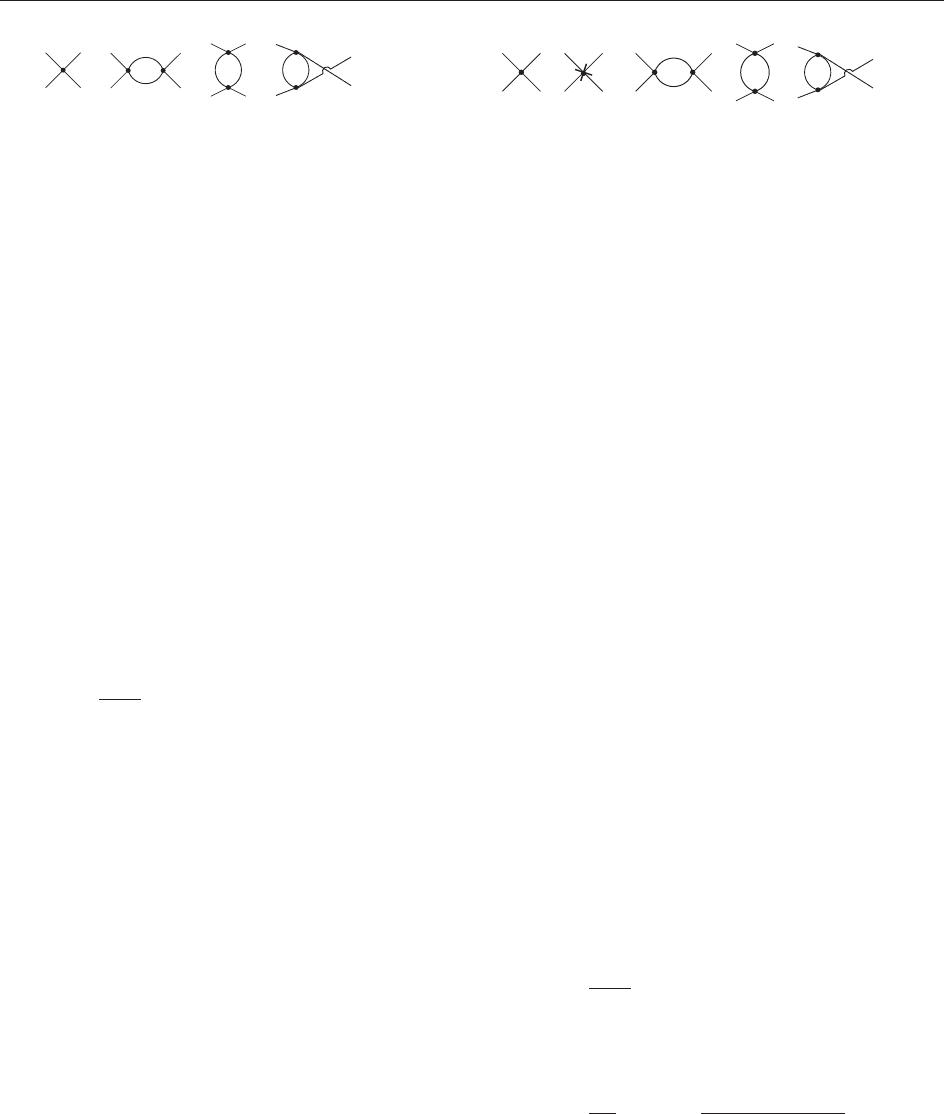
Low-order graphs for the connected and amputated
four-point Green function are shown in Figure 1.
Each one-loop graph has the form
i
2
Iðp
2
Þ
¼
?
2
2
Z
d
4
k
ð2Þ
4
1
ðk
2
m
2
þi0Þ½ðp kÞ
2
m
2
þi0
½2
where p is a combination of external momenta.
There is a divergence from where the loop
Renormalization: General Theory 399
momentum k goes to infinity. We define the degree
of divergence, , by counting powers of k at large k,
to get =0. In an n-dimensional spacetime we
would have =n 4. The integral is divergent
whenever 0. Comparing the dimensions of the
one-loop and tree graphs shows that equals the
negative of the energy dimension of the coupling .
Thus, the dimensionlessness of at the physical
spacetime dimension is equivalent to the integral
being just divergent.
The infinity in the integral implies that the theory
in its naive formulation is not defined. With the aid
of RG methods, it has been shown that the problem
is with the complete theory, not just perturbation
theory.
The divergence only arises because we use a
continuum spacetime. So suppose that we formulate
the theory initially on a lattice of spacing a (in space
or spacetime). Our loop graph is now
i
2
Iðp; m; aÞ
¼
2
32
4
Z
d
4
kSðk; m; aÞSðp k; m; aÞ½3
where the free propagator S(k, m; a) approaches the
usual value i=(k
2
m
2
þ i0) when k is much smaller
than 1=a, and it falls off more rapidly for large k.
The basic observation that propels the renormaliza-
tion program is that the divergence as a !0is
independent of p. This is most easily seen by
differentiating once with respect to p, after which
the integral is convergent when a = 0, because the
differentiated integral has degree of divergence 1.
Thus we can cancel the divergence in eqn [2] by
replacing the coupling in the first term in Figure 1,
by the so-called bare coupling
0
¼ þ 3AðaÞ
2
þ Oð
3
Þ½4
Here A(a) is chosen so that the renormalized value
of our one-loop graph,
i
2
I
R
ðp
2
; m
2
Þ¼i
2
lim
a!0
½Iðp; m; aÞþAðaÞ ½5
exists, at a = 0, with A(a) in fact being real valued.
The factor 3 multiplying A(a) in eqn [4] is because
there are three one-loop graphs, with equal diver-
gent parts. The replacement for the coupling is made
in the tree graph in Figure 1, but not yet at the
vertices of the other graphs, because at the moment
we are only doing a calculation accurate to order
2
;
the appropriate expansion parameter of the theory is
the finite renormalized coupling , held fixed as
a !0. We call the extra term in eqn [5] a counter-
term. The diagrams for the correct renormalized
calculation are represented in Figure 2, which has a
counter-term graph compared with Figure 1.
In the physics terminology, used here, the cutting-
off of the divergence by using a modified theory is
called a regularization. This contrasts with the
mathematics literature, where ‘‘regularized integral’’
usually means the same as a physicist’s ‘‘renorma-
lized integral.’’
There is always freedom to add a finite term to a
counter-term. When we discuss the RG, we will see
that this corresponds to a reorganization of the
perturbation expansion and provides a powerful
tool for improving perturbatively based calculations,
especially in QCD. Contrary to the impression given
in some parts of the literature, it is not necessary
that a renormalized mass equal a corresponding
physical particle mass, with similar statements for
coupling and field renormalization. While such a
prescription is common and natural in a simple
theory like QED, it is by no means required and
certainly may not always be best. If nothing else, the
correspondence between fields and stable particles
may be poor or nonexistent (as in QCD).
One classic possibility is to subtract the value of
the graph at p = 0, a prescription associated with
Bogoliubov, Parasiuk, and Hepp (BPH), which
leads to
i
2
I
R; BPH
ðp
2
Þ
¼
i
2
32
2
Z
1
0
dx ln 1 p
2
xð1 xÞ=m
2
½6
In obtaining this from [2], we used a standard
Feynman parameter formula,
1
AB
¼
Z
1
0
dx
1
½Ax þ Bð1 xÞ
2
½7
to combine the propagator denominators, after
which the integral over the momentum variable
k is elementary. We then obtain the renormalized
one-loop (four-point and amputated) Green function
i i
2
I
R
ðsÞþI
R
ðtÞþI
R
ðuÞ½þOð
3
Þ½8
where s, t,andu are the three standard Mandelstam
invariants for the Green function. (For a 2 !2
3A
++ + ++
O(λ
3
)
Figure 2 One-loop approximation to renormalized connected
and amputated four-point function, with counter-term.
+
+
O(λ
3
)
++
Figure 1 One-loop approximation to connected and amputated
four-point function, before renormalization.
400 Renormalization: General Theory
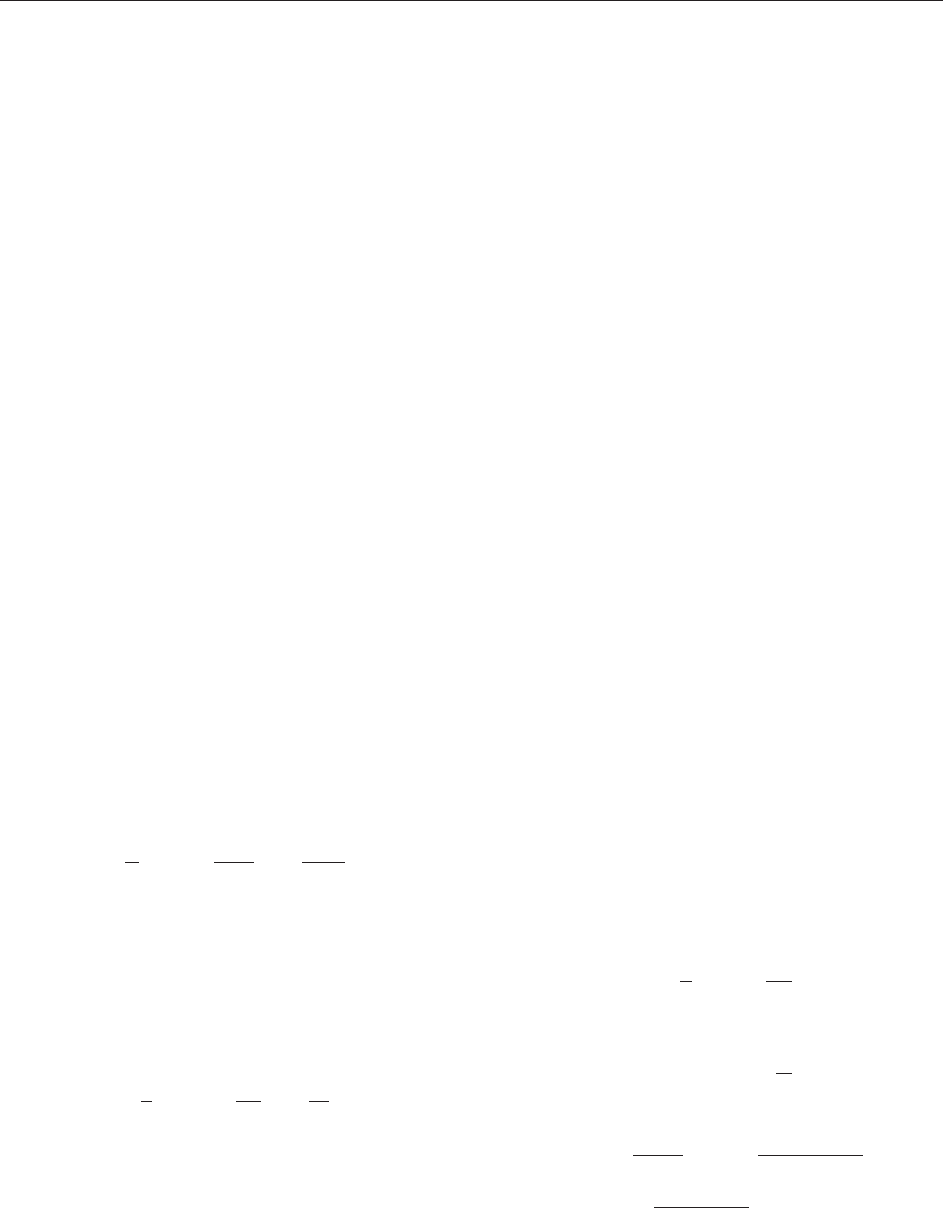
scattering process, or a corresponding off-shell
Green function, in which particles of momenta p
1
and p
2
scatter to particles of momenta p
0
1
and p
0
2
,
the Mandelstam variables are defined as s = (p
1
þ
p
2
)
2
, t = (p
1
p
0
1
)
2
,andu = (p
1
p
0
2
)
2
.)
In the general case, with a nonzero degree of
divergence, the divergent part of an integral is a
polynomial in p and m of degree D, where D is the
smallest positive integer less than or equal to .Ina
higher spacetime dimension, this implies that renor-
malization of the original, momentum-independent,
interaction vertex is not sufficient to cancel the
divergences. We would need higher derivative terms,
and this is evidence that the theory is not renorma-
lizable in higher than 4 spacetime dimensions. Even
so, the terms needed would be local, because of the
polynomiality in p.
Complete Formulation of
Renormalization Program
The full renormalization program motivated by
example calculations is:
the theory is regulated to cut off the divergences;
the numerical value of each coefficient in L is
allowed to depend on the regulator parameter
(e.g., a); and
these dependences are adjusted so that finite
results for Green functions are obtained after
removal of the regulator.
In
4
theory, we therefore replace L by
L¼
Z
2
ð@Þ
2
Zm
2
0
2
2
Z
2
0
4!
4
½9
with the bare parameters, Z, m
0
and
0
, having a
regulator dep endence such that Green functions of
are finite at a = 0.
The slightly odd labeling of the coefficients in
eqn [9] arises because observables like cross sections
are invariant under a redefinition of the field by a
factor. In terms of the bare field
0
=
def
ffiffiffiffi
Z
p
, we have
L¼
1
2
ð@
0
Þ
2
m
2
0
2
2
0
0
4!
4
0
½10
The unit coefficie nt of (1=2)(@
0
)
2
implies that
0
has canonical commutation relations (in the regu-
lated theory). This provides a natural standard for
the normalization of the bare mass m
0
and the bare
coupling
0
.
All terms in L have coefficients with dimensi on
zero or larger. This is commonly characterized by
saying that the terms L ‘‘have dimension 4 or less,’’
which refers to the products of field operators and
derivatives in each term. A generalization of the
power-counting analysis shows that if we start with
a theory whose L only has terms of dimension 4 or
less, then no terms of higher dimension are needed
as counter-terms, at least not in perturbation theory.
This is a very powerful restriction on self-contained
QFTs, and was critical in the discovery of the
standard model.
Sometimes it is found that the description of some
piece of physics appears to need higher-dimension
operators, as was the case originally with weak-
interaction physics. The lack of renormalizability of
such theories indicates that they cannot be complete,
and an upper bound on the scal e of their applic-
ability can be computed, for example, a few
hundred GeV for the four- fermion theory of weak
interactions. Eventually, this theory was superseded
by the renormalizable Weinberg–Salam theory of
weak interactions, now a part of the standard
model, to which the four-fermi on theory provides a
low-energy approximation for charged current weak
interactions.
Certain operators of allowed dimensions are
missing in eqn [9]: the unit operator, and and
3
. Symmetry unde r the transformation !
implies that Green functions with an odd number of
fields vanish, so that no and
3
counter-terms are
needed. Divergences with the unit operator do
appear, but not for ordinary Green functions. In
gravitational physics, the coefficient of the unit
operator gives renormalization of the cosmological
constant.
To implement renormalized perturbation theory,
we partition L (nonuniquely) as
L¼L
free
þL
basic interaction
þL
counter-term
½11
where the free, the basic interaction, and the
counter-term Lagrangians are
L
free
¼
1
2
ð@Þ
2
m
2
2
2
½12
L
basic interaction
¼
4!
4
½13
L
counter-term
¼
Z 1
2
ð@Þ
2
ðZm
2
0
m
2
Þ
2
2
ðZ
2
0
Þ
4!
4
½14
The renormalized coupling and mass, and m,areto
be fixed and finite when the UV regulator is removed.
Both the basic interaction and the counter-terms are
treated as interactions. First we compute ‘‘basic
graphs’’ for Green functions using only the basic
Renormalization: General Theory 401