
Francoise J.-P., Naber G.L., Tsun T.S. (editors) Encyclopedia of Mathematical Physics
Подождите немного. Документ загружается.


the contour consisting of the points (, "), where
jj2 and " = 1 marks the surface sheet.
Inverse-Scattering Transform
The inverse-scattering transform method for solving
initial-value problems for integrable nonlinear equa-
tions written as the compatibility conditions [6] for
linear equations [5] consists in the following: starting
from the given initial data, solve the direct problem,
that is, determine appropriate eigenfunctions (solu-
tions of the differential x-equation in the Lax pair [5])
having well-controlled analytic properties as functions
of the auxiliary (spectral) parameter and the
associated spectral functions of ; then, by virtue of
the t-equations in the Lax pair [5], the associated
functions evolve in a simple, explicit way. Finally,
using the explicit evolution of the spectral functions,
solve the inverse problem of finding the associated
coefficients in the x-equation, which, by [5], evolve
according to the given nonlinear equation and thus
solve the Cauchy problem for this equation. The last
step in this procedure, the inverse-scattering problem,
can be effectively solved by reformulating it as an RH
problem, which in turn can be related to a system of
singular integral equations. The classical Gelfand–
Levitan–Marchenko integral equation of the inverse-
scattering problem is the Fourier transform of some
special cases of these singular integral equations.
To fix ideas, consi der the initial-value problem for
the NLS equation [7], where the data q(x, t = 0) =
q
0
(x) have sufficient smoot h and decay as jxj!1.
For each 2 CnR, one constructs solutions (x, )
of
x
= U with U given by [10], having the
properties
mðx;Þ :¼ ðx;Þexp
ix
3
2
! I as x !1
and m(x, ) is bounded as x !1. For each fixed x,
the 2 2 matrix function m(x, ) solves the RH
problem in , where =R and the jump matrix is
v ¼ vð; xÞ¼
1 jrðÞj
2
rðÞe
ix
rðÞe
ix
1
!
½11
Here r() is the reflection coefficient of q
0
(x).
The direct scattering map R is described by
mapping q 7!r,
q 7!mðx;Þ¼mðx;; qÞ7!vð; xÞ7!r ¼RðqÞ
By virtue of the t-equations in [5],ifq(t) = q(x, t)
solves the NLS equation, then r(t) = R(q( , t)) evolves
as r(t) = r(t, ) = e
it
2
r
0
(), where r
0
= R( q
0
). Given
r, the inverse-scattering map R
1
is obtained by
solving the normalized RH problem (RHP) with the
jump matrix [11] and evaluating its solution m(x, )as
!1[9]:
r 7!v 7!RHP 7!mðx;Þ
¼ mðx;; rÞ7!m
1
ðxÞ7!qðxÞ
¼iðm
1
ðxÞÞ
12
and thus
qðx; tÞ¼R
1
e
ixðÞitðÞ
2
rðÞ
½12
The mathematical rigor to this scheme is provided
by the general theory of analytic matrix factoriza-
tion making use of the relation between the
factorization problem and certain singular integral
equations; this relation can be established with the
help of the Cauchy operators
ChðÞ¼
Z
hðÞ
d
2i
;2 Cn
and
C
hðÞ¼ lim
0
!
0
2ðÞside of
ðChÞð
0
Þ
For a very general class of con tours, the Cauchy
operators C
: L
p
!L
p
,1< p < 1, are bounded,
C
þ
C
= I, and C
þ
þ C
= H, where
HhðÞ :¼ lim
"!0
Z
jj>"
hðÞ
d
i
is the Hilbert transform.
The map R is often considered as a nonlinear
Fourier-type map; this point of view is supported by
the fact that R is a bijection between the corre-
sponding Schwartz spaces of funct ions. Making use
of the L
p
or Ho
¨
lder theory of the Cauchy operators
and the related factorization problems, it is possible
to analyze the action of R and R
1
in various
functional spaces. This also requires making more
precise the definition of the RH problem: for fixed
1 < p < 1, given and v such that v, v
1
2
L
1
( !GL(N, C)), we say that m
solves an RH
L
p
-problem if m
2 I þ @C(L
p
)andm
þ
() =
m
()v() for 2 . Here a pair of L
p
()-functions
f
2 @C(L
p
) if there exists a unique function
h 2L
p
() such that f
() = (C
h)(). Then f() =
Ch(), 2 Cn, is called the extension of f
off .
Given a factorization of v = (v
)
1
v
þ
= (I w
)
1
(I þ w
þ
)on with v
,(v
)
1
2 L
p
, the basic
associated singular integral operator is defined by
C
w
h :¼ C
þ
ðhw
ÞþC
ðhw
þ
Þ
If the operator I C
w
is invertible on L
p
(), with
2 I þ L
p
(), solving (I C
w
)m = I, then m() =
I þ (C((w
þ
þ w
)))() is the unique solution of the
432 Riemann–Hilbert Methods in Integrable Systems

RH problem (, v). Although the operator C
w
need
not be compact, in many cases it is Fredholm with
zero index. Then the existence of (I C
w
)
1
is
equivalent to the solvability of the RH problem
(, v), and the normalized RH problem (m !I as
!1) has a unique solution if and only if the
corresponding homogeneous RH problem (with
m !0as !1) has only the trivial solution
(vanishing lemma).
The most complete theory for RH problem relative
to simple contours is the theory when v is in an
inverse, closed, decomposing Banach algebra A,that
is, the algebra of continuous functions with the
Hilbert transform bounded in it such that if f 2A,
then f
1
2A. For contours with self-intersections, the
RH factorization theory is formulated in terms of a
pair of decomposing algebras: choosing the orienta-
tion of the contour in such a way that it divides the
-plane into two disjoint regions,
þ
and
,and
each arc of forms part of the positively oriented
boundary of
þ
, the functions in the þ()algebra
are continuous up to the boundary in each connected
component of
þ
(
).
The choice of functional spaces in the RH problem
should be based on the integrable system at hand. For
example, an integrable flow connected to the scatter-
ing problem for
x
= U, with U defined by [10],
has in general the form e
it
p
3
v()e
it
p
3
(Ablowitz–
Kaup–Newell–Segur (AKNS) hierarchy) in the scat-
tering space (for the NLS equation, p = 2), so that
appropriate spaces are L
2
((1 þ x
2
)dx) \ H
p1
for
q( , t)andL
2
((1 þjj
2p2
)jdj) \ H
1
as the scatter-
ing space. Deift and Zhou showed that in this case
the scattering map R and the inverse-scattering map
R
1
indeed involve no ‘‘loss’’ of smoothness or decay.
A generalization of the inverse-scattering trans-
form method to the initial boundary-value problems
for integrable nonlinear equations (on the half-line
or on a finite interval with respect to the space
variable x) can be also developed on the basis of the
RH problem formalism. It this case, the construction
of the corresponding RH problem involves simulta-
neous spectral analysis of the both linear equations
in the Lax pair [5]. The boundary values generate an
additional set of spectral functions, which generally
makes the construction of the associated RH
problem more complicated than in the case of the
corresponding initial-value problem (particularly,
the contour is to be enhanced by adding the part
coming from the spectral analysis of the t-equation);
however, this RH problem again depends explicitly
on x and t, which makes it possible to develop
relevant techniques (such as the nonlinear steepest-
descent method for the asymptotic analysis) in the
same spirit as in the case of initial-value pr oblems.
An RH problem may be viewed as a special c ase
in a more general setting of problems of recon-
structing an analytic function from the known
structure of its singularities. The departure from
analyticity of a function m of the complex variable
can be described in terms of the ‘‘d-bar’’
derivative, @m=@
.If@m=@
can be linearly related
to m itself, then the use of the extension of
Cauchy’s formula
mðÞ¼
1
2i
Z
D
d ^ d
1
@m
@
þ
1
2i
Z
@D
d
mðÞ
leads to a linear integral equation for m. This is the
case for some multidimensional (2 þ 1) nonlinear
integrable equations. For example, for the Kadomtsev–
Petviashvili-I equation (the two-dimensional general-
ization of the Korteweg–de Vries equation) (q
t
þ
6qq
x
þ q
xxx
)
x
= 3q
yy
, the appropriate eigenfunctions
are still sectionally meromorphic, but their jumps
across a contour are connected nonlocally to m on
the contour, which leads to nonlocal RH problem of
the type
m
þ
ðÞ¼m
ðÞþ
Z
dm
ðÞf ð ; Þ;2
with given f (, ) (analogue of scattering data).
Contrarily, the eigenfunctions for the Kadomtsev–
Petviashvili-II equation (q
t
þ 6qq
x
þ q
xxx
)
x
= 3q
yy
are nowhere analytic, with @m=@
related to m by
@m
@
ðÞ¼Fð Re ; Im Þm ð
Þ;2 C
Nonlinear Steepest-Descent Method
The nonlinear steepest-descent method is based on a
direct asymptotic analysis of the relevant RH
problem; it is general and algorithmic in the sense
that it does not require a priori information (anzatz)
about the form of the solution of the asymptotic
problem. However, the noncommutativity of the
matrix setting requires developing rather sophisti-
cated technical ideas, which, in particular, enable an
explicit solution of the associated local RH problems.
To fix ideas, let us again consider the NLS
equation. The dependence of the jump matrix
v(; x, t)onx and t is oscillatory; it is the same as
in the integral
qðx; tÞ¼
1
ffiffiffiffiffiffi
2
p
Z
R
e
iðxt
2
Þ
^
q
0
ðÞd ½13
which solves the initial-value problem for the
linearized version of [7]:
iq
t
þ q
xx
¼ 0; qðx; 0Þ¼q
0
ðxÞ½14
Riemann–Hilbert Methods in Integrable Systems 433
(here
^
q
0
() is the Fourier transform of the initial data
q
0
). The main contribution to [13] as jxj and t tend to
1 comes from the point of stationary phase of
e
i(xt
2
)
, that is, the point =
0
= x=2t, for which
d
d
ðx t
2
Þ¼0
If
^
q
0
() is analytic in a strip jIm j <", then one can
use Cauchy’s theorem to deform [13] to an integral
on a contour
"
such that je
i(xt
2
)
j decreases rapidly
on
"
away from =
0
. Hence, as t !1,the
problem localizes to a neighborhood of =
0
;this
constitutes the standard method of steepest descent.
In the spirit of the oscillatory contour integral
case, the nonlinear steepest-descent method for an
oscillatory RH problem introduced by Deift and
Zhou consists in the following: deform the contour
and (rationally) approximate the jump matrix in
order to obtain an RH problem with a jump matrix
that decays to the identity away from stationary
phase points; then, rescaling the problem near the
stationary phase points, obtain a (loc al) RH problem
with a piecewise constant jump matrix, which can
be solved in closed form, usually in terms of certain
special functions.
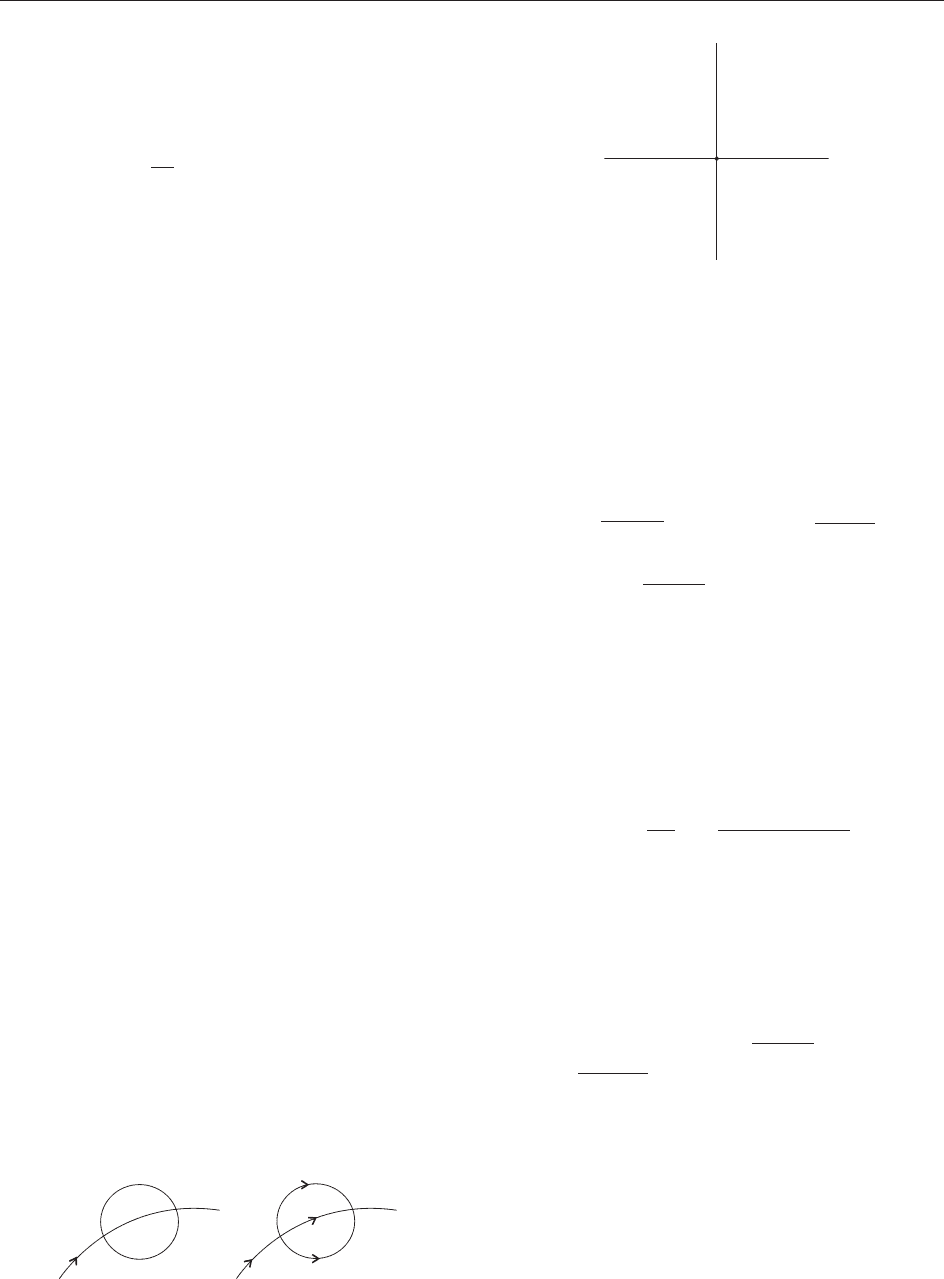
The contour deformation means the following.
Suppose that the jump matrix of an RH problem
(, v) has a factorization v = b
1
v
1
b
þ
between two
points on , where b
þ
(b
) has holomorphic and
nondegenerating continuation to the part
þ
(
)ofa
disk supported by these points, see Figure 2a. Then
the contour may be deformed to the contour
0
=[ @, and the jump matrices across
0
may be
defined as indicated in Figure 2b.Ifm solves the RH
problem (, v), then m
0
defined by m
0
= mb
1
in
and m
0
= m outside solves the deformed RH
problem associated with
0
.
The appropriate factorization of v given by [8]
and the contour deformation are to be chosen in
accordance with signature table; for the NLS
equation, it is given in Figure 3. The key step is to
move algebraically the factors e
i
in v(; x, t) into
regions of the complex plane, where they are
exponentially decreasing as t !1. The jump matrix
admits two algebraic factorizations:
v ¼
1 jrj
2
re
i
re
i
1
¼
1 re
i
01
10
re
i
1
ð>
0
Þ
¼
10
re
i
1 jrj
2
1
!
1 jrj
2
0
0
1
1 jrj
2
!
1
re
i
1 jrj
2
01
0
B
@
1
C
A
ð<
0
Þ
The diagonal factors (1 jrj
2
)
1
can be rem oved by
conjugating v by
3
, where () solves the scalar,
normalized RH problem on R :
þ
=
(1 jrj
2
) for
<
0
and
þ
=
for >
0
; the solution of the
latter can be written in a closed form:
ðÞ¼exp
1
2i
Z
0
1
logð1 jr ðÞj
2
Þ
d
()
Then
~
m := m
3
solves the RH problem across
=R, with the jump matrix
~
v ¼
1 r
2
e
i
01
10
r
2
e
i
1
ð>
0
Þ
¼
10
r
2
e
i
1 jrj
2
1
!
1
r
2
þ
e
i
1 jrj
2
01
!
ð<
0
Þ
Replacing r,
r, etc., by appropriate rational approx-
imations [r], [
r], matching at ¼
0
,
~
m
þ
10
½
r
2
e
i
1
can be continued to the sector above R
þ
þ
0
and
~
m
1 ½r
2
e
i
01
Σ, ν
Ω
+
Ω
–
ν
ν
1
b
+
ν
b
–
(a) (b)
–1
Figure 2 Deformation of an RH problem.
Re iθ > 0
Re
iθ < 0Re iθ > 0
Re
iθ < 0
λ
0
Figure 3 Signature table.
434 Riemann–Hilbert Methods in Integrable Systems

can be continued to the sector below R
þ
þ
0
, where
the factors e
i
are exponentially decreasing. Doing the
same for the appropriate factors on R
þ
0
,we
obtain an RH problem on a cross, say, (
0
þ e
i=4
R) [
(
0
þ e
i=4
R). As t !1, the RH problem then
localizes at
0
.
Performing an appropriate scaling, a straightfor-
ward computation shows that, as t !1, the
problem reduces to an RH problem with the jump
matrix that does not depend on (it is determined
by r(
0
)), which make it possible to solve this
problem explicitly (in terms of the parabolic cylinder
functions, in the case of the NLS equation). Using
explicit asymptotics for these functions and control-
ling the error terms, it is possible to obtain the
uniform (for all x 2 R) asymptotics for the solution
of the initial-value problem for the NLS equation
with q
0
2 L
2
((1 þ x
2
)dx) \ H
1
of the form
qðx; tÞ¼t
1=2
ð
0
Þexpðix
2
=ð4tÞið
0
Þlog 2tÞ
þ Oðt
ð1=2þÞ
Þ
for any fixed 0 <<1=4, where and are given
in terms of r = R(q
0
):
ðÞ¼
1
2
logð1 jrðÞj
2
Þ
jðÞj
2
¼
ðÞ
2
and
arg ðÞ¼
1
Z
1
logð Þdðlogð1 jrðÞj
2
ÞÞ
þ
4
þ arg ðiðÞÞþ arg rðÞ
The method can be used to obtain asymptotic
expansions to all orders. Also, for nonlinear equa-
tions supporting solitons, the soliton part of the
asymptotics can be incorporated via the dressing
method.
Further applications include long-time asympto-
tics for near-integrable systems, such as the per-
turbed NLS equation iq
t
þ q
xx
2jqj
2
q "jqj
l
q = 0
for l > 2 and ">0, and the small-dispersion limits
of integrable equations (e.g., for the Korteweg–
de Vries equation q
t
6qq
x
þ "
2
q
xxx
= 0 with small
dispersion " & 0).
The RH formalism makes possible a comprehen-
sive global asymptotic analysis of the Painleve´
transcendents (which, due to their increasing role
in the modern mathematical physics, should be
considered as new nonlinear special functions),
including explicit connection formulas, as x
approaches relevant critical points along different
directions in the complex plane.
The development of the RH method in the theory
of integrable systems caused emerging new analytic
and algebraic ideas for other branches of mathe-
matics and theoretical physics. The recent examples
are the study of the asymptotics in the theory of
orthogonal polynomials and random matrices and in
combinatories (random permutations).
See also: Boundary-Value Problems for Integrable
Equations;
Approach to Integrable Systems; Integrable
Systems and Algebraic Geometry; Integrable Systems
and the Inverse Scattering Method; Integrable Systems:
Overview; Nonlinear Schro
¨
dinger Equations; Painleve
´
Equations; Twistor Theory: Some Applications [in
Integrable Systems, Complex Geometry and String
Theory]; Riemann–Hilbert Problem.
Further Reading
Ablowitz MJ and Clarkson PA (1991) Solitons, Nonlinear
Evolution Equations and Inverse Scatting, London Math.
Soc., Lecture Notes Series, vol. 149. Cambridge: Cambridge
University Press.
Beals R, Deift PA, and Tomei C (1988) Direct and Inverse
Scattering on the Line. Mathematical Surveys and Mono-
graphs 28. Providence, RI: American Mathematical Society.
Belokolos ED, Bobenko AI, Enol’skii VZ, and Its AR (1994)
Algebro-Geometric Approach to Nonlinear Integrable
Equations. Springer Series in Nonlinear Dynamics. Berlin:
Springer.
Deift PA (1999) Orthogonal Polynomials and Random Matrices:
A Riemann–Hilbert Approach. Courant Lecture Notes in
Mathematics, vol. 3. New York: CIMS.
Deift PA and Zhou X (2003) Long-time asymptotics for solutions
of the NLS equation with initial data in a weighted Sobolev
space. Communications on Pure and Applied Mathematics
56(8): 1029–1077.
Deift PA, Its AR, and Zhou X (1993) Long-time asymptotics for
integrable nonlinear wave equations. In: Fokas AS and
Zakharov VE (eds.) Important Developments in Soliton
Theory, pp. 181–204. Berlin: Springer.
Faddeev LD and Takhtajan LA (1987) Hamiltonian Methods in
the Theory of Solitons. Berlin: Springer.
Fokas AS (2000) On the integrability of linear and nonlinear
partial differential equations. Journal of Mathematical Physics
41: 4188–4237.
Its AR (2003) The Riemann–Hilbert problem and integrable
systems. Notices of the AMS 50(11): 1389–1400.
Novikov SP, Manakov SV, Pitaevskii LP, and Zakharov VE
(1984) Theory of Solitons. The Inverse Scattering Method.
New York: Consultants Bureau.
Zhou X (1989) The Riemann–Hilbert problem and inverse
scattering. Journal on Mathematical Analysis. Society for
Industrial and Applied Mathematics (SIAM) 20: 966–986.
Riemann–Hilbert Methods in Integrable Systems 435

Riemann–Hilbert Problem
V P Kostov, Universite
´
de Nice Sophia Antipolis,
Nice, France
ª 2006 Elsevier Ltd. All rights reserved.
Regular and Fuchsian Linear Systems
on the Riemann Sphere
Consider a system of ordinary linear differential
equations with time belonging to the Riemann
sphere CP
1
= C [1:
dX=dt ¼ AðtÞX ½1
The n n matrix A is meromorphic on CP
1
, with
poles at a
1
, ..., a
pþ1
; the dependent variables X form
an n n matrix. One can assume that 1 is not
among the poles a
j
and it is not a pole of the 1-form
A(t)dt (this can be achieved by a fractionally-linear
transformation of t).
P Deligne has introduced a termi nology of
meromorphic connections and sections which is
often preferred in modern literature to the one of
meromorphic linear systems and their solutions, and
there is a one-to-one correspondence between the
two languages.
Definition 1 System [1] is regular at the pole a
j
if
its solutions have a moderate (or polynomial)
growth rate there, that is, for every sector S centered
at a
j
and not containing other poles of the system
and for every solution X restricted to S there exists
N
j
2 R such that kX(t a
j
)k= O(jt a
j
j
N
j
) for all
t 2 S. System [1] is regular if it is regular at all poles
a
j
. System [1] is Fuchsian if its poles are logarithmic
(i.e., of first order). Every Fuchsian system is
regular.
Remark 2 The opening of the sector S might be
>2. Restricting to a sector is necessary because the
solutions are, in general, ramified at the poles a
j
and
by turning around the poles much faster than
approaching them one can obtain any growth rate.
A Fuchsian system can be presented in the form
dX=dt ¼
X
pþ1
j¼1
A
j
=ðt a
j
Þ
!
X; A
j
2 glðn; CÞ½2
The sum of its matrices-residua A
j
is 0, that is,
A
1
þþA
pþ1
¼ 0 ½3
(recall that 1 is not a pole of the system).
Remark 3 The linear equation (with meromorphic
coefficients)
P
n
j = 0
a
j
(t)x
(j)
= 0 is Fuchsian if a
j
has
poles of order only n j. A linear equation is
Fuchsian if and only if it is regular. The best-studied
Fuchsian equations are the hypergeometric one and
its generalizations and the Jordan–Pochhammer
equation.
The linear change of the dependent variables
X 7!WðtÞX ½4
(where W is meromorphic on CP
1
) makes system [2]
undergo the gauge transformation
A !W
1
ðdW=dtÞþW
1
AW ½5
(Most often one requires W to be holomorphic and
holomorphically invertible for t 6¼ a
j
, j = 1, ..., p þ 1,
so that no new singular points appear in the system.)
This transformation preserves regularity but not
necessarily being Fuchsian. The only invariant under
the group of linear transformations [4] is the
monodromy group of the system.
Definition 4 Set =CP
1
n{a
1
, ..., a
pþ1
}. Fix a
base point a
0
2 and a matrix B 2 GL(n, C).
Consider a closed contour with base point a
0
and bypassing the poles of the system. The mono-
dromy operat or of system [1] defined by this
contour is the linear operator M acting on the
solution space of the syst em which maps the
solution X with Xj
t = a
0
= B into the value of its
analytic continuation along . Notation: X 7!
XM.
The monodromy operator depends only on the class
of homotopy equivalence of .
The monodromy group is the subgroup of
GL(n, C) generated by all monodromy operators. It
is defined only up to conjugacy due to the freedom
to choose a
0
and B.
Definition 5 Define the product (concatenation)
1
2
of two paths
1
,
2
in (where the end of
1
coincides with the beginning of
2
) as the path
obtained by running
1
first and
2
next.
Remark 6 The monodromy group is an antirepre-
sentation of the fundamental group
1
() into
GL(n, C) because one has
X 7!
1
XM
1
7!
2
XM
2
M
1
½6
that is, the concatenation
1
2
of the two contours
defines the monodromy operator M
2
M
1
. In the text,
the monodromy group is referred to as to a
representation, not an antirepresentation.
One usually chooses a standard set of generators
of
1
() (see Figure 1) defined by contours
j
, j = 1, ..., p þ 1, where
j
consists of a segment
436 Riemann–Hilbert Problem
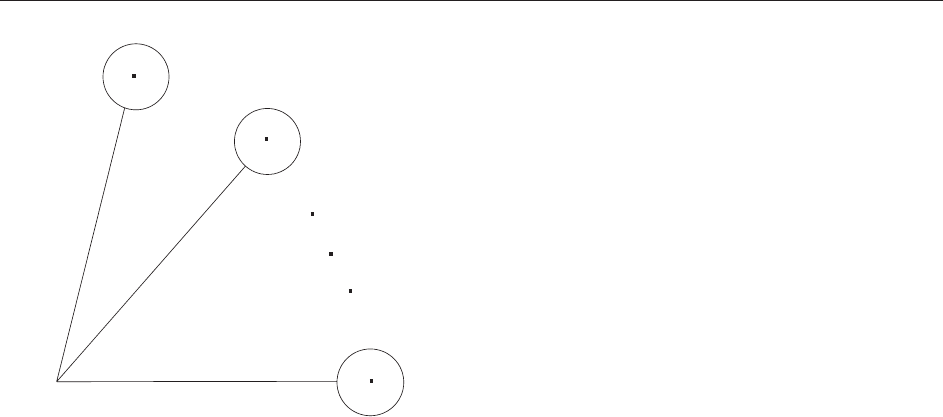
[a
0
, a
0
j
](a
0
j
being a point close to a
j
), of a small
circumference run counterclockwise (centered at a
j
,
passing through a
0
j
and containing inside no pole of
the system other than a
j
), and of the segment [a
0
j
, a
0
].
Thus,
j
is freely homotopic to a small loop
circumventing counterclockwise a
j
(and no other
pole a
i
). The indices of the poles are chosen such
that the indices of the contours increase from 1 to
p þ 1 when one turns around a
0
clockwise.
For the standard choice of the contours the
generators M
j
satisfy the relation
M
1
...M
pþ1
¼ I ½7
Indeed, the concatenation of contours
pþ1...
1
is
homotopy equivalent to 0 and equality [7] results
from Remark 6.
Remarks 7
(i) If the matrix-residuum A
j
of a Fuchsian system
has no eigenvalues differing by a nonzero
integer, then the monodromy operator M
j
defined as above is conjugate to exp (2iA
j
). It
is always true that the eigenvalues
k, j
of M
j
equal exp (2i
k, j
), where
k, j
are the eigenva-
lues of A
j
.
(ii) If the generators M
j
of the monodromy group
are defined after a standard set of contours
j
,
then they are conjugate to the corresponding
operators L
j
of local monodromy, that is, when
the poles a
j
are circumvented counterclockwise
along small loops. The operators L
j
of a regular
system can be computed (up to conjugacy)
algorithmically – one first makes the system
Fuchsian at a
j
by means of a change [4] and
then carries out the computation. Thus,
M
j
= Q
1
j
L
j
Q
j
for some Q
j
2 GL(n, C) and the
difficulty when computing the monodromy
group of system [1] consists in computing the
matrices Q
j
which is a transcendental problem.
(iii) As will be noted in Theorem 9, every compo-
nent of every solution to a regular linear system
is a function of the class of Nilsson, that is,
representable as a convergent (on sectors) series
P
k2N,1in,0n1
a
i, k,
t
i
þk
ln
t,
i
2 C, a
i, k,
2 C.
Example 8 The Fuchsian system dX=dt = (A=t)X,
A 2 gl(n, C), has two poles – at 0 and at 1,
with matrices-residua A and A. Any solution
is of the form X = exp (A ln t)G, G 2 GL(n, C).
To compute the local monodromy around 0, change
the argument of t by 2i. This results in ln t 7!
ln t þ2i and X 7!XG
1
exp (2 iA)G, that is the
monodromy operator at 0 equals G
1
exp (2iA)G
(and in the same way the one at 1 equals
G
1
exp (2iA)G).
Formulation and History of the Problem
The Riemann–Hilbert problem (or Hilbert’s twenty-
first problem) is formulated as follows:
Prove that for any set of points a
1
, ..., a
pþ1
2 CP
1
and for any set of matrices M
1
, ..., M
p
2 GL(n, C)
there exists a Fuchsian linear system with poles
at and only at a
1
, ..., a
pþ1
for which the correspond-
ing monodromy operators are M
1
, ..., M
p
,
M
pþ1
= (M
1
...M
p
)
1
.
Historically, the Riemann–Hilbert problem was
first stated for Fuchsian equations, not for systems –
Riemann mentions in a note at the end of the 1850s
the problem how to reconstruct a Fuchsian equation
from its monodromy representation and Hilbert
includes it in 1900 as the twenty-first problem on
his list in a formulation mentioning equations and
not systems. However, the number of parameters
necessary to parametrize a Fuchsian equation is, in
general, smaller than the one necessary to parame-
trize a monodromy group generated by p matrices.
Therefore, one has to allo w the presence of
additional apparent singularities in the equation,
that is, singularities the monodromy around which is
trivial.
It had been believed for a long time that the
Riemann–Hilbert problem has a positive solution
for any n 2 N, after J. Plemelj in 1908 gave a proof
with a gap. In his proof, Plemelj tries to reduce the
Riemann–Hilbert problem to the so-called homo-
geneous Hilbert bounda ry-value problem of the
theory of singular integral equations. It follows
from the correct part of the proof that if one of
a
1
a
2
a
0
a
p + 1
Figure 1 The standard set of generators.
Riemann–Hilbert Problem 437

the monodromy operators of system [1] is diagonal-
izable, then system [1] is equivalent to a Fuchsian
one; this is due to Yu S Il’yas henko. (In particular, if
one allows just one additional apparent singularity,
then the Riemann–Hilbert problem is pos itively
solvable. The author has shown that the resul t still
holds if one of the monodromy operators has one
Jordan block of size 2 and n 2 Jordan blocks of
size 1. The result is sharp – it would be false if one
allows one Jordan block of size 3 or two blocks of
size 2.) It also follows that any finitely generated
subgroup of GL(n, C) is the monodromy group of a
regular system with prescribed poles which is
Fuchsian at all the poles with the possible exception
of one (where the system is regular) which can be
chosen among them at random.
After the publication of Plemelj’s result, the
interest shifted basically towards the question how
to construct a Fuchsian system given the mono-
dromy operators M
j
. At the end of the 1920s
IA Lappo-Danilevskii expressed the solutions to a
Fuchsian syst em as series of the monodromy
operators. These series are convergent for mono-
dromy operators close to the identity matrix and for
such operators one can express the residua A
j
of the
Fuchsian system as convergent series of the mono-
dromy operators.
In 1956 BL Krylov proved that the Riemann–
Hilbert problem is solvable for n = p = 2 by con-
structing a Fuchsian system after its monodromy
group. In 1983 NP Erugin did the same in the case
n = 2, p = 3, and established a connection between
the Riemann–Hilbert problem and Painleve´’s
equations.
In 1957 H Ro¨ hrl reformulated the problem in
terms of fibre bundles. His approach is more
geometric; however, it does not require the system
realizing a given monodromy group to be Fuchsian,
but only regular.
In 1978 W Dekkers considered the particular case
n = 2 of the Riemann–Hilbert problem, and gave a
positive answer to it. The gap in Plemelj’s proof was
detected in the 1980s by AT Kohn and YuS
Il’yashenko.
It was proved by AA Bolibrukh in 1989 that, for
n 3, the problem has a negative answer. For n = 3,
the answer is negative precisely for those couples
(monodromy group, set of poles) for which each
monodromy operator M
1
, ..., M
pþ1
is conjugate to
a Jordan block of size 3, the monodromy group is
reducible, with an invariant subspace or factor-space
of dimension 2, the monodromy sub- or factor-
representation corresponding to it is irreducible and
cannot be realized by a Fuchsian system having all
its matrices-residua conjugate to Jordan blocks of
size 2. In Bolibrukh’s work, the last condition is
formulated in a different (but equivalent) way using
the notion of Fuchsian weight.
The New Setting of the Problem
After the negati ve answer to the Riemann–Hilbert
problem for n 3, it is reasonable to reformulate it
as follows:
Find necessary and/or sufficient conditions for the
choice of the monodromy operators M
1
, ..., M
p
and
the points a
1
, ..., a
pþ1
so that there should exist a
Fuchsian system with poles at and only at the given
points and whose monodromy operators M
j
should
be the given ones.
In the new setting of the Riemann–Hilbert pro-
blem, the answer is positive if the monodromy group
is irreducible (for any positions of the poles a
j
). This
has been first proved by Bolibrukh for n = 3 and then
independently by the author and by him for any n.
Bolibrukh found many examples of couples
(reducible monodromy group, poles) for which the
answer to the Riemann–Hilbert problem is nega-
tive. For n = 3, the negative answer is due to
possible ‘‘bad position’’ of the poles and a small
shift from this position while keeping the same
monodromy group leads to a couple for which the
answer is positive. For n 4, there are couples
where the negative answer is due to arithmetic
properties of the eigenvalues of the matrices-
residua and the corresponding monodromy groups
are not realizable by Fuchsian systems for any
position of the poles. During the last years of his
life, Bolibrukh studied upper-triangular mono-
dromy representations and found other examples
with negative answer to the Riemann–Hilbert
problem.
Bolibrukh also found some sufficient conditions
for the positive resolvability of the Ri emann–Hilbert
problem in the case of a reducible monodrom y
group. For example, suppose that the monodromy
group is a semidirect sum:
M
j
¼
M
1
j
0 M
2
j
!
where the matrices M
i
j
(of size l
i
l
i
, i = 1, 2) define
the representations
i
. Suppose that the representa-
tion
2
is realizable by a Fuchsian system, that the
representation
1
is irreducible, and that one of the
matrices M
j
is block-diagonal, with left upper block
of size s s, where s l
1
. Then for any choice of the
poles a
j
the monodromy group can be realized by
some Fuchsian system.
438 Riemann–Hilbert Problem

Bolibrukh also gave an estimation upon the
number m of additional apparent singularities in a
Fuchsian equation which are sufficient to realize a
given irreducible monodromy group. It follows from
his result that
m
nðn 1Þðp 1Þ
2
þ 1 n
One can ask the question what the codimension of
the subset in the space (monodromy group, poles) is
which provides the negative answer to the Riemann–
Hilbert problem in its initial setting. The (author’s)
answer for p 3is2p(n 1), and for n 7 this
codimension is attained only at couples (mono-
dromy group, poles) for which every monodromy
operator M
j
is conjugate to a Jordan block of size n,
the group has an invar iant subspace or factor-space
of dimension n 1, the corresponding sub- or
factor-representation is irreducible and cannot be
realized by a Fuchsian system in which all matrices-
residua are conjugate to Jordan blocks of size n 1.
For n 6 there are examples wher e the same
codimension is attained (but cannot be decreased)
on other couples as well.
Levelt’s Result and Bolibrukh’s Method
In 1961, AHM Levelt described the form of the
solution to a regular system at its pole. His result is
in the core of Bolibrukh’s method for solving the
Riemann–Hilbert problem.
Theorem 9 In the neighborhood of a pole, the
solution to a regular linear system is representable in
the form
X ¼ U
j
ðt a
j
Þðt a
j
Þ
D
j
ðt a
j
Þ
E
j
G
j
½8
where the matrix U
j
is holomorphic in a neigh-
borhood of 0, D
j
= diag(’
1, j
, ..., ’
n, j
), ’
n, j
2 Z,
det G
j
6¼ 0. The matrix E
j
is in upper-triangular
form and the real parts of its eigenvalues belong to
[0, 1) ( by definition,(t a
j
)
E
j
= e
E
j
ln (ta
j
)
). The num-
bers ’
k, j
satisfy the condition [10] formulated
below. They are valuations in the eigenspaces of
the monodromy operator M
j
(i.e., in the maximal
subspaces invariant for M
j
on which it acts as an
operator with a single eigenvalue).
A regular system is Fuchsian at a
j
if and only if
det U
j
ð0Þ 6¼ 0 ½9
The condition on ’
k, j
can be formulated as follows: let
E
j
have one and the same eigenvalue in the rows with
indices s
1
< s
2
< < s
q
. Then one has
’
s
1
; j
’
s
2
; j
’
s
q
; j
½10
Remark 10 Denote by
k, j
the diagonal entries
(i.e., the eigenvalues) of the matrix E
j
. Then the
sums
k, j
þ ’
k, j
are the eigenvalues of the mat rix-
residuum A
j
at a
j
.
In proving that the Riemann–Hilbert problem is
positively solved in the case of an irreducible mono-
dromy group, Bolibrukh (or the author) uses the
correct part of Plemelj’s proof – namely, that the given
monodromy group can be realized by a regular system
which is Fuchsian at all poles but one. After this, a
suitable change [4] is sought which makes the system
Fuchsian at the last pole. The criterium to be Fuchsian
is provided by the above theorem; one checks how the
matrices D
j
, that is, the exponents ’
k, j
and the
matrices U
j
change as a result of the transformation
[4]. This is easier (one has only to multiply to the left
by W(t)) than to see how the matrix A(t)ofsystem[1]
changes because one has conjugation in rule [5].This
idea is also due to Bolibrukh.
When Bolibrukh obtains the negative answer to
the Riemann–Hilbert problem in some case of
reducible monodromy group, he often uses the
following two propositions:
Proposition 11 The sum
P
k, j
þ ’
k, j
relative to a
subspace of the solution space invariant for all
monodromy operators is a non-positive integer.
In particular, the sum of all expon ents
k, j
þ ’
k, j
is a non-positive integer which is 0 if and only if the
system is Fuchsian.
Proposition 12 If some component of some col-
umn of some matrix solution to a regular system is
identically equal to 0, then the monodromy group of
the system is reducible.
A reducible monodromy group can be conjugated
to a block upper-triangular form, with the diagonal
blocks defining irreducible representations. Thus, the
Riemann–Hilbert problem for reducible monodromy
groups makes necessary the answer to the question
‘‘given the set of poles a
j
, for which sets of exponents
’
k, j
can a given irreducible monodromy group be
realized by such a Fuchsian system?’’ For n 2, an
irreducible monodromy group can be apriorirealized
by infinitely many Fuchsian systems, with different
sets of exponents ’
k, j
. Consider the case when these
exponents are fixed for j 6¼ 1; suppose that a
1
= 0.
The author has shown that then infinitely many of
the a priori possible choices of the exponents ’
k,1
cannot be realized by Fuchsian systems if and only if
the given monodromy group is realized by a Fuchsian
system which is obtained from another one via the
change of time t 7!t
k
=(b
k
t
k
þ b
k1
t
k1
þþb
0
),
b
i
2 C, b
0
6¼ 0, k 2 N
, k > 1. This change increases
the number of poles.
Riemann–Hilbert Problem 439

Further Developments – The
Deligne–Simpson Problem
The Riemann–Hilbert problem can be generalized for
irregular systems as follows. One asks whether for
given poles a
j
there exists a linear system of ordinary
differential equations on the Riemann sphere with
these and only these poles which is Fuchsian at the
regular singular points, which has prescribed formal
normal forms, formal monodromies and Stokes
multipliers at the irregular singular points, and
which has a prescribed global monodromy.
The Riem ann–Hilbert problem has been consid-
ered in some papers (of H Esnau lt, E View eg, and C
Hertling) in the context of algebraic curves of higher
genus instead of CP
1
.
The study of the so-called Riemann–Hilbert
correspondence between the category of holonomic
D-modules and the one of perverse sheaves with
constructible cohomology has been initiated in the
works of J Bernstein in the algebraic aspect and of
M Sato, T Kawai, and M Kashiwara in the analytic
one. This has been done in the case of a variety of
arbitrary dimension (not necessarily CP
1
), with
codimension one pole divisor. Perversity has been
defined by P Deligne, M Goresky, and R MacPher-
son. Regularity has been defined by M Kashiwara in
the analytic aspect and by Z Mebkhout in the
geometric one. Important contributions in the
domain are due to Ph Maisonobe, M Merle, N
Nitsure, C Sabbah, and the list is far from being
exhaustive. The Riemann–Hilbert correspondence
plays an important role in other trends of mathe-
matics as well.
The Deligne–Simpson problem is formulated like
this: Give necessary and sufficient conditions upon
the choice of the conjugacy classes c
j
gl(n, C) or
C
j
GL(n, C) so that there should exist an irredu-
cible (i.e., without proper invariant subspace)
(p þ 1)-tuple of matrices A
j
2 c
j
satisfying [3] or of
matrices M
j
satisfying [7].
The problem was stated in the 1980s by P Deligne
for matrices M
j
and in the 1990s by the author for
matrices A
j
. C Simpson was the first to obtain results
towards its resolution in the case of matrices M
j
.The
problem admits the following geometric interpretation
in the case of matrices M
j
: For which (p þ 1)-tuples of
local monodromies does there exist an irreducible
global monodromy with such local monodromies?
For generic eigenvalues the problem has found a
complete solution in the author’s papers in the form of
a criterium upon the Jordan normal forms defined by
the conjugacy classes. The author has treated the case
of nilpotent matrices A
j
and the one of unipotent
matrices M
j
as well. For matrices A
j
,theproblemhas
been completely solved (for any eigenvalues) by W
Crawley-Boevey. The case of matrices A
j
with p = 2
has been treated by O Gleizer using results of A
Klyachko. The case when the matrices M
j
are unitary
is considered in papers of S Agnihotri, P Belkale, I
Biswas, C Teleman, and C Woodward. Several cases of
finite groups have been considered by M Dettweiler, S
Reiter, K Strambach, J Thompson, and H Vo¨ lklein.
The important rigid case has been studied by NM
Katz. Y Haraoka has considered the problem in the
context of linear systems in Okubo’s normal form.
One can find details in an author’s survey on the
Deligne–Simpson problem (Kostov, 2004).
See also: Affine Quantum Groups; Bicrossproduct Hopf
Algebras and Non-Commutative Spacetime; Einstein
Equations: Exact Solutions; Holonomic Quantum Fields;
Integrable Systems: Overview; Isomonodromic
Deformations; Leray–Schauder Theory and Mapping
Degree; Painleve
´
Equations; Riemann–Hilbert Methods
in Integrable Systems; Twistors; WDVV Equations and
Frobenius Manifolds.
Further Reading
Anosov DV and Bolibruch AA (1994) The Riemann–Hilbert
Problem, A Publication from the Moscow Institute of
Mathematics, Aspects of Mathematics, Vieweg.
Arnol’d VI and Ilyashenko YuS (1988) Ordinary differential
equations. In: Dynamical Systems I, Encyclopedia of Mathe-
matical Sciences, t. 1. Berlin: Springer.
Beukers F and Heckman G (1989) Monodromy for the hypergeo-
metric function
n
F
n1
. Inventiones Mathematicae 95: 325–354.
Bolibrukh AA (1990) The Riemann–Hilbert problem. Russian
Mathematical Surveys 45(2): 1–49.
Bolibrukh AA (1992) Sufficient conditions for the positive
solvability of the Riemann–Hilbert problem. Mathematical
Notes 51(1–2): 110–117.
Crawley-Boevey W (2003) On matrices in prescribed conjugacy
classes with no common invariant subspace and sum zero.
Duke Mathematical Journal 118(2): 339–352.
Dekkers W (1979) The matrix of a connection having regular
singularities on a vector bundle of rank 2 on P
1
(C). Lecture
Notes in Mathematics 712: 33–43.
Deligne P (1970) Equations diffe´rentielles a` points singuliers
re´guliers, Lecture Notes in Mathematics, vol. 163, pp. 133.
Berlin: Springer.
Dettweiler M and Reiter S (1999) On rigid tuples in linear groups
of odd dimension. Journal of Algebra 222(2): 550–560.
Esnault H and Viehweg E (1999) Semistable bundles on curves
and irreducible representations of the fundamental group.
Algebraic geometry: Hirzebruch 70 (Warsaw, 1998), Con-
temporary Mathematics AMS, Providence, RI 241: 129–138.
Esnault H and Hertling C (2001) Semistable bundles on curves
and reducible representations of the fundamental group.
International Journal of Mathematics 12(7): 847–855.
Haraoka Y (1994) Finite monodromy of Pochhammer equation.
Annales de l’Institut Fourier 44(3): 767–810.
Katz NM (1995) Rigid Local systems. Annnals of Mathematics,
Studies Series, Study, vol. 139. Princeton: Princeton University
Press.
440 Riemann–Hilbert Problem

Kohn A and Treibich (1983) Un re´sultat de Plemelj, Mathematics
and Physics (Paris 1979/1982). In: Progr. Math., vol. 37,
pp. 307–312. Boston: Birkha¨user.
Kostov VP (1992) Fuchsian linear systems on CP
1
and the
Riemann–Hilbert problem. Comptes Rendus de l’Acade´mie
des Sciences a` Paris, 143–148.
Kostov VP (1999) The Deligne–Simpson problem. C.R. Acad. Sci.
Paris, t. 329 Se´rie I, 657–662.
Kostov VP (2004) The Deligne–Simpson problem – a survey.
Journal of Algebra 281: 83–108.
Levelt AHM (1961) Hypergeometric functions. Indagationes
Mathematicae 23: 361–401.
Maisonobe Ph and Narva´ez-Macarro L (eds.) (2004) Ele´ments de
la the´orie des syste`mes diffe´rentiels ge´ome´triques. Cours du
C.I.M.P.A. Ecole d’e´te´deSe´ville. Se´minaires et Congre`s 8,
xx þ 430 pages.
Vo¨ lklein H (1998) Rigid generators of classical groups. Mathe-
matische Annalen 311(3): 421–438.
Wasow WR (1976) Asymptotic Expansions for Ordinary Differ-
ential Equations. New York: Huntington.
Riemannian Holonomy Groups and Exceptional Holonomy
D D Joyce, University of Oxford, Oxford, UK
ª 2006 Elsevier Ltd. All rights reserved.
Riemannian Holonomy Groups
Let (M, g) be a Riemannian n-manifold. The
holonomy group Hol(g) is a Lie subgrou p of O(n),
a global invariant of g which measures the constant
tensors S on M preserved by the Levi-Civita
connection r of g. The most well -known examples
of metrics with special holonomy are Ka¨ hler metrics,
with Hol(g) U(m) O(2m). A Ka¨hler manifold
(M, g) also carries a complex structure J and Ka¨ hler
2-form ! with rJ = r! = 0.
The classification of Riemannian holonomy
groups gives a list of interesting special Riemannian
geometries such as Calabi–Yau manifolds and the
exceptional holonomy groups G
2
and Spin(7), all of
which are important in physics. These geometries
have many features in common with Ka¨hler geome-
try, and are characterized by the existence of
constant exterior forms.
General Properties of Holonomy Groups
Let M be a connected manifold of dimension n and g a
Riemannian metric on M, with Levi-Civita connec-
tion r, regarded as a connection on the tangent
bundle TM of M. Suppose : [0, 1] !M is a smooth
path, with (0) = x and (1) = y. Let s be a smoot h
section of
(TM), so that s : [0, 1] !TM with s(t) 2
T
(t)
M for each t 2 [0, 1]. Then we say that s is
parallel if r
˙(t)
s(t) = 0 for all t 2 [0, 1], where
˙
(t)is
d
dt
ðtÞ2T
ðtÞ
M
For each v 2 T
x
M, there is a unique parallel
section s of
(TM) with s(0) = v. Define a map
P
: T
x
M !T
y
M by P
(v) = s(1). Then P
is well
defined and linear, and is called the parallel
transport map along . This easily generalizes
to continuous, piecewise-smooth paths .As
rg = 0, we see that P
: T
x
M !T
y
M is orthogonal
with respect to the metric g on T
x
M and T
y
M.
Definition 1 Fix a point x 2 M. is said to be loop
based at x if : [0, 1] !M is a continuous, piece-
wise-smooth path with (0) = (1) = x.If is a loop
based at x, then the parallel transport map P
lies in
O(T
x
M), the group of orthogonal linear transforma-
tions of T
x
M. Define the (Riemannian) holonomy
group Hol
x
(g)ofg based at x to be
Hol
x
ðgÞ¼ P
: is a loop based at x
OðT
x
MÞ½1
Here are some elementary properties of Hol
x
(g).
The only difficult part is showing that Hol
x
(g)isa
(closed) Lie subgroup.
Theorem 2 Hol
x
(g) is a Lie subgroup of O(T
x
M),
which is closed and connected if M is simply
connected, but need not be closed or connected
otherwise. Let x, y 2 M, and suppose : [0, 1] !M
is a continuous, piecewise-smooth path with
(0) = x and (1) = y, so that P
: T
x
M !T
y
M. Then
P
Hol
x
ðgÞP
1
¼ Hol
y
ðgÞ½2
By choosing an orthonormal basis for T
x
M we
can identify O(T
x
M) with the Lie group O(n), and
so identify Hol
x
(g) with a Lie subgroup of O(n).
Changing the basis changes the subgroups by
conjugation by an element of O(n). Thus, Hol
x
(g)
may be regarded as a Lie subgroup of O(n) defined
up to conjugation. Equation [2] shows that in this
sense, Hol
x
(g) is independent of the base point x.
Therefore, we omit the subscript x and write
Hol(g) for the holonomy group of g, regarded as
a subgroup of O(n) defined up to conjugation.
It is significant that Hol(g) is a global invariant of g,
that is, it does not vary from point to point like
local invariants of g such as the curvature. Generic
metrics g on M have Hol(g) = SO(n)ifM is
orientable, and Hol(g) = O(n) otherwise. But some
special metrics g can have Hol(g) a proper
Riemannian Holonomy Groups and Exceptional Holonomy 441