
Francoise J.-P., Naber G.L., Tsun T.S. (editors) Encyclopedia of Mathematical Physics
Подождите немного. Документ загружается.


projection to the Fermi surface (Feldman and
Trubouitz 1990, 1991). Consequently, the
~
T
i
vanish
linearly on the Fermi surface, so that the integral over
k in [11] converges. The effect of the counter-term
function K can be described less technically: it fixes
the Fermi surface to be S, the zero set of e. Thus, K
forces S to be the Fermi surface of the interacting
system. To achieve this, K must be chosen a function
of e, k, and V. In contrast to the situation for
covariances with point singularities, the function K
will, for a nontrivial Fermi surface, be very different
from the original e. It can, however, be constructed to
all orders in perturbation theory for a large class of
Fermi surfaces. More precisely, one can prove: if e 2
C
2
(B
d
, R),
^
v 2 C
2
(B
d
, R), and the Fermi surface S
contains no points k with re(k) = 0 and no flat sides,
then K =
P
r
r
K
r
exists as a formal power series in
and the map e 7!e þ K is locally injective on this set
of e’s (Feldman et al. 1996, 2000). With this counter-
term, the order-rm-point functions on scale j satisfy
the bounds
^
v
ðjÞ
m;r
1
w
m;r
M
ð4mÞj=2
jjj
r
and
^
v
ðjÞ
m;r
1
~
w
m;r
½13
with constants w
m, r
and
~
w
m, r
. Here
^
v
(j)
m, r
is the
Fourier transform of v
(j)
m, r
(see [9], with the momen-
tum conservation delta function from translation
invariance removed.
Equation [13] implies that in the RG sense, the
two-point function is relevant, the four-point func-
tion is marginal, and all higher m-point functions
are irrelevant.
In one dimension, the Fermi ‘‘surface’’ reduces to
two points which are related by a symmetry, so the
counter-term function K is just a constant, that is, an
adjustment of the chemical potential , whi ch is
justified because is only an auxiliary parameter
used to fix the average value of the particle number.
The counter-term function is a constant also in
higher dimensions in the special case e(k) = k
2
:
there, rotational symmetry implies that K can be
chosen independent of k (if v is also rotationally
symmetric). However, in the generic case of non-
spherical Fermi surfaces, K depends nontrivially
on k, and an inversion problem arises: adding the
counter-term changes the model. To obtain the
Green functions of a model with a given dispersion
relation and interaction (E, V ), one needs to show
that given E in a suitable set, the equation
eðkÞþKð; e; VÞðkÞ¼EðkÞ½14
has a unique solution. If this is done, the procedure
for renormalization is as follows. For a model given
by dispersion relation and interaction (E, V), solve
[14], then add and subtract e in the kinetic term.
This automatically puts K = E e as a counter-term,
and the expansion is now set up automatically with
the right cou nter-term. The function K describes
the shift from the Fermi surface of the free system (the
zero set of E) to that of the interacting system
(the zero set of e). Proving that K is sufficiently
regular and solving [14] is nontrivial. Uniqueness of
the solution follows from the above stated properties
of K as a function of e. Existence was shown for a
class of Fermi surfaces with strictly positive curva-
ture in Feldman et al. (1996, 2000), to every order
in perturbation theory. This implies a bijective
relation between the Fermi surfaces of the free and
the interacting model.
Positive temperature and the zero-limit temperature
One advantage of the functional-integral approach
is that the setup at positive temperatures is identical
to that at zero temperature, save for the discreteness
of the set M
F
at T > 0. Because 0 62 M
F
, the
temperature effectively pro vides an IR cutoff, so
that all term-by-term divergences are regularized in
a natural way. However, renormalization is still
necessary because the temperature is a physical
parameter and unrenormalized expansions give
disastrous bounds for the behavior of observables
as functions of the temperature. Renormalization
carries over essentially unchanged (the counter-term
function is constructed slightly differently).
Because j!j= for all ! 2 M
F
, [12] implies
supp
j
= ; for j < J
, where
J
¼ log
M
0
½15
Thus, the scale decomposition is now a finite sum
over 0 j J
. This restriction is inessential for
the problem of renormalizing the Fermi surface, but
it puts a cutoff on the marginal growth of the four-
point function: [15] and [13] imply that
k
^
v
ðjÞ
m;r
k
1
~
w
m;r
log
0
r
½16
If one can show that
~
w
m, r
AB
r
with constants A
and B, this implies that perturbation theory con-
verges for jjlog (
0
=) < B
1
. Such a bound has
been shown using constructive methods (Disertori
and Rivasseau 2000, Feldman et al. 2003, 2004) (see
below). The logarithm of is due to the Cooper
instability (see Feldman and Trubowitz (1990,
1991) and Salmhofer (1998, section 4.5)).
412 Renormalization: Statistical Mechanics and Condensed Matter

The application of renormalization at positive
temperature also led to the solution of a longstanding
puzzle in solid-state physics, namely the (seeming)
discontinuity of the results of perturbation theory as a
function of the temperature claimed in the early
literature. When renormalization is done correctly,
there is no discontinuity in the temperature.
Nonperturbative Renormalization for Fermions
It is a rem arkable feature of fermio nic field theories
that for a covariance for which k
^
Ck
1
and kCk
1
are
both finite, the effective action defined in [7] exists
and is analyt ic in the fields and in the original
interaction V, thanks to determinant bounds. For a
V as in [6], with v weak and of short range, the
skeleton functions (where all relevant m-point
functions are projected back to their initial values
in the RG iteration) satisfy
k
^
v
ðjÞ
m
k
1
const: k
^
C
j
k
ðm=2Þþ1
1
kC
j
k
1
1
½17
For the many-electron covariance [10], with a
positively curved C
d
Fermi surface and with the
scale decomposition [12], k
^
C
j
k
1
is of order M
j
and
kC
j
k
1
is of order M
j(dþ1)=2
. The right-hand side of
[17] then contains M
(dþ3m)j=2
, which agrees (up to
logarithms) with the perturbative power-counting
bounds [13] only for d = 1. In dimension d = 2, the
method has been refined by dividing the Fermi
surface into angular sectors. The corresponding
sectorized propagat ors have a better decay bound
kC
j
k
1
, but the trade-off is sector sums at every
vertex. Momentum conservation restricts these
sector sums sufficiently in two dimensions to allow
for good power-counting bounds. This has allowed
for the construction of an interes ting class of
interacting fermionic models.
The major results obtained with the RG method
are as follows.
Luttinger liquid behavior at zero temperature was
proved for one-dimensional models with a repulsive
interaction (Benfatto and Gallavotti 1995).
Fermi liquid behavior in the region where
jjlog (
0
) 1 was proved for the two-
dimensional model with e(k) = k
2
1, a local poten-
tial V,andaUVcutoffbothonk and the Matsubara
frequencies ! in Disertori and Rivasseau (2000).
A two-dimensional model with a band function
e(k) that is nonsymmetric under k !k and a
general short-range interaction was proved to be a
Fermi liquid at zero temperature (Feldman et al.
2003, 2004). Due to the asymmetry under k !k,
the Cooper instability can be proved to be absent. In
Feldman et al. (2003, 2004), a counter-term func-
tion as in Feldman et al. (1996, 2000) was used. The
nonperturbative proof of the corresponding inver-
sion theorem remains open.
In d = 3, the proof of Fermi liquid behavior remains
an open problem, despite some partial results.
Condensed Matter: Bosons
Recent advances in quantum optice, in particular the
trapping of ultraco ld atoms, have led to the
experimental realization of Bose–Einstein condensa-
tion (BEC), which caused a surge of theoretical and
mathematical works. For bosons, the definition of
the ensembles is similar to, but more involved than
in, the fermionic case. On a formal level, the
functional-integral representation is analogous to
fermions, except that the fields are not Grassmann
fields but complex fields, and the covariance is given
by a sum as in [10], but now the summation over !
runs over the bosonic Matsubara frequencies
M
B
= 2 TZ. The existence of even the free partition
function in finite volume restricts the chemical
potential (for free particles, <inf
k
"(k) must
hold). Note that C is complex and Gaussian
measures with complex covariances exist in infinite
dimensions only under rather restricted conditions,
which are not satisfied by [10]. This is inessential for
perturbative studi es, where everything can be
reduced to finite-dimensional integrals involving
the covariance, but a nonperturbative definition of
functional integrals for such systems requires again a
carefully regularized (e.g., discrete-time) definition
of the functional integral.
Bose–Einstein Condensation
The problem was treated to all orders in perturba-
tion theory at positive particle density >0by
Benfatto (Benfatto and Gallavotti 1995). The initial
interaction is again quartic, "(k) = k
2
, and one
considers the problem at zero temperature, in the
limit !0
, which is the limit in which BEC occurs
for free pa rticles. The interaction is expected to
change the value of , given the density, so a
chemical potential term is included in the action, to
give the interaction
VðÞ¼
Z
ddxdyjð; xÞj
2
vðx yÞjð; yÞj
2
þ
Z
ddxjð; xÞj
2
½18
After writing (, x) = þ ’(, x), where is indepen-
dent of and x, the density condition becomes
= jj
2
. now needs to be chosen such that the
free energy has a minimum at =
ffiffiffi
p
.Thiscanbe
reformulated in terms of the self-energy of the boson.
Renormalization: Statistical Mechanics and Condensed Matter 413

Benfatto uses the RG to prove that the propagator of
the interacting system no longer has the singularity
structure (i! k
2
)
1
but instead (!
2
þ c
2
k
2
)
1
, where
c is a constant. This requires a nontrivial analysis of
Ward identities in the RG flow.
BEC has been proved in the Gross–Pitaevskii limit
(Lieb et al. 2002). In the present formulation, this limit
corresponds to an infinite-volume limit L !1where
the density is taken to zero as an inverse power of L.
A nonperturbative proof of BEC at fixed positive
particle density remains an open problem.
Superconductivity
Superconductivity (SC) occurs in fermionic systems,
but it happens at energy scales where the relevant
excitations have bosonic character: the Cooper pairs
are bosons. In the RG framework, they arise naturally
when the fermionic RG flow discussed above is
stopped before it leaves the weak-coupling region
and the dominant Cooper pairing term is rewritten by
a Hubbard–Stratonovich transformation. The fer-
mions can then be integrated over, resulting in the
typical Mexican hat potential of an O(2) nonlinear
sigma model. Effectively, one now has to deal with a
problem similar to the one for BEC, but the action is
considerably more complicated.
The Nonlinear Sigma Models
The prototypical model, into whose universality
class both examples mentioned ab ove fall, is that
of O(N) nonlinear sigma models: both BEC and SC
can be reformulated as spontaneous symmetry
breaking (SSB) in the O(2) model in dimensions
d 3. For d = 2, long-range order is possible only at
zero temperature because only then does the time
direction truly represent a third dimension, prevent-
ing the Mermin–Wagner theorem from applying.
SSB has been proved for lattice O(N) models by
reflection positivity and Gaussian domination meth-
ods (Fro¨ hlich et al. 1976). The elegance and
simplicity of this method is unsurpassed, but only
very special actions satisfy reflection positivity, so
that the method cannot be used for the effective
actions obtained in condensed matter models.
Results in the direction of proving SSB in O(N)
models for d 3 by RG methods, which apply to
much more general actions, have been obtained by
Balaban (1995).
See also: Bose–Einstein Condensates; Fermionic
Systems; High T
c
Superconductor Theory; Holomorphic
Dynamics; Operator Product Expansion in Quantum
Field Theory; Perturbative Renormalization Theory and
BRST; Phase Transition Dynamics; Reflection Positivity
and Phase Transitions.
Further Reading
Bach V, Fro¨ hlich J, and Sigal IM (1998) Renormalization group
analysis of spectral problems in quantum field theory.
Advances in Mathematics 137: 205–298.
Balaban T (1988) Convergent renormalization expansions for
lattice gauge theories. Communications in Mathematical
Physics 119: 243–285.
Balaban T (1995) A low-temperature expansion for classical
N-vector models I. A renormalization group flow. Commu-
nications in Mathematical Physics 167: 103–154.
Benfatto G and Gallavotti G (1995) Renormalization Group.
Princeton: Princeton University Press.
Bricmont J and Kupiainen A (2001) Renormalizing the renorma-
lization group pathologies. Physics Reports 348: 5–31.
Brydges DC and Kennedy T (1987) Mayer expansions and the
Hamilton–Jacobi equation. Journal of Statistical Physics 48:
19–49.
Disertori M and Rivasseau V (2000) Interacting Fermi liquid in
two dimensions at finite temperature I. Convergent contribu-
tions. Communications in Mathematical Physics 215: 251–290.
Domb C and Green M (eds.) (1976) Phase Transitions and
Critical Phenomena, vol. 6. London: Academic Press.
Feldman J, Magnen J, Rivasseau V, and Se´ne´or R (1987)
Construction of infrared
4
4
by a phase space expansion.
Communications in Mathematical Physics 109: 437.
Feldman J and Trubowitz E (1990) Perturbation theory for
many-fermion systems. Helvetica Physica Acta 63: 157.
Feldman J and Trubowitz E (1991) The flow of an electron-
phonon system to the superconducting state. Helvetica
Physica Acta 64: 213.
Feldman J, Salmhofer M, and Trubowitz E (1996) Perturbation
theory around non-nested Fermi surfaces I. Keeping the Fermi
surface fixed. Journal of Statistical Physics 84: 1209–1336.
Feldman J, Salmhofer M, and Trubowitz E (2000) An inversion
theorem in Fermi surface theory. Communications on Pure
and Applied Mathematics 53: 1350–1384.
Feldman J, Kno¨rrer H, and Trubowitz E (2003) A class of Fermi
liquids. Reviews in Mathematical Physics 15: 949–1169.
Feldman J, Kno¨ rrer H, and Trubowitz E (2004) Communications
in Mathematical Physics 247: 1–319.
Fro¨ hlich J, Simon B, and Spencer T (1976) Infrared bounds, phase
transitions, and continuous symmetry breaking. Communica-
tions in Mathematical Physics 50: 79.
Gallavotti G (1985) Renormalization theory and ultraviolet
stability via renormalization group methods. Reviews of
Modern Physics 57: 471–569.
Gawedzki K and Kupiainen A (1985) Massless lattice
4
4
theory:
Rigorous control of a renormalizable asymptotically free model.
Communications in Mathematical Physics 99: 197–252.
Lieb E, Seiringer R, Solovej JP, and Yngvason J (2002) The ground
state of the Bose gas. In: Current Developments in Mathematics,
2001, pp. 131–178. Cambridge: International Press.
Polchinski J (1984) Renormalization and effective Lagrangians.
Nuclear Physics B 231: 269.
Rivasseau V (1993) From Perturbative to Constructive Renorma-
lization. Princeton, NJ: Princeton University Press.
Salmhofer M (1998) Renormalization: An Introduction, Springer
Texts and Monographs in Physics. Heidelberg: Springer.
Wiese KJ (2001) Polymerized membranes, a review. In: Domb C
and Lebowitz J (eds.) Phase Transitions and Critical Phenom-
ena, vol. 19. Academic Press.
414 Renormalization: Statistical Mechanics and Condensed Matter
Resonances
N Burq, Universite
´
Paris-Sud, Orsay, France
ª 2006 Elsevier Ltd. All rights reserved.
Introduction
In quantum mechanics and wave propagation,
eigenvalues (and eigenfunctions) appear naturally
as they describe the behavior of a quantum
system (or the vibration of a structure). There
are however some cases where these simple
notions do not suffice and one has to appeal to
the more subtle notion of resonances. For
example, if the vibration of a drum is well
understood in terms of eigenvalues (the audible
frequencies) and eigenfunctions (the correspond-
ing vibrating modes), the notion of resonances is
necessary to understand the propagation of waves
in the exterior of a bounded obstacle. Another
example (taken from Zworski (2002))which
allows us to understand both the similarities of
resonances with eigenvalues and their differences
is the following: consider the motion of a
classical particle submitted to a force field
deriving from the potential V
1
(x) on a bounded
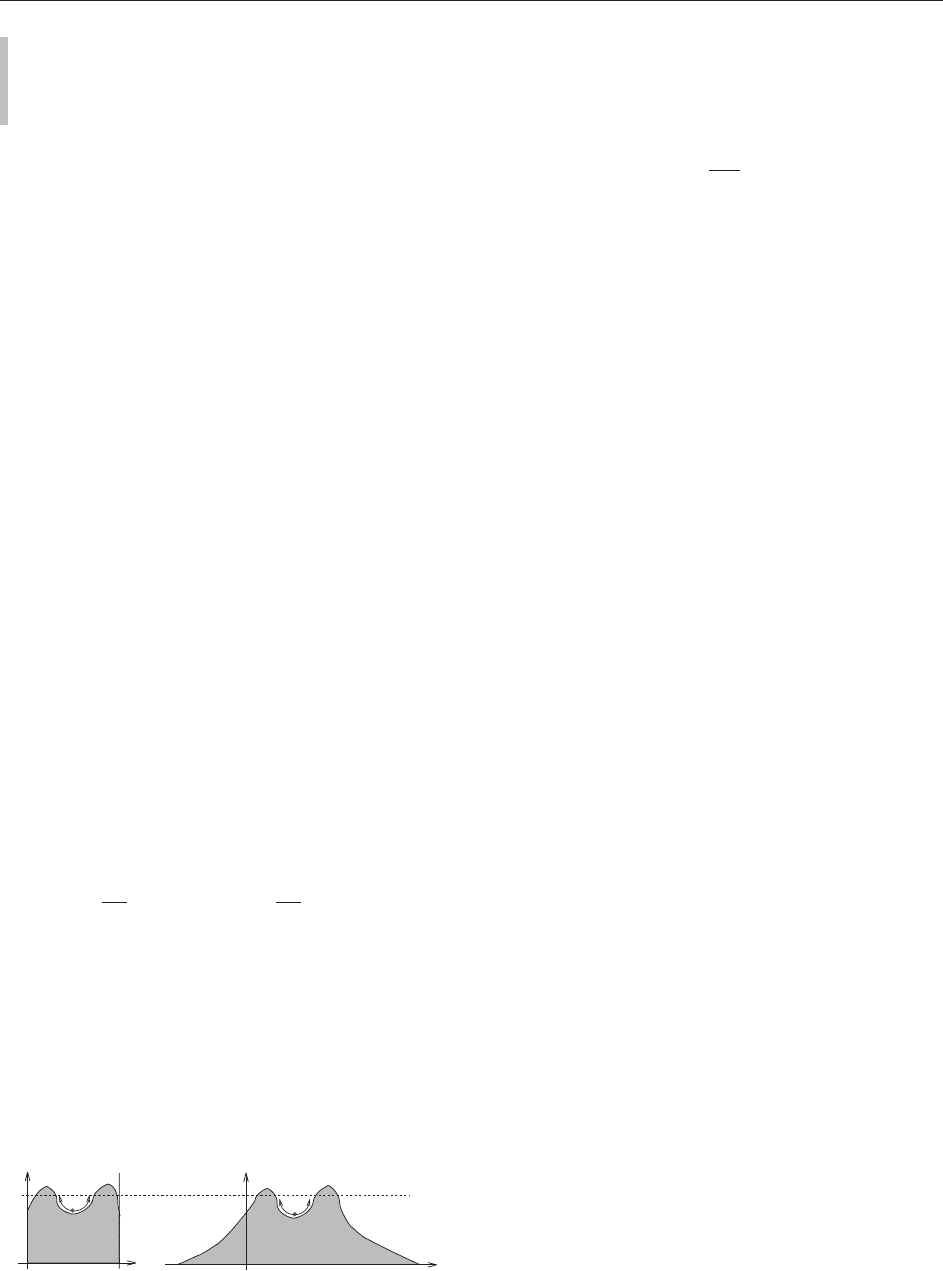
interval as shown in Figure 1a. If the classical
momentum is denoted by , then the classical
energy is given by
E ¼jj
2
þ V
1
ðxÞ
and the classical motion is given by the relations of
Hamiltonian mechanics:
_
x ¼
@E
@
¼ 2;
_
¼
@E
@x
¼V
0
ðxÞ
Since energy is conserved, if the initial energy is
smaller than the top of the barrier, then the classical
particle bounces forever in the well. Now we can
consider the same example with the potential V
2
(x)
on R as shown in Figure 1b. Of course, if the
particle is initially inside the well (with the same
energy as before), the classical motion remains the
same.
On the quantum mechanics point of view, both
systems are described by the Hamiltonians
H
i
¼h
2
d
2
dx
2
þ V
i
ðxÞ
acting on L
2
([1, 1]) (with boundary conditions) and
L
2
(R), respectively. In the first case, H
1
has a discrete
spectrum,
j, h
2 R with eigenfunctions e
j, h
(x), j 2 N,
and the time evolution of the system is given by
e
itH
1
u ¼
X
j
e
it
j;h
u
j;h
e
j;h
½1
where u
j, h
e
j, h
is the orthogonal projection of u on
the eigenspace Ce
j, h
. In the second case, H
2
has no
square integrable eigenfunction, and no simple
description as [1] can consequently hold. However
as h !0, the correspondence principle tells us that
quantum mechanics should get close to classical
mechanics. Since for both quantum problems the
classical limit is the same (at least for initial states
confined in the well with energy E ), we expect that
for the second potential there should exist a
quantum state corresponding to the classical one.
In fact, this is indeed the case and one can show that
there exist resonant states e
j, h
associated to reso-
nances E
j, h
which are solution of the equation
H
2
e
j;h
E
j;h
e
j;h
; E
j;h
E
are not square integrable, but still have moderate
growth at infinity and are confined in the interior of
the well (see sections ‘‘Definition’’ and ‘‘Location of
resonances’’). On the other hand, the first quantum
system is confined, whereas the second one is not and
we know that even for initial states confined in the
well, tunneling effect allows the quantum particle to
escape to infinity. This fact should be described by
the theory as a main difference between eigenvalues
and resonances. This is indeed the case as the
resonances E
j, h
are not real (contrarily to eigenvalues
of self-adjoint operators) but have a nonvanishing
imaginary part (see section ‘‘Resonance-free regions’’)
Im E
j;h
e
C=h
If we assume that a similar description as [1] still
holds for the second system, at least locally in space
(see section ‘‘Resonances and time asymptotics’’),
then, for time t >> e
C=h
, the factor e
itE
h
becomes
very small (the quantum particle has left the well
due to tunneling effect).
There have been several studies on resonances and
scattering theory and the presentation here cannot be
complete. For a more in-depth presentation, one can
(b)
π
00
E
(a)
π
Figure 1a, b A particle trapped in a well.
Resonances 415

consult the books by Lax and Phillips (1989) and
Hislop and Sigal (1987), or the reviews on resonances
by Vodev (2001) and Zworski (1994) for example.
Definition
There are different (equivalent) definitions of reso-
nances. The most elegant is certainly the Helffer and
Sjo¨ strand (1986) definition (see also the presentation
of complex scaling by Combes et al. (1984) and the
very general ‘‘black box’’ framework by Sjo¨strandand
Zworski (1991)). However, it requires a few prerequi-
sites and we preferred to stick to the more elementary
(but less general) resolvent point of view. The starting
point for this definition of resonances is the fact that
the eigenvalues of a (self-adjoint) operator P are the
points where P is not injective. The more general
resonances will be the points where the operator is not
invertible (on suitable spaces).
More precisely, consider a perturbation of the
Laplace operator on R
n
, P
0
(h) = h
2
in the following
sense: let R
d
be a (possibly empty) smooth obstacle
whose complementary, =
c
, is connected. Consider
a classical self-adjoint operator defined on L
2
():
P
h
u ¼ðh
2
þ VðxÞÞu ½2
with boundary conditions (Dirichlet)
u j
@
¼ 0 ½3
(Neumann boundary conditions could be used too).
This setting contains both the Schro¨ dinger operator
(P
h
= h
2
þ V(x) E on =R
n
) and the Helmoltz
equation with Dirichlet conditions, in the exterior of
an obstacle (waves at large frequencies: P =
2
;
in this case, define h =
1
and P
h
= h
2
), which we
shall define as acoustical scattering.
We assume that P is a perturbation of P
0
, that is,
V !0, jxj!þ1 sufficiently fast (see Sjo¨ strand and
Zworski (1991) for the very general black box
assumptions). For example, this perturbation
assumption is fulfilled if V has compact support.
Then the resolvent P
h
(z) = (P
h
z)
1
is well defined
for Im z 6¼ 0 as a bounded operator from L
2
()to
H
2
ðÞ\H
1
0
ðÞ
(because the operator P
h
is self-adjoint). However, it
is not bounded for z > 0onL
2
() because the
essential spectrum of P
h
is precisely the semiaxis z >
0, but it admits a meromorphic continuation from
Im z > 0 toward the lower half-plane:
R
h
ðzÞ : L
2
ðÞ
comp
! L
2
ðÞ
loc
The poles of this resolvent R
h
are by definition the
semiclassical resonances, Res
sc
(P
h
).
Remark 1 In the case of acoustical scattering
(P =
2
, = h
1
), the introduction of the addi-
tional parameter z is pointless and one works
directly with the parameter = h
1
ffiffiffi
z
p
. In that case
the resolvent R()(
2
)
1
is well defined for
Im <0, the essential spectrum is precisely the axis
2 R and the resolvent admits a meromorphic
continuation from Im z < 0 toward the upper half-
plane (with possibly a cut at 0):
RðÞ : L
2
ðÞ
comp
! L
2
ðÞ
loc
The acoustic resonances are by definition the poles
of this meromorphic continuation. They are related
to semiclassical resonances by the relation
Res
sc
¼ h
ffiffiffiffiffiffiffiffiffiffiffi
Res
ac
p
It can also be shown that if z is a resonance, there
exists an associated resonant state e
z
such that
ðP
h
zÞe
z
¼ 0
the function e
z
satisfies Sommerfeld radiation con-
ditions (in polar coordinates (r, ) 2 [0, þ1) S
n1
)
jh@
r
e i
ffiffiffi
z
p
ejCje
i
ffiffi
z
p
r
j=r
1þn=2
and the function
e
z
1 þ r
ð1=2Þþ
e
i
ffiffi
z
p
r
is square integrable.
Resonance-Free Regions
The very first result about resonance-free regions is
based on Rellich uniqueness theorem (uniqueness for
solutions of elliptic second-order equations) and says
that there are no real resonances (except possibly 0).
The more precise determination of resonance-free
regions (originally in acoustical scattering) has been a
subject of study from the 1960s and it has motivated a
large range of works from the multiplier methods of
Morawetz (1975) to the general propagation of
singularity theorem of Melrose and Sjo¨strand (1978).
To state the main result in this direction, we need the
notion of nontrapping perturbation.
Definition 1 A generalized bicharacteristic at energy
E(x(s), (s)) is an integral curve of the Hamiltonian field
H
p
¼
@p
@
@
@x
@p
@x
@
@
of the principal symbol p(x, ) = jj
2
þV(x) of the
operator P, included in the characteristic set
p(x, ) = E and which, when hitting the boundary of
the obstacle, reflects according to the laws of
geometric optics (see (Melrose and Sjo¨ strand 1978)).
416 Resonances

The operator P (or by extension the obstacle in the
case of acoustic scattering) is said to be nontrapping
at energy E if all generalized bicharacteristics go to
the infinity:
lim
s!1
jxðsÞj ¼ þ1
The operator P (or by extension the obstacle in the
case of acoustic scattering) is said to be nontrapping
near energy E if P is nontrapping at energy E
0
for E
0
in a neighborhood of E.
The following result was obtained in different
generalities by Morawetz (1975), Melrose and
Sjo¨ strand (1978), and others.
Theorem 1 Assume that the operator P is nontrap-
ping near energy E. Then for any N > 0 there exist
h
0
> 0 such that for 0 < h < h
0
there are no
resonances in the set
fz; jIm zjNh logðhÞg
In the case of analytic geometries (and coefficients),
this result (see Bardos et al. 1987) can be improved to
Theorem 2 Assume that the operator P is non
trapping. Then there exist >0, N
0
> 0 and h
0
> 0
such that for 0 < h < h
0
there are no resonances in
the set
fz; jIm zjN
0
h
1ð1=3Þ
g\fjz Ejg
Remark 2 In the case of acoustical scattering, with
the new definition of resonances, = h
1
ffiffiffi
z
p
, the
resonance-free zones have respectively the forms
fz; jIm zjN logðjzjÞ; jzj >> 1g
fz; jIm zjN
0
jzj
1=3
; jzj >> 1g
In the case of trapping perturbations, the first result
was obtained by Burq (1998).
Theorem 3 There exist C > 0 and h
0
> 0 such that
for 0 < h < h
0
there are no resonances in the set
fz; jIm zjN
0
e
C=h
g\fjz Ejg
Resonances and Time Asymptotics
The relationship between eigenfunctions/eigen-
values and time asymptotics is straightforward.
This is no longer the case for resonances. For
nontrapping problems however, this question has
been studied in the late 1960s by Lax and Phillips
(1989) and Vainberg (1968). In particular, this
approach was decisive to study the local energy
decay in acoustical scattering. As a consequence of
Theorem 1,wehave
Theorem 4 If the acoustical problem is nontrap-
ping, then there exist C, >0 such that for any
solution of the wave equation
&u ¼0; uj
t¼0
¼u
0
;@
t
uj
t¼0
¼u
1
; uj
D
¼0;
@u
@
n
j
N
¼0
with compactly supported initial data (u
0
,u
1
)(in a
fixed compact), one has
E
loc
ðuÞ
¼
Z
\fjxjC
jruj
2
þj@
t
uj
2
Ce
t
if the space dimension is even
C
t
d
if the space dimension is odd
8
<
:
½4
Trapping perturbations were investigated more
recently. In that case, the local energy decays, but the
rate cannot be uniform. The first trapping example in
acoustic scattering was studied by Ikawa (1983):the
obstacle is the union of a finite number (and at least
two) convex bodies. In that case, one has
Theorem 5 For any >0 there exists C > 0 such
that for any initial data supported in a fixed
compact set
E
loc
ðuÞðt ÞC e
t
kðu
0
; u
1
Þk
2
Dðð1Þ
ð1þÞ=2
Þ
where D((1 )
(1þ)=2
) is the domain of the
operator (1 )
(1þ)=2
. Remark that the norm in
D((1 )
1=2
) is the natural energy and consequently
the estimate above exhibits a loss of derivatives.
For strongly trapping perturbations, the results are
worse. They are consequences of Theorem 3.
Theorem 6 For any k there exists C
k
> 0 such that
for any initial data supported in a fixed compact set
E
loc
ðuÞðt Þ
C
k
logðtÞ
2k
kðu
0
; u
1
Þk
2
Dðð1Þ
ð1þkÞ=2
Þ
One can also obtain real asymptotic expansions in
terms of resonances (see the work by Tang and
Zworski (2000)).
Theorem 7 Let 2 C
1
c
(R
n
) and 2 C
1
c
((0, 1))
and let chsupp = [a, b]. There exists 0 <<
c(h) < 2 such that for every M > M
0
there exists
L = L(M), and we have
e
itðPÞ=h
ðPÞ¼
X
z2ðhÞ\ResðPÞ
Resðe
itðÞ=h
Rð; hÞ; zÞ ðPÞ
þO
H!H
ðh
1
Þ; for t > h
L
ðhÞ¼ða cðhÞ; b þcðhÞÞi½0; h
M
Þ
½5
Resonances 417

where Res(f ( ), z) denotes the residue of a mer-
omorphic family of operators, f, at z.
The function c(h) depends on the distribution of
resonances: roughly speaking we cannot ‘‘cut’’
through a dense cloud of resonances. Even in the
very well understood case of the modular surface
there is, currently at least, a need for some
nonexplicit grouping of terms. The same ideas can
be applied to acoustic scattering.
Trace Formulas
Trace formulas provide a description of the classical/
quantum correspondence: one side is given by the trace
of a certain function of the operator f (P
h
), whereas the
other side is described in terms of classical objects
(closed orbits of the classical flow). In the case of
discrete eigenvalues, the question is relatively simple
and can be solved by using the spectral theorem. In the
case of continuous spectrum, the problem is much more
subtle (self-adjoint operators with continuous spectrum
behave in some ways as non-normal operators). It has
been studied by Lax and Phillips (1989), Bardos et al.
(1982),andMelrose (1982). More recently, Sjo¨strand
(1997) introduced a local notion of trace formulas.
Let W be an open precompact subsets of
e
i[2
0
,0]
]0, þ1[. Assume that the intersections I
and J of W and with the real axis are intervals and
that is simply connected.
Theorem 8 Let f (z, h) be a family of holomorphic
functions on z 2 such that jfj
nW
j1. Let 2
C
1
0
(R) equal to 1 on a neighborhood of I. Then
Trace fðÞP
h
ðÞfðÞh
2
¼
X
a resonance of P
h
\
f ; hðÞþOh
n
ðÞ
The use of this result with a clever choice of functions f
allows Sjo¨ strand to show that an analytic singularity of
the function E 7!Vol({x; V(x) E}) (observe that if V
is bounded, this function vanishes for large E and
consequently it has analytic singularities) gives a lower
bound for a neighborhood of E
]ResðP
h
Þ\ ch
n
which coincides with the upper bound (see Zworski
(2002) and the references given there).
Location of Resonances
In some particular cases, one can expect to have a
precise description of the location of resonances.
This is the case in Ikawa’s example in acoustic
scattering where the obstacle is the union of two
disjoint convex bodies. In this case, the line
minimizing the distance, d, between the bodies is
trapped. However, this trapped trajectory is isolated
and of hyperbolic type (unstable). Ikawa (1983) and
Ge´rard (1988) have obtained:
Theorem 9 There exist geometric positive constants
k
p
!þ1 as p !þ1 such that all resonances
located above the line Im z C (C arbitrary large
but fixed) have an asymptotic expansion
j;p
þ
X
l
a
l;p
l=2
j;p
þOð
1
j;p
Þ; j !þ1
where the approximate resonanc es
j;p
¼ j
d
ik
p
are located on horizontal lines.
Another example is when the obstacle is convex.
This example is nontrapping and Sjo¨ strand and
Zworski (1999) are able to prove that the resonances
in any region Im z Njzj
1=3
(N arbitrary large) are
asymptotically distributed near cubic curves
C
j
¼fz 2 C; Im z ¼c
j
jzj
1=3
g
Finally, the last main example where one can give a
precise asymptotic for resonances is when there
exists a stable (elliptic) periodic trajectory for the
Hamiltonian flow. In that case it had been known
from the 1960s (see the works by Babic
ˇ
(1968)) that
one can construct quasimodes, that is, compactly
supported approximate solutions of the eigenfunc-
tions equation:
ðP
h
E
h
Þe
j
¼Oðh
1
Þ
It is only recently that Tang and Zworski (1998) and
Stefanov (1999) proved that these quasimodes
constructions imply the existence of resonances
asymptotic to E
h
, h !0.
See also: h-Pseudodifferential Operators and
Applications; Semi-Classical Spectra and Closed Orbits.
Further Reading
Babic
ˇ
VM (1968) Eigenfunctions which are concentrated in the
neighborhood of a closed geodesic. Zapiski Nauchnykh
Seminanov Leningradkogo Otdeleniya Matematicheskogo
Instituta Imeni V.A. Steklova 9: 15–63.
Bardos C, Guillot JC, and Ralston J (1982) La relation de Poisson
pour l’e´quation des ondes dans un ouvert non borne´.
Application a` la the´orie de la diffusion. Communications in
Partial Differential Equations 7: 905–958.
Bardos C, Lebeau G, and Rauch J (1987) Scattering frequencies and
Gevrey 3 singularities. Inventiones Mathematicae 90: 77–114.
Burq N (1998) De´croissance de l’e´nergie locale de l’e´quation des
ondes pour le proble` me exte´rieur et absence de re´sonance au
voisinage du re´el. Acta Mathematica 180: 1–29.
418 Resonances

Combes J-M, Duclos P, and Seiler R (1984) On the shape
resonance. In: Resonances – Models and Phenomena (Biele-
feld, 1984), Lecture Notes in Physics, vol. 211, pp. 64–77.
Berlin: Springer.
Ge´rard C (1988) Asymptotique des poˆ les de la matrice de scattering
pour deux obstacles strictement convexes. Supple´ment au
Bulletin de la Socie´te´ Mathe´matique de France 116: 146 pp.
Helffer B and Sjo¨ strand J (1986) Resonances en limite semi-
classique. Me´moire de la S.M.F 114(24–25): 228 pp.
Hislop PD and Sigal IM (1987) Shape resonances in quantum
mechanics. In: Differential Equations and Mathematical
Physics (Birmingham, Ala., 1986), Lecture Notes in Mathe-
matics, vol. 1285, pp. 180–196. Berlin: Springer.
Ikawa M (1983) On the poles of the scattering matrix for two
convex obstacles. Journal of Mathematics of the Kyoto
University 23: 127–194.
Lax PD and Phillips RS (1989) Scattering Theory, Pure and Applied
Mathematics, 2nd edn., vol. 26. Boston: Academic Press.
Melrose RB (1982) Scattering theory and the trace of the wave
group. Journal of Functional Analysis 45: 429–440.
Melrose RB and Sjo¨ strand J (1978) Singularities of boundary
value problems. I. Communications in Pure and Applied
Mathematics 31: 593–617.
Melrose RB and Sjo¨ strand J (1982) Singularities of boundary
value problems. II. Communications in Pure and Applied
Mathematics 35: 129–168.
Morawetz CS (1975) Decay for solutions of the exterior problem
for the wave equation. Communication in Pure Applied
Mathematics 28: 229–264.
Sjo¨ strand J (1997) A trace formula and review of some estimates
for resonances. In: Rodino L (ed.) Microlocal Analysis and
Spectral Theory (Lucca, 1996), NATO Adv. Sci. Inst. Ser. C
Math. Phys. Sci., vol. 490, pp. 377–437. Dordrecht: Kluwer
Academic.
Sjo¨ strand J and Zworski M (1991) Complex scaling and the
distribution of scattering poles. Journal of the American
Mathematical Society 4(4): 729–769.
Sjo¨ strand J and Zworski M (1999) Asymptotic distribution of
resonances for convex obstacles. Acta Mathematica 183(2):
191–253.
Stefanov P (1999) Quasimodes and resonances: sharp lower
bounds. Duke Mathematical Journal 99(1): 75–92.
Tang S-H and Zworski M (1998) From quasimodes to reason-
ances. Mathematical Research Letters 5(3): 261–272.
Tang SH and Zworski M (2000) Resonance expansions of
scattered waves. Communication in Pure and Applied Mathe-
matics 53(10): 1305–1334.
Vainberg BR (1968) On the analytical properties of the resolvent
for a certain class of operator pencils. Mathematics of the
USSR Sbornik 6(2): 241–273.
Vodev G (2001) Resonances in euclidean scattering. Cubo Mate-
matica Educacional 3: 317–360. http://www.math.sciences.
univ-nantes.fr.
Zworski M (1994) Counting scattering poles. In: Ikawa M (ed.)
Spectral and Scattering Theory (Sanda, 1992), Lecture Notes
in Pure and Applied Mathematics, vol. 161, pp. 301–331.
New York: Dekker.
Zworski M (2002) Quantum resonances and partial differential
equations. In: Li Ta Tsien (ed.) Proceedings of the Interna-
tional Congress of Mathematicians (Beijing, 2002), vol. III,
pp. 243–252. Beijing: Higher Education Press.
Ricci Flow see Singularities of the Ricci Flow
Riemann Surfaces
K Hulek, Universita
¨
t Hannover, Hannover, Germany
ª 2006 Elsevier Ltd. All rights reserved.
Introduction
Riemann surfaces were first studied as the natural
domain of definition of (multivalued) holomorphic
or meromorphic functions. They were the starting
point for the development of the theory of
real and complex manifolds (see Weyl (1997)).
Nowadays, Riemann surfaces are simply defined
as one-dimensional complex manifolds (see the
next section). Compact Riemann surfaces can
be embedded into projective spaces and are thus,
by virtue of Chow’s theorem, algebraic curves. By
uniformization theory, the universal cover of
a connected Riemann surface is either the unit
disk, the complex plane, or the Riemann sphere
(see the section ‘‘Uniformization’’).
This article discusses the basic theory of compact
Riemann surfaces, such as their topology, their
periods, and the definition of the Jacobian variety.
Studying the zeros and poles of meromorphic
functions leads to the notion of divisors and linear
systems. In modern language this can be rephrased
in terms of line bundles, resp. locally free sheaves
(see the section ‘‘Divisors, linear systems, and line
bundles’’). One of the fundamental results is the
Riemann–Roch theorem which expresses the
difference between the dimension of a linear system
and that of its adjoint system in terms of the degree
of the linear system and the genus of the curve. This
theorem has been vastly generalized and is truly one
of the cornerstones of algebraic geometry.
A formulation of this result and a discussion of
some of its applications are also discussed.
Riemann Surfaces 419
A study of the subsets of the Jacob ians parame-
trizing linear systems of given degree and dimension
leads to Brill–Noether theory, which is discussed in
the section ‘‘Brill–N oether theory .’’ This is follow ed
by a brief introduction to the theory of equations
and syzygies of canonical curves .
Moduli spaces play a central role in the theory
of com plex variables and in algebraic geometry.
Arguably, the most important of these is the
moduli space of curves of genus g. This and
related moduli problems are treated in the section
‘‘Moduli of compact Riemann s urfaces.’’ I n parti-
cular, the space of stable maps is closely related to
quantum cohomology. Finally, we present a brief
discussion of the Verlinde formula and conformal
blocks.
Basic Definitions
Riemann surfaces are one-dimensional complex
manifolds. An n-dimensional c omplex manifold
M is a topological Hausdorff space (i.e., for any
two points x 6¼ y on M, there are disjoint open
neighborhoods containing x and y), which h as a
countable basis for its t opology, together with a
complex atlas A. The latter is an open covering
(U
)
2A
together with homeomorphisms f
: U
!
V
C
n
,wheretheU
are open subsets of M and
the V
are open sets in C
n
. The main requirement
is that these charts are holomorphically compati-
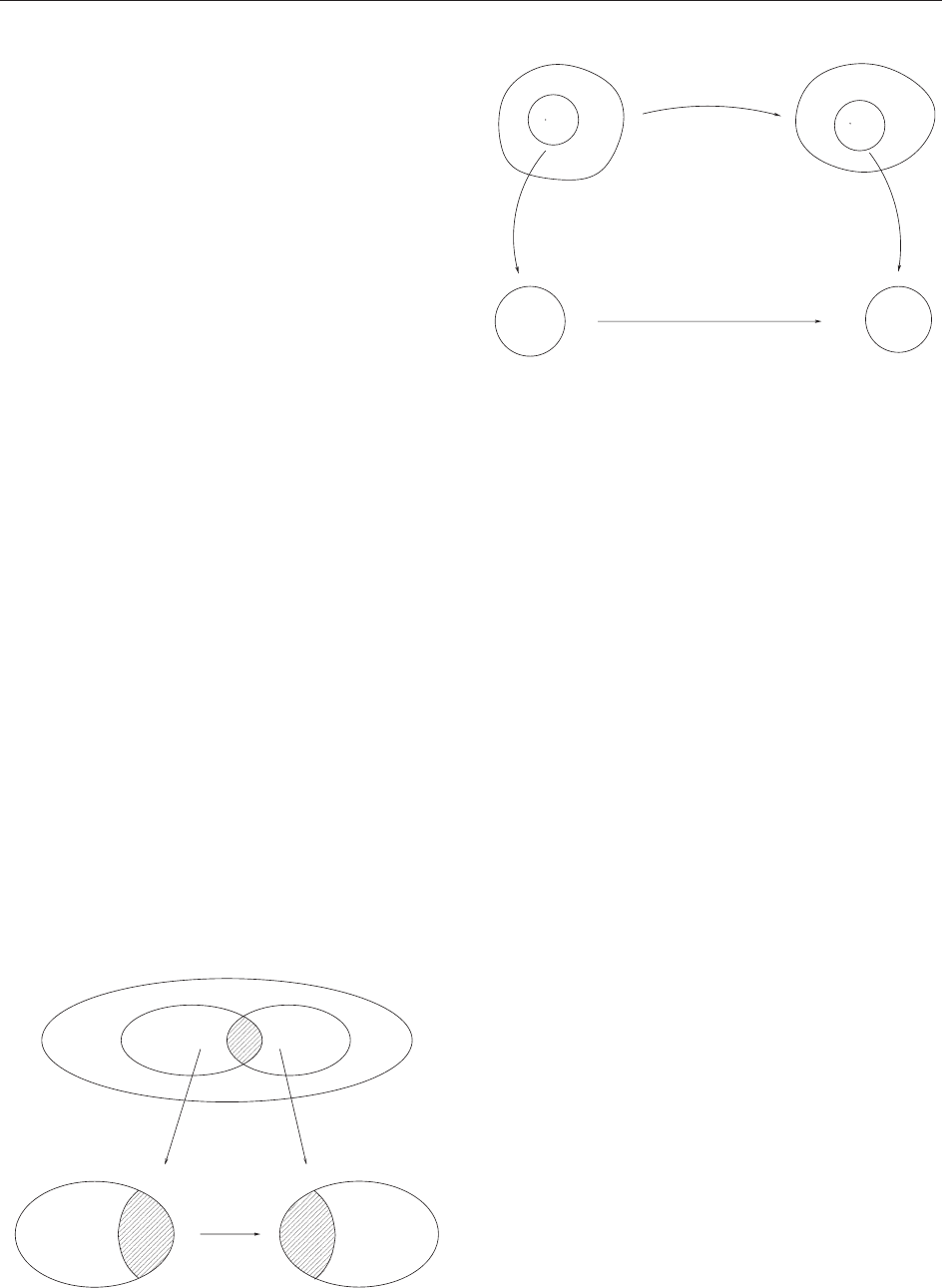
ble, that is, for U
\ U
6¼;, the map shown in
Figure 1,
f
f
1
j
f
ðU
\U
Þ
: f
ðU
\ U
Þ!f
ðU
\ U
ÞC
n
is biholomorphic. A map h : M ! N between two
complex manifolds is holomorphic if it is so with
respect to the local charts. This means the following:
for each point x 2 M, there are charts
f
M
: U
M
!V
M
C
n
near x and f
N
: U
N
! V
N
C
m
near h(x) with h(U
M
) U
N
such that the map
shown in Figure 2
f
N
h ðf
M
Þ
1
: V
M
! V
N
C
m
is holomorphic (one checks easily that this does not
depend on the choice of the charts).
A Riemann surface i s a one-dimensional com-
plex manifold. Trivial examples are given by open
sets in C (where one chart suffices). Another
example is the Riemann sphere
^
C = C [ {1},
which can be covered by the two charts given by
z 6¼1and z 6¼ 0. Both of these charts are home-
omorphic to C with the transition function given
by z 7!1=z. Historically, Riemann surfaces were
viewed as (branched) coverings of C or of the
sphere, where they appear as the natural domain
of definition of multivalued holomorphic or
meromorphic functions.
Uniformization
If M is a Riemann surface, then its universal
covering
~
M is again a Riemann surface. The
connected and simply connected Riemann surfaces
can be fully classified. Let
E ¼fz 2 C; jzj < 1g
be the unit disk and
^
C = C [ {1} the Riemann
sphere. The latter can be identified with the complex
projective line P
1
C
.
Theorem 1 (Generalized Riemann mapping
theorem). Every connected and simply connected
Riemann surface is biholomorphically equivalent
U
α
U
β
f
α
f
β
V
α
⊂
C
n
V
β
⊂
C
n
M
f
β
°
f
α
–1
Figure 1 Charts of a complex manifold.
x
h(x)
MN
h
U
α
M
U
β
N
f
β
N
f
β °
h
°
(f
α
)
–1
N
M
f
α
M
V
β
⊂ C
n
N
V
α
⊂ C
m
M
Figure 2 Holomorphic map between manifolds.
420 Riemann Surfaces
to the unit disk E, the complex plane C, or the
Riemann sphere
^
C.
This theore m was proved rigor ously by Koebe
and Poincare´ at the beginning of the twentieth
century.
Compact Riemann Surfaces
The topological structure of a compact Riemann
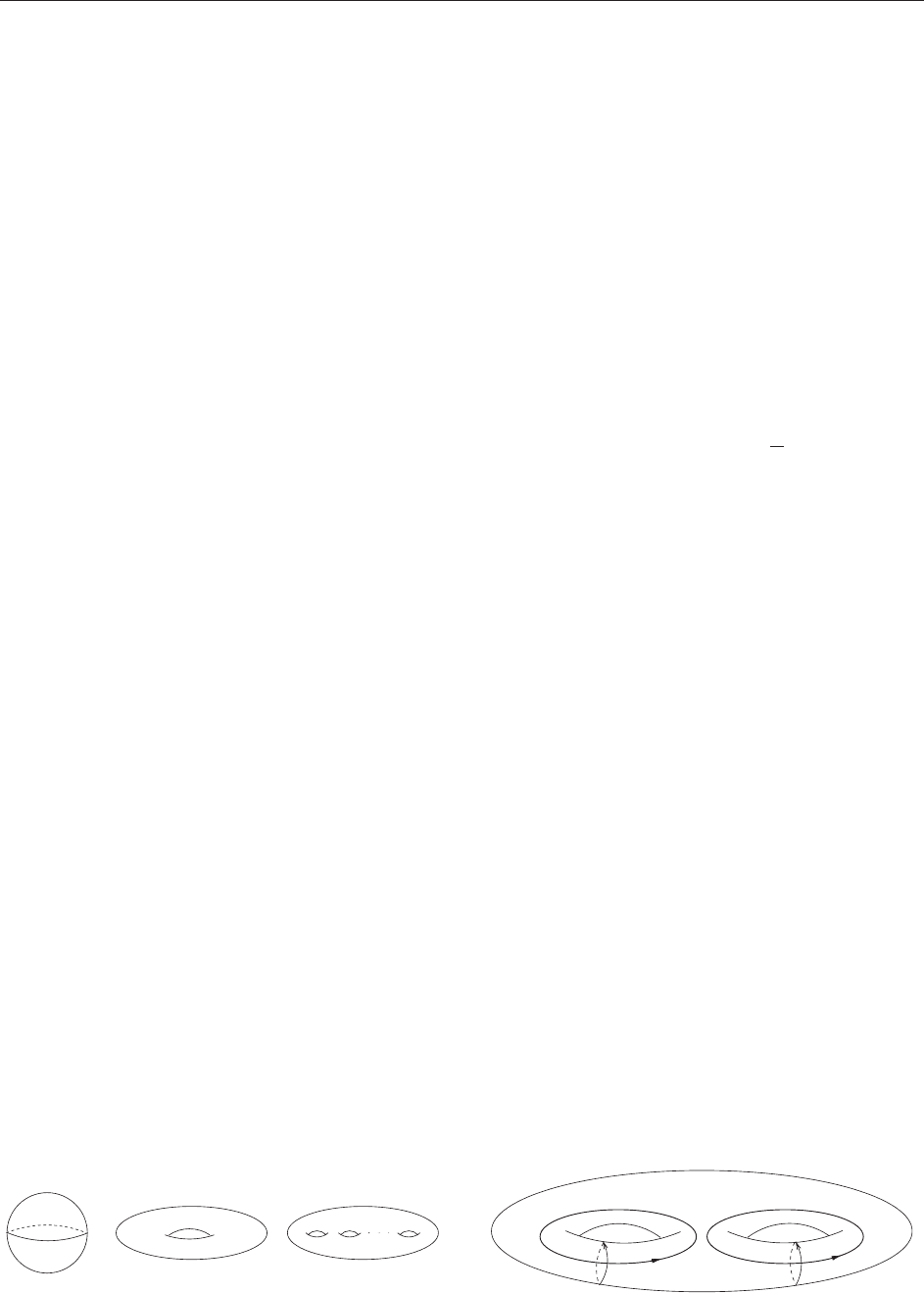
surface C is determined by its genus g (Figure 3).
Topologically, a Riemann surface of genus g is a
sphere with g handles or, equivalently, a torus with
g holes.
Analytically, the genus can be characterized as the
maximal number of linearly independent holo-
morphi c form s on C (see also the section ‘‘The
Riem ann–Roc h theore m an d ap plications’’).
There exists a very close link with algebraic
geometry: every compact Riemann surface C can
be embedded into some projective space P
n
C
(in
fact already into P
3
C
). By Chow’s theorem, C is
then a (projective) a lgebraic variety, that is, it can
be described by finitely many homogeneous equa-
tions. It should be noted that such a phenomenon
is special to complex dimension 1. The crucial
point is that one can always construct a non-
constant meromorphic function on a Riemann
surface ( e.g., by Dirichlet’s principle). Given such
a function, it is not difficult to find a projective
embedding of a compact Riemann surface C.On
the other hand, it is easy to construct a compact
two-dimensional torus T = C
2
=L for some suitably
chosen lattice L, which cannot be embedded into
any projective space P
n
C
.
The dichotomy Riemann surface/algebraic curve
arises from different points of view: analysts think
of a real two-dimensional surface with a Rieman-
nian metric which, via isothermal coordinates,
defines a holomorphic structure, whereas algebraic
geometers think of a complex one-dimensional
object.
In this article, the expressions compact Riemann
surface and (projective) algebraic curve are both
used interchangeably. The choice depends on
which expression is more commonly used in the
part of the theory w hich is discussed in the
relevant section.
Periods and the Jacobian
On a compact Riem ann surface C of genus g, there
exist 2g homologically indepe ndent paths, that is,
H
1
(C, Z) ffi Z
2g
.
Let
1
, ...,
2g
be a basis of H
1
(C, Z)and
let !
1
, ..., !
g
be a basis of the space of holom orphic
1-forms on C. Integrating these forms over the paths
1
, ...,
2g
defines the period matrix
¼
R
1
!
1
R
2g
!
1
.
.
.
.
.
.
R
1
!
g
R
2g
!
g
0
B
B
@
1
C
C
A
If Q = (
i
,
j
) is the intersection matrix of the paths
1
, ...,
2g
, then satisfies the Riemann bilinear
relations
Q
t
¼ 0;
ffiffiffiffiffiffiffi
1
p
Q
t
> 0 ½1
where the latter condition means positive definite.
One can choose (see Figure 4)
1
, ...,
2g
such that
Q ¼ J ¼
0 1
g
1
g
0
where 1
g
is the g g unit matrix. Moreover,
!
1
, ..., !
g
can be chosen such that
¼
1 0
11
1g
.
.
.
.
.
.
.
.
.
.
.
.
.
.
.
0 1
g1
gg
0
B
@
1
C
A
Let
0
¼ð
ij
Þ
1i; jg
Then the Riemann bilinear relations [1] become
0
¼
t
0
; Im
t
0
> 0
that is,
0
is an element of the Sieg el upper half-
space
H
g
¼ 2 Matðg g; CÞ; ¼
t
; Im >0
fg
The matrix
0
is defined by the Riemann surface C
only up to the action of the symplectic group
Spð2g; Z Þ¼ M 2 Matð2g 2g; ZÞ; MJM
t
¼ J
fg
g = 0 g = 1 genus g
Figure 3 Genus of Riemann surfaces.
γ
4
γ
3
γ
2
γ
1
Figure 4 Homology of a compact Riemann surface.
Riemann Surfaces 421