
Francoise J.-P., Naber G.L., Tsun T.S. (editors) Encyclopedia of Mathematical Physics
Подождите немного. Документ загружается.

Bicrossproduct Hopf Algebras and Noncommutative Spacetime
S Majid, Queen Mary, University of London,
London, UK
ª 2006 Elsevier Ltd. All rights reserved.
Introduction
One of the sources of quantum groups is a
bicrossproduct construction coming in the case of
Lie groups from considerat ions of Planck-scale
physics in the 1980s. This article describes these
objects and their currently known applications. See
also the overview of Hopf algebras which provides
the algebraic context (see Hopf Algebras and
q-Deformation Quantum Groups).
The construction of quantum groups here is
viewed as a microcosm of the proble m of quantiza-
tion in a manner compatible with geometry. Here
quantization enters in the noncommutativity of the
algebra of observables and ‘‘curvature’’ enters as a
quantum nonabelian group structure on phase
space. Among the main featu res of the resulting
bicrossproduct models (Majid 1988) are
1. Compatibility takes the form of nonlinear ‘‘matched
pair equations’’ generically leading to singular
accumulation regions (event horizons or a max-
imum value of momentum depending on context).
2. The equations are solved in an ‘‘equal and
opposite’’ form from local factorization of a
larger object.
3. Different classical limits are related by observer–
observed symmetry and Hopf algebra duality.
4. Nonabelian Born reciprocity re-emerges and is
linked to T-duality.
It has also been argued that noncommutative
geometry should emerge as an effective theory of the
first corrections to geometry coming from any
unknown theory of quantum gravity. Concrete
models of noncommutative spacetime currently
provide the first framework for the experimental
verification of such effect s. The most basic of these
possible effects is curvature in momentum space or
‘‘cogravity.’’ We start with this.
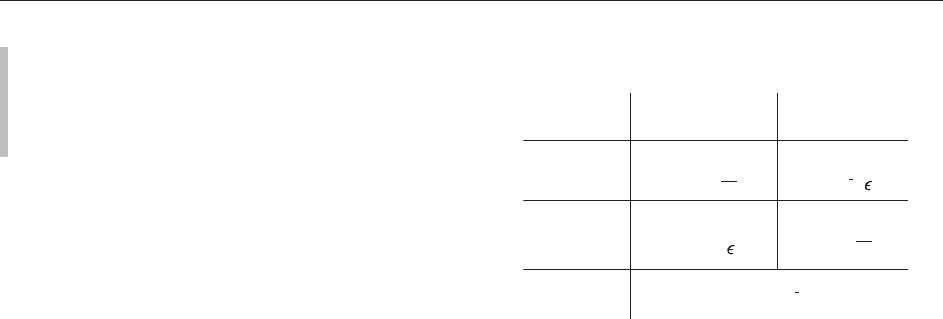
Cogravity
We recall that curvature in space or spacetime
means by definition noncommutativity among the
covariant derivatives D
i
. Here the natural momenta
are p
i
= ihD
i
and the situation is typified by the
top line in Figure 1. There are also mixed relations
between the D
i
and position functions as indicated
for flat space in the bottom line, which is quantum
mechanics (there is a similar story for quantum
mechanics on a curved space). We see however a
third and dual possib ility – noncommutativity in
position space which should be interpreted as
curvature in momentum space, that is, the dual of
gravity. This is an independent physical effect and
comes therefore with its own length scal e which we
denote . These ideas were made precise in the mid
1990s using the quantum group Fourier transform;
see Majid (2000). Here we show what is involved on
three illustrative examples.
1. We consider the ‘‘spin space’’ algebra
R
3
: ½x
i
; x
j
¼i2
ij
k
x
k
where
12
3
= 1 and where it is convenient to insert a
factor 2. This is the enveloping algebra U(su
2
), that
is, just angular momentum space but now regarded
‘‘upside down’’ as a coordinate algebra (see Hopf
Algebras and q-Deformation Quantum Groups).
Then a plane wave is of the form
p
¼ e
ipx
; p 2 R
3
where we set h = 1 for this discussion. The momenta
p
i
are nothing but local coordinates for the
corresponding point e
i p
2 SU
2
where is the
representation by Pauli matrices. It is really elements
of this curved space SU
2
where momenta live. Here
R
3
= U(su
2
) has dual C[SU
2
] and Hopf algebra
Fourier trans form (after suitable completion) takes
one between these spaces. Thus, in one direction
Fðf Þ¼
Z
SU
2
duf ðuÞu
Z
d
3
pJðpÞf ðpÞe
ipx
for f a function on SU
2
. We use the Haar measure on
SU
2
. The local result on the right has J the Jacobian
for the change to the local p coordinates and f is
written in terms of these. Note that the coproduct in
Gravity
Position Momentum
Curved Noncommutative
Noncommutative
[p
i
, p
j
]
=
ihγ
x
Σ
Cogravity
Quantum
mechanics
μμ
2
2
=
1
γ
Curved
P
Σ
μμ
2
2
=
λ
ijk
p
k
[x
i
, p
j
]
=
ihδ
ij
[x
i
, x
j
]
=
2iλ
ijk
x
k
1
Figure 1 Noncommutative spacetime means curvature in
momentum space. The equations are for illustration.
Bicrossproduct Hopf Algebras and Noncommutative Spacetime 265

C[SU
2
] in terms of the p
i
generators is an infinite
series given by the Campbell–Baker–Hausdorff series,
and not the usual linear one (this is why the measure
is not the Lebesgue one). The physical content here is
in the plane waves themselves, one can use any other
momentum coordinates to parametrize them with the
corresponding measure and coproduct. Differential
operators on R
3
are given by the action of elements of
C[SU
2
] and are diagonal on these plane waves,
f :
p
¼ f ðpÞ
p
which corresponds under Fourier transform simply
to pointwise multiplication in C[SU
2
]. For example,
the function
2
(tr 2) as a function on SU
2
will
give a rotationally invariant wave operator which is
also invariant under inversion in the group. Its value
on plane waves is
1
2
trðe
ip
1Þ¼
2
2
ðcosðjpjÞ 1Þ
In the limit !0 this gives the usual wave operator
on R
3
.
It is also possible to put a differential graded
algebra (DGA) structure of differential forms on this
algebra, the natural one being
dx
i
¼
i
; x
i
x
i
¼ i
2
dx
i
ðdx
i
Þx
j
x
j
dx
i
¼ i
ij
k
dx
k
þ i
ij
where is the 2 2 identity matrix which, together
with the Pauli matrices
i
, completes the basis of
left-invariant 1-forms. The 1-form provides a
natural time direction, even though there is no time
coordinate, and the new parameter 6¼ 0 appears as
the freedom to change its normalization. The partial
derivatives @
i
are defined by
d ðxÞ¼ð@
i
Þdx
i
þð@
0
Þ
and act diagonally on plane waves as
@
i
¼
i
2
trð
i
ðÞÞ¼i
p
i
jpj
sinðjpjÞ
while @
0
= i(tr 2)=2
2
is computed as above.
Note that cannot be taken to be zero due to an
anomaly for trans lation invariance of the DGA. It is
in fact a typical feature of noncommutative differ-
ential geometry that there is a 1-form generating d
by commutator which can be required as an extra
cotangent dire ction with its associated partial
derivative an induced Hamiltonian. In the present
model we have
@
0
¼ i
2
X
i
ð@
i
Þ
2
þ Oð
2
Þ
which is of the form of Schro¨ dinger’s equation with
respect to an auxiliary time variable and for a
particle with mass 1=.
The reader may ask what happens to the
Euclidean group of translations and rotations in
this context. From the above we find that
U
(poinc
3
) = C[SU
2
] U(su
2
), the semidirect pro-
duct generated by translations @
i
and usual rota-
tions. This in turn is the quantum double D(U(su
2
))
of the classical enveloping alge bra, and as such a
quantum group with braiding etc. (see Hopf
Algebras and q-Deformation Quantum Groups).
This quantum double has been identified as part
of an effective theory in 2 þ 1 quantum gravity in a
Euclidean version based on Chern–Simons theory
with Lie algebra poinc
3
and the spin space algebra
proposed as an effective theory for this. The
quotient of R
3
by an allowed value of the quadratic
Casimir x
2
(which then makes it a matrix algebra)
is called a ‘‘fuzzy sphere’’ and appears as a ‘‘world-
volume algebra’’ in certain string theories and
reduced matrix models. The noncommutative dif-
ferential geometry that we have described is due to
Batista and the author.
2. We take the same type of construction to
obtain the ‘‘bicrossproduct model’’ spacet ime
algebra
R
1;3
: ½t; x
i
¼ix
i
; ½x
i
; x
j
¼0
These are the relations of a Lie algebra b
þ
(say) but
again regarded as coordinates on a noncommutative
spacetime. Here is a timescale which can be
written as a mass scale = 1= instead. We
parametrize the plane waves as
p;p
0
¼ e
ipx
e
ip
0
t
;
p;p
0
p
0
;p
00
¼
pþe
p
0
p
0
;p
0
þp
00
which identifies the p
as the coordinates of the
nonabelian group B
þ
= R
R
3
with Lie algebra
b
þ
. The group law in these coordinates is read off
as usual from the product of plane waves, which
also gives the coproduct of C[B
þ
]onthep
.We
have parametrized plane waves in this way
(rather than the canonical way by the Lie algebra
as before) in order to have a more m anage-
able form for this. We do pay a price that in these
coordinates group inversion is not simply p
,
but
ðp; p
0
Þ
1
¼ðe
p
0
p; p
0
Þ
which is also the action of the antipode S on the
abstract p
generators.
In particular, the right-invariant Haar measure on
B
þ
in these coordinates is the usual d
4
p so the
266 Bicrossproduct Hopf Algebras and Noncommutative Spacetime

quantum group Fourier transform reduces to the
usual one but normal ordered,
FðfÞ¼
Z
R
4
d
4
pfðpÞe
ipx
e
ip
0
t
(one can also Fourier transform with respect to the left-
invariant measure d
4
p e
3p
0
on B
þ
). The inverse is again
given in terms of the usual inverse transform if we
specify general fields in R
1, 3
by normal ordering of
usual functions, which we shall do. As before, the action
of elements of C[B
þ
] defines differential operators on
R
1, 3
and these act diagonally on plane waves.
We also have a natural DGA with
ðdx
j
Þx
¼ x
dx
j
; ðdtÞx
x
dt ¼ idx
which leads to the partial derivatives
@
i
¼:
@
@x
i
ðx; tÞ:¼ip
i
:
@
0
¼:
ðx; t þ iÞ ðx; tÞ
i
:¼
i
ð1 e
p
0
Þ:
for normal-ordered polynomial functions or in
terms of the action of the coordinates p
in C[B
þ
].
These @
do respect our implicit -structure
(unitarity) on R
1, 3
but in a Hopf algebra sense
which is not the usual sense, since the action of the
antipode S is not just p
. This can be remedied by
using adjusted derivatives L
(1=2)
@
where
L ¼: ðx; t þ iÞ:¼e
p
0
:
In this case the natural 4D Laplacian is L
1
((@
0
)
2
P
i
(@
i
)
2
), which acts on plane waves as
2
2
ðcoshðp
0
Þ1Þþp
2
e
p
0
where
p
2
=
X
3
i¼1
p
i
2
This deforms the usual Laplacian in such a way as to
remain invariant under the Lorentz group (which now
acts nonlinearly on B
þ
in this model) and under group
inversion.
This model may provide the first experimental test
for noncommutative spacetime and cogravity. For the
analysis of an experiment, we assume the identification
of noncommutative waves in the above normal-ordered
form with classical ones that a detector might register.
In that case one may argue (Amelino-Camelia and
Majid 2000) that the dispersion relation for such waves
has the classical derivation as @p
0
=@ p
i
which now
computes as propagation speed for a massless particle:
@p
0
@p
¼ e
p
0
in units where 1 is the usual speed of light. So
the prediction is that the speed of light depends
on energy. What is remarkable is that even if
10
44
s (the Planck times cale), this prediction
could in principle be tested, for example using -ray
bursts. These are known in some cases to travel
cosmological distances before arriving on Earth, and
have a spread of energies from 0.1–100 MeV.
According to the above, the relative time delay
t
on traveling distance L for frequencies correspond-
ing to p
0
, p
0
þ
p
0 is
t
p
0
L
c
10
44
s 100 MeV 10
10
y 1ms
which is in principle observable by statistical
analysis of a large number of bursts correlated
with distance (determined, e.g., by using the Hubble
telescope to lock in on the host galaxy of each
burst). Although the above is only one of a class of
predictions, it is striking that even Planck-scale
effects are now in principle within experimental
reach.
We now explain what happens to the full
Poincare´ symmetry here. The nonlinear action of
the Lorentz group on B
þ
Fourier transforms to an
action on the generators of R
1, 3
, which combines
with the above action of the p
to generate an entire
Poincare´ quantum group U(so
1, 3
) C[B
þ
]. We will
say more about its ‘‘bicrossproduct’’ structure in a
later section. The above wave operator in momen-
tum space is the natural Casimir in these momentum
coordinates. A common mistake in the literature for
this model is to suppose that the Casimir relation
alone amounts to a physical prediction , whereas in
fact the momentum coordinates are arbitrary and
have meaning only in conjunction with the plane
waves that they parametrize. The deformed Poincare´
as an algebra alone is actually isomorphic to the
undeformed one by a different choice of generators,
so by itself has no physical content; one need s rather
the noncommutative spacetime as well. Prior work
on the relevant deformed Poincare´ algebra either did
not consider it acting on spacetime or took it acting
on classical (commutative) Minkowski spacetime
with inconsistent results (there is no such action as a
quantum group).
The above model was introduced by Majid
and Ruegg (1994) and later tied up with a dual
approach of Woronowicz. There is also a previous
‘‘-Poincare´’’ version of the Hopf algebra alone
obtained (Lukierski et al. 1991) in another context
(by contraction of U
q
(so
2, 3
)) but with fundamentally
different generators and relations and hence
different physical content (e.g., the Lorentz
Bicrossproduct Hopf Algebras and Noncommutative Spacetime 267

generators there do not close among themselves but
mix with momentum).
3. The usual Heisenberg algebra of quantum
mechanics is another possible noncommutative
(phase) space; one may also take the same algebra
and view it as a noncommutative spacetime, so:
R
1;3
: ½x
; x
¼i
for any antisymmetric te nsor
. This is not a
Hopf algebra but it turns out that this model can
also be completely solved by Hopf algebra meth-
ods, namely the theory of covariant twists. Twist
models also include versions of the noncommuta-
tive torus studied by Connes, and related -spaces,
which are nontrivial at the level of C
-algebras.
However, at an algebraic level, all covariant
structures are automatically provided by applying
the twisting functor T to the desired classical
construction (see Hopf Algebras and q-Deformation
Quantum Groups). This is not usually appreciated in
the physics literature on such models, but see Oeckl
(2000).
Thus, consider H = U(R
1, 3
) with generators p
=
i@
acting as usual on functions on Minkowski
space. It has a cocycle
F ¼ e
ði=2Þp
p
which induces a new product on functions by
= (F
1
( )). This is just the standard
Moyal product, in the present case on R
1, 3
, viewed
as a covariant twist using Hopf algebra methods.
The Hopf algebra U(R
1, 3
) in principle has a twisted
coproduct given by
F
= F(())F
1
but this does
not change as the algebra is commutative.
Next, H also acts covariantly on (R
1, 3
), the
usual algebra of differential forms, and twisting this
in the same way gives
ðxÞdx
¼ dx
¼ðdx
Þ ¼ðdx
Þ
unchanged. This is because no terms higher than
p
p
contribute and then d(1) = 0. The asso-
ciated partial derivatives defined by d are likewise
unchanged and act in the usual way as derivations
with respect to both the product and the
undeformed product. The result may look different
when the same (x) is exp ressed as a function of the
variables with the product. In other words, the
only deformation comes from the Moyal product
itself, with the rest being automatic. Moreover, the
plane waves themselves are unchanged because
(x k)
n
= (x k)
n
due to being antisymmetric.
Hence,
k
ðxÞ¼e
ixk
¼ e
ix:k
; p
k
ðxÞ¼k
k
ðxÞ
where p
= i@
. The wave operator @
@
is
therefore given by the action of p
p
and has value
k
k
as usual on plane waves. On the other hand,
k
k
0
¼ e
ði=2Þk
k
0
kþk
0
or in algebraic terms the twist functor T applied
to the Fourier transform implies also a twisted
coproduct or coaddition law for the abstract k
generators, now different from the linear one for the
covariance momentum operators p
. This leads to
some of the more interesting features of the model.
One immediately also has a Poincare´ quantum
group here, U
(poinc
1, 3
), obtained by similarly
twisting the classical U(poinc
1, 3
). We just view
F as living here rather than in the original H. The
translation sector is unchanged as before but if M
are the usual Lorentz generators, then
F
M
¼M
1 þ 1 M
þ
1
2
ðp
p
p
p
Þ
1
2
ðp
p
p
p
Þ
using the metric
to raise or lower indices. The
antipode is also modified according to the theory
in Majid (1995). The relations in the Poincare´
algebra are not modified (so, e.g., p
p
will
remain central). Any construction originally Poin-
care´ covariant becomes covariant under this
twisted one after application of the twisting
functor. As with the differe ntials above, the
action on R
1, 3
is not actually modified but may
appear so when functions are expressed in terms
of the product.
The above model is popular at the t ime of
writing in connection with string theory. Here, an
effective description of the endpoints of open
strings landing on a fixed 4-brane has been
modeled conveniently in terms of the product
above (Seiberg and Witten 1999). It should be
borne in mind, however, that this fixed 4-brane
lives in some of the higher dimensions of the string
spacetime, so this is not necessarily a prediction of
noncommutative spacetime R
1, 3
.
In fact, a proposal superficially similar to R
1, 3
above was already proposed in Snyder (1947).
Here
½x
; x
¼i
2
M
where is our length scale and the M
are now
operators with the usual commutation rules for the
Lorentz algebra with themselves and with x
and the
momenta p
. The latter obey
½p
; x
¼ið
2
p
p
Þ; ½p
; p
¼0
268 Bicrossproduct Hopf Algebras and Noncommutative Spacetime

so the entire Poincare´ algebra is undeformed but the
phase-space relations are deformed. Snyder also
constructed the orbital angular momentum realiza-
tion M
= x
p
x
p
. This model is not a propo-
sal for a noncommutative spacetime because the
algebra does not even close among the x
. Rather it
is a proposal for ‘‘mixing’’ of position and Lorentz
generators. On the other hand (which was the point
of view in Snyder (1947)), in any representation of
the Poincare´ algebra, the M
become operators and
in some sense numerical. The rotational sector has
discrete eigenvalues as usual, so to this extent the
spacetime has been discretized. Although not fitting
into the methods in this article, it is also of interest
that the relations above were motivated by con-
sidering p
as coordinates projected from a 5D flat
space to de Sitter space an d x
as the 5-component
of orbital angular momentum in the flat space.
To conclude this section, let us note that there are
further models that we have not included for lack of
space. One of them is a much-studied R
1, 3
q
in which
t is central but the x
i
enjoy complicated q-relations
best understood as q-deformed Hermitian matrices.
One of the motivations in the theory was the result
in Majid (1990) that q-deformation could be used to
regularize infinities in quantum field theory as poles
at q = 1. Another entire class is to use noncommu-
tative geometry and quantum group methods on
finite or discrete spaces. Unlike lattice theory where
a finite lattice is viewed as approximation, these
models are not approximations but exact noncom-
mutative geometries valid even on a few points. The
noncommutativity enters into the fact that finite
differences are bilocal and hence naturally have
different left and right multiplications by functions.
Both aspects are mentioned briefly in the overview
article (see Hopf Algebras and q-Deformation
Quantum Groups). Also, on the experimental
front, another large area that we have not had
room to cover is the prediction of modified
uncertainty relations both in spacetime and phase
space (Kempf et al. 1995).
Moreover, for all of the models above, once one
has a noncommutative differential calculus one may
proceed to gauge theory etc., on noncommutative
spacetimes, at least at the level where a connection
is a noncommutative (anti-Hermitian) 1-form .
Gauge transformations are invertible (unitary)
elements u of the noncommutative ‘‘coordinate
algebra’’ and the connection and curvature trans-
form as
! u
1
u þ u
1
du
FðÞ¼d þ ^ ! u
1
FðÞu
The full extent of quantum bundles and gravity
(see Quantum Group Differentials, Bundles and
Gauge Theory) and quantum field theory is not
always possible, although both have been done for
covariant twist examples (for functorial reasons)
and for small finite sets. For the first two models
above, for example, it is not clear at the time of
writing how to interpret scattering when the addi-
tion of momenta is nonabelian.
Matched Pair Equations
Although we have presented noncommutative space-
time first, the first actual application of quantum
group methods to Planck-scale physics was the
Planck-scale Hopf algebra obtained by a theory of
bicrossproducts. Like the Snyder model, the inten-
tion here was to deform phase space itself, but since
then bicrossproducts have had many further appli-
cations. The main ingredient here is the notion of a
pair of groups (G, M), say, acting on each other as
we explain now. The mathematics here goes back to
the early 1910s in group theory, but also arose in
mathematical physics as a toy version of Einstein’s
equation in the sense of compatibility between
quantization and curvature (see the next section).
By definition, (G, M) are a matched pair of
groups if there are left and right actions
M
3
M G !
"
G
of each group on the set of the other, such that
s3e ¼ s; e"u ¼ u; s"e ¼ e; e3u ¼ e
ðs3uÞ3v ¼ s3ðuvÞ; s" ðt"uÞ¼ðstÞ"u
s"ðuvÞ¼ðs"uÞððs3uÞ"vÞ
ðstÞ3u ¼ðs3ðt"uÞÞðt3uÞ
for all u, v 2 G, s, t 2 M. Here e denotes the relevant
group unit element. As a first application of such
data, one may make a ‘‘double cross product group’’
G ffl M
with product
ðu; sÞ:ðv; tÞ¼ðuðs"vÞ; ðs3vÞtÞ
and with G, M as subgroups. Since it is built on the
direct product space, the bigger group factorizes into
these subgroups. Conversely, if X is a group
factorization such that the product G M !X is
bijective, each group acts on the other by actions
", 3 defined by su = ( s"u)(s3u) for u 2 G and s 2
M, where s, u are multiplied in X and the product is
factorized as something in G and something in M.
So finite group matched pairs are equivalent to
group factorizations. In the Lie group context, the
Bicrossproduct Hopf Algebras and Noncommutative Spacetime 269
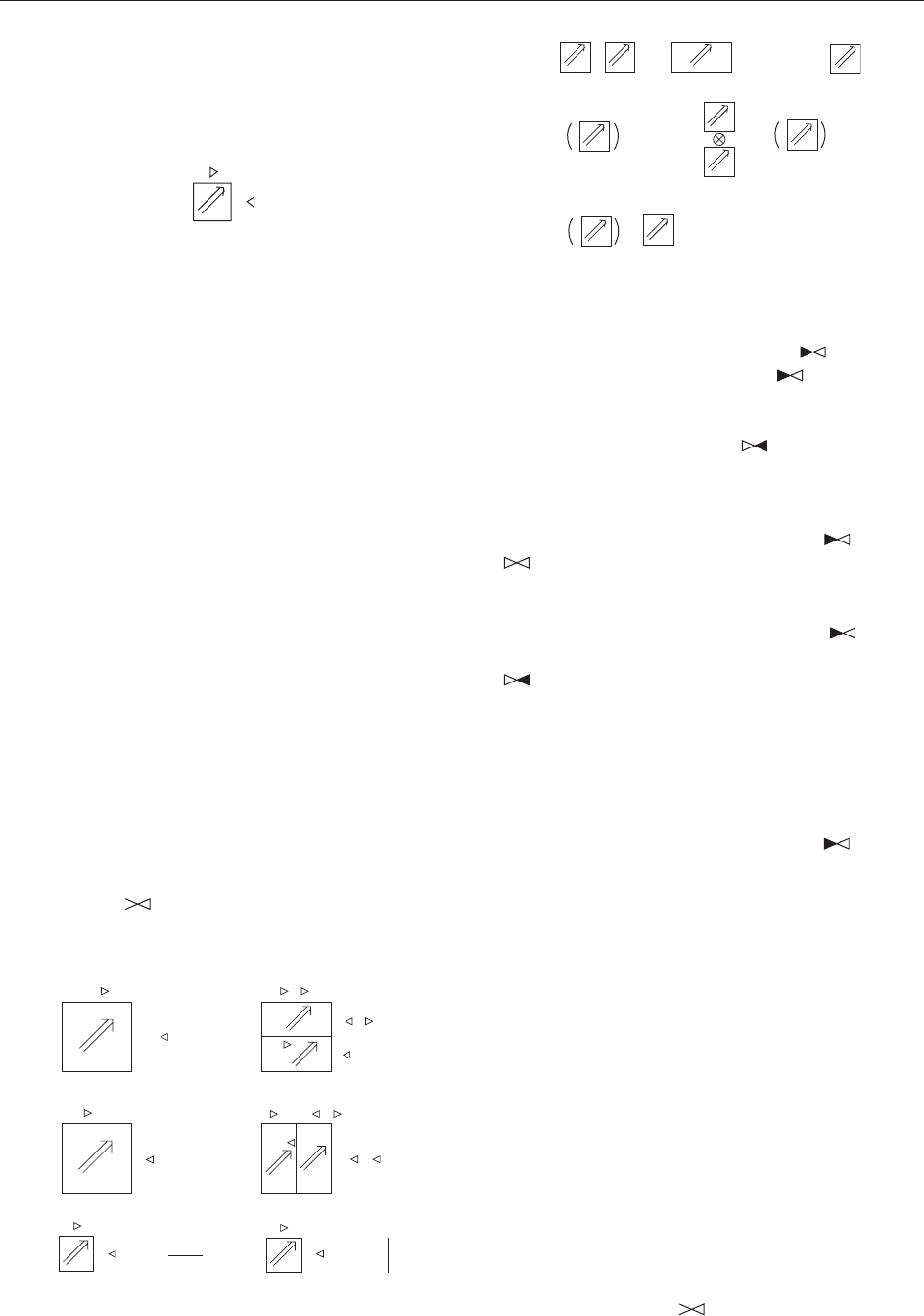
corresponding system of differential equations is
equivalent to a local factorization.
There is a nice graphical representation of the
matched pair conditions which relates to ‘‘surface
integration.’’ Thus, consider squares
u
s
us
su
labeled by elements of M on the left edge and
elements of G on the bottom edge. We can fill in the
other two edges by thinking of an edge transformed
by the other edge as it goes through the square either
horizontally or vertically, the two together is the
surface transport ) across the square. The matched
pair equations have the meaning that a square can
be subdivided either vertically or horizontally as
shown in Figure 2, where the labeling on vertical
edges is to be read from top down. The transport
operation here is nothing other than normal order-
ing in the factorizing group. In the Lie setting, it
means that the equations can be solved from
infinitesimal solutions (a matched pair of Lie
algebras) by a simultaneous double integration over
the group (i.e., building up a large box from many
small ones). If one considers solving the quantum
Yang–Baxter equations on groups, they appear in
this notation as an equality of surface transport
going two ways around a cube, and the classical
Yang–Baxter equations as curvature of the under-
lying higher-order connect ion.
Also in this notation there is a bicrossproduct
quantum group defined in Figure 3, at least when M
is finite. The expressions are considered zero unless
the juxtaposed edges have the same group labels. In
that case, the product is a semidirect product
algebra C(M)
CG of functions on M by the
group algebra of G. The coproduct is the adjoint of
this, so is a semidirect coalgebra C(M)
CG. Hence
the two together are denoted C(M)
CG. The dual
needs G finite and has the same form but with
vertical and horizontal compositions interchanged,
that is, a bicrossproduct CM
C(G). Both Hopf
algebras have the above labeled squares as basis.
It is possible to generalize both bicrossproducts
and double cross products associated to matched
pairs to general Hopf algebras H
1
H
2
and
H
1
H
2
, respectively, where H
1
, H
2
are Hopf
algebras (see Majid 1990) and to relate the two in
general by dualization of one factor. Another
general result (Majid 1995) is that H
1
H
2
acts
covariantly on the algebra H
1
from the right, or
H
1
H
2
acts covariantly on H
2
from the left. A
third general result is that bicrossproducts solve the
extension problem
H
1
!H !H
2
meaning that such a Hopf algebra H subject to some
technical requirements (such as an algebra splitting
map H
2
!H) is of the form H ffi H
1
H
2
. The
theory was also extended to include cocycle bicros-
sproducts at the end of the 1980s (by the author).
The finite group case, however, was first found by
Kac and Paljutkin (1966) in the Russian literature
and later rediscovered independently in Takeuchi
(1981) and in the course of Majid (1988).
The Planck-Scale Hopf Algebra
We consider a quantum algebra of observables H
and ask when it is a Hopf algebra extending some
classical position coordinate algebra C[M ] and some
possibly noncommutative momentum coordinate
algebra U(g) in the form of a strict extension
C½M!H !Uðg Þ
From the theory above this problem is governed by local
solutions of the matched pair equations on (G, M). It
requires that H ffi C[M]
U(g ) as an algebra, that is,
s
e
t u
s (uv)
(s u ) v
(s u) v
s u
s
t
u
s
u
(st ) u
s (t u)
t
t u
(st ) u
=
=
s
uv u
s
s (uv )
s u
eu
u
=
u
ee
u
e
eu
se
se
=
s
s
e
e
u)s (t
v
Figure 2 Matched pair condition as a subdivision property.
δ
s,
e
Σ
u
ab = s
s
u
u
b
a
ss
uv
=
uv
.
1 =
s
e
s
Σ
u
ε
s
–1
u
–1
Δ
s
S
s
=
=
Figure 3 Bicrossproduct Hopf algebra showing horizontal
product and vertical coproduct as an ‘‘unproduct.’’
270 Bicrossproduct Hopf Algebras and Noncommutative Spacetime

the quantization of a particle moving on orbits in M
under some action of G (in an algebraic setting, or
one can use von Neumann or C
-algebras etc.). And
it requires the classical phase space to be a
nonabelian or ‘ ‘ curved’’ group M
g
. This extends
to a coproduct on H which becomes the bicross-
product Hopf algebra C[M]
U(g ). In this way, the
problem which was open at the start of the 1980s of
finding true examples of Hopf algebras was given a
physical interpretation as being equivalent to finding
quantum-mechanical systems reconciled with curva-
ture, and the equations that governed this were the
matchedpairones(Majid 1988).
We still have to solve the se equations. In the
Lie case, they mean a pair of cross-coupled first-
order equations on G M. These can be solved
locally as a double-holonomy construction in line
with the surface transport point of view, but are
nonlinear t ypically with singularities in the non-
compact case. The equations are also symmetric
under interchange of G, M so Born reciprocity
between position and momentum is extended to
the quantum system with generally ‘‘curved’’
position and momentum spaces. Moreover, in so
farasEinstein’sequationG
= 8T
is also a
compatibility between a quantity in position
space and a quantity o riginating (ultimately) in
momentum space, the matched pair equations can
be viewed as a toy version of these.
Let us note that the reason to look for H a Hopf
algebra in the first place, aside from the reasons
already given, is for observer–observed symmetry
(this was put forward as a postulate for Planck-scale
physics). Thus, H
is also an algebra of observables
of some dual system, in our case U(m)
C[G]or
particles in G moving on orbits under M. Thus,
Born reciprocity is truly implemented in the
quantum/curved syst em by Hopf algebra duality.
Put another way, Hopf algebras are the simplest
objects after abelian groups that admit Fourier
transform (see Hopf Algebras and q-Deformation
Quantum Groups) and we require this on phase
space if Born reciprocity is to be extended to the
quantum/curved system.
The Planck-scale Hopf algebra is the simplest
example of these ideas (Majid 1988). Here G =
M = R and the mat ched pair equations can be solved
completely. The general solut ion is
^
p ¼ ihð1 e
x
Þ
@
@x
;
^
x ¼
i
h
ð1 e
hp
Þ
@
@p
for the action of one group with generator p on
functions of x in the other group and vice-versa. It
has two parameters which we have denoted as h and
a background curvature scale , and the correspond-
ing bicrossproduct C[p]
C[x]is
½p; x¼ihð1 e
x
Þ; x ¼ x 1 þ 1 x
p¼ p e
x
þ 1 p;x ¼ p ¼ 0
Sx ¼x; Sp ¼pe
x
where we should allow power series or take e
x
as
an invertible generator.
It is important to note that the matched pair
equations here have only this solution and it is
necessarily singular at p = 0orx = 0. The inter-
pretation in position space is as follows. Consider an
infalling particle of mass m with fixed momentum
p = mv
1
(in terms of the velocity at infinity). By
definition, p is the free-particle momentum and acts
on R as above. This corresponds to a free-particle
Hamiltonian
^
p
2
=2m and induces
_
p ¼ 0
_
x ¼
p
m
ð1 e
x
Þ¼v
1
1
1
1 þ x þ
at the classical level. We see that the particle takes
an infinite time to reach the origin, which is an
accumulation point. This can be compared with the
formula in standard radial infalling coordinates
_
x ¼ v
1
1
1
1 þ
c
2
x
2GM
!
for distance x from the event horizon of a black hole
of mass M (here G is Newton’s constant and c the
speed of light). So c
2
=GM and for the sake of
further discussion we will use this value. With a
little more work, one can then see that
mM m
2
P
C½x C½p
!
!
mM m
2
P
C½xC ½pusual qu. mech.
CðXÞusual curved geometry
where m
P
is the Planck mass of the order of 10
5
g
and X = R
R is a nonabelian grou p. In the first
limit, the particle motion is not detectably different
from usual flat space quantum mechanics outside
the Compton wavelength from the origin. In the
second limit, the estimate is such that noncommu-
tativity would not show up for length scales much
larger than the background curvature scale.
This Hopf algebra is also the simplest way to
extend classical position C[x] and momentum C[p]
in the sense above. In other words, requiring to
maintain observer–observed symmetry or Born
reciprocity throws up both quantum mechanics (in
the form of h) and something with the flavor of
Bicrossproduct Hopf Algebras and Noncommutative Spacetime 271

gravity (in the form of ) and both are required for a
nontrivial Hopf algebra. Moreover, the construction
necessarily has a self-dual form and indeed the
dually paired Hopf algebra is C[p]
C[x] with new
parameters h
0
= 1=h and
0
=h if we take the
standard pairing x, p across the two algebras. Hopf
algebra duality realized by the quantum group
Fourier transform F takes one between the two
models.
Bicrossproduct Poincare´
Quantum Groups
Another example from the 1980s in the same family
as the Planck-scale Hopf algebra is G = SU
2
and
M = B
þ
, a nonabelian version of R
3
with Lie algebra
b
þ
of the form
½x
3
; x
i
¼ix
i
; ½x
i
; x
j
¼0
for i = 1, 2. The required solution of the matched
pair equations was found in Majid (1990) and has a
nonlinear action of rotations on B
þ
. The interpreta-
tion of C[B
þ
] U(su
2
) is of particles moving along
orbits which are deformed spheres in B
þ
, and there
is a dual model where particles move instead on
orbits in SU
2
under the action of b
þ
. Moreover,
from the general theory of bicrossproducts, we
automatically have a covariant action of C[B
þ
]
U(su
2
) on the auxiliary noncommutative space
R
3
= U(b
þ
) with relations as above.
The quantum group here was actually obtained as a
Hopf–von Neumann algebra but we limit ourselves to
the underlying algebraic version. Also, there is of
course nothing stopping one considering this Hopf
algebra equally well as U
(poinc
3
), that is, a deforma-
tion of the group of motions on R
3
, rather than as an
algebra of observables. The only difference is to denote
the generators of C[B
þ
] by the symbols p
i
,reservingx
i
instead for the auxiliary noncommutative space. We
lower i, j, k indices using the Euclidean metric. Then
the bicrossproduct has the form
½p
i
; p
j
¼0; ½M
i
; M
j
¼i
ij
k
M
k
½M
3
; p
j
¼i
3j
k
p
k
; ½M
i
; p
3
¼i
i3
k
p
k
as usual, for i, j = 1, 2, 3, and the modified relations
½M
i
; p
j
¼
i
2
ij
3
1 e
2p
3
p
2
þ i
i
k3
p
j
p
k
for i, j = 1, 2 and p
2
= p
2
1
þ p
2
2
. The coproducts are
M
i
¼ M
i
e
p
3
þ M
3
p
i
þ 1 M
i
p
i
¼ p
i
e
p
3
þ 1 p
i
for i = 1, 2 and the usual additive ones for p
3
, M
3
.
There is also an appropriate counit and antipode.
The deformed spheres under the nonlinear rotation
in Majid (1990) are constant values of the Casimir
for the above algebra. This is
2
2
ðcoshðp
3
Þ1Þþp
2
e
p
3
which from the group of motions point of view
generates the noncommutat ive Laplacian when
acting on R
3
. The model here is a Euclidean
inhomogeneous one.
The four- dimensional (4D) version U(so
1, 3
)
C[B
þ
] of this construction (Majid and Ruegg
1994) is again linked to Planck-scale predictions,
this time as a generalized symmetry. In terms of
translation generators p
, rotations M
i
and boosts
N
i
we have
½p
; p
¼0; ½M
i
; M
j
¼i
ij
k
M
k
½N
i
; N
j
¼i
ij
k
M
k
; ½M
i
; N
j
¼i
ij
k
N
k
½p
0
; M
i
¼0; ½p
i
; M
j
¼i
i
jk
p
k
; ½p
0
; N
i
¼ip
i
as usual, and the modified relations and coproduct
½p
i
; N
j
¼
i
2
i
j
1 e
2p
0
þ p
2
!
þ ip
i
p
j
N
i
¼N
i
1 þ e
p
0
N
i
þ
ijk
p
j
M
k
p
i
¼p
i
1 þ e
p
0
p
i
and the usual additive coproducts on p
0
, M
i
. This
time the Lorentz group orbits in B
þ
are deformed
hyperboloids rather than deformed spheres, and the
Casimir that controls this has the same form as
above but with in the cosh term, that is, the
model is a Lorentz ian one. We know from the
general theory of bicrossproducts that this Hopf
algebra acts on U(b
þ
) = R
1, 3
the spacetime in the
section ‘‘Cogravity,’’ and the Casimir induces the
wave operator as we have seen there .
Let us look a bit more closely at the deformed
hyperboloids. Because neither group here is com-
pact, one expects from the general theory of
bicrossproducts to have limiting accumulation
regions. This is visible in the contour plot of p
0
against jpj in Figure 4, where the p
0
> 0 mass shel ls
are now cups with almost vertical walls, compressed
into the vertical tube
jpj <
1
In other words, the 3-momentum is bounded above
by the Planck momentum scale (if is the Planck
time). Indeed, the light-cone equation (setting the
Casimir to zero) reads jpj= 1 e
p
3
so this is
272 Bicrossproduct Hopf Algebras and Noncommutative Spacetime
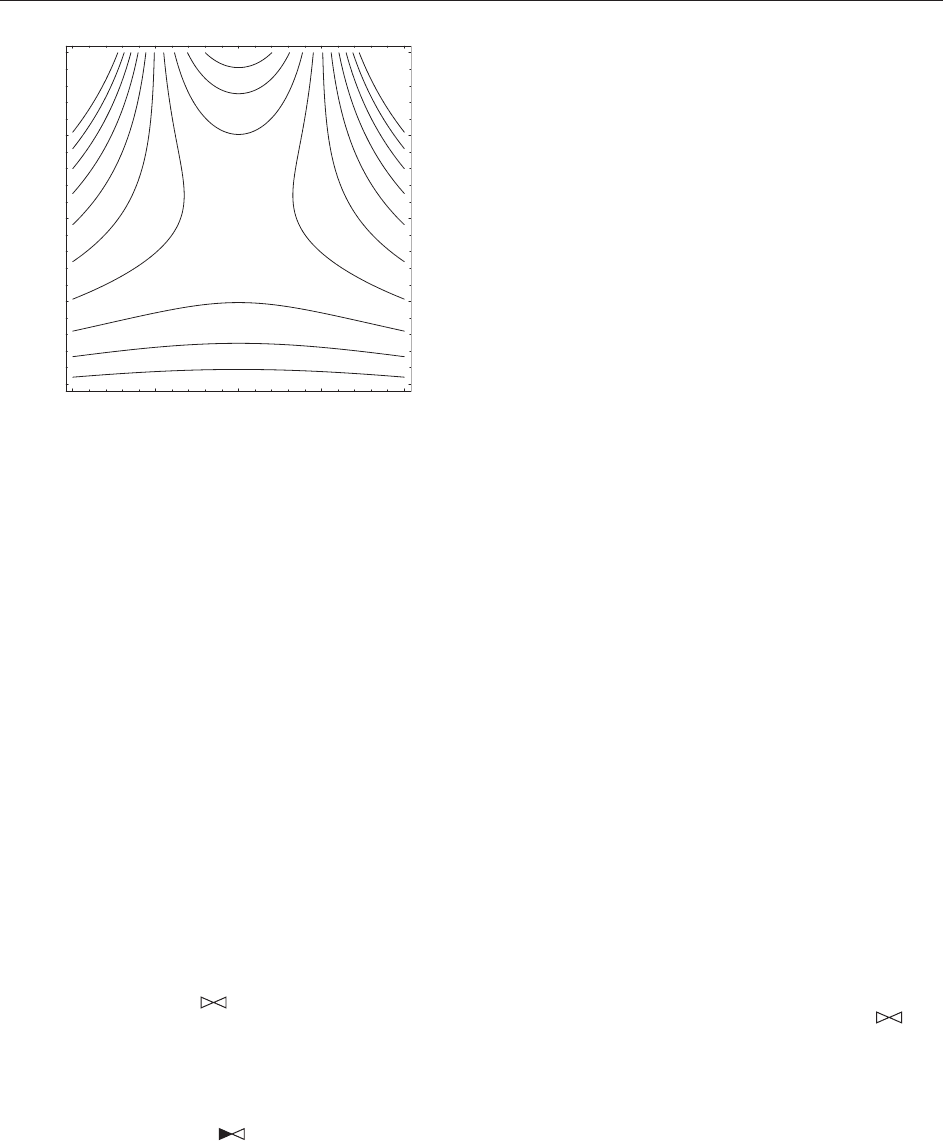
immediate. Nevertheless, this observation is so
striking that the bicrossproduct model has been
dubbed ‘‘doubly special’’ and spawned the search for
other such models. Such accumulation regions are a
main discovery of the noncompact bicrossproduct
theory visible already in the Planck-scale Hopf
algebra. The model further confirms the role of
the matched pair equations as a toy version of
Einstein’s.
Poisson–Lie T-Duality
We have explained in Section 3 that the matched
pair equations are equivalent to a local factorization
of Lie groups, with the action and back-reaction
created ‘‘equally and opposit ely’’ from this. For the
two models in the last section, these are SL
2
(C)
factorizing as SU
2
and a 3D B
þ
,andSO
2, 3
locally as
SO
1, 3
and a 4D B
þ
. The first of these examples is in
fact one of a general family based on the Iwasawa
decomposition G
C
= G G
where G is a compact
Lie group with complexification G
C
and G
a
certain solvable group. From this, one may construct
a solution (G, G
) of the matched pair equations and
bicrossproduct quantum group
C½G
UðgÞ
associated to all complex simple Lie algebras. Thi s is
again part of the bicrossproduct theory from the
1980s. On the other hand, the Lie algebra g
here
can be identified with the dual of g in which case its
Lie algebra corresponds to a Lie coproduct
: g !g g and makes (g, ) into a Lie bialgebra in
the sense of Drinfeld. This exponentiates to a
Poisson bracket on G making it a ‘‘Poisson–Lie
group’’ and the quantization of this is provided
by the qua ntum group coordinate algebras C
q
[G]
(see Hopf Algebras and q-Deformation Quantum
Groups and Classical r-matrices , Lie Bialgebras, and
Poisson Lie Groups). The bicrossproduct quantum
groups are nevertheless unrelated to the latter even
though they spring form related classical data.
As alr eady discussed, one interpr etation here is
of quantized particles in G
moving on orbits
under G and in vice versa in the dual model. The
dual model is equivalent in the sense that the
states of one (in the sense of positive-linear
functionals) lie in the algebra of observables of
theotherandwealsosawinthePlanck-scale
example inversion of structure constants reminis-
cent of T-duality in string t heory. Motivated in
part by this duality Klimcik (1996) along with
Severa in the mid 1990s showed that indeed a
-model on G could be constructed in such a way
that there was a matching dual -model on G
in
some sense equivalent in t erms of solutions to the
equations of motion. The L agrangians here have
the usual form
L¼E
u
ðu
1
@
þ
u; u
1
@
uÞ;
^
L¼
^
E
s
ðs
1
@
þ
s; s
1
@
sÞ
where u : R
1, 1
!G and s : R
1, 1
!G
are the dyna-
mical fields, except that the inner products E,
^
E
are not constant. Rather they are obtained by
solving nonlinear differential equations on the
groups defined through the structure con stants
of g, g
and the Drinfeld double D(g ). At the time,
T-duality here was well understood in the case of
abelian groups while these Poisson–Lie T-duality
models provided the first convincing nonabelian
models.
This construction was extended by Beggs and
Majid (2001) to a general matched pair (G, M), that
is, a -mode l on G dual to one on M. The Poisson–
Lie case is the special case where the actions are
coadjoint actions and the Lie algebra of G
M is
D(g). The solutions of the equations of motion for
the two systems are created ‘‘equally and oppo-
sitely’’ from one on the factorizing group. It could
be expected that T-duality ideas again play a role in
Planck-scale physics.
Other Bicrossproducts
There are also infinite-dimensional factorizations
such as the Riemann–Hilbert problem (see
Riemann–Hilbert Problem) in the theory of
integrable systems and hence infinite-dimensional
matched pairs and bicrossproducts linked to
–2 –1 0 1 2
–2
–1
0
1
2
Figure 4 Deformed mass-shell orbits in the bicrossproduct
curved momentum space for = 1.
Bicrossproduct Hopf Algebras and Noncommutative Spacetime 273

them. H ere we mention just one partly infinite
example of current interest.
Thus, the diffeomorphisms on the line R may be
factorized into transformati ons of the form ax þ b
and diffeomorphisms that fix the origin and have
unit differential there. After a (logarithmic) change
of generators to arrive at an algebrai c picture, one
has a bicrossproduct
Hð1Þ¼Uðb
þ
Þ H
1
where b
þ
is now the two-dimensional (2D) Lie
algebra with relations [x, y] = x and H
1
is the algebra
of polynomials in generators
n
and a certain
coalgebra as a model of the coordinate algebra of
the group of diffeomorphisms that fix the origin with
unit differential. The Hopf algebra H(1) was intro-
duced by Connes and Moscovici (1998) although not
actually as a bicrossproduct (bu t motivated by the
bicrossproduct theory) as part of a family H(n) useful
in cyclic cohomology computations. It has cross
relations and coproduct determined by
½
n
; x¼
nþ1
; ½
n
; y¼n
n
;
1
¼
1
1 þ 1
1
x ¼ x 1 þ 1 x þ
1
y;
y ¼ y 1 þ 1 y
which we see has a semidirect product form where
n
3x =
nþ1
,
n
3y = n
n
. The coalgebra is also a
semidirect coproduct by means of a back-reaction of
H
1
in B
þ
(expressed as a coaction). From the
bicrossproduct theory, we also have a dual model
C½B
þ
Uðdiff
0
Þ
where diff
0
is the Lie algebra of the group of
diffeomorphisms fixing the origin. As such it could be
viewed as in the family of examples in the section
‘‘Bicrossproduct Poincare´ quantum groups’’ but
now with a 2D B
þ
. We also conclude from
the bicrossproduct theory that this acts covariantly on
R
2
= U(b
þ
) after introducing the scaling parameter .
Finally, the Hopf algebra H(1) is also part of a
family of bicrossproduct Hopf algebras built on rooted
trees and related to bookkeeping of overlapping
divergences in renormalizable quantum field theories
(see Hopf Algebra Structure of Renormalizable Quan-
tum Field Theory). While we have not had room to
cover all bicrossproduct quantum groups of interest, it
would appear that bicrossproducts are indeed inti-
mately tied up with actual quantum physics.
See also: Classical r-Matrices, Lie Bialgebras, and
Poisson Lie Groups; Hopf Algebra Structure of
Renormalizable Quantum Field Theory; Hopf Algebras
and q-Deformation Quantum Groups; Quantum Group
Differentials, Bundles and Gauge Theory;
Riemann–Hilbert Problem; von Neumann Algebras:
Introduction, Modular Theory, and Classification Theory.
Further Reading
Amelino-Camelia G and Majid S (2000) Waves on noncommu-
tative spacetime and gamma-ray bursts. International Journal
of Modern Physics A 15: 4301–4323.
Beggs E and Majid S (2001) Poisson–Lie T-duality for quasi-
triangular Lie bialgebras. Communications in Mathematical
Physics 220: 455–488.
Connes A and Moscovici H (1998) Hopf algebras, cyclic
cohomology and the transverse index theory. Communications
in Mathematical Physics 198: 199–246.
Kac GI and Paljutkin VG (1966) Finite ring groups. Transactions
of the American Mathematical Society 15: 251–294.
Kempf A, Mangano G, and Mann RB (1995) Hilbert space
representation of the minimal length uncertainty relation.
Physical Review D 52: 1108–1118.
Klimcik C (1996) Poisson–Lie T-duality. Nuclear Physics B (Proc.
Suppl.) 46: 116–121.
Lukierski J, Nowicki A, Ruegg H, and Tolstoy VN (1991)
q-Deformation of Poincare´ algebra. Physics Letters B
268: 331–338.
Majid S (1988) Hopf algebras for physics at the Planck scale.
Journal of Classical and Quantum Gravity 5: 1587–1606.
Majid S (1990) Physics for algebraists: non-commutative and
non-cocommutative Hopf algebras by a bicrossproduct
construction. Journal of Algebra 130: 17–64.
Majid S (1990) Matched pairs of Lie groups associated to
solutions of the Yang–Baxter equations. Pacific Journal of
Mathematics 141: 311–332.
Majid S (1990) On q-regularization. International Journal of
Modern Physics A 5: 4689–4696.
Majid S (1995) Foundations of Quantum Group Theory.
Cambridge: Cambridge University Press.
Majid S (2000) Meaning of noncommutative geometry and the
Planck-scale quantum group. Springer Lecture Notes in
Physics 541: 227–276.
Majid S and Ruegg H (1994) Bicrossproduct structure of the
-Poincare´ group and non-commutative geometry. Physics
Letters B 334: 348–354.
Oeckl R (2000) Untwisting noncommutative R
d
and the
equivalence of quantum field theories. Nuclear Physics B
581: 559–574.
Seiberg N and Witten E (1999) String theory and noncommuta-
tive geometry. Journal of High Energy Physics 9909: 032.
Snyder HS (1947) Quantized space-time Physical Review D
67: 38–41.
Takeuchi M (1981) Matched pairs of groups and bismash products
of Hopf algebras. Communications in Algebra 9: 841.
274 Bicrossproduct Hopf Algebras and Noncommutative Spacetime