
Francoise J.-P., Naber G.L., Tsun T.S. (editors) Encyclopedia of Mathematical Physics
Подождите немного. Документ загружается.


Wavelets: Application to Turbulence
M Farge, Ecole Normale Supe
´
rieure, Paris, France
K Schneider, Universite
´
de Provence, Marseille,
France
ª 2006 Published by Elsevier Ltd.
Introduction about Turbulence
and Wavelets
What is Turbulence?
Turbulence is a highly nonlinear regime encoun-
tered in fluid flows. Such flows are described by
continuous fields , for example, velocity or pressure,
assuming that the characteristic scale of the fluid
motions is much larger than the mean free path of
the molecular motions. The prediction of the
spacetime evolution of fluid flows from first
principles is given by the solutions of the Navier–
Stokes equations. The turbulent regime develops
when the nonlinear term of Navier–Stokes equa-
tions strongly dominates the linear term; the ratio
of the norms of both terms is the Reynolds number
Re, which character izes the level of turbul ence. In
this regime nonlinear instabilities dominate, which
leads to the flow sensitivity to initial conditions and
unpredictability.
The corresponding turbulent fields are highly
fluctuating and their detailed motions cannot be
predicted. However, if one assumes some statistical
stability of the turbulence regime, averaged quan-
tities, such as mean and variance, or other related
quantities, for example, diffusion coefficients, lift or
drag, may still be predicted.
When turbulent flows are statistically stationary
(in time) or homogeneous (in space), as it is
classically supposed, one studies their energy spec-
trum, given by the modulus of the Fourier transform
of the velocity autocorrelatio n.
Unfortunately, since the Fourier representation
spreads the information in physical space among the
phases of all Fourier coefficients, the energy spec-
trum loses all struc tural information in time or
space. This is a major limitation of the classical way
of analyzing turbulent flows. This is why we have
proposed to use the wavelet representation instead
and defi ne new analysis tools that are able to
preserve time and space locality.
The same is true for computing turbulent flows.
Indeed, the Fourier representation is well suited to
study linear motions, for which the superposition
principle holds and whose generic behavior is, either
to persist at a given scale, or to spread to larger
ones. In contrast, the superposition principle does
not hold for nonlinear motions, their archetype
being the turbulent regime, which therefore cannot
be decomposed into a sum of independent motions
that can be separately studied. Generically, their
evolution involves a wide range of scales, exciting
smaller and smaller ones, even leading to finite-time
singularities, e.g., shocks. The ‘‘art’’ of predicting
the evolution of such nonlinear phenomena consists
of disentangling the active from the passive
elements: the former should be deterministically
computed, while the latter could either be discarded
or their effect statistically modeled. The wavelet
representation allows to analyze the dynamics
in both space and scale, retaining only those degrees
of freedom which are essential to predict the
flow evolution. Our goal is to perform a kind
of ‘‘distillation’’ and retain only the elements
which are essential to compute the nonlinear
dynamics.
How One Studies Turbulence?
When studying turbulence one is uneasy about the
fact that there are two different descriptions,
depending on which side of the Fourier transform
one looks from.
On the one hand, looking from the Fourier space
representation, one has a theory which assumes
the existence of a nonlinear cascade in an
intermediate range of wavenumbers sets, called
the ‘‘inertial range’’ where energy is conser ved
and transferred towards high wavenumbers, but
only on average (i.e., considering either ensemble
or time or space averages). This implies that a
turbulent flow is excited at wavenumbers lower
than those of the inertial range and dissipated at
wavenumbers higher. Under these hypotheses, the
theory predicts that the slope of the energy
spectrum in the inertial range scales as k
5=3
in
dimension 3 and as k
3
in dimension 2, k being
the wavenumber, i.e., the modulus of the wave
vector.
On the other hand, if one studies turbulence from
the physical space representation, there is not yet
any universal theory. One relies instead on
empirical observations, from both laboratory
and numerical experiments, which exhibit the
formation and persistence of coherent vortices,
even at very high Reynolds numbers. They
correspond to the condensation of the vorticity
field into some organized structures that contain
most of the energy (L
2
-norm of veloc ity) and
enstrophy (L
2
-norm of vorticity).
408 Wavelets: Application to Turbulence

Moreover, the classical method for modeling turbu-
lent flows consists in neglecting high-wavenumber
motions and replacing them by their average, suppos-
ing their dynamics to be either linear or slaved to the
low wavenumber motions. Such a method would work
if there exists a clear separation between low and high
wavenumbers, that is, a spectral gap.
Actually, there is now strong evidence, from
both laboratory and direct numerical simulation
(DNS) experiments, that this is not the case.
Conversely, one observes that turbulent flows are
nonlinearly active all along the inertial range and that
coherent vortices seem to play an essential dynamical
role there, especially for transport and mixing. One
may then ask the following questions: Are coherent
vortices the elementary building blocks of turbulent
flows? How can we extract them? Do their mutual
interactions have a universal character? Can we
compress turbulent flows and compute their evolu-
tion with a reduced number of degrees of freedom
corresponding to the coherent vortices?
The DNS of turbulent flows, based on the integra-
tion of the Navier–Stokes equations using either grid
points in physical space or Fourier modes in spectral
space, requires a number of degrees of freedom per
time step that varies as Re
9=4
in dimension 3 (and as
Re in dimension 2). Due to the inherent limitation of
computer performances, one can presently only per-
form DNS of turbulent flows up to Reynolds numbers
Re = 10
6
. To compute higher Reynolds flows, one
should then design ad hoc turbulence models, whose
parameters are empirically adjusted to each type of
flows, in particular to their geometry and boundary
conditions, using data from either laboratory or
numerical experiments.
What are Wavelets?
The wavelet transform unfolds signals (or fields)
into both time (or space) and scale, and possibly
directions in dimensions higher than 1. The starting
point is a function 2 L
2
(R), called the ‘‘mother
wavelet’’, which is well localized in physical space
x 2 R, is oscillating ( has at least a vanishing
integral, or better, its first m moments vanish), and
is smooth (its Fourier transform
^
(k) exhibits fast
decay for wave numbers jkj tending to infinity). The
mother wavelet then generates a family of dilated
and translated wavelets
a; b
ðxÞ¼a
1=2
x b
a
with a 2 R
þ
the scale parameter and b 2 R the
position parameter, all wavelets being normalized
in L
2
-norm.
The wavelet transform of a function f 2 L
2
(R)is
the inner product of f with the analyzing wavelets
a, b
, which gives the wavelet coefficients:
e
f (a, b) =
hf ,
a, b
i=
R
f (x)
a, b
(x)dx. They measure the fluc-
tuations of f around the scale a and the position
b. f can then be reconstruct ed without any loss as
the inner product of its wavelet coefficients
e
f with
the analyzing wavelets
a; b
: f ðxÞ= C
1
ZZ
e
f ða; bÞ
a; b
ðxÞa
2
da db
C
=
R
j
^
j
2
jkj
1
dk being a constant which depends
on the wavelet .
Like the Fourier transform, the wavelet transform
realizes a change of basis from physical space to
wavelet space which is an isometry. It thus conserves
the inner product (Plancherel theorem), and in
particular energy (Parseval’s identity). Let us men-
tion that, due to the localization of wavelets in
physical space, the behavior of the signal at infinity
does not play any role. Therefore, the wavelet
analysis and synthesis can be performed locally, in
contrast to the Fourier transform where the nonlocal
nature of the trigonometric functions does not allow
to perform a local analysis.
Moreover, wave lets constitute building blocks of
various function spaces out of which some can be
used to contruct orthogonal bases. The main
difference between the continuous and the orthogo-
nal wavelet trans forms is that the latter is non-
redundant, but only preserves the invariance by
translation and dilation only for a discrete subset of
wavelet space which corresponds to the dyadic grid
= (j, i), for which scale is sampled by octaves j and
space by positions 2
j
i. The advantage is that all
orthogonal wavelet coefficients are decorr elated,
which is not the case for the continuous wavelet
transform whose coefficients are redundant and
correlated in space and scale. Such a correlation
can be visualized by plotting the continuous wavelet
coefficients of a white noise and the patterns one
thus observes are due to the reproducing kernel of
the continuous wavelet transform, which corre-
sponds to the correlation between the analyzing
wavelets themselves.
In practice, to analyze turbulent signals or fields,
one should use the continuous wavelet transform
with complex-valued wavelets, since the modulus of
the wavelet coefficients allows to read the evolution
of the energy density in both space (or time) and
scales. If one uses real-valued wavelets instead, the
modulus of the wavelet coefficients will present the
same oscillations as the analyzing wavelets and it
will then become difficult to sort out features
Wavelets: Application to Turbulence 409

belonging to the signal or to the wavelets. In the case
of complex-valued wavelets, the quadrature between
the real and the imaginary parts of the wavelet
coefficients eliminates these spurious oscillations; this
is why we recommend to use complex-valued wave-
lets, such as the Morlet wavelet. To compress
turbulent flows, and afortiorito compute their
evolution at a reduced cost, compared to standard
methods (finite difference, finite volume, or spectral
methods), one should use orthogonal wavelets. This
avoids redundancy, since one has the same number of
grid points as wavelet coefficients. Moreover there
exists a fast algorithm to compute the orthogonal
wavelet coefficients which is even faster than the fast
Fourier transform, having O(N) operations instead of
O(N log
2
N).
The first paper about the continuous wavelet
transform has been published by Grossmann and
Morlet (1984). Then, discrete wavelets were
constructed, leading to frames (Daubechies et al.
1986) and orthogonal bases (Lemarie´ and Meyer,
1986). From there the formalism of multiresolution
analysis (MRA) has been constructed which led
to the fast wavelet algorithm (Mallat 1989). The
first application of wavelets to analyze turbulent
flows has been published by Farge and Rabreau
(1988). Since then a long-term research program has
been develo ped for analyzing, computing and
modeling turbul ent flows using either continuous
wavelets, orthogonal wavelets, or wavelet packets.
Wavelet Analysis
Wavelet Spectra
Wavelet space To study turbulent signals one uses
the continuous wavelet transform for analysis, and
the orthogonal wavele t transform for compression
and computation. To perform a continuous wavelet
transform, one can choose:
either a real-valued wavelet, such as the Marr
wavelet, also called ‘‘Mexican hat,’’ which is the
second derivative of a Gaussian,
ðxÞ¼ð1 x
2
Þexp
x
2
2
½1
or a complex-valued wavelet, such as the Morlet
wavelet,
b
ðkÞ¼
1
2
exp
ðk k
Þ
2
2
!
for k > 0
b
ðkÞ¼0 for k 0
8
>
>
<
>
>
:
½2
with the wavenumber k
denoting the barycenter of
the wavelet support in Fourier space computed as
k
¼
R
1
0
kj
b
ðkÞjdk
R
1
0
j
b
ðkÞjdk
½3
For the orthogonal wavelet transform, there is
a large collection of possible wavelets and the
choice depends on which properties are preferred,
for instance: compact support, symmetry, smooth-
ness, number of cancelations, computational
efficiency.
From our own experience, we tend to prefer
the Coifman wavele t 12, which is compactly
supported, has four vanishing moments, is quasi-
symmetric, and is defined with a filter of length 12,
which leads to a computational cost for the fast
wavelet transform in 24N operations, since two
filters are used.
As stated above, we recommend the complex-
valued conti nuous wavelet transform for analysis. In
this case, one plots the modulus and the phase of the
wavelet coefficients in wavelet space, with a linear
horizontal axis for the position b, and a logarithmic
vertical axis for the scale a, with the largest scale at
the bottom and the smallest scale at the top.
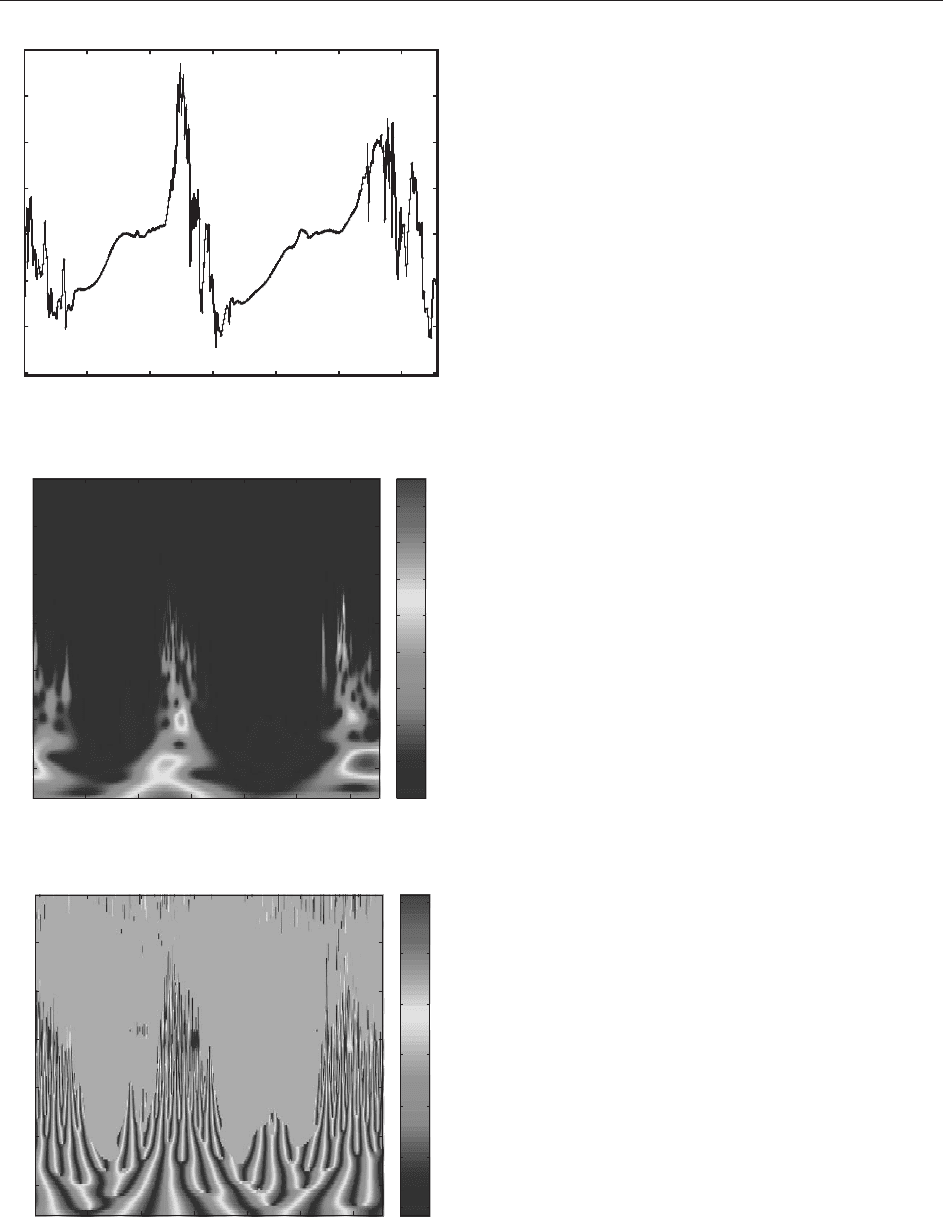
In Figure 1a we show the wavelet analysis of
a turbulent signal, corresponding to the time
evolution of the velocity fluctuations of two succes-
sive vortex breakdowns, measured by hot-wire
anemometry at N = 32768 = 2
15
instants (Cuypers
et al. 2003 ). The modulus of the wavelet coefficients
(Figure 1b) shows that during the vortex break-
down, which is due to strong nonlinear flow
instability, energy is spread over a wide range of
scales. The phase of the wavelet coefficients
(Figure 1c) is plotted only where the modulus is
non-negligible, otherwise the phase information
would be meaningless. In Figure 1c, one observes
that the lines of constant phase point towards the
instants where the signal is less regular, that is,
during vortex breakdowns.
Local wavelet spectrum Since the wavelet trans-
form conserves energy and preserves locality in
physical space, one can extend the concept of energy
spectrum and define a local energy spectrum, such
that
e
Eðk; xÞ¼
1
C
k
e
f
k
k
; x
2
for k 0 ½4
where k
is the centroid wavenumber of the
analyzing wavelet and C
is defined in the
410 Wavelets: Application to Turbulence
admissibility condition (respectively, eqns [10] and
[1] in the article Wavelets: Mathematical Theory).
By measuring
e
E(k, x) at different instants or
positions, one estimates which elements in the
signal contribute most to the global Fourier energy
spectrum, inorder to suggest a way to decompose
the signal into different components. For example,
if one considers turbulent flows, one can compare
the energy spectrum of the coherent structures
(such as isolated vortices in incompressible flows
or shocks in compressible flows) and the energy
spectrum of the incoherent background flow, since
both elements exhibit different correlations and
therefore different spectral slopes.
Global wavelet spectrum Although the wavelet
transform analyzes the flow using localized func-
tions rather than complex exponentials, one can
show that the global wavelet energy spectrum
converges towards the Fourier energy spectrum,
provided the analyzing wavelet has enough vanish-
ing moments. Mo re precisely, the global wavelet
spectrum, defined by integrating [4] over all
positions,
e
EðkÞ¼
Z
1
1
e
Eðk; xÞdx ½5
gives the correct exponent for a power-law Fourier
energy spectrum E(k) /k
if the analyzing wavelet
has at least M > ( 1)=2 vanishing moments.
Thus, the steeper the energy spectrum one studies,
the more vanishing moments the analyzing wavelet
should have.
The inertial range which corresponds to the scales
when turbulent flows are dominated by nonlinear
interactions, exhibits a power-law behavior as
predicted by the statistical theory of homogeneous
and isotropic turbulence.
The ability to correctly evaluate the slope of the
energy spectrum is an important property of the
wavelet transform which is related to its ability to
detect and characterize singularities. We will not
discuss here how wavelet coefficients could be used
to study singularities and fractal measures, since it is
presented in detail elsewhere (see Wavelets:
Applications).
Relation to Classical Analysis
Relation to Fourier spectrum The global wavelet
energy spectrum
e
E(k) is actually a smoothed version
of the Fourier energy spectrum E(k). This can be
0
(a)
0.5 1 1.5 2 2.5 3
0
2
4
6
8
10
12
14
(b)
0.2
0.4
0.6
0.8
1
1.2
1.4
1.6
0.5 1 1.5 2 2.5 3
20
40
60
80
100
120
(
c
)
–3
–2
–1
0
1
2
3
0.5 1 1.5 2 2.5 3
20
40
60
80
100
120
x 10
4
x 10
4
x 10
4
Figure 1 Example of a one-dimensional continuous wavelet
analysis. (a) the signal to be analyzed, (b) the modulus of its
wavelet coefficients, (c) the phase of its wavelet coefficients.
Wavelets: Application to Turbulence 411

seen from the following relation between the two
spectra:
e
EðkÞ¼
1
C
k
Z
1
0
Eðk
0
Þ
b
k
k
0
k
2
dk
0
½6
which shows that the global wavelet spectrum is an
average of the Fourier spectrum weighted by the
square of the Fourier transform of the analyzing
wavelets at wavenumber k. Note that the larger k,
the larger the averaging interval, because wavelets
are bandpass filters with k=k consta nt. This
property of the global wavelet energy spectrum is
particularly useful to study turbulent flows. Indeed,
the Fourier energy spectrum of a single realization
of a turbulent flow is too oscillating to be able to
clearly detect a slope, whi le it is no more the case
for the global wavelet energy spectrum, which is a
better estimator of the spectral slope.
The real-valued Marr wavelet [1] has only two
vanishing moments and thus can correctly measure
the energy spectrum exponents up to <5. In the
case of the complex-valued Morlet wavelet [2], only
the zeroth-order moment is null, but the higher mth
order moments are very small (/ k
m
e
(k
2
=2)
),
provided that k
is larger than 5. For instance, the
Morlet wavelet transform with k
= 6 gives accu-
rate estimates of the power–law exponent of the
energy spectrum up to <7.
There is also a family of wavelets with an infinite
number of cancelations
b
n
ðkÞ¼
n
exp
1
2
k
2
þ
1
k
2n
n 1 ½7
where
n
is chosen for normalization.
These wavelets can therefore correctly measure
any power–law energy spectrum, and thus detect the
difference between a power–law energy spectrum
and a Gaussian energy spectrum (E(k) / e
((k=k
0
)
2
)
).
For instance, it is important in turbulence to
determine the wavenumber after which the
energy spectrum decays exponentially, since this
wavenumber defines the end of the inertial range,
dominated by nonlinear interactions, and the begin-
ning of the dissipative range, dominated by linear
dissipation.
Relation to structure functions In this subsection
we will point out the limitations of classical
measures of intermittency and present a set of
wavelet-based alternatives.
The classical measures based on structure func-
tions can be thought of as a special case of wavelet
filtering using a nonsmooth wavelet defined as the
difference of two Diracs (DOD). It is this lack of
regularity of the underlying wavelet that limits the
adequacy of classical measures to analyze smooth
signals. Wavelet-based diagnostics can overcome
these limitations, and produce accurate results,
whatever the signal to be analyzed.
We will link the scale-dependent mom ents of the
wavelet coefficients and the structure functions,
which are classically used to study turbulence. In
the case of second-order statistics, the global wavelet
spectrum corresponds to the second-order structure
function. Furthermore, a rigorous bound for the
maximum exponent detected by the structure func-
tions can be computed, but there is a way to
overcome this limitation by using wavelets.
The increments of a signal, also called the
modulus of continuity, can be seen as its wavelet
coefficients using the DOD wavelet
ðxÞ¼ðx þ 1ÞðxÞ½8
We thus obtain
f ðx þ aÞf ðxÞ¼
e
f
x; a
¼hf ;
x; a
i½9
with
x, a
(y) = 1=a[((y x)=a þ 1) ((y x)=a)].
Note that the wavelet is normalized with respect to
the L
1
-norm. The pth-order structure function S
p
(a)
therefore corresponds to the pth-order moment of
the wavelet coefficients at scale a
S
p
ðaÞ¼
Z
ð
e
f
x;a
Þ
p
dx ½10
As the DOD wavelet has only one vanishing
moment (its mean), the exponent of the pth-order
structure function in the case of a self-similar
behavior is limited by p, that is, if S
p
(a) / a
(p)
,
then (p) < p. To be able to detect larger exponents,
one has to use increments with a larger stencil, or
wavelets with more vanishing moments.
We now concentrate on the case p = 2, that is, the
energy norm. Equation [6] gives the relation
between the global wavelet spectrum
e
E(k) and the
Fourier spectrum E(k) for an arbitrary wavelet .
For the DOD wavelet we find, since
b
(k) =
e
ik
1 = e
ik=2
(e
ik=2
e
i k=2
) and hence j
b
(k)j
2
=
2(1 cos k), that
e
EðkÞ¼
1
C
k
Z
1
0
Eðk
0
Þ 2 2 cos
k
k
0
k
dk
0
½11
412 Wavelets: Application to Turbulence

Setting a = k
=k, we see that the wavelet spectrum
corresponds to the second-order structure function,
such that
e
EðkÞ¼
1
C
k
S
2
ðaÞ½12
The above results show that, if the Fourier spectrum
behaves like k
for k !1,
e
E(k) / k
if <2M þ
1, where M denotes the number of vanishing
moments of the wavelets. Consequently, we find
for S
2
(a) that S
2
(a) / a
(p)
= (k
=k)
(p)
for a !0if
(2) 2M. For the DOD wavelet, we have M = 1,
therefore, the second-order structure function
can only detect slopes smaller than 2, corresponding
to an energy spectrum whose slope is shallower
than 3. Thus, the usual structure functions give
spurious results for sufficiently smooth signals. The
relation between structure functions and wavelet
coefficients can be generalized in the context of
Besov spaces , which are classically used for non-
linear approximation theory (see Wavelets: Mathe-
matical Theory).
Intermittency Measures
Intermittency is defined as localized bursts of high-
frequency activity. This means that intermittent
phenomena are local ized in both physical and
spectral spaces, and thus a suitable basis for
representing intermittency should reflect this dual
localization. The Fourier basis is well localized in
spectral space, but delocalized in physical space.
Therefore, when a turbulence signal is filtered using
a high-pass Fourier transform and then recon-
structed in physical space, for example, to calculate
the flatness, some spatial information is lost. This
leads to smoothing of strong gradients and spurious
oscillations in the background, which come from the
fact that the modulus and phase of the discarded
high wavenumber Fourier modes have been lost.
The spatial errors introduced by such a Fourier
filtering lead to errors in estimating the flatness, and
hence the signal’s intermittency.
When a quantity (e.g., velocity derivative) is
intermittent, it contains rare but strong events (i.e.,
bursts of intense activity), which correspond to
large deviations reflected in the ‘‘heavy tails’’ of the
PDF. Second-order statistics (e.g., energy spectrum,
second-order structure function) are relatively
insensitive to such rare events whose time or
space supports are v ery small and thus do not
dominate the integral. However, these events
become increasingly important for higher-order
statistics, where they finally dominate. High-order
statistics therefore characterize intermittency. Of
course, intermittency is not essential for all problems:
second-order statistics are sufficient to measure
dispersion (dominated by energy-containing scales),
but not to calculate drag or mixing (dominated by
vorticity production in thin boundary or shear
layers).
To measure intermittency, one uses the space–
scale information contained in the wavelet coeffi-
cients to define scale-dependent moments and
moment ratios. Useful diagnostics to quantify the
intermittency of a field f ar e the moments o f its
wavelet coefficients at different scale s j
M
p;j
ðf Þ¼2
j
X
2
j
1
i¼0
j
e
f
j;i
j
p
½13
Note that the distribution of energy scale by scale,
that is, the scalogram, can be computed from the
second-order moment of the orthogonal wavelet
coefficients: E
j
= 2
j1
M
2, j
. Due to orthogonality of
the decomposition, the total energy is just the sum:
E =
P
j0
E
j
.
The sparsity of the wavelet coefficients at each
scale is a measure of intermittency, and it can be
quantified using ratios of moments at different
scales
Q
p;q;j
ðf Þ¼
M
p;j
ðf Þ
ðM
q;j
ðf ÞÞ
p=q
½14
which may be interpreted as quotient norms
computed in two different functional spaces,
L
p
-and L
q
-spaces. Classically, one choo ses q = 2to
define typical statistical quantities as a function of
scale. Recall that for p = 4 we obtain the scale-
dependent flatness F
j
= Q
4, 2, j
. It is equal to 3 for a
Gaussian white noise at all scales j, which proves that
this signal is not intermittent. The scale-dependent
skewness, hyperflatness, and hyperskewness are
obtained for p = 3, 5, and 6, respectively. For inter-
mittent signals Q
p, q, j
increases with j, whatever p
and q.
Wavelet Compression
Principle
To study turbul ent signals, we now propose to
separate the rare and extreme events from the dense
events, and then calculate their statistics indepen-
dently. A major difficulty in turbulence research is
that there is no clear scal e separation between these
two kinds of events. This lack of ‘‘spectral gap’’
excludes Fourier filtering for disentangling these
two behaviors. Since the rare events are well
Wavelets: Application to Turbulence 413

localized in physical space, one might try to use an
on–off filter defined in physical space to extract
them. However, this approach changes the spectral
properties by introducing spurious discontinuities,
adding an artificial scaling (e.g., k
2
in one
dimension) to the energy spectrum. To avoid these
problems, we use the wavelet representation, which
combines both physical and spectral space localiza-
tions (bounded from below by Heisenberg’s uncer-
tainty principle). In turbulence, the relevant rare
events are the coherent vortices and the dense
events correspond to the residual background flow.
We have proposed a nonlinear wavelet filtering of
the wavelet coefficients of vorticity to ex tract the
coherent vortices out of turbulent flows. We now
detail the differe nt steps of this procedure.
Extraction of Coherent Structures
Principle We propose a new method to extract
coherent structures from turbulent flows, as encoun-
tered in fluids (e.g., vortices, shocklets) or plasmas
(e.g., bursts), in order to study their role in transport
and mixing.
We first replace the Fourier representation by the
wavelet representation, which keeps track of both
time and scale, instead of frequency only. The
second improvement consists in changing our view-
point about coherent structures. Since there is not
yet a universal definition of coherent structures, we
prefer starting from a minimal but more consensual
statement about them, that everyone hopefully could
agree with: ‘‘coherent structures are not noise.’’
Using this apophatic method, we propose the
following definition: ‘‘coherent structures are what
remain after denoising.’’
For the noise we use the mathematical definition
stating that a noise cannot be compressed in any
functional basis. Another way to say this is to
observe that the shortest description of a noise is the
noise itself. Notice that often one calls ‘‘noise’’ what
is actually ‘‘experimental noise,’’ but not noise in the
mathematical sense.
Considering our definition of coherent structures,
turbulent signals can be split into two contribu-
tions: coherent bursts, corresponding to that part of
the signal which can be compressed in a wave let
basis, and incoherent noise, corresponding to that
part of the signal which cannot be compressed,
neither in wavelets nor in any other basis. We will
then check a posteriori that the incoherent con-
tribution is spread, and therefore does not com-
press, in both Fourier and grid-point basis. Since we
use the orthogonal wavelet representation, both
coherent and incoherent components are
orthogonal and therefore the L
2
-norm, for example,
energy or enstrophy, is a superposition of coherent
and incoherent contributions (Mallat 1998).
Assuming that coherent structures are what
remain after denoising, we need a model, not for
the structures themselves, but for the noise. As a first
guess, we choose the simplest model and suppose the
noise to be additive, Gaussian and white, that is,
uncorrelated. Having this model in mind, we use
Donoho a nd Johnstone’s theorem to compute the
value to threshold the wavelet coefficients. Since the
threshold value depends on the variance of the noise,
which in the case of turbu lence is not a priori
known, we propose a recursive method to estimate
it from the variance of the weakest wavelet
coefficients, that is, those whose modulus is below
the threshold value.
Wavelet decomposition We describe the wavelet
algorithm to extract coherent vortices out of
turbulent flows and apply it as example to a 3D
turbulent flow. We consider the vorticity field
w = rv, computed at resolution N = 2
3J
, N being
the number of grid points and J the number of
octaves in each spatial direction. Each vorticity
component is developed into an orthogonal wavelet
series from the largest scale l
max
= 2
0
to the smallest
scale l
min
= 2
J1
using a three-dimensional (3D) MRA:
!ðxÞ¼
!
0;0;0
0;0;0
ðxÞ
þ
X
J1
j¼0
X
2
j
1
i
x
¼0
X
2
j
1
i
y
¼0
X
2
j
1
i
z
¼0
X
7
d¼1
~
!
d
j;i
x
;i
y
;i
z
d
j;i
x
;i
y
;i
z
ðxÞ½15
with
j, i
x
, i
y
i, i
z
(x) =
j, i
x
(x)
j, i
y
(y)
j, i
z
(z), and
d
j;i
x
;i
y
;i
z
ðxÞ¼
j;i
x
ðxÞ
j;i
y
ðyÞ
j;i
z
ðzÞ d ¼ 1
j;i
x
ðxÞ
j;i
y
ðyÞ
j;i
z
ðzÞ d ¼ 2
j;i
x
ðxÞ
j;i
y
ðyÞ
j;i
z
ðzÞ d ¼ 3
j;i
x
ðxÞ
j;i
y
ðyÞ
j;i
z
ðzÞ d ¼ 4
j;i
x
ðxÞ
j;i
y
ðyÞ
j;i
z
ðzÞ d ¼ 5
j;i
x
ðxÞ
j;i
y
ðyÞ
j;i
z
ðzÞ d ¼ 6
j;i
x
ðxÞ
j;i
y
ðyÞ
j;i
z
ðzÞ d ¼ 7
8
>
>
>
>
>
>
>
>
>
>
>
>
>
>
<
>
>
>
>
>
>
>
>
>
>
>
>
>
>
:
½16
where
j, i
and
j, i
are the one-dimensional
scaling function and the corresponding wavelet,
respectively. Due to orthogonality, the scaling coeffi-
cients are given by
!
0, 0, 0
= h!,
0, 0, 0
i and the wavelet
coefficients are given by
~
!
d
j, i
x
, i
y
, i
z
= h!,
d
j, i
x
, i
y
, i
z
i, where
h,i denotes the L
2
-inner product.
414 Wavelets: Application to Turbulence
Nonlinear thresholding The vorticity field is then
split into w
C
and w
I
by applying a nonlinear threshold-
ing to the wavelet coefficients. The threshold is defined
as = ð
4
3
Z ln NÞ
1=2
. It only depends on the total
enstrophy Z =
1
2
R
jwj
2
dx and on the number of grid
points N without any adjustable parameter. The choice
of this threshold is based on theorems by Donoho
and Johnstone proving optimality of the wavelet
representation to denoise signals in the presence of
Gaussian white noise, since this wavelet-based
estimator minimizes the maximal L
2
-error for func-
tions with inhomogeneous regularity (Mallat 1998).
Wavelet reconstruction The coherent vorticity field
w
C
is reconstructed from the wavelet coefficients
whose modulus is larger than and the incoherent
vorticity field w
I
from the wavele t coefficients whose
modulus is smaller or equal to . The two fields thus
obtained, w
C
and w
I
, are orthogonal, which ensures
a separation of the total enstrophy into Z = Z
C
þ Z
I
because the interaction term hw
C
, w
I
i vanishes. We
then use Biot–Savart’s relation v = r(r
2
w)to
reconstruct the coherent velocity v
C
and the inco-
herent velocity v
I
from the coherent and incoherent
vorticities, respectivel y.
Application to 3D Turbulence
We consider a 3D homogeneous isotropic turbulent
flow, computed by DNS at resolution N = 256
3
,
which corresponds to a Reynolds number based
on the Taylor microscale R
= 168 (Farge et al.
2003). The computation uses a pseudospectral
code, with a Gaussian random vorticity field as initial
condition, and the flow evolution is integrated until a
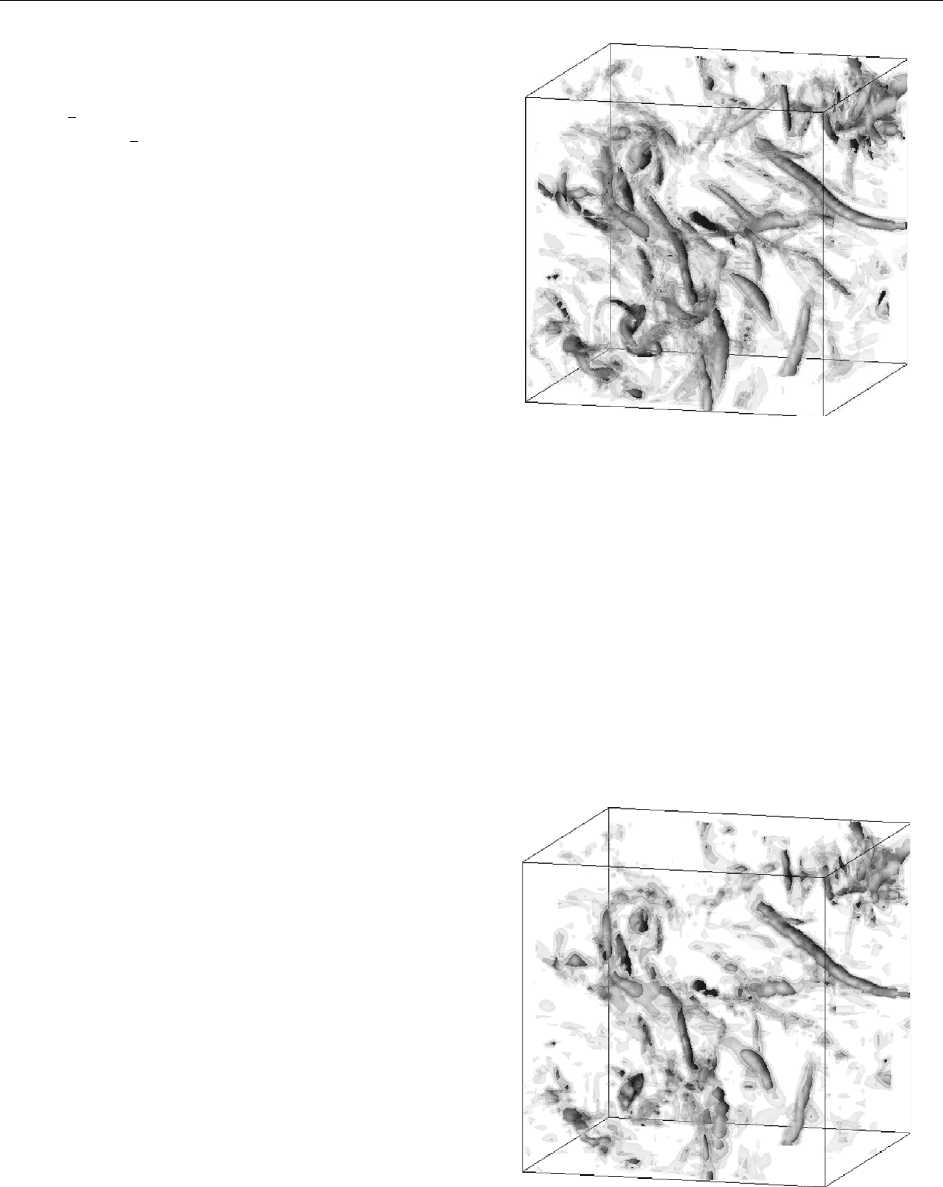
statistically stationary state is reached. Figure 2 shows
the modulus of the vorticity fluctuations of the total
flow, zooming on a 64
3
subcube to enhance structural
details. The flow exhibits elongated, distorted, and
folded vortex tubes, as observed in laboratory and
numerical experiments.
We apply to the total flow the wavelet compres-
sion algorithm described above. We find that only
2.9% wavelet modes correspond to the coherent
flow, which retains 79% of the energy (L
2
-norm of
velocity) and 75% of the enstrophy (L
2
-norm of
vorticity), while the remaining 97.1% incoherent
modes contain only 1% of the energy and 21% of
the enstrophy. We display the modulus of the
coherent (Figure 3) and incoherent (Figure 4) vorti-
city fluctuations resulting from the wavelet
decomposition.
Note that the values of the three isosurfaces chosen
for visualization (j!j= 6Z
1=2
,8Z
1=2
and 10Z
1=2
,with
Z the total enstrophy) are the same for the total and
coherent vorticities, but they have been reduced by a
factor 2 for the incoherent vorticity whose fluctuations
are much smaller. In the coherent vorticity (Figure 3)
we recognize the same vortex tubes as those present in
the total vorticity (Figure 2). In contrast, the remaining
vorticity (Figure 4) is much more homogeneous and
ω
Figure 2 Isosurfaces of total vorticity field, for
jwj= 3,4,5 with opacity 1, 0.5, 0.1, respectively, and
2
the
total enstrophy. Simulation with resolution N = 256
3
for R
= 168.
Zoom on a subcube 64
3
. Reprinted with permission from Farge
et al. Coherent vortex extraction in three-dimensional homo-
geneous turbulence: Comparison between CVS-wavelet and
POD-Fourier decompositions. Physics of Fluids 15(10): 2886–
2896. Copyright 2003, American Institute of Physics.
ω>
Figure 3 Isosurfaces of coherent vorticity field, for
jwj= 3,4,5 with opacity 1, 0.5, 0.1, respectively. Simulation
with resolution N = 256
3
. Zoom on a subcube 64
3
: Reprinted with
permission from Farge et al. Coherent vortex extraction in three-
dimensional homogeneous turbulence: Comparison between CVS-
wavelet and POD-Fourier decompositions. Physics of Fluids
15(10): 2886–2896. Copyright 2003, American Institute of Physics.
Wavelets: Application to Turbulence 415
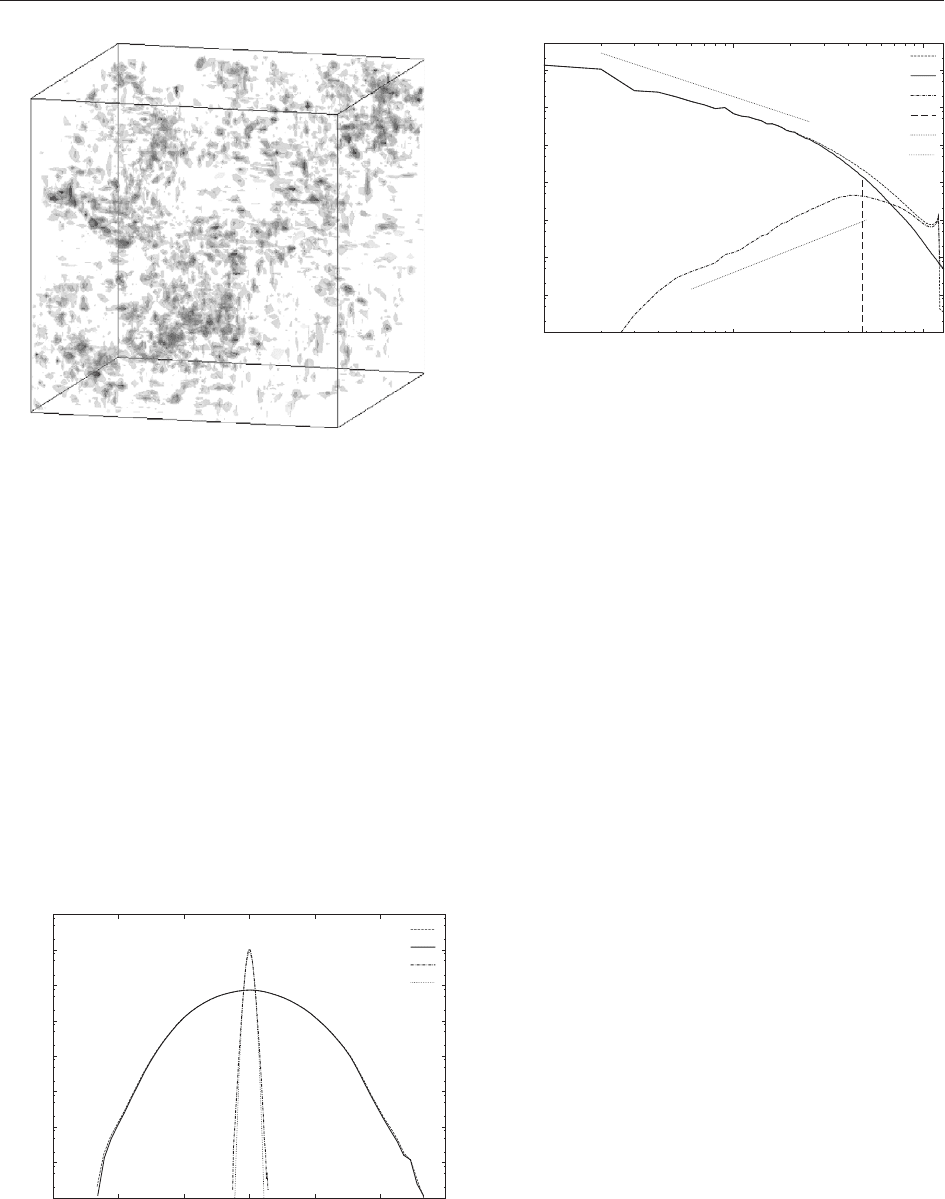
does not exhibit coherent structures. Hence, the
wavelet compression retains all the vortex tubes and
preserves their structure at all scales. Consequently, the
coherent flow is as intermittent as the total flow, while
the incoherent flow is structureless and non intermit-
tent. Modeling the effect of the incoherent flow onto
the coherent flow should then be much simpler than
with methods based on Fourier filtering.
Figure 5 shows the velocity PDF in semilogarithmic
coordinates. We observe that the coherent velocity has
the same Gaussian distribution as the total velocity,
while the incoherent velocity remains Gaussian, but its
variance is much smaller. The corresponding energy
spectra are plotted on Figure 6. We observe that the
spectrum of the coherent energy is identical to the
spectrum of the total energy all along the inertial
range. This implies that the vortex tubes are respon-
sible for the k
5=3
energy scaling, which corresponds to
a long-range correlation, characteristic of 3D turbu-
lence as predicted by Kolmogorov’s theory. In con-
trast, the incoherent energy has a scaling close to k
2
,
which corresponds to an energy equipartition between
all wave vectors k, since the isotropic spectrum is
obtained by integrating energy in 3D k-space over 2D
shells k = jkj. The incoherent velocity field is therefore
spatially uncorrelated, which is consistent with the
observation that incoherent vorticity is structureless
and homogeneous.
From these observations, we propose the following
scenario to interpret the turbulent cascade: the
coherent energy injected at large scales is transferred
towards small scales by nonlinear interactions between
vortex tubes. In the meantime, these nonlinear inter-
actions also produce incoherent energy at all scales,
which is dissipated at the smallest scales by molecular
kinematic viscosity. Thus, the coherent flow causes
direct transfer of the coherent energy into incoherent
energy. Conversely, the incoherent flow does not
trigger any energy transfer to the coherent flow, as it
is structureless and uncorrelated. We conjecture that
the coherent flow is dynamically active, while the
incoherent flow is slaved to it, being only passively
advected and mixed by the coherent vortex tubes. This
is a different view from the classical interpretation
since it does not suppose any scale separation. Both
ω<
Figure 4 Isosurfaces of incoherent vorticity field, for
jwj= 3=2,2,5=2 with opacity 1, 0.5, 0.1, respectively. Simula-
tion with resolution N = 256
3
. Zoom on a subcube 64
3
.Reprinted
with permission from Farge et al. Coherent vortex extraction in
three-dimensional homogeneous turbulence: Comparison between
CVS-wavelet and POD-Fourier decompositions. Physics of Fluids
15(10): 2886–2896. Copyright 2003, American Institute of Physics.
1e–07
1e–06
1e–05
0.0001
0.001
0.01
0.1
1
10
–30 –20 –10 0 10 20 30
Total
Coherent
Incoherent
Gaussian fit
Figure 5 Velocity PDF, resolution N = 256
3
with a zoom at
64
3
. Reprinted with permission from Farge et al. Coherent vortex
extraction in three-dimensional homogeneous turbulence: Com-
parison between CVS-wavelet and POD-Fourier decomposi-
tions. Physics of Fluids 15(10): 2886–2896. Copyright 2003,
American Institute of Physics.
1e–06
1e–05
0.0001
0.001
0.01
0.1
1
10
1 10 100
Total
Coherent
Incoherent
Fourier cut
k
(–5/3)
k
2
Figure 6 Energy spectrum, resolution N = 256
3
with a
zoom at 64
3
. Reprinted with permission from Farge et al.
Coherent vortex extraction in three-dimensional homogeneous
turbulence: Comparison between CVS-wavelet and POD-Fourier
decompositions. Physics of Fluids 15(10): 2886–2896. Copyright
2003, American Institute of Physics.
416 Wavelets: Application to Turbulence

coherent and incoherent flows are active all along the
inertial range, but they are characterized by different
probability distribution functions and correlations:
non-Gaussian and long-range correlated for the
former, while Gaussian and uncorrelated for the latter.
Wavelet Computation
Principle
The mathematical properties of wavelets (see Wave-
lets: Mathe matical Theory) motivate their use for
solving of partial differential equations (PDEs).
The localization of wavelets, both in scale and
space, leads to effective sparse representations of
functions and pseudodifferential operators (and their
inverse) by performing nonlinear thresholding of the
wavelet coefficients of the function and of the matrices
representing the operators. Wavelet coefficients allow
to estimate the local regularity of solutions of PDEs
and thus can define autoadaptive discretizations with
local mesh refinements. The characterization of func-
tion spaces in terms of wavelet coefficients and the
corresponding norm equivalences lead to diagonal
preconditioning of operators in wavelet space.
Moreover, the existence of the fast wavelet trans-
form yields algorithms with optimal linear complex-
ity. The currently existing algorithms can be
classified in different ways. We can distinguish
between Galerkin, collocation, and hybrid schemes.
Hybrid schemes combine classical discretizations,
for example, finite differe nces or finite volumes, and
wavelets, which are only used to speed up the linear
algebra and to define adaptive grids. On the other
hand, Galerkin and collocation schemes employ
wavelets directly for the discretization of the
solution and the operators. Wavelet methods have
been developed to solve Burger’s, Stokes, Kura-
moto–Sivashinsky, nonlinear Schro¨ dinger, Euler,
and Navier–Stokes equations. As an example, we
present an adaptive wavelet algorithm, of Galerkin
type, to solve the 2D Navier–Stokes equations.
Adaptive Wavelet Scheme
We consider the 2D Navier–Stokes equations writ-
ten in terms of vorticity ! and stream function ,
which are both scalars in two dimensi ons,
@
t
! þ v r! r
2
! ¼rF ½17
r
2
¼ ! and v ¼r
?
½18
for x 2 [0, 1]
2
, t > 0. The velocity is denoted by v, F
is an external force, >0 is the molecular kinematic
viscosity, and r
?
= (@
y
, @
x
).
The above equations are completed with bound-
ary conditions and a suitable initial condition.
Time discretization Introducing a classical semi-
implicit time discretization with a time step t and
setting !
n
(x) !(x, nt), we obtain
ð1 tr
2
Þ!
nþ1
¼!
n
þtðrF
n
v
n
r!
n
Þ
½19
r
2
nþ1
¼ !
nþ1
and v
nþ1
¼r
?
nþ1
½20
Hence, in each time step two elliptic problems
have to be solved and a differential operator has to
be applied.
Formally the above equations can be written in
the abstract form Lu = f , where L is an elliptic
operator with constant coefficients. This corre-
sponds to a Helmholtz type equation for ! with
L = (1 tr
2
) and a Poisson equation for with
L = r
2
.
Spatial discretization For the spatial discretization,
we use the method of weighted residuals, that is, a
Petrov–Galerkin scheme. The trial functions
are orthogonal wavelets and the test functions
are operator adapted wavelets, called ‘‘vaguelettes,’’
. To solve the elliptic equation Lu = f at time
step t
nþ1
, we develop u
nþ1
into an orthogonal
wavelet series, that is, u
nþ1
=
P
e
u
nþ1
, where
= (j, i
x
, i
y
, d) denotes the multi-index for scale j,
space i, and direction d. Requiring that the residual
vanishes with respect to all test functions
,we
obtain a linear system for the unknown wavelet
coefficients
e
u
nþ1
of the solution u:
X
e
u
nþ1
hL
;
0
i¼hf ;
0
i½21
The test functions are defined such that the
stiffness matrix turns out to be the identity.
Therefore, the solution of Lu = f reduces to a
change of basis, that is, u
nþ1
=
P
hf ,
i
. The
right-hand side (RHS) f can then be develop ed into a
biorthogonal operator adapted wavelet
basis f =
P
hf ,
i
, with
= L
?1
and
= L
,
?
denoting the adjoint operator. By
construction, and are biorthogonal, that is,
such that h
,
0
i=
,
0
. It can be sho wn that
both have similar localization properties in physical
and Fourier space as , and that they form a Riesz
basis.
Adaptive discretization To get an adaptive space
discretization for the linear problem Lu = f ,we
Wavelets: Application to Turbulence 417