
Francoise J.-P., Naber G.L., Tsun T.S. (editors) Encyclopedia of Mathematical Physics
Подождите немного. Документ загружается.


See Evans and Kawahigashi (1998) and Goodman et
al. (1989) for these constructions and clas sifications.
Evans-Kawahigashi and Xu studied the orbifold
construction of subfactors applied to the Hecke
algebra subfactors of Wenzl.
In a theory of integrable lattice models, we have
squares with labeled edges, and we assign complex
numbers to them. A paragroup has much formal
similarity to such a lattice model, and the para-
groups of subfactors of Jones and Wenzl correspond
to the lattice models of Andrews–Baxter–Forrester.
Goodman–de la Harpe–Jones have another con-
struction of subfactors from the Dynkin diagrams,
and for E
6
this gives a hyperfinite type II
1
subfactor
with Jones index 3 þ
ffiffiffi
3
p
and finite depth. Haagerup
has made a combinatorial study on type II
1
sub-
factors with Jones index values between 4 and 3 þ
ffiffiffi
3
p
and obtained a list of candidates of possible higher
relative commutants. Haagerup himself showed one
in the list with Jones index (5 þ
ffiffiffiffiffiffi
13
p
)=2 is indeed
realized. Asa eda–Haagerup showed that another in
the list having the Jones index (5 þ
ffiffiffiffiffiffi
17
p
)=2 is also
realized. These two examples are still among the
most mysterious examples of subfactors today and
do not seem to arise from other constructions using
quantum groups or conformal field theory. Izumi
has another construction of a subfactor with the
Jones index (7 þ
ffiffiffiffiffiffi
29
p
)=2 using an endomorphism of
the Cuntz algebra.
Popa has obtained a complete characterization of
higher relative commutants including the case of
infinite depth, and axiomatized the higher relative
commutant as the standard -lattices. Xu has
constructed standard -lattices, hence subfactors,
from quantum groups. This realization of Popa of a
given standard -lattice produces a nonhyperfinite
type II
1
subfactor. Popa–Shlyakhtenko later showed
that any standard -lattice is realized for a subfactor
of a single type II
1
factor, a group II
1
factor arising
from the free group F
1
having countably many
generators, which is not hyperfinite.
Jones (1999) has introduced a combinatorial
characterization of standard -lattices as planar
algebras. This approach uses planar operads based
on tangles and provides a new viewpoint on the
structure of higher relative commutants. More
studies on planar algebras have been done by
Bisch–Jones.
Topological Invariants in Three
Dimensions and Tensor Categories
Through the relations of the Jones projections, Jones
(1985) discovered the Jones polynomial as an
invariant for links. This was the beginning of series
of entirely new theories in three-dimensional topol-
ogy. The Jones polynomial was quickly generalized
to the two-variable HOMFLY polynomial by Hoste,
Ocneanu, Millet, Freyd, Lickorish, and Yetter.
A three-dimensional topological quantum field
theory (TQFT
3
) assigns a complex number to each
closed oriented 3-manifold and a finite dimensional
vector space to each closed oriented surfa ce.
Furthermore, to each compact oriented 3-manifold
with boundary, it assigns a vector in the vector space
corresponding to its boundary. Turaev–Viro have
constructed TQFT
3
from combinatorial data called
quantum 6j-symbols arising from quantum groups.
Ocneanu has found that a subfactor of finite index
and finite depth also produces quantum 6j-symbols,
which give rise to a TQFT
3
generalizing the Turaev–Viro
construction. See Evans and Kawahigashi (1998) for
this construction. Reshetikhin–Turaev have another
construction of TQFT
3
from a modular tensor
category, which is a braided tensor category with
nondegenerate braiding. Ocneanu has found a
subfactor version of the quantum double construc-
tion which produces a modular tensor category
from a type II
1
subfactor of finite index and finite
depth. From a type II
1
subfactor of finite index and
finite depth, we can apply Ocneanu’s generalization
of the Turaev–Viro construction on one hand, and
also the Reshetikhin–Turae v constructio n to the
modular tensor category arising from the quantum
double construction of Ocneanu . The resulting two
TQFT
3
s are shown to be equal by Kawahigashi–
Sato–Wakui. Concrete computations of these topo-
logical invariants have been made by Sato–Wakui
based on Izumi’s work. Turaev and Wenzl have
other constructions of TQFT
3
and modular tensor
categories.
Algebraic Quantum Field Theory
An operator algebraic approach to quantum field
theory is called algebraic quantum field theory and
the standard reference is Haag (1996). In this
approach, instead of quantum fields which are
operator-valued distributions, we consider a family
{A(O)} of von Neumann algebras parametrized by
spacetime regions O in a Minkowski space. Each
A(O) is meant to be generated by self-adjoint
operators which are observables in O. We axioma-
tize such a family of von Neumann algebras and call
one a local net of von Neumann algebras. It is
enough to take O of a special form, called a double
cone. The name ‘‘local’’ comes from the locality
axiom whi ch is a mathematical expression of the
Einstein causality on a Minkow ski space. The
388 von Neumann Algebras: Subfactor Theory

Poincare´ group is used as the spacetime symmetry of
the Minkowski space. Doplicher et al. (1971, 1974)
have introd uced a representation theory of a local
net A of von Neumann algebras and found that a
‘‘physically nice’’ representation is realized as an
endomorphism of a one von Neumann algebra A(O)
for some fixed O. They have a notion of a statistical
dimension for such a representation and it is an
integer (or infinite) if the spacetime dimension is
larger than 2. Longo (1989, 1990) has shown that
this statistical dimension of a representation is equal
to the square root of the index [A(O):(A(O))],
where is the corresponding endomorphism of
A(O) to the representation. The relation between
algebraic quantum field theory and subfactor theory
has been found in this way. Longo (1989, 1990) has
also started a theory of canonical endomorphisms
for a subfactor and Izumi has further studied it.
Longo has later obtained a characterization when an
endomorphism of a factor becomes a canonical
endomorphism by introducing a Q-system.
Recently, conformal field theory has attracted
much attention. An approach based on algebraic
quantum field theory describes a conformal field
theory with a local net of von Neumann algebras on
a two-dimensional Minkowski space with diffeo-
morphism group as the spacetime symmetry. We can
restrict such a theory into a tensor product of two
theories on the circle, the compactified one-
dimensional Euclidean space. Each theory on the
circle is called a chiral conformal field theory and
described by a local conformal net of von Neumann
algebras, which is a family of von Neumann
algebras parametrized by intervals on the circle.
The name ‘‘conformal’’ comes from the fact that we
use the orientation preserving diffeomorphism group
on the circle as the symmetry group of the space. For
a local conformal net A of vo n Neumann algebras
on the circle with natural irreducibility assumption,
each von Neumann algebra A(I) is automatically a
type III factor. The Doplicher–Haag–Roberts theory
works in this setting after an appropriate adaptation
as in Fredenhagen et al. (1989) and each representa-
tion of a local conformal net of von Neumann
algebras is realized by an endomorphism of A (I),
where I is an arbitrarily fixed interval on the circle.
(Here we do not need an assumption that a
representation is ‘‘physically nice’’ since it now
automatically holds.) Now the representations give
a braided tensor category.
Buchholz–Mack–Todorov constructed examples of
local conformal nets of von Neumann algebras on the
circle using the U(1)-current algebra. Wassermann
(1998) has constructed more examples using positive
energy representations of the loop groups LSU(N)
and computed their representation theory, and his
construction has been extended to other Lie groups
by Toledano Laredo and others. For the local
conformal net A of von Neumann algebras on the
circle arising from LSU(N), we take an endomorph-
ism of A(I) arising from a representation of the
local conformal net, then we have a subfactor
(A(I)) A(I). This is isomorphic to the type II
1
subfactor constructed by Jones and Wenzl tensored
with a common type III factor.
Longo–Rehren (1995) started the study of a local
net of subfactors, A(I) B(I). They have defined a
certain induction procedure which gives a represen-
tation of the larger local conformal net B from that
of A. This procedure is today called -induction. Xu
has studied this procedure and found several basic
properties. In the cases of local conformal nets of
subfactors arising from conformal embeddings, he
has found a simple construction of subfactors with
principal graphs E
6
and E
8
using -induction.
In the context of subfactor theory, -induction
has been further studied by Bo¨ ckenhauer–Evans–
Kawahigashi, together with graphical methods of
Ocneanu on the Dynkin diagrams. More detailed
studies on local conformal nets of factors on the
circle have been pursued partly using various
techniques of subfactor theory, including classifica-
tion of local conformal nets of von Neumann
algebras on the circle with central charge less than
1 by Kawahigashi–Longo.
See also: Algebraic Approach to Quantum Field Theory;
Braided and Modular Tensor Categories; C
-Algebras
and Their Classification; Hopf Algebras and
q-Deformation Quantum Groups; The Jones Polynomial;
Quantum 3-Manifold Invariants; Quantum Entropy; von
Neumann Algebras: Introduction, Modular Theory, and
Classification Theory; Yang–Baxter Equations.
Further Reading
Doplicher S, Haag R, and Roberts JE (1971) Local observables
and particle statistics, I. Communications in Mathematical
Physics 23: 199–230.
Doplicher S, Haag R, and Robert JE (1974) Local observables an
particle statistics, II. Communications in Mathematical Phy-
sics 35: 49–85.
Evans DE and Kawahigashi Y (1998) Quantum Symmetries on
Operator Algebras. Oxford: Oxford University Press.
Fredenhagen K, Rehren K-H, and Schroer B (1989) Superselection
sectors with braid group statistics and exchange algebras.
Communications in Mathematical Physics 125: 201–226.
Goodman F, de la Harpe P, and Jones VFR (1989) Coxeter
Graphs and Towers of Algebras, vol. 14. Berlin: MSRI
Publications, Springer.
Haag R (1996) Local Quantum Physics. Berlin: Springer.
Jones VFR (1983) Index for subfactors. Inventiones Mathematical
72: 1–25.
von Neumann Algebras: Subfactor Theory 389

Jones VFR (1985) A polynomial invariant for knots via von
Neumann algebras. Bulletin of the American Mathematical
Society 12: 103–112.
Jones VFR (1999) Planar algebras, I, math.QA/9909027.
Longo R (1989) Index of subfactors and statistics of quantum fields I.
Communications in Mathematical Physics 126: 217–247.
Longo R (1990) Index of subfactors and statistics of quantum
fields II. Communications in Mathematical Physics 130:
285–309.
Longo R and Rehren K-H (1995) Nets of subfactors. Reviews in
Mathematical Physics 7: 567–597.
Ocneanu A (1988) Quantized group, string algebras and Galois
theory for algebras. In: Evans DE and Takesaki M (eds.)
Operator Algebras and Applications, vol. 2 (Warwick 1987),
London Mathematical Society Lecture Note Series, vol. 36,
pp. 119–172. Cambri dge: Cambridge University Press.
Pimsner M and Popa S (1986) Entropy and index for subfactors.
Annales Scientifques de l’Ecole Normale 19: 57–106.
Popa S (1994) Classification of amenable subfactors of type II.
Acta Mathematica 172: 163–255.
Popa S (1995) An axiomatization of the lattice of higher relative
commutants of a subfactor. Inventiones Mathematicae 120:
427–445.
Takesaki M (2002, 2003) Theory of Operator Algebras I, II, III.
Berlin: Springer.
Wassermann A (1998) Operator algebras and conformal field theory
III: Fusion of positive energy representations of SU(N)using
bounded operators. Inventiones Mathematicae 133: 467–538.
Vortex Dynamics
M Nitsche, University of New Mexico, Albuquerque,
NM, USA
ª 2006 Elsevier Ltd. All rights reserved.
Introduction
A vortex is commonly associated with the rotating
motion of fluid around a common centerline. It is
defined by the vorticity in the fluid, which measures
the rate of local fluid rotation. Typically, the fluid
circulates around the vortex, the speed increases as
the vortex is approached and the press ure decreases.
Vortices arise in nature and technology applications
in a large range of sizes, as illustrated by the
examples given in Table 1. The next section presents
some of the mathematical background necessary to
understand vortex formation and evolution. Next,
some sample flows are described, including impor-
tant instabilities and reconnection processes. Finally,
some of the numerical methods used to simulate
these flows are presented.
Background
Let D be a region in three-dimensional (3D) space
containing a fluid, and let x = (x, y, z)
T
be a point in
D. The fluid motion is described by its velocity
u(x, t) = u(x, t)i þ v(x, t)j þ w(x, t)k, and depends on
the fluid density (x, t), temperature T(x, t), gravita-
tional field g, and other external forces possibly
acting on it. The fluid vorticity is defined by w = ru.
The vorticity measures the local fluid rotation about an
axis, as can be seen by expanding the velocity near
x = x
0
,
uðxÞ¼uðx
0
ÞþDðx
0
Þðx x
0
Þþ
1
2
wðx
0
Þðx x
0
Þ
þ Oðjx x
0
j
2
Þ½1
where
Dðx
0
Þ¼
1
2
ðru þru
T
Þ; ru ¼
u
x
u
y
u
z
v
x
v
y
v
z
w
x
w
y
w
z
2
4
3
5
½2
The first term u(x
0
) corresponds to translation: all
fluid particles move with constant velocity u(x
0
).
The second term D(x
0
)(x x
0
) corresponds to a
strain field in the three directions of the eigenvectors
of the symmetric matrix D. If the eigenvalue
corresponding to a given eigenvector is positive,
the fluid is stretched in that direction, if it is
negative, the fluid is compressed. Note that, in
incompressible flow, ru = 0, so the sum of the
eigenvalues of D equals zero. Thus, at least one
eigenvalue is positive and one negative. If the third
eigenvalue is positive, fluid particles move towards
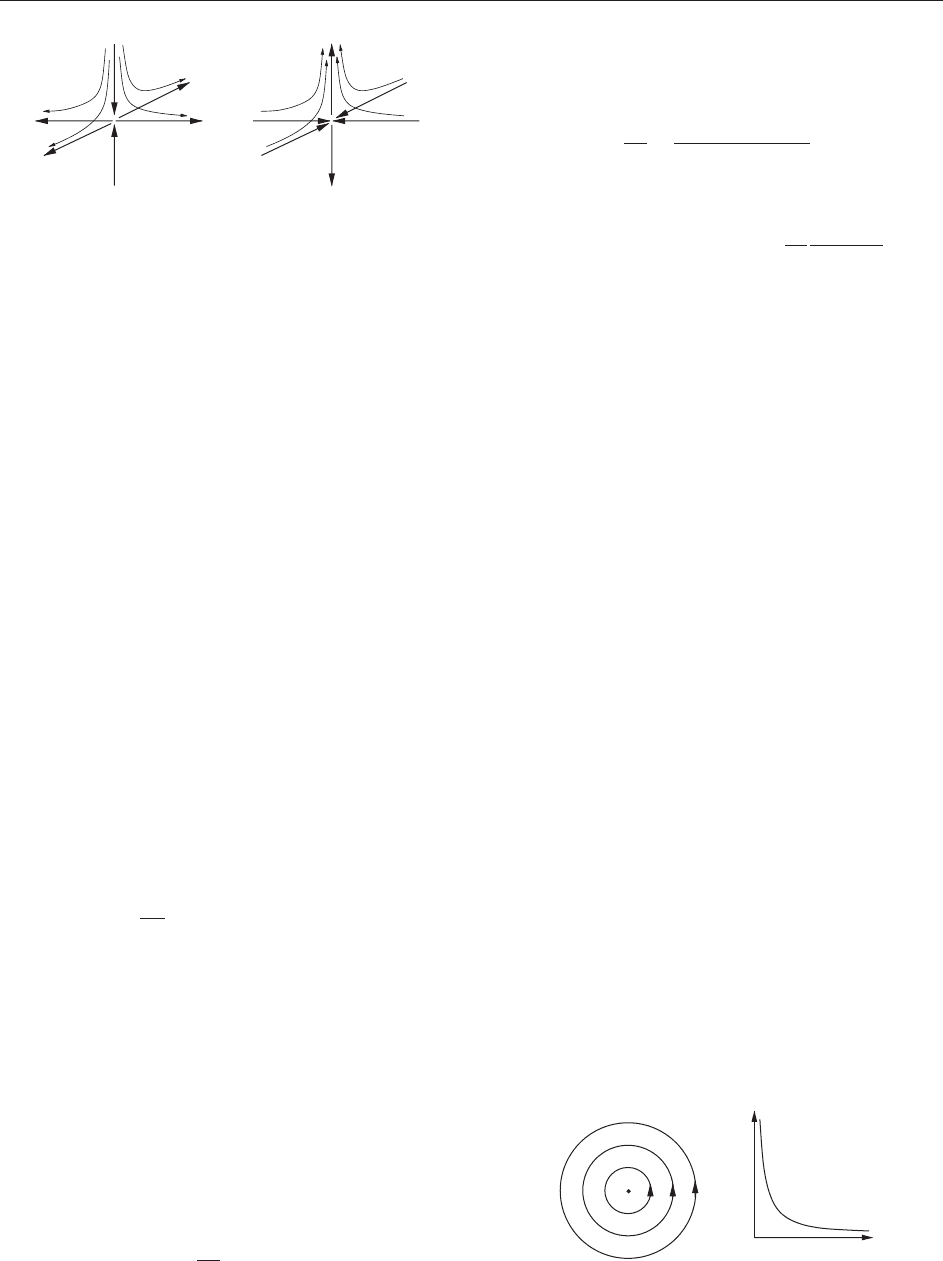
sheets (Figure 1a). If the third eigenvalue is negative,
fluid particles move towards tub es (Figure 1b). The
last term in eqn [1], (1/2)w(x
0
) (x x
0
), corre-
sponds to a rotation: near a point with w(x
0
) 6¼ 0,
the fluid rotates with angular velocity jwj=2ina
plane normal to the vorticity vector w. Fluid for
which w = 0 is said to be irrotational.
A vortex line is an integral curve of the vorticity.
For incompressible flow, rw = r(ru) = 0,
which implies that vortex lines cannot end in the
interior of the flow, but must either form a closed loop
Table 1 Sample vortices and typical sizes
Vortex Diameter
Superfluid vortices 10
8
cm ( = 1A
˚
)
Trailing vortex of Boeing 727 1–2 m
Dust devils 1–10 m
Tornadoes 10–500 m
Hurricanes 100–2000 km
Jupiter’s Red Spot 25 000 km
Spiral galaxies Thousands of light years
390 Vortex Dynamics
interior of the flow, but must either form a closed loop
or start and end at a bounding surface. In 2D flow,
u = ui þ vj and the vorticity is w = !k,where! is the
scalar vorticity. Thus, in 2D, the vorticity points in the
z-direction and the vortex lines are straight lines
normal to the x–y plane. A vortex tube is a bundle
of vortex lines. The strength of a vortex tube is defined
as the circulation
R
C
u ds about a curve C enclosing
the tube. By Stokes’ theorem,
Z
C
u ds ¼
ZZ
A
w n dS ½3
and thus the circulation can also be interpreted as
the flux of vorticity through a cross section of the
tube. In inviscid incompressible flow of constant
density, Helmholtz’ theorem states that the tube
strength is independent of the curve C, and is
therefore a well-defined quantity, and Kelvin’s
theorem states that a tube’s strength remains
constant in time. A vortex filament is an idealization
in which a tube is represented by a single vortex line
of nonzero strength.
The evolution equation for the fluid vorticity, as
derived from the Navier–Stokes equations, is
dw
dt
¼ w ru þ w ½4
where d=dt = @=@t þ u r is the total time deriva-
tive. Equation [4] states that the vorticity is
transported by the fluid velocity (first term),
stretched by the fluid velocity gradient (second
term), and diffused by viscosity (last term). These
equations are usually nondimensionalized and writ-
ten in terms of the Reynolds number, a dimension-
less quantity inversely proportional to viscosity.
To understand high Reynolds number flow it is of
interest to study the inviscid Euler equations. The
corresponding vorticity evolution equation in 2D is
d!
dt
¼ 0 ½5
which states that 2D vortex filaments in inviscid
flow move with the fluid velocity. Furthermore, in
incompressible flow, the fluid velocity is determined
by the vorticity, up to an irrotational far-field
component u
1
, through the Biot–Savart law,
uðxÞ¼
1
4
Z
ðx x
0
Þwðx
0
Þ
jx x
0
j
3
dx
0
þ u
1
½6
In planar 2D flow, eqn [6] reduces to
uðxÞ¼K
2D
!; K
2D
ðxÞ¼
1
2
yi þ xj
jxj
2
½7
where !(x) is the scalar vorticity. Equations [4], [5]
and [6], [7] are the basis of the numerical methods
discussed later in this article.
A vortex is typically defined by a region in the
fluid of concentrated vorticity. A simple model is a
point vortex in 2D flow, which corresponds to a
straight vortex filament of unit circulation. The
associated scalar vorticity is a -function in the
plane, and the induced velocity is obtained from the
Biot–Savart law. For a point vortex at the origin,
this reduces to the radial velocity field
u(x) = K
2D
= K
2D
(x). Corresponding particle tra-
jectories are shown in Figure 2a. The particle speed
juj= 1=(2r) increases unboundedly as the vortex
center is approached, and vanishes as r !1
(Figure 2b). In general, the far-field velocity of a
concentrated vortex behaves similarly to the one of
a point vortex, with speeds decaying as 1=r. Near
the vortex center, the velocity typically increases in
magnitude and, as a result, the fluid pressure
decreases (Bernoulli’s theorem). A vortex of arbi-
trary shape can be approximated by a sum of point
vortices (in 2D) or vortex filaments (in 3D), as is
often done for simulation purposes.
Vorticity can be generated by a variety of
mechanisms. For example, vorticity can be gen-
erated by density gradients, which in turn are
induced by spatial temperature variations. This
mechanism explains the formation of warm-air
vortices when a layer of hot air is trapped
underneath cooler air. Vorticity is also generated
near solid walls in the form of boundary layers
caused by viscosity. To illustrate, imagine
(a)
(b)
Figure 1 Strain field: (a) two positive eigenvalues, sheet
formation and (b) one positive eigenvalue, tube formation.
(a) (b)
Distance, r
Speed, |u |
Figure 2 Flow induced by a point vortex: (a) streamlines and
(b) speed juj vs. distance r.
Vortex Dynamics 391
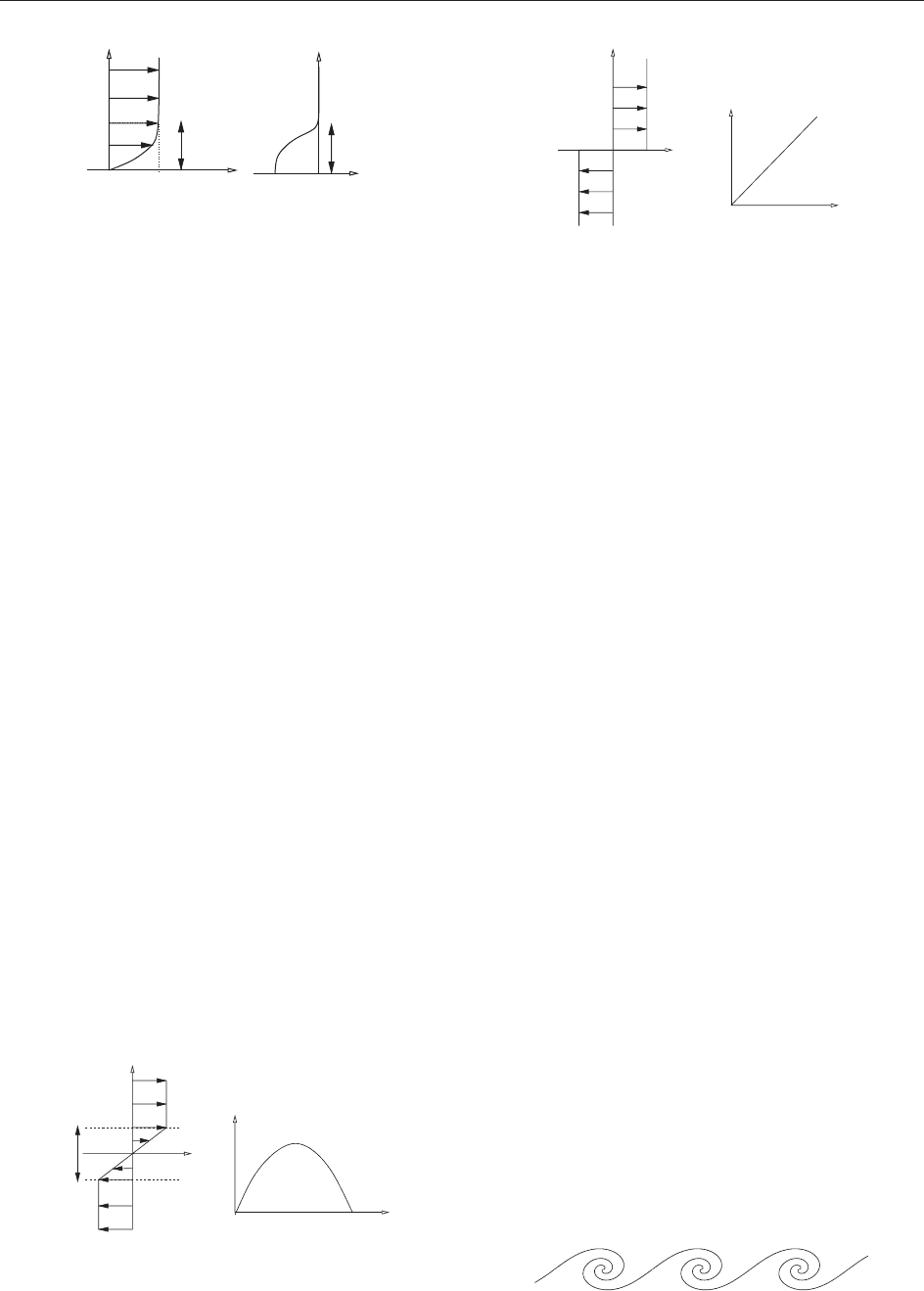
horizontal flow with speed U
o
moving past a
solid wall at rest (Figure 3a). Since in viscous
flow the fluid sticks to the wall (the no-slip
boundary condition), the fluid velocity at the wall
is zero. As a result, there is a thin layer near the
wall in which the horizontal velocity varies
greatly while the vertical velocity gradients are
small, yielding large negative vorticity values
! = v
x
u
y
(Figu re 3b). Similarity solutions to
the approximating Prandtl boundary-layer equa-
tions show that the boundary-layer thickness d
grows proportional to
ffiffi
t
p
,wheret measures the
time from the beginning of the motion. Boundary
layers can separate from the wall at corners or
regions of high curvature and move into the fluid
interior, as illustrated in several of the following
examples.
Sample Vortex Flows
Shear Layers
A shear layer is a thin region of concentrated
vorticity across which the tangential velocity com-
ponent varies greatly. An example is the constant-
vorticity layer given by parallel 2D flow
u(x, y) = U(y), v(x, y) = 0, where U is as shown in
Figure 4a. In this case, the velocity is constant
outside the layer and linear inside. The vorticity
! = U
0
(y) is zero outside the layer and constant
inside. Shear layers occur naturally in the ocean or
atmosphere when regions of distinct temperature or
density meet. To illustrate this scenario, consider a
tank containing two horizontal layers of fluids of
different densities, one on top of the other. If the
tank is tilted, the heavier bottom fluid moves
downstream, and the lighter one moves upstream,
creating a shear layer.
Flat shear layers are unstable to perturbations:
they do not remain flat but roll up into a sequence
of vortices. This is the Kelvin–Helmholtz instability,
which can be deduced analytically using linear
stability analysis. One shows that in a periodically
perturbed flat shear layer, the amplitude of a
perturbation with wave number k will initially
grow exponentially in time as e
wt
, where w = w(k)
is the dispersion relation, leading to instability. The
wave number of largest growth depends on the layer
thickness. This is illustrated in Figure 4b, which
plots w(k) for a constant-vorticity layer of thickness
2d. The wave number of maximal growth is
proportional to 1=d.
A vortex sheet is a model for a shear layer. The
layer is approximated by a surface of zero thickness
across which the tangential velocity is discontinu-
ous, as illustrated in Figure 5a. In this case, the
dispersion relation reduces to w(k) = k. That is,
for each wave number k there is a growing and a
decaying mode, and the growing mode grows faster
the higher the wave number is, as shown in
Figure 5b. The vortex sheet arises from a constant
vorticity shear layer as the thickness d ! 0 and the
vorticity ! !1in such a way that the product !d
remains constant. Figure 6 shows the roll-up of a
periodically perturbed vortex sheet due to the
y
ω
U
o
u
y
d
(a) (b)
Figure 3 Velocity and vorticity in boundary layer near a flat
wall.
2D
y
U
(a) (b)
0.65
kd
w
Figure 4 Shear layer: (a) velocity profile and (b) dispersion
relation.
y
U
(a) (b)
w
k
Figure 5 Vortex sheet: (a) velocity profile and (b) dispersion
relation.
Figure 6 Computation of vortex sheet roll-up.
392 Vortex Dynamics
Kelvin–Helmholtz instability, computed using one of
the methods described in the next section.
Aircraft Trailing Vortices
One can often observe trailing vortices that shed
from the wings of a flying aircraft (also called
contrails). These vortices are formed because the
wing develops lift. The pressure on the top of the
wing is lower than on bottom, causing air to move
around the edge of the wing from the bottom
surface to the top. The boundary layer on the wing
separates as a shear layer that rolls up into a vortex
attached to the tip of the wing (Figure 7). Since the
velocity inside the vortex is high, the pressure is
correspondingly low and causes water vapor in the
air to condense, forming water droplets that
visualize the vortices. The vortex strength increases
with increasing lift, and is particularly strong in
high-lift conditions such as take-off and landing.
Since lift is proportional to weight, it also increases
with the size of the airplane. Vortices of large planes
are strong enough to flip a small one if it gets too
close. Trailing vortices are the principal reason for
the time delay between take-off and landing and are
still a serious issue for crowded urban airports.
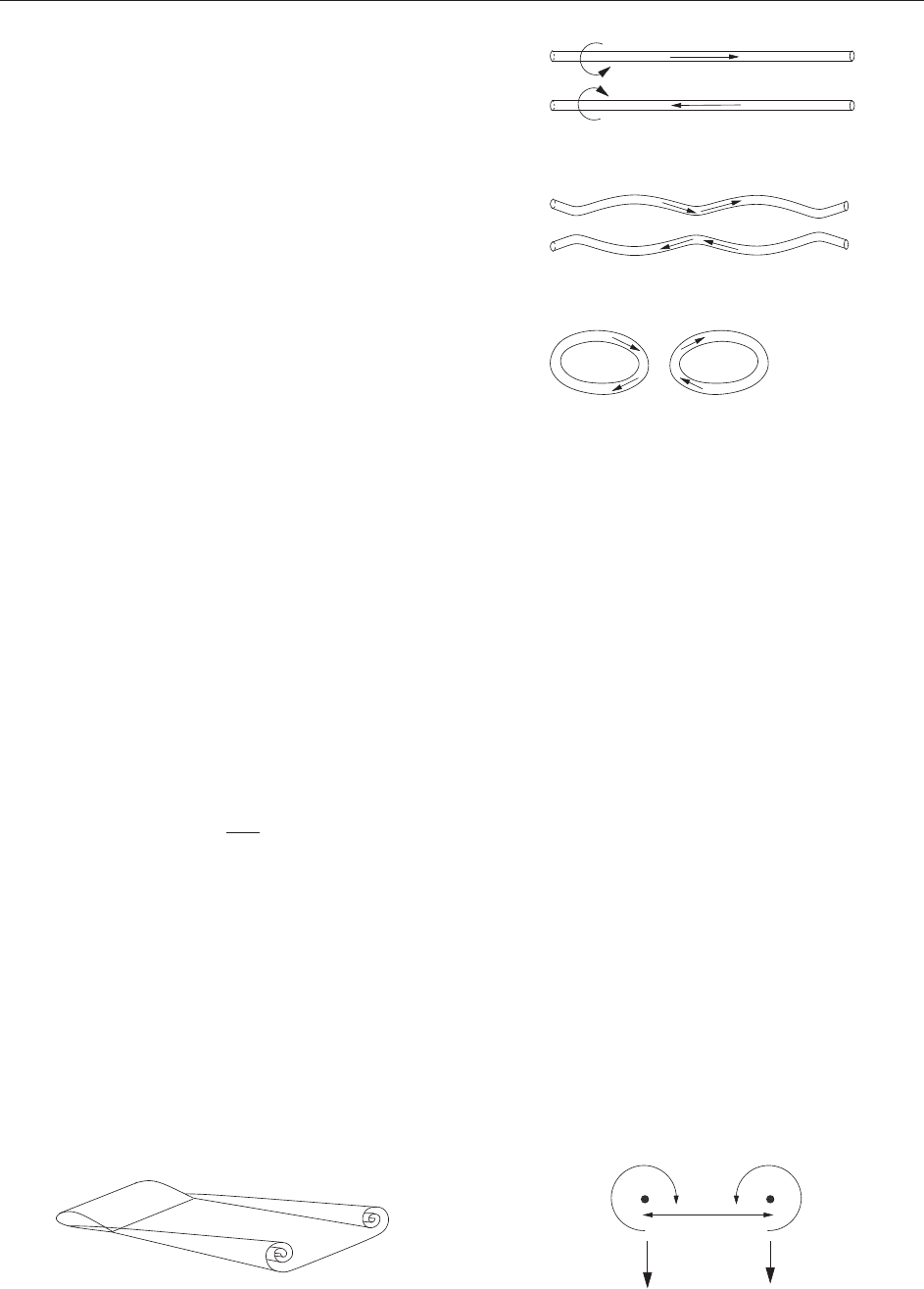
The trailing vortices can be modeled by a pair of
counter-rotating vortex lines (Figure 8a). Two
parallel vortex lines of opposite strength induce a
downward motion on each other, similar to two
point vortices, the zero-core limit. Two point
vortices of strength at a distance 2d from each
other translate with self-induced velocity (Figure 9):
U ¼
4d
½8
As a result trailing vortices near takeoff hit the
ground as a strong downwash air current.
Vortex decay results generally from the develop-
ment of instabilities. Two parallel vortex tubes are
subject to the long-wavelength Crow instability.
Triggered by turbulence in the surrounding air, or
by local variations in air temperature or density, the
vortices develop symmetric sinusoidal perturbations
with long wavelength, of the same order as the
vortex separation (Figure 8b). As the perturbations
grow to finite amplitude, the tubes reconnect and
produce a sequence of vortex rings. Note that the
two-dimensional schematic in Figure 8c does not
convey the three-dimensional structure of the rings.
The reconnection process destroys the initial wake
structure more rapidly than viscous decay of the
individual filaments.
Of much interest is the study of how to accelerate
the vortex decay. High-aspect-ratio vortices are subject
to a shorter-wavelength elliptic instability, which leads
to earlier destruction. However, such vortices are not
realistic in current aircraft wakes. Wing designs have
been proposed in which more than two trailing
vortices form which interact strongly and lead to
faster decay. Other interesting aspects are the effect of
ambient turbulence and vortex breakdown. Break-
down refers to a disturbance in the vortex core in
which it quickly, within an axial distance of few core
diameters, develops a region of reversed flow and loses
its laminar behavior.
Unlike the counter-rotating vortices discussed so
far, two equally signed vortices rotate under their
self-induced velocity about a common axis. If the
separation distance between them is too small, two
equally signed patches merge into one. Vortex
merging occurs in two- or three-dimensional flows,
as opposed to vortex reconnection, which is a
strictly three-dimensional phenomenon.
Figure 7 Sketch. Shear layer separation and roll-up into
trailing vortices behind an airfoil.
(a)
(b)
(c)
Figure 8 Sketch. Onset of Crow instability in a pair of vortex
lines and ensuing reconnection.
Γ−Γ
2d
U
Figure 9 Self-induced downward motion of a vortex pair.
Vortex Dynamics 393
Vortex Rings
A vortex tube that forms a closed loop is called a
vortex ring. Vortex rings can be formed by ejecting
fluid from a circular opening, such as when a smoke
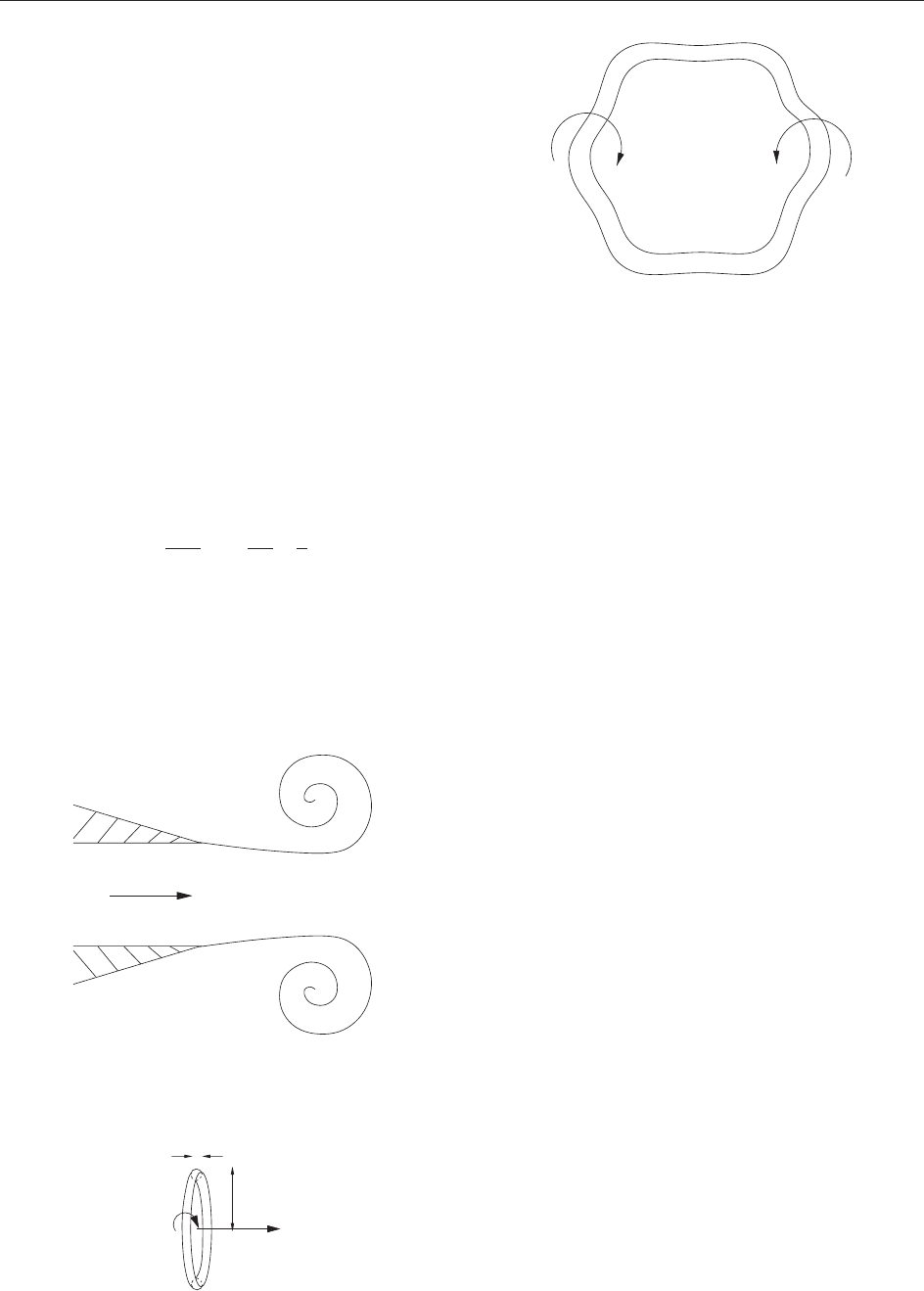
ring is formed. The boundary layer wall vorticity
separates at the opening as a cylindrical shear layer
that rolls up at its edge into a ring (Figure 10). The
vorticity is concentrated in a core, which may be
thin or thick relative to the ring diameter. The
limiting cases are an infinitely thin circular filament
of nonzero circulation and the Hill’s vortex, in
which the vorticity occupies all the interior of a
sphere.
Just as a counter-rotating vortex pair, a ring
translates under its self-induced velocity U in
direction normal to the plane of the ring (Figure 11).
However, unlike the vortex pair, the ring velocity
depends significantly on its core thickness. For a ring
with radius, circulation and core size, respectively,
R, , a, the self-induced velocity is
U
4R
log
8R
a
1
4
½9
asymptotically as a ! 0. Thus, the translation
velocity becomes unbounded for rings with decreas-
ing core size. In reality, at some point viscosity takes
over and spreads the core vorticity, slowing the ring
down.
Vortex rings of small cross section are subject
to an azimuthal instability. Theory, experiment,
and simulations show that if a ring is perturbed
in the azimuthal direction, there exists a domi-
nant wave number which is unstable and grows
(Figure 12). The unstable wave number increases
as the core size decreases, while its spatial
amplification rate is almost independent of the
core size.
Interesting dynamics are obtained when two or
more rings interact. Two coaxial vortex rings of
equally signed circulation move in the same
direction and exhibit leap-frogging: the rear ring
causes the front ring to grow in radius and the
front ring causes the rear one to decrease. From
eqn [9] it can be seen that the ring velocity is
inversely proportional to its radius. Consequently,
the front ring slows down and the rear ring
speeds up, until the rear ring travels through the
front ring. This process repeats itself and is
known as leap-frogging. On the other hand, two
coaxial vortex rings of oppositely signed circula-
tion approach each other and grow in radius.
Their cores contract in order to preserve volume,
and their vorticity increases in order to preserve
circulation. Under certain experimental condi-
tions, the azimuthal instability develops, the
resulting waves on opposite rings reconnect and
a sequence of smaller rings form.
Vortices, Mixing, and Chaos
Mixing is important in many natural processes and
technological applications. For example, mixing in
shear flows and wakes is relevant to aeronautics and
combustion, mixing and diffusion determine chemi-
cal reaction rates, and mixing of contaminants
pollutes oceans and atmosphere. It is therefore
important to understand and control mixing
processes.
Efficient mixing of two fluids is obtained by
efficient stretching and folding of material lines.
Figure 10 Vortex ring, formed by ejecting fluid from a circular
tube.
Γ
a
R
U
Figure 11 Self-induced motion of a vortex ring.
Figure 12 Sketch. Onset of azimuthal vortex ring instability.
394 Vortex Dynamics
Stretching and folding in turn are the fingerprint
of chaos; thus, mixing and chaos are intimately
related. Mixing and associated chaotic fluid
motion can be obtained by simple vortical
motion. For example, two counter-rotating vor-
tices subject to a periodic strain field oscillate in a
regular fashion but induce chaos in a region of
fluid moving with them. Similarly, two corotating
vortices of equal strength that are turned on and
off periodically so that one is on when the other
is off, known as the blinking vortices, rotate
around a common axis in a stepwise manner but
induce chaos in nearby regions. On the other
hand, if there are four or more vortices present,
the vortex motion itself is generally chaotic. It
should be noted that there are also nonchaotic
equilibrium solutions of four or more vortices
forming what is called a vortex crystal.
Information about chaotic particle motion is
obtained by studying Poincare´ sections, examining
the associated stable and unstable manifolds, and
investigating the existence of chaotic maps such as
the horseshoe map.
Atmospheric Vortices
Atmospheric vortices are driven by temperature
gradients, Earth’s rotation (Coriolis force), spatial
landscape variations, and instabilities. For example,
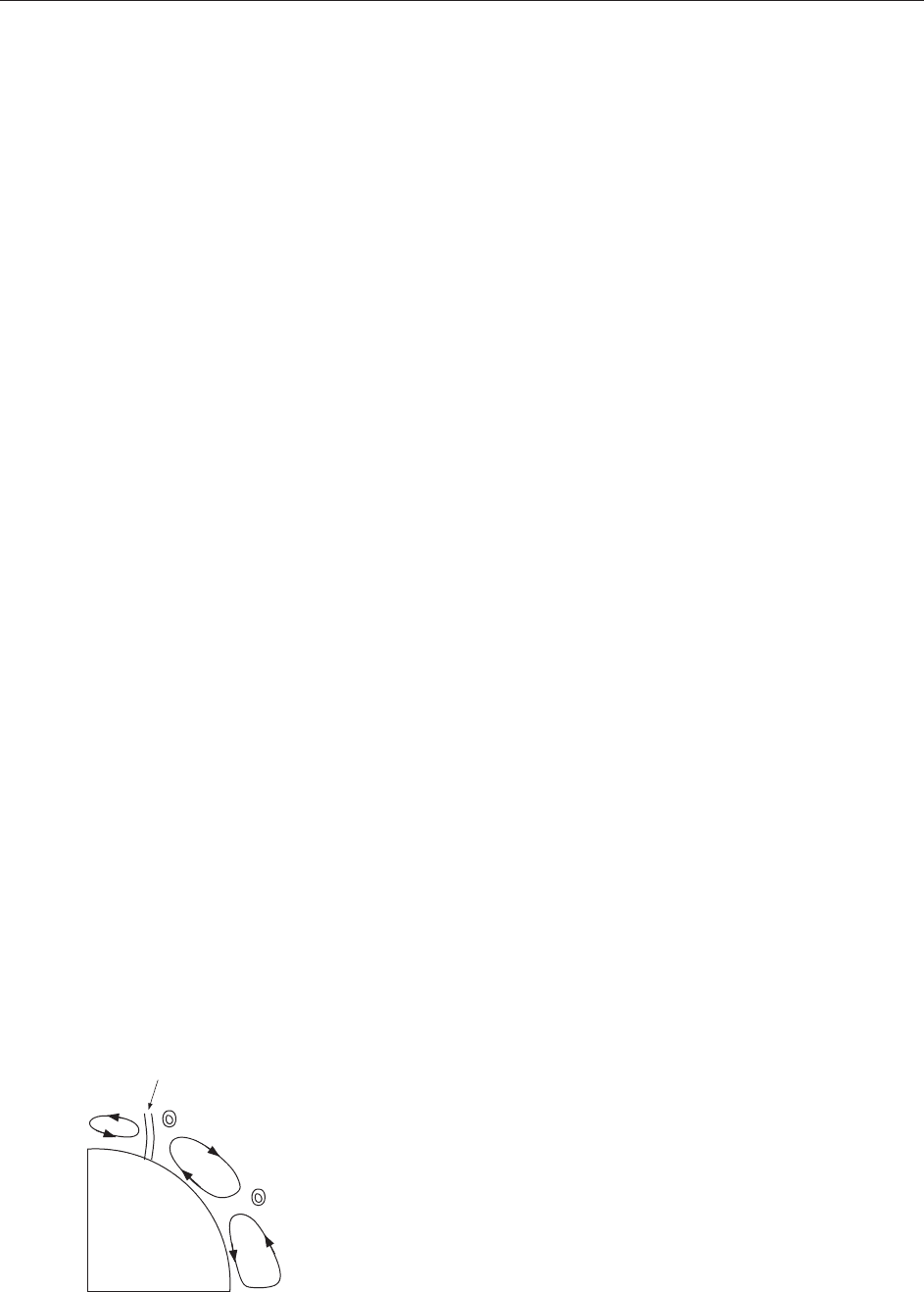
temperature differences between the equator and the
poles and Earth’s rotation lead to large-scale
vortices such as the trade winds (Hadley cell), the
jet streams, and the polar vortex (Figure 13). Semi-
annual temperature oscillations are responsible for
the Indian monsoons. Daily oscillations cause land-
and sea-breezes. Landscape variations can cause
urban–rural wind flows and mountain–valley
circulations.
Instabilities are often responsible for large
cyclonic vortices. Barotropic instability results
from large horizontal velocity gradients, and has
been deemed responsible for disturbances over the
Sahara region that occasionally intensify into
tropical cyclones. Baroclinic instability, which
occurs when temperature advection is superposed
on a velocity field, can lead to cyclonic vortices at
the front between air of polar origin and that of
tropical origin. The inertial or centrifugal
instability occurs when air flows around high-
pressure systems and the pressure gradient force
is not large enough to balance the centripetal
acceleration and the Coriolis effect.
Vortices also form on other planets with an
atmosphere. On Mars, dust devils are quite
common. They are 10–50 times larger than the
ones on Earth and can carry high-voltage electric
fields caused by the rubbing of dust grains against
each other. Jupiter’s characteristic spots are
extremely large storm vortices. The Great Red
Spot is a vortex spanning twice the diameter of
the Earth. Unlike the low-pressure terrestrial
storms and hurricanes, the Great Red Spot is a
high-pressure system that has been stable for
more than 300 years. Other vortices on Jupiter
decay and vanish, such as the White Ovals, three
large anticyclones which merged into one within
two years. Recent computer simulations predict
that many of Jupiter’s vortices will merge and
disappear in the next decade. As a result, mixing
of heat across zones will decay and the planet’s
temperature is predicted to increase.
Numerical simulations of the atmosphere are
expensive due to the large number of parameters
and the relatively small scales that need to be
resolved. For climate models and medium-range
forecast models, the governing 3D compressible
Euler equations are simplified using the hydro-
static approximation (in which only the pressure
gradient and the gravitational forces are retained
in the vertical-momentum equation) and the
anelastic approximation (in which d=dt is
neglected), to obtain the primitive equations.
Additional vertical averaging yields the shallow-
water equations. One big hurdle is to accurately
incorporate the effect of clouds, which is sig-
nificant and is usually treated using subgrid
models.
Vortices in Superfluids and Superconductors
At temperatures below 2.2 K, liquid helium is a
superfluid, meaning that it acts essentially like a
fluid with zero viscosity governed by the Euler
equations. The fluid is irrotational, except for
extremely thin vortex filaments, which are formed
by quantum-mechanical processes. Since the vortices
cannot end in the interior of the flow, they can be
generated only at the surface or they nucleate as
Subtropical
jet stream
Hadley cell
Ferrel cell
Polar jet stream
Polar front
Polar
vortex
Figure 13 Vortices in the atmosphere.
Vortex Dynamics 395
vortex rings inside the fluid. As an example, if
a cylindrical container with helium is rotated
sufficiently fast, vortex lines attached to both ends
of the container appear. These quantum vortices
have discrete values of circulation (= nh=m, where
h = Planck’s constant, m = mass of helium atom,
n = integer), core sizes of about 1 A
˚
(roughly the
diameter of a single hydrogen atom) and move
without viscosity.
Similarly, certain types of materials lose their
electric resistance at low temperatures and
become superconductors. One distinguishes type-I
superconductors (most pure metals) from type-II
superconductors (alloys). Using the Ginzburg–
Landau theory it has been predicted that in
type-II superconductors a lattice of vortex fila-
ments forms, each carrying a quantized amount
of magnetic flux. This was subsequently con-
firmed by experimental observation. More pre-
cisely, for temperatures T below a critical value
T
c
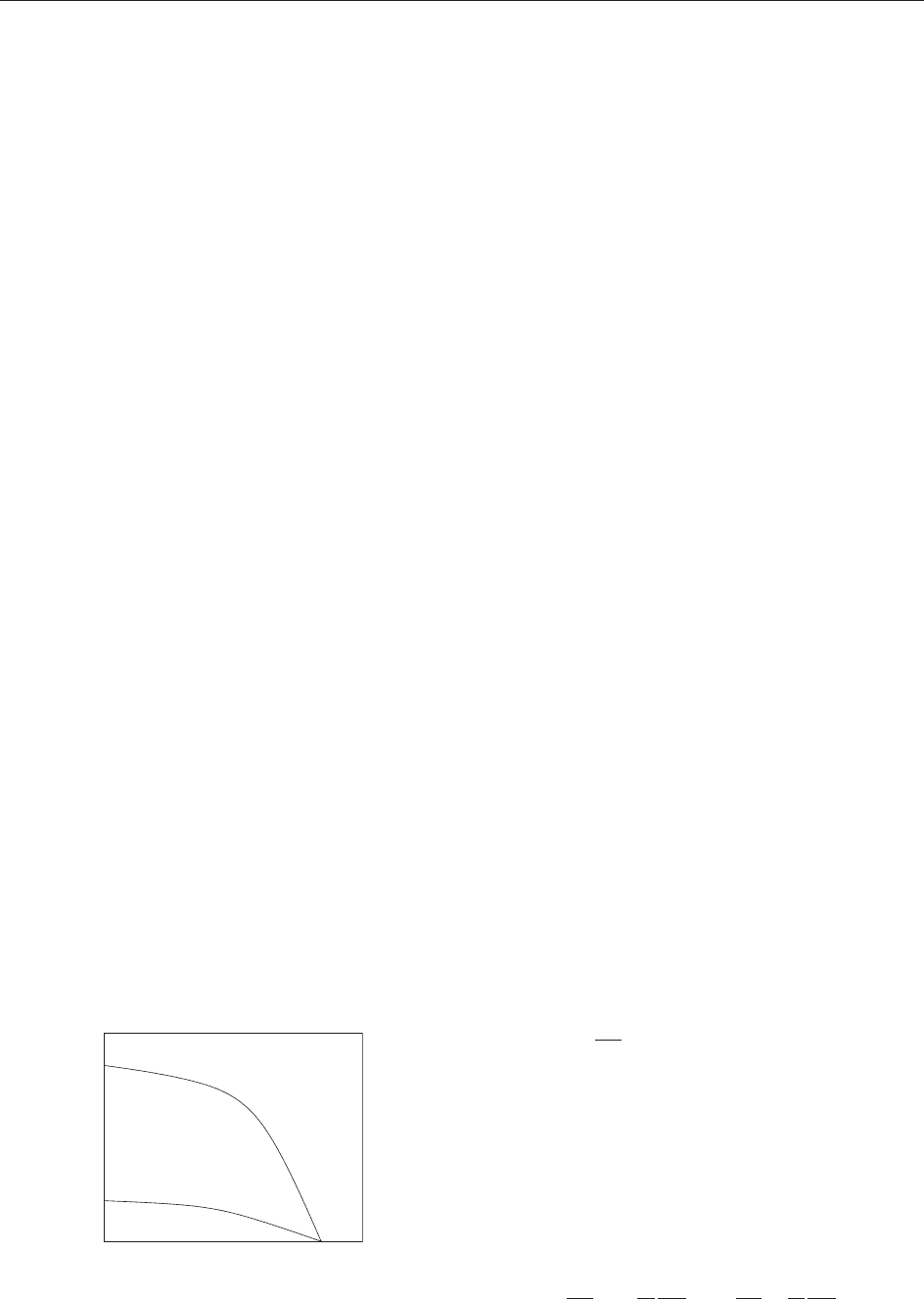
, there are three regions corresponding to
increasing values of the magnetic field (Figure 14).
At low magnetic fields (H < H
c1
), no vortices
exist (superconducting phase). At intermediate
values (H
c1
< H < H
c2
), the magnetic field pene-
trates the superconductor in the form of quan-
tized vortices, also called flux lines (mixed
phase). The values H
c1, c2
are determined by the
London penetration depth , which measures the
electromagnetic response of the superconductor.
With increasing magnetic field, the density of flux
lines increases until the vortex cores overlap
when the upper critical field H
c2
is reached,
beyond which one recovers the normal metallic
state (normal conductor).
When an external current density j is applied to
the vortex system, the flux lines start to move under
the action of the Lorentz force. As a result, a
dissipating electric field E appears that is parallel to
j, and the superconducting property of dissipation-
free current flow is lost. In order to recover the
desired property of dissipation-free flow, flux lines
have to be pinned, for example, by introducing
inhomogeneities and structural defects. For a given
pinning force, flux lines remain pinned as long as the
current density stays below a critical value. A major
research objective is to optimize the pinning force in
order to preserve superconductivity at larger current
densities.
Numerical Vortex Methods
Many numerical methods used to compute fluid
flow are Eulerian schemes based on a fixed mesh,
such as finite difference, finite element, and spectral
methods, commonly used for example in atmo-
sphere and ocean modeling. This section briefly
describes alternative vorticity-tracking methods
used to simulate incompressible inviscid vortex
flows, and concludes with some extensions to
viscous flows. The premise of these methods is
that since the fluid velocity is determined by the
vorticity through the Biot–Savart law (eqn [6]), it
suffices to track only that portion of the fluid
carrying nonzero vorticity. This region is often
much smaller than the total fluid volume, and
computational efficiency is gained. Numerical vor-
tex methods are typically Lagrangian, that is, the
computational elements move with the fluid
velocity.
Point-Vortex Approximation in 2D
To compute the evolution of a vorticity distribution
!(x, t) in 2D, the simplest approach is to approx-
imate the vorticity by a set of point vortices at x
j
(t)
with circulation
j
and evolve them under their self-
induced motion. The values
j
are an estimate of the
initial circulation around x
j
(0). The vortex positions
x
j
(t) evolve in the induced velocity field
dx
j
dt
¼
X
N
k¼1
k6¼j
k
K
2D
ðx
j
x
k
Þ½10
where the exclusion k 6¼ j accounts for the fact that
a point vortex induces zero velocity on itself. The
solution to the system of ordinary differential
equations [10] can be obtained using any method,
such as Runge–Kutta or Adams–Bashforth.
The point-vortex approximation can be written in
Hamiltonian form as
dx
j
dt
¼
1
j
@H
@y
j
;
dy
j
dt
¼
1
j
@H
@x
j
½11
T
c
T0
H
H
c2
H
c1
Mixed phase
Normal
conductor
Superconductor
no vortices
Figure 14 Superconductor phase dependence on magnetic
field H and temperature T.
396 Vortex Dynamics
where the Hamiltonian
Hðx; yÞ¼
1
4
X
N
j¼1
X
N
k¼1
k>j
j
k
log ðx
j
x
k
Þ
2
h
þðy
j
y
k
Þ
2
i
½12
is conserved along fluid particles, dH=dt = 0. The
method also conserves the fluid circulation and the
linear and angular momenta.
Ideally, the solution to [10] should converge as
N !1 to the solution of the Euler equations.
This is true for smooth vorticity distributions, but
for singular distributions such as a vortex sheet,
the situation is more complicated. The vortex
sheet, a curve in the plane, develops a singularity
in finite time at which the curvature becomes
unbounded at a point. The point-vortex approx-
imation converges before the singularity formation
time, provided the growth of spurious roundoff
error due to Kelvin–Helmholtz instability is
suppressed using a filter. However, past the
singularity formation time, the point-vortex
approximation no longer converges.
The general approach is to replace the singular
kernel K
2D
by a regularization K
2D
, such as
K
2D
¼
1
2
yi þ xj
jxj
2
þ
2
½13a
K
2D
¼
1
2
yi þ xj
jxj
2
1 e
jxj
2
=
2
½13b
where is a numerical parameter. The regulariza-
tion amounts to replacing the -function vorticity
of a point vortex by an approximate -function. In
order to recover the solution to the Euler equations,
it is necessary to study the limit N !1, ! 0. For
smooth vorticity distributions, this process con-
verges. For vortex sheet initial data, there is
evidence of convergence, but details of the limiting
behavior remain under investigation. Regularized
solutions with fixed value and vortex sheet initial
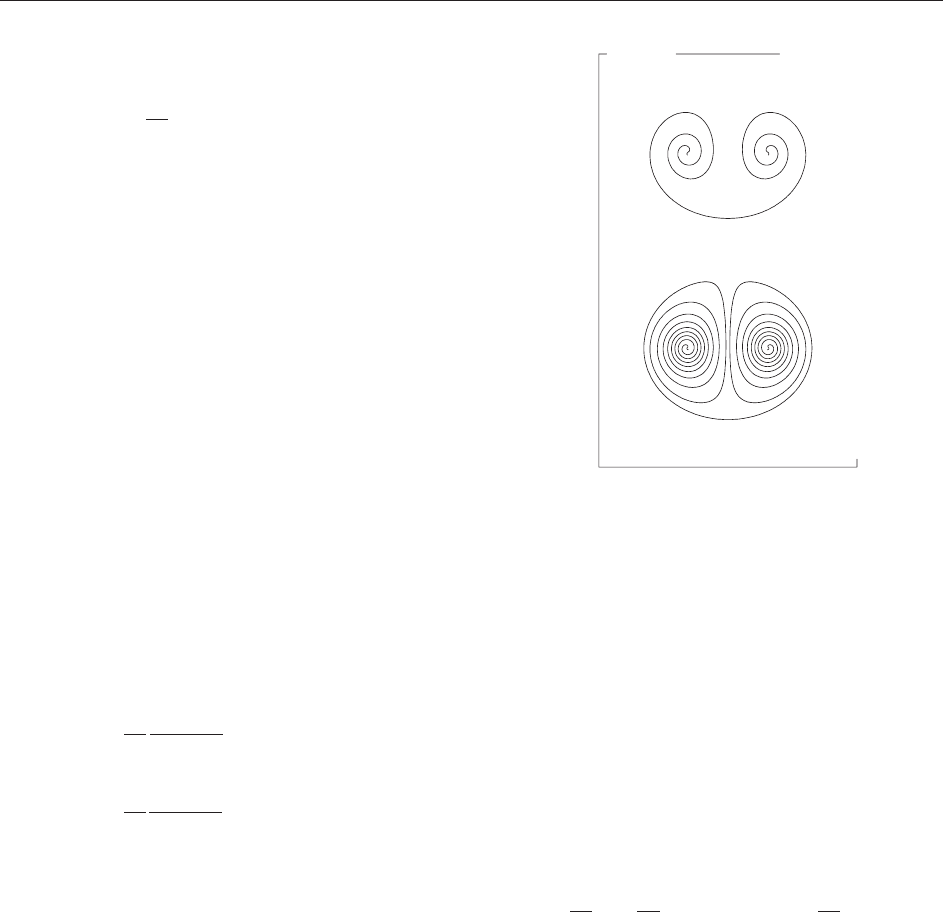
data are shown in Figures 6 and 15. Figure 6 shows
the onset of the Kelvin–Helmholtz instability in a
periodically perturbed flat vortex sheet. Figure 15
shows the rollup of an elliptically loaded flat vortex
sheet that models the evolution of an aircraft
wake (see Figure 7). The correspondence between
the two-dimensional simulation and the three-
dimensional wake is made by replacing the spatial
coordinate in the aircraft’s line of flight by a time
coordinate.
Contour Dynamics in 2D
Consider a planar patch of constant vorticity !
o
bounded by a curve x(s, t), 0 s L, moving in
inviscid, incompressible flow. In view of Kelvin’s
theorem and eqn [5], the vorticity in the patch
remains constant and equal to !
o
for all time, and
the patch area remains constant. Only the patch
boundary moves. The velocity at a point x(, t)on
the boundary can be written as a line integral over
the boundary:
dx
dt
¼
!
o
2
Z
C
log jx xðs; tÞj
@x
@s
ds ½14
The contour dynamics method consists of approx-
imating a given vorticity distribution by a super-
position of vortex patches, and moving their
boundaries according to eqn [14]. This method
has been applied to compute the evolution of
single-vortex patches and shear layers, and to
geophysical flows. Typically, filamentation occurs:
the patch develops thin filaments which increase the
boundary length significantly and thereby the
computational expense. The approach generally
taken is to remove the thin filaments at several
times throughout the computation, which is
referred to as contour surgery. The contour
dynamics approach as well as the point-vortex
approximation have also been generalized to treat
quasigeostrophic flows.
0.0
–8.0
–2.5 2.5
t
= 60
t
= 20
t
= 0
Figure 15 Computed evolution of an elliptically loaded flat
vortex sheet.
Vortex Dynamics 397