
Francoise J.-P., Naber G.L., Tsun T.S. (editors) Encyclopedia of Mathematical Physics
Подождите немного. Документ загружается.

consider only the significant wavelet coefficients of
the solution. Hence, we only retain coefficients
e
u
n
whose modulus is larger than a given threshold ",
that is, j
e
u
n
j >". The corresponding coefficients
are shown in Figure 7 (white area under the solid
line curve).
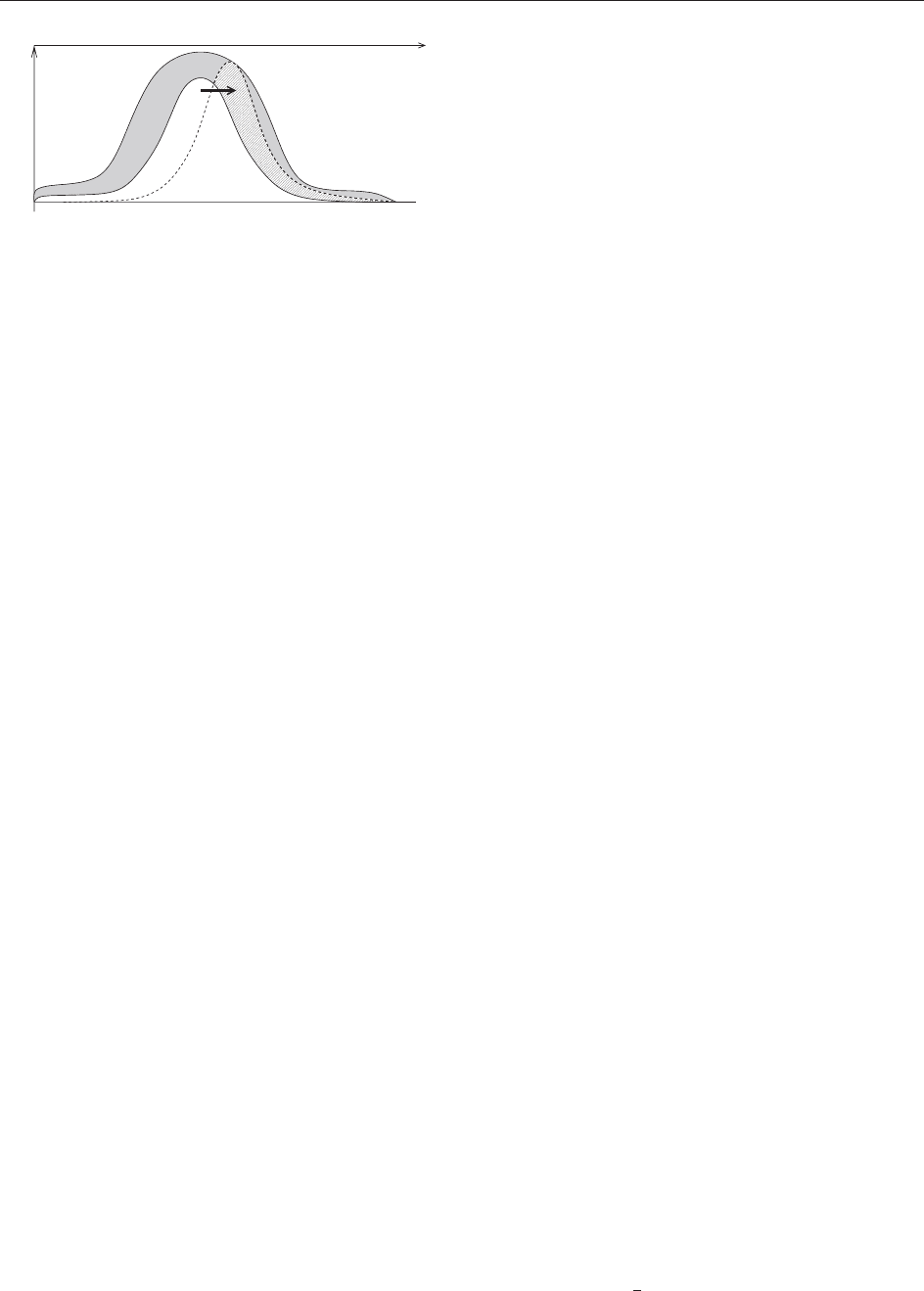
Adaption strategy To be able to integrate the
equation in time we have to account for the
evolution of the solution in wavelet coefficient
space (indicated by the arrow in Figure 7). There-
fore, we add at time step t
n
the neighbors to the
retained coefficients, which constitute a security
zone (gray area in Figure 7). The equation is then
solved in this enlarged coefficient set (white and
gray areas below the curves in Figure 7) to obtain
e
u
nþ1
. Subsequently, we thresh old the coefficients
and retain only those whose modulus j
e
u
nþ1
j >"
(coefficients under the dashed curve in Figure 7).
This strategy is applied in each time step and hence
allows to automatically track the evolution of the
solution in both scale and space.
Evaluation of the nonlinear term For the
evaluation of the nonlinear term f (u
n
), where the
wavelet coefficients
e
u
n
are given , there are two
possibilities:
Evaluation in wavelet coefficient space.As
illustration, we consider a quadratic nonlinear
term, f (u) = u
2
. The wavelet coefficients of f can
be calculated using the connection coefficients,
that is, one has to calculate the bilinear expres-
sion,
P
P
0
e
u
I
0
00
e
u
0
with the interaction
tensor I
0
00
= h
0
,
00
i. Although many coeffi-
cients of I are zero or very small, the size of I
leads to a computation which is quite untractable
in practice.
Evaluation in physical space. This approach is
similar to the pseudospectral evaluation of the
nonlinear terms used in spectral methods, there-
fore it is called pseudowavelet technique. The
advantage of this scheme is that general nonlinear
terms, for example, f (u) = (1 u)e
C=u
, can be
treated more easily. The method can be summar-
ized as follows: starting from the significant
wavelet coefficients, j
e
u
j >", one reconstructs u
on a locally refined grid and gets u(x
). Then one
can evaluate f (u(x
)) pointwise and the wavelet
coefficients
e
f
are calculated using the adaptive
decomposition.
Finally, one computes the scalar products of the
RHS of [21] with the test functions to advance the
solution in time. We compute
e
u
= hf ,
i belonging
to the enlarged coefficient set (white and gray
regions in Figure 7).
The algorithm is of O(N) complexity, where N
denotes the number of wavelet coefficients retained
in the computation.
Application to 2D Turbulence
To illustrate the above algorithm we present an
adaptive wavelet computation of a vortex dipole in
a square domain, impinging on a no-slip wall at
Reynolds numb er Re = 1000. To take into account
the solid wall, we use a volume penalization
method, for which both the fluid flow and the
solid container are modeled as a porous medium
whose porosity tends tow ards zero in the fluid and
towards infinity in the solid region.
The 2D Navier–Stokes equations are thus mod-
ified by adding the forcing term F = (1=)v
in eqn [18], where is the penalization parameter
and is the characteristic function whose value is 1
in the solid region an d 0 elsewhere. The equations
are solved using the adaptive wavelet method in
a periodic square domain of size 1.1, in which
the square container of size 1 is imbedded,
taking = 10
3
. The maximal resolution corre-
sponds to a fine grid of 1024
2
points. Figure 8a
shows snapshots of the vorticity field at times
t = 0.2, 0.4, 0.6, and 0.8 (in arbitrary units). We
observe that the vortex dipole is moving towards
the wall and that strong vorticity gradients are
produced when the dipole hits the wall. The
computational grid is dynamically adapted during
the flow evolution, since the nonlinear wavelet filter
automatically refines the grid in regions where
strong gradi ents develop. Figure 8b shows the
centers of the retained wavelet coefficients at
corresponding times.
Note that during the computation only 5% out of
1024
2
wavelet coefficients are used. The time
evolution of total kinetic energy and the total
enstrophy F = (
1
y
)v, are plotted in Figure 9 to
J
0
j
i
∼
|ω | > ε
Figure 7 Illustration of the dynamic adaption strategy in
wavelet coefficient space.
418 Wavelets: Application to Turbulence
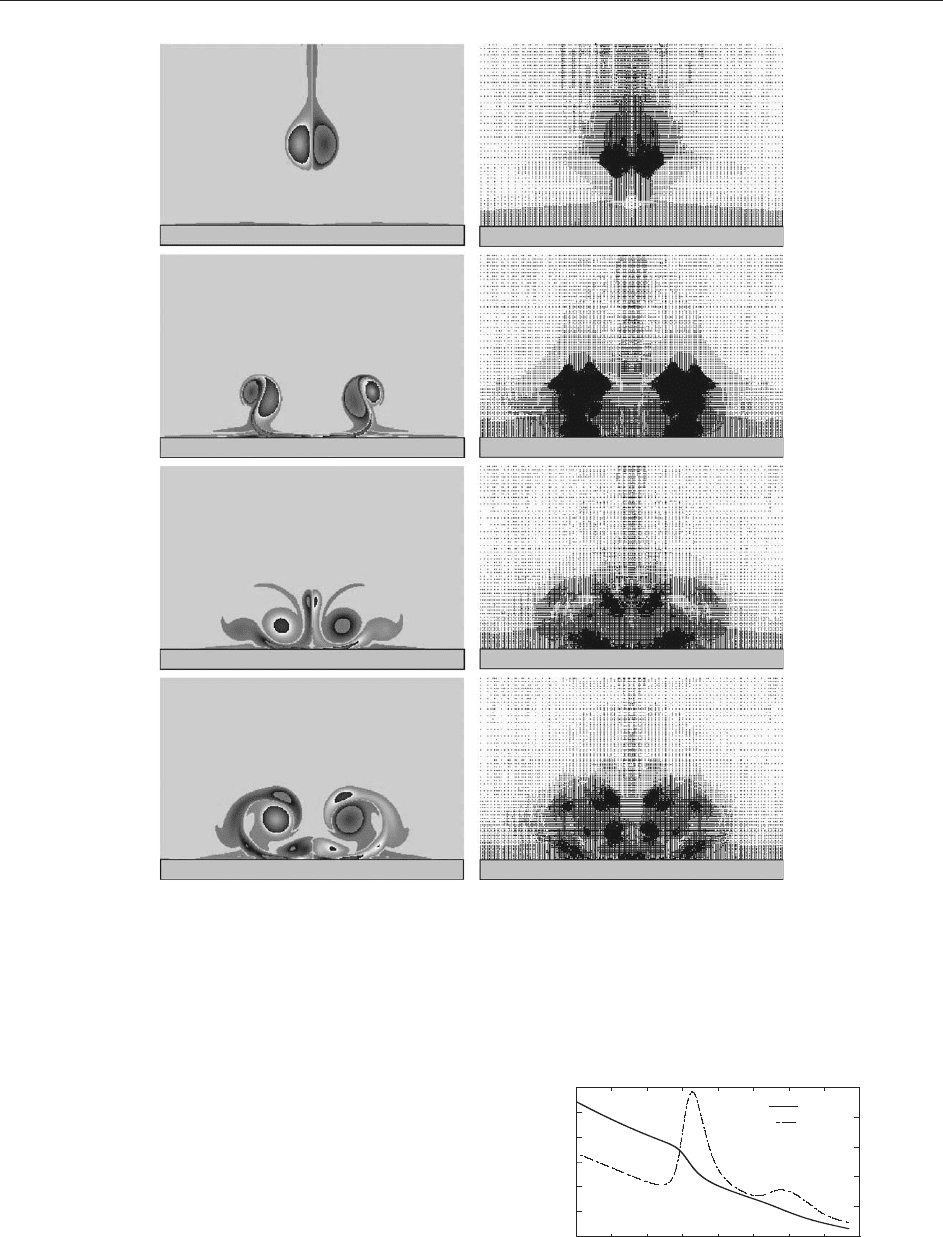
show the production of enstrophy and the concomi-
tant dissipation of energy when the vortex dipole
hits the wall.
This computation illustrates the fact that the
adaptive wavelet method allows an automatic grid
refinement, both in the boundary layers at the
wall and also in shear layers which develop during
the flow evolution far from the wall. Therewith,
the number of grid points necessary for the
computation is significantly reduced, and we con-
jecture that the resulting compression rate will
increase with the Reynolds number.
(a)
(b)
Figure 8 Dipole wall interaction at Re = 1000. (a) Vorticity field, (b) corresponding centers of the active wavelets, at t = 0.2, 0.4, 0.6,
and 0.8 (from top to bottom).
0.2
0.25
0.3
0.35
0.4
0.45
0.5
50
100
150
200
250
300
0 0.1 0.2 0.3 0.4 0.5 0.6 0.7 0.8
E(t )
Z(t
)
E(t )
Z(t )
t
Figure 9 Time evolution of energy (solid line) and enstrophy
(dashed line).
Wavelets: Application to Turbulence 419

Acknowledgments
Marie Farge thankfully acknowledges Trinity Col-
lege, Cambridge, UK, and the Centre International
de Rencontres Mathe´matiques (CIRM), Marseille,
France, for hospitality while writing this paper.
See also: Turbulence Theories; Viscous Incompressible
Fluids: Mathematical Theory; Wavelets: Applications;
Wavelets: Mathematical Theory.
Further Reading
Cohen A (2000) Wavelet methods in numerical analysis. In:
Ciarlet PG and Lions JL (eds.) Handbook of Numerical
Analysis, vol. 7, Amsterdam: Elsevier.
Cuypers Y, Maurel A, and Petitjeans P (2003) Physics Review
Letters 91: 194502.
Dahmen W (1997) Wavelets and multiscale methods for operator
equations. Acta Numerica 6: 55–228.
Daubechies I (1992) Ten Lectures on Wavelets. SIAM.
Daubechies I, Grossmann A, and Meyer Y (1986) Journal of
Mathematical Physics 27: 1271.
Farge M (1992) Wavelet transforms and their applications to
turbulence. Annual Reviews of Fluid Mechanics 24: 395–457.
Farge M and Rabreau G (1988) Comptes Rendus Hebdomadaires
des Seances de l’Academie des Sciences, Paris 2: 307.
Farge M, Kevlahan N, Perrier V, and Goirand E (1996)
Wavelets and turbulence. Proceedings of the IEEE 84(4):
639–669.
Farge M, Kevlahan N, Perrier V, and Schneider K (1999)
Turbulence analysis, modelling and computing using wavelets.
In: van den Berg JC (ed.) Wavelets in Physics, pp. 117–200.
Cambridge: Cambridge University Press.
Farge M and Schneider K (2002) Analysing and computing
turbulent flows using wavelets. In: Lesieur M, Yaglom A, and
David F (eds.) New trends in turbulence, Les Houches 2000,
vol. 74, pp. 449–503. Springer.
Farge M, Schneider K, Pellegrino G, Wray AA, and Rogallo RS
(2003) Physics of Fluids 15(10): 2886.
Grossmann A and Morlet J (1984) SIAM J. Appl. Anal 15: 723.
Lemarie´ P-G and Meyer Y (1986) Revista Matematica Ibero-
americana 2: 1.
Mallat S (1989) Transactions of the American Mathematical
Society 315: 69.
Mallat S (1998) A Wavelet Tour of Signal Processing. Academic Press.
Schneider K, Farge M, and Kevlahan N (2004) Spatial
intermittency in two-dimensional turbulence. In: Tongring
N and Penner RC (eds.) Woods Hole Mathematics, Perspec-
tives in Mathe matics and Physics, pp. 302–328. Word
Scientific.
http://wavelets.ens.fr – other papers about wavelets and turbu-
lence can be downloaded from this site.
Wavelets: Applications
M Yamada, Kyoto University, Kyoto, Japan
ª 2006 Elsevier Ltd. All rights reserved.
Introduction
Wavelet analysis was first developed in the early
1980s in the field of seismic signal analysis in the
form of an integral transform with a localized kernel
function with continuous parameters of dilation and
translation. When a seismic wave or its derivative
has a singular point, the integral transform has a
scaling property with respect to the dilation para-
meter; thus, this scaling behavior can be available to
locate the singular point. In the mid-1980s, the
orthonormal smooth wavelet was first constructed,
and later the construction method was generalized
and reformulated as multiresolution analysis
(MRA). Since then, several kinds of wavelets have
been proposed for various purposes, and the concept
of wavelet has been extended to new types of basis
functions. In this sense, the most important effect of
wavelets may be that they have awakened deep
interest in bases employed in data analysis and data
processing. Wavelets are now widely used in various
fields of research; some of their applications are
discussed in this article.
From the perspective of time–frequency analysis,
the wavelet analys is may be regarded as a windowe d
Fourier analysis with a variable window width,
narrower for higher frequency. The wavelets can
therefore give information on the local frequency
structure of an event; they have been applied to
various kinds of one-dimensional (1D) or multi-
dimensional signals, for example, to identify an
event or to denoise or to sharpen the signal.
1D wavelets
(a,b)
(x) are defined as
ða;bÞ
ðxÞ¼
1
ffiffiffiffiffiffi
jaj
p
x b
a
where a(6¼0), b are real parameters and (x)isa
spatially localized function called ‘‘analyzing wave-
let’’ or ‘‘mother wavelet.’’ Wavelet analysis gives a
decomposition of a function into a linear combina-
tion of those wavelets, where a perfect reconstruc-
tion requires the analyzing wavelet to satisfy some
mathematical conditions.
For the continuous wavelet transform (CWT),
where the parameters (a, b) are continuous, the
analyzing wavelet (x)L
2
(R) has to satisfy the
admissibility condition
420 Wavelets: Applications
analyzing wavelet (x)L
2
(R) has to satisfy the
admissibility condition
C
Z
1
1
j
^
ð!Þj
2
j!j
d!<1
where
ˆ
(!) is the Fourier transform of (x):
^
ð!Þ¼
Z
1
1
e
i!x
ðxÞdx
The admissibility condition is known to be equiva-
lent to the condition that (x) has no zero-frequency
component, that is,
ˆ
(0) = 0, under some mild
condition for the decay rate at infinity. Then the
CWT and its inverse transform of a data function
f (x) 2 L
2
(R) is defined as
T
ða; bÞ¼
1
ffiffiffiffiffiffi
C
p
Z
1
1
ða;bÞ
ðxÞf ðxÞdx
f ðxÞ¼
1
ffiffiffiffiffiffi
C
p
Z
1
1
Z
1
1
T
ða; bÞ
ða;bÞ
ðxÞ
da db
a
2
In the case of the discrete wavelet transform
(DWT), the parameters (a, b) are taken discret e; a
typical cho ice is a = 1=2
j
, b = k=2
j
, where j and k are
integers:
j;k
ðxÞ¼2
j=2
ð2
j
x kÞ
In order that the wave lets {
j,k
(x) jj, k 2 Z} may
constitute a complete orthonormal system in L
2
(R),
the analyzing wavelet should satisfy more stringent
conditions than the admissibility condition for the
CWT, and is now constructed in the framework of
MRA. A data function is then decomposed by the
DWT as
f ðxÞ¼
X
1
j¼1
j;k
j;k
ðxÞ;
j;k
¼
Z
1
1
j;k
ðxÞf ðxÞdx
Even when the discrete wavelets do not constitute
a complete orthnormal system, they often form a
wavelet frame if linear combinations of the wavelets
are dense in L
2
(R) and if there are two constants A,
B such that the inequality
Akf k
2
X
j;k
jh
j;k
; f ij
2
Bkf k
2
holds for an arbitrary f (x) 2 L
2
(R). For the wavelet
frame {
j,k
}, there is a corresponding dual frame,
{
˜
j,k
}, which permits the following expansion of f (x):
f ðxÞ¼
X
j;k
h
j;k
; f i
~
j;k
ðxÞ¼
X
j;k
h
~
j;k
; fi
j;k
ðxÞ
The wavelet frame is also employed in several
applications.
From the prospect of applications, the CWTs are
better adapted for the analysis of data functions,
including the detection of singul arities and patterns,
while the DWTs are adapted to the data processing,
including signal compression or denoising.
Singularity Detection and Multifractal
Analysis of Functions
Since its birth, the wavelet analysis has been applied
for the detecti on of singularity of a data function.
Let us define the Ho¨ lder exponent h(x
0
)atx
0
of a
function f (x) is defined here as the largest value of
the exponent h such that there exists a polynomial
P
n
(x) of degree n that satisfies for x in the
neighborhood of x
0
:
jf ðxÞP
n
ðx x
0
Þj ¼ Oðjx x
0
j
h
Þ
The da ta function is not differentiable if h(x
0
) < 1,
but if h(x
0
) > 1 then it is differentiable and a
singularity may arise in its higher derivatives. The
wavelet transform is applied to find the Ho¨ lder
exponent h(x
0
), because T
(a, b) has an asymptotic
behavior T
(a, b) = O(a
h(x
0
þ1=2)
)(a ! 0) if the ana-
lyzing wavelet has N(>h(x
0
)) vanishing moments,
that is,
Z
1
1
x
m
ðxÞdx ¼ 0; m 2 Z; 0 m < N
A commonly used analyzing wavelet for this purpose
may be the N-time derivative of the Gaussian
function (x) = d
N
(e
x
2
=2
)=dx
N
.Thismethodworks
well to examine a single or some finite number of
singular points of the data function.
When the data function is a multifractal function
with an infinite number of singular point of various
strengths, the multifractal property of the data
function is often charac terized by the singularity
spectrum D(h) which denotes the Hausdorff dimen-
sion of the set of points where h(x) = h. The
singularity spectrum is, however, difficult to obtain
directly from the CWT, and the Legendre transfor-
mation is introduced to bypass the diff iculty.
Fully developed 3D fluid turbulence may be a
typical example of wavelet application to the
singularity detection. The Kol mogorov similarity
law of fluid turbulence for the longitudinal velocity
increment u(r) e (u(x þ r e) u(x)), where u(x)
is the velocity field and e is a constant unit vector,
Wavelets: Applications 421

predicts a scaling property of the structure function;
for r in the inertial subrange,
hðuðrÞÞ
p
ir
p
;
p
¼ p=3
where hi denotes the statis tical mean. In reality,
however, the scaling exponent
p
measured in
experiments shows a systematic deviation from p/3,
which is considered to be a reflection of intermit-
tency, namely the spatial nonuniformity or multi-
fractal property of active vortical motions in
turbulence. For simplicity, let us consider the
velocity field on a linear section of the turbulence
field. According to the multifractal formalism, the
turbulence veloc ity field has singularities of various
strengths described by the singularity spectrum
D(h), which is related to the scaling exponent
p
through the Legendre transform, D(h) = inf
p
(ph
p
þ 1). This relation is often used to determine D(h)
from the knowledge of
p
(structure function
method). However, this method does not necessarily
work well because, for example, it does not capture
the singular points of the Ho¨ lder exponent larger
than 1 and it is unstable for h < 0.
These difficulties are not restricted to the turbu-
lence research, but arise commonly when the
structure function is employed to determine the
singularity spectrum. In these problems, the CWT
T
(a, b) provide s an alternative method. An inge-
nious technique is to take only the modulus maxima
of T
(a, b) (for each of fixed a) to construct a
partition function
Zða; qÞ¼
X
l2L
max
sup
ða;b
0
Þ2l
jT
ða; b
0
Þj
"#
q
where q 2 R, and L
max
denotes the set of all maxima
lines, each of which is a continuous curve for small
value of a, and there exists at least one maxima line
toward a singular point of the Ho¨ lder exponent
h(x
0
) < N. In the limit of a ! 0, defining the
exponent (q)asZ(a, q) a
(q)
, one can obtain the
singularity spectrum through the Legendre
transform:
DðhÞ¼inf
q
qhþ
1
2
ðqÞ
This method (wavelet-transform modulus-maxima
(WTMM) method) is advantage ous in that it works
also for singularities of h > 1 and h < 0. Several
simple examples of multifractal functions have been
successfully analyzed by this method. For fluid
turbulence, this method gives a singularity spectrum
D(h) which has a peak value of 1ath 1=3,
consistently with Kolmogorov similarity law, but
has a convex shape around h = 1=3 suggesting a
multifractal property. For a fractal signal, we note
that the WTMM method enlightens the hierarchical
organization of the singularities, in the branching
structure of the WT skeleton defined by the
maxima lines arrangement in the (a, b ) half-plane.
Though the above discussion also applies to the
DWT, the detection of the Ho¨ lder exponent h in
experimental situations is usually performed by the
CWT, which has no restriction on possible values of
a, while the DWT is often employed for theoretical
discussions of singularity and multifractal structure
of a function.
Multiscale Analysis
Wavelet transform expands a data function in the
time–frequency or the position–wavenumber space,
which has twice the dimension of the original signal,
and makes it easier to perform a multiscale analysis
and to identify events involved in the signal. In the
wavelet transform, as stated above, the time resolu-
tion is higher at higher frequency, in contrast with
the windowed Fourier transform where the time and
the frequency resolutions are independent of fre-
quency. Another advantage of wavelet is a wide
variety of analyzing wavelet, which enables us to
optimize the wavelet according to the purpose of
data analysis. Both the CWT and the DWT are
available for these time–frequency or position–
wavenumber analysis. However, the CWT has
properties quite different from those of familiar
orthonormal bases of discrete wavelets.
Multidimensional CWT
The CWT can be formulated in an abstract way. We
can regard G = {(a, b) ja(6¼0), b 2 R} as an affine
group on R with the group operation of
(a, b)(a
0
, b
0
) = (aa
0
, ab
0
þ b) associated with the
invariant measure d = da db=a
2
. The group G has
its unitary representation in the Hilbert space
H = L
2
(R):
ðUða; bÞf ÞðxÞ¼
1
ffiffiffiffiffiffi
jaj
p
f
x b
a
and then we can consider the CWT can be constructed
as a linear map W from L
2
(R)toL
2
(G;da db=a
2
):
W : f ðxÞ7!T
ða; bÞ¼
1
ffiffiffiffiffiffi
C
p
hUð a ; bÞ ; f i
where h, i is the inner product of L
2
(R) with the
complex conjugate taken at the first element, and
422 Wavelets: Applications
(x) is a unit vector (analyzing wavelet) satisfying
the abstract admissibility condition
C
¼
Z
G
jhUða; bÞ ; ij
2
d<1
This formulation is applicable also to a locally
compact group G and its unitary and square
integrable representation in a Hilbert space H.
Note that even the canonical coherent states are
included in this framework by taking the Weyl–
Heisenberg group and L
2
(R)forG and H,
respectively. This abstract formulation allows us
to extend the CWT to higher-dimensional Eucli-
dean spaces and other manifolds: for example, 2D
sphere S
2
for geophysical application and 4D
manifold of spacetime t aking the Poincare´ group
into consideration.
In R
n
, the CWT of f (x) 2 L
2
(R
n
) and its inverse
transform are given by
T
ða; r; bÞ¼
1
ffiffiffiffiffiffi
C
p
Z
R
n
ða;r;bÞ
ðxÞf ðxÞdx
f ðxÞ¼
1
ffiffiffiffiffiffi
C
p
Z
G
Tða; r; bÞ
ða;r;bÞ
ðxÞ
da dr db
a
nþ1
where r 2 SO(n), b 2 R
n
,dr is the normalized invar-
iant measure of G = SO(n), and the wavelets are
defined as
(a, r, b)
(x) = (1=a
n=2
) (r
1
(x b)=a), with
the analyzing wavelet satisfying the admissibility
condition
C
¼
Z
R
n
j
^
ðwÞj
jwj
n
dw < 1
Note that these wavelets are constructed not only
by dilation and translation but also by rotation
which therefore gives the possibility for directional
pattern detection in a da ta function. In the case of
2D sphere S
2
, on the other hand, the dilation
operation should be reinterpreted in such a way
that at the North Pole, for example, it is the normal
dilation in the tangent plane followed by lifting it
to S
2
by the stereographic projection from the
South Pole.
Generally, the abstract map W thus defined is
injective and therefore reversal, but not surjective in
contrast with the Fourier case. Actually in the case of
1D CWT, T
(a, b) is subject to an integral condition:
T
ða; bÞ¼
Z
1
1
Z
1
1
da db
a
2
Kða; b; a
0
; b
0
ÞT
ða
0
; b
0
Þ
Kða; b; a
0
; b
0
Þ¼
Z
1
1
ða;bÞ
ðxÞ
ða
0
;b
0
Þ
ðxÞdx
which defines the range of the CWT, a subspace
of L
2
(R). Therefore, if one wants to modify T
(a, b)
by, for example, assigning its value as zero in some
parameter region just as in a filter process, care
should be taken for the resultant T
(a, b) to be in the
image of the CWT. The reason may be understood
intuitively by noticing that the wavelets
(a,b)
(x) are
linearly dependent on each other. The expression of
a data function by a linear combination of the
wavelets is therefore not unique, and thus is
redundant. The CWT gives only T
(a, b)ofthe
least norm in L
2
(R
2
;da db=a
2
). In physical inter-
pretations of the CWT, however, this nonuniqueness
is often ignored.
Pattern Detection
Edge detection The edges of an object are often the
most important components for pattern detection.
The edge may be considered to consist of points of
sharp transition of image intensity. At the edge, the
modulus of the gradient of the image f (x, y)is
expected to take a local maximum in the 1D
direction perpendicular to the edge. Therefore, the
local maxima of jrf (x, y)j may be the indicator of
the edge. However, the image textures can also give
similar sharp transitions of f (x, y), and one should
take into account the scal e dependence which
distinguishes between edges and textures. One of
the practically possible ways for this purpose is to
use dyadic wavelets
m
j
(x, y) = 2
j
m
(2
j
x,2
j
y) which
are generated from the two wavelets (
1
,
2
) = (
@=@x, @=@y), where is a localized function
(multiscale edge detection method). The dyadic
wavelet transform of the image f (x, y )
T
m
j
ðb
1
; b
2
Þ¼hf ðx; yÞ;
m
j
ðx b
1
; y b
2
Þi; m ¼ 1; 2
defines the multiscale edges as a set of points
b = (b
1
, b
2
) where the modulus of the wavelet trans-
form, j(T
1
j
, T
2
j
)j, takes a locally maximum value
(WTMM) in a 1D neighborhood of b in the
direction of (T
1
j
(b), T
2
j
(b)). Scale dependence of
the magni tude of the modulus maxima is related to
the Ho¨ lder exponent of f (x, y) similarly to 1D case,
and thus gives information to distinguish between
the edges and the textures.
Inversely, the information of WTMM b
j,p
=
{(b
1,j,p
, b
2,j,p
)} of multiscale edges can be made use
of for an approximate reconstruction of the original
image, although the perfect reconstruction cannot be
expected because of the noncompleteness of the
modulus maxima wavelets. Assuming that
{
1
j,p
,
2
j,p
} = {
1
j
(x b
j,p
),
2
j
(x b
j,p
)} constitutes a
frame of the linear closed space generated by
Wavelets: Applications 423

{
1
j,p
,
2
j,p
}, an approximate image
ˆ
f is obtained by
inverting the relation
L
ˆ
f
X
m
X
j;p
h
ˆ
f ;
m
j;p
i
m
j;p
¼
X
m
X
j;p
T
m
j
ðb
j;p
Þ
m
j;p
using, for example, a conjugate gradient algorithm,
where a fast calculation is possible with a filter bank
algorithm for the dyadic wavelet (‘‘algorithm a`
trous’’). This algorithm gives only the solution of
minimum norm among all possible solutions, but it
is often satisfactory for practical purposes and thus
is applicable also to data compression.
Directional detection For oriented features such as
segments or edges in images to be detected, a
directionally selective wavelet for the CWT is desired.
A useful wavelet for this purpose is one that has the
effective support of its Fourier transform in a convex
cone with apex at the origin in wave number space. A
typical example of the directional wavelet may be the
2D Morlet wavelet:
ðxÞ¼expðik
0
xÞexpðjAxj
2
Þ
where k
0
is the center of the support in Fourier
space, and A is a 2 2 matrix diag[
1=2
, 1]( 1),
where the admissibility condition for the CWT is
approximately satisfied for jk
0
j5. Another exam-
ple is the Cauchy wavelet which has the support
strictly in a convex cone in wave number space.
These wavelets have the directional selectivity
with preference to a slender object in a specific
direction. One of their applications is the analysis of
the velocity field of fluid motion from an experi-
mental data, where many tiny plastic balls distrib-
uted in fluid give a lot of line segments in a picture
taken with a short exposure. The directional wavelet
analysis of the picture classifies the line segments
according to their directions, indicating the direc-
tions of fluid velocity. Another example may be a
wave-field analysis where many waves in different
directions are superimposed; the directional wavelets
allow one to decompose the wave field into the
component waves. Directional wave lets have also
been applied successfully to detect symmetry of
objects such as crystals or quasicrystals.
Denoising and separation of signals The wavelet
frame as well as the CWT give a redundant
representation of a data function. If, instead of the
original data, the redundant expression is trans-
mitted, the redundancy is used to reduce the noise
included in the received data because the redun-
dancy requires the data to belong to a subspace, and
the projection of the received data to the subspace
reduces the noise component orthogonal to it. More
specifically, the wavelet frame gives a representation
of a data function as f (t) =
P
j,k
j,k
j,k
, where the
expansion coefficients
j,k
= h
j,k
, f (x)i satisfy the
defining equation of the subspace
j
0
;k
0
¼
X
j;k
h
j
0
;k
0
;
j;k
i
If the frame coefficients are transmitted, the projec-
tion operator P, which is defined on the right-hand
side of the above equation, reduces the noise in the
received coefficients
j,k
contaminated during the
transmission.
However, this method is not applicable if the
transmitted signal is not redundant. Then some
a priori criterion is necessary to discriminate between
signal and noise. Various criteria have been pro-
posed in different fields. If the signal and the noise,
or plural signals have different power-law forms of
spectra, then their discrimination may be possible by
the DWT at higher-frequency region where the
difference in the magnitude of the coefficients is
significant. In this approach, the wavelets of Meyer
type, that is, an orthogonal wavelet with a compact
support in Fourier space, may be preferable because
the wavelets of differen t scales are separated, at least
to some extent, in Fourier space.
In fluid dynamics, the vorticity field of 2D
turbulence is found to be decom posed into coherent
and incoherent vorticity fields, according as the
CWT is larger than a threshold value or not,
respectively. These two fie lds give different Fourier
spectra of the velocity field (k
5
for coherent part
while k
3
for incoherent part), showing that the
coherent structures are responsible for the deviation
from k
3
predicted by the classical enstrophy
cascade theory. In an astronomical application, on
the other hand, the data processing is performed by
a more sophisticated method taking into account
interscale relation in the wavelet transform, because
an astronomical image contains various kinds
of objects, including stars, double-stars, galaxies,
nebulas, and clusters. In a medical image however
contrast analysis is indispensable for diagnostic
imaging to get a clear detailed picture of organic
structure. A scale-dependent local contrast is defined
as the ratio of the CWT to that given by an
analyzing wavelet with a larger support. A multi-
plicative scheme to improve the contrast is con-
structed by using the local contrast.
Signal Compression
Signal compression is quite an important technology
in digital communication. Speech, audio, image, and
digital video are all important fields of signal
424 Wavelets: Applications

compression, and plenty of compression methods
have been put to practical use, but we mention here
only a few.
The MRA for orthogonal wavelets gives a
successive procedure to decompose a subspace of
L
2
(R) into a direct sum of two subspaces corre-
sponding to higher- and lower-frequency parts; only
the latter of which is decomposed again into its
higher- and lower-frequency parts. Algebraically,
this procedure was already known before the
discovery of MRA in filter theory in electrical
engineering, where a discretely sampled signal is
convoluted with a filter series to give, for example, a
high-pass-filtered or low-pass-filtered series. An
appropriate designed pair of a high-pass and a
low-pass filters followed by the downsampling
yields two new series corresponding to the higher-
and lower-frequency parts, respectively, which are
then reversible by another two reconstruction filters
with the upsampling. These four filters which are
often employed in a widely us ed technique of ‘‘sub-
band coding’’ then constitute a perfect reconstruc-
tion filter bank. Under some conditions, successive
applications of this decomposition process to the
series of lower-frequency parts, which is equivalent
to the nesting structure of MRA, have been used for
data compression (quadrature mirror filter). A
famous example is a data compression system of
FBI for finger prints, consisting of wavelet coding
with scalar quantization.
In MRA, however, it is only the lower-frequency
parts that are successively decomposed. If both the
lower- and the higher-frequency parts are repeatedly
decomposed by the decomposition filters, then the
successive convolution processes correspond to a
decomposition of data function by a set of wavelet-
like functions, called ‘‘wavelet packet,’’ where there
are choices whether to decompose the higher- and/or
the lower-frequency parts. The best wavelet packet, in
the sense of the entropy, for example, within a
specified number of decompositions, often provides
with a powerful tool for data compression in several
areas, including speech analysis and image analysis.
We also note that from the viewpoint of the best basis
which minimizes the statistical mean square error of
the thresholded coefficients, an orthonormal wavelet
basis gives a good concentration of the energy if the
original signal is a piecewise smooth function super-
imposed by a white noise, which is thus efficiently
removed by thresholding the coefficients. The effi-
ciency of a wavelet expansion of a signal is sometimes
evaluated with the entropy of ‘‘probability’’ defined as
j
j,k
j
2
=jjf jj
2
. A better wavelet can be selected by
reducing the entropy, practically from among some
set of wavelets, and its restricted expansion coefficients
give a compressed signal. One of the systematic
methods to generate such a suitable basis is also to
employ the wavelet packets.
Numerical Calculation
Application of wavelet transform, especially of the
DWT, to numerical solver for a differential equation
(DE) has long been studied. At the first sight, the
wavelets appear to give a good DE solver because
the wavelet expansion is generally quite efficient
compared to Fourier series due to its spatial
localization. But its implementation to an efficient
computer code is not so straight forward; research is
still continuing for concrete problems. Application
of the CWT to spectral method for partial differ-
ential equation (PDE) has been studied extensively.
There is no wavelet which diagonalizes the differ-
ential operator @=@x; therefore, an efficient numer-
ical method is necessary for derivatives of wavelets.
Products of wavelets also yield another numerical
problem. MRA brings about mesh points which are
adaptive to some extent, but finite element method
still gives more flexible mesh points.
For some scaling-invariant differential or integral
operators, including @
2
=@x
2
, Abel transformations,
and Reisz potential, adaptive biorthogonal wavelets
can be provided with block-diagonal Galerkin
representations, which has been applied to data
processing. Generally, simultaneous localization of
wavelets, both in space and in scale, leads to a
sparse Galerkin representation for many pseudodif-
ferential operators and their inverses. A threshold-
ing technique with DWT has been introduced to
coherent vortex simulation of the 2D Navier–Stokes
equations, to reduce the relevant wavelet co effi-
cients. Another promising application of wavelet
occurs as a preprocessor for an iterative Poisson
solver, where a wavelet-based preconditioning leads
to a matrix with a bounded condition number.
Other Wavelets and Generalizations
Several new types of wavelets have been proposed:
‘‘coiflet’’ whose scaling function has vanishing
moments giving expansion coefficients approxi-
mately equal to values of the data functions, and
‘‘symlet’’ which is an orthonormal wavelet with a
nearly symmetric profile . Multiwavelets are wavelets
which give a complete orthonormal system in L
2
space. In 2D or multidimensional applications of the
DWT, separable orthonormal wavelets consisting of
tensor products of 1D orthonormal wavelets are
frequently used, while nonseparable orthonormal
wavelets are also available. Another generalization
Wavelets: Applications 425

of wavelets is the Malvar basis which is also a
generalization of local Fourier basis, and gives a
perfect reconstruction. A new direction of wavelet is
the second-generation wavelets which are con-
structed by lifting scheme and free from the regular
dyadic procedure, and thus applicable to compact
regions as S
2
and a finite interval.
See also: Fractal Dimensions in Dynamics; Image
Processing: Mathematics; Intermittency in Turbulence;
Wavelets: Application to Turbulence; Wavelets:
Mathematical Theory.
Further Reading
Benedetto JJ and Frazier W (eds.) (1994) Wavelets: Mathematics
and Applications. Boca Raton, FL: CRC Press.
van den Berg JC (ed.) (1999) Wavelets in Physics. Cambridge:
Cambridge University Press.
Daubechies I (1992) Ten Lectures on Wavelets, SIAM, CBMS61,
Philadelphia.
Mallat S (1998) A Wavelet Tour of Signal Processing. San Diego:
Academic Press.
Strang G and Nguyen T (1997) Wavelet and Filter Banks.
Wellesley: Wellesley-Cambridge Press.
Wavelets: Mathematical Theory
K Schneider, Universite
´
de Provence, Marseille,
France
M Farge, Ecole Normale Supe
´
rieure, Paris, France
ª 2006 Elsevier Ltd. All rights reserved.
Introduction
The wavelet transform unfolds functions into time
(or space) and scale, and possibly directions. The
continuous wavelet trans form has been discovered
by Alex Grossmann and Jean Morlet who published
the first paper on wavelets in 1984. This mathema-
tical technique, based on group theory and square-
integrable representations, allows us to decompose a
signal, or a field, into both space and scale, and
possibly directions. The orthogonal wavelet trans-
form has been discovered by Lemarie´ and Meyer
(1986). Then, Daubechies (1988) found orthogonal
bases made of compactly supported wavelets, and
Mallat (1989) designed the fast wavelet transform
(FWT) algorithm. Further developments were done
in 1991 by Raffy Coifman, Yves Meyer, and Victor
Wickerhauser who introduced wavelet packets and
applied them to data compression. The development
of wavelets has been interdisciplinary, with con-
tributions coming from very different fields such as
engineering (sub-band coding, quadrature mirror
filters, time–frequency analysis), theoretical physics
(coherent states of affine group s in quantum
mechanics), and mathematics (Calderon–Zygmund
operators, characterization of function spaces, har-
monic analysis). Many reference textbooks are
available, some of them we recommend are listed
in the ‘‘Further readin g’’ section. Meanwhile, a large
spectrum of applications has grown and is still
developing, ranging from signal analysis and image
processing via numerical analysis and turbu lence
modeling to data compression.
In this article, we will first define the continuous
wavelet transform and then the orthogonal wavelet
transform based on a multiresolution analysis.
Properties of both transforms will be discussed
and illustrated by examples. For a general intro-
duction to wavelets, see Wavelets: Applications.
Continuous Wavelet Transform
Let us consider the Hilbert space of square-int egr-
able functions L
2
(R) = {f : jkf k
2
< 1}, equipped
with the scalar product hf , gi=
R
R
f (x)g
?
(x)dx
(
?
denotes the complex conjugate in the case of
complex-valued functions) and where the norm is
defined by kf k
2
= hf , f i
1=2
.
Analyzing Wavelet
The starting point for the wavelet transform is to
choose a real- or complex-valued function 2
L
2
(R), called the ‘‘mother wavelet,’’ which fulf ills
the admissibility condition,
C
¼
Z
1
0
b
ðkÞ
2
dk
jkj
< 1½1
where
b
ðkÞ¼
Z
1
1
ðxÞe
2kx
dx ½2
denotes the Fourier transform, with =
ffiffiffiffiffiffi
1
p
and k
the wave number. If is integrable, that is, 2
L
1
(R), this implies that has zero mean,
Z
1
1
ðxÞdx ¼ 0or
b
ð0Þ¼0 ½3
In practice , however, one also requires the wavelet
to be well localized in both physical and Fourier
426 Wavelets: Mathematical Theory
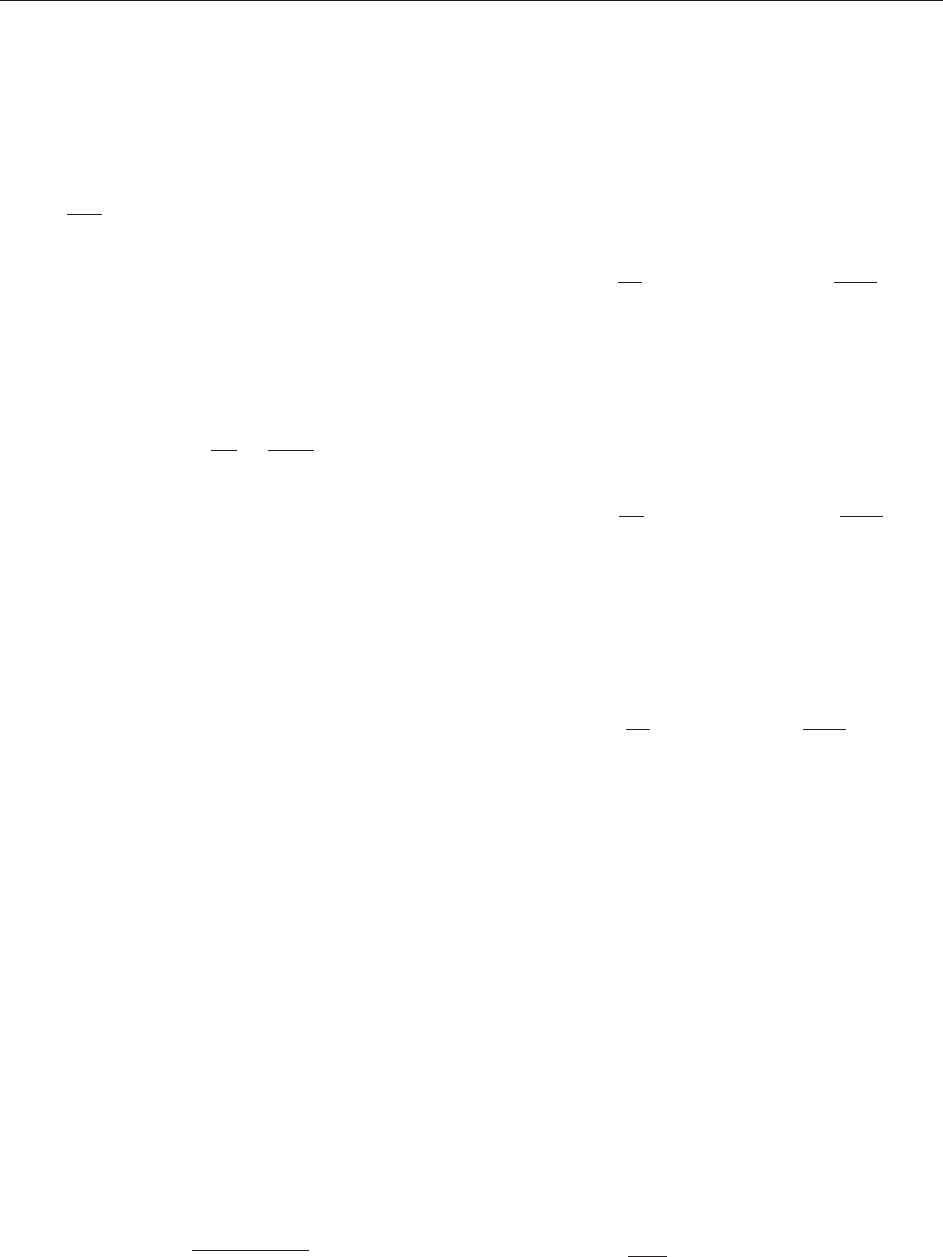
Z
1
1
x
m
ðxÞdx ¼ 0 for m ¼ 0; M 1 ½4
that is, monomials up to degree M 1 are exactly
reproduced. In Fourier space, this property is
equivalent to
d
m
dk
m
b
ðkÞj
k¼0
¼ 0 for m ¼ 0; M 1 ½5
therefore, the Four ier transform of decays
smoothly at k = 0.
Analysis
From the mother wavelet , we generate a family of
continuously translated and dilated wavelets,
a;b
ðxÞ¼
1
ffiffiffi
a
p
x b
a
for a > 0andb 2 R ½6
where a denotes the dilation parameter, correspond-
ing to the width of the wavelet support, and b the
translation parameter, corresponding to the position
of the wavelet. The wavelets are normalized in
energy norm, that is, k
a, b
k
2
= 1.
In Fourier space, eqn [6] reads
b
a;bðkÞ
¼
ffiffiffi
a
p
b
ðakÞe
2kb
½7
where the contraction with 1/a in [6] is reflected in
a dilation by a [7] and the translation by b implies a
rotation in the complex plane.
The continuous wavelet transform of a function f
is then defined as the convolution of f with the
wavelet family
a, b
:
e
f ða; bÞ¼
Z
1
1
f ðxÞ
a;b
ðxÞdx ½8
where
a, b
denotes, in the case of complex-valued
wavelets, the complex conjuga te.
Using Parseval’s identity, we get
e
f ða; bÞ¼
Z
1
1
b
f ðkÞ
b
a;b
ðkÞdk ½9
and the wavelet transform could be interpreted as a
frequency decomposition using bandpass filters
b
a, b
centered at frequencies k = k
=a. The wave number
k
denotes the barycenter of the wavele t support in
Fourier space
k
¼
R
1
0
kj
b
ðkÞjdk
R
1
0
j
b
ðkÞjdk
½10
Note that these filters have a variable width k=k;
therefore, when the wave number increases, the
bandwidth becomes wider.
Synthesis
The admissibility condition [1] implies the existence
of a finite energy reproducing kernel, which is a
necessary condition for being able to reconstruct the
function f from its wavele t coefficients
~
f . One then
recovers
f ðxÞ¼
1
C
Z
1
0
Z
1
1
e
f ða; bÞ
a;b
ðxÞ
dadb
a
2
½11
which is the inverse wavelet transform.
The wavelet transform is an isometry an d one has
Parseval’s identity. Therefore, the wavelet transform
conserves the inner product an d we obtain
hf ; gi¼
Z
1
1
f ðxÞg
ðxÞdx
¼
1
C
Z
1
0
Z
1
1
e
f ða; bÞ
e
g
ða; b Þ
dadb
a
2
½12
As a consequence, the total energy E of a signal
can be calculated either in physical space or in
wavelet space, such as
E ¼
Z
1
1
jf ðxÞj
2
dx
¼
1
C
Z
1
0
Z
1
1
j
e
f ða; bÞj
2
dadb
a
2
½13
This formula is also the starting point for the
definition of wave let spectra and scalogram (see
Wavelets: Application to Turbulence).
Examples
In the following, we apply the continuous wavelet
transform to different academic signals using the
Morlet wavelet. The Morlet wavelet is complex
valued, and consists of a modulated Gaussian with
width k
0
=:
ðxÞ¼ðe
2x
e
k
2
0
=2
Þe
2
2
x
2
=k
2
0
½14
The envelope factor k
0
controls the number of
oscillations in the wave packet; typically, k
0
= 5is
used. The correction factor e
k
2
0
=2
, to ensure its
vanishing mean, is very small and often neglected.
The Fourier transform is
b
ðkÞ¼
k
0
2
ffiffiffi
p
e
ðk
2
0
=2Þð1þk
2
Þ
ðe
k
2
0
k
1Þ½15
Figure 1 shows wavelet analyses of a cosine, two
sines, a Dirac, and a characteristic function. Below
Wavelets: Mathematical Theory 427