
Francoise J.-P., Naber G.L., Tsun T.S. (editors) Encyclopedia of Mathematical Physics
Подождите немного. Документ загружается.

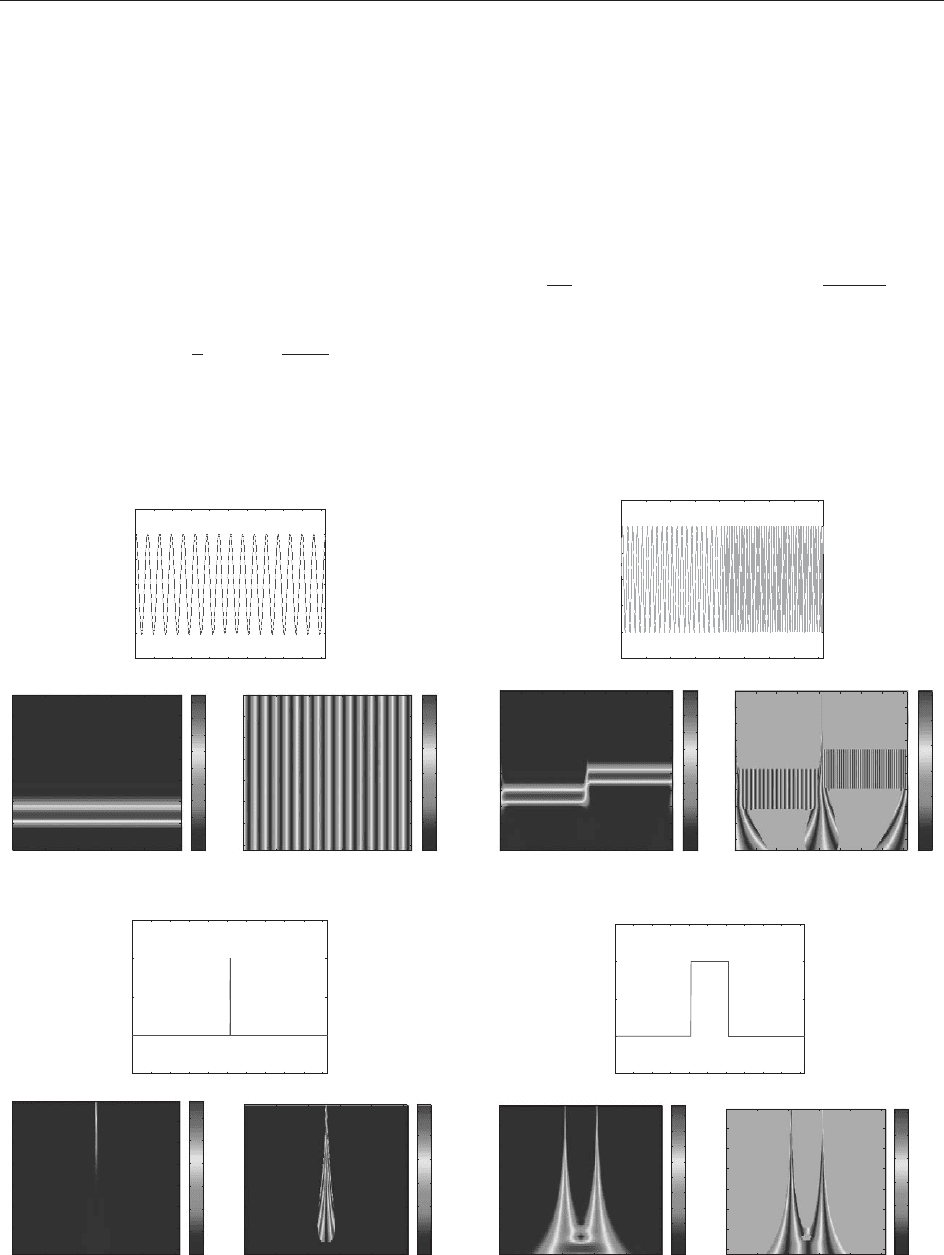
the four signals we plot the modulus and the phase
of the corresponding wavelet coefficients.
Higher Dimensions
The continuous wavelet transform can be extended to
higher dimensions in L
2
(R
n
)indifferentways.Either
we define spherically symmetric wavelets by setting
(x) =
1d
(jxj)forx 2 R
n
or we introduce in addition
to dilations a 2 R
þ
and translations b 2R
n
also rota-
tions to define wavelets with a directional sensitivity. In
the two-dimensional case, we obtain for example,
a;b;
ðxÞ¼
1
a
R
1
x b
a
½16
where a 2 R
þ
, b 2 R
2
, and where R
is the rotation
matrix
cos sin
sin cos
½17
The analysis formula [8] then becomes
e
f ða; b;Þ¼
Z
R
2
f ðxÞ
a;b;
ðxÞdx ½18
and for the corresponding inverse wavelet transform
[11] we obtain
f ðxÞ¼
1
C
Z
1
0
Z
R
2
Z
2
0
e
f ða;b;Þ
a;b;
ðxÞ
dadbd
a
3
½19
Similar constructions can be made in dimensions
larger than 2 using n 1 angles of rotation.
0 100 200 300 400 500 600 700 800 900 1000
–1.5
–1
–0.5
0
0.5
1
1.5
Cosine
Two sines
0 500 1000 1500 2000 2500 3000 3500 4000
–1.5
–1
–0.5
0
0.5
1
1.5
0 100 200 300 400 500 600 700 800 900 1000
–0.5
0
0.5
1
Dirac
0 100 200 300 400 500 600 700 800 900 1000
–0.5
0
0.5
1
1.5
Characteristic function
Modulus of the wavelet coefficients Phase of the wavelet coefficients
0.1
0.2
0.3
0.4
0.5
0.6
0.7
0.8
0.9
200 400 600 800 1000
10
20
30
40
50
60
70
3
–3
–2
–1
0
1
2
200 400 600 800 1000
10
20
30
40
50
60
70
Modulus of the wavelet coefficients Phase of the wavelet coefficients
0.1
0.2
0.3
0.4
0.5
0.6
0.7
0.8
0.9
500 1000 1500 2000 2500 3000 3500 4000
10
20
30
40
50
60
70
80
90
–3
–2
–1
0
1
2
3
500 1000 1500 2000 2500 3000 3500 4000
10
20
30
40
50
60
70
80
90
Modulus of the wavelet coefficients
Phase of the wavelet coefficients
0.05
0.1
0.15
0.2
0.25
0.3
200 400 600 800 1000
10
20
30
40
50
60
70
0
0.5
1
1.5
2
2.5
3
200 400 600 800 1000
10
20
30
40
50
60
70
Modulus of the wavelet coefficients
0.02
0.04
0.06
0.08
0.1
0.12
0.14
0.16
0.18
200 400 600 800 1000
10
20
30
40
50
60
70
–3
–2
–1
0
1
2
3
200 400 600 800 1000
10
20
30
40
50
60
70
Phase of the wavelet coefficients
Figure 1 Examples of a one-dimensional continuous wavelet analysis using the complex-valued Morlet wavelet. Each subfigure
shows on the top the function to be analyzed and below (left) the modulus of its wavelet coefficients and below (right) the phase of its
wavelet coefficients.
428 Wavelets: Mathematical Theory
Discrete Wavelets
Frames
It is possible to obtain a discrete set of quasiortho-
gonal wavelets by sampling the scale and position
axes a, b. For the scale a we use a logarithmic
discretization: a is replaced by a
j
= a
j
0
, where a
0
is
the sampling rate of the log a axis (a
0
=( log a))
and where j 2 Z is the scale index. The position b is
discretized linearly: b is replaced by x
ji
= ib
0
a
j
0
,
where b
0
is the sampling rate of the position axis at
the largest scale and where i 2 Z is the position
index. Note that the sampling rate of the position
varies with scale, that is, for finer scales (increasing j
and hence decreasing a
j
), the sampling rate
increases. Accordingly, we obtain the discrete wave-
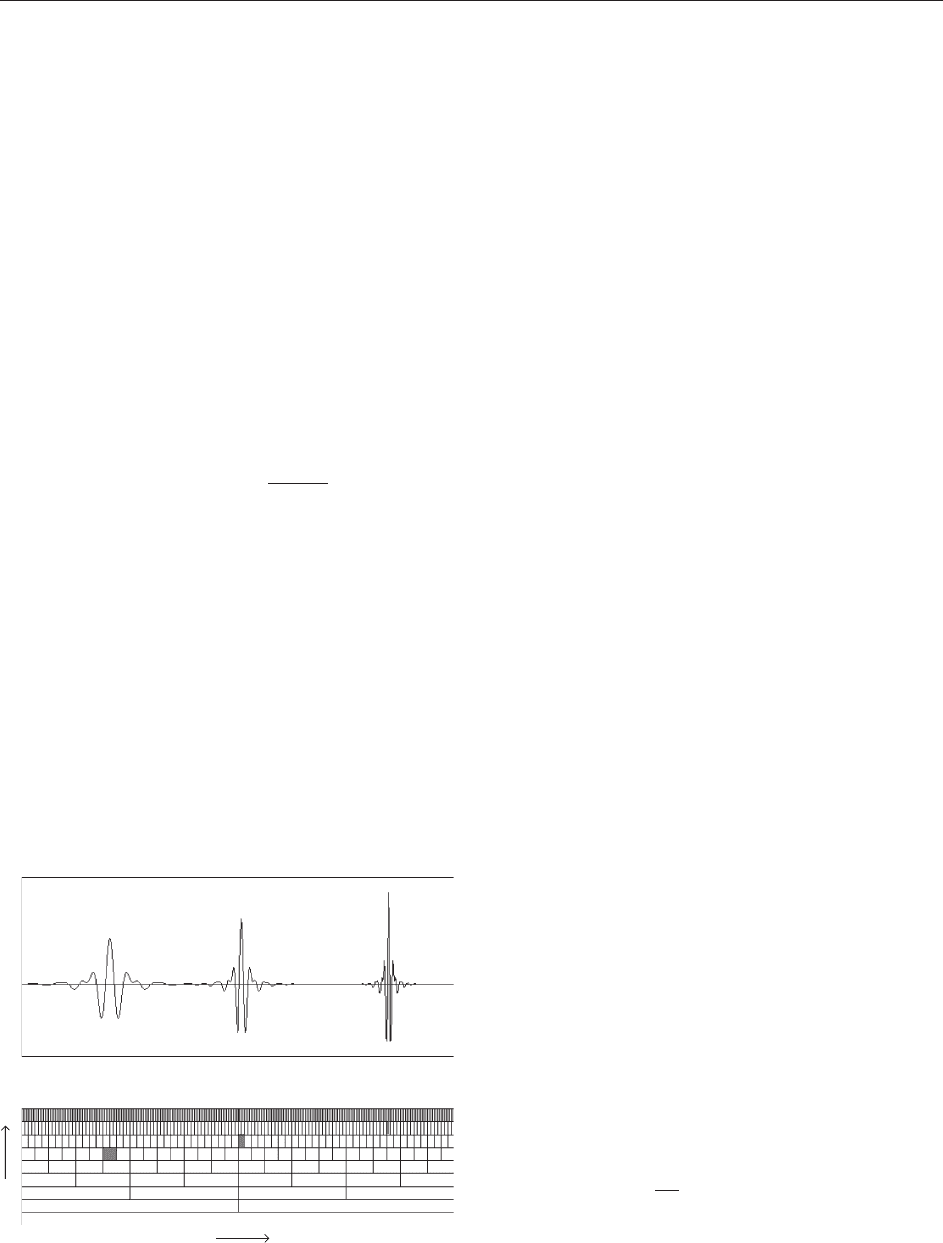
lets (cf. Figure 2)
ji
ðx
0
Þ¼a
j
1=2
x
0
x
ji
a
j
½20
and the corresponding discrete decomposition for-
mula is
e
f
ji
¼h
ji
; f i¼
Z
1
1
f ðx
0
Þ
ji
ðx
0
Þdx
0
½21
Furthermore, the wavelet coefficients satisfy the
following estimate:
Akf k
2
2
X
j;i
j
e
f
ji
j
2
Bkf k
2
2
½22
with frame bounds B A > 0. In the case A = B we
have a tight frame.
The discrete reconstruction formula is
f ðxÞ¼C
X
1
j¼1
X
1
i¼1
e
f
ji
ji
ðxÞþRðxÞ½23
where C is a constant and R(x) is a residual, both
depending on the choice of the wavelet and the
sampling of the scale and position axes. For the parti-
cular choice a
0
= 2 (which corresponds to a scale
sampling by octaves) and b
0
= 1, we have the dyadic
sampling, for which there exist special wavelets
ji
that
form an orthonormal basis of L
2
(R), that is, such that
h
ji
;
j
0
i
0
i¼
jj
0
ii
0
½24
where denotes the Kronecker symbol. This means
that the wavelets
ji
are orthogonal with respect to
their translates by discrete steps 2
j
i and their dilates
by discrete steps 2
j
corresponding to octaves. In
this case, the recons truction formula is exact with
C = 1 and R = 0. Note that the discrete wavelet
transform has lost the invariance by translation and
dilation of the continuous one.
Orthogonal Wavelets and Multiresolution Analysis
The construction of orthogonal wavelet bases and the
associated fast numerical algorithm is based on the
mathematical concept of multiresolution analysis
(MRA). The underlying idea is to consider approx-
imations f
j
of the function f at different scales j.
The amount of information needed to go from a coarse
approximation f
j
to a finer resolution approximation
f
jþ1
is then described using orthogonal wavelets. The
orthogonal wavelet analysis can thus be interpreted as
decomposing the function into approximations of the
function at coarser and coarser scales (i.e., for
decreasing j), where the differences between the
approximations are encoded using wavelets.
The definition of the MRA was introduced by
Ste´phane Mallat in 1988 (Mallat 1989). This
technique constitutes a mathematical framework of
orthogonal wavelets and the related FWT.
A one-dimensional orthogonal MRA of L
2
(R)is
defined as a sequence of successive approximation
spaces V
j
, j 2 Z, which are closed imbedded subspaces
of L
2
(R). They verify the following conditions:
V
j
V
jþ1
8j 2 Z ½25
[
j2Z
V
j
¼ L
2
ðRÞ½26
\
j2Z
V
j
¼f0g½27
f ðxÞ2V
j
, f ð2xÞ2V
jþ1
½28
i
j
8
7
6
5
4
3
2
1
00
01
0
01
13
2
2
3456 7
0
...
...
(a)
(b)
Figure 2 Orthogonal quintic spline wavelets
j, i
(x) = 2
j=2
(2
j
x i ) at different scales and positions: (a)
5, 6
(x),
6, 32
(x),
7, 108
(x), and (b) corresponding wavelet coefficients.
Wavelets: Mathematical Theory 429

A scaling function (x) is required to exist. Its
translates generate a basis in each V
j
, that is,
V
j
V
j
¼ spanf
ji
g
i2Z
½29
where
ji
ðxÞ¼2
j=2
ð2
j
x iÞ; j; i 2 Z ½30
At a given scale j, this basis is orthonormal with respect
to its translates by steps i=2
j
but not to its dilates,
h
ji
;
jk
i¼
ik
½31
The nestedness of the approximation spaces [28]
generated by the scaling function implies that it
satisfies a refinement equation:
j1;i
ðxÞ¼
X
1
n¼1
h
n2i
jn
ðxÞ½32
with the filter coefficients h
n
= h
jn
,
j1,0
i, which
determine the scaling function completely. In gen-
eral, only the filter coefficients h
n
are known and no
analytical exp ression of is given. Equation [32]
implies that the approximation of a function at
coarser scale can be described by linear combina-
tions of the same function at finer scales.
The orthogonal projection of a function f 2 L
2
(R)
on V
J
is defined as
P
V
J
: f ! P
V
J
f ¼ f
J
½33
with
f
J
ðxÞ¼
X
k2Z
hf ;
jk
i
jk
ðxÞ½34
This coarse graining at a given scale J is done by
filtering the function with the scaling function .As
a filter, the scaling function does not have
vanishing mean but is normalized so that
R
1
1
(x)dx = 1.
As V
J1
is included in V
J
, we can define its
orthogonal complement space in V
J
:
V
J
¼ V
J1
W
J1
½35
Correspondingly, the approximation of the func-
tion f at scale 2
J
, belonging to V
J
, can be
decomposed as a sum of orthogonal projections on
V
J1
and W
J1
, such that
P
V
J
f ¼ P
V
J1
f þ P
W
J1
f ½36
Based on the scaling function , one can construct a
function , the so-called mother wavelet, given by
the relation
ji
ðxÞ¼
X
n2Z
g
n2i
j;n
ðxÞ½37
with g
n
= h
jn
,
j1, 0
i, and where
ji
(x) = 2
j=2
(2
j
x i), j, i 2 Z (cf. Figure 2). The filter coeffi-
cients g
n
can be computed from the filter coefficients
h
n
using the relation
g
n
¼ð1Þ
1n
h
1n
½38
The translates and dilates of the wavelet
constitute orthonormal bases of the spaces W
j
,
W
j
¼ spanf
ji
g
i2Z
½39
As in the continuous case, the wavelets have
vanishing mean, and also possibly vanishing higher-
order moments; therefore,
Z
1
1
x
m
ðxÞdx ¼ 0 for m ¼ 0; ...; M 1 ½40
Let us now consider approximations of a function
f 2 L
2
(R) at two different scales j:
at scale j
f
j
ðxÞ¼
X
1
i¼1
f
ji
ji
ðxÞ½41
at scale j 1
f
j1
ðxÞ¼
X
1
i¼1
f
j1;i
j1;i
ðxÞ½42
with the scaling coefficients
f
ji
¼hf ;
ji
i½43
which correspond to local averages of the function
f at position i2
j
and at scale 2
j
.
The difference between the two approximations is
encoded by the wavelets
f
j
ðxÞf
j1
ðxÞ¼
X
1
i¼1
e
f
j1; i
j1;i
ðxÞ½44
with the wavelet coefficients
e
f
ji
¼hf ;
ji
i½45
which correspond to local differences of the function
at position (2 i þ 1)2
(jþ1)
between approximations
at scales 2
j
and 2
(jþ1)
.
Iterating the two-scale decomposition [44], any
function f 2 L
2
(R) can be expressed as a sum of a
coarse-scale approximation at a reference scale j
0
that we set to 0 here, and their successive
430 Wavelets: Mathematical Theory

differences. These details are needed to go from one
scale j to the next finer scale j þ 1 for
j = 0, ..., J 1,
f ðxÞ¼
X
1
i¼1
f
0;i
0;i
ðxÞþ
X
1
j¼0
X
1
i¼1
e
f
ji
ji
ðxÞ½46
For numerical applications, the sums in eqn [46]
have to be trunca ted in both scale j and position i.
The truncation in scale corresponds to a limitation
of f to a given finest scale J, which is in practice
imposed by the available sampling rate. Due to the
finite length of the available data, the sum over i
also becomes finite. The decomposition [46] is
orthogonal, as, by construction,
h
ji
;
j
0
i
0
i¼
jj
0
ii
0
½47
h
ji
;
j
0
i
0
i¼0 for j j
0
½48
in addition to [31].
Fast Wavelet Transform
Starting with a funct ion f 2 L
2
(R) given at the finest
resolution 2
J
(i.e., we know f
J
2 V
J
and hence the
coefficients
f
Ji
for i 2 Z), the FWT computes its
wavelet coefficients
e
f
ji
by decomposing successively
each approximation f
J
into a coarser scale approx-
imation f
J1
, plus the corresponding details which
are encoded by the wavelet coefficients. The
algorithm uses a cascade of discrete convolutions
with the low pass filter h
n
and the bandpass filter g
n
,
followed by downsampling, in which only one
coefficient out of two is retained. The direct wavelet
transform algorithm is
initialization
given f 2 L
2
ðRÞ and f
Ji
¼ f
i
2
J
for i 2 Z
decomposition
for j = J to 1, step 1, do
f
j1;i
¼
X
n2Z
h
n2i
f
jn
½49
e
f
j1;i
¼
X
n2Z
g
n2i
f
jn
½50
The inverse wavelet transform is based on
successive reconstructions of fine-scale approxima-
tions f
j
from coarser scale approximations f
j1
,
plus the differences between approximations at
scale j 1 and the finer scale j which are encoded
by
e
f
j1, i
. The algorithm uses a cascade of discrete
convolutions with the filters h
n
and g
n
, preceded by
upsampling which adds zeros in between two
successive coefficients.
reconstruction
for j = 1toJ, step 1, do
f
ji
¼
X
1
n¼1
h
i2n
f
j1;n
þ
X
1
n¼1
g
i2n
e
f
j;n
½51
The FWT has been introduced by Ste´phane Mallat
in 1989. If the scaling functions (and wavelets) are
compactly supported, the filters h
n
and g
n
have only
a finite number of nonvanishing coefficients. In this
case, the numerical complexity of the FWT is O(N)
where N denotes the number of samples.
Choice of Wavelets
Orthogonal wavelets are typically defined by their
filter coefficients h
n
, since in general no analytic
expression for is available. In the following, we
give the filter coefficients of h
n
for some typical
orthogonal wavelets. The filter coefficients of g
n
can
be obtained using the quadrature relation between
the two filters [38].
Haar D1 (one vanishing moment):
h
0
¼ 1=
ffiffiffi
2
p
h
1
¼ 1=
ffiffiffi
2
p
Daubechies D2 (two vanishing moments):
h
0
¼ 0:482 962 913 145
h
1
¼ 0:836 516 303 736
h
2
¼ 0:224 143 868 042
h
3
¼0:129 409 522 551
Daubechies D3 (three vanishing moments):
h
0
¼ 0:332 670 552 950
h
1
¼ 0:806 891 509 311
h
2
¼ 0:459 877 502 118
h
3
¼0:135 011 020 010
h
4
¼0:085 441 273 882
h
5
¼ 0:035 226 291 882
Coiflets C12 (four vanishing moments): the
wavelets and the corresponding scaling function
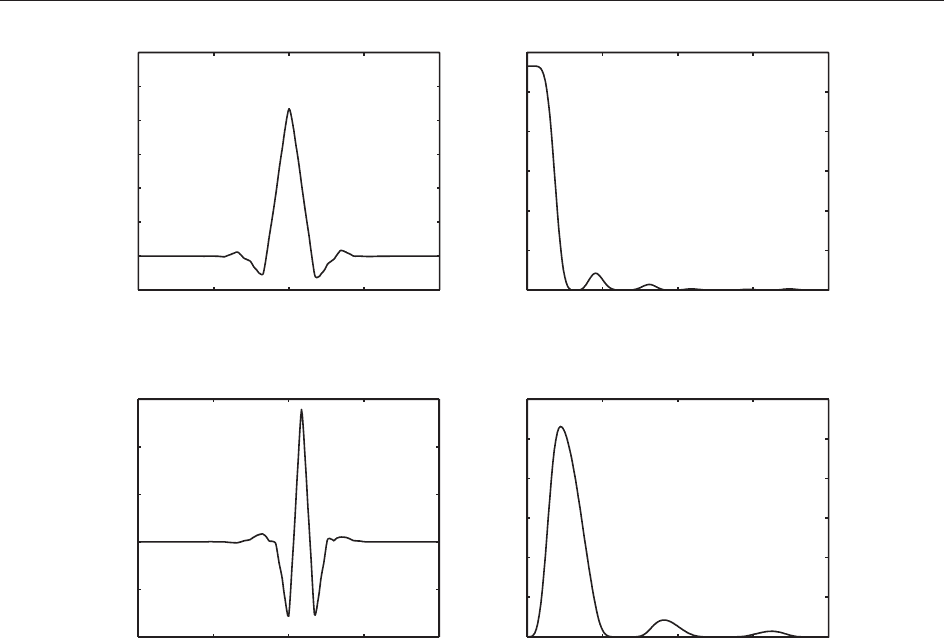
are shown in Figure 3.
Remarks The construction of orthogonal wavelets
in L
2
(R) can be modified to obtain wavelets on the
interval, that is, in L
2
([0, 1]). Therewith, boundary
wavelets are introduced, while in the interior of the
interval the wavelets are not modified.
Wavelets: Mathematical Theory 431
A periodic MRA of L
2
(T), wher e T = R=Z
denotes the torus, can also be constructed by
periodizing the wavelets in L
2
(R), using
per
ðxÞ¼
X
k2Z
ðx þ kÞ
Relaxing the condition of orthogonality allows
greater flexibility in the choice of the basis
functions. For example, biorthogonal wavelets can
be designed using differen t basis functions for
analysis (
a
) and synthesis (
s
) which are related
but no longer orthogonal. A couple of refinable
scaling functions (
a
,
s
) with related wavelets
(
a
,
s
) which are by construction biorthogonal
generate a biorthogonal MRA V
a
j
, V
s
j
. From an
algorithmic point of view, only two different filter
couples (g
a
, h
a
) for the forward and (g
s
, h
s
) for the
backward FWT are used, without changing the
algorithm.
The multiresolution approach can be further
generalized, for samplings on nonequidistant
grids leading to the so-called second-generation
wavelets.
Higher Dimensions
The previously presented one-dimensional construc-
tion can be extended to higher dimensions. For
simplicity, we will consider only the two-
dimensional case, since higher dimensions can be
treated analogously.
Tensor product construction Having developed a
one-dimensional orthonormal basis
ji
of L
2
(R), one
could use these functions as building blocks in
higher dimensions. One way of doing so is to take
the tensor product of two one-dimensional bases
and to define
j
x
;j
y
;i
x
;i
y
ðx; yÞ¼
j
x
;i
x
ðxÞ
j
y
;i
y
ðyÞ½52
The resulting functions constitue an orthonormal
wavelet basis for L
2
(R
2
). Each function f 2 L
2
(R
2
)
can then be developed into
f ðx; yÞ¼
X
j
x
;i
x
X
j
y
;i
y
e
f
j
x
;j
y
;i
x
;i
y
j
x
;j
y
;i
x
;i
y
ðx; yÞ½53
with
e
f
j
x
, j
y
, i
x
, i
y
= hf ,
j
x
, j
y
, i
x
, i
y
i. However, in this basis
the two variables x and y are dilatated separately
1 0.5 0 0.5 1
0.05
0
0.05
0.1
0.15
0.2
0.25
0.3
0 50 100 150 200
1
2
3
4
5
6
(a)
1 0.5 0 0.5 1
0
0.2
0.1
0.1
0.2
0.3
0 50 100 150 200
1
2
3
4
5
6
(b)
Figure 3 Orthogonal wavelets Coiflet C12. (a) Scaling function (x ) (left) and j
ˆ
(!)j. (b) Wavelet (x ) (left) and j
ˆ
(!)j.
432 Wavelets: Mathematical Theory
and therefore no longer form an MRA. This means
that the functions
j
x
, j
y
involve two scales, 2
j
x
and
2
j
y
, and each of the functions is essentially supported
on a rectangle with these side-lengths. Hence, the
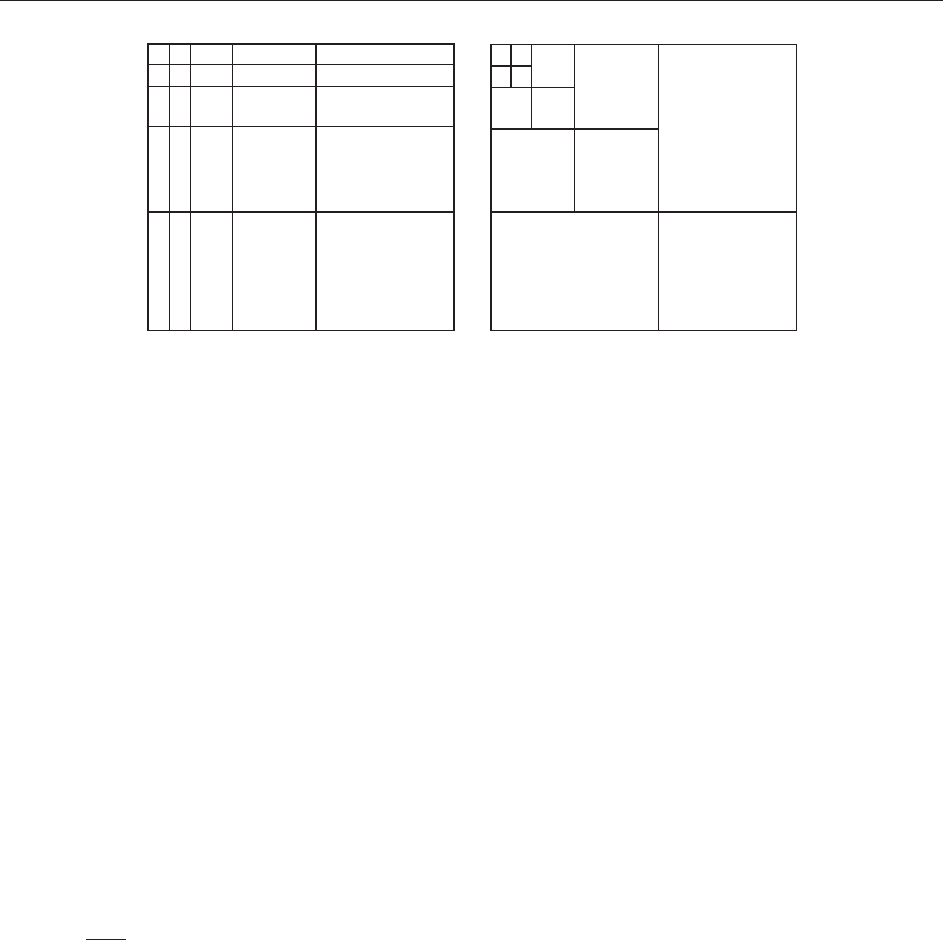
decomposition is often called rectangular wavelet
decomposition (cf. Figure 4a). From the algorithmic
viewpoint, this is equivalent to applying the one-
dimensional wavelet transform to the rows and the
columns of a mat rix or a function. For some
applications, such a basis is advantageous, for others
not. Often the notion of a scale has a certain
meaning. For an application, one would like to have
a unique scale assigned to each basis function.
Multiresolution construction Another much more
interesting construction is the construction of a truly
two-dimensional MRA of L
2
(R
2
). It can be obtained
through the tensor product of two one-di mensional
MRAs of L
2
(R). More precisely, one defines the
spaces V
j
, j 2 Z by
V
j
¼ V
j
V
j
½54
and V
j
= span{
j, i
x
, i
y
(x, y) =
j, i
x
(x)
j, i
y
(y), i
x
, i
y
2 Z}
fulfilling analogous properties as in the one-
dimensional case.
Likewise, we define the complement space W
j
to
be the orthogonal complement of V
j
in V
jþ1
, that is,
V
jþ1
¼ V
jþ1
V
jþ1
¼ðV
j
W
j
ÞðV
j
W
j
Þ½55
¼V
j
V
j
ððW
j
V
j
Þ
ðV
j
W
j
ÞðW
j
W
j
ÞÞ ½56
¼ V
j
W
j
½57
It follows that the orthogonal complement W
j
=
V
jþ1
V
j
consists of three different types of func-
tions and is generated by three different wavelets
"
j;i
x
;i
y
ðx; yÞ¼
j;i
x
ðxÞ
j;i
y
ðyÞ;"¼ 1
j;i
x
ðxÞ
j;i
y
ðyÞ;"¼ 2
j;i
x
ðxÞ
j;i
y
ðyÞ;"¼ 3
8
>
<
>
:
½58
Observe that here the scale parameter j simulta-
neously controls the dilatation in x and y. We recall
that in d dimensions this construction yields 2
d
1
types of wavelets spanning W
j
.
Using [58], each function f 2 L
2
(R
2
) can be
developed into a multiresolution basis as
f ðx; yÞ¼
X
j
X
i
x
;i
y
X
"¼1;2;3
e
f
"
j;i
x
;i
y
"
j;i
x
;i
y
ðx; yÞ½59
with
e
f
"
j, i
x
, i
y
=< f ,
"
j, i
x
, i
y
>. A schematic representa-
tion of the wavelet coefficients is sho wn in
Figure 4b. The algorithmic structure of the one-
dimensional transforms carries over to the two-
dimensional case by simple tensorization, that is,
applying the filters at each decom position step to
rows and columns.
Remark The described two-dimensional wavelets
and scaling functions are separable. This advantage is
the ease of generation starting from one-
dimensional MRAs. However, the main drawback
of this construction is that three wavelets are needed
to span the orthogonal complement space W
j
.
Another property should be mentioned. By construc-
tion, the wavelets are anisotropic, that is, horizontal,
diagonal, and vertical directions are preferre d.
Approximation Properties
Reproduction of Polynomials
A fundamental property of the MRA is the exact
reproduction of polynomials. The vanishing
moments of the wavele t , that is,
R
R
x
m
(x)dx = 0
...
...
...
... ...
...
...
f
j
x
–1, j
y
–1, i
x
, i
y
~
f
j
–1
, i
x
, i
y
~1
f
j, i
x
, i
y
~1
f
j, i
x
, i
y
~2
f
j, i
x
, i
y
~3
f
j
–1
, i
x
, i
y
~3
f
j
–1
, i
x
, i
y
~2
f
j
x
, j
y
–1, i
x
, i
y
~
f
j
x
, j
y
, i
x
, i
y
~
...
~
f
j
x
–1, j
y
, i
x
, i
y
(a) (b)
Figure 4a Schematic representation of the 2D (b) wavelet transforms: (a) Tensor product construction and (b) 2D MRA.
Wavelets: Mathematical Theory 433
for m = 0, M 1, is equivalent to the fact that
polynomials up to degree M 1, can be expressed
exactly as a linear combination of scaling functions,
p
m
(x)=
P
n2Z
n
m
(xn) for m=0,M 1. This so-
called Strang–Fix condition proves that has M
vanishing moments if and only if any polynomial of
degree M 1 can be written as a linear combination
of scaling functions . Note that, as p
m
62L
2
(R), the
coefficients n
m
are not in l
2
(Z).
Regularity and Local Decay of Wavelet
Coefficients
The local or global regul arity of a function is closely
related to the decay of its wavelet coefficients. If a
function is locally in C
s
(R) (the space of s-times
continuously differentiable functions), it can be well
approximated locally by a Taylor series of degree s.
Consequently, its wavelet coefficients are small at
fine scales, as long as the wavelet has enough
vanishing moments. The decay of the coefficients
hence determines directly the error being made when
truncating a wavelet sum at some scale.
Depending on the type of norm used and whether
global or local characterization is concerned, various
relations of this kind have been developed. Let us
take as example the case of an -Lipschitz function.
Suppose f 2 L
2
(R), then for [a, b] R the func-
tion f is -Lipschitz with 0 <<1 for any x
0
2
[a, b], that is, jf (x
0
þ h) f (x
0
)jCjhj
,ifand
only if there exists a constant A such that j
e
f
ji
j
A2
j1=2
for any (j, i)withi=2
j
2 [a, b].
This shows the relation between the local reg-
ularity of a function and the decay of its wavelet
coefficients in scale.
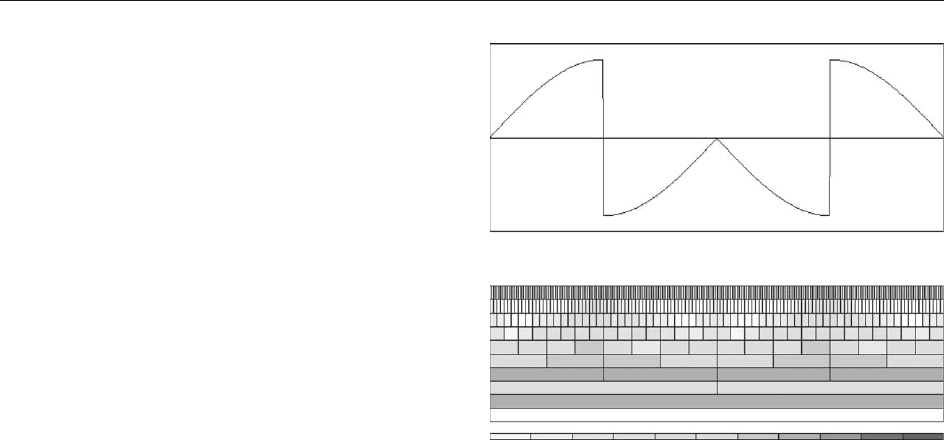
Example To illustrate the local decay of the
wavelet coefficients, we consider in Figure 5 the
function f (x) = sin (2x) for x 1=4 and x 3=4
and f (x) = sin (2x) for 1=4 < x < 3=4. The corre-
sponding wavelet coefficients for quintic spline
wavelets are plotted in logarithmic scale. The
wavelet coefficients show that only in a local region
around singularities the fine-scale coefficients are
significant.
Linear Approximation
The exact reproduction of polynomials can be used
to derive error estimates for the approximation of a
function f at a given scale, which corresponds to
linear approximation. We consider f belonging to
the Sobolev space W
s, p
(R
d
), that is, the weak
derivatives of f up to order s belong to L
p
(R
d
). The
linear approximation of f at scale J, corresponding
to the projection of f onto V
J
, is then given by
f
J
ðxÞ¼
X
J1
j¼0
X
i2Z
e
f
j;i
j;i
ðxÞ½60
The approximation error can be estimated by
kf f
J
k
L
p
< C2
J minðs;mÞ=d
½61
where s denotes the smoothness of the function in
L
p
, d the space dimension, and m the number of
vanishing moments of the wavelet . In the case of
poor global regularity of f, that is, for small s,a
large number of scales J is needed to get a good
approximation of f.
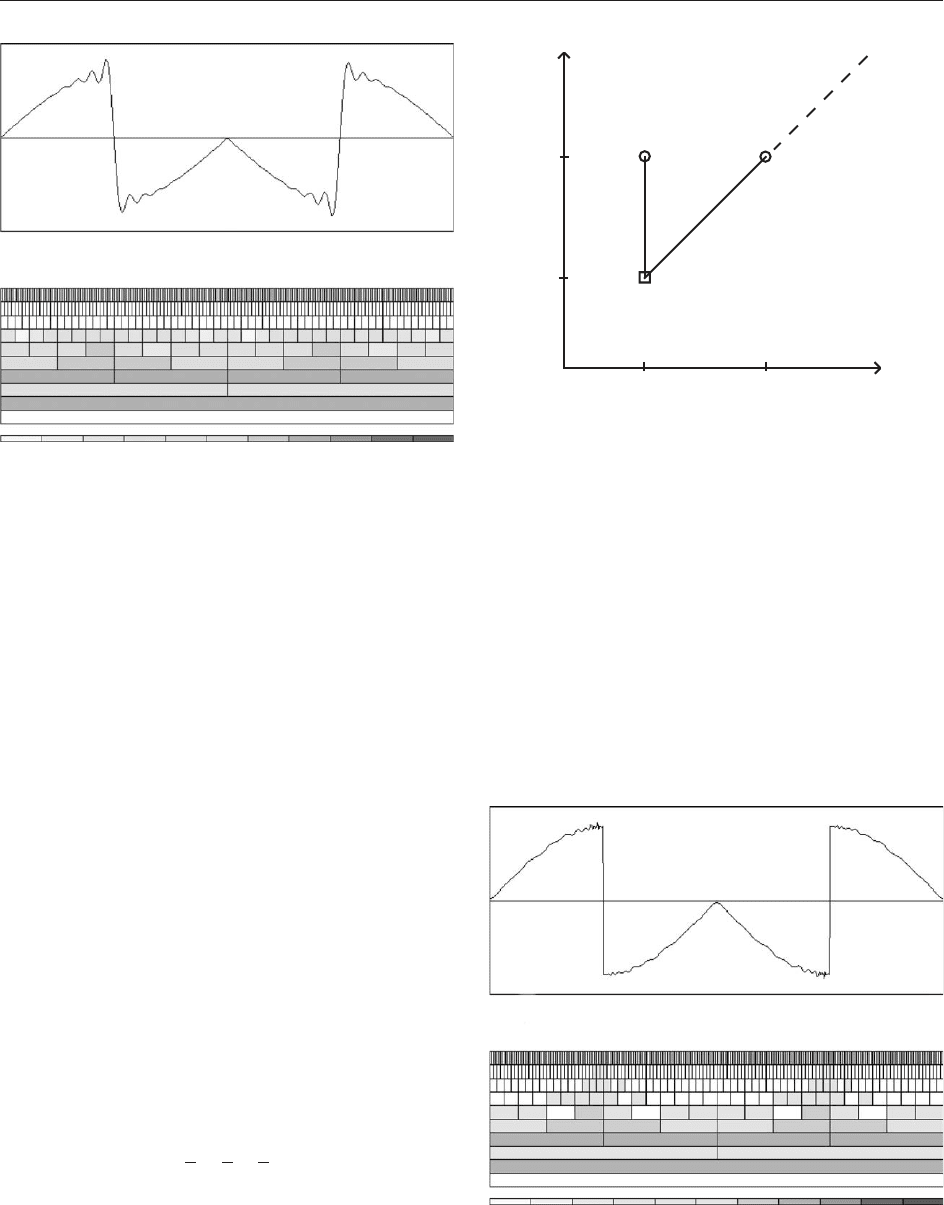
In Figure 6, we plot the linear approximation of
the function f shown in Figure 5. The function f
6
is
reconstructed using wavelet coefficients up to scale
J 1 = 5, so that in total only 64 out of 512
coefficients are retained. We observe an oscillating
behavior of f
J
near the discontinuities of f which
dominates the approximation error.
Nonlinear Approximation
Retaining the N largest wavelet coefficients in the
wavelet expansion of f in [46], without imposing
any a priori cutoff scale, yields the best N-term
approximation f
N
. In contrast to the linear approx-
imation [60], it is called nonlinear approximation,
since the choice of the retained coefficients depends
–4.00E + 00 Logarithm 1.00E + 00
(a)
(b)
Figure 5 Orthogonal wavelet decomposition using quintic
spline wavelets: (a) function f (x ) = sin (2x) for x 1=4 and x
3=4 and f (x )= sin(2x) for 1=4 < x < 3=4 sampled on a grid
x
i
=i=2
J
,i = 0,...,2
J
1 with J =9 and (b) corresponding wavelet
coefficients log
10
j
e
f
j, i
j for i = 0,...,2
j
1 and j =0,...,J 1.
434 Wavelets: Mathematical Theory
on the function f. The mathematical theory has been
formalized by Cohen, Dahmen, and De Vore.
The nonlinear approximation of the function f can
then be written as
f
N
ðxÞ¼
X
ðj;iÞ2
N
e
f
j;i
j;i
ðxÞ½62
where
N
denotes the ensemble of all multi-indices
= (j, i), indexing the N largest coefficients (mea-
sured in the l
p
norm),
N
¼f
k
;k ¼1; Njk
e
f
k
k
l
p
> k
e
f
k
l
p
8 2g½63
with ={= (j,i),j 0,i 2Z}. The nonlinear
approximation leads to the following error estimate:
kf f
N
k
L
p
< CN
s=d
½64
where s denotes the smoothness of f in the larger
space L
q
(R
d
) with
1
q
¼
1
p
þ
s
d
which corresponds to the Sobolev embedding line
(Figure 7). This estimate shows that the nonlinear
approximation converges faster than the linear one,
if f has a larger regularity in L
q
, that is, f 2 W
s, q
(R
d
), which is for example the case for functions
with isolated singularities and for small q.
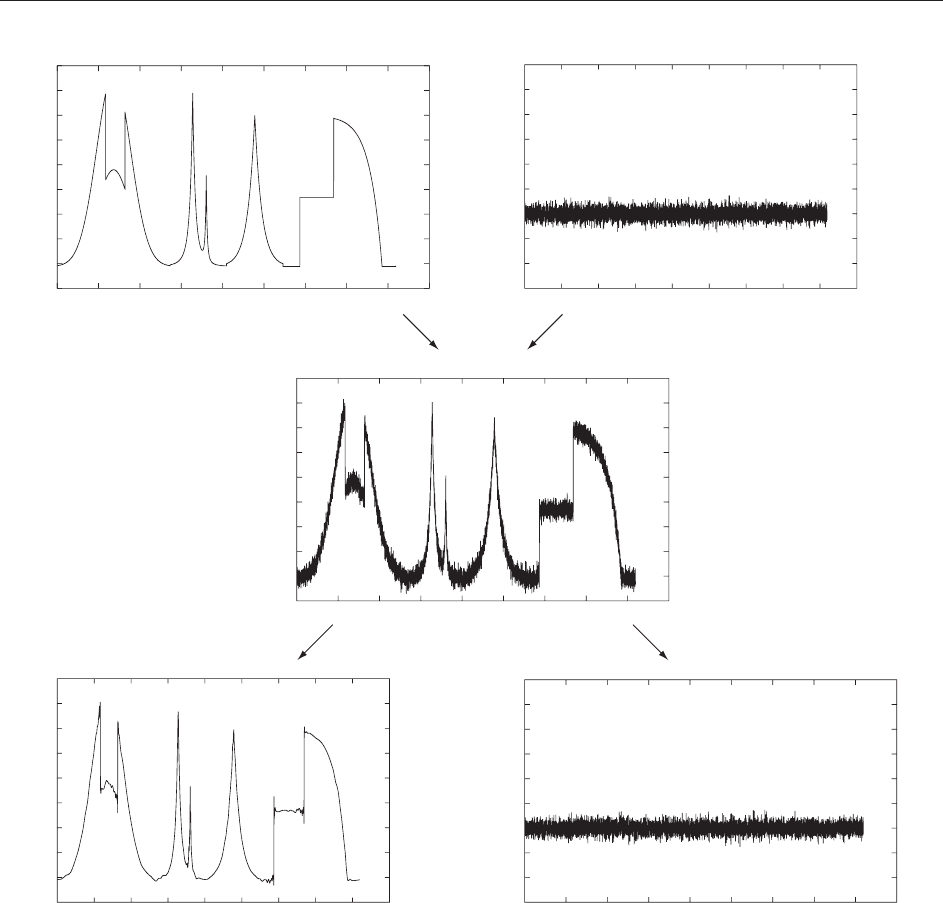
In Figure 8, we plot the nonlinear approximation
of the function f shown in Figure 5. The function f
N
is reconstructed using the strongest 64 wavelet
coefficients out of 512 coefficients. Compared to
the linear approximation (cf. Figure 6), the oscilla-
tions around the discontinuities disappear and the
approximation error is reduced while using the same
number of coefficients.
Compression and Preconditioning of Operators
The nonlinear approximation of functions can be
extended to certain operators leading to an efficient
s
t
C
α
(IR
d
)
L
p
(IR
d
)
1/p
1/q
= 1/p + t /d
Embedding
Linear approx.
O(N
–t /d
)
Nonlinear approx.
O(N
–t /d
)
W
s,p
(IR
d
)
Figure 7 Schematic representation of linear and nonlinear
approximation.
–4.00E + 00 Logarithm 1.00E + 00
(a)
(b)
Figure 6 (a) Linear approximation f
J
of the function f in
Figure 5 for J = 6, reconstructed from 64 wavelet coefficients
using quintic splines wavelets and (b) corresponding wavelet
coefficients log
10
j
e
f
j, i
j for i = 0, ...,2
j
1 and j = 0, ..., J 1.
Note that the coefficients for J > 5 have been set to zero.
–4.00E + 00 Logarithm 1.00E + 00
(a)
(b)
Figure 8 (a) Nonlinear approximation f
N
of the function f in
Figure 5 reconstructed from the 64 largest wavelet coefficients
using quintic splines wavelets, (b) retained wavelet coefficients
log
10
j
e
f
j, i
j for i = 0, ...,2
j
1 and j = 0, ..., J 1.
Wavelets: Mathematical Theory 435

representation in wavelet space, that is, to sparse
matrices. For integral operators, for example,
Calderon–Zygmund operators T on R defined by
Tf ðxÞ¼
Z
R
Kðx; yÞf ðyÞdy ½65
where the kernel k satisfies
jkðx; y; Þj
C
jx yj
and
@
@x
kðx; yÞ
þ
@
@y
kðx; y; Þ
C
jx yj
2
their wavelet representation hT
j, i
,
j
0
, i
0
i is sparse
and a large number of weak coefficients can be
suppressed by simple thresholding of the matrix
entries while controlling the precision. The resulting
numerical scheme is called BCR algorithm and is
due to Beylkin et al. (1991).
The characterization of funct ion spaces by the
decay of the wavelet coefficients and the corre-
sponding norm equiva lences can be used for
diagonal preconditioning of integral or differential
operators which leads to matrices with uniformly
bounded condition numbers. For elliptic differential
operators, for example, the Laplace operator r
2
the
norm equivalence kr
2
f k’k2
2j
e
f
ji
k can be used for
preconditioning the matrix hr
2
j, i
,
j
0
, i
0
i by a simple
diagonal scaling with 2
2j
to obtain a uniformly
bounded condition number. For further details, we
refer to the book of Cohen (2000).
Wavelet Denoising
We consider a function f which is corrupted by a
Gaussian white noise n 2N(0,
2
). The noise is
spread over all wavelet coeffic ients
e
s
, while,
typically, the original function f is deter mined by
only few significant wavelet coefficients. The aim is
then to reconstruct the function f from the observed
noisy signal s = f þ n.
The principle of the wavelet denoising can be
summarized in the following procedure:
Decomposition. Compute the wavelet coefficients
e
s
using the FWT.
Thresholding. Apply the thresholding function
"
to the wavelet coefficients
e
s
, thus reduci ng the
relative impo rtance of the coefficients with small
absolute value.
Reconstruction. Reconstr uct a denoised version s
C
from the thresholded wavelet coefficients using
the fast inverse wavelet transform.
The thresholding parameter " depends on the
variance of the noise and on the sample size N.
The thresholding function we consider corre-
sponds to hard thresholding:
"
ðaÞ¼
a if jaj >"
0ifjaj"
½66
Donoho and Johnstone (1994) have shown that
there exists an optimal " for which the relative
quadratic error between the signal s and its
estimator s
C
is close to the minimax error for all
signals s 2H, where H belongs to a wide class of
function spaces, including Ho¨ lder and Besov spaces.
They showed using the threshold
"
D
¼
n
ffiffiffiffiffiffiffiffiffiffiffiffiffi
2lnN
p
½67
yields an error which is close to the minimum error.
The threshold "
D
depends only on the sampling N
and on the variance of the noise
n
; hence, it is
called universal threshold. How ever, in many
applications,
n
is unknown and has to be estimated
from the available noisy data s. For this, the present
authors have developed an iterative algorithm (see
Azzolini et al. (2005)), which is sketched in the
following:
1. Initialization
(a) given s
k
, k = 0, ..., N 1. Set i = 0 and com-
pute the FWT of s to obtain
e
s
;
(b) compute the variance
2
0
of s as a rough
estimate of the variance of n and compute the
corresponding threshold "
0
= (2 ln N
2
0
)
1=2
;
(c) set the number of coefficients considered as
noise N
noise
= N.
2. Main loop repeat
(a) set N
0
noise
= N
noise
and count the wavelet
coefficients N
noise
with modulus smaller
than "
i
;
(b) compute the new variance
2
iþ1
from the
wavelet coefficients whose modulus is smal-
ler than "
i
and the new threshold "
iþ1
=
(2( ln N)
2
iþ1
)
1=2
;
(c) set i = i þ 1 until (N
0
noise
==N
noise
).
3. Final step
(a) compute s
C
from the coefficients with mod-
ulus larger than "
i
using the inverse FWT.
Example To illustrate the properties of the denoising
algorithm, we apply it to a one-dimensional test signal.
We construct a noisy signal s by superposing a
Gaussian white noise, with zero mean and variance
2
W
= 1, to a function f,normalizedsuchthat
((1=N)
P
k
jf
k
j
2
)
1=2
= 10. The number of samples is
436 Wavelets: Mathematical Theory
N = 8192. Figure 9a shows the function f together
with the noise n; Figure 9b shows the constructed
noisy signal s and Figure 9c shows the wavelet
denoised signal s
C
together with the extracted noise.
Acknowledgments
Marie Farge thankfully acknowledges Trinity Col-
lege, Cambridge, UK, and CIRM, Marseille, France,
for support while writing this paper. The authors also
thank Barbara Burke for kindly revising their English.
See also: Coherent States; Fractal Dimensions in
Dynamics; Homeomorphisms and Diffeomorphisms of
the Circle; Image Processing: Mathematics; Wavelets:
Application to Turbulence; Wavelets: Applications.
Further Reading
Azzolini A, Farge M, and Schneider K (2005) Nonlinear wavelet
thresholding: A recursive method to determine the optimal
denoising threshold. Applied and Computational Harmonic
Analysis 18(2): 177.
Beylkin, Coifman, and Rohklin (1991) Fast wavelet transforms
and numerical algorithms. Communications in Pure and
Applied Mathematics 44: 141.
Cohen A (2000) Wavelet methods in numerical analysis. In:
Ciarlet PG and Lions JL (eds.) Handbook of Numerical
Analysis, vol. 7. Amsterdam: Elsevier.
–
15
–
10
–5
0
5
10
15
20
25
30
0 1000 2000 3000 4000
fn
–15
–10
–5
0
5
10
15
20
25
30
0
1000 2000 3000 4000 5000 6000 7000 8000 9000
s
s
C
s – s
C
5000 6000 7000 8000 9000
–15
–10
–5
0
5
10
15
20
25
30
0 1000 2000 3000 4000 5000 6000 7000 8000 9000
–15
–10
–5
0
5
10
15
20
25
30
0 1000 2000 3000 4000 5000 6000 7000 8000 9000
–15
–10
–5
0
5
10
15
20
25
30
0 1000 2000 3000 4000 5000 6000 7000 8000 9000
Figure 9 Construction (top) of a 1D noisy signal s = f þ n (middle), and results obtained by the recursive denoising algorithm
(bottom).
Wavelets: Mathematical Theory 437