
Francoise J.-P., Naber G.L., Tsun T.S. (editors) Encyclopedia of Mathematical Physics
Подождите немного. Документ загружается.

Weakly Coupled Oscillators
E M Izhikevich, The Neurosciences Institute,
San Diego, CA, USA
Y Kuramoto, Hokkaido University, Sapporo, Japan
ª 2006 Elsevier Ltd. All rights reserved.
Introduction
Practically any physical, chemical, or biological
system can exhibit rhythmic oscillatory activity, at
least when the conditions are right. Winfree (2001)
reviews the ubiquity of oscillations in nature,
ranging from autocatalytic chemical reactions to
pacemaker cells in the heart, to animal gates, and to
circadian rhythms. When coupled, even weakly,
oscillators interact via adjustment of their phases,
that is, their timing, often leading to synchroniza-
tion. In this chapter, we review the most important
concepts needed to study and understand the
dynamics of coupled oscillators.
From a mathematical point of view, an oscillator
is a dynamical system,
_
x ¼ f ðxÞ; x 2 R
m
½1
having a limit-cycle attractor – periodic orbit R
m
.
Its period is the minimal T > 0suchthat
ðtÞ¼ðt þ TÞ for any t
and its frequency is =2=T.Letx(0) = x
0
2 be
an arbitrary point on the attractor, then the state of
the system, x(t), is uniquely defined by its phase
# 2 S
1
relative to x
0
,whereS
1
is the unit circle.
Throughout this article, we assume that the
periodic orbit is exponentially stable, which
implies normal hyperbolicity. In this case, there is a
continuous transformation : U ! S
1
defined in a
neighborhood U such that #(t) =(x(t)) for any
trajectory in U, that is, maps solutions of [1] to
solutions of
_
# ¼ ½2
Such a transformation removes the amplitude but
saves the phase of oscillation.
Accordingly, there is a continuous transformation
that maps solutions of the weakly coupled network
of n oscillators,
_
x
i
¼ f
i
ðx
i
Þþ"g
i
ðx
1
; ...; x
n
;"Þ;" 1 ½3
onto solutions of the phase system
_
#
i
¼
i
þ "h
i
ð#
1
; ...;#
n
;"Þ;#
i
2 S
1
½4
which is easier for studying the collective properties
of [3].
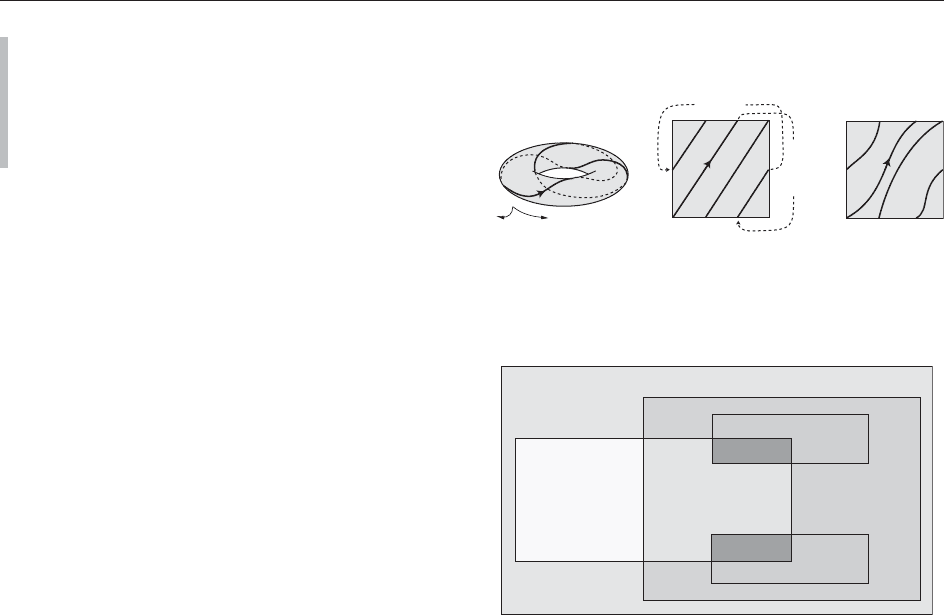
The oscillators are said to be frequency locked when
[4] has a stable periodic orbit #(t) = (#
1
(t), ..., #
n
(t))
on the n-torus T
n
,asinFigure 1a. The ‘‘rotation
vector’’ or ‘‘winding ratio’’ of the orbit is the set of
integers q
1
: q
2
: : q
n
such that #
1
makes q
1
rotations
while #
2
makes q
2
rotations, etc., as in the 2 : 3
frequency locking in Figure 1a. The oscillators
are entrained when they are 1 : 1: :1 frequency
locked. The oscillators are phase locked when there is
an (n 1) n integer matrix K having linearly
independent rows such that K#(t) = const. For exam-
ple, the two oscillators in Figure 1b are phase locked
with K = (2, 3), while those in Figure 1c are not. The
oscillators are synchronized when they are entrained
and phase locked. Synchronization is in-phase when
#
1
(t) = = #
n
(t) and out-of-phase otherwise. Two
oscillators are said to be synchronized antiphase when
#
1
(t) #
2
(t) = . Frequency locking without phase
locking, as in Figure 1c, is called phase trappi ng. The
relationship between all these definitions is depicted
in Figure 2.
Phase Resetting
An exponentially stable periodic orbit is a normally
hyperbolic invariant manifold, hence its sufficiently
small neighborhood, U, is invariantly foliated by
(c)
θ
1
θ
2
(a)
θ
1
θ
2
(b)
Identify
Identify
θ
1
θ
2
Figure 1 A 2-torus and its representation on the square.
(Modified from Hoppensteadt and Izhikevich 1997.)
Frequency locking
Phase locking
In
phase
Antiphase
Synchronization
Entrainment
(1:1 frequency locking)
Figure 2 Various degrees of locking of oscillators. (Modified
from Izhikevich 2006.)
448 Weakly Coupled Oscillators
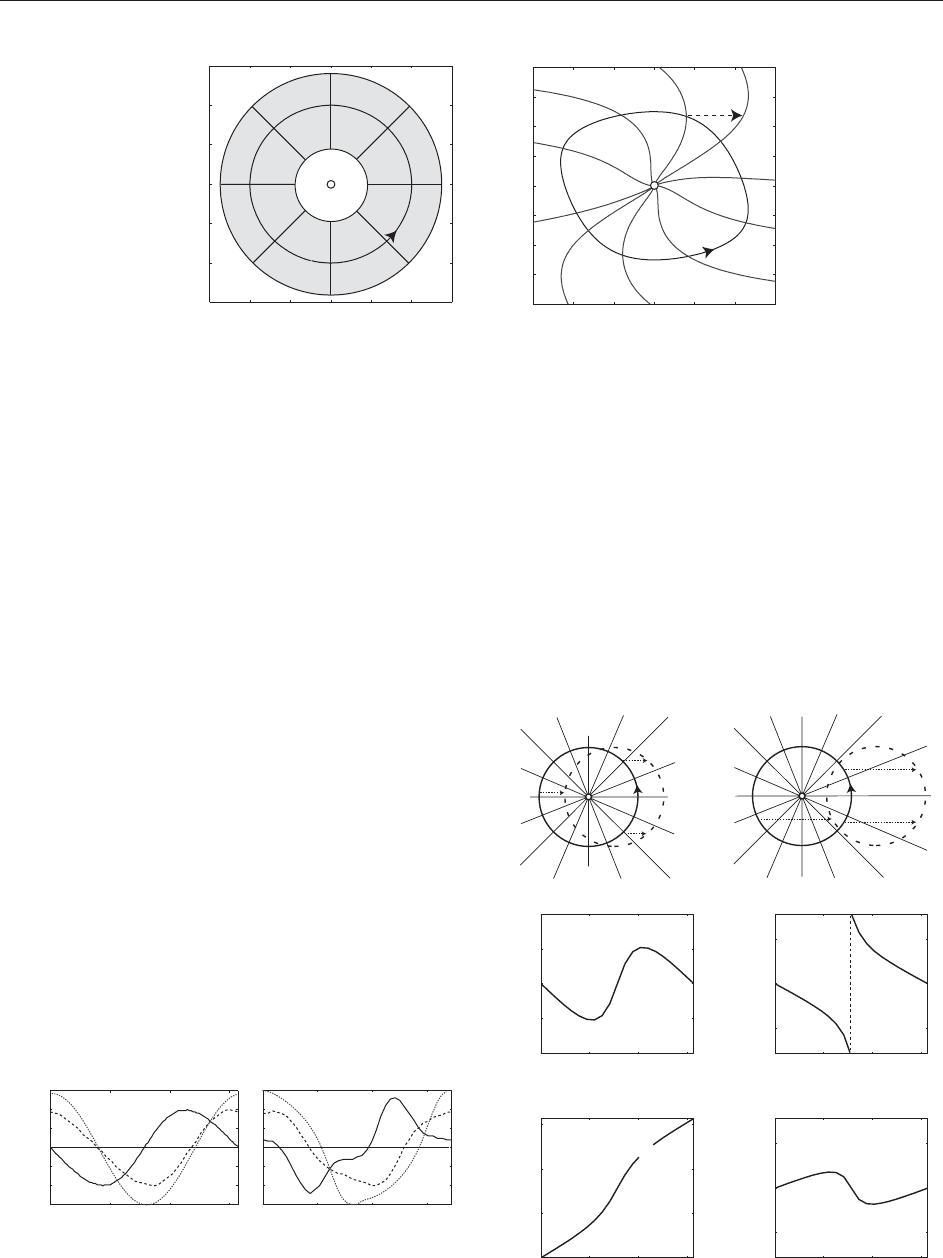
stable submanifolds (Guckenheimer 1975)illustrated
in Figure 3. The manifolds represent points having
equal phases and, for this reason, they are called
isochrons (from Greek ‘‘iso’’ meaning equal and
‘‘chronos’’ meaning time).
The geometry of isochrons determines how the
oscillators react to perturbations. For example, the
pulse in Figure 3, right, moves the trajectory from
one isochron to another, thereby changing its pha se.
The magnitude of the phase shift depends on the
amplitude and the exact timing of the stimulus
relative to the phase of oscillation #. Stimulating the
oscillator at different phases, one can measure the
phase transition curve (Winfree 2001)
#
new
¼ PTCð#
old
Þ
and the phase resetting curve
PRCð#Þ¼PTCð#Þ#
ðshift ¼ new phase old phaseÞ
Positive (negative) values of the PRC correspond to
phase advances (delays). PRCs are convenient when
the phase shifts are small, so that they can be
magnified and clearly seen, as in Figure 4. PTCs are
convenient when the phase shifts are large and
comparable with the period of oscillation.
In Figure 5 we depict phase portraits of the
Andronov–Hopf oscillator receiving pulses of
magnitude 0.5 ( left) and 1. 5 ( right). Notice the
drastic difference between the corresponding PRCs
or PTCs. Winfree (2001) distinguishes two cases:
1. type 1 (weak) resetting results in continuous PRCs
and PTCs with mean slope 1, and
2. type 0 (strong) resetting results in discontinuous
PRCs and PTCs with mean slope 0.
–1.5 –1 –0.5 0 0.5 1 1.5
–2
–1.5
–1
–0.5
0
0.5
1
1.5
2
van der Pol oscillator
x
y
pulse
–1.5 –1 – 0.5
0 0.5 1 1.5
–1.5
–1
–0.5
0
0.5
1
1.5
Andronov–Hopf oscillator
Re z
Im z
x
0
θ = 5π /4
θ = 3π /4
θ = π /2
θ = π /4
θ = π
θ = 3π /2
θ = 7π /4
θ = 0
γ
U
Figure 3 Isochrons of Andronov–Hopf oscillator (
_
z = (1 þi )z zjzj
2
, z 2 C) and van der Pol oscillator (
_
x = x x
3
y ,
_
y = x ):
0
–0.2
0
0.2
Stimulus phase, θ
PRC(θ)
Re z (t )
Andronov–Hopf oscillator
PRC
1
PRC
2
2π
Stimulus phase, θ
x
(t )
van der Pol oscillator
PRC
1
PRC
2
0
2π
Figure 4 Examples of phase response curves (PRCs) of the
oscillators in Figure 3. PRC
1
(#) and PRC
2
(#) correspond to
horizontal (along the first variable) and vertical (along the second
variable) pulses with amplitudes 0.2. An example of oscillation is
plotted as a dotted curve in each subplot (not to scale).
0
0
00
2π 2π
π
−π
2π
Stimulus phase, θ Stimulus phase, θ
PTC(θ)
=
{θ
+ PRC(θ)} mod 2π
PTC(θ)
=
{θ
+ PRC(θ)} mod 2π
Phase transition
Phase transition
0
–1
0
1
0
0
2π
2π
π
–π
Stimulus phase, θ Stimulus phase, θ
PRC(θ) PRC(θ)
Phase resetting
Phase resetting
Type 1 (weak) resetting Type 0 (strong) resetting
θ
= 0, 2π
θ
= π
θ = π /2
θ
= 3π /2
Figure 5 Types of phase resetting of the Andronov–Hopf
oscillator in Figure 3.
Weakly Coupled Oscillators 449
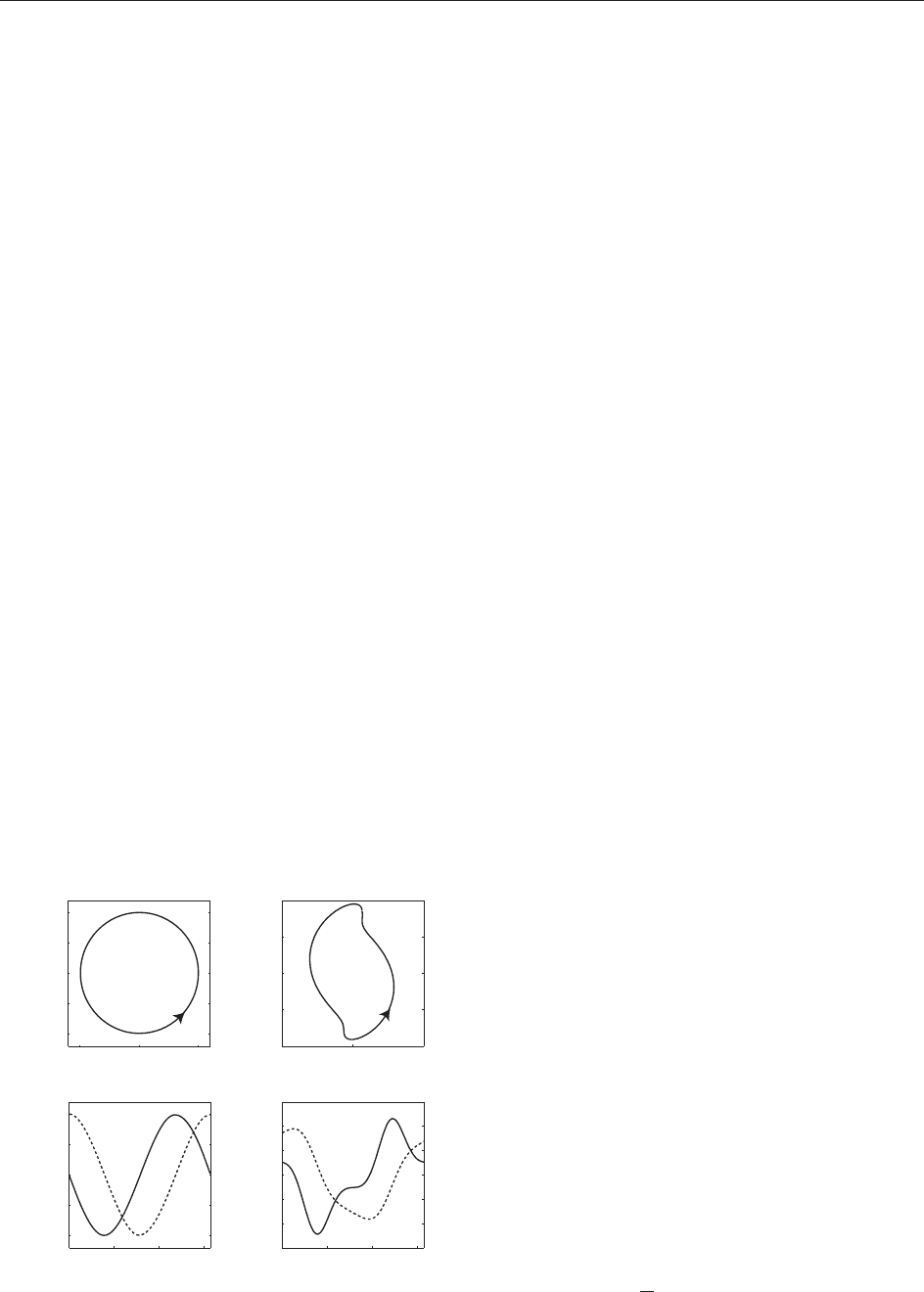
The discontinuity of type 0 PRC in Figure 5 is a
topological property that cannot be removed by
reallocating the initial point x
0
that corresponds to
zero phase. The discontinuity stems from the fact
that the shifted image of the limit cycle (dashed
circle) goes beyond the central equilibrium at which
the phase is not defined.
The stroboscopic mapping of S
1
to itself, called
Poincare
´
phase map,
#
kþ1
¼ PTCð#
k
Þ½5
describes the response of an oscillator to a T-periodic
pulse train. Here, #
k
denotes the phase of oscillation
when the kth input pulse arrives. Its fixed points
correspond to synchronized solutions, and its periodic
orbits correspond to phase-locked states.
Weak Coupling
Now consider dynamical systems of the form
_
x ¼ f ðxÞþ"sðtÞ½6
describing periodic oscillators,
_
x = f (x), forced by
a weak time-depended input "s(t), for example, from
other oscillators in a network. Let (x) denote the
phase of oscillation at point x 2 U, so that the map
: U ! S
1
is constant along each isochron. This
mapping transforms [6] into the phase model
_
# ¼ þ "Qð#ÞsðtÞ
with function Q(#), illustrated in Figure 6, satisfying
three equivalent conditions:
1. Winfree: Q(#) is normalized PRC to infinitesimal
pulsed perturbations;
2. Kuramoto: Q(#) = grad (x); and
3. Malkin: Q is the solution to the adjoint problem
_
Q ¼fDf ððtÞÞg
>
Q ½7
with the normalization Q(t) f ((t)) =for any t.
The function Q(#) can be found analytically in a
few simple cases:
1. a nonlinear phase oscillator
_
x = f (x) with x 2 S
1
and f > 0 has Q(#) ==f ((#));
2. a system near saddle-node on invariant circle
bifurcation has Q(#) proportional to 1 cos #;
and
3. a system near supercritical Andronov–Hopf
bifurcation has Q(#) proportional to sin(# ),
where 2 S
1
is a constant phase shift.
Other interesting cases, including homoclinic,
relaxation, and bursting oscillators are considered
by Izhikevich (2006).
Treating s(t)in[6] as the input from the network,
we can transform weakly coupled oscillators
_
x
i
¼ f
i
ðx
i
Þþ"
X
n
j¼1
g
ij
ðx
i
; x
j
Þ
zfflfflfflfflfflfflfflfflffl}|fflfflfflfflfflfflfflfflffl{
s
i
ðtÞ
; x
i
2 R
m
½8
to the phase model
_
#
i
¼
i
þ " Q
i
ð#
i
Þ
X
n
j¼1
g
ij
ðx
i
ð#
i
Þ; x
j
ð#
j
ÞÞ
zfflfflfflfflfflfflfflfflfflfflfflfflfflfflfflfflffl}|fflfflfflfflfflfflfflfflfflfflfflfflfflfflfflfflffl{
s
i
ðtÞ
½9
having the form [4] with h
i
= Q
i
P
g
ij
, or the form
_
#
i
¼
i
þ "
X
n
j¼1
h
ij
ð#
i
;#
j
Þ
where h
ij
= Q
i
g
ij
. Introducing phase deviation vari-
ables #
i
=
i
t þ ’
i
, we transform this system into the
form
_
’
i
¼ "
X
n
j¼1
h
ij
ð
i
t þ ’
i
;
j
t þ ’
j
Þ
which can be averaged to
_
’
i
¼ "
X
n
j¼1
H
ij
ð’
i
’
j
Þ½10
with the functions
H
ij
ðÞ¼ lim
T!1
1
T
Z
T
0
h
ij
ð
i
t;
j
t Þdt ½11
0
–1
–1
0
1
1
Q
2
Q
1
Andronov–Hopf oscillator
Q
(θ)
Phase, θ
0
–1
0
1
2π
Q
1
(θ)
Q
2
(θ)
Phase, θ
0
–1
0
1
2π
Q
1
(θ)
Q
2
(θ)
van der Pol oscillato
r
0
–1
–2
0
1
2
Q
2
Q
1
Q (θ)
Figure 6 Solutions Q = (Q
1
, Q
2
) to the adjoint problem [7] for
oscillators in Figure 3.
450 Weakly Coupled Oscillators

describing the interaction between oscillators
(Ermentrout and Kopell 1984). To summarize, we
transformed weakly coupled system [8] into the
phase model [10] with H given by [11] and each Q
being the solut ion to the adjoint problem [7]. This
constitutes the Malkin theorem for weakly coupled
oscillators (Hoppens teadt and Izhikevi ch 1997,
theorem 9.2).
Existence of one equilibrium of the phase model
[10] implies the existence of the entire circular
family of equilibria, since translation of all ’
i
by a
constant phase shift does not change the phase
differences ’
i
’
j
and hence the form of [10]. This
family corresponds to a limit cycle of [8], on which
all oscillators have equal frequencies and constant
phase shifts, that is, they are synchronized, possibly
out of phase.
We say that two oscillators, i and j, have resonant
(or commensurable) frequencies when the ratio
i
=
j
is a rational number, for exampl e, it is p=q
for some integer p and q. They are nonr esonant
when the ratio is an irrational number. In this case,
the function H
ij
defined above is constant regardless
of the details of the oscillatory dynamics or the
details of the coupling, that is, dynamics of two
coupled nonresonant oscillators is described by an
uncoupled phase model. Apparently, such oscillator s
do not interact; that is, the phase of one of them
cannot change the phase of the other one even on
the long timescale of order 1=".
Synchronization
Consider [8] with n = 2, describing two mutually
coupled oscillators. Let us introduce ‘‘slow’’ time
= "t and rewrite the corresponding phase model
[10] in the form
’
0
1
¼ !
1
þ H
12
ð’
1
’
2
Þ
’
0
2
¼ !
2
þ H
21
ð’
2
’
1
Þ
where
0
= d=d and !
i
= H
ii
(0) is the frequency
deviation from the natural oscillation, i = 1, 2. Let
= ’
2
’
1
denote the phase difference between the
oscillators; then
0
¼ ! þ HðÞ½12
where
! ¼ !
2
!
1
and HðÞ¼H
21
ðÞH
12
ðÞ
is the frequency misma tch and the antisymmetric
part of the coupling, respectively, illustrated in
Figure 7, dashed curves. A stable equilibrium of
[12] corresponds to a stable limit cycle of the phase
model.
All equilibria of [12] are solutions to H() = !,
and they are intersections of the horizontal line !
with the graph of H. They are stable if the slope
of the graph is negative at the intersection. If
oscillators are identical, then H() is an odd
function (i.e., H() = H()), and = 0and
= are always equilibria, possibly unstable,
corresponding to the in-phase and antiphase syn-
chronized solutions. The in-phase synchronization
of gap–junction coupled oscillators in Figure 7 is
stable because the slope of H (dashed curves) is
negative at = 0. The max and min values of the
function H determine the tolerance of the network
to the frequency mismatch !, since there are no
equilibria outside this range.
Now consider a network of n > 2 weakly coupled
oscillators [8]. To determine the existence and
stability of synchronized states in the network, we
need to study equilibria of the corresponding phase
model [10]. The vector = (
1
, ...,
n
)isan
equilibrium of [10] when
0 ¼ !
i
þ
X
n
j6¼1
H
ij
ð
i
j
Þðfor all iÞ½13
It is stable when all eigenvalues of the linearization
matrix (Jacobian) at have negative real parts,
except one zero eigenvalue corresponding to the
eigenvector along the circular family of equilibria (
plus a phase shift is a solution of [13] too since the
phase shifts
j
i
are not affected).
In general, determining the stability of equilibria
is a difficult problem. Ermentrout (1992) found a
simple sufficient condition. If
1. a
ij
= H
0
ij
(
i
j
) 0, and
2. the directed graph defined by the matrix a = (a
ij
)
is connected, (i.e., each oscillator is influenced,
possibly indirectly, by every other oscillator),
then the equilibrium is neutrally stable, and the
corresponding limit cycle x(t þ )of[8] is asympto-
tically stable.
Andronov–Hopf oscillator
Phase difference,
χ
H(χ)
H
ij
(χ)
0
–0.5
0
0.5
2π
van der Pol oscillator
Phase difference, χ
H(χ)
H
ij
(χ)
0
2
π
Figure 7 Solid curves: functions H
ij
() defined by [11]
corresponding to the gap–junction input g(x
i
, x
j
) = (x
j1
x
i1
, 0).
Dashed curves: functions H() = H
ji
() H
ij
().: Parameters
are as in Figure 3.
Weakly Coupled Oscillators 451
Another sufficient condition was found by
Hoppensteadt and Izhikevich (1997). If system [10]
satisfies
1. !
1
= = !
n
= ! (identical frequencies)
2. H
ij
() = H
ji
() (pairwise odd coupling)
for all i and j, then the network dynamics converge to a
limit cycle. On the cycle, all oscillators have equal
frequencies 1 þ "! and constant phase deviations.
The proof follows from the observation that [10]
is a gradient system in the rotating coordinates
’ = ! þ with the energy function
EðÞ¼
1
2
X
n
i¼1
X
n
j¼1
R
ij
ð
i
j
Þ
where
R
ij
ðÞ¼
Z
0
H
ij
ðsÞds
One can check that dE()=d =
P
(
0
i
)
2
0
along the trajectories of [12] with equality only at
equilibria.
Mean-Field Approximations
Let us represent the phase model [10] in the form
’
0
i
¼ !
i
þ
X
n
j6¼i
H
ij
ð’
i
’
j
Þ
where
0
= d=d, = "t is the slow time, and
!
i
= H
ii
(0) are random frequency deviations. Collec-
tive dynamics of this system can be analyzed
in the limit n !1. We illustrate the theory
using the special case, H() = sin , known as the
Kuramoto (1984) model:
’
0
i
¼ !
i
þ
K
n
X
n
j¼1
sinð’
j
’
i
Þ;’
i
2½0; 2½14
where K > 0 is the coupling strength and the factor
1=n ensures that the model behaves well as n !1.
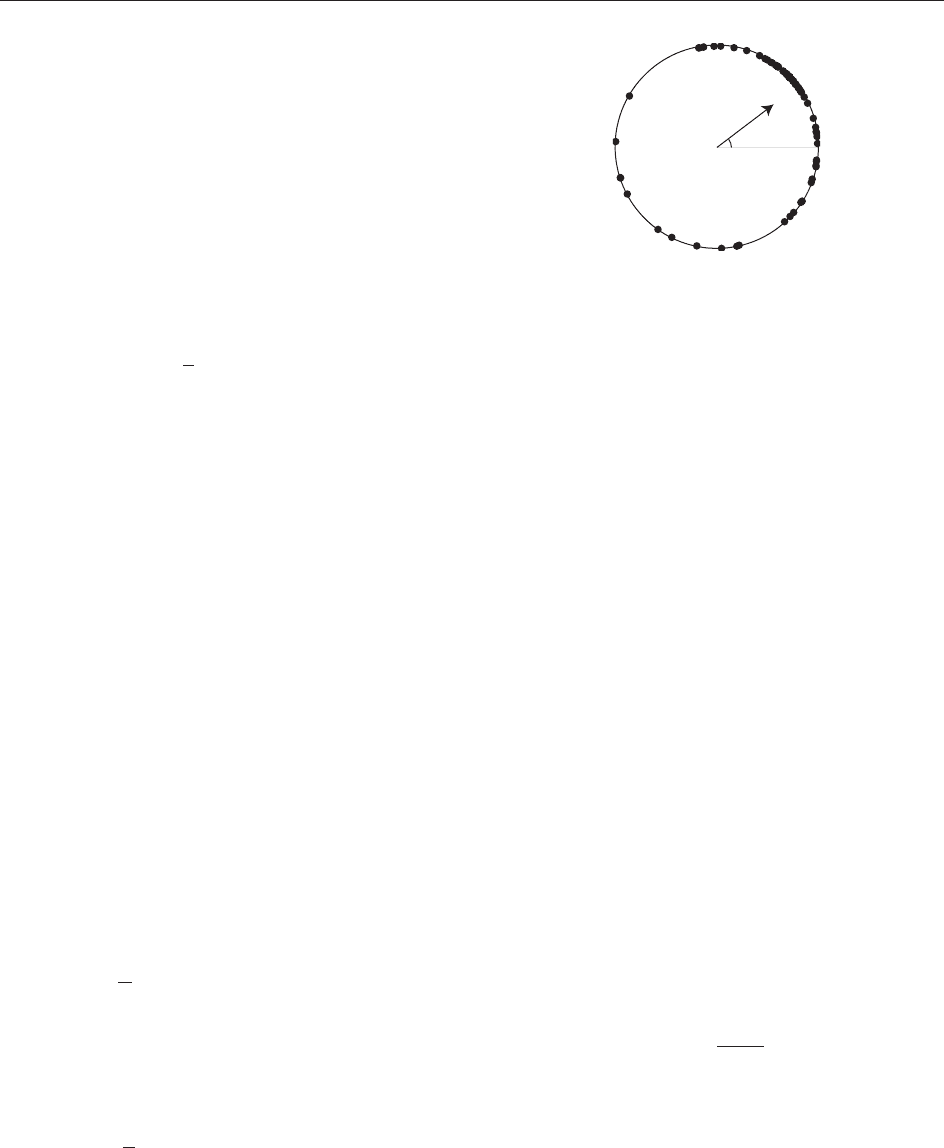
The complex-valued sum of all phases,
re
i
¼
1
n
X
n
j¼1
e
i’
j
ðKuramoto synchronization indexÞ½15
describes the degree of synchronization in the
network. Apparently, the in-phase synchronized
state ’
1
= = ’
n
corresponds to r = 1 with
being the population phase. In contrast, the inco-
herent state with all ’
i
having different values
randomly distributed on the unit circle, corresponds
to r 0. Intermediate values of r correspond to a
partially synchronized or coherent state, depicted in
Figure 8. Some phases are synchronized forming a
cluster, while others roam around the circle.
Multiplying both sides of [15] by e
i’
i
and
considering only the imaginary parts, we can rewrite
[14] in the equivalent form
’
0
i
¼ !
i
þ Kr sinð ’
i
Þ
that emphasizes the mean-filed character of interac-
tions between the oscillators: they all are pulled into
the synchronized cluster (’
i
! ) with the effective
strength proportional to the cluster size r. This pull
is offset by the random frequency deviations !
i
that
pull away from the cluster.
Let us assume that !
i
’s are distributed randomly
around 0 with a symmetrical probability density
function g(!), for example, Gaussian. Kuramoto has
shown that in the limit n !1, the cluster size r
obeys the self-consistenc y equation
r ¼ rK
Z
þ=2
=2
gðKr sin ’Þcos
2
’ d’ ½16
Notice that r = 0, corresponding to the incoherent
state, is always a solution of this equation. When the
coupling strength K is greater than a certain critical
value,
K
c
¼
2
gð0Þ
an additional , nontrivial solution r > 0 appears,
which corre sponds to a partially synchronized
state. Expanding g in a Taylor series, one gets the
scaling r =
ffiffiffiffiffiffiffiffiffiffiffiffiffiffiffiffiffiffiffiffiffiffiffiffiffiffiffiffiffiffiffiffiffiffiffiffiffiffiffiffiffiffiffiffiffiffiffiffiffiffiffi
16(K K
c
)=(g
00
(0)K
4
c
)
p
. Thus, the
stronger the coupling K relative to the random
distribution of frequencies, the more oscillators syn-
chronize into a coherent cluster. The issue of stability
of incoherent and partially synchronized states is
discussed by Strogatz (2000). Other generalizations
of the Kuramoto model are reviewed by Acebron et al.
(2005). An extended version of this article with the
r
r
e
i ψ
ϕ
i
ϕ
j
ψ
Figure 8 Kuramoto synchronization index [15] describes the
degree of coherence in the network [14].
452 Weakly Coupled Oscillators

emphasis on computational neuroscience can be found
in the recent book by Izhikevich (2006).
See also: Bifurcations of Periodic Orbits; Dynamical
Systems and Thermodynamics; Hamiltonian Systems:
Stability and Instability Theory; Singularity and Bifurcation
Theory; Stability Theory and KAM; Synchronization of
Chaos.
Further Reading
Acebron JA, Bonilla LL, Vincente CJP, Ritort F, and Spigler R (2005)
The Kuramoto model: a simple paradigm for synchronization
phenomena. Reviews of Modern Physics 77: 137–186.
Ermentrout GB (1992) Stable periodic solutions to discrete and
continuum arrays of weakly coupled nonlinear oscillators. SIAM
Journal on Applied Mathematics 52: 1665–1687.
Ermentrout GB and Kopell N (1984) Frequency plateaus in a chain
of weakly coupled oscillators, I. SIAM Journal on Applied
Mathematics 15: 215–237.
Glass L and MacKey MC (1988) From Clocks to Chaos. Princeton:
Princeton University Press
Guckenheimer J (1975) Isochrons and phaseless sets. Journal of
Mathematical Biology 1: 259–273.
Hoppensteadt FC and Izhikevich EM (1997) Weakly Connected
Neural Networks. New York: Springer.
Izhikevich EM (1999) Weakly connected quasiperiodic oscillators,
FM interactions, and multiplexing in the brain. SIAM Journal
on Applied Mathematics 59: 2193–2223.
Izhikevich EM (2006) Dynamical Systems in Neuroscience: The
Geometry of Excitability and Bursting. Cambridge, MA: The
MIT Press.
Kuramoto Y (1984) Chemical Oscillations, Waves, and Turbulence.
New York: Springer.
Pikovsky A, Rosenblum M, and Kurths J (2001) Synchronization: A
Universal Concept in Nonlinear Science. Cambridge: Cambridge
University Press.
Strogatz SH (2000) From Kuramoto to Crawford: exploring the
onset of synchronization in populations of coupled oscillators.
Physica D 143: 1–20.
Winfree A (2001) The Geometry of Biological Time, 2nd edn.
New York: Springer.
Wheeler–De Witt Theory
J Maharana, Institute of Physics, Bhubaneswar, India
ª 2006 Elsevier Ltd. All rights reserved.
Introduction
It is recognize d that one of the outstanding problems
in modern physics is to formulate the quantum
theory of gravity, synthesizing the principles of
quantum mechanics and general theory of relativity.
The fundamental units for measuring time, length,
and energy, known as Planck time, Planck length,
and Planck energy, respectively, are defined to be
t
Pl
=(hG=c
5
)
1=2
=5.39 10
44
s, l
Pl
=(hG=c
3
)
1=2
=
1.61 10
33
cm, and m
Pl
=(hc =G)
1=2
=2.17
10
5
g, in terms of the Newton’s constant, G,
velocity of light, c, and h=h=2,h being the
Planck’s constant. We may con clude, on dimen-
sional arguments, that quantum gravity effects will
play an important role when we consider physical
phenomena in the vicinity of these scales. Therefore,
when we probe very short distances, consider
collisions at Planckian energies, and envisage evolu-
tion of the universe in the Planck era, the quantum
gravity will come into play in a predominant
manner. The purpose of this article is to present an
overview of an approach to quantize Einstein’s
theory of gravity, pioneered by Wheeler and De
Witt almost four decades ago. We proceed to
recapitulate various prescriptions for quantizing
gravitation and then discuss simple derivation of
the Wheeler–De Witt (WDW) equation in general
relativity and some of its applications in the study of
quantum cosmology. There are, broadly speaking,
three different approaches to quantize gravity.
The general theory of relativity has been tested to
great degree of accuracy in the classical regime. The
geometrical description of spacetime plays a cardinal
role in Einstein’s theory. Therefore, the general
relativists emphasize the geometrical attributes of the
theory and the central role played by the spacetime
structure in their formulation of quantum theory.
It is natural to adopt a background-independent
approach. In contrast, the path followed by
quantum field theorists, where the prescription is
valid in the weak-field approximation, the theory is
quantized in a given background, usually the Min-
kowskian space. It is argued by the proponents of the
geometric approach, that the background metric
should emerge from the theory in a self-consistent
manner rather than being introduced by hand when
we quantize the theory. One of the earliest attempts
to quantize gravity was to follow the route of
canonical method. The canonical quantization
approach has many advantages. One of the impor-
tant features is that it is quite similar to the
prescriptions adopted in quantum field theory where
one uses notion of operators, commutation relations,
etc. Moreover, the subtleties encountered in quantiz-
ing gravity are transparent. Therefore, the canonical
procedure is preferred over the path-integral formula-
tion, although the latter has its own advantages too.
Another positive aspect of the canonical approach is
that the requirement of background-independent
Wheeler–De Witt Theory 453
formulation could be maintained to some extent.
Thus, there is room for exploring some of the
nonperturbative attributes of the theory. The relati-
vists favor canonical formulation, since some of the
geometrical features of general theory of relativity
could be incorporated here and be explored to see
how far the quantum theory captures such properties
of the classical theory. As we shall discuss in sequel,
some of the interesting issues of quantum cosmology
are addressed in this approach. However, there are
limitations and short comings in this formulation and
we refer the reader to the text books and review
articles for further reading and critical assessments of
canonical approach to quantize gravity.
The second approach is primarily the endeavor of
physicists who have devoted their research to
quantum field theory. Feynman’s seminal work on
quantization of gravity from this perspective has
profoundly influenced the subsequent developments.
The quantization of gravity is carried out in the
weak-field approximation such that the graviton is
identified as the fluctuation over the Minkowski
background metric. It is a massless spin-2 field as one
concludes from the properties of low-energy gravita-
tional interaction in the classical limit. Furthermore,
the gauge invariance associated with a spin-2 mass-
less field gets intimately related with invariance of
Einstein’s theory under general coordinate transfor-
mation. In this setup, the field-theoretic techniques
could be employed to quantize theory and to consider
perturbative expansions for the scattering amplitudes.
It is realized that low-energy amplitudes computed
from the massless spin-2 theory match with those
derived from the Einstein–Hilbert action in the weak-
field approximation. Furthermore, the theory is not
perturbatively renormalizable since the coupling
constant carries dimension. One of the most impor-
tant outcomes of the investigations from this per-
spective is the discovery, due to Feynman, that the
introduction of ghost fields is necessary in order to
maintain unitarity of the S-matrix when one goes
beyond the tree level. As is well known, this work has
profoundly influenced frontiers of research in physics
leading to quantization of Yang–Mills theory which,
in turn, paved way for electroweak theory and the
QCD. It is worthwhile to mention in passing that the
quantum phenomena associated with gravity in the
nonperturbative regime cannot be addressed in this
framework.
In recent years, superstring theory has been at the
center stage in order to provide a unified theory of
fundamental interactions. It is postulated that all
elementary constituents of matter and the carriers of
the interactions such as gauge bosons and graviton
are excitations of one-dimensional extended objects:
the string s. The superstring theories are perturba-
tively consistent in critical ten dimensions. The
closed-superstring spectrum contains a spin-2 mass-
less state which is identified to be the graviton. It is
well known that perturbative computation of pro-
cesses involving graviton turn out to be finite.
Moreover, the Einstein–Hilbert term appears natu-
rally when one derives the string effective action.
Therefore, it is expected that string theory will be
able to provide answers to questions related to
quantum gravity. Indeed, the theory has met with
success in resolving some important issues. We note
that cosmological scenario has been discussed in the
string theory framework and the WDW equation
has played an important role in study of quantum
string cosmology. We shall comment on this aspect
towards the end of this article.
The Canonical Structure of Einstein
Gravity
The Einstein–Hilbert action is
S ¼
1
16G
Z
M
ffiffiffiffiffiffiffi
g
p
d
4
xðR 2Þ½1
where R is the Ricci scalar derived from the metric,
g
, and is the cosmological constant. The field
equations are derived from the action by the
standard variati onal technique. Note that R involves
second derivative of the metric. If we have compac t
manifolds with boundary @M such that variations of
the metric vanish on the bounda ry and the normal
derivatives do not, it is necessary to add a surface
term to this action. The exact form of this term will
be discussed later. The Einstein’s theory of gravita-
tion is manifestly covariant. The associated action
[1] is invariant under genera l coordinate transforma-
tions: under x
!x
0
(x),
g
0
ðx
0
Þ¼g
ðxÞ
@x
0
@x
@x
0
@x
½2
Therefore, we expect that the theory will be
endowed with constraints expressed in terms of the
canonical variables. One can implement general
coordinate transformations so that there are only
two pairs of canonical phase-space variables on a
spacelike hypersurface. In other words, from physi-
cal considerations, graviton has only two polariza-
tions whereas the metric has ten components.
Therefore, the two physical degrees of freedom can
be obtained using the freedom of choosing the
‘‘gauge’’ transformations in this context. It is
desirable to identify the constraints and analyze
their structure, most appropriately in Dirac’s
454 Wheeler–De Witt Theory
formalism, and to quantize the theory canonically as
the next step. This is the path we intend to follow in
order to arrive at the WDW equation.
The Classical Constraints
The Hamiltonian approach is most appropriate to
employ the constraint formalism due to Dirac. We
recall that the Lagrangian formulation is manifestly
covariant as is reflected in the field equations;
whereas the spacetime covariance is lost in the
passage to the Hamiltonian approach. Furthermore,
the spatial components of the metric are the
dynamical degrees of freedom. We adopt the
formalism introduced by Arnowitt, Deser, and
Misner (ADM) for the so-called 3 þ 1 split of the
hyperbolic Riemannian spacetime metric, g
. One
introduces the lapse function, N
?
, and the shift
function, N
i
. We suppress the factors of 1=16G,
etc., for the time being for the general discussions
and shall reintroduce them later. The family of
spacelike hypersurfaces,
t
, are constructed, with
metric h
ij
induced on it. Here t is a timelike
parameter, param etrize
t
. The distance between
points on two neighbor ing hyp ersurface,
t
and
tþdt
, with coordinates (t, x
i
)and(t þ dt, x
i
þ dx
i
),
respectively, is given by
ds
2
¼ðN
?
Þ
2
dt
2
þ h
ij
ðN
i
dt þ dx
i
ÞðN
j
dt þ dx
j
Þ
¼ g
dx
dx
½3
The indices of tensors defined on
t
are raised and
lowered by h
ij
and its inverse h
ij
. The relations
between the components of g
and N
?
, N
i
, h
ij
can
be obtained easily,
g
00
¼ h
ij
N
i
N
j
ðN
?
Þ
2
; g
0i
¼ h
ij
N
j
½4
The above relations can be inverted to give
N
i
¼ h
ij
g
0i
N
?
¼
1
ffiffiffiffiffiffiffiffiffiffiffi
g
00
p
½5
The relations between spatial components, g
ij
,ofg
and h
ij
and some other useful relations are listed
below for later conveniences:
g
ij
¼ h
ij
N
i
N
j
ðN
?
Þ
2
ffiffiffiffiffiffiffi
g
p
¼ N
?
ffiffiffi
h
p
g
0i
¼
N
i
ðN
?
Þ
2
½6
Note that (N
?
, N
i
) are introduced to specify the
deformation of the hypersurface and therefore, the
evolution equations through the Hamiltonian will
not determine them; they are arbitrary functions.
Consequently, [4] implies that g
00
and g
0i
will enter
the Hamiltonian as arbitrary functions. As alluded
to above, h
ij
and their conjugate momenta
ij
are the
dynamical degrees of freedom. We may choose
(N
?
, N
i
) = N
and h
ij
as independen t variables
rather than (g
00
, g
0i
) = g
0
and h
ij
for convenience
and go back to the other set of variables through [4]
and [5] if we desire. Let
be canonically conjugate
momenta to N
, then it is obvious that a Lagrangian
multiplier,
, is necessary so that . term has to be
supplemented to the Hamiltonian due to the
arbitrariness of N
. We remind the reader that in
electrodynamics an analogous situation arises while
analyzing its canonical structure – local gauge
symmetry plays a crucial role there. It is obvious
that the generic form of the Hamiltonian is (w e shall
introduce 1=16G, etc., later)
H ¼
Z
d
3
xN
?
H
?
½h
ij
;
ij
þN
i
H
i
½h
ij
;
ij
þ:
½7
From the perspective of constraint analysis, it is
natural that
0 appears as a first-class constraint
as they are multiplied by arbitrary functions. More-
over, this constraint must hold good under the
deformation of the surface which implies {
,H}
PB
must vanish weakly leading to H
0. As a
consistency requirement, these must be first-class
constraints if N
are to be arbitrary functions. We
identify that
0 and H
0 are the primary and
secondary constraints, respectively. Thus far, we
have discussed the case for pure gravity; the
presence of matter fields in the full action modifies
the treatment appropriately.
Let us analyze the structure of the constraints for
the Einstein–Hilbert action [1]. For a compact
manifold with boundary @M, we have to add the
surface term which takes the form:
1
8G
Z
@M
d
3
x
ffiffiffi
h
p
K
Here K stands for the trace of the extrinsic curvature
of the boundary 3-surface and h = det h
ij
; note that
h
ij
is the induced metric on the 3-surface. If we
include mat ter fields, the correspon ding action is to
be taken into account. Once we make the 3 þ 1 split
of the metric, the action assumes the following form:
S ¼
1
16G
Z
d
3
x dtN
?
ffiffiffi
h
p
K
ij
K
ij
K
2
þ
3
R 2
½8
where
K
ij
¼
1
N
?
@h
ij
@t
þ D
i
N
j
þ D
j
N
i
½9
Wheeler–De Witt Theory 455
Here D
i
N
j
represents covariant derivative of N
j
with
the connections computed from h
ij
and
3
R is
curvature of the 3-surface. The canonical momenta
are
ij
¼
ffiffiffi
h
p
16G
K
ij
h
ij
K
l
l
½10
and we can invert this relation to get
K
ij
¼
1
16G
ffiffiffi
h
p
ij
1
2
h
ij
l
l
The Hamiltonian form of action is give n by
S
H
¼
Z
d
3
x dt
_
h
ij
ij
N
?
H
?
N
i
H
i
½11
Notice that [8] does not involve time derivatives of
N
?
and N
i
, their corresponding canonical momenta
vanish.
?
0;
i
0 ½12
as expected from our earlier discussions about the
role of N
. A straightforward constraint analysis
leads to the pair of constraints
H
i
¼2D
j
j
i
0 ½13
H
?
¼
16G
ffiffiffi
h
p
h
ij
h
kl
1
2
h
ik
h
jl
ik
jl
ffiffiffi
h
p
16G
3
R 0 ½14
We mention in passing that the above constraint
equations get modified in the presence of matter
fields in the theory. This is relevant. The WDW
equation plays an important role in quantum
cosmology to describe the evolution of the universe
in early epochs and the equation is studied in the
presence of a generic matter content, that is, a scalar
field with potential. The constraint equations [13]
and [14] modify to
H
T
i
¼H
i
þH
matter
i
0 ½15
H
T
?
¼H
?
þH
matter
0 ½16
The Algebra of Constraints
In order to compute the classical Poisson bracket
algebra of the constraints [13] and [14], we use the
canonical Poisson bracket relations for the phase-
space variables on
t
:
fh
ij
ðxÞ; h
kl
ðx
0
Þg ¼ 0 ½17
f
ij
ðxÞ;
kl
ðx
0
Þg ¼ 0 ½18
fh
ij
ðxÞ;
kl
ðx
0
Þg ¼
k
ði
l
jÞ
ðx; x
0
Þ½19
Thus, Poisson brackets among the constraints [13]
and [14] are
fH
i
ðxÞ; H
j
ðx
0
Þg ¼ H
j
ðxÞ@
x
0
i
ð x; x
0
Þ
þH
i
@
x
j
ðx; x
0
Þ½20
fH
i
ðxÞ; H
?
ðx
0
Þg ¼ H
?
ðxÞ@
x
i
ð x; x
0
Þ½21
fH
?
ðxÞ; H
?
ðx
0
Þg ¼ h
ij
ðxÞH
i
ðxÞ@
x
0
j
ðx ; x
0
Þ
h
ij
ðx
0
ÞH
i
ðx
0
Þ@
x
j
ðx; x
0
Þ½22
When we resort to canonical quantization, the
starting point is the Hamiltonian action in the first-
order formalism, where the canonical variables are
subjected to the constraints [13] and [14] in terms of
H
?
and H
i
satisfying the algebra given by [20]–[22].
One encounters a number of important issues while
proceeding to canonically quantize the theory. We
shall mention only a few of them in what follows. It
is important to address issues related to the role of
the constraints in the quantized theory and how to
deal with the Lagrange multipliers N
?
and N
i
.A
simple proposal is to solve the constraints at the
classical level and identify the physical degrees of
freedom and quantize the theory subsequently.
There are four constraints (first class), H
?
, H
i
,
therefore, out of the 12 phase-space variables,
(h
ij
,
ij
), only eight are independent. We need to
supply four gauge conditions in order to render the
theory (classically) solvable. Thus, we are left with
four physical degrees of freedom in the Hamiltonian
phase space and we can quantize them. The
implementation of this idea is easier said than
done. One obstacle is that the constraint s cannot
be solved in a closed form in this formalism. If we
fix a gauge and quantize the theory, we obviously
break the gauge invariance. It is essential to show,
subsequently, that a ll physically observable quanti-
ties are independent of the gauge choice. Another
criticism of this formalism is that we already get rid
of some of the components of the metric. Therefore,
the spirit of the general theory of relativity, which is
based on the geometrical structure of spacetime, is
somewhat diluted. There are other suggestions
where h
ij
and their conjugate momenta are elevated
to quantum status before supplying the gauge
conditions. The issues of gauge fixing and dealing
with the constraints are addressed at the quantum
level. We replace the canonical Poisson bracket
456 Wheeler–De Witt Theory
algebra by the canonical commutators and procee d
further. The momentum operat or assumes the form
^
ij
¼ih
h
ij
and the wave functional depends on h
ij
that is, [h].
There are many technical problems related to the
properties of the states and we shall not deal with
them due to limitations of space. It is essential to
discuss the role of the constraints in the quantum
theory. We demand that the quantum constraints
annihilate the physical states (recall the Gauss law
constraint in gauge theories). However, the issue of
operator ordering is to be dealt with which in turn is
connected with the Hermiticity properties of the
quantum constraints. The Hamiltonian constraint
H
?
0 (henceforth denoted as H and defined as the
Hamiltonian) is a product of the metric
^
h
ij
and
ij
.
There is certain ambiguity in defining the constraint.
Therefore, one has to choose a convention.
The condition that the Hamiltonian,
^
H
T
, consisting
of gravitational and matter components, annihilates
the state is expressed as
^
H
T
¼ 0 ½23
When we ado pt coordinate representation for
ij
,
the above equation takes the form
16GG
ijkl
h
ij
h
kl
ffiffiffi
h
p
16G
ð
3
R 2ÞþH
matter
#
½h;¼0 ½24
This is the celebrated WDW equation. Here we have
considered a simple case where matter Hamiltonian
density generically contains a single scalar field, ,
and therefore is functional of 3-metric on
t
and
. G
ijkl
is the De Witt metric in the superspace:
G
ijkl
¼
1
ffiffiffi
h
p
ðh
ik
hjl þ h
il
h
jk
h
ij
h
kl
Þ½25
Remarks The space of all 3-metrics and the scalar
field (h
ij
, ), on
t
, for the description of classical
evolutions is called the superspace (no connection
with the superspace of supersymmetry). Thus,
[h
ij
, ] is a functional on superspace. Furthermore,
carries no explicit dependence on t. This is a
consequence of the fact that ‘‘time’’ plays the role of
a parameter in the general theory of relativity, thus
the dynamical variables h
ij
and already provide the
evolutionary processes although t does not make its
appearance. As mentioned earlier, we always discuss
the case when
t
is compact. Another point to note
is that the quantum momentum constraint,
^
H
i
,asan
operator annihilates the wave function which is a
statement of the quantum-mechanical invariance of
the theory under three-dimensional diffeomorph-
isms. However, the WDW equation conveys invar-
iance of the theory under reparametrization,
although careful analysis is necessary to prove this
point. Now we proceed to discuss the solutions of
the WDW equation.
WDW Equation and the Solutions
It is recognized that the WDW equation [24] is a
second-order hyperbolic functional differential equa-
tion and naturally it has enormous number of
solutions. Therefore, if we want the WDW equation
to have any predictive power, it is necessary to
introduce boundary conditions. One of the possible
choice is to specify the wave function on the
boundary of the superspace. Indeed, the central
issue of quantum co smology is about the choice of
various boundary conditions which has been an
important topic of debates. This point will be briefly
discussed later. Notice that the boundary condition
has to be introduced keeping in mind how the
universe is expected to behave as it evolves. There is
a proposition that the boundary condition for the
quantum evolution of the universe be given the
status of a physical law. Therefore, the role of the
wave functional, [h
ij
(x), (x), B], its evolution, and
interpretation are central to the development of
quantum cosmology. Thus, represents the ampli-
tude for the universe to hav e h
ij
(x) on the 3-surface,
B, and matter field (x). It is argued that path-
integral formalism should be adopted as an alt er-
native to the canonical presc ription to solve for the
wave function, rather the transition amplitude,
satisfying the WDW equation. Her e the first step is
to define the Euclidean version of the gravitational
action keeping in mind the subtleties. As is well
known, we deal with propagator (or transition
amplitude) in the path-integral approach where the
functional integral is carried out over a set of
4-metrics and matter fields with Euclidean action
inside the integral acting as the weight factor. We
recall that while formulating quantum mechanics in
the path-integral approach, we sum over all possible
paths in the functional integral. However, in the
semiclassical approximation, the amplitude is domi-
nated by the action corresponding to the classical
path and we approximate the wave function as
e
(i=h)S
cl
and it gets modified appropriately in the
Euclidean formulation. In this background, we
briefly discuss how the wave function of the
universe is obtained in the path-integral formalism.
Wheeler–De Witt Theory 457