
Francoise J.-P., Naber G.L., Tsun T.S. (editors) Encyclopedia of Mathematical Physics
Подождите немного. Документ загружается.


operator, which resolves one problem of the one-particle
theory. However, q(K) is not bounded from below, and
thus
P
(0)
is not yet the physical representation.
The physical representation can be constructed
using the operators
T ¼
1
ffiffiffi
2
p
B
1=2
iB
1=2
B
1=2
iB
1=2
; F ¼
10
0 1
½53
(for simplicity, we restrict ourselves to the case C = 0
and B > 0; we use the calculus of self-adjoint operators
here) with the following remarkable properties:
T
1
¼ JT
F
TKT
1
¼
B 0
0 B
^
K
½54
One can check that
^
y
ðf Þ
y
ðTf Þ;
^
ðf Þ ðT
1
f Þ½55
is a quasifree representation
P
of A
(h) with
P
= (1 F)=2. With that the construction of
^
q and
^
Q is very similar to the fermion case described
above (the crucial simplification is that
^
K and F now
are diagonal). In particular,
^
q(K) is a non-negative
operator with the ground state , and
^
q(A) and
^
Q(U) are self-adjoint and unitary for every one-
particle observable A and transformation U, respec-
tively. One also gets relations as in [43] and [46].
Related Topics of Recent Interest
The impossibility to construct relativistic quantum-
mechanical models played an important role in the
early history of quantum field theory, as beautifully
discussed in chapter 1 of Weinberg (1995).
The abstract formalism of quasifree representations
of fermion and boson field algebras was developed in
many papers (see, e.g., Ruijsenaars (1977), Grosse and
Langmann (1992), and Langmann (1994) for explicit
results on
^
Q and ). A nice textbook presentation
with many references can be found in chapter 13 of
Gracia-Bondı´a et al. (2001) (this chapter is rather self-
contained but mainly restricted to the fermion case).
Based on the Shale–Stinespring theorem, there has
been considerable amount of work to investigate
whether the quasifree representations associated
with different external electromagnetic fields
1
, A
1
and
2
, A
2
are unitarily equivalent, if and
which time-dependent many-body Hamiltonians
exist, etc. (see chapter 13 of Gracia-Bondı´a et al.
(2001), and references therein).
The infinite-dimensional Lie algebra g
2
of Hilbert
space operators satisfying the condition in [45] is an
interesting infinite-dimensional Lie algebra with a
beautiful representation theory. This subject is closely
related to conformal field theory (see, e.g., Kac and
Raina (1987) for a textbook presentation and Carey
and Ruijsenaars (1987) for a detailed mathematical
account within the framework described by us).
It turns out that the mathematical framework
discussed in the previous section is sufficient for
constructing fully interacting quantum field theories,
in particular Yang–Mills gauge theories, in 1 þ 1
but not in higher dimensions. The reason is that, in
3 þ 1 dimensions, the one-particle observables A of
interest do not obey the Hilbert–Schmidt condition
in [45] but only the weaker condition
trða
aÞ
n
< 1; a ¼ P
AP
½56
with n = 2, and the natural analog of g
2
in 3 þ 1
dimensions thus seems to be the Lie algebra g
2n
of
operators satisfying this condition with n = 2. Various
results on the representation theory of such Lie
algebras g
2n>2
have been developed (see Mickelsson
(1989), where various interesting relations to infinite-
dimensional geometry are also discussed).
As mentioned, the Schwinger term S(A,B)in[44] is
an example of an anomaly. Mathematically, it is a
nontrivial 2-cocycle of the Lie algebra g
2
, and analogs
for the groups g
2n>2
have been found. These cocycles
provide a natural generalization of anomalies (in the
meaning of particle physics) to operator algebras. They
not only shed some interesting light on the latter, but
also provide a link to notions and results from
noncommutative geometry (see, e.g., Gracia-Bondı´a
et al. (2001)). We believe that this link can provide a
fruitful driving force and inspiration to find ways to
deepen our understanding of quantum Yang–Mills
theories in 3 þ 1dimensions(Langmann 1996).
See also: Anomalies; C*-Algebras and Their
Classification; Dirac Fields in Gravitation and Nonabelian
Gauge Theory; Dirac Operator and Dirac Field; Gerbes in
Quantum Field Theory; Quantum Field Theory in Curved
Spacetime; Quantum n-Body Problem; Superfluids;
Two-Dimensional Models.
Further Reading
Carey AL and Ruijsenaars SNM (1987) On fermion gauge
groups, current algebras and Kac–Moody algebras. Acta
Applicandae Mathematicae 10: 1–86.
DeWitt B (2003) The Global Approach to Quantum Field
Theory, International Series of Monographs on Physics, vols.
1 and 2, p. 114. New York: Oxford University Press.
Gracia-Bondı´a JM, Va´rilly JC, and Figueroa H (2001) Elements
of Noncommutative Geometry, Birkha¨ user Advanced Texts:
Basel Textbooks. Boston: Birkha¨user.
Grosse H and Langmann E (1992) A superversion of quasifree second
quantization. Journal of Mathematical Physics 33: 1032–1046.
Kac VG and Raina AK (1987) Bombay Lectures on Highest
Weight Representations of Infinite-Dimensional Lie Algebras,
Bosons and Fermions in External Fields 325
Advanced Series in Mathematical Physics, vol. 2. Teaneck:
World Scientific Publishing.
Langmann E (1994) Cocycles for boson and fermion Bogoliubov
transformations. Journal of Mathematical Physics 96–112.
Langmann E (1996) Quantum gauge theories and noncommuta-
tive geometry. Acta Physica Polonica B 27: 2477–2496.
Mickelsson J (1989) Current Algebras and Groups, Plenum
Monographs in Nonlinear Physics. New York: Plenum Press.
Rafelski J, Fulcher LP, and Klein A (1978) Fermions and bosons
interacting with arbitrary strong external fields. Physics
Reports 38: 227–361.
Reed M and Simon B (1975) Methods of Modern Mathematical
Physics. II. Fourier Analysis, Self-Adjointness. New York:
Academic Press.
Ruijsenaars SNM (1977) On Bogoliubov transformations for
systems of relativistic charged particles. Journal of Mathema-
tical Physics 18: 517–526.
Weinberg S (1995) The Quantum Theory of Fields,vol.I(English
summary) Foundations. Cambridge: Cambridge University Press.
Boundaries for Spacetimes
S G Harris, St. Louis University, St. Louis, MO, USA
ª 2006 Elsevier Ltd. All rights reserved.
Introduction
There is a common practice in mathematics of placing a
boundary on an object which may not appear to come
naturally equipped with one; this is often thought of as
adding ideal points to the object. Perhaps the most
famous example is the addition of a single ‘‘point at
infinity’’ to the complex plane, resulting in the Riemann
sphere: this is a boundary point in the sense of providing
an ideal endpoint for lines and other endless curves in
the plane. Often, there is more than one reasonable way
to construct a boundary for a given object, depending
on the intent; for instance, the plane is sometimes
equipped, not with a single point at infinity, but with a
circle at infinity, resulting in a space homeomorphic to a
closed disk. Both these boundaries on the plane have
useful but different things to tell us about the nature of
the plane; the common feature is that, by bringing the
infinite reach of the plane within the confines of a more
finite object, we are better able to grasp the behavior of
the original object.
The general usefulness of the construction of
boundaries for an object is to allow behavior of
structures in the ‘‘completed’’ object to aid in
visualization of behavior in the original object,
such as by providing a degree of measurement or
other classification of processes at infinity. This
utility has not been overlooked for spacetimes. A
variety of purposes may be served by various
boundary construction methods: providing a locale
for singularities (as the spacetime itself is modeled
by a smooth manifold with a smooth metric, free of
singular points); providing a platform from which to
measure global properties such as total energy or
angular momentum; displaying in finite form the
causal structure at infinity; or providing a compact
(or quasicompact) topological envelope for the
spacetime while preserving the causal structure.
This article will consider several of the methods
that have been used or proposed for constructing
boundaries for spacetimes, ranging from the ad hoc
(but practical) to the universal. Perhaps the
simplest way to classify these methods is into
those which employ or analyze embeddings of the
spacetime in question and those that do not.
Boundaries from Embeddings
General
The simplest and most common method of construct-
ing a boundary for a spacetime M is to find a suitable
manifold N (of the same dimension) and an appro-
priate map : M ! N which is a topological embed-
ding, that is, a homeomorphism onto its image (M).
We can consider
M
, the closure of (M)inN,asthe
-completion of M,and@
(M) =
M
(M)asthe
-boundary. Typically, this embedding is chosen in
such a way that curves of interest in M –suchas
timelike or null geodesics or causal curves of bounded
acceleration – which have no endpoints in M, do have
endpoints in @
(M); in other words, if c : [0, 1) ! M is
such a curve of interest, then lim
t!1
(c(t)) exists in N.
The common practice, initiated by Penrose in
1967, is to choose N to be another spacetime –
often called the unphysical spacetime, while M is
considered the spacetime of physical interest – and to
require the embedding to be a conformal mapping,
that is, carries the spacetime metric in M to a scalar
multiple of the spacetime metric in N. As conformal
maps preserve the local causal structure, leaving
unchanged the notions of timelike curve or null
curve, this means that
M
inherits from N a causal
structure which, locally, is an extension of that of M.
This allows us to speak of causal relationships within
M
, closely related to those in M.
Minkowski Space
The prototypical example is the conformal embedding
of Minkowski space into the Einstein static spacetime.
326 Boundaries for Spacetimes
Let R
n
denote Euclidean n-space, S
n
the unit
n-sphere, and L
n
Minkowski n-space, that is, R
n
with
metric ds
2
= dx
2
1
þþdx
2
n1
dt
2
(so L
n
=
R
n1
L
1
). The n-dimensional Einstein static space-
time is the product spacetime E
n
= S
n1
L
1
.Con-
sider S
n1
as embedded in R
n
= R
n1
R
1
. Then the
conformal embedding is : L
n
! E
n
,expressedas
: R
n1
L
1
! S
n1
L
1
R
n1
R
1
L
1
given
by (x, t) = ((x=j xj)sin ,cos, ), where = tan
1
(t þjxj) tan
1
(t jxj)and = tan
1
(t þjxj) þ
tan
1
(t jxj). The boundary @
(L
n
)consistsofthe
following: the points { þ = ;0 < }, composed
of an S
n2
of null lines coming together at the point
i
þ
= (0,1,); a similar cone of null lines { = ;
<0} with vertex at i
= (0,1, ); and a single
limit-point for both cones at i
0
= (0, 1, 0). The >0
null cone is called I
þ
(the letter is read ‘‘scri’’ for
‘‘script-I’’), its counterpart I
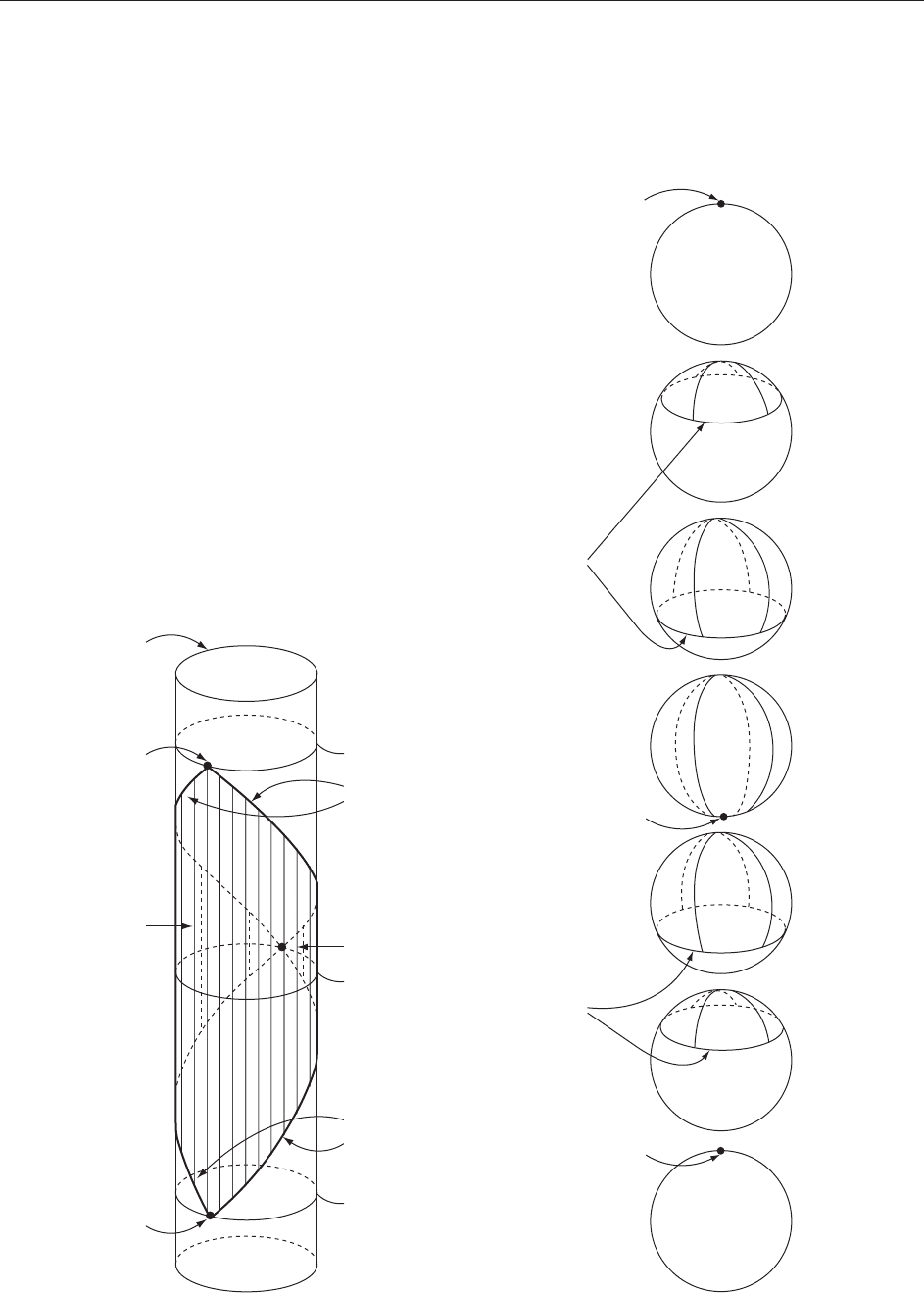
(Figures 1 and 2). As all
future-directed timelike geodesics in L
n
have i
þ
as an
endpoint in E
n
, i
þ
is called future-timelike infinity;
similarly, i
is past-timelike infinity. Every future-
directed null geodesic ends up on I
þ
, which is thus
termed future-null infinity, and I
is past-null infinity.
All spacelike geodesics come to i
0
, spacelike infinity.
For n = 2, this picture produces the familiar
diamond representation of L
2
(Figure 3): as E
2
is
easily unrolled into another copy of L
2
(metric
E
2
i
+
i
–
i
0
ᑣ
+
Image of L
2
ᑣ
–
τ = –
π
τ = π
τ = 0
Figure 1 L
2
conformally embedded in E
2
= S
1
L
1
:
i
+
i
0
ᑣ
–
i
–
ᑣ
+
τ = π
τ
= 0
τ
= –
π
Figure 2 L
3
conformally embedded in E
3
= S
2
L
1
:
Boundaries for Spacetimes 327
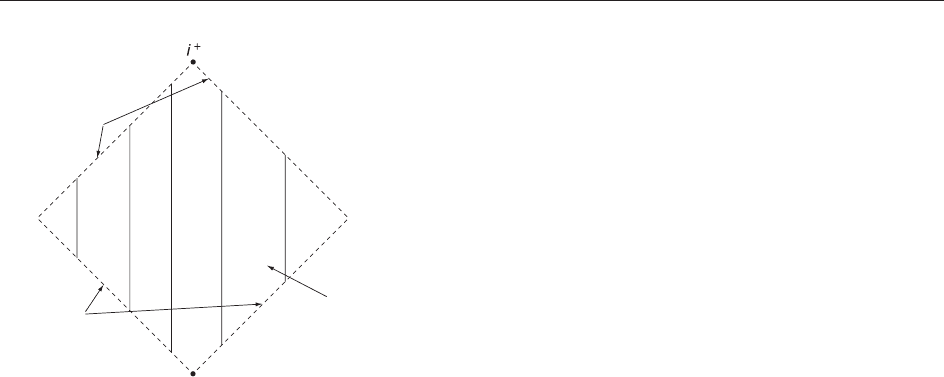
d
2
d
2
), this means that (L
2
) is the region jjþ
jj < in L
2
; timelike curves and null geodesics in
the original L
2
are the same as in (L
2
), and their
endpoints in the boundary of the diamond are
evident. For higher dimensions, the picture is not as
visually obvious, since E
n
cannot be unrolled; but the
principle of reading the causal structure at infinity of
L
n
via its boundary points in E
n
remains the same.
Conformal Embeddings
There have been various formulations designed to
emulate the conformal mapping of L
n
with respect to
spacetimes, which are, in some sense, asymptotically
like Minkowski space being conformally mapped into
larger spacetimes. A spacetime M with metric g is
called asymptotically simple or (alternatively) asymp-
totically flat if there is a spacetime N with metric h,
an embedding : M ! N, and a scalar function
defined on N with
h = ( )
2
g (i.e., is
conformal with
2
the conformal factor) and =0
on @
(M), d 6¼ 0on@
(M), and various other
restrictions on , depending on the intent. One can
define asymptotic symmetries of M by means of
motions within @
(M), leading to notions of global
energy and angular momentum (see Hawking and
Ellis (1973) and Wald (1984) for details).
Classifications of Embeddings
As a general rule, there is no uniqueness in the
choice of an embedding for a spacetime M to
construct a boundary, nor in the topology of the
resulting boundary @
(M), or even of which curves
of interest end up having endpoints in the boundary.
In an attempt to categorize which embeddings yield
equivalent results and what sort of results there are
in terms of endpoints of curves, Scott and Szekeres
(1994) formulated what they called the abstract
boundary of a spacetime. This depends on a choice
of class of ‘‘interesting’’ curves, each characterizable
as having either infinite or finite parameter length;
typical choices for this class would be timelike
geodesics or causal geodesics or timelike curves of
bounded acceleration. For instance, a boundary
point may be said to represent a singularity with
respect to the chosen class of curves if it is the
endpoint of one such curve with finite parameter
length; nonsingular points are points at infinity.
These classifications do not require conformal
embeddings, nor even that the target of the embed-
dings be spacetimes; they accommodate boundaries
of a far more general type than Penrose’s notion
stemming from conformal embeddings.
A somewhat different study of boundaries from
embeddings has been formulated by Garcı´a-Parrado
and Senovilla (2003), classifying points at infinity and
singularities in @
(M) for embeddings : M ! N in
which N is a spacetime, preserves the chronology
relation , and there is also a diffeomorphism
: (M) ! N which again preserves (the chronol-
ogy relation in a spacetime is defined thus: x y if
and only if there is a future-directed timelike curve
from x to y). This scheme applies more generally than
to conformal embeddings, but the requirement for
chronology-preserving maps in both directions guar-
antees a strong sensitivity to causality; it amounts to a
mild extension of Penrose’s notion that is often much
easier to construct.
Universal Constructions
B-Boundary
Attempts have been made to formulate boundary
concepts specifically for defining singularities as
ideal endpoints for finite-length geodesics. The
most complete venture in this direction is the
b-boundary (‘‘b’’ for ‘‘bundle’’) of Schmidt (Hawking
and Ellis 1973, pp. 276–284). This is a formulation
that takes note only of the connection in the linear
frames bundle L(M) of a spacetime M (or of any
manifold with a linear connection, metric or other-
wise); in other words, it takes no particular note of
the spacetime metric or even of the causal structure of
the spacetime, but only of the notion of parallel
translation of tangent vectors along curves. Parallel
translation of a frame (a basis for the tangent space)
along a curve is used to obtain an ad hoc length for
the curve by treating the translated frame as positive-
definite orthonormal at each point; whether this
length is finite or infinite is independent of the choice
of the original frame. The Schmidt construction
i
–
ᑣ
+
ᑣ
–
Image of L
2
Unrolled E
2
Figure 3 L
2
conformally embedded in unrolled E
2
, i.e.,
R
1
L
1
= L
2
:
328 Boundaries for Spacetimes
defines a boundary on M which gives an endpoint for
each curve, endless in M, which is finite in that sense:
Select a positive-definite metric on L(M ), give it a
boundary by means of Cauchy completion, and then
take the appropriate quotient by the bundle group.
This has an appealing universality of application, but
the problems of putting it into practice are quite
formidable. Also, the fact that it takes no special note
of the spacetime character of M suggests that it may
not be of particular utility for physical insights.
Causal Boundary: Basics
In 1972 Geroch, Kronheimer, and Penrose (GKP)
formulated a notion of boundary – the causal
boundary – that is specifically adapted to the causal
character of a spacetime M; indeed, it is defined in
such a way that one need know only the chronology
relation on M without any further reference to
the metric (another way of saying this is that the
causal boundary is conformally invariant). Like
Schmidt’s b-boundary, the causal boundary is a
universal construction, not depending on any extra-
neous choices; however, although it has an obvious
clarity in its causal structure, there are subtleties in
the choice of an appropriate topology which are
perhaps not yet fully resolved. As this boundary
construction appears to embody the best hopes for a
practical universal construction, it is detailed here in
some depth.
The causal boundary construction applies only to
strongly causal spacetimes; essentially, this means
that the local causal structure at each point is
exactly reflective of the global causal structure.
The basic construction of the causal boundary of
a spacetime M starts with two separate parts: the
future and past (pre-)boundaries of M, intended as
yielding endpoints for, respectively, future- and past-
endless causal curves. Part of the difficulty of the
causal boundary is knowing how best to meld these
two into one; currently, there are several answers to
this conundrum.
The elements of the future causal boundary of M
are defined in terms of the past-set operator I
. For
a point x 2 M, the past of x is I
(x) = {y jy x}; for
a set A M, I
[A] =
S
x2A
I
(x). A set P M is
called a past set if I
[P] = P; anything of the form
P = I
[A] is a past set, and all past sets have this
form. A past set P is an indecomposable past set (IP)
if P cannot be written as P
1
[ P
2
for past sets which
are proper subsets P
i
( P. IPs come in exactly two
varieties: pointlike IPs (PIPs), of the form I
(x)
(Figure 4), and terminal IPs (TIPs), of the form I
[c]
for c a future-endless causal curve (Figure 5). (Of
course, any I
(x) can also be expressed as I
[c] for c
a causal curve ending at x.) The future causal
boundary of M,
^
@(M), consists of all the TIPs of M;
the future causal completion of M is
^
M =
^
@(M) [ M.
But that is just a set; the causal structure of M needs
to be extended to
^
M.
For any x 2 M and P 2
^
@(M), set x P if and
only if x 2 P; set P x if and only if P I
(y) for
some y x (y 2 M); and for P and Q in
^
@(M), set
P Q if and only if P I
(y) for some y 2 Q.
If we consider this an extension of the relation on
M, then we end up with a relation which, like that
on M, is transitive and antireflexive. Furthermore, it
has the property that for all , 2
^
M, if and
only if for some x 2 M, x . (One can also
amend the chronology relation within M to be more
like the definition in the extension; that is not of
major import.)
We can also extend the causality relation on M
to one on
^
M (in M, x y if there is a future-directed
P
Figure 4 PIP P = I
(x).
c
P
Figure 5 TIP P = I
c.
Boundaries for Spacetimes 329

causal curve from x to y ): for x 2 M and P, Q 2
^
@(M), x P for I
(x) P, P x for P I
(x), and
P Q for P Q.
The intent is to have the elements of
^
@(M) provide
future endpoints for future-endless causal curves in
M; in particular, we want two such curves, c
1
and
c
2
, to be assigned the same future endpoint precisely
when I
[c
1
] = I
[c
2
]. This is accomplished by the
simple expedient of defining the future endpoint of a
future-endless causal curve c to be P = I
[c]. We do
not have a topology on
^
M as yet, but it is worth
noting that if P is the assigned future endpoint of c,
then I
(P) = I
[c]; this is at least the correct causal
behavior for a putative future endpoint of c.
We can perform all the operations above in the
time-dual manner, obtaining the past causal bound-
ary
@(M), consisting of terminal indecomposable
future sets (TIFs), and the past causal completion
M =
@(M) [ M. The full causal boundary of M
consists of the union of
^
@(M) with
@(M) with some
sort of identifications to be made.
As an example of the need for identifications,
consider M to be L
2
with a closed timelike line
segment deleted, say M = L
2
{(0, t) j0 t 1}.
For
^
@(M), we have first the boundary elements at
infinity: the TIP i
þ
= M (the past of the positive time
axis) and the set of TIPs making up I
þ
(the pasts of
null lines going out to infinity in L
2
); and then, the
boundary elements coming from the deleted points:
for each t with 0 < t 1, two IPs emanating from
(0, t), that is, P
þ
t
, the past of the null line going
pastwards from (0, t) toward x > 0, and P
t
, the past
of the null line going pastwards from (0, t) toward
x < 0; and P
0
, emanating from (0, 0), that is, the
past of the negative time axis. Similarly,
@(M)
consists of i
, I
, TIFs F
þ
t
and F
t
emanating from
(0, t) for 0 t < 1, and the TIF F
1
emanating from
(0, 1). We probably want to make at least the
following identifications for each t with 0 < t < 1,
P
þ
t
F
þ
t
and P
t
F
t
; P
þ
1
F
1
P
1
; and F
þ
0
P
0
F
0
. This results in a two-sided replacement
for the deleted segment; for some purposes, it might
be deemed desirable to identify the two sides as one,
but a universal boundary is probably a good idea,
leaving further identifications as optional quotients
of the universal object.
How best to define the appropriate identifications
in general is a matter of some controversy. GKP
defined a somewhat complicated topology on
M =
^
@(M) [
@(M) [ M, then used an identification
intended to result in a Hausdorff space. There are
significant problems with this approach in some
outre´ spacetimes, as pointed out by Budic and Sachs
(1974) and Szabados (1989), both of whom recom-
mended a different set of identifications. But what is
of more concern is that the topology prescribed by
GKP is not what might be expected in even the
simplest of cases, for example, Minkowski space:
L
n
needs no identifications among boundary points (no
matter whose identification procedure is followed).
The GKP topology on
L
n
,restrictedto
^
@(L
n
), is not
that of a cone (S
n2
R
1
with a point added), as is
the case for I
þ
in the conformal embedding into E
n
;
but, instead, each null line in
^
@(L
n
) (not including i
þ
)
is an open set, and i
þ
has no neighborhood in
^
@(L
n
)
save for the entire boundary. This is a topology
bearing no relation at all to that of any embedding.
Future Causal Boundary
Construction An alternative approach, initiated by
Harris (1998), is to forego the full causal boundary
and concentrate only on
^
M and
M separately. There
is an advantage to this in that the process of future
causal completion – that is to say, forming
^
M from
M – can be made functorial in an appropriate
category of ‘‘chronological sets’’: a set X with a
relation which is transitive and antireflexive such
that it possesses a countable subset S which is
‘‘chronologically dense,’’ that is, for any x, y 2 X,
there is some s 2 S with x s y. Any strongly
causal spacetime M is a chronological set, as is
^
M.
The entire construction of the future causal bound-
ary works just as well for a chronological set. The
role of a timelike curve in a chronological set is
taken by a future chain: a sequence c = {x
n
} with
x
n
x
nþ1
for all n.Foranyfuturechainc, I
[c]isan
IP, and any IP can be so expressed; but unlike in
spacetimes, I
(x) may or may not be an IP for x 2 X.
Then,
^
X is always future complete in the sense that
for any future chain c in
^
X, there is an element 2
^
X
with I
() = I
[c]: for instance, if the chain c lies in
X but there is no x 2 X with I
(x) = I
[c], just let
= I
[c], which is an element of
^
@(X). This yields a
functor of future completion from the category of
chronological sets to the category of future-complete
chronological sets, and the embedding X !
^
X is a
universal object in the sense of the category theory;
this implies that it is categorically unique and is the
minimal future-completion process.
However, it is crucial to have more than the
chronology relation operating in what is to be a
boundary; topology of some sort is needed. This is
accomplished by defining what might be called the
future-chronological topology for any chronological
set – including for
^
M when M is a strongly causal
spacetime. This topology is defined by means of a
limit-operator
^
L on sequences: if X is the chron-
ological set, then for any sequence of points = {x
n
}
in X,
^
L() denotes a subset of X which is the set of
330 Boundaries for Spacetimes
limits of . It is explicitly recognized that there may
be more than one limit of a sequence, as the space
may not be Hausdorff; no attempt is made to
remove any non-Hausdorffness, as this is viewed as
giving important information on how, possibly,
two points in the future causal boundary represent
very similar and yet not identical pieces of
information about the causal structure at infinity.
Once the limit operator is in place, the actual
topology on X is defined thus: a subset A X is
said to be closed if and only if for any sequence
A,
^
L() A (and open sets are complements of
closed sets). This yields the elements of
^
L()as
topological limits of .
The definition of
^
L is simplest when X has the
property that I
(x) is an IP for any x 2 X; as this is
true for X being either a spacetime M or the future
causal completion
^
M of a spacetime, the discussion
here is restricted to this situation. Let us also make
the common assumption that X is past-distinguishing,
that is, I
(x) = I
(y)impliesx = y.
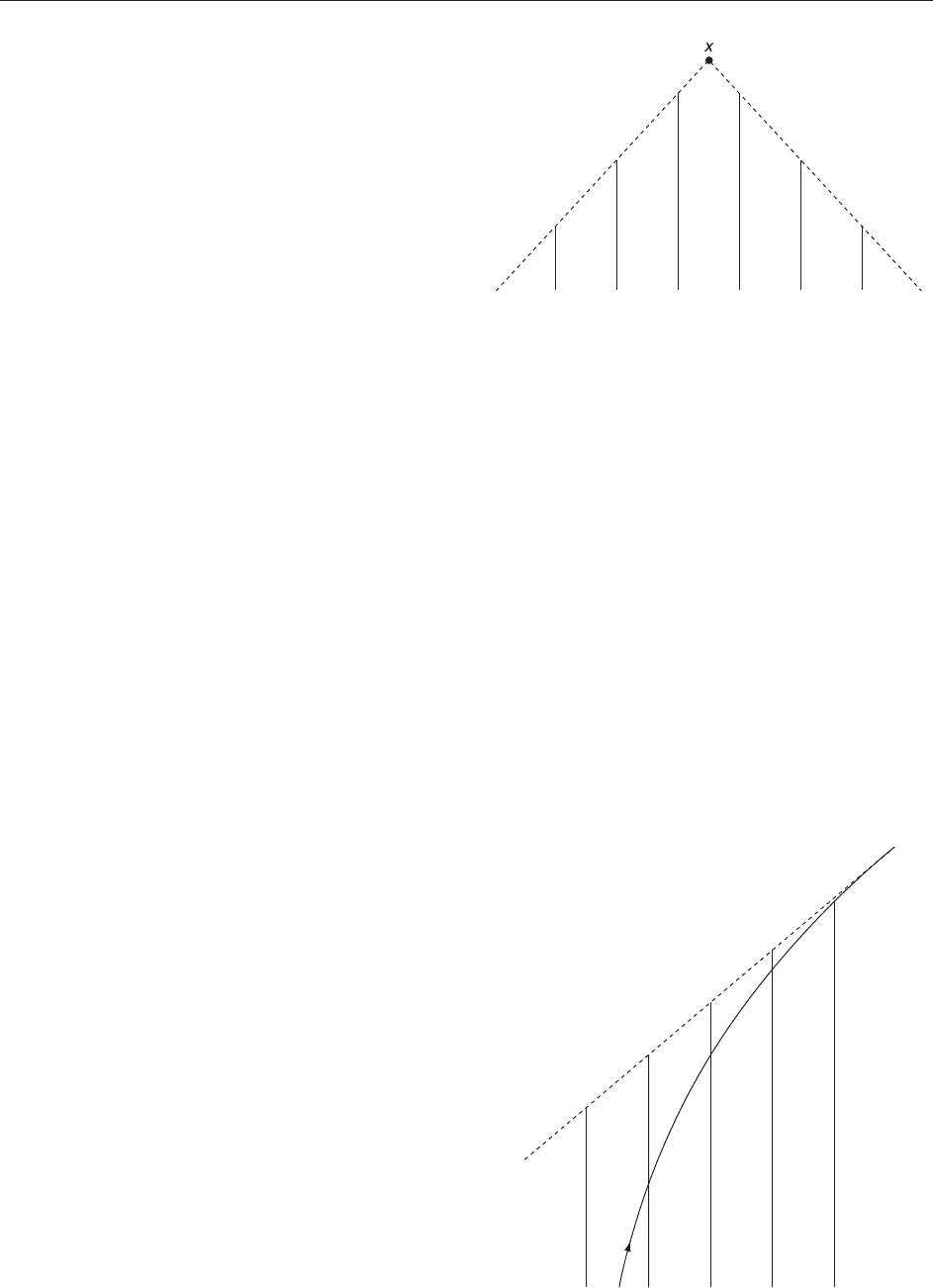
Let = {x
n
} be a sequence of points in a past-
distinguishing chronological set X in which the past
of any point is an IP. Then
^
L() consists of those
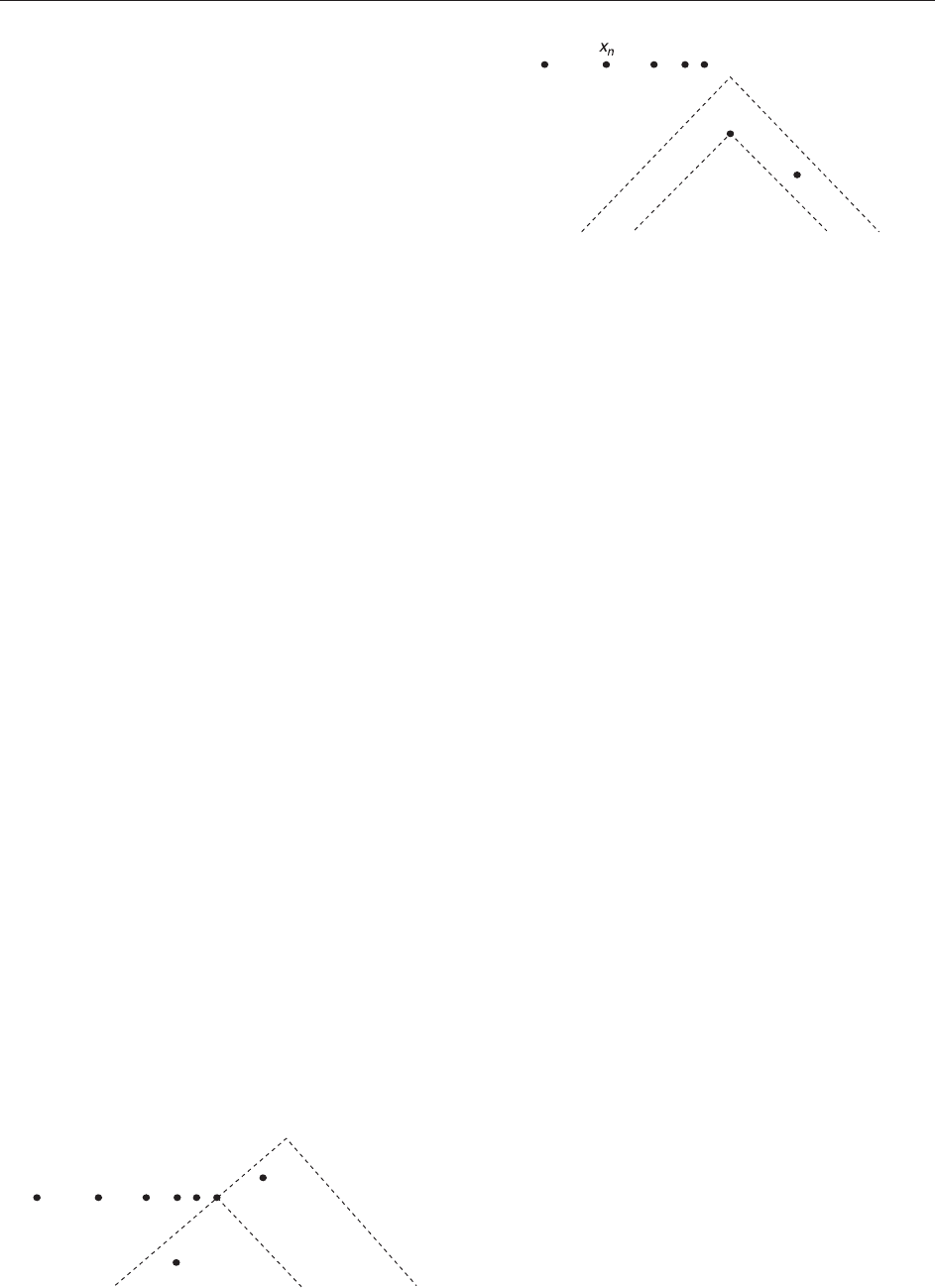
points x for which (see Figures 6 and 7)
1. for all y 2 I
(x), for n sufficiently large, y x
n
,
and
2. for any IP P ) I
(x), there is some z 2 P such that
for n sufficiently large, z 6 x
n
.
Then the future-chronological topology on X has
these features:
1. It is a T
1
topology, that is, points are closed.
2. If I
(x) = I
[c] for a future chain c = {x
n
}, then x
is a topological limit of the sequence {x
n
}.
3. If X = M, a strongly causal spacetime, then the
future-chronological topology is precisely the
manifold topology.
4. If X =
^
M, the future causal completion of a
strongly causal spacetime M, then the induced
topology on M is the manifold topology,
^
@(M)is
a closed subset of
^
M, and M is dense in
^
M. As per
property (2), for any future-endless causal curve c
in M, the point I
[c]in
^
@(M) is the topological
endpoint of c in
^
M.
5. If X =
c
L
n
,thenX is homeomorphic to the conformal
image of L
n
in E
n
together with I
þ
and i
þ
;in
particular,
^
@(L
n
) has the topology of a cone.
Examples The future causal boundary with the
future-chronological topology can be calculated
with a fair degree of success. For instance, if M
is conformal to a simple product spacetime Q L
1
(Q a Riemannian manifold), then
^
@(M)ismuch
like
^
@(L
n
) in that it consists of null or timelike
lines factored over a particular boundary construc-
tion @(Q)onQ, coming together at a single point i
þ
(the IP which is all of M); if Q is complete, then
these are all null lines, and together they may be
called I
þ
.
The elements of @(Q) are defined in terms of the
Lipschitz-1 functions on Q known as Busemann
functions: if c :[, !) !Q is any endless unit-speed
curve (typically, ! = 1), then the Busemann function
b
c
: Q !R is defined by b
c
(q) = lim
s!!
(s d(c(s), q)),
where d is the distance function in Q; this function
is either finite for all q or infinite for all q.Theset
B(Q) of finite Busemann functions has an R-action
defined by a b
c
= b
ac
,where(a c)(s) = c(s þ a).
Then @(Q) = B(Q)=R. For any P 2
^
@(M), the
boundary of P, as a subset of Q L
1
ffi Q R,is
the graph of a Busemann function (the function is
b
c
for P generated by a null curve projecting to c);
and a point x = (q, t)inM can be represented by
@(I
(x)), which is the graph of the function
t d(, q). Thus, one could use the function-
space topology on B(Q) to topologize
^
M;inthat
function-space topology
^
@(M) is a cone on @(Q),
and
^
M, apart from i
þ
, is the topological product of
R with Q [ @(Q). The future-chronological topol-
ogy is sometimes different from the function-space
topology, allowing more convergent sequences
than the function-space topology does. When this
happens, the result is non-Hausdorff, revealing
pairs of points in
^
@(M) which are more closely
related to one another than the function-space
X
n
X
Z
P
y
I
–
(x)
Figure 6 x 2
^
L(fx
n
g): for all y 2 I
(x), eventually y x
n
, and for
all IP P ) I
(x), there is some z 2 P such that eventually z 6 x
n
:
x
P
z
I
–
(x)
Figure 7 x 62
^
L(fx
n
g): there is some IP P ) I
(x) such that for
all z 2 P, z x
n
for infinitely many n.
Boundaries for Spacetimes 331

topology reveals; but it is still the case that
^
@(M),
apart from i
þ
,isfiberedbyR over @(Q).
If Q is a warped product Q = (a, b) K for a
compact manifold K with metric dr
2
þ e
(r)
h with h
a metric on K, then one can calculate more precisely:
if, for instance, has a minimum in the interior of
(a, b) and has suitable growth on either end, then
@(Q) represents two copies of K (one for each end of
(a, b) K), the future-chronological topology is the
same as the function-space topology, and
^
M (apart
from i
þ
) is a simple product of R with Q [ @(Q):
^
@(M) is precisely a null cone over two copies of K.
This applies, for instance, to exterior Schwarzschild,
where K = S
2
; the boundary at one end of exterior
Schwarzschild is the usual I
þ
, and the boundary at
the other end is the null cone {r = 2m}, where
exterior attaches to interior Schwarzschild.
Calculations for the future-chronological topology
become much easier when
^
@(M) is purely spacelike,
that is, no P 2
^
@(M) is contained in the past of any
other element of
^
M. For instance, if M is conformal
to a multiwarped product, Q
1
Q
m
(a, b)
with metric f
1
(t)
2
h
1
þþf
m
(t)
2
h
m
dt
2
, where h
i
is a Riemannian metric on Q
i
, then
^
@(M) will be
purely spacelike if all the Riemannian factors are
complete and for each i,
R
b
b
1=f
i
(t)dt < 1; in that
case,
^
@(M) ffi Q, where Q = Q
1
Q
m
and
^
M ffi Q (a, b). This applies, for instance, to inter-
ior Schwarzschild, where Q
1
= R
1
and Q
2
= S
2
,
yielding the topology of R
1
S
2
for the Schwarzs-
child singularity.
There is a categorical universality for spacelike
boundaries and the future-chronological topology.
This means that any other reasonable way of
future-completing interior Schwarzschild must yield
R
1
S
2
or a topological quotient of that for the
singularity; and if the result is to be past-distinguishing,
R
1
S
2
is the only possibility.
Of course, all this can be done in the time-dual
fashion, using the past-chronological topology on
M. It would be desirable to combine the future and
past causal boundaries with a suitable topology as
well as appropriate identifications. There has been
some work in that direction.
Causal Boundary: Revisited
Marolf and Ross (2003) have proposed an identification
of TIPs and TIFs that relies on the equivalence relation
defined by Szabados. For an IP P and IF F,call(P, F)a
Szabados pair if P I
(x)forallx 2 F, P is maximal
among IPs for that property, and dually for F with
respect to P. For instance, for any x 2 M,(I
(x), I
þ
(x))
is a Szabados pair. The Marolf–Ross version of the
causal boundary,
@(M), consists of all Szabados pairs
formed of TIPs and TIFs, plus any TIP or TIF that
cannot be paired; this produces an appropriate set of
identifications within
^
@(M) [
@(M). The chronology
relation on M is extended to
M =
@(M) [ M by treating
each point x in M astheSzabadospair(I
(x), I
þ
(x)) and
each unpaired IP P as (P , ;) and unpaired IF F as (; , F),
and then defining (P, F) (P
0
, F
0
) whenever
F \ P
0
6¼;.
The resulting chronological set is not necessarily
either past- or future-distinguishing, but it is (past and
future)-distinguishing. The topology they propose
places endpoints in
@(M) for all causal curves which
are endless in M, but there may be multiple future
endpoints for a single future-endless curve. The
topology need not be T
1
: points can fail to be closed.
For a product spacetime M = Q L
1
, the Marolf–Ross
topology on
M is always the function-space topology.
As of this writing, there is active research by J L Flores
to institute a Marolf–Ross type of identification of
^
@(M)
with
@(M) using a topology that partakes more of the
future- and past-chronological topologies.
See also: Asymptotic Structure and Conformal Infinity;
Spacetime Topology, Causal Structure and Singularities.
Further Reading
Budic R and Sachs RK (1974) Causal boundaries for general relativistic
space-times. Journ al of Mathematical Physics 15: 1302–1309.
Garcı´a-Parrado A and Senovilla JMM (2003) Causal relationship:
a new tool for the causal characterization of Lorentzian
manifolds. Classical and Quantum Gravity 20: 625–664.
Geroch RP, Kronheimer EH, and Penrose R (1972) Ideal points
in space-time. Proceedings of the Royal Society of London,
Series A 327: 545–567.
Harris SG (1998) Universality of the future chronological
boundary. Journal of Mathematical Physics 39: 5427–5445.
Harris SG (2000) Topology of the future chronological boundary:
universality for spacelike boundaries. Classical and Quantum
Gravity 17: 551–603.
Harris SG (2001) Causal boundary for standard static spacetimes.
Nonlinear Analysis 47: 2971–2981 (Special Edition: Proceed-
ings of the Third World Congress in Nonlinear Analysis).
Harris SG (2004a) Boundaries on spacetimes: an outline. Classical
and Quantum Gravity 359: 65–85.
Harris SG (2004b) Discrete group actions on spacetimes: causality
conditions and the causal boundary. Classical and Quantum
Gravity 21: 1209–1236.
Harris SG and Dray T (1990) The causal boundary of the trousers
space. Classical and Quantum Gravity 7: 149–161.
Hawking SW and Ellis GFR (1973) The Large Scale Structure of
Space-Time. Cambridge: Cambridge University Press.
Marolf D and Ross SF (2003) A new recipe for causal
completions. Classical and Quantum Gravity 20: 4085–4118.
Schmidt BG (1972) Local completeness of the b-boundary.
Communications in Mathematical Physics 29: 49–54.
Scott SM and Szekeres P (1994) The abstract boundary – a new
approach to singularities of manifolds. Journal of Geometry
and Physics 13: 223–253.
332 Boundaries for Spacetimes
Szabados LB (1988) Causal boundary for strongly causal space-
times. Classical and Quantum Gravity 5: 121–134.
Szabados LB (1989) Causal boundary for strongly causal space-
times: II. Classical and Quantum Gravity 6: 77–91.
Wald RM (1984) General Relativity. Chicago: University of
Chicago Press.
Boundary Conformal Field Theory
J Cardy, Rudolf Peierls Centre for Theoretical
Physics, Oxford, UK
ª 2006 Elsevier Ltd. All rights reserved.
Boundary conformal field theory (BCFT) is simply
the study of conformal field theory (CFT) in
domains with a boundary. It gains its significance
[1] because, in some ways, it is mathematically
simpler: the algebraic and geometric structures of
CFT appear in a more straightforward manner; and
[2] because it has important applications: in string
theory in the physics of open strings and D-branes,
and in condensed matter physics in boundary critical
behavior and quantum impurity models.
This article, however, describes the basic ideas
from the point of view of quantum field theory,
without regard to particular applications or to any
deeper mathematical formulations.
Review of CFT
Stress Tensor and Ward Identities
Two-dimensional CFTs are massless, local, relati-
vistic renormalized quantum field theories.
Usually they are considered in imaginary time,
that is, on two-dimensional manifolds with
Euclidean signature. In this article, the metric is
also taken to be Euclidean, although the formula-
tion of CFTs on general Riemann surfaces is also
of great interest, especially for string theory. For
the time being, the domain is the entire complex
plane.
Heuristically, the correlation functions of such a
field theory may be thought of as being given by
the Euclidean path integral, that is, as expectation
values of products of local densities with respect
to a Gibbs measure Z
1
e
S
E
({ })
[d ], where the
{ (x)} are some set of fundamental local fields, S
E
is the Euclidean action, and the normalization
factor Z is the partition function. Of course, such
an object is not in general well defined, and this
picture should be seen only as a guide to
formulating the basic principles of CFT which
can then be developed into a mathematically
consistent theory.
In two dimensions, it is useful to use the so-called
complex coordinates z = x
1
þ ix
2
,
¯
z = x
1
ix
2
.In
CFT, there are local densities
j
(z,
¯
z), called primary
fields, whose correlation functions transform covar-
iantly under conformal mappings z ! z
0
= f (z):
h
1
ðz
1
;
z
1
Þ
2
ðz
2
;
z
2
Þi
¼
Y
i
f
0
ðz
j
Þ
h
j
f
0
ðz
j
Þ
h
j
h
1
z
0
1
;
z
0
1
2
z
0
2
;
z
0
2
i ½1
where (h
j
,
¯
h
j
) (usually real numbers, not complex
conjugates of each other) are called the conformal
weights of
j
. These local fields can in general be
normalized so that their two-point functions have
the form
h
j
ðz
j
;
z
j
Þ
k
ðz
k
;
z
k
Þi ¼
jk
=ðz
j
z
k
Þ
2h
j
ð
z
j
z
k
Þ
2
h
j
½2
They satisfy an algebra known as the operator
product expansion (OPE)
i
ðz
1
;
z
1
Þ
j
ðz
2
;
z
2
Þ
¼
X
k
c
ijk
ðz
1
z
2
Þ
h
i
h
j
þh
k
ð
z
1
z
2
Þ
h
i
h
j
þ
h
k
k
ðz
1
;
z
1
Þþ ½3
which is supposed to be valid when inserted into
higher-order correlation functions in the limit when
jz
1
z
2
j is much less than the separations of all the
other points. The ellipses denote the contributions of
other nonprimary scaling fields to be described
below. The structure constants c
ijk
, along with the
conformal weights, characterize the particular CFT.
An essential role is played by the energy–
momentum tensor, or, in Euclidean field theory
language, the stress tensor T
. Heuristically, it is
defined as the response of the partition function to
a local change in the metric:
T
ðxÞ¼ð2Þ ln Z=g
ðxÞ½4
(the factor of 2 is included so that similar factors
disappear in later equations).
The symmetry of the theory under translations
and rotations implies that T
is conserved,
@
T
= 0, and symmetric. Scale invariance implies
that it is also traceless T
= 0. It should be
noted that the vanishing of the trace of the stress
tensor for a scale invariant classical field theory does
Boundary Conformal Field Theory 333
not usually survive when quantum corrections are
taken into account: indeed , / (g), the renorma-
lization group (RG) beta-function. A quantum field
theory is thus only a CFT when this vanishes, that is,
at an RG fixed point. In complex coordinates, the
components T
z¯z
= T
¯zz
= 4 vanish, while the con-
servation equations read
@
z
T
zz
¼ @
z
T
z
z
¼ 0 ½5
Thus, correlators of T(z) T
zz
are locally analytic
(in fact, globally meromorphic) functions of z, while
those of
T(
¯
z) T
¯z¯z
are antianalytic. It is this
property of analyticity which makes CFTs tractable
in two dimensions.
Since an infinitesimal conformal transformation
z ! z þ (z) induces a change in the metric, its effect
on a correlation function of primary fields, given by [1],
may also be expressed through an appropriate integral
involving an insertion of the stress tensor. This leads to
the conformal Ward identity:
Z
C
hTðzÞ
Y
j
j
ðz
j
;
z
j
ÞiðzÞdz
¼
X
j
h
j
0
ðz
j
Þþðz
j
Þð@=@z
j
Þ
D
Y
j
j
ðz
j
;
z
j
Þ
E
½6
where C is a contour encircling all the points {z
j
}.
(A similar equation holds for the insertion of
T.)
Using Cauchy’s theorem, this determines the first
few terms in the OPE of T with any primary density:
TðzÞ
j
ðz
j
;
z
j
Þ¼
h
j
ðz z
j
Þ
2
ðz
j
;
z
j
Þ
þ
1
z z
j
@
z
j
ðz
j
;
z
j
ÞþOð1Þ½7
The other, regular, terms in the OPE generate new
scaling fields, which are not in general primary,
called desce ndants. One way of defining a density to
be primary is by the condition that the most singular
term in its OPE with T is a double pole.
The OPE of T with itself has the form
TðzÞTðz
1
Þ¼
c=2
ðz z
1
Þ
4
þ
2
ðz z
1
Þ
2
Tðz
1
Þþ ½8
The first term is present because hT(z)T(z
1
)i is
nonvanishing, and must take the form shown, with c
being some number (which cannot be scaled to
unity, since the normalization of T is fixed by its
definition) which is a property of the CFT. It is
known as the conformal anomaly number or the
central charge. This term implies that T is not itself
primary. In fact, under a finite conformal transfor-
mation z ! z
0
= f (z),
TðzÞ!f
0
ðzÞ
2
Tðz
0
Þþ
c
12
fz
0
; zg½9
where {z
0
, z} = (f
000
f
0
3
2
f
00
2)=f
0
2
is the Schwartzian
derivative.
Virasoro Algebra
As with any quantum field theory, the local fields
can be realized as linear operators acting on a
Hilbert space. In ordinary QFT, it is customary to
quantize on a constant-time hypersurface. The
generator of infinitesimal time translat ions is the
Hamiltonian
ˆ
H, which itself is independent of
which time slice is chosen, because of time
translational symmetry. It is also given by the
integral over the hypersurface of the time–time
component of the stress tensor. In CFT, because of
scale invariance, one may instead quantize on fixed
circle of a given radius. The analog of the
Hamiltonian is the dilatation operator
ˆ
D,which
generates scale transformations. Unlike
ˆ
H,the
spectrum of
ˆ
D is usually discrete, even in an
infinite system. It may also be expressed as an
integral over the radial component of the stress
tensor:
^
D ¼
1
2
Z
2
0
r
^
T
rr
rd
¼
1
2i
Z
C
z
^
TðzÞdz
1
2i
Z
C
z
^
Tð
zÞd
z
^
L
0
þ
^
L
0
½10
where, because of analyticit y, C can be any contour
encircling the origin.
This suggests that one define other operators
^
L
n
1
2
Z
C
z
nþ1
^
TðzÞdz ½11
and similarly the
^
L
n
. From the OPE [8] then follows
the Virasoro algebra V:
½
^
L
n
;
^
L
m
¼ðn mÞ
^
L
nþm
þ
c
12
nðn
2
1Þ
nþm;0
½12
with an isomorphic algebra
V generated by the
^
L
n
.
In radial quantization, there is a vacuum state j0i.
Acting on this with the operator correspon ding to a
scaling field gives a state j
j
i
^
j
(0, 0)j0i which is
an eigenstate of
ˆ
D: in fact,
^
L
0
j
j
i¼h
j
j
j
i;
^
L
0
j
j
i¼
h
j
j
j
i½13
From the OPE [7], one sees that jL
n
j
i/
ˆ
L
n
j
j
i,
and, if
j
is primary,
ˆ
L
n
j
j
i= 0 for all n 1.
The states corresponding to a given primary field,
and those generated by acting on these with all the
ˆ
L
n
with n < 0 an arbitrary number of times, form a
334 Boundary Conformal Field Theory