
Francoise J.-P., Naber G.L., Tsun T.S. (editors) Encyclopedia of Mathematical Physics
Подождите немного. Документ загружается.


highest-weight representation of V. However, this is
not necessarily irreducible. There may be null
vectors, which are linear combinations of states at
a given level which are themselves annihilated by all
the
ˆ
L
n
with n > 0. They exist whenever h takes a
value from the Kac table:
h ¼ h
r;s
¼
ðrðm þ 1ÞsmÞ
2
1
4mðm þ 1Þ
½14
with the central charge parametrized as c = 1 6=
(m (m þ 1)), and r, s are non-negative integers. These
null states should be projected out, giving an
irreducible representation V
h
.
The full Hilbert space of the CFT is then
H¼
M
h;
h
n
h;
h
V
h
V
h
½15
where the non-negative integers n
h,
¯
h
specify how
many distinct primary fields of weights (h,
¯
h) there
are in the CFT.
The consistency of the OPE [3] with the existence
of null vectors leads to the fusion algebra of the
CFT. This applies separately to the holomorphic and
antiholomorphic sectors, and determines how many
copies of V
c
occur in the fusion of V
a
and V
b
:
V
a
V
b
¼
X
c
N
c
ab
V
c
½16
where the N
c
ab
are non-negative integers.
A particularly important subset of all CFTs
consists of the minimal models. These have rational
central charge c = 1 6(p q)
2
=pq, in which case
the fusion algebra closes with a finite num ber of
possible values 1 r q,1 s p in the Kac
formula [14]. For these models, the fusion algebra
takes the form
V
r
1
;s
1
V
r
2
;s
2
¼
X
r
1
þr
2
1
r¼jr
1
r
2
j
0
X
s
1
þs
2
1
s¼js
1
s
2
j
0
V
r;s
½17
where the prime on the sums indicates that they are
to be restricted to the allowed intervals of r and s.
There is an important theorem which states that
the only unitary CFTs with c < 1 are the mini-
mal models with p=q = (m þ 1)=m, where m is an
integer 3.
Modular Invariance
The fusion algebra limi ts which values of (h,
¯
h)
might appear in a consistent CFT, but not which
ones actually occur, that is, the values of the n
h,
¯
h
.
This is answered by the r equirement of modular
invariance on the torus. First consider the theory on
an infinitely long cylinder, of unit circumference.
This is related to the (punctured) plane by the
conformal mapping z ! (1=2)lnz t þ i x.The
result is a QFT on the circle 0 x < 1, i n
imaginary time t. The generator of infinitesimal
time translations is related to that for dilatations in
the plane:
^
H ¼ 2
^
D
c
6
¼ 2ð
^
L
0
þ
^
L
0
Þ
c
6
½18
where the last term comes from the Schwartzian
derivative in [9]. Similarly, the generator of trans la-
tions in x, the total momentum operator, is
ˆ
P = 2(
ˆ
L
0
^
L
0
).
A general torus is, up to a scale transformation, a
parallelogram with vertices (0, 1, ,1þ ) in the
complex plane, with the opposite edges identified.
We can make this by taking a cylinder of unit
circumference and length Im, , twisting the ends by
a relative amount Re , and sewing them together.
This means that the partiti on function of the CFT on
the torus can be written as
Zð; Þ¼tr e
ðIm Þ
^
HþiðIm Þ
^
P
¼ tr q
^
L
0
c=24
q
^
L
0
c=24
½19
using the above expressions for
ˆ
H and
ˆ
P and
introducing q e
2i
.
Through the decomposition [15] of H, the trace
sum can be written as
Zð; Þ¼
X
h;
h
n
h;
h
h
ðqÞ
h
ðqÞ½20
where
h
ðqÞtr
V
h
q
^
L
0
c=24
¼
X
N
d
h
ðNÞq
hðc=24ÞþN
½21
is the character of the representation of highest weight
h, which counts the degeneracy d
h
(N)atlevelN.Itis
purely an algebraic property of the Virasoro algebra,
and its explicit form is known in many cases.
All of this would be less interesting were it not
for the observation that the parametrization of the
torus through is not unique. In fact, the
transformations S : !1= and T : ! þ 1
give the same torus (see Figure 1). Together, these
0
–1/τ
0
τ
1
1
Figure 1 Two equivalent parametrizations of the same torus.
Boundary Conformal Field Theory 335

operations generate the modular group SL(2, Z),
and the partition function Z(, ) should be
invariant under them. T-invariance is simply imple-
mented by requiring that h
¯
h is an integer, but
the S-invariance of the right-hand side of [20]
places highly nontrivial constraints on the n
h,
¯
h
.
That this can be satisfied at all relies on the
remarkable property of the characters that they
transform linearly under S:
h
ðe
2i=
Þ¼
X
h
0
S
h
0
h
h
0
ðe
2i
Þ½22
This follows from applying the Poisson sum formula
to the explicit expressions for the characters, which
are related to Jacobi theta-functions. In many cases
(e.g., the minimal models) this representation is
finite dimensional, and the matrix S is symmetric
and orthogonal. This means that one can immedi-
ately obtain a modular invariant partition function
by forming the diagonal sum
Z ¼
X
h
h
ðqÞ
h
ð
qÞ½23
so that n
h,
¯
h
=
h
¯
h
. However, because of various
symmetries of the characters, other modular invariants
are possible: for the minimal models (and some others)
these have been classified. Because of an analogy of the
results with the classification of semisimple Lie
algebras, the diagonal invariants are called the A-series.
Boundary CFT
In any field theory in a domain with a boundary,
one needs to consider how to impose a set of
consistent boundary cond itions. Since CFT is for-
mulated independently of a particular set of funda-
mental fields and a Lagrangian, this must be done in
a more general manner. A natural requirement is
that the off-diagonal component T
k?
of the stress
tensor parallel/perpendicular to the boundary should
vanish. This is called the conformal boundary
condition. If the boundary is parallel to the time
axis, it implies that there is no momentum flow
across the boundary. Moreover, it can be argued
that, under the RG, any uniform boundary condi-
tion will flow into a conformally invariant one. For
a given bulk CFT, however, there may be many
possible distinct such boundary conditions, and it is
one task of BCFT to classify these.
To begin with, take the domain to be the upper-
half plane, so that the boundary is the real axis. The
conformal boundary condi tion then i mplies that
T(z) =
T(
z) when z is on the real axi s. T his has the
immediate consequence that correlators of
T are
those of T, analytically continued into the lower-
half plane. The conformal Ward identity, cf. [7],
now reads
D
TðzÞ
Y
j
j
ðz
j
;
z
j
Þ
E
¼
X
j
h
j
ðz z
j
Þ
2
þ
1
z z
j
@
z
j
þ
h
j
ð
z
z
j
Þ
2
þ
1
z
z
j
@
z
j
!
D
Y
j
j
ðz
j
;
z
j
Þ
E
½24
In radial quantization, in order that the Hilbert
spaces defined on different hypersurfaces be equiva-
lent, one must choose semicircles centered on some
point on the boundary, conventionally the origin.
The dilatation operator is now
^
D ¼
1
2i
Z
S
z
^
TðzÞdz
1
2i
Z
S
z
^
Tð
zÞd
z ½25
where S is a semicircle. Using the conformal
boundary condition, this can also be written as
^
D ¼
^
L
0
¼
1
2i
Z
C
z
^
TðzÞdz ½26
where C is a complete circle around the origin. As
before, one may similarly define the
ˆ
L
n
, and they
satisfy a Virasoro algebra.
Note that there is now only one Virasoro algebra.
This is related to the fact that conformal mappings
which preserve the real axis correspond to real
analytic functions. The eigenstates of
ˆ
L
0
correspond
to boundary operators
^
j
(0) acting on the vacuum
state j0i. It is well known that in a renormalizable
QFT operators at the boundary require a different
renormalization from those in the bulk, and this will
in general lead to a different set of conformal
weights. It is one of the tasks of BCFT to determine
these, for a given allowed boundary condition.
However, there is one feature unique to boundary
CFT in two dimensions. Radial quantization also
makes sense, leading to the same form [26] for the
dilation operator, if the boundary conditions on the
negative and positive real axes are different. As far as
the structure of BCFT goes, correlation functions with
this mixed boundary condition behave as though a
local scaling field were inserted at the origin. This has
led to the term ‘ ‘bou ndary condition changing (bcc)
operator,’’ but it must be stressed that these are not
local operators in the conventional sense.
The Annulus Partition Function
Just as consideration of the partition function on the
torus illuminates the bulk operator content n
h,
¯
h
,it
336 Boundary Conformal Field Theory
turns out that consistency on the annulus helps
classify both the allowed boundary conditions, and
the boundary operator content. To this end, con-
sider a CFT in an annulus formed of a rectangle of
unit width and height , with the top and bottom
edges identified (see Figure 2). The boundary
conditions on the left and right edges, labeled by
a, b, ..., may be different. The partition function
with boundary conditions a and b on either edge is
denoted by Z
ab
().
One way to compute this is by first considering
the CFT on an infinitely long strip of unit width.
This is conformally related to the upper-half plane
(with an insertion of bcc operators at 0 and 1 if
a 6¼ b) by the mapping z ! (1=)lnz. The gen-
erator of infinitesimal translations along the strip is
^
H
ab
¼
^
D c=24 ¼
^
L
0
c=24 ½27
Thus, for the annulus,
Z
ab
ðÞ¼tr e
^
H
ab
¼ tr q
^
L
0
c=24
½28
with q e
. As before, this can be decomposed
into characters:
Z
ab
ðÞ¼
X
h
n
ab
h
h
ðqÞ½29
but note that now the expression is linear. The non-
negative integers n
h
ab
give the operator content with
the boundary conditions (ab): the lowest value of h
with n
h
ab
> 0 gives the conformal weight of the bcc
operator, and the others give conformal weights of
the other allowed primary fields which may also sit
at this point.
On the other hand, the annulus partition function
may be viewed, up to an overall rescaling, as the
path integral for a CFT on a circle of unit
circumference, being propagated for (imaginary)
time
1
. From this point of view, the partition
function is no longer a trace, but rather the matrix
element of e
ˆ
H=
between boundary states:
Z
ab
ðÞ¼haje
^
H=
jbi½30
Note that
ˆ
H is the same Hamiltonian that appears in
[18], and the boundary states lie in H, [15].
How are these boundary states to be character-
ized? U sing the trans formation law [9] the
conformal boundary condition applied to the
circle implies that L
n
=
L
n
. This means that
any boundary state jBi lies in the subspace
satisfying
^
L
n
jBi¼
^
L
n
jBi½31
Moreover, because of the decomposition [15] of
H, jBi is also some linear superposition of states from
V
h
V
¯
h
. This condition can therefore be applied in
each subspace. Taking n = 0in[31] constrains
¯
h = h.
For simplicity, consider only the diagonal CFTs with
n
h,
¯
h
=
h,
¯
h
. It can then be shown that the solution
of [31] is unique and has the following form.
The subspace at level N of V
h
has dimension
d
h
(N). Denote an orthonormal basis by jh, N ; ji,
with 1 j d
h
(N), and the same basis for
V
h
by
jh, N ; ji. The solution to [31] in this subspace is
then
jhii
X
1
N¼0
X
d
h
ðNÞ
j¼1
jh; N; jijh; N; ji½32
These are called Ishibashi states. Matrix elements of
the translation operator along the cylinder between
them are simple:
hhh
0
je
^
H =
jhii
¼
X
1
N
0
¼0
X
d
h
0
ðN
0
Þ
j
0
¼1
X
1
N¼0
X
d
h
ðNÞ
j¼1
hh
0
; N
0
; j
0
j
hh
0
; N
0
; j
0
je
ð2=Þð
^
L
0
þ
^
L
0
c=12Þ
½33
jh; N; ji
jh; N; ji
¼
h
0
h
X
1
N ¼0
X
d
h
ðNÞ
j¼1
e
ð4=Þ hþNðc=24ÞðÞ
½34
¼
h
0
h
h
ðe
4=
Þ½35
Note that the characters which appear are
related to those in [29] by the modular transfor-
mation S.
The physical boundary states satisf ying [29],
sometimes called the Cardy states, are linear
combinations of the Ishibashi states:
jai¼
X
h
hhhjaijhii ½36
Equating the two different expressions [29] and [30]
for Z
ab
, and using the modular transformation law
1
δ
b
a
Figure 2 The annulus, with boundary conditions a and b on
either boundary.
Boundary Conformal Field Theory 337

[22] and the linear independence of the characters
gives the (equivalent) conditions:
n
h
ab
¼
X
h
0
S
h
h
0
hajh
0
iihhh
0
jbi½37
hajh
0
iihhh
0
jbi¼
X
h
S
h
0
h
n
h
ab
½38
These are called the Cardy conditions. The require-
ments that the right-hand side of [37] should give a
non-negative integer, and that the right-hand side of
[38] should factorize in a and b, give highly
nontrivial constraints on the allowed boundary
states and their operator content.
For the diagonal CFTs considered here (and for
the nondiagonal minimal models) a complete solu-
tion is possible. It can be shown that the elements S
h
0
of S are all non-negative, so one may choose
hhhj
~
0i= (S
h
0
)
1=2
. This defines a boundary state
j
~
0i
X
h
S
h
0
1=2
jhii ½39
and a corresponding boundary condition such that
n
h
00
=
h0
. Then, for each h
0
6¼ 0, one may define a
boundary state
hhhj
~
h
0
iS
h
h
0
=ðS
h
0
Þ
1=2
½40
From [37], this gives n
h
h
0
0
=
h
0
h
. For each allowed h
0
in the torus partition function, there is therefore a
boundary state j
~
h
0
i satisfying the Cardy conditions.
However, there is a further requirement:
n
h
h
0
h
00
¼
S
h
h
0
S
h
h
00
S
h
0
½41
should be a non-negative integer. Remarkably, this
combination of elements of S occurs in the Verlinde
formula, which follows from con sidering consis-
tency of the CFT on the torus. This states that the
right-hand side of [41] is equal to the fusion algebra
coefficient N
h
h
0
h
00
. Since these are non-negative
integers, the consistency of the above ansatz for the
boundary states is consistent.
We conclude that, at least for the diagonal models,
there is a bijection between the allowed primary fields
in the bulk CFT and the allowed conformally invariant
boundary conditions. For the minimal models, with a
finite number of such primary fields, this correspon-
dence has been followed through explicitly.
Example The simplest example is the diagonal c =
1
2
unitary CFT corresponding to m = 3. The allowed
values of the conformal weights are h = 0,
1
2
,
1
16
,and
S ¼
1
2
1
2
1
ffiffi
2
p
1
2
1
2
1
ffiffi
2
p
1
ffiffi
2
p
1
ffiffi
2
p
0
0
B
@
1
C
A
½42
from which one finds the allowed boundary states
j
~
0i¼
1
ffiffiffi
2
p
j0ii þ
1
ffiffiffi
2
p
1
2
þ
1
2
1=4
1
16
½43
~
1
2
+
¼
1
ffiffiffi
2
p
j0ii þ
1
ffiffiffi
2
p
1
2
1
2
1=4
1
16
½44
~
1
16
+
¼j0ii
1
2
½45
The nontrivial part of the fusion algebra of this
CFT is
V
1
16
V1
16
¼V
0
þV1
2
½46
V
1
16
V
1
2
¼V
1
16
½47
V
1
2
V
1
2
¼V
0
½48
from which can be read off the boundary operator
content
n
h
~
h
¼ 1 n
0
~
1
16
~
1
16
¼ n
1
2
~
1
16
~
1
16
¼ n
1
2
~
1
16
~
1
16
¼ n
1
16
~
1
2
~
1
16
¼ 1 ½49
The c =
1
2
CFT is known to describe the continuum limit
of the critical Ising model, in which spins s = 1are
localized on the sites of a regular lattice. The above
boundary conditions may be interpreted as the con-
tinuum limit of the lattice boundary conditions s =1,
free and s = 1, respectively. Note there is a symmetry
of the fusion rules which means that one could
equally well have inverted the ordering of this
correspondence.
Other Topics
Boundary Entropy
The partition function on annulus of length L and
circumference can be thought of as the quantum
statistical mechanics partition function for a one-
dimensional QFT in an interval of length L,at
temperature
1
. It is interesting to consider this
in the thermodynamic limit when = L= is large. In
that case, only the ground state of
ˆ
H contributes in
[30], giving
Z
ab
ðL;Þhaj0ih0j bie
cL=6
½50
from which the free energy F
ab
=
1
ln Z
ab
and
the entropy S
ab
=
2
(@F
ab
=@) can be obtained.
The result is
S
ab
¼ðc=3ÞL þ s
a
þ s
b
þ oð1Þ½51
338 Boundary Conformal Field Theory

where the first term is the usual extensive contribu-
tion. The other two pieces s
a
ln (haj0i) and s
b
ln (hbj0 i) may be identified as the boundary entropy
associated with the corresponding bounda ry states.
A similar definition may be made in massive QFTs.
It is an unproven but well-verified conjecture that
the boundary entropy is a nonincreasing function
along boundary RG flows, and is stationary only for
conformal boundary states.
Bulk–Boundary OPE
The boundary Ward identity [24] has the implica-
tion that, from the point of view of the dependence
of its correlators on z
j
and
z
j
, a primary field
j
(z
j
,
z
j
) may be thought of as the product of two
local fields which are holomorphic functions of z
j
and
z
j
, respectively. These will satisfy OPEs as jz
j
z
j
j!0, with the appearance of primary fields on the
right-hand side being governed by the fusion rule s.
These fields are localized on the real axis: they are
the boundary operators. There is therefore a kind of
bulk–boundary OPE:
j
ðz
j
;
z
j
Þ¼
X
k
d
jk
ðIm z
j
Þ
h
j
h
j
þh
k
b
k
ðRe z
j
Þ½52
where the sum on the right-hand side is, in principle,
over all the boundary fields consistent with the
boundary condition, and the coefficients d
jk
are
analogous to the OPE coefficients in the bulk. As
before, they are nonvanishing only if allowed by the
fusion algebra: a boundary field of conformal weight
h
k
is allowed only if N
h
k
h
j
¯
h
j
> 0.
For example, in the c =
1
2
CFT, the bulk operator
with h =
¯
h =
1
16
goes over into the boundary opera-
tor with h = 0, or that with h =
1
2
, depending on the
boundary condition. The bulk operator with
h =
¯
h =
1
2
, however, can only go over into the
identity boundary operator with h = 0 (or a descen-
dent thereof.)
The fusion rules also apply to the boundary
operators themselves. The consistency of these with
bulk–boundary and bulk–bulk fusion rules, as well
as the modular properties of partition functions, was
examined by Lewellen.
Extended Algebras
CFTs may contain other conserved currents apart
from the stress tensor, which generate algebras
(Kac–Moody, superconformal, W-algebras) which
extend the Virasoro algebra. In BCFT, in addition to
the conformal boundary condition, it is possible (but
not necessary) to impose further boundary condi-
tions relating the holomorphic and antiholomorphic
parts of the other currents on the boundary. It is
believed that all rational CFTs can be obtained from
Kac–Moody algebras via the coset construction. The
classification of boundary conditions from this point
of view is fruitful and also important for applica-
tions, but is beyond the scope of this article.
Stochastic Loewner Evolution
In recent years, there has emerged a deep connection
between BCFT and conformally invariant measures
on curves in the plane which start at a boundary of a
domain. These arise naturally in the continuum limit
of certain statistical mechanics models. The measure
is constructed dynamically as the curve is extended,
using a sequence of random conformal mappings
called stochastic Loewner evolution (SLE). In CFT,
the point wher e the curve begins can be viewed as
the insertion of a boundary operator. The require-
ment that certain quantities should be conserved in
mean under the stochastic process is then equivalent
to this operator having a null state at level two.
Many of the standard results of CFT correspond to
an equivalent property of SLE.
Acknowledgments
This article was written while the author was a
member of the Institute for Advanced Study. He
thanks the School of Mathematics and the School of
Natural Sciences for their hospitality. The work was
supported by the Ellentuck Fund.
See also: Affine Quantum Groups; Eight Vertex and Hard
Hexagon Models; Indefinite Metric; Operator Product
Expansion in Quantum Field Theory; Quantum Phase
Transitions; Stochastic Loewner Evolutions; String Field
Theory; Superstring Theories; Symmetries in Quantum
Field Theory: Algebraic Aspects; Two-Dimensional
Conformal Field Theory and Vertex Operator Algebras.
Further Reading
Affleck I (1997) Boundary condition changing operators in
conformal field theory and condensed matter physics. Nuclear
Physics B Proceedings Supplement 58: 35.
Cardy J (1984) Conformal invariance and surface critical
behavior. Nuclear Physics B 240: 514–532.
Cardy J (1989) Boundary conditions, fusion rules and the
Verlinde formula. Nuclear Physics B 324: 581.
di Francesco P, Mathieu P, and Senechal D (1999) Conformal
Field Theory. New York: Springer.
Kager W and Nienhuis B (2004) A guide to stochastic Loewner evolution
and its applications. Journal of Statistical Physics 115: 1149.
Lawler G (2005) Conformally Invariant Processes in the Plane.
American Mathematical Society.
Lewellen DC (1992) Sewing constraints for conformal field theories
on surfaces with boundaries. Nuclear Physics B 372: 654.
Petkova V and Zuber JB Conformal Boundary Conditions and What
They Teach Us, Lectures given at the Summer School and
Conference on Nonperturbative Quantum Field Theoretic
Boundary Conformal Field Theory 339

Methods and their Applications, August 2000, Budapest,
Hungary, hep-th/0103007.
Verlinde E (1988) Fusion rules and modular transformations in
2D conformal field theory. Nuclear Physics B 300: 360.
Werner W Random Planar Curves and Schramm–Loewner Evolu-
tions, Springer Lecture Notes (to appear), math.PR/0303354.
Boundary Control Method and Inverse Problems of Wave
Propagation
M I Belishev, Petersburg Department of Steklov
Institute of Mathematics, St. Petersburg, Russia
ª 2006 Elsevier Ltd. All rights reserved.
Introduction
Inverse problems are generally positioned as the
problems of determination of a system (its structure,
parameters, etc.) from its ‘‘input ! output’’
correspondence.
The boundary-value inverse problems deal with
systems which describe processes (wave, heat, electro-
magnetic ones, etc.) occurring in media occupying a
spatial domain. The process is initiated by a boundary
source (input) and is described by a solution of a certain
partial differential equation in the domain. Certain
additional information about the solution, which can be
extracted from measurements on the boundary, plays
the role of the output. The objective is to determine the
parameters of the medium – in particular, the coeffi-
cients in the equation – from this information.
The boundary control (BC) method (Belishev
1986) is an approach to the boundary-value inverse
problems based on their links with the con trol
theory and system theory. The present article is a
version of the BC method which solves the problem
of reconstruction of a Riemannian manifold from its
boundary spectral or dynamical data.
Forward Problems
Manifold
Let (, d ) be a smooth compact Riemannian manifold
with the boundary ,dim 2; d is the distance
determined by the metric tensor g.ForA denote
hAi
r
:¼fx 2 jd ðx; AÞrg; r 0
the hypersurfaces
T
:= {x 2 jd(x, ) = T}, T > 0
are equidistant to . In terms of the dynamics of
the system, the value
T
:¼ min f T > 0 jhi
T
¼ g¼max
dð; Þ
means the time needed for waves, moving from
with the unit speed, to fill .
A point x 2 is said to belong to the set c
0
if
x is connected with via more than one shortest
geodesic. The set c :=
c
0
is called the separation set
(cut locus) of with respect to . It is a closed set of
zero volume. Let
() be the length of the geodesic
emanating from 2 orthogonal ly to and
connecting with c. The function
() is continuous
on .
For x 2 n c the pair (, ), such that
= d(x, ) = d(x, ), constitutes the semigeodesic
coordinates of x. The set of these coordinates
:¼fð;Þj 2 ; 0 <
ðÞg ½0; T
is called the pattern of . Pictorially, to get the
pattern, one needs to slit along c and then pull it
on the cylinder [0, T
]. The part
T
:=\ (
[0, T]) of the pattern consists of the semigeodesic
coordinates of the points x 2hi
T
nc (Figure 1).
Dynamical System
Propagation of waves in the manifold is described by
a dynamical system
T
of the form
u
tt
g
u ¼ h in ð0; TÞ½1
u j
t¼0
¼ u
t
j
t¼0
¼ 0in ½2
u ¼ f on ½0; T½3
where
g
is the Beltrami–Laplace operator, 0<T 1,
f and h are the boundary and volume sources
(controls), u= u
f ,h
(x,t)isthesolution(wave).
Set H:= L
2
(); the spaces of the controls are
F
T
:¼ L
2
ð ½0 ; TÞ; G
T
:¼ L
2
ð½0; T; HÞ
γ
Γ
Ω
Γ
T
c
τ
x
Γ
T
γ
τ = T
*
τ
= T
τ
= 0
γ
τ
γ
Θ
Θ
T
τ
*
(γ)
τ
*
(γ)
Figure 1 Manifold and pattern. (Data from Belishev (1997).)
340 Boundary Control Method and Inverse Problems of Wave Propagation

The ‘‘input 7! state’’ map of the system
T
is
realized by the control operator W
T
:
F
T
G
T
!H; W
T
ff ; hg :¼ u
f ;h
ð; TÞ
and its parts
W
T
bd
: F
T
!H; W
T
vol
: G
T
!H
W
T
bd
f :¼ u
f ;0
ð; TÞ; W
T
vol
h :¼ u
0;h
ð; TÞ
In the case f = 0 the evolution of the syst em is
governed by the operator L :=
g
defined on the
Sobolev class H
2
() \ H
1
0
() of functions vanishing
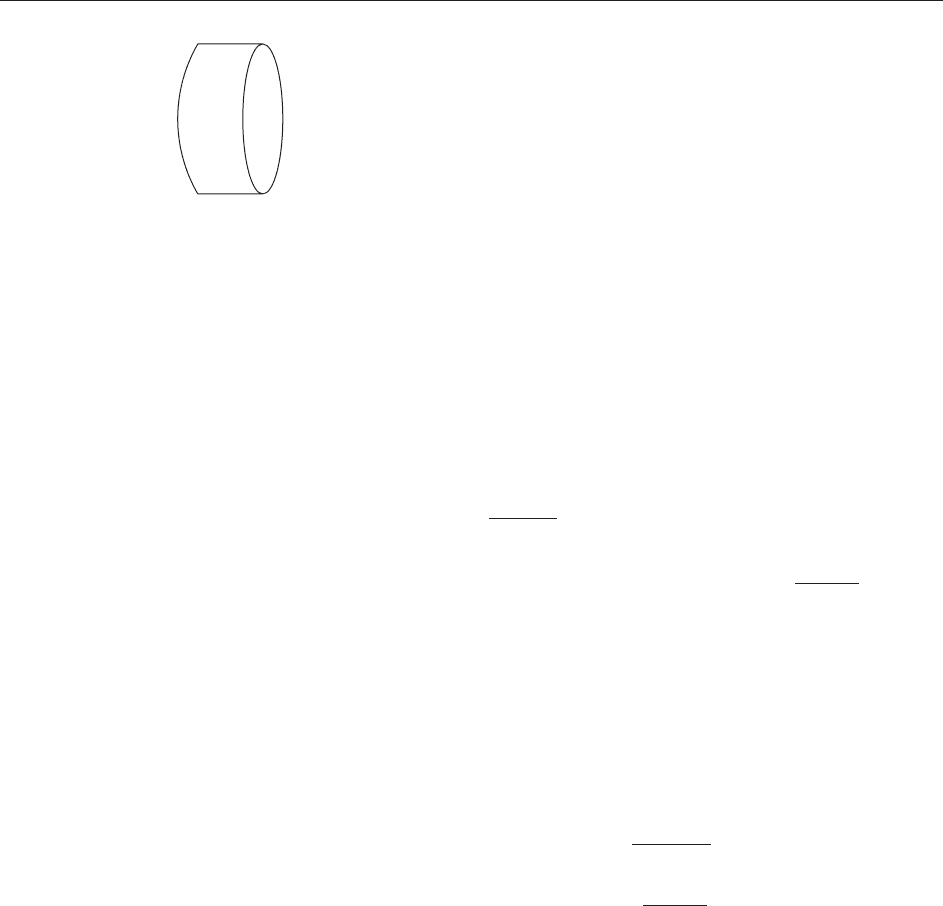
on , and the semigroup representation
u
0;h
ð; rÞ¼W
r
vol
h
¼
Z
r
0
L
1=2
sin ðr tÞL
1=2
hi
hð; tÞdt ½4
holds for all r 0.
The ‘‘input 7! output’’ map is implemented by the
response operator R
T
: F
T
!F
T
,
R
T
f :¼ @
u
f ;0
on ½0; T
defined on controls f 2 H
1
( [0, T]) vanishing on
{t = 0}; here = () is the outward normal to .
The normal derivative @
u
f ,0
describes the forces
appearing on as a result of interaction of the wave
with the boundary.
The map C
T
: F
T
!F
T
, C
T
:= (W
T
bd
)
W
T
bd
, which
is called the connecting operator, can be represented
via the response operator of the system
2T
:
C
T
¼
1
2
ðS
T
Þ
R
2T
J
2T
S
T
½5
S
T
: F
T
!F
2T
being the extension of controls from
[0, T] onto [0, 2T] as odd functions of t
with respect to t = T, and J
2T
: F
2T
!F
2T
being the
integration
ðJ
2T
f Þð; tÞ¼
Z
t
0
f ð; sÞds
Controllability
Open subsets and ! determine the
subspaces
F
T
:¼ff 2F
T
jsupp f ½0; Tg
G
T
!
:¼fh 2G
T
jsupp h ! ½0; Tg
of controls acting from and !, respectively. In view
of hyperbolicity of the problem [1]–[3], the relation
supp u
f ;h
ð; tÞhi
t
[h!i
t
; t 0 ½6
holds for f 2F
T
and h 2G
T
!
. This means that the
waves propagate in with the speed = 1.
The sets of waves
U
T
:¼ W
T
bd
F
T
; U
T
!
:¼ W
T
vol
G
T
!
are said to be reachable at time t = T from and ! ,
respectively. Denoting
HA :¼fy 2Hjsupp y
Ag
by virtue of [6] one has the embeddings U
T
Hhi
T
and U
T
!
Hh!i
T
. The property of the system
T
that plays the key role in inverse problems is that
these embeddings are dense:
cl U
T
¼Hhi
T
; cl U
T
!
¼Hh!i
T
½7
for any T > 0 (cl denotes the closure in H).
In control theory, relations [7] are interpreted as
an approximate controllability of the system in
subdomains filled with waves; the name ‘‘BC
method’’ is derived from the first one (boundary
controllability). This property means that the sets
of waves are rich enough: any function supported
in the subdomain h
i
T
reachable for waves excited
on can be approximated with any precision in
H-norm by the wave u
f ,0
( , T) due to appropriate
choice of the control f acting from . The proof of
[7] relies on the fundamental Holmgren–John–Tataru
unique continuation theorem for the wave equation
(Tataru 1993).
Laplacian on Waves
If h = 0, so that the system is governed only by
boundary controls, its trajectory {u
f ,0
( , t)j0 t T}
does not leave the reachable set U
T
. In this case, the
system possesses one more intrinsic operator L
T
which acts in the subspace cl U
T
and is introduced
through its graph
gr L
T
:¼ cl
fW
T
bd
f ; W
T
bd
f
tt
gjf 2 C
1
0
ð ð0; TÞÞ
½8
(closure in HH). By virtue of the relation
L
T
W
T
bd
f =
g
W
T
bd
f following from the wave
equation [1] and [6], the operator L
T
is interpreted
as Laplacian on waves filling the subdomain hi
T
.
In the case T > T
, one has hi
T
=,clU
T
= H,
and L
T
is a densely defined operator in H, satisfying
L
T
L. Usin g [7], one proves the equality L
T
= L.
This equality and representation [4] imply that
W
r
vol
h¼
Z
r
0
ðL
T
Þ
1=2
sin ðrtÞðL
T
Þ
1=2
hi
hð;tÞdt ½9
for all r0 and any fixed T > T
.
Boundary Control Method and Inverse Problems of Wave Propagation 341
Spectral Problem
The Dirichlet homogeneous bounda ry-value pro-
blem is to find nontrivial solutions of the system
g
’ ¼ ’ in ½10
’ ¼ 0on ½11
This problem is equivalent to the spectral analysis
of the operator L; it has the discrete spectrum
{
k
}
1
k=1
,0<
1
<
2
,
k
!1; the eigen functions
{’
k
}
1
k=1
,L’
k
=
k
’
k
, form an orthonormal basis
in H.
Expanding the solutions of the problem (1)–(3)
over the eigenfunctions of the problem [10], [11]
one derives the spectral representation of waves:
u
f ;0
ð; TÞ¼W
T
bd
f ¼
X
1
k¼1
ðf ; s
T
k
Þ
F
T
’
k
ðÞ ½12
where
s
T
k
ð; tÞ :¼
1=2
k
sin ðT tÞ
1=2
k
hi
@
’
k
ðÞ
Thus, for a given control f, the Fourier coefficients
of the wave u
f ,0
are determined by the spectrum
{
k
}
1
k = 1
and the derivatives {@
’
k
}
1
k = 1
.
Inverse problems
General Setup
The set of pairs : = {
k
; @
’
k
}
1
k = 1
associated with
the problem [10], [11] is said to be the Dirichlet
spectral data of the manifold (, d). The spectral
(frequency domain) inverse problem is to recover the
manifold from its spectral data.
Since the speed of wave propagation is unity, the
response operator R
T
contains the information not
about the entire manifold but only about its part
hi
T=2
. This fact is taken into account in the
dynamical (time domain) inverse problem which
aims to recover the manifold from the operator R
2T
given for a fixed T > T
.
If the manifolds (
0
, d
0
) and (
00
, d
00
) are isometric
via an isometry i :
0
!
00
, then, identifying the
boundaries by i() , one gets two manifolds with
the common boundary =@
0
= @
00
which possess
identical inverse data:
0
=
00
, R
0
2T
= R
00
2T
. Such
manifolds are called equivalent: they are indistin-
guishable for the external observer extracting or
R
2T
from the boundary measurements. Therefore,
these data do not determine the manifold uniquely
and both of the inverse problems need to be
clarified. The precise formulation is given in the
form of two questions:
1. Does the coincidence of the inverse data imply
the equivalence of the manifolds?
2. Given the inverse data of an unknown manifold,
how to construct a manifold possessing these
data?
The BC method gives an affirmative answer to the
first question and provides a procedure producing a
representative of the class of equivalent manifolds
from its inverse data. The method is based on the
concepts of model and ‘‘coordinatization.’’
Model
A pair consisting of an auxiliary Hilbert space
~
H
and an operator
˜
W
T
bd
: F
T
!
~
H is said to be a model
of the system
T
,if
˜
W
T
bd
is determined by inverse
data, and the map U : W
T
bd
f 7!
˜
W
T
bd
f is an isometry
from Ran W
T
bd
Honto Ran
˜
W
T
bd
~
H. The model is
an intermediate object in solving inverse problems. It
plays the role of an auxiliary copy of the original
dynamical system which an external observer can build
from measurements on the boundary. While the
genuine wave process inside , initiated by a boundary
control, remains unaccessible for direct measurements,
its
~
H-representation can be visualized by means of the
model control operator
˜
W
T
bd
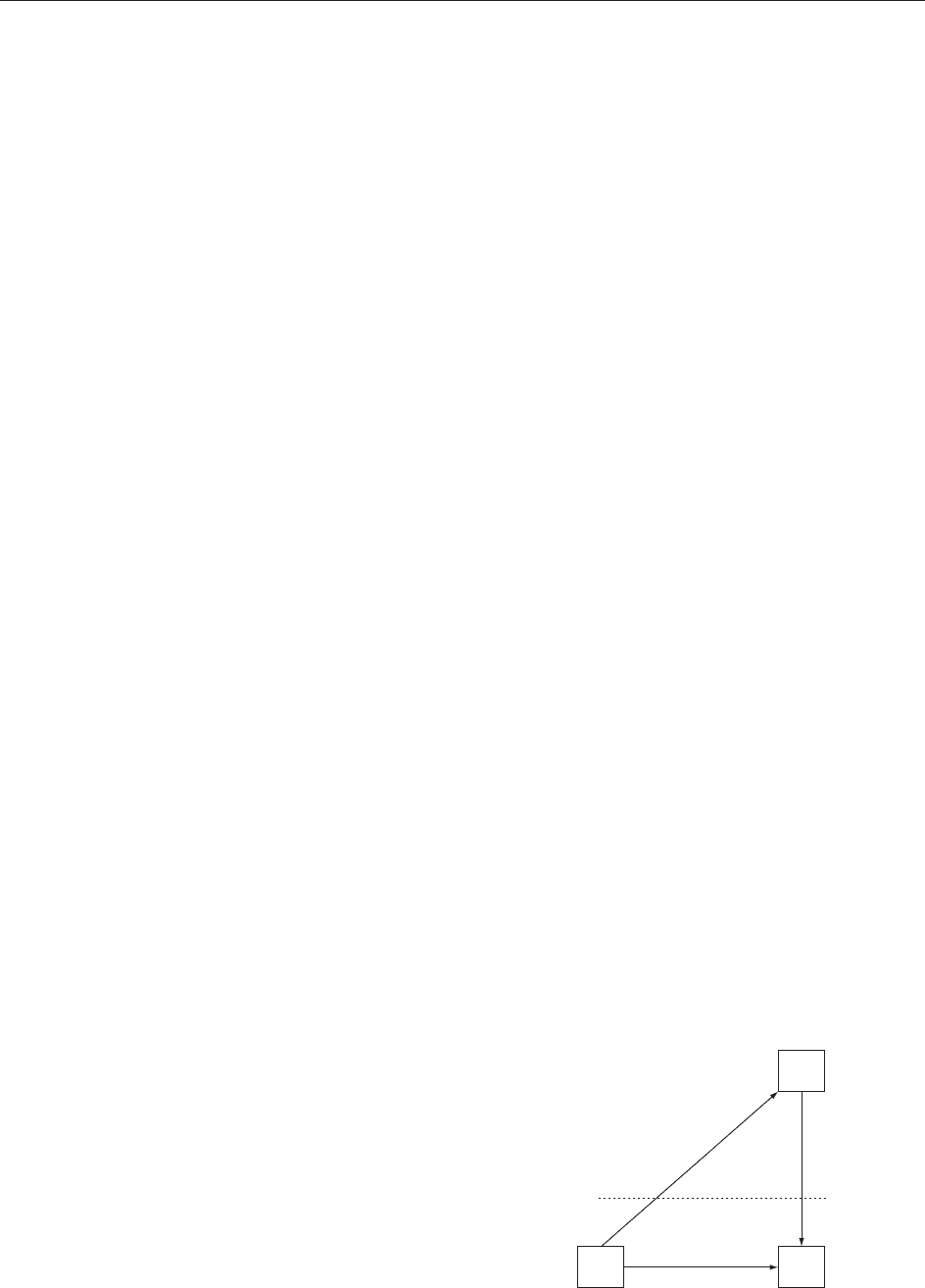
. This is illustrated by the
diagram on Figure 2, where the upper part is invisible
for an external observer, whereas the lower part can be
extracted from inverse data.
Each type of data determines a corresponding
model. The spectral model is the pair
~
H :¼ l
2
;
~
W
T
bd
:¼ fð; s
T
k
Þ
F
T
g
1
k¼1
½13
(see [12]); the role of isometry U is played by the
Fourier transform F : H!
~
H, Fy := {(y,’)
H
}
1
k = 1
.By
virtue of [4], the data also determine the operator
˜
W
r
vol
: L
2
([0, r];
~
H) !
~
H,
˜
W
r
vol
¼
Z
r
0
~
L
1=2
sin ðr tÞð
~
LÞ
1=2
hi
ðÞðtÞdt;
r 0 ½14
H
F
T
W
T
bd
W
T
bd
U
~
H
~
Figure 2 Model of a system. (Data from Belishev (1997).)
342 Boundary Control Method and Inverse Problems of Wave Propagation
where
˜
L := ULU
= diag{
k
}
1
k = 1
. Thus, the spectral
model allows one to see the Fourier images of
invisible waves.
According to [5], the response operator R
2T
determines the modulus of the control operator
jW
T
bd
j¼½ðW
T
bd
Þ
W
T
bd
1=2
¼ðC
T
Þ
1=2
which enters in the polar decomposition
W
T
bd
=jW
T
bd
j. Along with it, the response operator
determines the dynamical model
~
H :¼ cl RanðC
T
Þ
1=2
;
~
W
T
bd
:¼ðC
T
Þ
1=2
½15
The correspondence ‘‘system ! model’’ is realized
by the isometry U =
: W
T
bd
f 7!jW
T
bd
jf . The opera-
tor
˜
L
T
:= UL
T
U
dual to the Laplacian on waves, is
determined by its graph
gr
~
L
T
:¼ cl
f
~
W
T
bd
f ;
~
W
T
bd
f
tt
gjf 2 C
1
0
ð ð0; TÞÞ
½16
(see [8])and,therefore,
˜
L
T
is also determined
by R
2T
. In the case T > T
, the operator
˜
W
r
vol
: L
2
([0, r];
~
H) !
~
H dual to W
r
vol
, is represented
in the form
~
W
r
vol
¼
Z
r
0
ð
~
L
T
Þ
1=2
sin ðr tÞð
~
L
T
Þ
1=2
hi
ðÞðtÞdt;
r 0 ½17
in accordance with [9]. Thus, the dynamical model
visualizes the
-images of the waves propagating
inside .
Wave Coordinatization
In a general sense, a coordinatization is a corre-
spondence between points x of the studied set A and
elements
˜
x of another set
~
A such that: (i) the
elements of
~
A are accessible and distinguishable; (ii)
the map x 7!
˜
x is a bijection; and (iii) relations
between elements of
~
A determine those between
points of A which are studied (H Weyl). Coordina-
tization enables one to study A via operations with
coordinates
˜
x 2
~
A.
The external observer investigating the mani-
fold probes with waves initiated by sources on
. The relevant coordinatization of described
below uses s uch waves and is implemented in
three s teps.
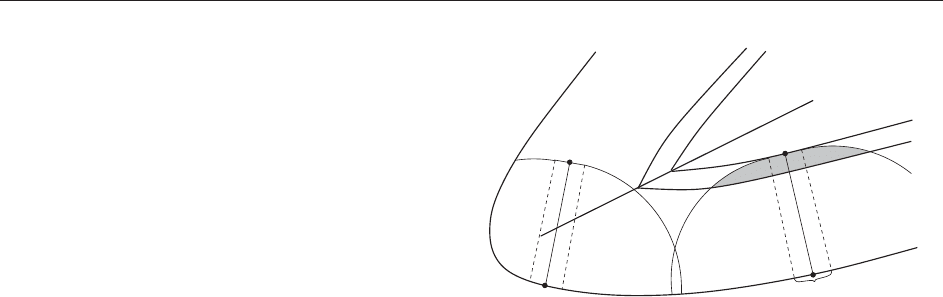
Step 1 (subdomains)Letx(, )betheendpointof
the geodesic of the length >0 emanating from 2
in the direction (), and let
"
be a small
neighborhood shrinking to as " ! 0. If
(),
then the family of subdomains
!
"
ð; Þ :¼½hi
nhi
"
\h
"
i
(shaded domain on Figure 3) shrinks to x(, ); if
>
(), then the family terminates: !
"
(, ) = ; as
"<"
0
() (the case =
0
in Figure 3). Such behavior
of subdomains implies that
lim
"!0
½hi
nhi
"
\h
"
i
DE
r
¼
hxð; Þi
r
;
ðÞ
;;>
ðÞ
½18
Step 2 (wave subspaces) Pass from the subdomains
to the corresponding subspaces Hhi
, Hh
"
i
,
Hh!
"
(, )i
r
, and represent them via reachable sets
by [7]:
Hhi
¼ cl W
bd
F
; Hh
"
i
¼ cl W
bd
F
"
Hh!
"
ð; Þi
r
¼ cl W
r
vol
L
2
½0; r ; H!
"
ð; ÞðÞ
¼ cl W
r
vol
L
2
½0; r; ½Hhi
Hhi
"
\Hh
"
i
¼ cl W
r
vol
L
2
½0; r; ½cl W
bd
F
cl W
"
bd
F
"
\cl W
bd
F
"
Define
W
r
ð; Þ
:¼ lim
"!0
cl W
r
vol
L
2
½0; r; ½cl W
bd
F
cl W
"
bd
F
"
\cl W
bd
F
"
½19
W
r
(,0)
:= W
r
(,þ0)
, r 0 (the limits in the sense of the
strong operator convergence of the projections in H
on the corresponding subspaces). By the definitions,
one has W
r
(,)
= lim
"!0
Hh!
"
(,)i
r
, whereas [18]
leads to the equality
W
r
ð; Þ
¼
Hhxð; Þi
r
;
ðÞ
f0g;>
ðÞ
½20
γ′
Γ
γ
x
(γ, τ)
c
Γ
τ
Γ
τ −
ε
σ
γ
ε
x (γ′, τ)
Figure 3 The subdomains.
Boundary Control Method and Inverse Problems of Wave Propagation 343

for all 2 , 0, r 0. As a result, since any x 2
can be represented as x = x(, ), one attaches to every
point of the manifold a family of expanding subspaces
{W
r
(,)
jr 0} built out of waves. As is seen from [20],
the family is determined by the point x (not dependent
on the representation x = x(,)); the subspaces which
it consists of coincide with Hhxi
r
.
Expressing the distance as
dðx
0
; x
00
Þ¼2 inf fr > 0 jHhx
0
i
r
\Hhx
00
i
r
6¼f0gg
in accordance with [20], one can repre sent
dðx
0
; x
00
Þ
¼ 2 inf fr > 0 jW
r
ð
0
;
0
Þ
\W
r
ð
00
;
00
Þ
6¼f0gg ½21
where x
0
= x(
0
,
0
), x
00
= x(
00
,
00
), and hence find
the distance via the above families.
Step 3 ( wave copy) By varying 2 , 0,
gather all nonzero families {W
r
(,)
jr 0} =:
˜
x in the
set
˜
={
˜
x}. Redenoting W
r
˜
x
:= W
r
(,)
2
˜
x, endow the
set with the distance
~
dð
~
x
0
;
~
x
00
Þ :¼ 2 inf fr > 0 jW
r
~
x
0
\W
r
~
x
00
6¼f0gg ½22
In view of [21], one has d(x
0
, x
00
) =
˜
d(
˜
x
0
,
˜
x
00
), so
thatthemetricspace(
˜
,
˜
d) is an isometric copy
of (, d) by construction. Thus, the correspondence
x 7!
˜
x (‘‘point 7!family’’) is an isometry and
satisfies the general principles (i)–(iii) of
coordinatization.
The manifold (
˜
,
˜
d) is the end product of the
wave coordinatization. It repre sents the original
manifold as a collection of infinitesimal sources
interacting with each other via the waves which they
produce.
Solving Inverse Problems
The motivation for the above coordinatization is
that the wave copy can be reproduced via any
model. Namely, the external observer with the
knowledge of or R
2T
(T > T
) can recover (
˜
,
˜
d)
up to isometry by the following procedure:
1. Construct the model corresponding to the given
inverse data and determine the operators
˜
W
bd
,
0 T by [13], [15]; then determine
˜
L,
˜
L
T
,and
˜
W
r
vol
by [14] or [16], [17].
2. Replace on the right-hand side of [19] all
operators W without tildes by the ones with
tildes, and get the subspaces
~
W
r
(,)
= UW
r
(,)
,
2 , 0, r 0.
3. Gather all nonzero families {
~
W
r
(,)
jr 0} = :
ˆ
x in the
set
ˆ
={
ˆ
x} and redenote the subspaces as
~
W
r
ˆ
x
:=
~
W
r
(,)
2
ˆ
x; endow the set with the metric
ˆ
d(
ˆ
x
0
,
ˆ
x
00
):= 2inf{r > 0 j
~
W
r
ˆ
x
0
\
~
W
r
ˆ
x
00
6¼ {0}} (see [22]),
and get a sample (
ˆ
,
ˆ
d) of the wave copy (
˜
,
˜
d).
This sample is isometric to the original (, d)by
construction. Identifying properly the boundaries @
ˆ
and , one turns (
ˆ
,
ˆ
d) into a canonic al representa-
tive of the class of equivalent manifolds possessing
the given inverse data.
If the response operator R
2T
is given for a fixed
T < T
, the above procedure produces the wave
copy of the submanifold (hi
T
, d). This locality in
time is an intrinsic feature and advantage of the BC
method: longer time of observation on increases
the depth of penetration into .
Amplitude Formula
Another variant of the BC method is based on
geometrical optics formulas describing the propaga-
tion of singularities of the waves.
Let y 2H, and let be the density of the vo lume
in semigeodesic coordinates: dx = d d; the
function
~
yð; Þ :¼
1=2
ð; Þyðxð; ÞÞ; ð; Þ2
0; otherwise
defined on [0, T
] is called the image of y. The
amplitude formula represents the images of waves
initiated by boundary controls in the form
g
u
f ;0
ð; TÞð; Þ¼ lim
t!T0
½ðW
T
bd
Þ
ðI P
ÞW
T
bd
f ð; tÞ
0 <<T
where I is the identity operator and P
is the
projection in H onto clW
bd
F
. The formula is
derived by the ray method going back to
J Hadamard, the derivation uses the controllability
[7].
Any model determines the right-hand side of the
last relation by the isometry: (W
T
bd
)
(I P
)
W
T
bd
= (
˜
W
T
bd
)
(
˜
I
˜
P
)
˜
W
T
bd
, where
˜
W
T
bd
= UW
T
bd
,
˜
I is
the identity operator, and
˜
P
= UP
U
is the projec-
tion in
~
H onto cl
˜
W
bd
F
. This leads to the
representation
g
u
f ;0
ð; TÞð; Þ¼ lim
t!T0
½ð
~
W
T
bd
Þ
ð
~
I
~
P
Þ
~
W
T
bd
f ð; tÞ
0 <<T ½23
and makes the amplitude formula a useful tool for
solving the inverse problems. The external observer
can construct a model via inverse da ta and then
visualize by [23] the wave images on the part
T
of
the pattern (see Figure 1). The collection of images
g
u
f ,0
corresponding to all possible controls f is rich
enough for recovering the tensor g on
T
(i.e., the
metric tensor in semigeodesic coordi nates) and
turning the pattern into an isometric copy of the
submanifold (hi
T
, d). This variant of the method is
344 Boundary Control Method and Inverse Problems of Wave Propagation