
Francoise J.-P., Naber G.L., Tsun T.S. (editors) Encyclopedia of Mathematical Physics
Подождите немного. Документ загружается.

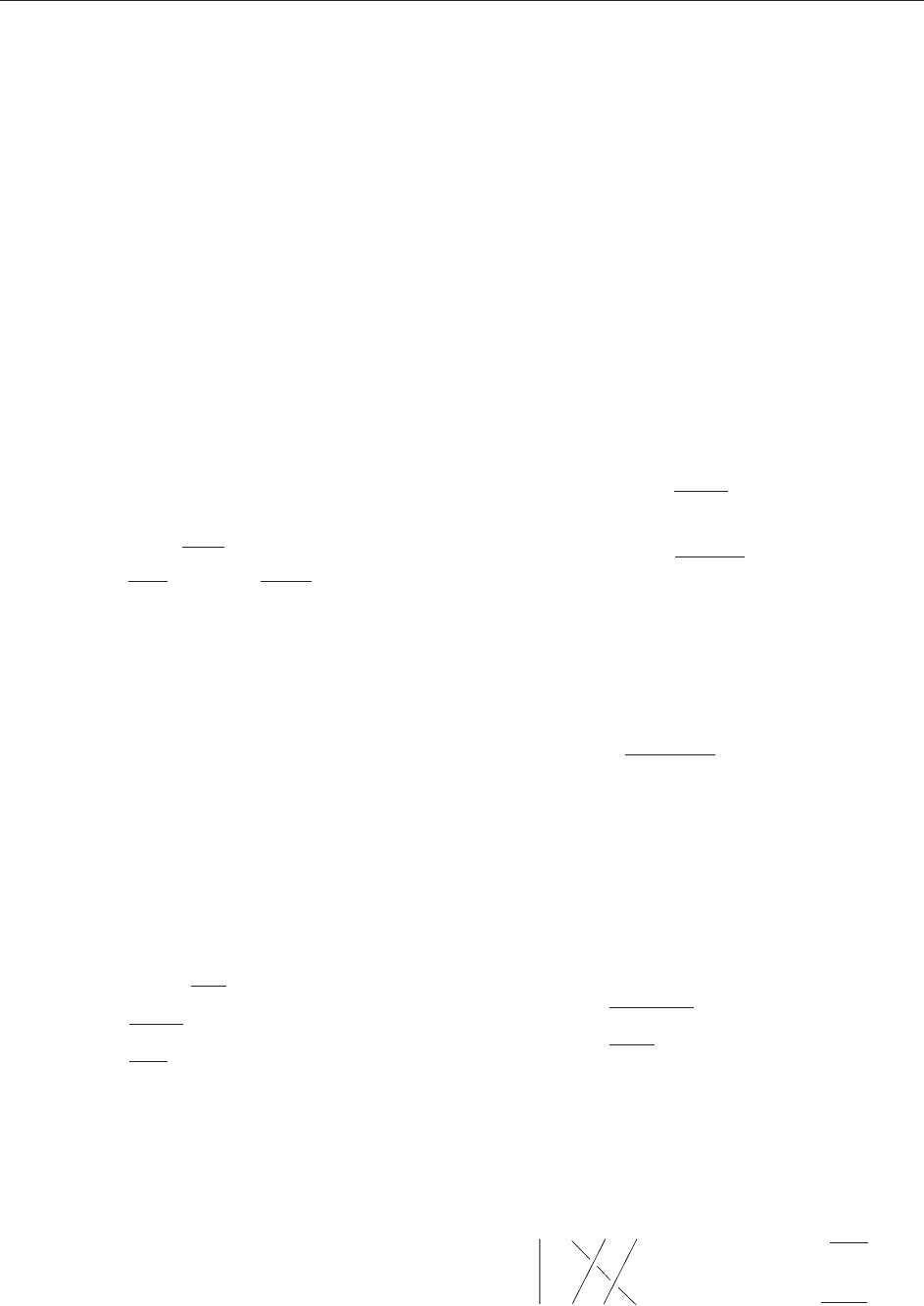
The following result can be used to simplify
notations:
Proposition 1 For any ribbon category C there exists
a ribbon category D equivalent to C such that in it
(i) 1
_
= 1;
(ii) for any object X we have
_
X = X
_
, X
__
= X,
and
X
= id
X
: X !X
__
¼¼¼¼ X.
(iii) for any object X we have ev
X
= ev
0
X
_
: X
X
_
!1, and coev
X
= coev
0
X
_
: 1 !X
_
X.
In the category C= H-mod, where H is a ribbon
Hopf algebra, the equation X
_
=
_
X is not neces-
sarily satisfied. Nevertheless, X
_
is canonically
isomorphic to
_
X. The same holds in any ribbon
category. We identify these objects via = u
2
0
:
_
X !X
_
. This allows us to use the right dual
objects in place of the left ones. In that role, the
right duals are equipped with the left evaluation
and coevaluation, called flipped evaluation and
coevaluation, respectively:
e
ev : X
_
X
^
X
_
X
_
X
__
!
ev
1
g
coev : 1
^
coev
X
__
X
_
^
1
X
_
X X
_
They are often denoted simply ev and coev and
should be replaced by
e
ev and
g
coev in applications. In
the context of Hopf algebra, is given by the action
of a group-like element introduced by Drinfeld.
Hopf Algebras in Braided Categories
Let C be a braided monoidal category. A Hopf
algebra H in C is an object H 2 Ob C together with
an associative multiplication m : H H !H and an
associative comultiplication : H !H H, obeying
the bialgebra axiom
H H !
m
H !
H H
¼
H H
^
H H H H
^
H cH
H H H H
^
mm
H H
Moreover, H has a unit : 1 !H, a counit " : H !1,
an antipode : H !H, and the inverse antipode
1
: H !H. The defining relations for these are the
same as in the classical case. Notice, in particular,
that the unit is also a morphism. Associativity of
multiplication, as well as coassociativity of comulti-
plication, is formulated with the use of associativity
isomorphism (in the nonstrict case).
Hopf algebras in braided categories have also
been called braided groups. Their basic properties
are very similar to those of usual Hopf algebras, for
example, the antipode is antimultiplicative with
respect to the braiding (see, e.g., Majid (1993)).
For Hopf algebras in rigid braided categories, there
exist integrals in a sense very much similar to the
case of ordinary finite-dimensional Hopf algebras,
as shown by Bespalov et al. (2000).
Modular Categories
Assume that a braided rigid monoidal category C is
equivalent as a category (w ith monoidal structure
ignored) to the category of finite-dimensional mod-
ules over a finite-dimensional algebra. In particular,
C is abelian. Then there exists an object F in C,
equipped with a morphism i
X
: X X
_
!F for each
X 2 Ob C, such that the diagram
X Y
_
^
f Y
_
Y Y
_
Xf
t
##i
Y
X X
_
^
i
X
F
is commutative for all morphisms f : X !Y of C ,and,
moreover, F is universal between objects with such
properties. Here f
t
: Y
_
!X
_
is the transpose of a
morphism f : X !Y. In other words, F is a direct limit,
called the coend and denoted as F =
R
Z2C
Z Z
_
.It
can also be defined via an exact sequence
M
f :X!Y2C
X Y
_
^
f Y
_
Xf
t
M
Z2C
Z Z
_
!
i
Z
F ! 0
It turns out that the coend F is a Hopf algebra in
the braided category C, when it is equipped with the
following operations. The comultiplication in F is
uniquely determined by the equation
X X
_
!
i
X
F !
F F
¼
X X
_
¼ X 1 X
_
^
XcoevX
_
X X
_
X X
_
^
i
X
i
X
F F
The counit in F is determined by the equation
X X
_
!
i
X
F !
"
1
¼ X X
_
!
ev
1
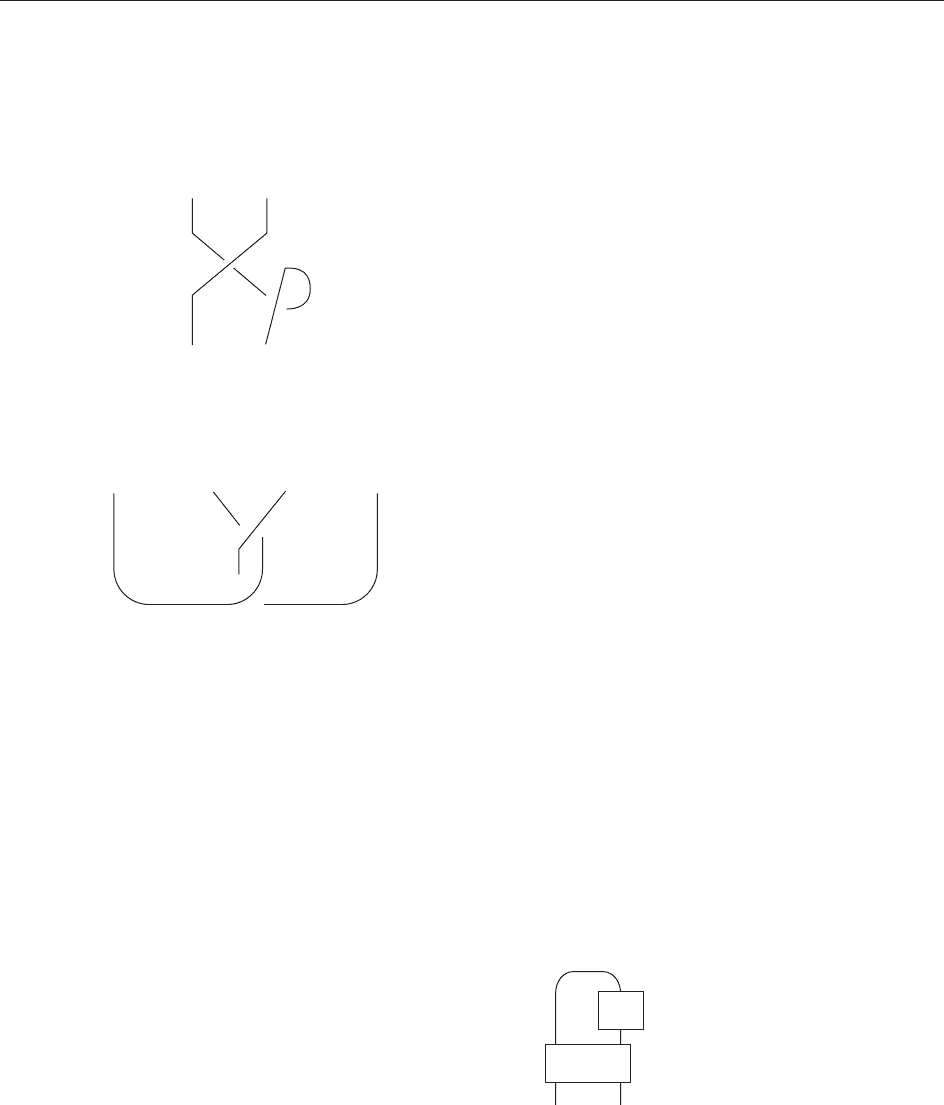
The multiplication m : F F !F is defined by the
following diagram:
X
X
∨
Y
Y
∨
XY
Y
∨
X
∨
m =
and
X X
_
ðY Y
_
Þ
^
i
X
i
Y
F F
Xc
#
9
#
m
X Y ðXYÞ
_
^
i
XY
F
Braided and Modular Tensor Categories 355
The unit is given by the morphism
: 1 ¼ 1 1
_
!
i
1
F
The diagram corresponding to the antipode
F
: F !F is given by
F
γ
F
=
F
The structure of the coend F as a Hopf algebra can
also be found directly from its universal property, as
in Majid (1993).
There is a pairing of Hopf algebras ! : F F !1 in C:
FF
ω =
It induces a homomorphism of Hopf algebras F !F
_
.
Definition 6 A ribbon category C, equivalent as
a category to the category of finite-dimensional
modules over a finite-dimensional algebra, is called
modular if the pairing ! is nondegenerate, that is,
the induced morphism F !F
_
is invertible.
Examples of nonsemisimpl e modular categories
include C= H-mod, where H = u
q
(g) is a finite-
dimensional algebra, quotient of the quantum
universal enveloping algebra U
q
(g), and q is a root
of unity of odd degree. In these examples, the
coalgebra F identifies with the dual Hopf algebra
H
, but the multiplication in F differs from that of
H
. Explicit formula for the multiplication in F uses
the R-matrix for H (see, e.g., Majid (1993)).
A definition of modularity for another type of
categories (not necessarily abelian) was given by
Turaev (1994).
When the category C is modular, the integrals for
the Hopf algebra F have especially simple properties.
The integral element in F is two sided. It is a
morphism : 1 !F such that
F ¼ F 1 !
1
F F !
m
F
¼ F !
"
1 !
F
¼ F ¼ 1 F !
1
F F !
m
F
and is universal between morphisms with such
property. By duality, the integral functional : F !1
is also two sided. It satisfies
F !
F F !
1
F 1 ¼ F
¼ F !
1 !
F
¼ F !
F F !
1
1 F ¼ F
and is universal between morphisms with such property.
The integral element and the integral functional are
unique up to a multiplication by an element of Aut
C
1.
Semisimple Abelian Modular Categories
Reshetikhin and Turaev proposed to construct invari-
ants of 3-manifolds via quantum groups. More
precisely, they use certain abelian semisimple ribbon
categories obtained from quantum groups at roots of
unity as trace quotients. One can forget about the origin
of these categories and work simply with semisimple
modular categories. We shall describe them as input
data for the modular functor construction.
Let C be a C-linear abelian semisimple modular
ribbon category. Assume that the number of
isomorphism classes of simple objects is finite.
Assume also that 1 is simple and for each simple
object X the endomorphism algebra End X = C.We
denote by S= {X
i
}
i
the list of (representatives of
isomorphism classes of) all simple objects.
Under these assumptions, many formulas simplify.
The coend F 2Ctakes the form
F ¼
M
X2S
X X
_
2C
Any morphism 1 !F is a C-linear combination of the
standard morphisms for X 2S,
X
¼
F
X
∨
X
i
X
u
2
0
: 1 !
coev
X
_
X!
1u
2
0
X X
_
!
i
F
The morphism s
X
form a basis of the commu-
tative algebra Inv F = Hom
C
(1, F). T he Groth en-
dieck ring of the category C determines the
multiplication law in Inv F via the a lgebr a
isomorphism C
Z
K
0
(C) !Inv F,[X] 7!
X
.
Any morphi sm F !1 can be represented as a
linear combination of the morphisms
X
: F !
pr
X
X X
_
!
ev
X
1
356 Braided and Modular Tensor Categories
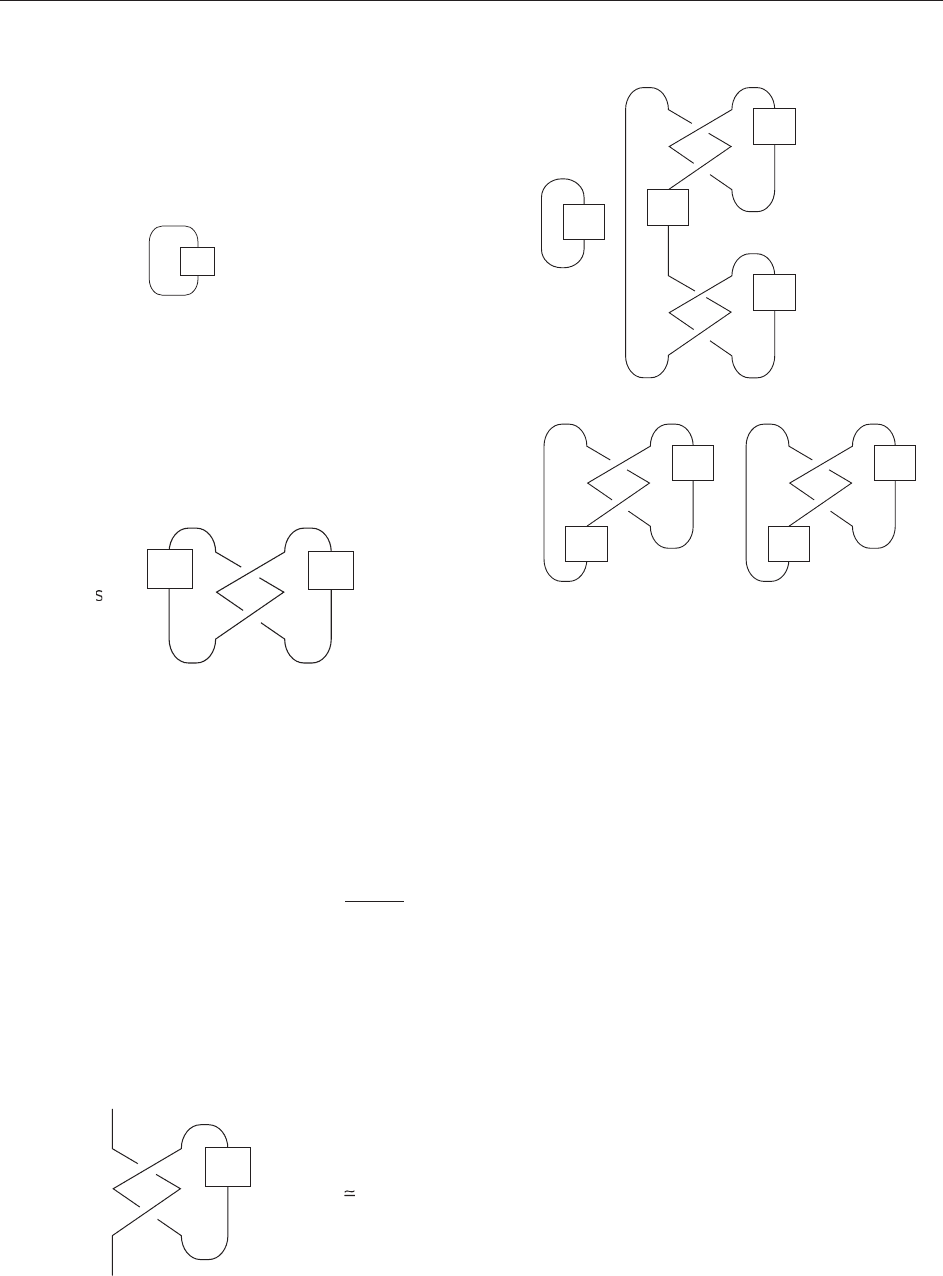
where X 2S. The functional
1
: F !1 satisfies the
properties of a two-sided integral of the braided
Hopf algebra F.
The Verlinde Formula
The number
dim
q
ðXÞ¼
X
∨
X
u
2
0
: 1 !
coev
X
_
X!
1u
2
0
X
_
X
__
!
ev
1
is called the dimension of an object X 2 Ob C. (The
index q reminds us that this number coincides with
the q-dimension in the case C= U
q
(g)-mod.) We
have dim
q
(X
_
) = dim
q
(X).
Definition 7 Introduce a biadditive function of two
variables s :ObCOb C!C on the class of objects of C:
u
–2
0
u
2
0
XY
∨
Y
∨
X
XY =
In particular, its restriction to S is a matrix sj
S
:S
S!C, denoted again by s = (s
XY
)
X,Y2S
by abuse of
notation; here X and Y run over simple objects.
Notice that s
XY
= s
YX
,sothematrixs is symmetric.
Let us consider the C-algebra Inv F = Hom
C
(1, F). It has
the basis
X
, X 2S; hence, it is n-d imension al, where
n = Card S.Theform! on F induces a bilinear form
!
0
: Inv F Inv F !
Homð1; F FÞ
^
Homð1;!Þ
1
The matrix (s
XY
) is the matrix of the form !
0
in the
basis (
X
).
Lemma 1 (The Verlinde formula) For any simple
X 2Sand any objects Y and Z of C, we have
s
X1
¼ dim
q
ðXÞ; s
X1
s
X;YZ
¼ s
XY
s
XZ
½2
Proof The first formula is straightforward. Since
u
2
0
Y
∨
Y
∨
X
End
∨
X C
is a number, we can move it from the second factor
to the first in the following computatio n:
s
X1
s
X;YZ
u
2
0
u
2
0
XY
X
∨
u
2
0
Z
Z
∨
Y
∨
X
∨
X
u
2
0
=
Y
∨
Z
∨
X
∨
X
∨
u
2
0
u
2
0
YX
u
2
0
u
2
0
ZX
=
¼ s
XY
s
XZ
This proves the second formula.
&
Proposition 2 (Criterion of modularity) In the
above assumption of semisimplicity, the following
conditions are equivalent:
(i) C is modular (! is nondegenerate);
(ii) the matrix (s
XY
)
X, Y2S
is nondegenerate;
(iii) for any X 2S its dimension dim
q
X does not
vanish, and there exist numbers
0
Y
, Y 2S, such
that for all X 2Swe have
P
Y2S
s
XY
0
Y
=
X1
; and
(iv) for each simple X 6’ 1 we have
P
Y2S
s
XY
dim
q
Y = 0 and dim
q
X 6¼ 0.
The easy implication (ii) ¼) (iii) can be deduced
from the Verlinde formula. If the dimension
dim
q
(X) = s
X1
of a simple object X vanishes, then
s
2
XY
= 0 for all Y 2 Ob C. This contradicts to the
assumption of nondegeneracy of (s
XY
).
Let us determine the coefficients
Y
of the integral
element
¼
X
Y2S
Y
Y
: 1 !F
of the Hopf algebra F. It also has a two-sided
integral-functional : F !1. The corresponding
endomorphism is
~
Z
¼ Z !
Z
F Z !
Z
1 Z ¼¼¼¼ Z
Braided and Modular Tensor Categories 357
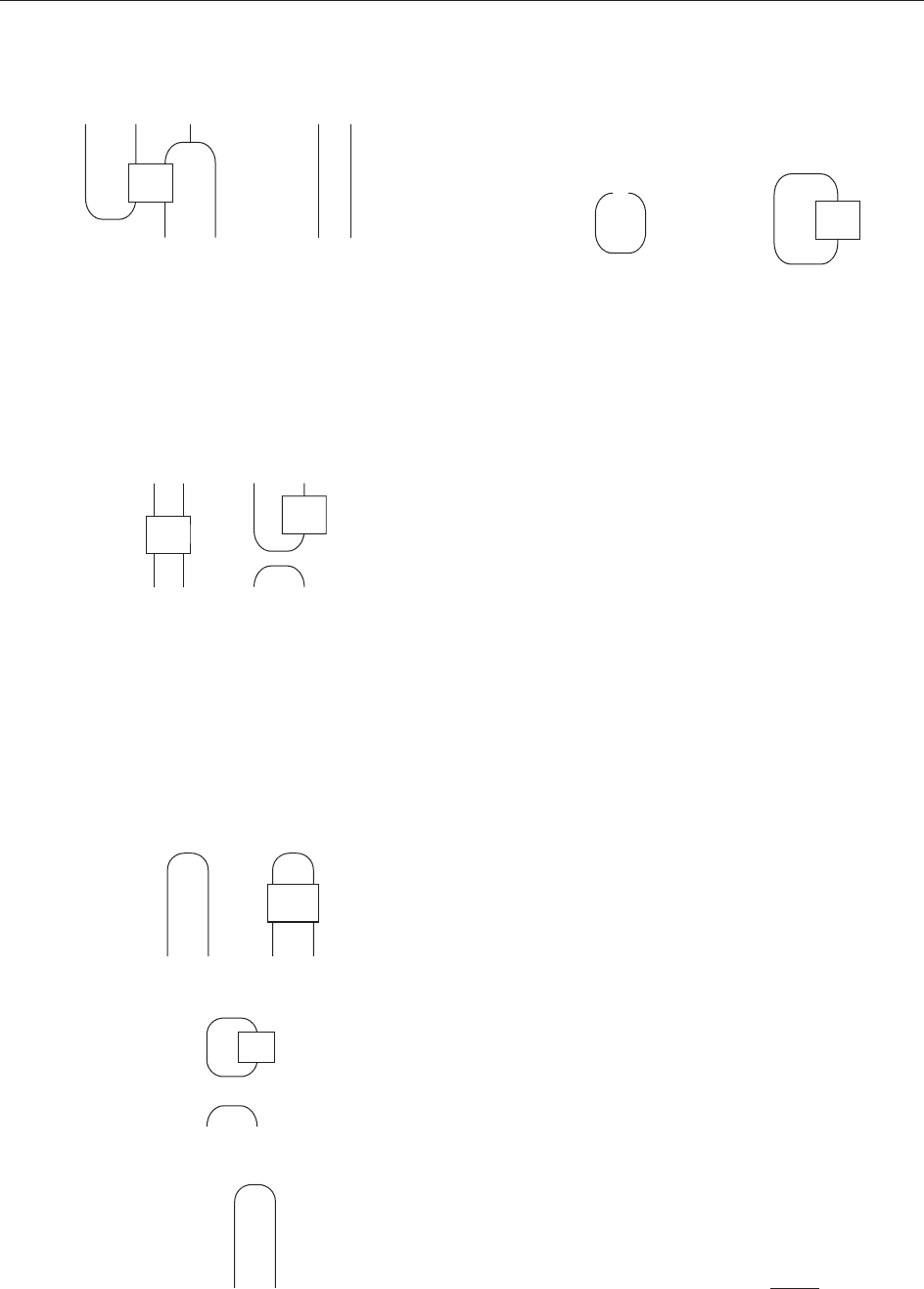
for an arbitrary object Z of C , where
Z
is the
natural coaction. The equation
X
∨
Y
∨
Y
X
X
∨
Y
∨
Y
X
λ
=
δ
XY
μ
Y
φ
Y
½3
follows from the properties of the two-sided integral
of the Hopf algebra F. Due to uniqueness of
integrals, is proportional to
1
. In eqn [3], X and
Y vary over S. The right-hand side is the ident ity
morphism if X = Y, and vanishes otherwise. Sub-
stituting the definition of
Y
, we rewrite the
equation as follows:
X
∨
Y
X
∨
Y
X
∨
Y
= δ
XY
λ
~
μ
y
YX
∨
u
2
0
½4
For X = 1, we get
Y
~
Y
¼
1Y
id
Y
: Y !Y ½5
If Y 6’ 1, then
~
Y
= 0. So [5] tells essentially that
1
~
1
¼ id
1
: 1 !1 ½6
Now return to [4] with X = Y. If we compose that
equation with coev : 1 !Y
_
Y, we obtain
Y
∨
Y
Y
X
∨
X
~
= μ
y
μ
y
. λ
n
Y
∨
λ
~
=
Y
∨
Y
Y
∨
Y
u
2
0
= dim
q
Y
Y
Y
∨
½7
Multiplying both sides of [7] with
1
, we find
Y
¼
1
dim
q
ðYÞ
The normalization is fixed by eqn [6], which we can
write as
1 ¼
1
μ
¼
1
X
Y2S
Y
Y
∨
Y
u
2
0
¼
2
1
X
Y2S
ðdim
q
ðYÞÞ
2
Hence,
ð
1
Þ
2
¼
X
Y2S
dim
q
ðYÞ
2
!
1
½8
So, we find
1
, unique up to a sign.
Conjugation Properties
From the Verlinde formula [2], we conclude that
the comm utati ve C-algebra Inv F possesses
homomorphisms
X
: Inv F ! C
Y
7!ðdim
q
ðXÞÞ
1
s
XY
¼ s
XY
=s
X1
The matrix s is invertible, so that its columns cannot
be proportional. Hence, all
X
are different char-
acters. Their number is n = Card S= dim
C
F; hence,
there is an isomorphism of C-algebras
: Inv F ! C C ¼ C
n
7!ð
1
ðÞ; ...;
n
ðÞÞ
Now we show that the dimensions dim
q
(Y) are
real numbers, so that
1
is also a real number. One
can introduce in Inv F an antilinear involution,
: Inv F ! Inv F; ð
X
Þ
¼
X
_
and a scalar (Hermitian) product
ð
X
j
Y
Þ¼
XY
; X; Y 2S
Then Inv F becomes a finite-dimensional commu-
tative Hilbert algebra. Indeed,
ð
X
Y
j
Z
Þ¼dim HomðX Y; ZÞ
¼ dim HomðX; Y
_
ZÞ¼ð
X
j
Y
Z
Þ
From the theory of finite-dimensional commutative
Hilbert algebras, we know that idempotents in the
algebra Inv F are self-adjoint (only in that case the
scalar produ ct can be positive definite). Hence, is
a -morphism, that is,
X
(
) =
X
(). Therefore,
358 Braided and Modular Tensor Categories

s
XY
_
=s
X1
= s
XY
=s
X1
. In the particular case of X = 1,
we obtain
dim
q
ðYÞ¼dim
q
ðY
_
Þ¼s
1Y
_
¼s
1Y
¼ dim
q
ðYÞ
since s
11
= 1. This proves that for any Y 2C its
dimension dim
q
(Y) is a real number.
It is natural to take for
1
the positive root of the
right-hand side of [8]. Positiveness fixes
1
uniquely.
Examples of Semisimple Modular Categories
In their original paper, Reshetikhin and Turaev
(1991) use as algebraic input data the representation
theory of the quantum deformation U = U
q
(sl
2
)of
the Lie algebra sl(2, C), where q is a root of unity.
They construct the invariant as a trace over
U-equivariant morphisms, and prove the necessary
modularity condition concerning the nondegener acy
of the braided pairing.
The general picture is drawn by Turaev (1994),
where 3-manifold invariants and TQFTs are con-
structed from semisimple modular categories. He
shows how to obtain the latter as quotients of
certain subcategories of representations of a modu-
lar Hopf algebra by the ideal of trace-negligible
morphisms.
Finkelberg (1996), based on results of Gelfand
and Kazhdan, establishes (via the theory of Kazhdan
and Lusztig) an equivalence between two modular
categories. The first is the semisimple category C of
integrable modules over an affine Lie algebra
^
g of
positive integer level k. The second is a certain
subquotient of the category of U
q
(g)-modules for
q = exp(im
1
=(k þ h
_
)), where m 2 {1, 2, 3} and h
_
is the dual Coxeter number of g. Huang and
Lepowsky (1999) describe the rigid braided struc-
ture of C using vertex operators. Bakalov and
Kirillov (2001) use geometrical constructions to
make C into a modular category, associated with
the Wess –Zumino–Witten (WZW) model. They
construct the corresponding WZW modular functor.
Modular Functor and TQFT
Modular categories give rise to a modular functor
and a TQFT. The meanings of those differ from
author to author, but the common features are the
following. Such a TQFT is a functor from the
category whose objects are smooth surfaces with
additional structures and morphisms are three-
dimensional manifolds with additional structures to
the category of vector spaces. A modular functor is
the restriction of such TQFT to the subcategory whose
morphisms are homeomorphisms of surfaces. One of
the constructions due to Kerler and Lyubashenko
(2001) takes a nonsemisimple modular category as an
input and assigns to it a double TQFT functor, that is,
a functor between double categories. The target is the
2-category of abelian categories.
See also: Axiomatic Approach to Topological Quantum
Field Theory; Hopf Algebras and q-Deformation Quantum
Groups; The Jones Polynomial; Knot Invariants and
Quantum Gravity; Quantum 3-Manifold Invariants;
Symmetries in Quantum Field Theory of Lower
Spacetime Dimensions; Topological Quantum Field
Theory: Overview; von Neumann Algebras: Introduction,
Modular Theory, and Classification Theory; von
Neumann Algebras: Subfactor Theory.
Further Reading
Bakalov B and Kirillov A Jr. (2001) Lectures on Tensor
Categories and Modular Functors, University Lecture Series,
vol. 21. Providence, RI: American Mathematical Society.
Bespalov Y, Kerler T, Lyubashenko VV, and Turaev VG (2000)
Integrals for braided Hopf algebras. Journal of Pure and
Applied Algebra 148(2): 113–164 (arXiv:math.QA/9709020).
Drinfeld VG (1987) Quantum groups. In: Gleason A (ed.)
Proceedings of the International Congress of Mathematicians
(Berkeley, 1986), vol. 1, pp. 798–820. Providence, RI:
American Mathematical Society.
Drinfeld VG (1989a) Quasi-Hopf algebras. Algebra i Analiz
1(6): 114–148.
Drinfeld VG (1989b) Quasi-Hopf algebras and Knizhnik–
Zamolodchikov equations. In: Problems of Modern Quantum
Field Theory, pp. 1–13. Berlin–New York: Springer.
Finkelberg M (1996) An equivalence of fusion categories.
Geometric and Functional Analysis 6(2): 249–267.
Huang Y-Z and Lepowsky J (1999) Intertwining operator
algebras and vertex tensor categories for affine Lie algebras.
Duke Mathematical Journal 99(1): 113–134 (arXiv:q-alg/
9706028) (arXiv:q-alg/9706028).
Joyal A and Street RH (1991) Tortile Yang–Baxter operators in
tensor categories. Journal of Pure and Applied Algebra
71: 43–51.
Kerler T and Lyubashenko VV (2001) Non-Semisimple Topologi-
cal Quantum Field Theories for 3-Manifolds with Corners,
Lecture Notes in Mathematics, vol. 1765, vi + 379 pp.
Heidelberg: Springer.
Mac Lane S (1971) Categories for the Working Mathematician,
GTM, vol. 5. New York: Springer.
Majid S (1993) Braided groups. Journal of Pure and Applied
Algebra 86(2): 187–221.
Majid S (1995) Foundations of Quantum Group Theory.
Cambridge: Cambridge University Press.
Moore G and Seiberg N (1989) Classical and quantum conformal
field theory. Communications in Mathematical Physics
123: 177–254.
Reshetikhin NY and Turaev VG (1991) Invariants of 3-manifolds
via link polynomials and quantum groups. Inventiones
Mathematicae 103(3): 547–597.
Turaev VG (1994) Quantum Invariants of Knots and 3-Manifolds,
de Gruyter Stud. Math, vol. 18. Berlin–New York: Walter de
Gruyter.
Braided and Modular Tensor Categories 359

Brane Construction of Gauge Theories
S L Cacciatori, Universita
`
di Milano, Milan, Italy
ª 2006 Elsevier Ltd. All rights reserved.
Introduction
Branes appear in string theories and M-theory as
extended objects which contain some nonperturba-
tive information about the theory, and, apart from
gravity, they can couple with gauge fields.
At low energies, M-theory can be approximated
with an 11-dimensional N = 1 supergravity, which in
fact is unique and contains a graviton field (the metric
g
), a spin 3/2 field (the gravitino) and a gauge field
consisting of a 3-form potential field c. The gauge
field, whose field strength is a 4-form G = dc , can then
couple electrically with two-dimensional extended
objects, called M2 membranes. Moving in spacetime,
an M2 membrane describes a three-dimensional world
volume W3 so that its coupling to the gauge field is
S
2
¼ k
Z
W3
c ½1
k representing the charge.
With c we can associate a dual field
~
c such that
d
~
c =
G. It is a 6-form and can then electrically
couple with a five-dimensional object, the M5
membrane. However, as c is the true field, we say
that M5 couples magnetically with c.
In superstring theories, which however are related
to M-theory by a dualities web, there are many
more objects to be considered. In particular, we will
consider type II strings, which at low energies are
described by ten-dimensional N = 2 supergravity
theories. They contain a Neveu–Schw arz sector
consisting of a graviton g
, a 2-form potential
B
, and a scalar field , the dilaton. The content of
the Ramond–Ramond fields depends on the chirality
of the supercharges.
Type IIA strings are nonchiral (the ir left and right
supercharges having opposite chiralities) and con-
tain only odd-dimensional p-form potentials A
(p)
,
with p = 1, 3, 5, 7, 9.
Type IIB strings are chiral and contain only
even-dimensional p-form potentials A
(p)
, with
p = 0, 2, 4, 6, 8.
Proceeding as before, we see that a (p þ 1)-form
potential can couple electrically with a p-dimensional
object and magnetically with a (6 p)-dimensional
object. Such objects in fact exist in type II strings: the
Dp branes are p-dimensional extended objects, with
p = 0, 2, 4, 6, 8 for IIA strings and p = 1, 1, 3, 5, 7, 9
for IIB strings. In particular, D0 and D1 branes are
called D-particles and D-strings respectively, whereas
D(1) branes are instantons, that is, points in
spacetime. Concretely, D-branes are extended regions
in spacetime where the endpoints of open strings are
constrained to live. Mathematically, they are defined
imposing Dirichlet conditions (whence the ‘‘D’’ of
D-brane) on the ends of the string, along certain
spatial directions. Excitation of these string states
gives rise to the dynamic of the brane. They
correspond to a ten-dimensional U(1) gauge field,
whose components, which are tangent to the brane
world volume, give rise to a gauge field in p þ 1
dimensions, whereas the orthogonal components
generate deformations of the brane shape. Moreover,
if n parallel p-branes overlap, the gauge theory on the
world volume is enhanced to a U(n) gauge theory.
Closed strings can generate gravitational interactions
responsible for wrappings of the brane. However, in
the cases when gravitational interaction is negligible,
we can use this mechanism to construct (p þ 1)-
dimensional gauge theories, as we will see.
Before explaining how the construction works let
us remember that there are two other interesting
objects which often appear. In fact, we have not yet
considered the Neveu–Schwarz B-field: this field can
couple electrically with a one-dimensional object
and magnetically with a five-dimensional object.
These are the usu al string (also called a fundamental
or F-string) and a five-dimensional membrane called
NS5 brane.
We will see how supersymmetric gauge theory
configurations can be realized geometrically, con-
sidering more or less simple configurations of
branes. We will also show that quantum corrections,
be they exact or perturbative, can be described in
this geometrical fashion. To be explicit, we will
work with four-dimensional gauge theories, but it is
clear that similar constructions can be done in
different dimensions.
Gauge Groups on the Branes
A deeper understanding of how D-branes and
related world-volume gauge theories work requires
the introduction of dualities, but a quite simple
heuristic argument can be given, giving up some
rigor in favor of intuition.
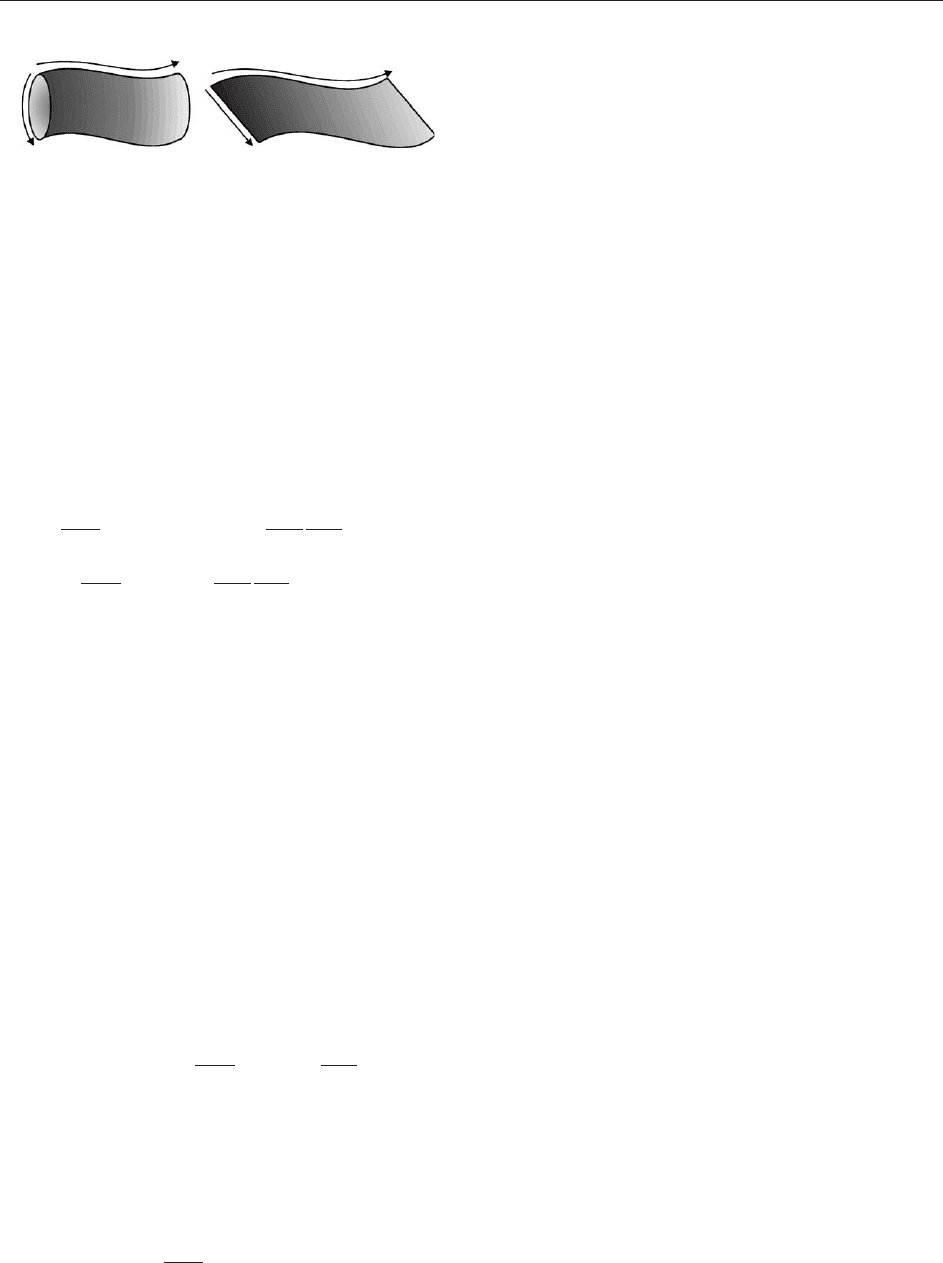
To set our ideas, let us think of an open string
moving in a nearly flat (but ten-dimensional) space-
time. Its trajectory will describe a two-dimensional
surface having a boundary traced by the ends of the
string ( Figure 1). The string can then be described by
a map from a two-dimensional surface , having a
360 Brane Construction of Gauge Theories
boundary = @, to spacetime, say X
(, ) with
= 0, 1, ..., 9. Here we chose on local coordi-
nates
= (, ), where 2 [0, ] is a spacelike
coordinate and is a timelike one. Then = 0,
individuate the ends of the string and are identi-
fied for the closed string. Now, on a given back-
ground, the string evolution is usually described as a
two-dimensional (supersymmetric) conform al field
theory for the fields X
(, ). The action for the
bosonic part is the same for both type IIA and IIB
strings, and reads
S½X¼
1
4
0
Z
d
ffiffiffi
h
p
h
g
ðXÞ
@X
@
@X
@
þ
1
4
0
Z
B
ðXÞ
@X
@
@X
@
d
^ d
½2
where g
and B are the metric and a 2-form
potential field for the given spacetime background,
and h
is a metric for . In general, we must also
add a scalar field (X), but it will not play any role
here. Using conformal invariance, we can reduce h
to the flat metric. Also consider a flat background
g
(X) =
and concentrate for a moment on the
B-field.
Conceived as a 2-form field over the spacetime,
the potential field B is a gauge field: its field strength
3-form H = dB is unchanged under a shift
B ! B þ dA ½3
generated by the 1-form field A(X). Here A should be
a totally unphysical field. However, note that if one
considers open strings, the action for the B-field, and
then the full action is shifted by a boundary term
S½X!S½Xþ
1
4
0
Z
A
ðXÞ
@X
@
d
½4
The boundary just describes the timelike world
lines of t he ends of the string. Thus, the ends of
the s tring carry a U(1) charge and, even though
the B-field vanishes, we can have the open-string
action
S½X¼
1
4
0
Z
@
X
@
X
d
2
þ
Z
A
ðXÞ@
X
d
½5
Here we conventionally rescaled the A field to
normalize the action. To define the equation of
motion, however, we must also specify boundary
conditions for X
(, )on. Let us choose Neu-
mann conditions for = 0, 1, ..., p and Dirichlet
conditions for the remaining directions
@
X
a
ðÞ¼0; a ¼ 0 ; ...; p ½6
@
X
i
ðÞ¼0; i ¼ p þ 1; ...; 9 ½7
This means that the extrema of the string are bound
on a (p þ 1)-dimensional region (including time): the
Dp brane. If for we consider the full strip
(, ) = [0, ] R then the U(1) action reduces to
S
A
½X¼
Z
1
1
A
a
@
X
a
ð; Þ
Z
1
1
A
a
@
X
a
ð0;Þ½8
Thus, only the components of A
a
tangent to the
brane interact with the ends of the strings. What
about the normal components A
i
?
To understand its meaning, let us proceed to
compute the mean momentum transferred by the
string, as it would be rigid. Imitating the Hamilton–
Jacobi procedures for particles, let us consider the
action up to a fixed time, say = 0, so that
=[0, ] [1, 0]. It is then a function of the
position X
(, 0) of the string at the instant = 0.
To compute the momentum, we must vary the
action by changing the position by a constant shift
X
() =
0
. The variation will then contain some
boundary terms which, for reasons of consistency,
we must make vanish.
Before doing such a computation, let us make
some further comments. It is plausible to assume
that the two ends of the string could be charged for
different U(1) fields. To the states of the open string
we can in fact add two discrete labels I, J = 1, ..., n,
for some integer n, called Chan–Paton factors, and
referring, respectively, to the two ends of the string.
We will indicate the ends of the string as X
(0, ; I)
and X
(, ; J) when we need to specify the states. If
the string is in the excited state (I, J), then X(0, ; I)
can couple with the field A
I
and X(, ; J) with A
( J)
.
For simplicity, we will now assume that these fields
are constant. Note however that A
(I)
must be
intended as a function of X(0, ) only, and similarly
for A
( J)
. Also to realize the vari ation we can vary
X
(, ) by a function X
(, ) =
() strictly
picked to
0
at = 0 so that essentially
@
ðÞ¼
0
ðÞ½9
where () is the Dirac delta function.
σσ
Closed strin
g
Open strin
g
τ
τ
Figure 1 Strings moving in spacetime.
Brane Construction of Gauge Theories 361
Using the chosen boundary conditions, the varia-
tion of the full action contains the boundary terms
S
bound
¼ A
ðJÞ
i
A
ðIÞ
i
Z
0
1
@
i
ðÞd
þ
1
2
0
Z
0
i
@
X
i
ð; 0Þd
¼
i
2
0
X
i
ð; 0ÞX
i
ð0; 0Þ
þ 2
0
A
ðJÞ
i
A
ðIÞ
i
½10
Imposing the condition of its vanishing gives the
physical interpretation for the normal components
of the U(1) fields
X
i
ð; 0ÞX
i
ð0; 0Þ¼2
0
A
ðJÞ
i
A
ðIÞ
i
½11
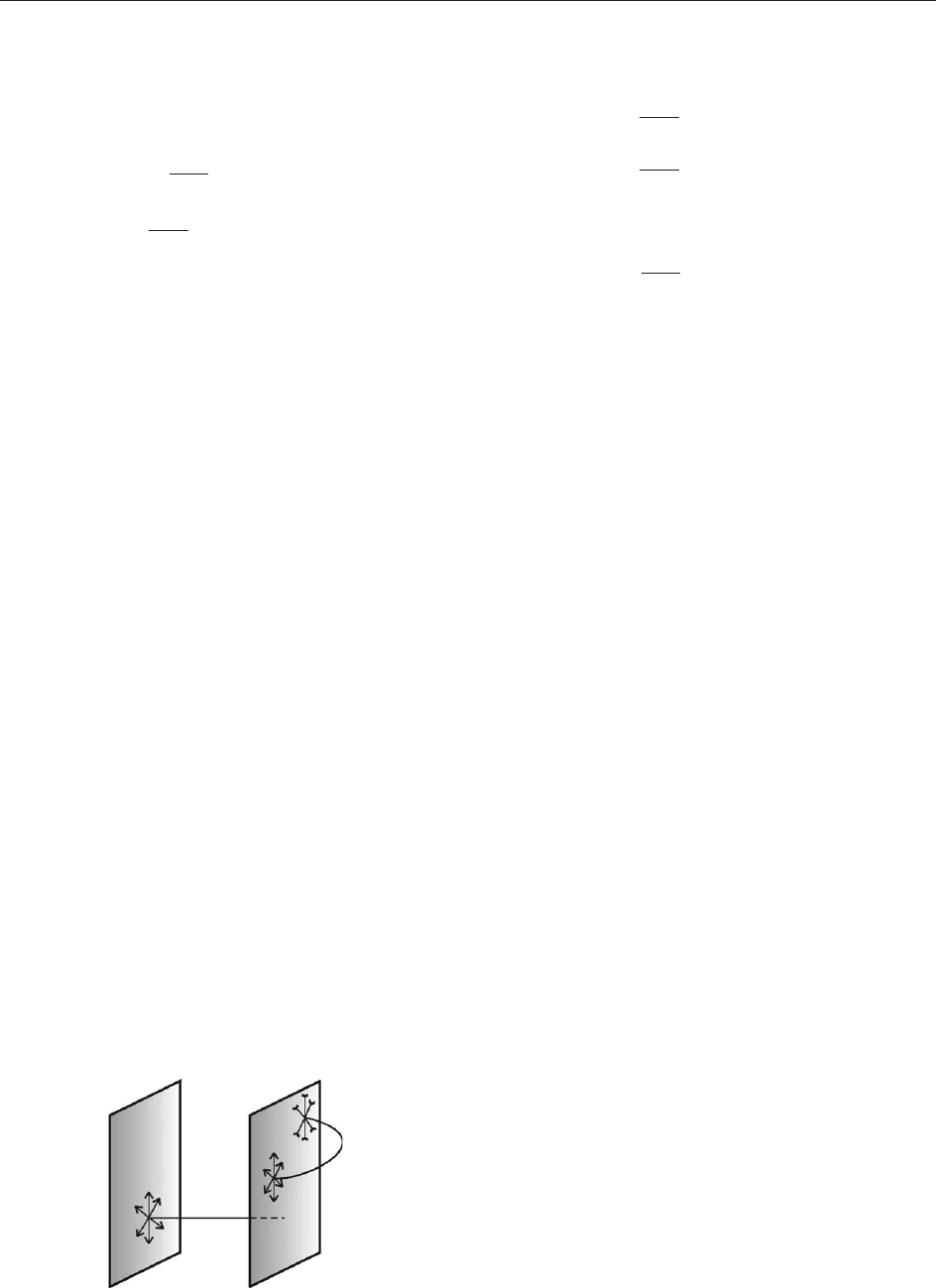
This means that, up to a constant shift, the fields
A
(K)
i
measure the positions of the ends of the strings
in the transverse directions! (Figure 2). Equivalently,
we can say that the string ends on two different Dp
branes, parallel but displaced in the transverse
directions by a quantity 2
0
A
( J)
i
A
(I)
i
. We are
thus also able to interpret the Chan–Paton factors.
They mean that the string is living in a background
of n parallel branes, stretched between the Ith and
the Jth brane. On every brane, a U(1) gauge gro up
lives so that the full gauge group is U(1)
n
. However,
when k of the branes overlap, the corresponding set
of states become indistinguishable, so that the gauge
group can be enhanced to a U(k) group. In
conclusion, n overlapping parallel Dp branes carry
a(p þ 1)-dimensional U(n) gauge theory which
breaks in U(k
i
) block factors if the branes separate
in stacks of k
i
overlapping branes.
We can say a little bit more about this. If the
string excited states represent gauge degree of
freedom, they must become massive to break gauge
symmetry when the branes separate. To see this, let
us conclude by computing the mean momentum
carried by the string. After elimination of the
boundary terms, the total variation of the action
due to the shift X
(,0)=
becomes
S ¼
1
2
0
Z
@
@
X
d
2
¼
2
0
Z
0
@
X
ð; 0Þd ½12
The resulting momentum is
P
¼
1
2
0
Z
0
@
X
ð; 0Þd
On the bulk, the fields X
satisfy the standard wave
equation in two dim ensions, so that the general
solution is the sum of a left-moving and a right-
moving part, X
(, ) = X
L
( þ ) þ X
R
( ).
Imposing the boundary conditions, one finds
X
a
ð; Þ¼X
a
L
ð þ ÞþX
a
L
ð Þ
þ 2
0
p
a
þ X
a
0
½13
X
i
ð; Þ¼X
i
L
ð þ ÞX
i
L
ð Þ
þ 2
0
A
ðJÞi
A
ðIÞi
þ X
i
0
½14
Here X
0
and p
a
are integration constants and
X
i
L
( þ ) X
i
L
( ) = 0. A dire ct computation
then shows that P
a
= p
a
and P
i
= 0, which is also
what intuition suggests: the string can freely move
along the branes but is fixed between them in the
orthogonal directions. However, if it is stretched
between two separated branes (i.e., if I 6¼ J), there is
another contribution to the energy. In fact the factor
T := 1=(2
0
) represents the string tension, so that if
is its minimal length, its minimal contribution to
the energy will be E = T. This energy must
equally contribute to the spectrum of the excited
modes, the gauge field bosons. Here in fact, is where
T-duality comes into play, but we will not discuss it.
The conclusion is that the spectrum corresponding to
the stretched string must satisfy the condition E T,
which is as if the string states acquired a mass T,
that is,
m
2
¼
X
9
i¼pþ1
A
ðJÞi
A
ðIÞi
2
½15
This gives us a geometric tool to construct (p þ 1)-
dimensional gauge theories: on n coincident Dp
branes there exists a U(n) gauge theory which can be
broken separating the branes and thus giving a mass
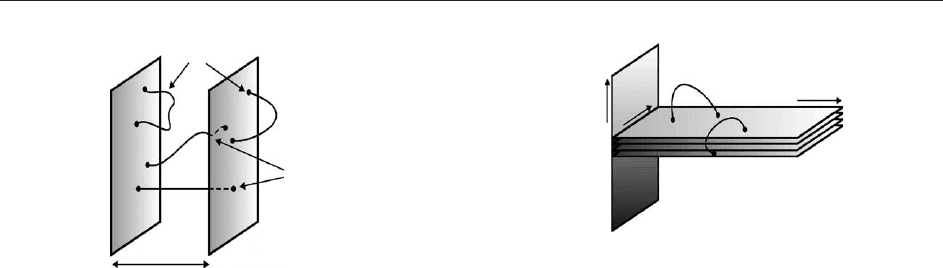
to the gauge bosons. Such a mass is proportional to
the distance between the branes (Figure 3).
Before continuing with some examples, let us
make two comments. First, the theory obtained in
this way is a supersymmetric one, because the
A
a
A
i
A
a
A
a
Figure 2 Tangential components of A
a
appear as gauge
modes. Normal components A
i
appear as shift modes.
362 Brane Construction of Gauge Theories
Dirichlet conditions allow the action of supersym-
metric transformations of the form
L
Q
L
þ
R
Q
R
,
where Q
L
and Q
R
are the fermionic left and right
supercharge operators and
L
,
R
are spinors satisfy-
ing the brane projection condition
L
=
0
1
...
p
R
. Here
are the ten-dimensional Dirac
matrices and one refers to ‘‘antibranes’’ for the
negative sign.
Second, the gauge group can be converted into an
SO(n) or an Sp(n=2) (for even n), adding an
orientifold plane parallel to the branes. The orienti-
fold plane acts on the orthogonal spacetime direc-
tions with a Z
2
-action
X
i
X
i
½16
if X
i
= 0 is the position of the orientifold. It further
acts on the string world sheet as making it
an unoriented string. The effect is to project out
some states from the spectra, thus reducing the
gauge group.
Geometric Engineering of Gauge
Theories from Branes
To illustrate how brane construction of gauge
theories works, we will consi der a particular con-
figuration of branes (Witten 1997).
We would like to obtain a four-dimensional U(n)
gauge theory. A possibility could be to take n D3
branes in a type IIB string background. However,
such a model would contain too many supersymme-
tries: in ten dimensions, supersymmetries are gener-
ated by two 16-dimensional chiral spinors
L
,
R
(
0
...
9
L,R
=
L,R
). From the four-dimensional
point of view, each of them represents four four-
dimensional spinors giving an N = 8supersymmetric
theory. The projection condition, due to the branes,
reduces the number of supersymmetries to four.
Supersymmetry not being manifest in nature, it is
desirable to have fewer supersymmetric gauge theo-
ries at hand. Because different brane projection
conditions can further reduce supersymmetry, we
can try to consider the coexistence of more kinds of
branes.
One way to do this is to consider n parallel 4-branes
ending on an NS5 brane in type IIA string theory
(Figure 4), and then analyze the gauge theory restricted
to the four-dimensional intersection (here the theory is
nonchiral as
0
...
9
L=R
=
L=R
). What kind of
branes can end on other kind of branes can be
established, starting from the fact that strings can end
on a brane, and using the dualities tool (Giveon and
Kutasov 1999).
Let us fix some conventions. We will indicate with
x = (x
0
, x
1
, x
2
, x
3
) 2 R
4
the coordinates on the inter-
section, so that (x; v ) = (x; x
4
, x
5
) 2 R
6
define the NS5
brane, and (x, x
6
), with x
6
2 [0, 1), the 4-branes. Also
v
I
will indicate the position of the Ith 4-brane on the 5-
brane, and y = (x
7
, x
8
, x
9
) will collect the remaining
coordinates. Finally, we will indicate the product of -
matrices, corresponding to given directions, indicizing
asimple with the respective coordinates. For
example
v
=
4
5
. With these conventions, the
brane projection conditions for D4 and NS5 branes,
respectively, read
L
¼
x
6
R
½17
L
¼
x
v
L
;
R
¼
x
v
R
½18
These projections reduce supersymmetry to N = 2.
After a short manipulation and using for example
antichirality of
R
, it is easy to see that the first
condition can be substituted by
L
¼
x
y
R
½19
In other words, we could add a number of 6-branes
in the (x, y) directions, without further reduci ng
supersymmetry. We will consider this possibility
later.
On the D4 branes there is an eventually broken
U(n) gauge theory. Here the vector fields
A
, = 0, 1, 2, 3, 6, and the scalar fields v
I
and y
live. The last ones are set to zero by the Dirichlet
conditions, whereas v
I
measure the fluctuations of
the D3 brane positions over NS5. The O(2) group
Massive
Massless
Δ
Figure 3 Stretched strings acquire a mass.
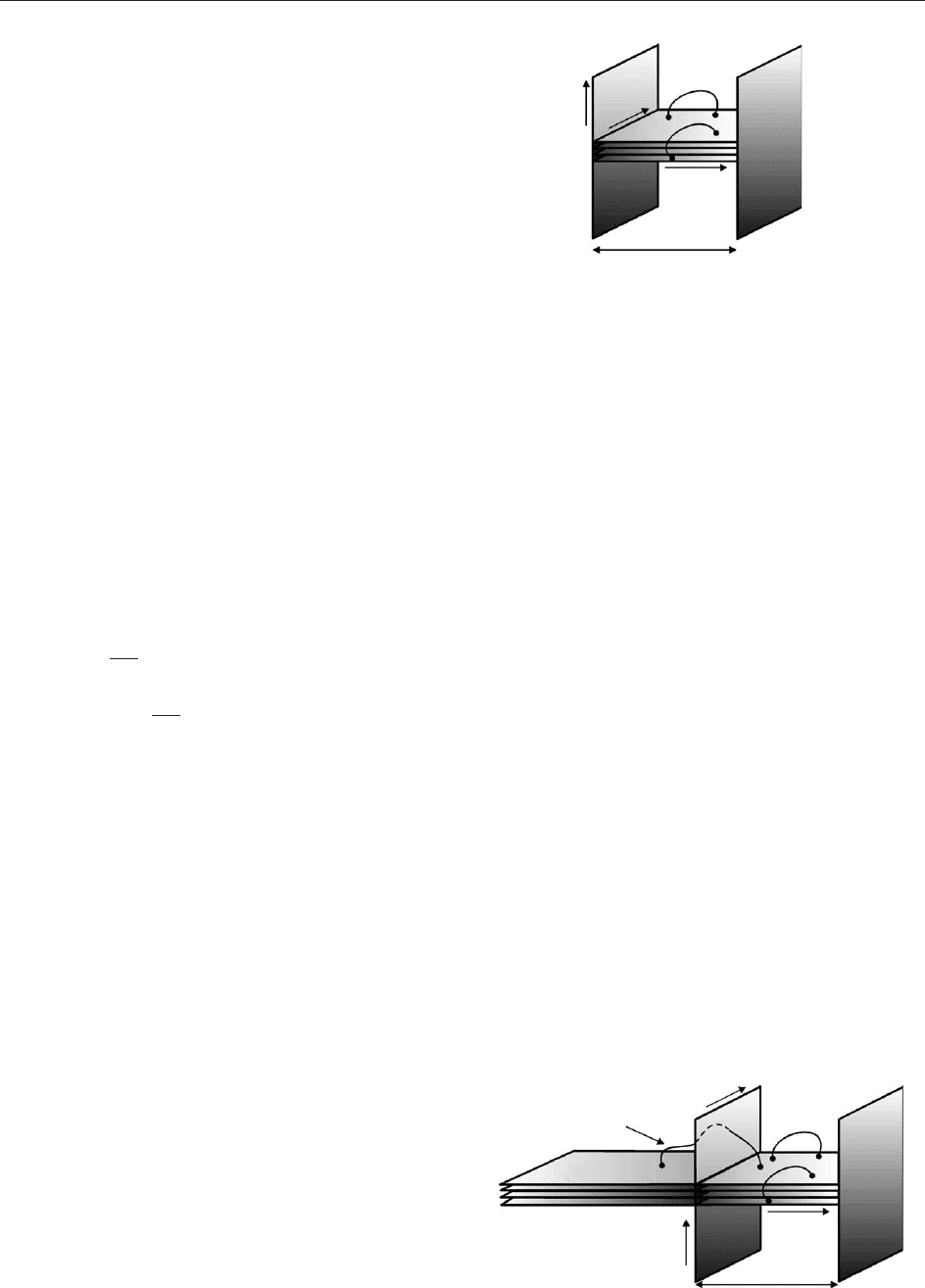
NS5
x
6
D4
x
v
•
Figure 4 D4 branes ending on an NS5 brane. Gauge degrees
of freedom are frozen in four dimensions.
Brane Construction of Gauge Theories 363
of rotations of the (x
4
, x
5
) coordinates acts on
them, which can be broken by an expectation
value hv
I
i 6¼ 0. The SO(3) rotations of (x
6
, x
7
, x
8
)
(under which v
I
are singulets) do not influence the
projection conditions and can then be identified with
the R-symmetry group SU(2)
R
. It could be broken by a
nonvanishing expectation value hyi 6¼ 0, but as we
said it cannot happen in the actual configuration. This
highlights an unbroken supersymmetric Coulomb
branch.
What is the physics as seen by an observer living
on the four-dimensional spacetime x? The compo-
nents A
, = 0, 1, 2, 3, of the vector fields transform
as vectors with respect to the four-dimensional
Lorentz group SO(1, 3). They satisfy Neumann
boundary conditions on x
6
= 0 and then survive as
U(n) gauge vector fields. The A
6
component behaves
as a scalar with respect to SO(1, 3) but is eliminated
by a Dirichlet condition in x
6
= 0. The v scalar field
will be respons ible for the eventual breaking of the
gauge group.
This seems to be quite a good scenario but
actually the situation is unsatisfactory. If a 4-brane
extends to the interval [0, L] in the x
6
direction, the
effective action for the gauge fields goes like this:
1
g
2
D
4
Z
L
0
dx
6
Z
R
4
d
4
xtrF
F
L
g
2
D
4
Z
R
4
d
4
xtrF
F
½20
where , = 0, 1, 2, 3. Thus, the gauge coupling in
four dimensions appears to be g
4
= (g
D
4
)=
ffiffiffiffi
L
p
. In our
case, where L goes to infinity, the gauge coupling
vanishes and the gauge degrees of freedom are
frozen. Moreover, an argument similar to the one
made for the stretched strings shows that the energy
of the D4 brane is very high and makes the
mechanism of gauge group breaking difficult. The
same is true for the NS5 brane, which also turns out
to be extremely massive and does not participate in
the dynamics. But this is what we want.
To solve the problem and restore gauge dynamics
in four dimensions, one must consider a stack of
4-branes of finite length in the x
6
direction. This can
be achieved placing in x
6
= L a second NS5 brane
parallel to the first one and in the same point in y
(Figure 5). In this way, the D4 branes can stretch
between the NS5 branes. If L is little enough, the
gauge dynamics is restored also requiring a small
value for g
D
4
, to ensure the gravitational coupling
(and the couplings with the Kaluza–K lein and NS5
modes) to be negligible. However, L must be bigger
then the X
6
fluctuations in order to avoid quantum
corrections.
What we just obtained is an N = 2 supersym-
metric classical U(n) gauge theory in four dimen-
sions, without matter, and in the Coulomb branch.
Before considering quantization, let us briefly
discuss some possible generalizations. For example,
matter can be realized attaching to the left-hand side
NS5 brane, new D4 branes parallel to the previous
ones, but extended in the x
6
direction from 1 to 0
(Figure 6). Considering strings stretched between
long and short branes, we obtain states whose half-
gauge action, associated with the end conn ected to
the long brane, is frozen. The corresponding states
thus appear in the fundamental representation and
can be interpreted as matter states.
To consider the Higgs branch, one should be able
to break supersymmetry giving an expectation value
to y. As mentioned above, in the actual configura-
tion this cannot happen because y is set to 0 by
Dirichlet condit ions. Fortunately, as we said, one
can add 6-branes in the (x, y) directions. If we insert
such branes to stop the long D4 branes in a large but
finite value of x
6
, say x
6
= M with M L, then
long branes have Neumann conditions in the y
directions. Thus, fluctuations of the long branes can
give an expectation value to y, breaking super-
symmetry and subsequently the Higgs branch can be
tuned, shifting 4-branes stretched between 6-branes
(Figure 7).
NS5 NS5
x
6
D4
x
v
L
Figure 5 N = 2 four-dimensional super Yang–Mills theory, with
U(n) gauge group.
v
Matter
x
NS5
NS5
x
6
D4
L
Figure 6 Adding matter.
364 Brane Construction of Gauge Theories