
Francoise J.-P., Naber G.L., Tsun T.S. (editors) Encyclopedia of Mathematical Physics
Подождите немного. Документ загружается.

The details require some careful inspection, but
we shall stop our analysis here (Giveon an d Kutasov
1999).
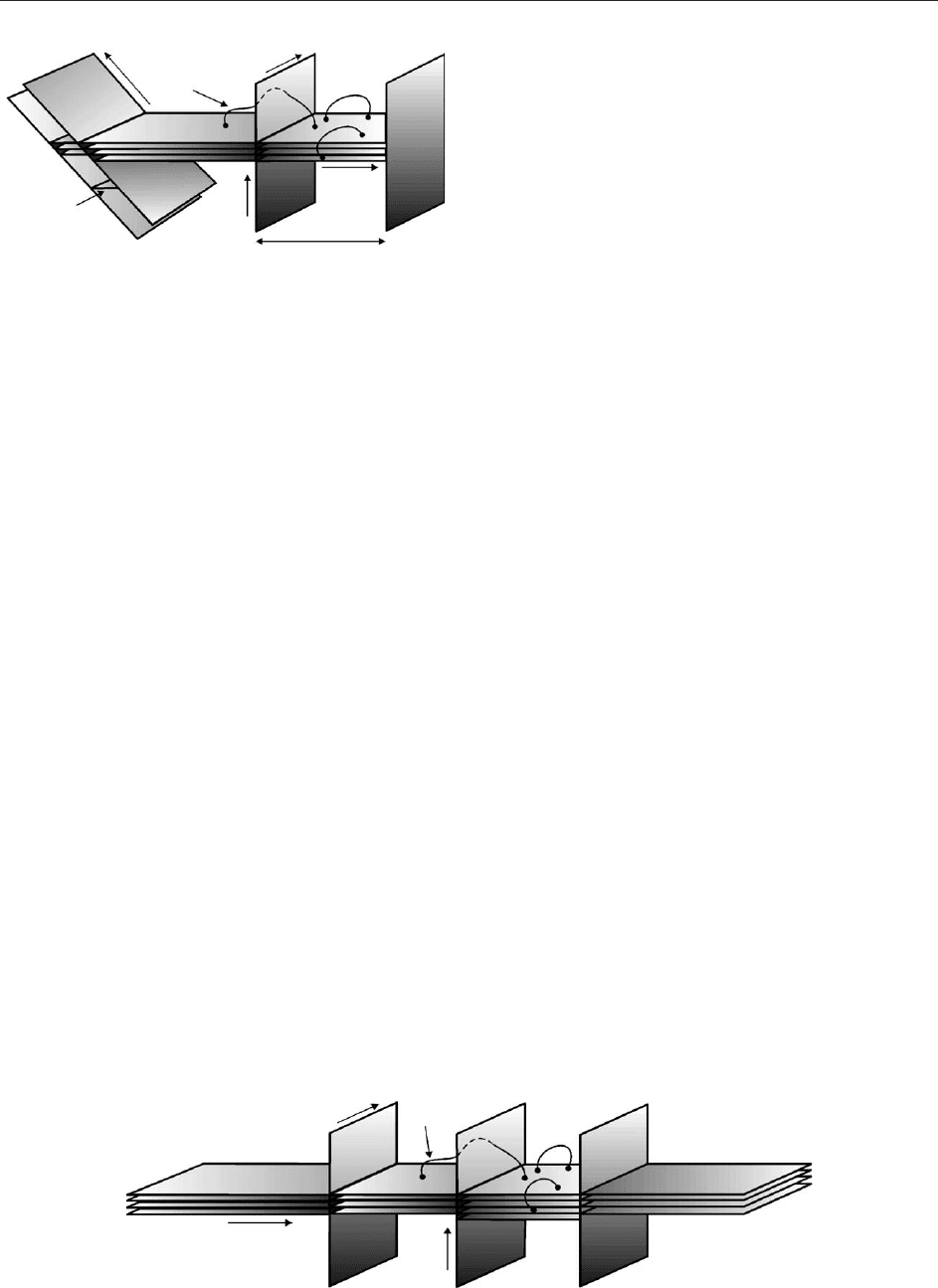
More general gauge configurations can be realized
by adding more parallel NS5 branes, and thus
obtaining product groups. Adding orientifold planes,
one can change gauge groups as explained in the
previous section (Figure 8).
Finally, we can take a further step towards more
physical models, constructing N = 1 gauge theories.
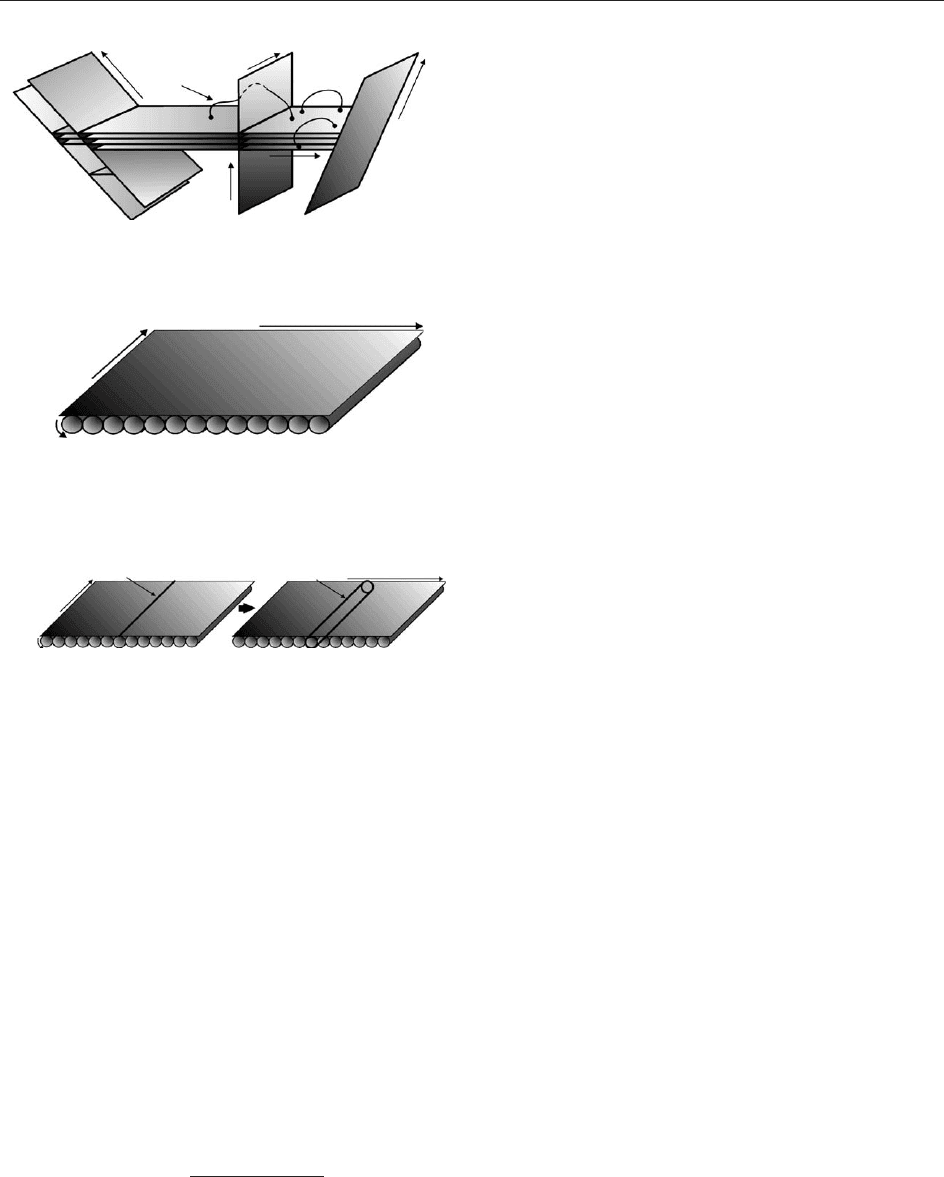
For example, this can be achieved from the previous
N = 2 model, rotating the second NS5 brane from
the (x, v) position, to the (x, w) position, where
w = (x
8
, x
9
)(Figure 9). Then a new brane projection
condition appears (
L
=
x
w
R
), breaking super-
symmetry down to N = 1.
In this case, one could also obtain chiral matter,
adding, for example, orientifold planes.
Quantum Corrections from M-Theory
Up to this point we have considered classical gauge
configurations. Quant um corrections could be com-
puted switching on brane fluctuations. However, it
is an amusing fact that working with M-theory one
can obtain exact quantum results. As an example,
let us sketch how the exact Seiberg–Witten solution
can be obtained for the N = 2 model described in the
previous section, in the simplest case without
matter.
The full web of dualities suggests the existence of
a unique unifying theory called M-theory. At low
energies, M-theory appears as the strong-coupling
limit of type IIA strings. In such a limit, D0 branes
become the dominant objects and the corresponding
states can be interpreted as Kaluza–Klein modes
coming from an eleventh dimension x
10
compacti-
fied on a circle S
1
(Figure 10).
Thus, M-theory manifests itself as an 11-dimensional
supergravity. In particular, it can be shown that there
can be only a unique 11-dimensional supergravity. As
said, here the nonperturbative objects are two- or five-
dimensional membranes.
From the M-theory point of view, the D4 branes
considered in our model appear as M5 membranes
wrapped on the eleventh direction S
1
(Figure 11).
Because quantum corrections are no longer negligi-
ble, we can no longer think of these branes as
stretched in the x
6
direction, but v must also be
considered. Thus, the M5 membranes will describe,
in R
10
S
1
, a region R
4
S, where R
4
are the x
coordinates, and S is a Riemann surface immersed in
Q S
1
, Q being spanned by the (v, x
6
) coordinates.
In fact, supersymmetry constrains the surface to be a
holomorphic curve, so that to describe it, it is
convenient to collect v = (x
4
, x
5
) and (x
6
, x
10
) into
complex coordinates v = x
4
þ ix
5
and s = x
6
þ ix
10
.
To compute quantum fluctuations, let us note that
the end of a D4 brane over an NS5 brane is free to
move along the v directions. A fully free end of a
brane would satisfy a free wave equation. However,
as x
6
is constrained in all directions but the v ones, it
will simply satisfy a Laplace equation in two
dimensions:
v
X
6
= 0. Let us solve it, for a fixed
NS5 brane. It will be (at least for large values of v)
x
6
ðvÞ¼k
X
n
L
i¼1
log jv v
ðÞ
Li
jk
X
n
R
i¼1
log jv v
ðÞ
Ri
j½21
where n
L
is the number of D4 branes ending on
the left-hand side of the NS5 brane, in the positions
v
()
Li
, and similar for the R index, which refers to
Higgs
branch
NS5
NS5
x
6
D6
L
Matter
y
x
v
Figure 7 Permitting Higgs phases.
NS5
NS5
x
6
D4 D4
x
v
n
1
n
2
(n
1
, n
2
)
Figure 8 N = 2 four-dimensional super Yang–Mills theory with U(n
1
) U(n
2
) gauge group and matter. Strings crossing the central
NS5 brane give matter in the (n
1
, n
2
) representation.
Brane Construction of Gauge Theories 365
the right-hand side. Here () refers to the th NS5
brane, and k is an integration constant.
Because x
6
is the real part of a holomorphic field,
whose imaginary part is compactified on a circle of
ray R
10
, we then find
sðvÞ¼R
10
X
n
L
i¼1
log
v v
ðÞ
Li
R
10
X
n
R
i¼1
log
v v
ðÞ
Ri
½22
This descr ibes the quantum fluctuations of the NS5
brane as seen in M-theory. In particular, because of
the imaginary part of s, the ends of the D4 branes
appear as vortices on the NS5 brane. In place of s,it
is now convenient to introduce a new field
t := exp (s=R
10
) so that
tðvÞ¼
Q
n
R
i¼1
v v
ðÞ
Ri
Q
n
L
i¼1
v v
ðÞ
Li
½23
Before continuing, let us look a bit again at the
classical limit. In this case, a fixed value of v will
correspond to the position of a D4 brane, whereas a
fixed value of s will correspond to the fixed position
of an NS5 brane. The classical configuration is then
s s
ð1Þ
s s
ð2Þ
Y
n
i¼1
ðv v
i
Þ¼0 ½24
Here s
()
are the positions of the NS5 branes, and
the positions v
i
of the D4 branes coincide for both
the NS5 branes. Also, for large values of v, one has
t
(1)
v
n
and t
(2)
v
n
.
Quantum mechanically, the configuration is
determined in terms of v and t by the holomorphic
curve S, which can be described as an algebraic
curve F(v, t) = 0, generalizing the classical configura-
tion. As there are two NS5 branes and n D4 branes,
F must be a polynomial of degree 2 in t,
Fðv; tÞ¼A
2
ðvÞt
2
þ A
1
ðvÞt þ A
0
ðvÞ½25
where A
a
, a = 1, 2, 3, are all polynomials of degree n.
Note that values of v such that A
1
vanishes give the
solution t = 0, which corresponds to sending the right-
hand side NS5 brane to 1. Similarly, A
2
= 0sendsthe
other NS5 brane to 1. To avoid these undesirable
configurations, we can set A
0
= A
2
= 1. For A
1
,we
can take the most general choice, up to an eventual
shift in v, giving the quantum configuration
t
2
þ v
n
þ a
n2
v
n2
þþa
1
v þ a
0
t þ 1 ¼ 0 ½26
This realizes a quantum-mechanical correspondence
between the M5 membrane configurations described
by the given polynomials, and the N = 2 super
Yang–Mills vacua. But this is also the claimed
Seiberg–Witten curve. In particular, M-theory gives
a concrete physical meaning for the support Rie-
mann surfaces of the Seiberg–Witten solutions.
To conclude, let us make some further comments.
It is clear how the construction can be extended for
involving more configurations, for example, with
more NS5 branes, or adding matter.
Also, we have seen that the geometrical picture
which branes give of gauge theories extends at the
quantum level.
A similar construction can be made for the N = 1
model, which also permits a full geometrical proof
of the Seiberg duality at both classical and quantum
levels.
Finally, we should note that there are also
other methods, which work in spacetimes where extra
dimensions are compactified. There, the branes wrap
around certain singular loci which contain information
about gauge symmetries (Lerche 1997).
See also: AdS/CFT Correspondence; Compactification of
Superstring Theory; Gauge Theories from Strings;
Noncommutative Geometry from Strings; Seiberg–Witten
Theory; Supergravity; Superstring Theories;
Supersymmetric Particle Models.
NS5
NS5′
x
6
D6
D4
y
x
v
w
Matter
Figure 9 Going down to N = 1 supersymmetry.
(x, x
6
)
(v, y)
x
10
Figure 10 In M-theory one can think as if at any ten-dimensional
spacetime point, there is attached an S
1
circle of ray R
10
.
(x, x
6
)
(v, y)
x
10
D4 brane M5 membrane
Figure 11 D4 branes become M5 membranes in M-theory.
366 Brane Construction of Gauge Theories

Further Reading
Giveon A and Kutasov D (1999) Brane dynamics and gauge
theory. Reviews of Modern Physics 71: 983.
Johnson CV (2003) D-Branes.Cambridge: Cambridge University
Press.
Lerche W (1997) Introduction to Seiberg–Witten Theory and Its
Stringy Origin. Nucl. Phys. Proc. Suppl. B 55: 83.
Polchinski J (1998) String Theory. Vol. 1: An Introduction to the
Bosonic String. Cambridge: Cambridge University Press.
Polchinski J (2004) String Theory. Vol. 2: Superstring Theory and
Beyond. Cambridge: Cambridge University Press.
Witten E (1997) Solutions of four-dimentional field theories via
M-theory. Nuclear Physics B 500: 3.
Zwiebach B (2004) A First Course in String Theory. Cambridge:
Cambridge University Press.
Brane Worlds
R Maartens, Portsmouth University, Portsmouth, UK
ª 2006 Elsevier Ltd. All rights reserved.
Introduction
At high enough energies, Einstein’s classical theory
of general relativity breaks down, and will be
superseded by a quantum gravity theory. The
singularities predicted by general relativity in grav-
itational collapse and in the hot big bang origin of
the universe are thought to be artifacts of the
classical nature of Einstein’s theory, which will be
removed by a quantum theory of gravity. Develop-
ing a quantum theory of gravity and a unified theory
of all the forces and particles of nature are the two
main goals of current work in fundamental physics.
The problem is that general relativity and quantum
field theory cannot simply be molded together.
There is as yet no generally accepted (pre-)quantum
gravity theory.
The quest for a quantum gravity theory has a long
and thus far not very successful history. Many
different lines of attack have been developed, each
having a different way of dealing with the classical
singularities that arise from point particles and
smooth spacetime geometry. String theory does
away with zero-dimensional point particles, and
particles are modeled as different states of new
fundamental objects, the one-dimensional strings. It
turns out, however, that there is a price to pay – the
number of sp acetime dimensions must be greater
than four for a consistent theory . When fermions are
included, which leads to superstring theory, the
required number of dimensi ons is ten – one time and
nine space dimensions.
There are in fact five distinct ð1þ9Þ-dimensional
superstring theories. In the mid-1990s, duality
transformations were discovered that relate these
superstring theories to each other and to the ð1þ10Þ-
dimensional supergravity theory. This led to the
conjecture that all of these theories arise as different
limits of a single theory, which has come to be
known as M theory. It was also discovered that
extended objects of higher dimension than strings
play a fundamental role in the theory. These objects
are known as ‘‘branes’’ (from membranes), and the
relation between them and strings leads to a new
picture of how gravity and matter may be connected
in the universe. Roughly speaking, open strings
describe the particles of the nongravitational sector,
and their ends are attached to branes, while closed
strings, which describe the graviton and associated
particles of the gravitational sector, can move freely
in all dimensions.
Thus, the obs ervable universe could b e a
ð1 þ3Þ-surface – a ‘‘brane,’’ embedded i n a
ð1 þ3 þdÞ-dimensional spacetime – the ‘‘bulk,’’
with standard-model particles and fields trapped on
the brane, while gravity is free to access the bulk.
Brane-world models offer a phenomenological way to
test some of the novel predictions and corrections to
general relativity that are implied by M theory.
Higher-Dimensional Gravity
Brane worlds can be seen as reviving the original
higher-dimensional ideas of Kaluza and Klein in the
1920s, but in a new context of quantum gravity. An
important consequence of extra dimensions is that
the four-dimensional Planck scale M
p
M
(4)
=
1.2 10
19
GeV is no longer the fundam ental energy
scale of gravity. The fundamental scale is instead
M
(4þd)
. This can be seen from the modification of
the gravitational potential. For an Einstein–Hilbert
gravitational action,
S
gravity
¼
1
2
2
ð4þdÞ
Z
d
4
x d
d
y
ffiffiffiffiffiffiffiffiffiffiffiffiffiffiffiffi
ð4þdÞ
g
q
ð4þdÞ
R 2
ð4þdÞ
hi
½1
we have the higher-dimensional Einstein field
equations,
ð4þdÞ
G
AB
ð4þdÞ
R
AB
1
2
ð4þdÞ
R
ð4þdÞ
g
AB
¼
ð4þdÞ
ð4þdÞ
g
AB
þ
2
ð4þdÞ
ð4þdÞ
T
AB
½2
Brane Worlds 367

where x
A
= (x
a
, y
1
, ..., y
d
) and
2
(4þd)
is the gravita-
tional coupling constant given by
2
ð4þdÞ
¼ 8G
ð4þdÞ
¼
8
M
2þd
ð4þdÞ
½3
The static weak field limit of the field equations
leads to the ð4þdÞ-dimensional Poisson equation,
whose solution is the gravitational potential
VðrÞ/
2
ð4þdÞ
r
1þd
½4
In the simplest scenario, we can assume a
toroidal configuration for the d extra dimensions,
with each compactified on the same length scale L.
Then on scales r . L, the potential is ð4þdÞ -
dimensional, V r
(1þd)
. By contrast, on scales
large relative to L, where the extra dimensions do
not contribute to variations in the potential, V behaves
like a four-dimensional potential, V L
d
r
1
.This
means that the usual Planck scale becomes an effective
coupling constant, describing gravity on scales much
larger than the extra dimensions, and related to the
fundamental scale via the volume of the extra
dimensions:
M
2
p
M
2þd
ð4þdÞ
L
d
½5
Large Extra Dimensions
If the extra-dimensional volume is significantly
above the Planck scale, then the true fundamental
scale M
(4þd)
can be much less than the effective scale
M
p
,
L
d
M
d
p
) M
ð4þdÞ
M
p
½6
In this case, we understand the weakness of gravity
as due to the fact that it ‘‘spreads’’ into extra
dimensions, and only a part of it is felt in four
dimensions.
A lower limit on M
(4þd)
is given by null results in
table-top experiments to test for deviations from
Newton’s law in four dimensions, V / r
1
. These
experiments currently probe submillimeter scales,
and find no detectable deviation, so that
L . 10
1
mm ð10
15
TeVÞ
1
) M
ð4þdÞ
& 10
ð3215dÞ= ðdþ2Þ
TeV ½7
Stronger bounds can be derived from null results in
particle accelerators in some brane-world mod els, or
from constraints imposed by observations of super-
novae or of light-element abundance.
Brane worlds, arising in the framework of string
theory, thus incorporate the possibility that the
fundamental scale is much less than the Planck
scale felt in four dimensions. This emerges by virtue
of the larg e size of the extra dimensions. It is not
necessary for all extra dimensions to be of equal size
for this mechanism to operate. There are string
theory solutions (Horava–Witten solutions) with
two ð1þ9Þ -branes located at the boundaries of the
bulk, at the endpoints of an S
1
=Z
2
orbifold, that is,
a circle folded on itself across a diameter. The
orbifold extra dimension is the large one, whereas
the other six extra dim ensions on the branes are
compactified on a very small scale, close to the
fundamental scale, and their effect on the
dynamics is felt through ‘‘moduli’’ fields, that is,
five-dimensional scalar fields.
These solutions can be thought of as effectively
five dimensional, with an extra dimension that can
be large relative to the fundamental scale. They
provide the basis for the Randall–Sundrum 1 (RS1)
phenomenological models of five-dimensional grav-
ity. The single-brane Randall–Sundrum 2 (RS2)
models with infinite extra dimension arise when
the orbifold radius tends to infinity. The RS models
are not the only phenomenological realizations of M
theory ideas. They were preceded by the brane-
world models of Arkani-Hamed, Dimopoulos, and
Dvali (ADD), which put forward the idea that a
large volume for the compact extra dimensions
would lower the effective Planck scale M
(4þd)
.If
M
(4þd)
is close to the electroweak scale, M
ew
, then
this would address the long-standing ‘‘hierarchy’’
problem, that is, why there is such a large gap
between M
ew
1 TeV and M
p
10
16
TeV.
In the ADD models, more than one extra
dimension is required for agreement with experi-
ments, and there is ‘‘democracy’’ among the equiva-
lent extra dimensions, which, in addition, are flat.
By contrast, the RS models have a ‘‘preferred’’ extra
dimension, with other extra dimensions treated as
ignorable (i.e., stabilized except at energies near the
fundamental scale). Furthermore, this extra dimen-
sion is curved or ‘‘warped’’ rather than flat: the bulk
is a portion of anti-de Sitter (AdS
5
) spacetime. The
RS branes are Z
2
-symmetric (mirror symmetry), and
have a tension, which serves to counter the influence
on the brane of the negative bulk cosmological
constant. This also means that the self-gravity of the
branes is incorporated in the RS models. The novel
feature of the RS models compared to previous
higher-dimensional models is that the obs ervable
three dimensions are protected from the large extra
dimension (at low energies) by curvature (warping),
rather than straightforward co mpactification.
The RS brane worlds provide phenomenological
models that reflect at least some of the features of
368 Brane Worlds

M theory, and that bring exciting new geometric
and particle physics ideas into play. The RS2
models also provide a framewor k for e xpl oring
holographic ideas that have emerged in M theory.
Roughly speaking, holography suggests that
higher-dimensional dynamics may be determined
from a knowledge of the fields on a lower-
dimensional boundary. The AdS/CFT c orrespon-
dence is an example in which the classical
dynamics of the higher-dimensional A dS gravita-
tional field are equivalent to the quantum
dynamics of a conformal field theory (CFT) on
the boundary.
Kaluza–Klein Modes
The dilution o f gravity via extra dimensions not
only weakens gravity, it also broadens the range of
graviton modes felt on the brane. The graviton is
more than just the four-dimensional massless mode
of four-dimensional gravity – other modes, with an
effective mass on the brane, arise from the fact
that the graviton is a (4þd)-dimensional massless
particle. These extra modes on the brane are
known as Kaluza–Klein ( KK) modes of the
graviton.
For simplicity, consider a flat brane with one flat
extra dimension, compactified through the identi-
fication y $ y þ 2nL,wheren = 0, 1, 2, ... .The
perturbative five-dimensional graviton is defined
via
ð5Þ
AB
!
ð5Þ
AB
þ h
AB
½8
where
(5)
AB
is the five-dimensional Minkowski metric
and h
AB
is a small transverse traceless perturbation. Its
amplitude can be Fourier expanded as
hðx
a
; yÞ¼
X
n
e
iny=L
h
n
ðx
a
Þ½9
where h
n
are the amplitudes of the KK modes, that
is, the effective four-dimensional modes of the five-
dimensional graviton. To see that these KK modes
are massive from the brane viewpoint, we start from
the five-dimensional wave equation that the massless
five-dimensional field h satisfies (in a suitable
gauge):
ð5Þ
&
h ¼ 0 )
&
h þ @
2
y
h ¼ 0 ½10
It follows that the KK modes satisfy a four-
dimensional Klein–Gordon equation with an effec-
tive four-dimensional mass, m
n
:
&
h
n
¼ m
2
n
h
n
; m
n
¼
n
L
½11
The massless mode, h
0
, is the usual four-
dimensional graviton mode. But there is a tower
of massive modes, L
1
,2L
1
, ...,which
imprint the effect of the five-dimensional gravita-
tional field on the four-dimensional brane. Com-
pactness of the extra dimension leads to
discreteness of the spectrum. For an infinite
extra dimension, L !1, the separation between
the modes disappears and the tower forms a
continuous spectrum.
Randall–Sundrum Brane Worlds
RS brane worlds do not rely on compactification to
localize gravity at the brane, but on the curvature of
the bulk. What prevents gravity from ‘‘leaking’’ into
the extra dimension at low energies is a negative
bulk cosmological constant,
ð5Þ
¼
6
‘
2
¼6
2
½12
where ‘ is the curvature radius of AdS
5
and is the
corresponding energy scale. The bulk cosmologi cal
constant with its repulsive gravity effect acts to
‘‘squeeze’’ the gravitational potential closer to the
brane. We can see this clearly in Gaussian normal
coordinates x
A
= (x
, y) based on the brane at y = 0,
for which the metric takes the form
ð5Þ
ds
2
¼ dy
2
þ e
2jyj=‘
dx
dx
½13
with
the Minkowski metric. The ex ponential
warp factor reflects the confining role of the bulk
cosmological constant. The Z
2
-symmetry about the
brane at y = 0 is incorporated via the jyj term. In the
bulk, this metric is a solution of the five-dimensional
Einstein equations,
ð5Þ
G
AB
¼
ð5Þ
ð5Þ
g
AB
½14
that is,
(5)
T
AB
= 0 in eqn [2]. The brane is a flat
Minkowski spacetime, g
AB
(x
,0)=
A
B
, with
self-gravity in the form of brane tension.
The two RS models are distinguished as follows:
RS1 There are two branes in RS1, at y = 0 and
y = L, with Z
2
-symmetry identifications
y $y; y þ L $ L y ½15
The branes have equal and opposite tensions, ,
where
¼
3
4
M
2
p
‘
2
½16
The positive-tension ‘‘TeV’’ brane has fundamental
scale M
(5)
1 TeV. Because of the exponential
Brane Worlds 369

warping factor, the effective scale on the negative
tension ‘‘Planck’’ brane at y = L is M
p
. On the
positive tension brane,
M
2
p
¼ M
3
ð5Þ
‘ 1 e
2L=‘
hi
½17
So RS1 gives a new approach to the hierarchy
problem. Because of the finite separation between
the branes, the KK spectrum is discrete.
RS2 In RS2, there is only one, positive-
tension, brane. This may be thought of as arising
from sendin g the ne gative ten sion brane off to
infinity, L !1. Then the energy scales are
related via
M
3
ð5Þ
¼
M
2
p
‘
½18
On the RS2 brane, the negative
(5)
is offset by
the positive brane tension . The fine-tuning in eqn
[16] ensures that there is zero effective cosmological
constant on the brane, so that the brane has the
induced geometry of Minkowski spacetime. To see
how gravity is localized at low energies, we consider
the five-dimensional graviton perturbations of the
metric:
ð5Þ
g
AB
!
ð5Þ
g
AB
þh
AB
h
Ay
¼ 0 ¼ h
¼ @
h
½19
We split the amplitude h into three-di mensional
Fourier modes, and the linearized five-dimensional
Einstein equations lead to the wave equatio n (y > 0)
e
2y=‘
€
h þ k
2
h
hi
¼ h
00
4
‘
h
0
½20
Separability means we can write
hðt; yÞ¼
X
m
’
m
ðtÞh
m
ðyÞ½21
and the wave equation reduces to
€
’
m
þðm
2
þ k
2
Þ’
m
¼ 0 ½22
h
00
m
4
‘
h
0
m
þ e
2y=‘
h
m
¼ 0 ½23
The zero-mode solution is
’
0
ðtÞ¼A
0þ
e
þikt
þ A
0
e
ikt
½24
h
0
ðyÞ¼B
0
þ C
0
e
4y=‘
½25
and the massive KK mode (m > 0) solutions are
’
m
ðtÞ¼A
mþ
exp þi
ffiffiffiffiffiffiffiffiffiffiffiffiffiffiffiffiffi
m
2
þ k
2
p
t
þ A
m
exp i
ffiffiffiffiffiffiffiffiffiffiffiffiffiffiffiffiffi
m
2
þ k
2
p
t
½26
h
m
ðyÞ¼e
2y=‘
B
m
J
2
mle
y=‘
h
þC
m
Y
2
mle
y=‘
i
½27
where J
2
, Y
2
are Bessel functions.
The boundary condition for the perturbations is
h
0
(t,0)= 0, which implies
C
0
¼ 0; C
m
¼
J
1
ðm‘Þ
Y
1
ðm‘Þ
B
m
½28
In the RS1 model, we have a further boundary
condition, h
0
(t, L) = 0, which leads to a discrete
eigenspectrum, namely the masses m that satisfy
J
1
m‘e
L=‘
Y
1
ðm‘ÞY
1
m‘e
L=‘
J
1
ðm‘Þ¼0 ½29
The zero mode is normalizable, since
Z
1
0
B
0
e
2y=‘
dy
< 1½30
Its contribution to the gravitational potential
V = ð1/2Þh
00
gives the four-dimensional result, V /
r
1
. The contribution of the massive KK modes sums
to a correction of the four-dimensional potential.
For r ‘, one obtains
VðrÞ
GM
r
1 þ
‘
r
GM‘
r
2
½31
which simply reflects the fact that the potential
becomes truly five dimensional on small scales. For
r ‘,
VðrÞ
GM
r
1 þ
2‘
2
3r
2
½32
which gives the small correction to four-dimensional
gravity at low energies from extra-dimensional effects.
Cosmological Brane Worlds
The RS models contain vacuum (Minkowski)
branes. In order to pursue brane-world ideas in
cosmology, we need to generalize the RS models to
incorporate cosmological branes with matter and
radiation on them. The effective field equations on
the brane are the vehicle for brane-bound observers
to interpret cosmological dynamics. They arise from
projecting the five-dimensional field equations onto
the brane, via the Gauss–Codazzi equations. These
equations involve also the extrinsic curvature K
of
the brane, which determines how the brane is
imbedded in the bulk.
The stress-energy on the brane (tension, matter,
radiation) means that there is a jump in K
across
370 Brane Worlds

the brane. More precisely, the junction conditions
across the brane are
g
þ
g
¼ 0 ½33
K
þ
K
¼
2
ð5Þ
T
brane
1
3
T
brane
g
hi
½34
where
T
brane
¼ T
g
½35
is the total energy–momentum tensor on the brane
and T
brane
= g
T
brane
. The Z
2
-symmetry means that
when approaching the brane from one side and
going through it, one emerges into a bulk that looks
the same, but with the normal reversed. This implies
that
K
¼K
þ
½36
so that we can use the junction condition (eqn [34])
to determine the extrinsic curvature:
K
¼
1
2
2
ð5Þ
T
þ
1
3
ð TÞg
½37
where T = T
, we have dropped the (þ) and we
evaluate quantities on the brane by taking the limit
y !þ0.
Together with the Gauss–Codazzi equations, eqn [37]
leads to the induced field equations on the brane:
G
¼g
þ
2
T
þ 6
2
z
S
E
½38
where
2
2
ð4Þ
¼
1
6
4
ð5Þ
½39
ð4Þ
¼
1
2
ð5Þ
þ
2
½40
S
¼
1
12
TT
1
4
T
T
þ
1
24
g
3T
T
T
2
½41
and
E
¼
ð5Þ
C
ACBD
n
C
n
D
g
A
g
B
½42
where n
A
is the unit normal to the brane and
(5)
C
ACBD
is the Weyl tensor in the bulk.
The induced field equations [38] show two key
modifications to the standard four-dimensional Einstein
field equations arising from extra-dimensional effects.
S
(T
)
2
is the high- energy correction term,
which is negligible for , but dominant for
(where is the energy density):
j
2
S
=j
j
2
T
j
jT
j
½43
E
, the projection of the bulk Weyl tensor on the
brane, encodes corrections from KK or five-
dimensional graviton effects. From the brane-
observer viewpoint, the energy–momentum
corrections in S
are local, whereas the KK
corrections in E
are nonlocal, since they
incorporate five-dimensional gravity wave
modes. These nonlocal corrections cannot be
determined purely from data on the brane. In
the perturbative analysis of RS2 which leads to
the corrections in the gravitational potential, eqn
[32], the KK modes that generate this correction
are responsible for a nonzero E
; this term is
what carries the modification to the weak-fiel d
field equations.
The effective field equations are not a closed system.
One needs to supplement them by five-dimensional
equations governing E
,whichareobtainedfromthe
five-dimensional Einstein equations.
Cosmological Dynamics
A(1þ4)-dimensional spacetime with spatial
4-isotropy (four-dimensional spherical/ plane/
hyperbolic symmetry) has a natural splitting into
hypersurfaces of symmetry, which are (1 þ3)-
dimensional surfaces with 3-isotropy and
3-homogeneity, that is, Friedmann–Robertson–
Walker (FRW) surfaces. In particular, the AdS
5
bulk of the RS2 brane world, which admits a
foliation into Minkowski s urfaces, also admits a n
FRW foliation since it is 4-isotropic. T he general-
ization of AdS
5
that preserves 4-isotropy and
solves the five-dimensional Einstein equation is
Schwarzschild AdS
5
, and this bulk therefore
admits an FRW foliation. It follows that an
FRW cosmological brane world can be embedded
in Schwarzschi ld A dS
5
spacetime.
The black hole in the bulk is felt on the brane
via the E
term. The bulk black hole gives rise to
‘‘dark radiation’’ on the brane via its Coulomb
effect. The FRW brane can be thought of as
moving radially along the fifth dimension, with the
junction conditions determining the velocity via
the Friedmann equation. Thus, one can interpret
the expansion of the universe as motion of the
brane through the static bulk. In the special case
of no black hole and no brane motion, the brane is
empty and has Minkowski geometry, that is, the
original RS2 brane world is recovered, in different
coordinates.
An intriguing aspect of the cosmological metric is
that five-dimensional gravitational wave signals can
take ‘‘shortcuts’’ through the bulk in traveling
Brane Worlds 371

between points A and B on the brane. The travel
time for such a graviton signal is less than the time
taken for a photon signal (which is stuck to the
brane) from A to B.
Cosmological dynamics on the brane are governed
by the modified Friedmann equation:
H
2
¼
2
3
1 þ
2
þ
m
a
4
þ
1
3
K
a
2
½44
where H = ˙a=a is the Hubble expansion rate, a(t)is
the scale factor, K is the curvature index, and m is
the mass of the bulk black hole.
The
2
= term is the high-energy term. When
, in the early universe, then H
2
/
2
. This means
that a given energy density produces a greater rate of
expansion that it would in standard four-dimen-
sional gravity. As a consequence, inflation in the
early universe is modified in interesting ways, some
of which may leave a signature in cosmological
observations.
The m=a
4
term in eqn [44] is the ‘‘dark
radiation,’’ so called because it redshifts with
expansion like ordinary radiation. But, unlike
ordinary radiation, it is not a form of detec table
matter, but the imprint on the brane of the
gravitational field in the bulk (the Coulomb effect
of the bulk black hole). This additional effective
relativistic degree of freedom is constrained by
nucleosynthesis in the early universe. Any extra
radiative energy not thermally coupled to radiation
affects the rate of production of light elements, and
observed abundances place tight constraints on
such extra energy. The dark radiation can be no
more than 3% of the radiation energy density at
nucleosynthesis:
3m
2
nuc
. 0:03 ½45
The other modification to the Hubble rate is via
the high-energy correction =. In order to recover
the observational successes of general relativity, the
high-energy regime where significant deviations
occur must take place before nucleosynthesis, that
is, cosmological observations impose the lower
limit
>ð1MeVÞ
4
) M
ð5Þ
> 10
4
GeV ½46
This is much weaker than the limit imposed by
table-top experiments, which limit the curvature
radius to ‘ . 0.2 mm, leading to
>ð100 GeVÞ
4
) M
ð5Þ
> 10
8
GeV ½47
The high-energy regime during radiation domina-
tion is short-lived. Since
2
= decays as a
8
during the
radiation era, it will rapidly drop below one, and the
universe will enter the low-energy four-dimensional
regime. However, traces of the high-energy era may be
left in the perturbation spectra that leave an imprint in
the cosmic microwave background radiation.
In conclusion, simple brane-world models of RS2
type provide a rich phenomenology for exploring
some of the ideas that are emerging from M theory.
The higher-dimensional degrees of freedom for the
gravitational field, and the confinement of standard
model fields to the visible brane, lead to a complex
but fascinating interplay between gravity, particle
physics, and geometry, which enlarges and enriches
general relativity in the direction of a quantum
gravity theory. High-pre cision astronomical data
mean that cosmology is a potential laboratory for
testing and constraining these brane worlds. The
models predict extra-dimensional signatures in the
cosmic microwave background and other observa-
tions, and these predictions can in principle be tested
against data.
See also: String Theory: Phenomenology; Supergravity;
Superstring Theories.
Further Reading
Brax P and van de Bruck C (2003) Cosmology and brane worlds:
a review. Classical and Quantum Gravity 20: R201 (arXiv:
hep-th/0303095) (arXiv: hep-th/0303095).
Cavaglia M (2003) Black hole and brane production in TeV
gravity: a review. International Journal of Modern Physics
A18: 1843 (arXiv:hep-ph/0210296).
Langlois D (2003) Cosmology in a brane-universe. Astrophysics
and Space Science 283: 469 (arXiv:astro-ph/0301022).
Maartens R (2004) Brane-world gravity. Living Reviews in
Relativity 7: 7 (arXiv:gr-qc/0312059).
Quevedo F (2002) Lectures on string/brane cosmology. Classical
and Quantum Gravity 19: 5721 (arXiv:hep-th/0210292).
Rubakov V (2001) Large and infinite extra dimensions. Physics-
Uspekhi 44: 871 (arXiv:hep-ph/0104152).
Wands D (2002) String-inspired cosmology. Classical and
Quantum Gravity 19: 3403 (arXiv:hep-th/0203107).
372 Brane Worlds

Branes and Black Hole Statistical Mechanics
S R Das, University of Kentucky, Lexington, KY, USA
ª 2006 Elsevier Ltd. All rights reserved.
Introduction
In classical general relativity, a black hole is a
solution of Einstein’s equations with a region of
spacetime which is causally disconnected from the
asymptotic region at infinity. The boundary of such
a region is called the ‘‘event horizon.’’ The spacetime
around the simplest black hole in three space
dimensions is described by the Schwarzschild metric
ds
2
¼ 1
2GM
rc
2
dt
2
þ 1
2GM
rc
2
1
dr
2
þ r
2
d
2
½1
where G is Newton’s gravitational constant, c is the
velocity of light, and we have used spherical
coordinates with d the line element on an S
2
.A
nonrotating, uncharged star which is too massive to
form a neutron star will eventually collapse, and at
late times the metri c will be given by [1]. The
horizon is a null surface S
2
t and the radius of the
S
2
is r
horizon
= 2GM= c
2
. The Schwarzschild solution
has generalizations to black holes with charge and
angular mom entum and no-hair theorems guarantee
that a black hole has no other characteristic property.
All these solutions can be generalized to other
theories like supergravity in various dimensions.
In 1974, Hawking showed that due to pair
production of particles near the horizon, black
holes radiate thermally. Hawking’s calculation is
valid for black holes whose masses are much larger
than the Planck mass: for such black holes, the
curvature at the horizon is weak and normal
semiclassical quantization is valid. Remarkably, the
properties of Hawking radiation are quite universal.
A black hole can be characterized by an entropy
called the Bekenstein–Hawking entropy. The leading
result for the entropy S
BH
for all black holes in any
theory with the standard Einstein–Hilbert action is
given by
S
BH
¼
A
H
4G
½2
where A
H
denotes the area of the horizon. The
temperature T
H
is given by
T
H
¼
2
½3
where is the surface gravity at the horizon. The
principle of detailed balance further ensures that the
radiation rate of some species of particle i,
i
(k),
in some given momentum range ( k, k þ dk) is related
to the corresponding absorption cross section
i
(k)by
ðkÞ¼
i
ðkÞ
e
!=T
H
1
d
d
k
ð2Þ
d
½4
where ! is the energy and d denotes the number of
spatial dimensions. The sign refers to fermions
(bosons), respectively. A nontrivial k dependence of
i
signifies a departure from black-body behavio r.
Consequently,
i
(k) is often called a grey-body
factor. Equations [2] and [3] may be derived by
combining Hawking’s calculation of the radiation
with standard thermodynamic relations. Alterna-
tively, they follow from the leading semiclassical
approximations of path-integral formulations of
Euclidean gravity based on the standard Einstein–
Hilbert action. For an account of black-hole
thermodynamics, see Wald (1994).
Unlike usual thermodynamic systems, black holes
appear to pose a deep puzzle. In usual systems,
thermodynamics is a coarse-grained description of a
system which is in a highly degenerate state.
Typically, such systems are described in terms of a
few macroscopic parameters such as the total
energy, the total volume, the total charge. For each
set of values of these macroscopic parameters, there
are a large number of microscopic states which can
be described in terms of the constituents such as
atoms or molecules. This degener acy manifests itself
as an entropy S which is related to the number of
microscopic states for a given set of value s of the
macroscopic parameters, by Boltzmann’s relation
S ¼ logðÞ½5
where units have been chosen such that the
Boltzmann constant is unity. For a black hole, the
macrostates are specified by its mass, charge, and
angular momentum. No-hair theorems, however,
seem to suggest that there are no other properties
and hence no obvious candidate for microstates. In
the absence of such a statistical basis, one would be
inevitably led to the conclusion that there is loss of
information in processes involving black holes.
In a consistent quantum theory of gravity, there
would be such a statistical basis since quantum
mechanics is unitary. String theory is a strong
candidate for a unified theory which contains
gravity. Indeed, string theory provides a microscopic
description for a class of black holes.
Branes and Black Hole Statistical Mechanics 373

Black Hole Solutions in String Theory
Perturbatively, the basic excitations of string theory
are f undamental closed and open strings character-
izedbyastringtensionT
s
and hence a length scale,
the string length l
s
= 1=
ffiffiffiffiffiffiffiffiffiffiffi
2T
s
p
. Consistency requires
that the string should be able to propagate in ten
spacetime dimensions and should be supersym-
metric at the fundamental level. Formulated in
this fashion, there are several consistent string
theories: type IIA, type IIB, and heterotic string
theory (which contain only closed strings perturba-
tively) and type I theory (which contains both open
and closed strings).
At energies much smaller than 1=l
s
,onlythe
massless modes of the string can be excited. For all
these string theories, the massless spectrum of closed
strings contains the graviton and the low-energy
dynamics is given by the appropriate supersymmetric
generalization of general relativity, supergravity. In
addition, the closed-string spectrum contains a
neutral scalar field, the dilaton , whose expectation
value gives rise to a dimensionless parameter govern-
ing interactions, called the string coupling g
s
:
g
s
¼ e
<>
½6
The ten-dimensional gravitational constant is given
by
G
10
¼ 8
6
g
2
s
l
8
s
½7
Ten-dimensional supergravity has a wide va riety of
black hole solutions, the simplest of which is the
straightforward generalization of the Schwarzschild
solution.
Black p-Brane Solutions
More significant ly, there are solutions which are
charged with respect to the various gauge fields that
appear in the supergravity spectrum. Generically,
these charged solutions represent extended objects.
For accounts of such solutions, see Maldacena
(1996).
Consider, for example, the supergravity which
follows from type IIB string theory. This theory has
a pair of 2-form gauge fields B
MN
and B
0
MN
and a
4-form gauge field A
MNPQ
with a self-dual field
strength. Just as an or dinary point electric charge
produces a 1-form gauge field, a (p þ 1)-form gauge
field may be sourced by an electrically charged
p-dimensional extended object. The corresponding
field strength is a (p þ 2)-form, whose Hodge dual in
d spacetime dimensions is a (d p 2) form. This
shows that there should be magnetically charged
(d p 4)-dimensional extended objects as well.
These extended objects are called ‘‘branes.’’
In the type IIB example, there should be two
kinds of one-dimensional extended objects
which carry electric charge under B
MN
, B
0
MN
,
called the F-string and the D-string, respectively.
There are also two k inds of five-dimensional
branes which carry magnetic charges under
B
MN
, B
0
MN
, called the NS 5- brane and D5 br ane,
respectively. Finally, there should be a 3-brane,
since the corresponding 5-form field strength is
self-dual as well as a D7 brane. A similar catalog
can be prepared for other string theories, as well
as for 11-dimensional supergravity, which is the
low-energy limit of M-theory.
The classical solutions for a set of p-branes of the
same kind generally have inner and outer horizons
which have the topology t S
8p
R
p
. The outer
horizon is then associated with a Hawking tempera-
ture and a Bekenstein–Hawking entropy. Of parti-
cular interest are extremal limits. In this limit, the
inner and outer horizons coincide and the mass
density is simply pro portional to the charge. Given
some charge, the extremal solution has the lowest
energy. Extremal limits are interesting because in
supergravity these correspond to solutions in which
some of the supersymmetries (in this case, half of the
supersymmetries) are retained – such solutions are
called Bogomolny–Prasad–Sommerfeld (BPS) satu-
rated solutions. The charge in question appears as a
central charge in the extended supersymmetry
algebra. This fact may be used to show that such
BPS solutions are absolutely stable. Indeed, for the
particular solution considered here, the Hawking
temperature T
H
! 0, so that there is no Hawking
radiation, as required by stability. Furthermore, the
entropy S
BH
! 0. The horizon shrinks to a point
which appears as a naked null singularity.
All the ten dimensions of string theory need not be
noncompact. In fact, to describe the real world, one
must have a solution of string theory in which six of
the dimensions are wrapped up and form a compact
space. In principle, however, one can compactify
any number of dimensions. In the above example
of a p-brane, it is trivial to compactify the
directions along which the brane is extended to a
p-dimensional torus, T
p
, which can be chosen to be
a product of p circles each of radius R. At length
scales much smaller than R, the theory then becomes
a (10 p)-dimensional theory. The p-brane appears
as a black hole with a spherical horizon and,
since the original p-form gauge field now behaves
as an ordinary 1-form gauge field with a nonzero
time component, this is an electrically charged
black hole.
374 Branes and Black Hole Statistical Mechanics