
Gates A.E., Ritchie D. Encyclopedia of Earthquakes and Volcanoes
Подождите немного. Документ загружается.

113
ice cap Glacier atop a volcano. Many mountains have ice
caps. At higher altitude, the air is colder and whereas pre-
cipitation may fall as rain on the slopes, it will be snow at
the peak if the mountain is high enough. At higher latitudes,
snow can occur at any elevation. When ice caps are atop vol-
canoes, they pose a different threat. When Mount Saint Hel-
ens erupted in 1980, tremendous amounts of ash at about
800°C landed on the ice cap. The water went from frozen
to boiling upon contact. Huge lahars of boiling mud swept
down the mountain, destroying everything in their path.
Although mudflows can result from several types of situa-
tions, lahars of boiling ash can only result if there is an ice
cap.
Iceland The island nation of Iceland is an exposed segment
of the Mid-Atlantic Ridge and is the site of intense volcanic
activity. The island is essentially all basalt and is, in effect,
being torn in two by the spreading action that occurs along
the mid-ocean ridge. Iceland’s Laki Fissure, a rift val-
ley, is evidence of this process. Volcanic eruptions is Iceland
generally occur as lava flows from fissures in the ground
rather than as outbursts from volcanic mountains. The most
famous eruption in Iceland’s history took place in June 1783
when strong earthquakes preceded an eruption that cast large
quantities of ash into the air, obscuring the sun and harming
crops as far away as Norway and Scotland. Two days later,
lava erupted from the ground along the Laki Fissure and
filled the valley of the nearby Skafta River, forming a natural
dam that caused extensive flooding upstream. Flowing south-
west toward the sea some 15 miles (24 km) away, the lava
from this eruption covered the land to an average depth of
100 feet (30 m). The lava flow was 10 miles (16 km) wide at
maximum. Another eruption on August 8 sent lava flowing
southeast and filled the Hverfisfljöt river valley, causing more
flooding.
Surtsey achieved worldwide prominence when a sub-
marine eruption built a new volcanic island between 1963
and 1967. It was accompanied by several impressive phre-
atic eruptions of firework-quality incandescence. Scientists
and the press flocked to the eruption at the time. An eruption
of Eldfell on the Island of Heimaey also made the evening
news. In 1973, a vigorous eruption of Eldfell encroached on
the fishing village of Vestmannaeyjar. Even worse, it threat-
ened to block the harbor, which would cut off the fleet. The
advancing lava flows were sprayed with water until they
hardened and stopped. It was very dramatic to see the strug-
gle between the advancing lava and the Icelanders.
Another impressive eruption in Iceland occurred of
Grimsvötn in 1996. A subglacial eruption produced a tre-
mendous amount of meltwater that was dammed up. When
the dam burst (jökulhlaup), 57,000 cubic yards (45,000 m
3
)
of water per second went coursing a valley, destroying every-
thing in its path.
The most active volcano in Iceland is Hekla. It has
erupted an estimated 167 times since a.d. 1104. Its most
recent eruption began on February 28, 2000, and continues
today.
See also Askja; Bardarbunga; Herdubreid; Keafla;
Kotlugja; Kverkfjöll; Öraefa-Jökull; Skaptarjökull;
Torfajökull.
Idaho United States Idaho experienced severe earthquakes
in 1916 and 1944, but only minor damage was reported. Vol-
canic landforms are abundant in Idaho, notably in the Snake
River Plain in the southern portion of the state.
See also Craters of the Moon Monument.
Idaho Batholith A tremendous mass of igneous rock some
250 miles (402 km) long and as wide as about 100 miles,
(160 km) the Idaho Batholith is associated with rich deposits
of metal ores at the Coeur d’Alene mining area.
See also Batholith.
igneous breccia A breccia that is made up of pieces of volca-
nic rock, broken up by explosions at the vent and lithified. To
be a breccia, a rock must be an aggregate of angular fragments
I
that are greater than 0.08 inch (2 mm) but typically much
larger, and up to boulder size.
igneous complex Intimately associated plutons and/or
volcanoes in both space and time. They are also related by
chemistry. Any large volcanic field or plutonic complex quali-
fies as an igneous complex.
igneous rock A rock that solidifies directly from a mol-
ten or partially molten state is known as an igneous rock.
(The word igneous is derived from ignis, the Latin word for
“fire.”) Igneous rocks are one of the three principal catego-
ries of rock, the others being metamorphic rock and sedi-
mentary rock. obsidian, pumice, and scoria are familiar
examples of igneous rocks, many of which have considerable
economic importance. Igneous rocks make up some of the
most famous and spectacular landforms on Earth, including
the Cascade Mountains in the United States and Can-
ada, the Hawaiian Islands, the Palisades near New York
City, and the formations of Monument Valley.
Igneous rocks are compositionally classified as ultra-
mafic, mafic, intermediate, and felsic. The term fel-
sic derives from feldspar, a dominant silicate mineral in
such rocks, and high silica is the si. Besides k-feldspar and
plagioclase, these rocks contain quartz and can contain
biotite, muscovite, hornblende, and others. Mafic rocks
have high concentrations of magnesium (mg) and iron (fe).
Common minerals in these rocks are pyroxene, plagioclase,
and some olivine. Felsic rocks are generally light in color,
whereas mafic rocks and minerals tend to be darker. Interme-
diate rocks are intermediate in color and composition. They
contain plagioclase and quartz and commonly contain horn-
blende, biotite, and/or pyroxene. Ultramafic rocks contain
only pyroxene and/or olivine and are very dark in color.
Grain size differs greatly among igneous rocks. Coarse-
grained rocks are called phaneritic (from the Greek pha-
nero-, meaning “visible”), whereas fine-grained rocks are
called aphanitic (from the Greek aphan-, meaning “invis-
ible”). granite is a familiar example of phaneritic rock, and
basalt is a widespread aphanitic rock. Grain size and degree
of crystallinity depend on how quickly the molten rock cools.
The finer the grain size, the faster the cooling; large grain size,
on the other hand, means slower cooling. In pegmatites,
very coarse-grained rocks, grains can be several feet long.
At the other extreme are volcanic glasses, such as obsidian,
which have an amorphous, grainless structure because rapid
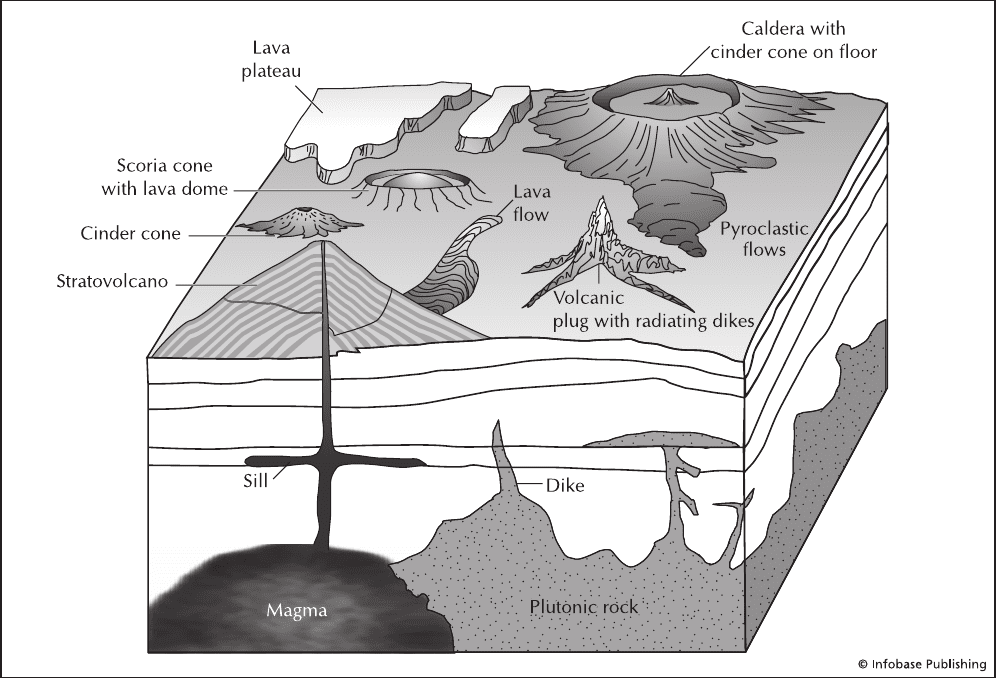
Block diagram showing several varieties of volcanic landforms and pluton types
114 igneous complex
cooling gave crystal structure no opportunity to form in the
solidifying lava.
Igneous rocks can be classified as acidic or basic but
those terms are holdovers from the 19th century when silicic
acid was believed to play a role in depositing silica (silicon
dioxide, or SiO
2
) in igneous rocks. A rock with high silica
content was therefore thought to be acidic, as opposed to
basic rock with less silica in it.
Extrusive igneous rocks are those that emerge from the
earth and solidify at the surface. Extrusive igneous rocks may
occur as lava flows, the result of molten rock flowing in
sheet form across the surface, or volcanic ejecta, pieces of
rock blasted from the throats of volcanoes and cast upward
and outward through the air.
See also ash; magma; pluton; tephra.
ignimbrite A deposit of pyroclastic, pumice-rich,
ejecta-rich rock laid down by a pyroclastic flow. A given
ignimbrite may extend more than 60 miles (97 km) and be 30
feet (9 m) thick or deeper.
Ijen caldera, Java, Indonesia Located at the eastern end of
Java, the giant Ijen caldera (about 12 miles [19 km] wide) is
the site of several volcanoes. Kawah Ijen volcano (also known
as Ijen Crater) stands inside the caldera, and Merapi and
Raung volcanoes have arisen along a ring fracture at the edge
of the caldera. A lake occupies the crater at Kawah Ijen.
Raung tends to exhibit modest eruptions of ash and occa-
sional flows of lava, preceded by minor earthquakes. phre-
atic eruptions, many of them occurring through the crater
lake, characterize Kawah Ijen. Eruptions of Kawah Ijen are
associated with increases in seismic activity and in the tem-
perature of the crater lake.
Ijen appears to be a noisy volcanic site; many reports of
eruptions mention loud noises from the volcanoes. The his-
torical record of volcanic activity at Ijen dates back to 1586
and includes dozens of eruptions. The 1593 eruption of
Raung had a VEI = 5 and caused fatalities. In one eruption
in 1638, a loud noise that appeared to come from Raung,
was comparable to thousands of artillery pieces going off at
once. Earthquakes were continuous and so powerful that a
person could hardly stand upright. Rivers reportedly dried
up for several days and then resumed flowing in a power-
ful flood. These floods and lahars killed more than 1,000
people. In 1817, the crater lake in Kawah Ijen collapsed, pro-
ducing mudflows that engulfed three villages and killed an
unknown number of people. When Raung underwent an ash
eruption in 1890, witnesses reported strong vibrations and
rumbling noises. A 1902 eruption of Raung was accompa-
nied by a very loud noise like cannon fire. Roaring sounds
were heard at Raung during a period of increased activity
in 1913–14, and two small earthquakes from Raung were
reported in 1915. Water from the lake at Kawah Ijen flowed
over a sluice after a large tectonic earthquake near Bali in
February 1917; the following month, water in the lake was
spouting some 30 feet (9 m) into the air in a muddy, noisy
display. The temperature of the lake rose to scalding intensi-
ties in March but dropped back to lukewarm levels by late
1917. The lake heated up again in 1921. Raung erupted in
1921 and again in 1931. A 1952 eruption at Ijen followed
immediately after several strong local earthquakes. An erup-
tion cloud appeared, and “boiling” activity was observed in
the lake. A minor earthquake preceded an eruption of Raung
in 1982; in 1985, 1993, 1995, and 1997, Raung underwent
ash explosions.
Ijen is especially interesting because of a relationship seen
between lake level and eruptive activity. On several occasions
when the lake level has been lowered by artificial means, fuma-
rolic activity under the lake has increased, lake temperature has
risen, and sometimes hydrothermal or phreatic eruptions
have occurred. These phenomena are thought to result from
reduced pressure resulting from lowering the lake level.
Ikeda See Ata.
Iliamna volcano, Alaska, United States Located in the
eastern Aleutian Islands, Iliamna has erupted on several
occasions in historical times including 1778, 1867, 1876,
and 1953. It is suspected to also have erupted in 1768, 1786,
1793, 1843, 1933, 1947, and 1952. Iliamna is one of many
Alaskan volcanoes characterized by explosive eruptions. An
earthquake swarm began beneath Iliamna in 1996 but
without eruption.
Illinois United States The state of Illinois has undergone
numerous strong earthquakes since it was settled by Ameri-
cans of European descent. One notable earthquake was the
Fort Dearborn earthquake of August 24, 1804, felt at Fort
Wayne, Indiana, some 200 miles (322 km) away. A series of
strong earthquakes occurred in southern Illinois in 1882–83.
A severe earthquake at Cairo on August 2, 1887, stopped
clocks and was felt over a large area of the Midwest. Illi-
nois is affected by seismic instability in the Mississippi Val-
ley, notably the New Madrid Fault Zone, where a future
earthquake comparable to those of 1811–12 could cause tre-
mendous damage in Illinois and other midwestern states.
Ilopango caldera, El Salvador The Ilopango caldera is
about five miles (8 km) wide and seven miles (11.2 km) long
and lies between two faults of a graben that extends paral-
lel to the string of volcanoes in El Salvador. The caldera is
thought to have formed during a huge eruption in a.d. 260.
Apparently, there was a sophisticated Mayan culture occupy-
ing the highlands of the area at the time. The violent eruption
of Ilopango destroyed everything in a 60-mile (97-km) radius
around the volcano and appears to have killed thousands
of people. Lake Ilopango occupies the caldera, and a lava
dome breaks the surface of the lake at one point to form the
Islas Quemadas, or “burned islands.” The Islas Quemadas
formed during an eruption in January 1880. The lake level
rose so dramatically at this time that the Jiboa river valley
was flooded on January 9, destroying the town of Atuscatla
and killing numerous cattle. This rise in the lake is thought
to have been due to the growth of a lava dome underwater.
The lake level subsided after this flood, but sulfur gas began
to emerge from the middle of the lake, and in late January
an eruption of ash and glowing rock occurred. Within three
days, the Islas Quemadas formed. Strong earthquakes in
Ilopango 115
1879 preceded this eruption. Another powerful earthquake
occurred in February, was felt all through El Salvador, and
preceded an intense smell of sulfur in the Ilopango area. Ilo-
pango appears to have been inactive since 1884.
impact structure In recent years, geologists have rec-
ognized that Earth’s surface bears the marks of numerous
impacts. Major impacts, involving meteorites perhaps a hun-
dred yards in diameter or larger, are by no means infrequent.
The impact that created the famous Meteor Crater in Ari-
zona (also known as the Barringer Crater after D. M. Bar-
ringer, a geologist who investigated its origins) is believed to
have occurred only a few thousand years ago. Evidence for
an impact origin of the Arizona crater began to accumulate
in the late 19th century. A mineralogist named A. E. Foote
gathered large numbers of iron meteorites, some of them con-
taining minuscule diamonds, at the site of the crater. After
Foote completed a report on his findings at the site, G. K.
Gilbert of the U.S. Geological Survey examined the crater and
found evidence to indicate it was the result of a large object
falling from outer space and striking Earth. (The alternative
view was that some kind of volcanic explosion had generated
the crater.)
A search for commercially workable deposits of nickel
and iron led around 1902 to a strong interest in mining the
crater. Within the next decade, drilling and excavation of
mine shafts at the crater established that there was no work-
able body of metal buried at the site. Pieces of meteoritic
material were found in a breccia extending several hundred
feet beneath the surface, but no substantial body of metal
appeared. These explorations revealed that the volcanic
explanation for the origin of the crater was flawed because
an unaffected layer of sandstone was discovered under the
breccia. Later studies of the crater indicated that a meteorite
some 140 feet (43 m) in diameter blasted out the formation
on striking Earth at a velocity of approximately 45,000 miles
(72,400 km) per hour. The energy released in the impact is
thought to have been equivalent to the explosion of a 15-
megaton thermonuclear weapon.
When a planetoid (in effect, a giant meteorite) strikes the
surface of Earth, the impact tends to generate a characteris-
tic structure often called an impact crater, although a more
general term is tistron or astrobleme. A classic impact charac-
ter has the following characteristics: round or roughly square
shape; depressed central area, with perhaps a central peak
where rebound has occurred following impact; a raised rim
with overturned strata outside the rim; and clastic material
generated by the impact distributed in and around the crater.
Arizona’s Meteor Crater exhibits these characteristics, except
for the central peak. Other indicators of an impact origin
include the presence of shatter cones, peculiar conical struc-
tures produced in rock by the tremendous forces released
on impact, and minerals, including diamond (found near
Meteor Crater) and stishkovite and coesite, two highly dense
forms of quartz. A slaglike material associated with impact
craters is known as impactite. pseudotachylite is a rock
believed to form from melting at impact sites.
Many well-preserved impact structures are found on the
Canadian Shield, including the Manicouagan formation in
Quebec, now the site of a ring-shaped reservoir, and Ontar-
io’s Brent Crater, some two miles (3 km) wide and discov-
ered in a study of aerial photos taken by the Royal Canadian
Air Force (RCAF). One of the first impact craters identified
in Canada was Chubb Crater, named after Frederick Chubb,
a prospector who in 1950 noticed a remarkable round lake in
an RCAF photo of northern Canada and saw that the lake lay
in a formation that looked much like a caldera. If a caldera
did exist there, Chubb figured, it might be worth investigat-
ing for diamonds, which are known to occur in some volca-
nic formations. Chubb went to see V. B. Meen of the Royal
Ontario Museum of Geology and Mineralogy in Toronto and
asked Meen if he thought the lake occupied a volcanic for-
mation. Meen thought the lake instead had formed inside an
impact crater like Meteor Crater in Arizona. An expedition to
the site was formed, funded by a newspaper publishing com-
pany, and Chubb and Meen left Toronto in an amphibious
plane on July 17, 1950, to investigate the lake. Four other
men (the pilot, an engineer, a reporter, and a photographer)
accompanied Chubb and Meen. On reaching the lake, the
men found its surface too icy to allow a safe landing, and
the pilot landed the aircraft on another lake in the vicinity.
Chubb and Meen made their way from the landing site to
the alleged impact crater, a study of which revealed quickly
that the formation was not volcanic in origin but rather was
formed by meteorite impact.
It has been suggested that much larger features of the
Canadian landscape are also impact structures, including
the Gulf of Saint Lawrence and the Nastapoka island arc in
Hudson Bay. In the United States confirmed and possible
impact structures (besides Meteor Crater) are found at Ser-
pent Mount, Ohio; Wells Creek, Tennessee; Decaturville,
Missouri; Odessa and Sierra Madera, Texas; Kentland,
Indiana; Manson, Iowa; Red Wing Creek, South Dakota;
Panther Mountain, New York; and Chesapeake Bay, Mary-
land, among other sites. One recently identified impact
structure in the United States is the Beaverhead astrobleme
in Montana. Believed to have been about 45 miles (72 km)
in diameter when formed, the Beaverhead astrobleme is not
immediately apparent to observers because various processes
have reworked the area extensively since the crater origi-
nated. Impressive shatter cones are present in strata extending
some 15 miles (24 km) from north to south at the Beaverhead
site, which also exhibits pseudotachylite, as well as suevite, a
“microbreccia,” characterized by very small fractures in the
rock.
Other identified or suspected impact structures are dis-
tributed widely around the globe. Germany’s Ries Kessel is
widely recognized as an impact structure, as is the Vredevoort
Ring in South Africa. The Vredevoort Ring, often identified
as the largest demonstrated astrobleme on Earth, appears to
be left over form an impact that created a crater roughly the
size of the state of West Virginia. An abundance of shatter
cones played an important part in identifying the Vredevoort
Ring as an impact structure. The Chixilub Crater in Mexico
to the Gulf of Mexico may be even larger. That impact has
been proposed to have caused the massive extinction event
that occurred at the end of the Mesozoic. That event included
the extinction of the dinosaurs. The impact can be seen in
116 impact structure
sediments worldwide by high levels of iridium and shocked
quarts. Shocked quartz has microscopic crossed fractures and
can only be produced from the excessive and paid increases
in pressure.
The physics of a planetoid impact is complex but may be
summarized in general terms as follows. A planetoid several
hundred feet wide or larger is not slowed greatly by passing
through Earth’s atmosphere and strikes the surface with much
of its original velocity undiminished. Depending on the mass
and velocity of the planetoid, the impact may release enough
energy to vaporize much or all of the planetoid, producing
the equivalent of a huge nuclear explosion. The impact may
create a crater miles in diameter, as is thought to have hap-
pened in the cases of Manicouagan and Vredevoort. ejecta
from the point of impact may fall great distances away from
the crater. Secondary meteorites, or sizable bodies of rock
cast out by the primary impact, may bring about further
destruction, albeit on a smaller scale, when they fall to Earth.
The physics of an impact on land are considerably differ-
ent from those of an impact at sea. On land, a giant meteorite
would cause widespread destruction through seismic effects
as well as from heat and other radiation from the fireball
produced on impact. A land impact also might alter climate
by casting large amounts of particulates (finely pulverized
rock and smoke from fires started by heat from the fireball)
into the upper atmosphere where the material could intercept
incoming sunlight and reduce temperatures at the surface.
The damage from an ocean impact, however, is projected to
be much greater because the sea acts in ways to amplify the
destructive effects of the planetoid strike. Some of the energy
released by the impact is transferred to the water as a tsu-
nami, that may travel around the globe many times before
eventually dissipating.
Imperial Valley earthquake, California On October 15,
1979, an earthquake of Richter magnitude 6.9 struck the
Imperial Valley of central California. It caused $30 million
and injured 91 people. There was extensive surface faulting,
liquefaction, and ground-deformation slumping. The
extensive agricultural industry in the area suffered heavy
losses from these surface effects. Canals, irrigation ditches,
and subsurface drain tiles were all disrupted by these effects.
incandescent The glowing of very hot pyroclastic mate-
rial as it shot from the mouth of a volcano. If there is much
glowing debris, then the eruption is referred to as incandes-
cent as are the pyroclastics. Incandescent eruptions are espe-
cially spectacular at night.
inclusion A piece of older country rock or a remnant of
the melting or crystallization process contained inside igne-
ous rock. The igneous rock may or may not be related oth-
erwise to the inclusion.
India The Indian subcontinent has been the site of numer-
ous strong and destructive earthquakes. India’s seismic poten-
tial is largely the result of an ongoing collision between the
Indian subcontinent and the Asian landmass to its north.
The Himalayas mark the boundary between the Indian and
Asian plates. Earthquakes in India tend to take large num-
bers of lives because of the country’s extremely high popula-
tion density. For example, an earthquake in Kitchen on June
16, 1819, wiped out 1,500, and one in Assam on June 12,
1897, killed about 1,000. On May 31, 1935, in Quetta, an
earthquake measuring 7.5 on the Richter scale killed some
60,000 people. An earthquake measuring 6.4 on the Rich-
ter scale struck a remote part of the state of Maharashta on
September 30, 1993, at 3:56 a.m. Approximately 50 villages
within a 50-mile (80-km) radius were damaged and 16 were
completely leveled within a few seconds. Many of the peo-
ple killed were asleep in badly constructed stone houses that
collapsed on top of them. Although the exact death toll was
not known in October 1993, it was thought to be in the tens
of thousands. Although there are no volcanoes in India, the
Deccan traps are one of the largest volcanic deposits in the
world. The Bhuj earthquake in 2001 killed 20,000 people
and injured 166,000.
Indiana United States Strong earthquakes affect Indiana
occasionally, although the state is not as susceptible to earth-
quakes as high-risk areas such as California. Strong shocks
were reported at Albany on August 6–7, 1827, and another
powerful earthquake on September 27, 1909, shook India-
napolis and was felt over much of the Midwest.
Indo-Australian crustal plate A major plate of Earth, the
Indo-Australian plate is involved in a subduction zone with
the Eurasian plate and several microplates in the East Indies.
The plate includes Australia, the Indian subcontinent, and
part of the Indian Ocean. The subduction zone underlies
Indonesia, which includes some of the most destructive vol-
canoes in the world. This subduction zone includes a signifi-
cant component of strike-slip motion. Major earthquakes
are commonplace and mainly associated with deformation
on the Segmanko Fault. The Banda arc is another part of an
active boundary. The boundary between India and Asia is
marked by the Himalaya Mountains—the classic continent-
continent convergent margin on Earth. Although there are
no longer volcanoes along that margin, there is significant
seismic activity. There are major reverse faults that are
seismogenic.
See also plate tectonics.
Indonesia An archipelago of volcanic islands between Aus-
tralia and the main Asian landmass. Indonesia is an island
arc beneath which oceanic crust from the Australian
plate is actively subducting into the Java trench. The island
arc is called the Sunda arc and it is the longest continuous
arc on Earth. This tectonic activity results in a very active
convergent margin with both earthquakes and volcanoes.
The islands of Indonesia include Java, Sumatra, Halhamera,
Sulawesi (Celebes), Timor, Irian Jaya (on New Guinea),
Flores Islands, and part of Borneo among others. Indonesia
has more than 200 active volcanoes by one estimate. Indone-
sia was the site of the 1883 eruption of Krakatoa, one of the
most famous and violent volcanic events in history. The erup-
tion of Tambora in 1815 cast tremendous amounts of finely
divided solid material into the atmosphere and was impli-
Indonesia 117
cated in the unusually cold climatic conditions that affected
much of the Northern Hemisphere over the following year.
Other volcanoes include Dieng, Dukono, Galung Gung,
Ijen, Makian, Raung, and Semeru among many others.
Earthquakes and tsunami activity also occur frequently in
the Indonesian archipelago. The long strike-slip Segmanko
fault has similar activity to the San Andreas Fault and adds
additional seismic activity to that of the subduction zone.
There are probably five earthquakes of magnitude 7 per year
in Indonesia. One of the world’s worst disasters occurred at
Banda Aceh on December 26, 2004. A huge tsunami was
generated by a massive magnitude 9.0 earthquake, killing
an astounding 283,000 people. The largest aftershock ever
recorded was at magnitude 8.7 in March 2004.
See also Banda Api; Segara Anak; Sukaria; Sunda;
Suoh depression; Tengger; Toba; Tondano.
injection Forceable intrusion of magma into country
rock. As magma is forced upward in Earth’s crust, it forc-
ibly squeezes into the preexisting rock. It may push the rock
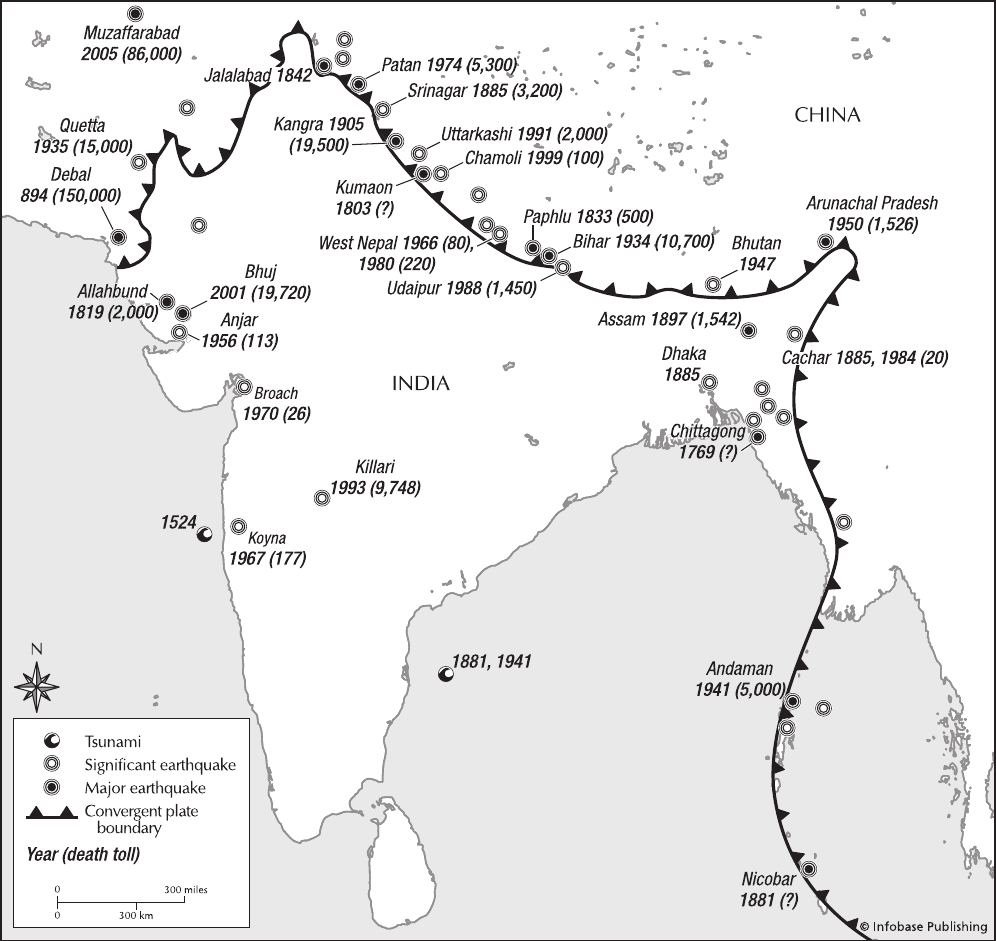
Map of India and surrounding countries showing the boundaries of the Indian plate and the epicenters of major earthquakes over the past 200 years,
including the names of the epicentral cities and the approximate death toll in parentheses. Lines with triangles represent subduction zones, with
triangles on the overriding plate.
118 injection
out of the way. It may force open existing cracks or create
its own cracks through which to flow. It may consume the
rock into itself by melting it and assimilating it. The magma
may intrude by any combination of these. All constitute injec-
tion. Waste and water can also be injected into rock, but the
source of the pressure is from above rather than below as it is
with magma.
injection well A deep well in which material (usually
waste) is pumped at very high pressure. Wells are usually
used for extracting fluids from the earth. Examples are water
wells and oil wells. Injection wells are used to put fluids and
gas into the earth. In the petroleum industry, they are used to
fracture the rock around the bottom of the well (hydro-
fracturing) so oil and gas will flow more freely to the well.
In waste disposal, they are used to put hazardous material out
of the biosphere. However, these well may spur earthquakes
through hydrofracturing if they are not placed properly.
inner core Solid Fe/Ni core in the center of Earth. It
lies within the outer core. There is likely an interaction
between the outer and inner core, based on different rates
of spinning within the Earth. This interaction forms a self-
exciting dynamo within the core, which produces Earth’s
magnetic field. It may also produce electrical impulses in the
earth.
insolation In general terms, insolation means the amount
of solar radiation reaching the Earth’s surface. Volcanoes
may affect insolation by injecting large quantities of ash and
aerosols into the upper atmosphere during eruptions and
thus intercepting sunlight before it can reach the ground. The
result is to diminish insolation and reduce temperatures at
Earthy’s surface. This cooling effect has been observed fol-
lowing several major volcanic eruptions over the past several
centuries.
See also Krakatoa; “year without a summer.”
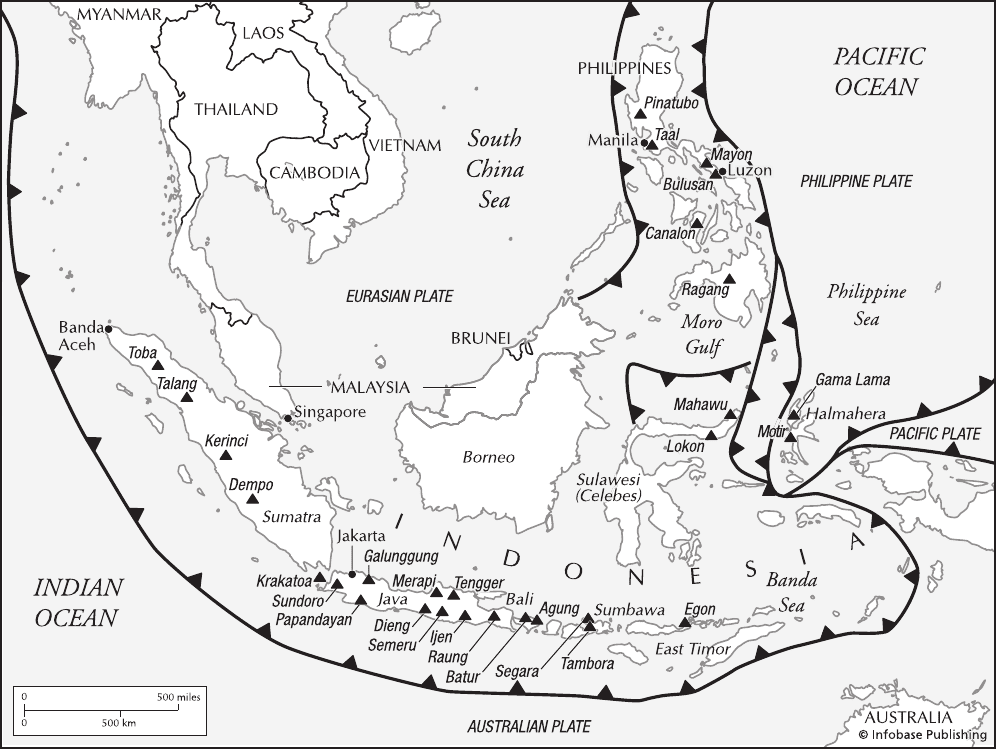
Map of the southeast Asia–Indonesia region showing the plate boundaries and plate relations of the region. Many of the major volcanoes as well as
several of the major cities are also shown. Lines with triangles represent subduction zones, with triangles on the overriding plate.
insolation 119
intensity In seismology, intensity refers to an earthquakes
effects at a particular location. Intensity, which may be mea-
sured by factors such as the presence (or absence) of cracks
in walls, and even of mass panic, is distinguished from mag-
nitude, which refers to the amount of energy released by an
earthquake. Magnitude is expressed by the strength of the
vibrations of the ground. Several scales are used to measure
earthquake intensity, including the famous Mercalli scale.
interference Interaction of the amplitude of waves in which
there is addition (positive interference) increasing the effect of
the wave or subtraction (negative interference) reducing or
eliminating the effect. In terms of a seismograph, two seis-
mic signals can arrive at a given point at the same time, and
one can mask the other.
intermediate A chemical range for igneous rocks. Inter-
mediate compositions lie between felsic and mafic compo-
sition. plutons of intermediate rocks include granodiorite,
diorite, and tonalite among others. Volcanic igneous rocks
include andesite, dacite, and trachyte. Intermediate rocks
are the primary igneous rocks produced in convergent
boundaries. island arcs and magmatic arcs are full of
intermediate igneous rocks.
interplate coupling faults between two tectonic plates
accumulate stress and then release it in a series of earth-
quakes. Weak interplate coupling means that the stress will
be released in a series of regular smaller earthquakes, whereas
strong interplate coupling means that the stress will be
allowed to accumulate. The accumulating stress is very dan-
gerous because at some point it will exceed the strength of the
rock and produce a massive earthquake. Small earthquakes
can be tolerated by settlements of people with less destruction
and injury. Large events cannot.
interstice A void or pore space inside a soil or rock. These
interstices may be filled with gas (typically air) or liquid
(groundwater). The number and degree of interstices or pores
in a rock constitute porosity. The interconnectivity of these
interstices constitutes permeability. During earthquakes, the
degree of these two quantities determine the extent of lique-
faction in an area.
intraplate As opposed to interplate, which means at a
boundary between plates, intraplate means something located
within a tectonic plate. Both earthquakes and volcanoes can
occur at intraplate locations, but they are not as common as
interplate examples. Hawaii, for example, is a volcano at an
intraplate location. These volcanoes can be destructive, but
they are not nearly as dangerous as interplate volcanoes. The
strongest historical earthquake in the continental United
States was not on the San Andreas Fault in Califor-
nia but instead at New Madrid in Missouri, an intraplate
earthquake. If an equivalent of the 1812 and 1814 event
recurs, it is expected to cause the deaths of 250,000 people,
making it one of the worst natural disasters ever. Intraplate
earthquakes do not recur at regular intervals, but they can
occur virtually anywhere and at any time without warning.
intrusion A body of igneous rock that has entered as
molten rock into surrounding solid country rock. Intru-
sions form plutons in rocks. Intrusion has a forcible rather
than passive connotation. Intrusion also refers to the process
by which such a body of igneous rock, known as intrusive
rock, is formed. Intrusion is not restricted to molten rock but
also may occur in salt deposits that pierce into conformable
strata. Salt may become buoyant and rise through the crust
by virtue of gravitational instability due to its low density and
ductile behavior.
intrusive rock See intrusion.
Inyo Craters See Mono Lake.
Io Jupiter’s moon Io is remarkable for having active volca-
noes. U.S. space probes have detected and photographed the
plumes of volcanoes ejecting sulfur high above the moon’s
surface. Images returned to Earth by Voyager space probes
in 1979 and 1980 showed that the whole visible surface of
Io appeared to be affected to one degree or another by volca-
nism. These images showed several plumes of volcanic mate-
rial, almost 200 miles (322 km) high and about 600 miles
(966 km) wide, rising from volcanoes. Approximately 200
calderas also were identified on the face of Io. Some of
these calderas are believed to contain lakes of lava. Appar-
ent lava flows on the surface of Io are colored black, red,
and orange. These colors are believed to be the result of tem-
peratures at which the molten material cooled and solidified.
Because these colors are those of molten sulfur as it cools,
the lava flows of Io are thought to be made at least partly of
sulfur.
Other materials also may be included in the magma
and lava because sulfur alone apparently does not have the
strength to form some of the steepsided features on Io’s face.
It has been suggested that basalt may make up part of the
surface rocks of Io. The moon appears to have a very high
internal heat flow compared to that of Earth. Io’s interior is
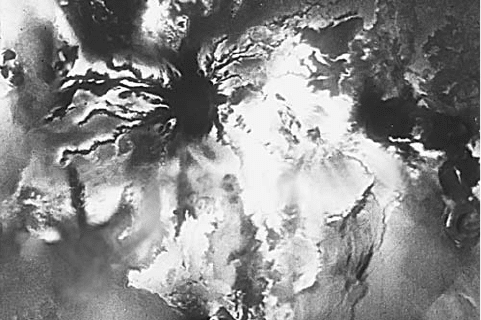
Io is the innermost moon of Jupiter and the most volcanically active place
in the solar system. Several lava flows at over 90 miles (150 km) in length
were erupted from the Ra Patera volcano. (Courtesy of NASA)
120 intensity
thought to be kept hot by gravitational influence from Jupiter
and from its moon Europa. Evidence of extraterrestrial volca-
nic activity has been discovered on Venus and Mars as well
as on Io.
Iowa United States Iowa is not characterized by frequent
seismic activity but has experienced strong earthquakes on
occasion. A severe earthquake at Sioux City on October 9,
1872, was accompanied by a noise like thunder.
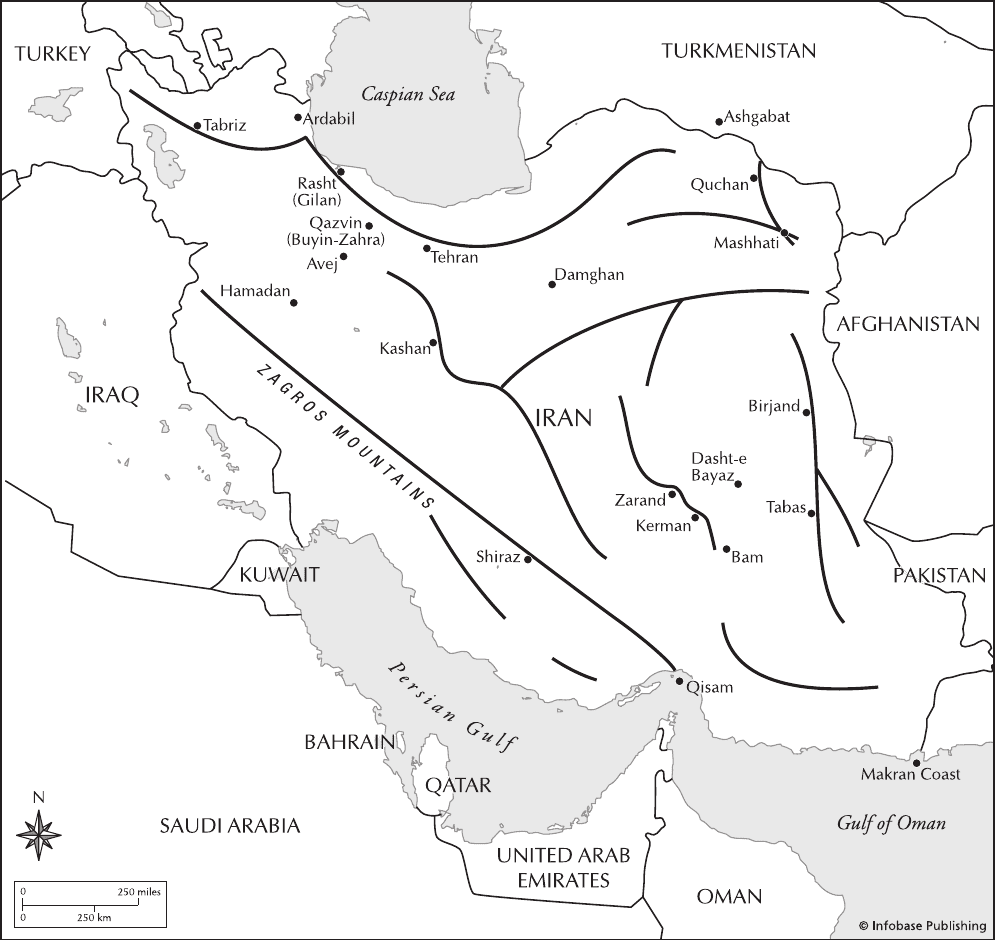
Iran Iran is located in an area of intense seismic activity
and has been the site of numerous highly destructive earth-
quakes. These are not always extremely powerful earth-
quakes; many are moderate but shallow. The northern part
of Iran is the most seismically active. Iran’s active faults
include, but are not limited to, the Ferdows, Kubbanan, and
Nayband Faults as well as portions of the Shahrud Fault. The
Tehran area reportedly has experienced some earthquakes
that are of interest for being evidently unrelated to surface
faults. Strong earthquakes have struck Iran repeatedly within
historical times, notably in 1611, 1619, 1755, 1879, 1881,
1883, 1911, 1930, 1968, 1969, 1972, and 1977. The March
21, 1977, earthquake (magnitude 7.0), which occurred in
southeast Iran, caused widespread damage and killed about
Map of Iran and surrounding countries showing the location of major faults and the epicentral cities of the major historical earthquakes
Iran 121