
Givan A.L. Flow Cytometry. First Principles
Подождите немного. Документ загружается.

Flow
Cytometry
First Principles
Second Edition
Flow Cytometry: First Principles, Second Edition. Alice Longobardi Givan
Copyright
2001 by Wiley-Liss, Inc.
ISBNs 0-471-38224-8 (Paper); 0-471-22394-8 (Electronic)

Flow
Cytometry
First Principles
S
econd Edition
Alice Longobardi Givan
The Herbert C. Englert Cell Analysis Laboratory
of the Norris Cotton Cancer Center
and Department of Physiology
Dartmouth Medical School
Lebanon, New Hampshire
A John Wiley & Sons, Inc., Publication
New York
.
Chichester
.
Weinheim
.
Brisbane
.
Singapore
.
Toronto
Designations used by companies to distinguish their products are often claimed as trademarks.
In all instances where John Wiley & Sons, Inc., is aware of a claim, the product names appear
in initial capital or all capital letters. Readers, however, should contact the appropriate
companies for more complete information regarding trademarks and registration.
All rights reserved.
No part of this publication may be reproduced, stored in a retrieval system or transmitted in
any form or by any means, electronic or mechanical, including uploading, downloading,
printing, decompiling, recording or otherwise, except as permitted under Sections 107 or 108
of the 1976 United States Copyright Act, without the prior written permission of the
Publisher. Requests to the Publisher for permission should be addressed to the Permissions
Department, John Wiley & Sons, Inc., 605 Third Avenue, New York, NY 10158-0012,
(212) 850-6011, fax (212) 850-6008, E-Mail: PERMREQ @ WILEY.COM.
This publication is designed to provide accurate and authoritative information in regard to the
subject matter covered. It is sold with the understanding that the publisher is not engaged in
rendering professional services. If professional advice or other expert assistance is required, the
services of a competent professional person should be sought.
ISBN 0-471-22394-8
This title is also available in print as ISBN 0-471-38224-8.
For more information about Wiley products, visit our web site at www.Wiley.com.
Copyright 2001 by Wiley-Liss, Inc.
The First Edition of this book was dedicated to my parents,
Violet Litwin Longobardi and Vincent Longobardi, Jr.,
with gratitude for the example they set,
with pride in their achievements,
and with love.
The Second Edition is dedicated to
Curt, Ben, and Becky
(not only because I promised them that their turn would come).
Contents
Preface xi
Acknowledgments (First Edition) xv
Acknowledgments (Second Edition) xvii
1 The Past as Prologue 1
2 Setting the Scene 11
3 Instrumentation: Into the Black Box 15
Illumination of the Stream 16
Centering Cells in the Illuminating Beam 18
Detection of Signals from Cells 25
Electronics 31
4 Information: Harnessing the Data 41
Data Storage 41
Data Analysis 43
5 Seeing the Light: Lasers, Fluorochromes, and
Filters
59
General Theory 59
Lasers 61
Fluorochromes 65
Partitioning the Signal with Lenses, Filters, and
Mirrors 72
Spectral Compensation 76
vii
6 Cells from Without: Leukocytes, Surface Proteins, and
the Strategy of Gating
81
Cells from Blood 82
Staining for Surface Markers 87
Controls 90
Quantitation 95
Sensitivity 98
The Strategy of Gating 99
Gating on Fluorescence 108
7 Cells from Within: Intracellular Proteins 115
Methods for Permeabilizing Cells 116
Examples of Intracellular Staining 118
8 Cells from Within: DNA in Life and Death 123
Fluorochromes for DNA Analysis 123
Ploidy 125
Cell Cycle Analysis 131
Two-Color Analysis for DNA and Another
Parameter 142
Chromosomes 147
Apoptosis 150
Necrosis 154
9 The Sorting of Cells 159
Sorting Theory 159
Characterization of Sorted Cells 166
Alternative Methods for Sorting 170
The Condition of Cells After Sorting 172
10 Disease and Diagnosis: The Clinical Laboratory 175
The Hematology Laboratory 178
The Pathology Laboratory 186
Solid Organ Transplantation 189
Comments 192
Flow Cytometryviii
11 Out of the Mainstream: Research Frontiers 195
Functional Assays 196
The Aquatic Environment 202
Reporter Molecules 207
Microbiology 211
Molecular Biology 213
Multiplex Cytometry for Soluble Analytes 218
Reproductive Technology 220
12 Flowing On: The Future 225
General References 229
Glossary 235
Figure Credits 257
Index 263
Contents ix
Preface
Although ¯ow cytometry is simply a technique that is useful in
certain ®elds of scienti®c endeavor, there is, at the same time, some-
thing special about it. Few other techniques involve specialists from
so many di¨erent backgrounds. Anyone working with ¯ow systems
for any length of time will realize that computer bu¨s, electronics
experts, mathematicians, optical and ¯uidics engineers, and organic
chemists rub shoulders with biologists, physicians, and surgeons
around the ¯ow cytometer bench.
And it is not just a casual rubbing of shoulders, in passing, so
to speak. Many of the specialists involved in ¯ow cytometry might,
if asked, call themselves ¯ow cytometrists because the second aspect
of ¯ow cytometry that distinguishes it from many other techniques
is that ¯ow cytometry has itself become a ``®eld.'' Indeed, it is a ®eld
of endeavor and of expertise that has captured the imaginations of
many people. As a result, there exists a spirit of camaraderie; ¯ow
cytometry societies, groups, meetings, networks, websites, journals,
courses, and books abound.
A third aspect of ¯ow cytometry (known sometimes simply with
the acronym for ¯uorescence-activated cell sorter, FACS, or even
more familiarly as just ¯ow) that distinguishes it from many other
techniques is the way in which its wide and increasing usefulness has
continued to surprise even those who consider themselves experts.
What began as a clever technique for looking at a very limited range
of problems is now being used in universities, in hospitals, within
industry, at marine stations, on submersible buoys, and on board
ships; plans have existed for use on board space ships as well. The
applications of ¯ow cytometry have proliferated (and continue to
proliferate) rapidly both in the direction of theoretical science, with
xi
botany, molecular biology, embryology, biochemistry, marine ecol-
ogy, genetics, microbiology, and immunology, for example, all rep-
resented; and in the direction of clinical diagnosis and medical prac-
tice, with hematology, bacteriology, pathology, oncology, obstetrics,
and surgery involved. We are, at present, living through what appears
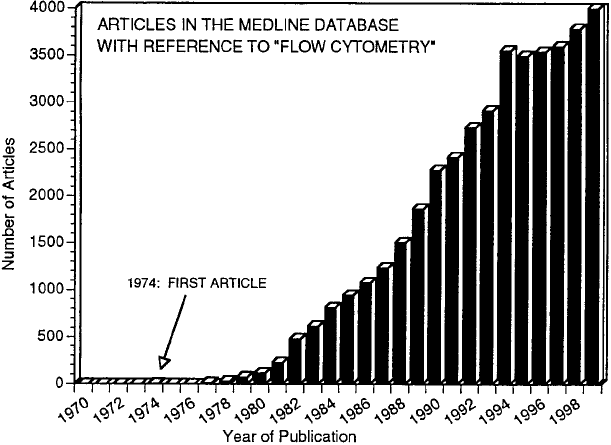
to be a rapid phase in ¯ow cytometry's growth curve (see Fig. 1).
Because ¯ow cytometry is an unusual ®eld, bringing together
people with di¨ering scienti®c backgrounds at meetings, on editorial
boards, in hospital wards, on advisory panels, and at laboratory
benches and reaching increasing numbers of workers in new and
unpredicted areas of endeavor, there is, as a result, a need to provide
both recent and potential entrants into this diverse community with
a common basis of knowledgeÐso that we can all understand the
vocabulary, the assumptions, the strengths, and the weaknesses of the
technology involved. I have for many years taught new and future
users of ¯ow cytometers. My teaching attempts to present enough
technical background to enable students, scientists, technologists, and
Fig. 1. Increasing reference to ``¯ow cytometry'' in the medical literature over the
past three decades. The development of ¯ow cytometers antedates the use of the term
itself.
Flow Cytometryxii
clinicians to read the literature critically, to evaluate the bene®ts of
the technique realistically, and, if tempted, to design e¨ective pro-
tocols and interpret the results. I try to describe the theory of ¯ow
cytometry in a way that also provides a ®rm (and accurate) founda-
tion for those few who will go on to study the technique in greater
depth. Details of protocols are avoided, but my teaching attempts
to give enough information about applications to provide concrete
examples of general concepts and to allow some appreciation of the
range of practical goals that the instruments are able to achieve. With
some expansion (but with little change in style or objectives), my
classroom and workshop teaching is the basis for this book.
Notes on the Second Edition: This new edition, while similar to the
®rst edition in style and scope, has been modi®ed in many ways. The
arrangement of some material has been altered to present, in my
opinion, a more coherent pedagogical sequence, re¯ecting my chang-
ing thoughts on teaching. While all chapters have been re-written to a
signi®cant extent, there are also some major expansions re¯ecting the
progress of the ®eld. In particular, I have included more detail about
the cell as it passes through the laser beam; the laser/¯uorochrome
chapter has been expanded to include recently developed ¯uoro-
chromes and multilaser options; a new chapter has been added on
cytoplasmic staining; a discussion of apoptosis has been added to the
chapter on DNA; the section on sorting has been expanded to a full
chapter and includes high-speed sorting and alternative sorting
methods as well as traditional technology; the clinical and research
chapters have been updated and expanded considerably; the chapter
on general references includes many of the recent excellent books in
the ®eld; and the chapter on the future of ¯ow cytometry is now a
subjective glimpse into the new decade from the vantage point of the
year 2000.
Preface xiii