
Givan A.L. Flow Cytometry. First Principles
Подождите немного. Документ загружается.

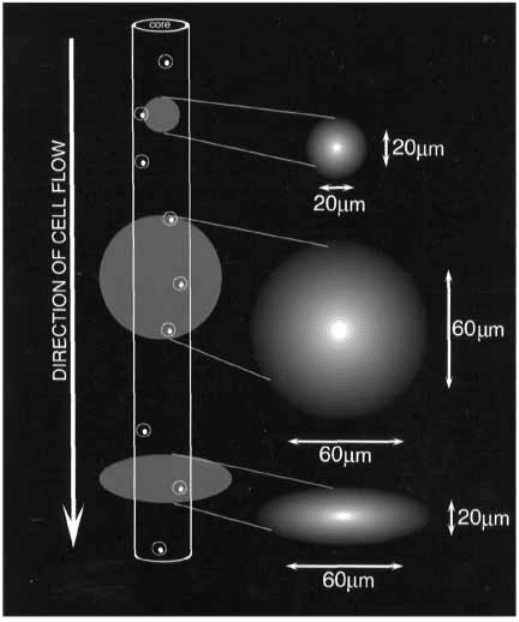
thus illuminating cells more-or-less identically even if they stray from
the exact center of the beam; but at the same time this elliptical pro-
®le can provide temporal resolution between cells, illuminating only
one at a time as they pass one by one into and out of the beam in its
narrow dimension. The narrower the beam is, the more quickly will a
cell pass through itÐgiving opportunity for the signal from that cell
to drop o¨ before the start of the signal from the next cell in line and
avoiding the coincidence of two cells in the beam simultaneously. In
Fig. 3.1. Cells ¯owing past illuminating beams of di¨erent pro®les. A beam with an
elliptical pro®le (lower beam) allows cells to pass into and out of the beam quickly
(avoiding the coincidence of two cells in the beam at the same time). In addition, it
provides more equal illumination if cells stray from the center of the beam. The small
circular beam at the top does not illuminate cells equally if they are at the edge of the
stream core. The larger circular beam (in the middle) illuminates cells equally, but
often includes multiple cells in the beam at the same time.
Instrumentation 17
multilaser systems, each beam of light is focused in a similar way but
at di¨erent points along the stream; a cell moves through each beam
in sequence.
CENTERING CELLS IN THE ILLUMINATING BEAM
The ¯uidics in a ¯ow cytometer are likely to be ignored until they go
wrong. If they go wrong disastrously, they can make a terrible mess.
If they go wrong with subtlety, they may turn a good experiment into
artifactual nonsense without anyone ever noticing. On the assump-
tion that the more disastrous problems can be solved by a combi-
nation of plumbing and mopping (both essential skills for ¯ow
cytometrists), I will concentrate on the more subtle aspects of ¯uid
control. Nevertheless, the potential hazard of working at the same
time with volumes of water and with a high-voltage source should
never be far from the mind of anyone working with a water-cooled
laser or with a sorting cytometer with high-voltage stream de¯ection
plates.
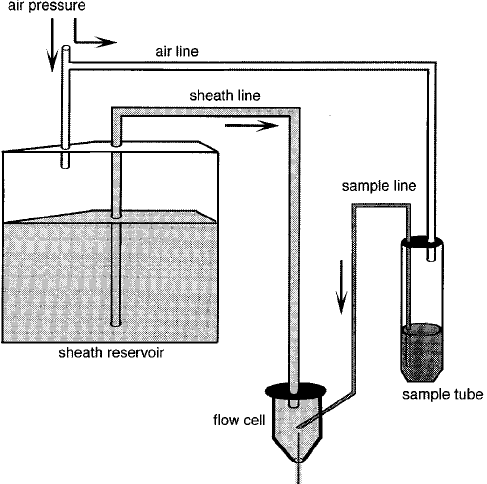
The ¯ow on a ¯ow cytometer begins (Fig. 3.2) at a reservoir of
liquid, called the sheath ¯uid. Sheath ¯uid provides the supporting
vehicle for directing cells through the laser beam. The sheath ¯uid
reservoir is pressurized, usually with pumped room air, to drive the
sheath ¯uid through a ®lter to remove extraneous particles and then
through plastic tubing to the illumination point. This sheath stream is
usually bu¨er of a composition that is appropriate to the types of
particles being analyzed. For leukocytes or other mammalian cells,
this usually means some sort of phosphate-bu¨ered saline solution.
Other cells or other particles may have other preferences.
Di¨erent instruments employ di¨erent strategies for getting the
sample with suspended cells into the sheath stream in the cytometer.
Some instruments require cells to be in small test tubes that form a
tight seal around an O-ring on a manifold. The manifold delivers air
to the test tube, thus pushing the suspended cells up out of the test
tube and through a plastic line to the sheath stream. Other instru-
ments use a motor-driven syringe to remove a volume of sample and
then inject it slowly into the cytometer. Depending on the instrument,
there may be a greater or lesser degree of operator control over the
rate of ¯ow. The amount of pressure driving the sample through the
system will a¨ect the uniformity of alignment between the cells and
Flow Cytometry18
the illuminating laser beam as the cells move through the cytometer.
Low pressure is less likely to cause perturbation of the stream pro®le
and of the position of the cells within that stream. Empirically, if
increasing the pressure on the sample causes undue broadening or
wavering of signals, the pressure is probably excessive.
If cells ¯ow too slowly through the cytometer, people start to make
bad jokes about how microscopes cost less and are quicker. Because
increasing the pressure may not be possible and, even if it is, is
probably only a good idea within reasonable limits, the best way of
getting cells to ¯ow at reasonably fast rates is simply to make up
the original sample with cells at a reasonably high concentration. A
million cells per milliliter is often about right; 10
5
cells per milliliter
is beginning to be low enough to test one's patience; 10
4
cells per
milliliter is probably too low a concentration to be worth analyzing.
If you have few cells, make them up in a small volume (you will
know how small a volume your system can handle). If the cells end
Fig. 3.2. The ¯uidics system, with air pressure pushing both the sample (with sus-
pended cells) and the sheath ¯uid into the ¯ow cell.
Instrumentation 19
up being too concentrated, they may ¯ow too fastÐbut you can
always dilute them on the spot and run the sample again. You may
wonder why too rapid a ¯ow is a source of problems. Faster seems as
if it should always be better (especially around 5:00 pm). However, if
cells are too close together as they ¯ow through the laser beam, there
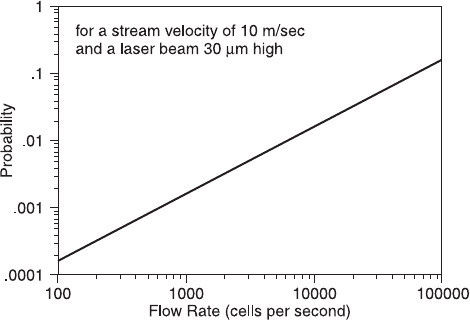
may be di½culty separating their signals: A second cell may arrive in
the illuminating beam before the preceding cell has emerged, and
they will be measured together as if they were a single particle (with
double the intensity). Figure 3.3 gives an indication of the probability
of cells coinciding in the laser beam at di¨erent ¯ow rates. Most cy-
tometers seem to be quite happy looking at particles that are ¯owing
at a rate of about 1000 particles per second.
Aside from concentration, another problem with samples is that
the particles may be the wrong size. If they are too small, they may
not be distinguishable from noise; nevertheless, bacteria and pico-
plankton and other bits and pieces of about 1 mm diameter or smaller
are analyzable in at least some well-tuned cytometers. If the particles
are too large, however, they will obstruct ¯ow. If the ¯uid system
is fully clogged, it may be di½cult to get things ¯owing again; if it
is only partially clogged, cells may ¯ow but that critical alignment
Fig. 3.3. The probability of an event recorded by the ¯ow cytometer as a single
``cell'' actually resulting from more than one cell coinciding in the laser beam. For
this model, the laser beam was considered to be 30 mm high and the stream ¯owing
at 10 m per second.
Flow Cytometry20
between stream and light beam may be skewed, thus causing arti-
factual signals. Most experienced ¯ow cytometrists recommend ®l-
tering any samples that are likely to contain large or clumped mate-
rial before attempting to run them through the instrument. Nylon
mesh of speci®ed pore size works well (35 mm mesh is appropriate for
most applications).
The exact size of particle that will be large enough to cause obstruc-
tion depends primarily on the diameter of the ori®ce of the nozzle or
¯ow cell being used (usually between 50 and 250 mm). This brings us
to the next stop downstream in our following of the ¯ow in this ¯ow
cytometer. The terms nozzle, ¯ow cell, and ¯ow chamber derive from
di¨erent engineering designs for the best way of delivering cells into
the sheath ¯uid and thence to the analysis point where they are illu-
minated by the light. What we require is a method for keeping the
cells in the center of the ¯uid stream so that they will pass through
the center of the focused light beam and be uniformly illuminated.
The ¯ow chamber is the place in the cytometer where the cells from
the sample join the ¯uid from the sheath reservoir. Within the ¯ow
chamber, the sample is injected into the center of the sheath stream;
the combined sample and sheath streams are then accelerated as they
move through a narrowing channel. This acceleration is critical to the
precise alignment of cells, one at a time, in the laser beam. References
at the end of this chapter will direct interested readers to mathemati-
cal discussion of the ¯uid mechanics related to this subject. For our
purposes here, it will be enough to note that, as a result of consid-
erations pertaining to laminar ¯ow through a narrowing path, the
sample with its suspended cells, after injection into the center of
the sheath stream, will remain in a central core as it ¯ows within the
sheath stream out through the ¯ow chamber.
The technical term for this is hydrodynamic focusing; ¯ow of a
sample stream within the center core of a sheath stream is called
coaxial ¯ow. The exact diameter of that central sample core within
the sheath stream is related to, among other things, the rate at which
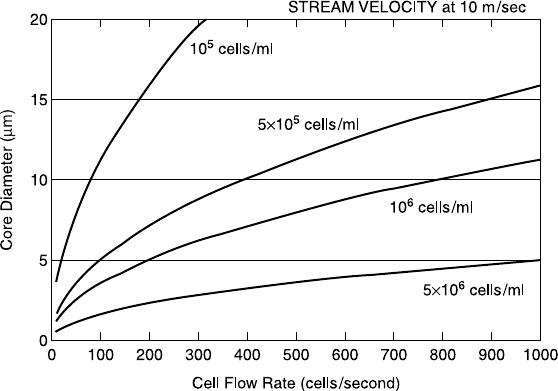
the sample is injected into the sheath stream; a 100 mm sheath stream
may, depending on sample injection velocity, have a core width of
perhaps 5±20 mm (Fig. 3.4). Because hydrodynamic focusing tends to
con®ne the cell sample to this central core, there is little mixing of
sample with sheath ¯uid (but di¨usion of small molecules will occur).
The reason that this type of coaxial sample ¯ow suits ¯ow cytometry
Instrumentation 21
is that a nozzle or ¯ow cell with a relatively wide ori®ce (50±250 mm)
can be used to avoid blockage; the particles to be analyzed are never-
theless maintained in alignment in the narrow (say 5±20 mm) core so
that they progress in single ®le down the center of the stream through
the laser beam. This ensures uniform illumination as long as the
central core is narrow and the illuminating beam is focused at the
center of the sheath stream. It also ensures that, because the cells are
stretched out at a distance from each other as rare beads along a gold
chain, for the most part one particle is illuminated at a time.
We are now in a position to understand why radical changes in the
rate at which the sample is pushed through the ¯ow cell will cause
changes in the resulting light signals. Changes in sample injection rate
cause changes in the diameter of the core; when the size of the core
increases, particles are no longer so tightly restricted in their position
as they ¯ow past the light beam, and illumination will be less uniform
(Fig. 3.5). The size of the core often has critical impact in this
way on DNA applications where precise analysis is important and
nonuniform illumination causes nonuniform ¯uorescence. The stream
diameter may be 100 mm, but if the illuminating beam has a width
of 60 mm, then the core diameter needs to be considerably less than
Fig. 3.4. When cells are pushed through the cytometer at faster rates, the sample
core widens. Use of a more concentrated cell suspension allows a faster ¯ow rate
while maintaining a narrow core.
Flow Cytometry22
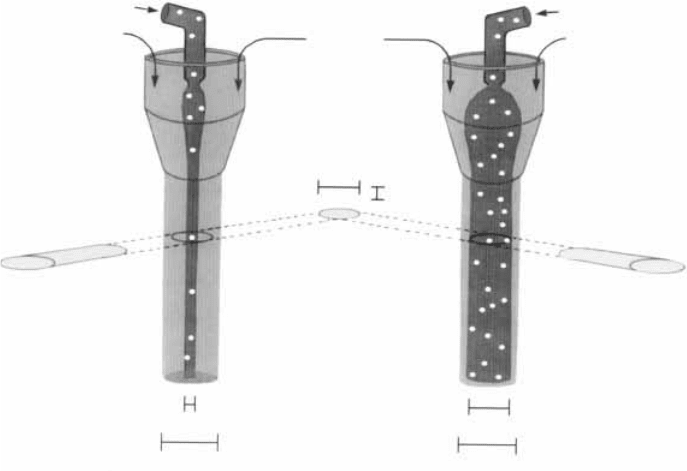
60 mm to keep the cells at the center of the beam in order to ensure
uniform illumination. In addition, with a wide sample core, two cells
are more apt to be illuminated simultaneously, resulting in addition
of their signals.
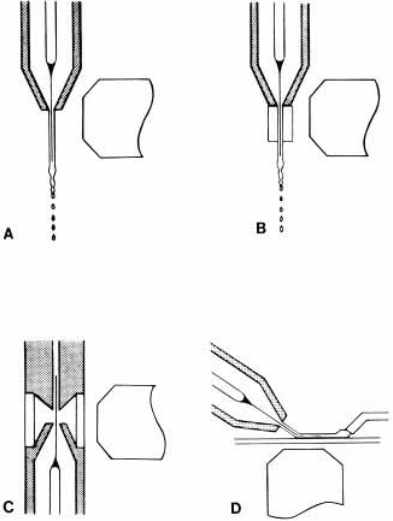
In some systems, the sheath stream with central sample core emerges
from the ori®ce of a nozzle where it is then intersected by the light
beam in the open air (a ``jet-in-air'' con®guration). In other systems,
the stream is directed (either upward or downward) through a narrow,
optically clear, ¯ow cell or chamber; the particles are illuminated by
the light beam while they are still within this ¯ow chamber. In still
other systems, a nozzle forces the stream at an angle across a glass
coverslip (Fig. 3.6). All systems have their advocatesÐthe positive
and negative considerations are based mostly on ideas about signal
sample
sheath
sheath
sheath
laser
sample
laser
60 µ
20 µ
20 µ
60 µ
100 µ
laser beam
100 µ
Fig. 3.5. The ¯ow of cells within the core of sheath ¯uid through the analysis point
in the illuminating beam. When the sample is injected slowly (left), the core is nar-
row and the cells ¯ow one at a time through the center of the laser beam. When the
sample is injected too rapidly (right), the core is wide (somewhat exaggerated in this
drawing); the cells may be illuminated erratically because they can stray from the
center of the beam. In addition, more than one cell may be illuminated at the same
time.
Instrumentation 23
noise, stream turbulence, and the control of drop formation for sort-
ing. There is no clear favorite, and purchasers of commercial instru-
ments usually base their choice of cytometer on factors other than
¯ow cell design and then live with the design they get.
The main point of concern on a daily basis is the avoidance of
blockage. Most ¯ow cells in nonsorting cytometers have ori®ces with
relatively wide dimensions (perhaps 150±250 mm in diameter) and are
tolerant of large material; sorting instruments are more restricted in
nozzle size. Although instruments can be modi®ed to sort large cells,
most commercial sorting cytometers operate with a stream diameter
of between 50 and 100 mm. Cells larger than the nozzle ori®ce diam-
eter will clog the nozzle. Furthermore, even if you think you have a
Fig. 3.6. Various types of ¯ow chambers. A and B are designs used in sorting
cytometers (in A the analysis point is in air after the stream has left the ¯ow cell; in B
analysis occurs within an optically clear region of the chamber itself ). C and D are
two designs for nonsorting cytometers (in C the stream ¯ows upward through an
optically clear region of the chamber; in D the stream is directed at an angle across a
glass coverslip). Adapted from Pinkel and Stovel (1985).
Flow Cytometry24
suspension of single cells, there will undoubtedly be some aggregates
of much larger size.
DETECTION OF SIGNALS FROM CELLS
An optical bench is simply a table that does not wobble. A ¯ow cy-
tometer's optical bench may be visible at the back or may be incor-
porated behind a closed door; in either case, it provides a stable
surface that ®xes the light source and the light detectors in rigid
alignment with the objects being illuminated. If the bench is moved,
the light source, the light detectors, and the object of illumination will
move in synchrony so that alignment between the three does not
change. The reason that users of a ¯ow cytometer should know about
optical benches is, simply, to remind them that signals from a cell can
vary beyond recognition if this alignment changes even slightly.
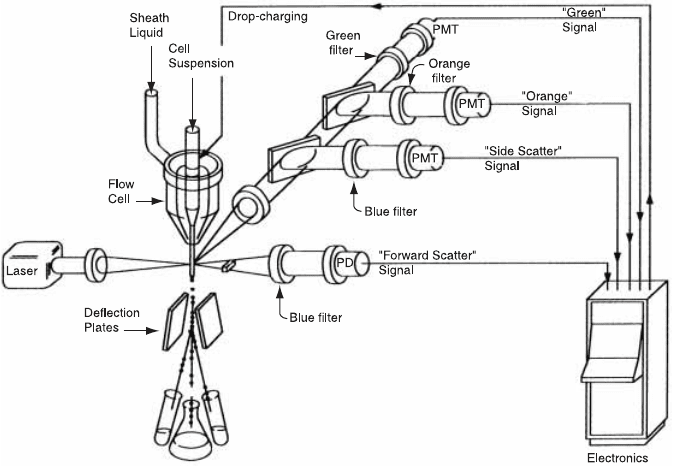
Figure 3.7 is a diagram of the components that sit on the optical
Fig 3.7. Components on the optical bench of a generalized ``four-parameter'' ¯ow
cytometer. (The drop charging, the de¯ection plates, and the drops moving into
separate test tubes apply only to sorting cytometers [see Chapter 9] and not to
benchtop instruments.) Adapted from Becton Dickinson Immunocytometry Systems.
Instrumentation 25
bench of a ¯ow cytometer. If we follow the light path from the begin-
ning, we can see that the light, after it leaves the laser source, is
focused through a lens into an elliptical beam of about 20 by 60 mm
as it approaches the liquid stream. The stream of 50±150 mm diame-
ter ¯ows perpendicularly to the light beam. The alignment of the light
beam and the stream must ensure that the stream is intersected by the
light beam in such a way that the core of the stream (with its cells) is
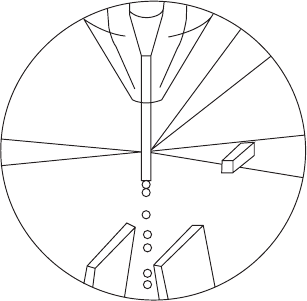
uniformly illuminated by the light. The point at which stream and
light beam intersect (Fig. 3.8) is called the analysis point, observation
point,orinterrogation point. If the light beam and the stream are not
perfectly and squarely aligned with each other, then cells within the
stream will be erratically illuminated and will give o¨ erratic light
signals. Although the reasons for imperfect alignment may have to do
with poor adjustment of the focusing lens or light source, the stability
of the optical bench is, on the whole, reliable. On a day-to-day basis,
poor alignment is much more likely to result from shifts in the ¯uid
stream resulting from bubbles or partial obstruction.
Surrounding the analysis point are lenses that collect light as
it emerges after its intersection with the cells in the stream. This
emerging light constitutes the signal. It is focused onto photodiodes
*
Laser
= ANALYSIS POINT
*
Fig. 3.8. The analysis point. Alignment between the illuminating beam and ¯uid
stream is critical in determining the characteristics of the resulting forward- and
right-angle signals.
Flow Cytometry26