
Givan A.L. Flow Cytometry. First Principles
Подождите немного. Документ загружается.

between a wide tube that allows particles to pass two or more abreast
across a particular section or a narrow tube that makes microscopical
observation of the contents of the tube di½cult due to the di¨erent
refractive indices of the tube and the suspending ¯uid. In addition,
narrow tubes tend to block easily. In response to this dilemma,
Crosland-Taylor applied the principles of laminar ¯ow to the design
of a ¯ow system. A suspension of red blood cells was injected into the
center of a faster ¯owing stream, thus allowing the cells to be aligned
in a narrow central ®le within the core of the wider stream prepara-
tory to electronic counting. This principle of hydrodynamic focusing
was pivotal for the further development of the ®eld.
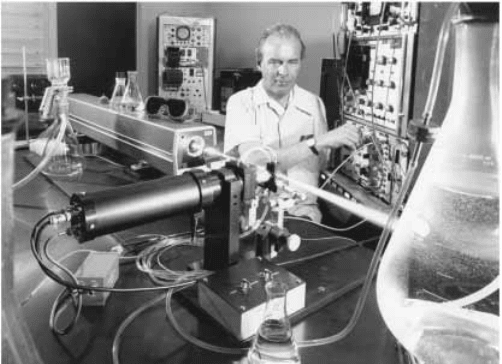
In 1969, Marvin Van Dilla and other members of the Los Alamos
Laboratory group reported development of the ®rst ¯uorescence-
detection cytometer that utilized the principle of hydrodynamic
focusing and, unlike the microscope-based systems, had the axes of
¯ow, illumination, and detection all orthogonal to each other; it also
used an argon laser as a light source (Fig. 1.3). Indeed, the con®gu-
ration of this instrument provided a framework that could support
both the illumination and detection electronics of Kamentsky's device
as well as the rapid ¯ow and vibrating ¯uid jet of Fulwyler's sorter.
In the initial report, the instrument was used for the detection of ¯uo-
rescence from the Feulgen-DNA staining of Chinese hamster ovary
Fig. 1.3. Marvin Van Dilla and the Livermore ¯ow sorter in 1973. Photograph
courtesy of the Lawrence Livermore National Laboratory.
Flow Cytometry6
cells and leukocytes as well as of their Coulter volume; however, the
authors ``anticipated that extension of this method is possible and of
potential value.'' Indeed, shortly thereafter, the Herzenberg group
at Stanford published a paper demonstrating the use of a similar
cytometer to sort mouse spleen and Chinese hamster ovary cells on
the basis of their ¯uorescence due to accumulation of ¯uorescein di-
acetate. These instruments thus led to systems for combining multi-
parameter ¯uorescence, light scatter, and ``Coulter volume'' detection
with cell sorting.
These sorting cytometers began to be used to look at ways of dis-
tinguishing and separating white blood cells. By the end of the 1960s,
they were able to sort lymphocytes and granulocytes into highly
puri®ed states. The remaining history of ¯ow cytometry involves the
elaboration of this technology, the exploitation of ¯ow cytometers
for varied applications, and the collaboration between scientists and
industry for the commercial production of cytometers as user-friendly
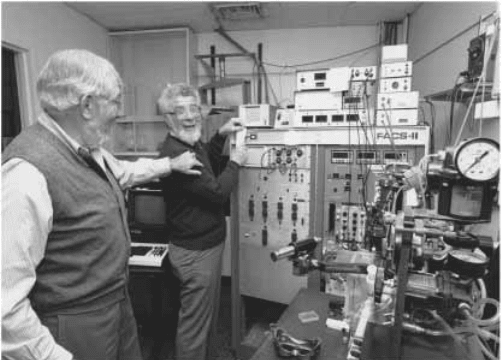
tools (Fig. 1.4). At the same time that these instruments began to be
seen as commercially marketable objects, research and development
continued especially at the United States National Laboratories at
Los Alamos (New Mexico) and Livermore (California), but also at
smaller centers around the world. At these centers, homemade in-
Fig. 1.4. Bernard Shoor (left) and Leonard Herzenberg at Stanford University with
one of the original Becton Dickinson ¯ow cytometers as it was packed for shipment
to the Smithsonian Museum. Photograph by Edward Souza, courtesy of the Stanford
News Service.
The Past as Prologue 7
struments continue to indicate the leading edge of ¯ow technology.
At the present time, this technology is moving simultaneously in two
directions: On the one hand, increasingly sophisticated instruments
are being developed that can measure and analyze more aspects of
more varied types of particles more and more sensitively and that can
sort particles on the basis of these aspects at faster and faster rates.
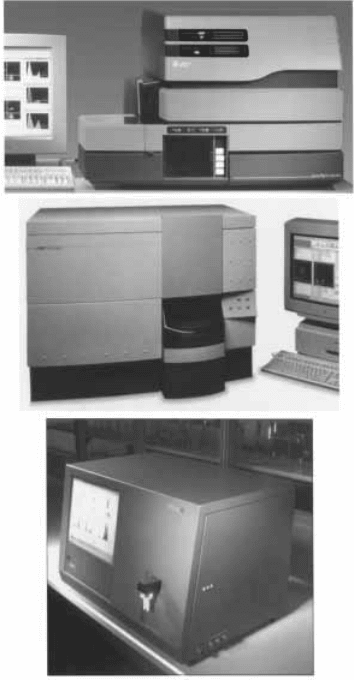
On the other hand, a di¨erent type of sophistication has streamlined
instruments (Fig. 1.5) so that they have become user-friendly and
essential equipment for many laboratory benches.
Fig. 1.5. Three user-friendly benchtop cytometers (in alphabetical order). Top:
A Beckman Coulter
R
z
XL
TM
. Middle: A Becton Dickinson FACSCalibur. Bottom:
A Dako Galaxy, manufactured for Dako by Partec.
Flow Cytometry8
FURTHER READING
Throughout this book, the ``Further Reading'' references at the end
of each chapter, while not exhaustive, are intended to point the way
into the speci®c literature related to the chapter in question. At the
end of the book, ``General References'' will direct readers to globally
useful literature. Titles in bold at the end of each chapter are texts
that are fully cited in the General References at the end.
Coulter WH (1956). High speed automatic blood cell counter and size
analyzer. Proc. Natl. Electronics Conf. 12:1034±1040.
Crosland-Taylor PJ (1953). A device for counting small particles suspended
in a ¯uid through a tube. Nature 171:37±38.
Dittrich W, Go
È
hde W (1969). Impuls¯uorometrie dei Einzelzellen in Suspen-
sionen. Z. Naturforsch. 24b:360±361.
Fulwyler MJ (1965). Electronic separation of biological cells by volume.
Science 150:910±911.
Herzenberg LA, Sweet RG, Herzenberg LA (1976). Fluorescence-activated
cell sorting. Sci. Am. 234:108±115.
Hulett HR, Bonner WA, Barrett J, Herzenberg LA (1969). Cell sorting:
Automated separation of mammalian cells as a function of intracellular
¯uorescence. Science 166:747±749.
Kamentsky LA, Melamed MR (1967). Spectrophotometric cell sorter.
Science 156:1364±1365.
Kamentsky LA, Melamed MR, Derman H (1965). Spectrophotometer: New
instrument for ultrarapid cell analysis. Science 150:630±631.
Moldavan A (1934). Photo-electric technique for the counting of micro-
scopical cells. Science 80:188±189.
Van Dilla MA, Trujillo TT, Mullaney PF, Coulter JR (1969). Cell micro-
¯uorimetry: A method for rapid ¯uorescence measurement. Science
163:1213±1214.
Chapter 1 in Melamed et al., Chapter 3 in Shapiro, and Chapter 1 in
Darzynkiewicz are good historical reviews of ¯ow cytometry. Alberto
Cambrosio and Peter Keating (2000) have used ¯ow cytometry as a model
for looking at historical changes in the way scientists use instrumentation
to view the world: Of lymphocytes and pixels: The techno-visual production
of cell populations. Studies in History and Philosophy of Biological and
Biomedical Sciences 31:233±270.
The Past as Prologue 9

2
Setting the Scene
As mentioned in the previous chapter, ¯ow cytometry has been
moving in two directions at once. The earliest ¯ow cytometers were
either homemade Rube Goldberg (Heath Robinson, U.K.) monsters
or, a few years later, equally complex, unwieldy commercial instru-
ments. These were expensive; they were also unstable and therefore
di½cult to operate and maintain. For these reasons, the cytometer
tended to collect around itself the trappings of what might be called a
¯ow facilityÐthat is, a group of scientists, technicians, students, and
administrators, as well as a collection of computers and printers, that
all revolved around the ¯ow cytometer at the hub. If a scientist or
clinician wanted the use of a ¯ow cytometer to provide some required
information, he or she would come to the ¯ow facility, discuss the
experimental requirements, make a booking, and then return with the
prepared samples at the allotted time. The samples would then be run
through the cytometer by a dedicated and knowledgeable operator.
Finally, depending on the operator's assessment of the skill of the
end-user, a number, a computer print-out, or a computer disk would
be handed over for analysis.
Just at the moment when such ¯ow facilities were beginning to see
themselves as essential components of modern research, the technol-
ogy of ¯ow cytometry began to move in a new direction. Users and
manufacturers both began to realize that di¨erent laboratories have
di¨erent instrumentation needs. A sophisticated sorter might be nec-
essary for certain applications, but its demands on daily alignment
and skilled maintenance are time-consuming and its research capa-
bilities might be super¯uous for routine processing of, for example,
clinical samples. Instead of simply continuing to become larger,
more expensive, more complicated, and more powerful, some ¯ow
11
Flow Cytometry: First Principles, Second Edition. Alice Longobardi Givan
Copyright
2001 by Wiley-Liss, Inc.
ISBNs 0-471-38224-8 (Paper); 0-471-22394-8 (Electronic)
cytometers started to become, in the late 1980s, smaller, less expen-
sive, more accessible, and, although less ¯exible, remarkably stable.
These instruments are called ``benchtop'' cytometers because they are
self-contained and can be taken from their shipping crates, placed on
a lab bench, plugged in, and (with luck) are ready to go.
The question arises as to how much training is required for use of
these benchtop instruments. Pushing the buttons has become easy,
but my prejudice on this issue should, of course, be obvious. If I
believed that ¯ow experiments could be designed and ¯ow data could
be acquired and analyzed appropriately by people with no awareness
of the limitations and assumptions inherent in the technique, I would
not have written this book. The actual operation of these small cy-
tometers has been vastly simpli®ed compared with that of the original
research instruments. It certainly can be said that the new wave of
cytometers has made ¯ow analysis a great deal more accessible to the
nonspecialist. A serious concern, however, is that the super®cial sim-
plicity of the instruments may lull users into a false sense of security
about the ease of interpretation of the results. The basis for this con-
cern is particularly clear in the medical community, where clinicians
have been conditioned to expect that laboratory reports will contain
unambiguous numbers; they may not be accustomed to the need for
an intellectual framework in which to interpret those numbers. Any-
one designing ¯ow experiments or interpreting ¯ow data needs some
essential training in the technique; more training is required as the
benchtop instruments (and the possible experiments) become more
complex. At the high end, the operation of sorting instruments is best
left to a dedicated operator; but, even here, the grass-roots user needs
to understand ¯ow cytometry in order to design an e¨ective sorting
protocol and communicate this protocol to the operator.
Although benchtop cytometers are less expensive than state-of-the-
art instrumentation, they are still expensive. Therefore core facilities
with shared instrumentation still provide for much of the current ¯ow
cytometric analysis. These shared facilities re¯ect a need by many for
¯ow cytometric instrumentation, but also recognition of its high cost,
its requirement for skilled maintenance and operation, and the fact
that many users from many departments may each require less than
full-time access. Such centralized facilities may have more than one
cytometer. The trend now is to have one or more sophisticated in-
struments for specialized procedures accompanied by several bench-
Flow Cytometry12
top cytometers as routine work horses. There are usually dedicated
operators who run the sophisticated instruments, supervise use of the
benchtop instruments, and ensure that all instruments are well-tuned
for optimum performance. In addition, there may be a network of
computers so that ¯ow data can be analyzed and re-analyzed at
leisureÐaway from the cytometer and possibly in the scientist's own
laboratory. A cytometry facility may also provide centrifuges, cell
incubators, and ¯uorescence microscopes to aid in cell preparation.
Increasingly, such institutional ¯ow facilities are also becoming
general cytometry facilities; the use of imaging microscopes for cell
analysis has proved to be a technique that complements ¯ow work.
Similar stains are used in both ¯ow and image analysis systems. Flow
cytometry is based on analysis of light from a large number of cells as
they individually pass a detector. Image analysis studies the distribu-
tion of light signals emanating from a large number of individual
positions scanned over a single stationary cell.
The funding of such central facilities often involves a combination
of institutional support, direct research grant support, and charges to
users (or patients). The charges to users may vary from nominal to
prohibitive and may need to support everything from consumables
like computer paper and bu¨ers to the major costs of laser replace-
ment, service contracts, and sta¨ salaries. With the increasing com-
plexity and variety of instrumentation and with the need for data
organization, booking systems, and ®nancial accounting, the running
of these ¯ow facilities can become an administrative task in itself.
Therefore a ``corporate identity'' often evolves, with logos designed,
meetings organized, newsletters written, and training sessions pro-
vided.
Moreover, a funny thing has been happening. What originally
appeared to be a rift in the ®eld of ¯ow cytometry, isolating the ``high
tech'' from the ``benchtop'' users, has turned out to be, instead, a
continuum. State-of-the-art instruments continue to improve, mark-
ing the advancing edge of technological and methodological devel-
opment. However, benchtop ¯ow cytometers have followed along
behind, becoming increasingly powerful and combining the advan-
tages of stable optics and ¯uidics with the new capabilities demon-
strated on last year's research instruments.
In this book, emphasis will be on the general principles of cy-
tometry that apply equally to benchtop and state-of-the-art instru-
Setting the Scene 13
mentation. The chapter on sorting will, however, provide some
insight into the ability of research cytometers to separate cells. In
addition, the chapter on research frontiers provides a glimpse into the
advanced capabilities of today's research instruments (and, without
doubt, many of these capabilities will soon appear on tomorrow's
benchtop cytometers).
Flow Cytometry14

3
Instrumentation:
Into the Black Box
I want ®rst to clear up some confusion that results simply from
words. A ¯ow cytometer, despite its name, does not necessarily deal
with cells; it deals with cells quite often, but it can also deal with chro-
mosomes or molecules or latex beads or with many other particles
that can be suspended in a ¯uid. Although early ¯ow cytometers were
developed with the purpose of sorting particles, many cytometers
today are in fact not capable of sorting. To add to the semantic con-
fusion, the acronym FACS is even applied to some of these non-
sorting cytometers. Flow cytometry might be broadly de®ned as a
system for measuring and then analyzing the signals that result as
particles ¯ow in a liquid stream through a beam of light. Flow cy-
tometry is, however, a changing technology. De®ning it is something
like capturing a greased pig; the more tightly it is grasped, the more
likely it is to wriggle free. In this chapter, I describe the components
that make up a ¯ow cytometric system in such a way that we may not
need a de®nition, but will know one when we see it.
The common elements in all ¯ow cytometers are
.
A light source with a means to focus that light
.
Fluid lines and controls to direct a liquid stream containing par-
ticles through the focused light beam
.
An electronic network for detecting the light signals coming from
the particles as they pass through the light beam and then
converting the signals to numbers that are proportional to light
intensity
15
Flow Cytometry: First Principles, Second Edition. Alice Longobardi Givan
Copyright
2001 by Wiley-Liss, Inc.
ISBNs 0-471-38224-8 (Paper); 0-471-22394-8 (Electronic)
.
A computer for recording the numbers derived from the elec-
tronic detectors and then analyzing them
In this chapter I describe the way a ¯ow cytometer shapes the light
beam from a laser to illuminate cells; the ¯uid system that brings the
cells into the light beam; and the electronic network for detecting and
processing the signals coming from the cells. The next chapter will
cover computing and analysis strategies for converting ¯ow cytometric
data into useful information.
ILLUMINATION OF THE STREAM
A laser beam has a circular, radially symmetrical cross-sectional
pro®le, with a diameter of approximately 1±2 mm. Lenses in the
cytometer itself are used to shape the laser beam and to focus it to a
smaller diameter as it illuminates the cells. Simple spherical lenses can
provide a round spot about 60 mm in diameter, with its most intense
region in the center and its brightness decreasing out toward the edge
of the spot. The decrease in intensity follows a Gaussian pro®le; cells
passing through the middle of the beam are much more brightly illu-
minated than those passing near the periphery. By convention, the
nominal diameter of a Gaussian beam of light refers to the distance
across the center of the beam at which the intensity drops to 13.5%
of its maximal, central value. Therefore, if a cell is 30 mm from the
center of a nominal 60 mm beam, it will receive only 13.5% of the
light it would receive at the center of that beam. At 10 mm from
the center, the intensity is about 78% and, at 3 mm from the center,
the intensity is 98% of the central intensity. Because intensity falls o¨
rapidly at even small distances from the center of the beam, cells
need to be con®ned to a well-de®ned path through the beam if they
are going, one by one, to receive identical illumination as they ¯ow
through a round beam of light.
To alleviate this stringency, the beam-focusing lenses most fre-
quently used in today's cytometers are a compromise; cylindrical lens
combinations provide an elliptical spot, for example, 10±20 by 60 mm
in size, with the short dimension parallel to the direction of cell ¯ow
and the longer dimension perpendicular to the ¯ow (Fig. 3.1). By re-
taining a wide beam diameter across the direction of ¯ow, an ellipti-
cal illumination spot can provide considerable side-to-side tolerance,
Flow Cytometry16