
Givan A.L. Flow Cytometry. First Principles
Подождите немного. Документ загружается.

or photomultiplier tubes (the latter are more sensitive to dim light
than the former; both can be called photodetectors) that convert the
light signal into an electrical impulse. The intensity of the electrical
impulse is proportional to the intensity of the light impinging on the
detector.
The photodiode that sits in direct ®ring line of the illuminating
beam receives signals that are responsible for much misunderstand-
ing. Rather than simply detecting the amount of the illuminating
beam (usually turquoise blue color) that gets through after bombarding
a cell in the stream, this forward-angle photodetector is ®tted with a
so-called obscuration bar in front of it. The function of this narrow
metal strip is to block the illuminating beam so that it cannot reach
the detector. It may be wondered why we bother to place a photo-
detector in this position on the optical bench if we are then going to
prevent any light from hitting it by blocking that light with a strip of
metal. The critical point is that any light that has been bent as it
passes through or around a cell will manage to avoid the bar, strike
the photodiode, and generate a signal. Depending on the width of
the bar, the angle of bending required to generate a signal is usually
about 0.5
. This so-called forward scatter (FSC) or forward-angle
light scatter (FALS) signal (de®ned as light of the same color as the
illuminating beam that has been bent to a small angle from the
direction of that original beam) is sometimes called a size or volume
signal. It is undoubtedly related to the size and volume (mostly to the
cross-sectional area) of the cell, but it is also related to other factors
such as the refractive index of the cell. A cell with a refractive index
very di¨erent from that of the surrounding medium will bend more
light around the bar than will a cell with a refractive index closer to
that of the stream. It is true that a large cell will bend more light
than a small cell of the same refractive index; however, confusion
inevitably results when the term volume is used carelessly to describe
this forward-angle scatter.
For example, anyone used to looking at cells under a microscope
will say that dead cells appear larger than living cells of the same
type. It is therefore something of a surprise to ®nd that dead cells
appear ``smaller'' than living cells in a ¯ow cytometer. Of course,
they are not actually smaller; they simply give a dimmer forward
scatter signal than living cells because they have leaky outer mem-
branes, and the refractive index of their contents has for this reason
Instrumentation 27
become more like the refractive index of the surrounding stream.
They therefore bend less light into the FSC detector than a viable cell
does. To give one more example ( just to hammer the message home),
erythrocytes, despite their uniform volume, give a broad range of
forward scatter signals in a ¯ow cytometer because their cross-
sectional area varies depending on their orientation in the stream.
However, anyone who remembers Fulwyler's experiments with red
cells in a Coulter counter should not ®nd this fact too surprising.
Since I mention Coulter volume measurements, I should add, for
the sake of completeness, that some ¯ow cytometers (most notably
the now-obsolete Becton Dickinson FACS Analyzers) have a volume
signal that is based on the Coulter-type measurement of electrical
impedance. This is not in any way related to the FSC signal discussed
in the paragraphs above. The Coulter-type volume signal is propor-
tional to the volume of a particle (as well as to its electrical charac-
teristics). The FSC signal is proportional to the cross-sectional area
of a particle (as well as to its refractive index). Some state-of-the-art
cytometers actually record both kinds of signals from particles; the
ratio between the two varies for di¨erent types of particles, and this
can be instructive. The take-home message is, therefore, that both of
these kinds of signals give information about the physical character-
istics of a particle, but neither tells much that we can count on about
the true volume of that particle. The news, however, is not all bad.
Although we may not know the exact biological meaning of a for-
ward scatter signal, scatter characteristics can allow us to distinguish
di¨erent classes of cells from each other, and this can, as we shall see,
be useful.
In addition to this detector in the line of the laser beam (to detect
FSC light), the standard con®guration for photodetectors around the
analysis point in a ¯ow cytometer includes three, four, or more
photomultiplier tubes at right angles to the illuminating beam Because
they are at the side and not in direct line of the illuminating beam, no
light will hit these detectors unless something in the stream causes the
illuminating beam to be de¯ected to the side or unless something in
the stream is in itself a source of light in that direction. One of these
detectors is usually ®tted with a glass ®lter of the same color as the
illuminating light (say, turquoise blue); it will register any illuminat-
ing (turquoise) light that is bounced to the side from the surface of a
Flow Cytometry28
cell in the stream. The rougher or more irregular or granular a par-
ticle is, the more it will scatter the illuminating beam to the side. The
intensity of this so-called side scatter (SSC) light (de®ned as light of
the same color as the illuminating beam that is scattered by a particle
to an angle of 90
from the illuminating beam) is therefore related to
a cell's surface texture and internal structure as well as to its size
and shape. It is sometimes referred to as a granularity signal or an
orthogonal light scatter signal. Granulocytic blood cells with their gran-
ules and irregular nuclei, for example, produce much more intense
SSC than do the more regular lymphocytes or erythrocytes.
The several other photomultiplier tubes that sit at right angles to
the illuminating beam are there to detect other colors of light (for
example, green, orange, or red) that might be emitted by the cell. If
the illuminating beam is blue, then there is no way that green, orange,
or red light will emerge from the analysis point unless a cell in the
stream is itself generating that green, orange, or red light. A cell can
generate light either because it contains endogenous ¯uorescent com-
pounds or because a scientist has stained it with a ¯uorescent stain. A
cell stained with a ¯uorescent stain will, when illuminated from one
direction by a beam of blue light, emit in all directions light of a dif-
ferent color (the color depending on the ¯uorescent stain used). It is
this ¯uorescence that will be registered on one or another of the right-
angle photomultiplier tubes.
The light coming out at right angles from the analysis point will be
a mixture of light of the same color as the laser beam (SSC) and light
of an assortment of other colors, depending on the ¯uorescent stains
or endogenous molecules associated with the cell. Photodetectors are,
unfortunately, relatively color blind; within their working range, they
register all wavelengths of light more or less equally and give out
electrical impulses that are proportional to intensity but provide no
information about the color of the detected light. It is by restricting
each photodetector, in some way, so that it receives only a particular
color of light that we can associate the signal from that detector with
a color and thereby obtain any speci®c knowledge about the color of
our cell.
Therefore, in order for the signal from a particular photodetector
to tell us what color a cell is, we need to use colored ®lters to make
the photodetectors color speci®c. Photodetectors can be ®tted with,
Instrumentation 29
for example, green, orange, or red ®ltersÐdepending on how many
of these detectors are present in a particular instrument. The role of
the ®lter is to ensure that each photodetector ``sees'' only light of the
color transmitted through its own ®lter. If a green ®lter is in front of
photodetector number one and an orange ®lter is in front of photo-
detector number two, then pd1 will respond with an electrical impulse
if green light emerges from a cell at the analysis point, pd2 will re-
spond with an electrical impulse if orange light emerges from that
cell, both detectors will respond if white light emerges, and neither
will respond if blue, or yellow, or no light appears. In this way, the
signal from each photomultiplier tube can indicate the presence of a
particular ¯uorochrome on a particle.
By way of recapitulation, before we move on to electronics, recall
simply that, in the ¯ow chamber, the sample with its suspended cells
has joined the sheath ¯uid, and, within the core of that sheath stream,
the cells have (with perfect orthogonal alignment) reached the inter-
section with the illuminating light beam. When the focused light
beam hits the cell in the stream of ¯uid, the light is a¨ected in several
ways. It can be re¯ected, di¨racted, and/or refracted; it can also be
converted to a di¨erent color if it has been absorbed by a ¯uorescent
chemical. The light that emerges after hitting a cell may register on
one or more of the available photodetectors. The photodetectors each
measure some speci®c aspect of the emerging light because of their
positions, the color of their ®lters, or the presence of an obscuration
bar. In a typical con®guration, two of the photodetectors measure
forward-angle scatter light and side scatter light in order to provide
some information about the physical characteristics of the cell (some-
times called size and granularity); and three or more photodetectors
are equipped with colored ®lters to provide information about the
¯uorescent light being emitted by the cells. These ®ve or more char-
acteristics registered on the photodetectors as each cell passes through
the light beam are known as the measured parameters in the ¯ow
cytometry system. An instrument may, for example, be called a three-
parameter cytometer or an eleven-parameter cytometer depending on
how many photodetectors are arranged around the analysis point.
Most commercial instruments now have a ®ve- or six-parameter
con®guration. Once the light has hit the photodetectors, the light
signals are converted into electrical signals.
Flow Cytometry30
ELECTRONICS
For many reasons, the circuit boards of a ¯ow cytometer are things
of beauty with which we are not going to concern ourselves. Integrated
circuits (chips) do occasionally wear out; if they do, the symptoms
can be most peculiar and di½cult, even for a trained cytometer engi-
neer, to diagnose (in our lab, we once had side scatter signals mas-
querading as green ¯uorescence). The message here is that you should
get to know the engineer who services your instrument, and you
should be nice to her at every possible opportunity. You will almost
certainly need her expertise some day. In this section, however, I will
describe just enough of the electronics so that you can understand the
control that you can exert over the way the light signal given o¨ by
a particle reaches the computational circuitry for data analysis. Your
ability to use these electronic controls correctly will have a signi®cant
in¯uence on the interpretability of your data.
Photodetectors, as I have said, convert light signals into electrical
impulses. The intensity of those electrical impulses are, within the
limits of normal operation, related to the intensity of the light signals.
However, the way in which the electrical impulses are then treated so
that they are strong enough to be processed is open to user choice.
Photomultiplier tubes (but not photodiodes) have voltages applied to
them so that the cascade of electrons resulting from the original light
impulse is converted into a su½ciently large current to be measured.
Changing the voltage applied to a photomultiplier tube is one way we
have of increasing or decreasing the current response of that tube (if
we go too high or too low on the voltage, the response of the tube
will no longer be proportional to the amount of light received). The
second method we have at our disposal to increase or decrease the
response to light is to change the ampli®cation of that electrical cur-
rent after it leaves the photodetector. Ampli®ers can be either loga-
rithmic or linear and can operate at varying gains. In general, we
should be aware of the fact that a logarithmic ampli®er allows us to
look at light signals over a wide range of intensity; a linear ampli®er
may restrict our sensitive measurements to signals all in the same
range.
Thus our two types of controls on the photodetectors are, one, the
control of the voltage applied to photomultiplier tubes and, two, our
Instrumentation 31
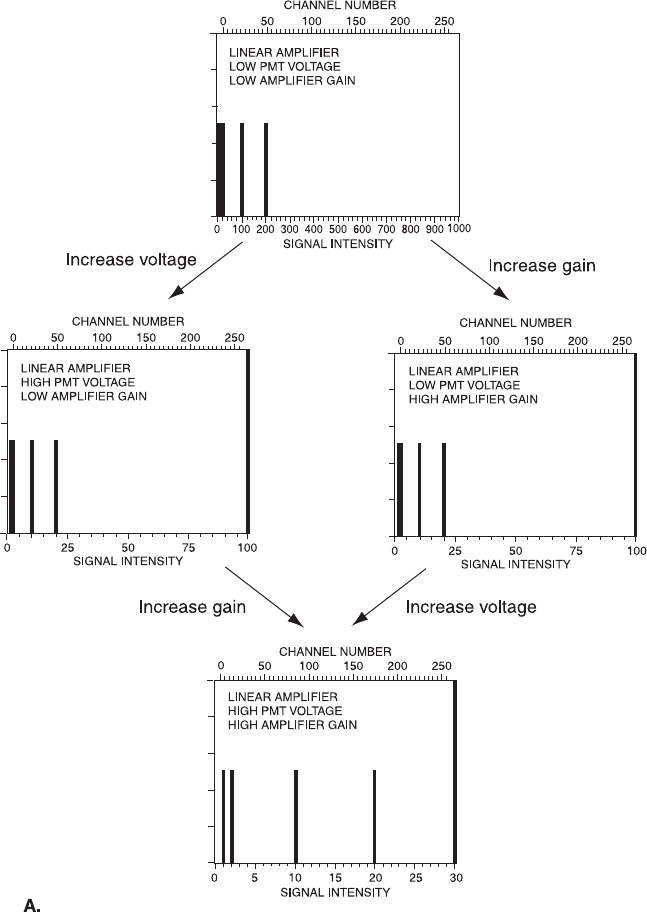
Fig. 3.9. The e¨ect of changes in the photomultiplier tube voltage and ampli®er gain
on the appearance of six signals with intensities in the relationship of 1:2:10:20:100:200
to each other. A: Linear ampli®cation. B: Logarithmic ampli®cation. (continued on
next page)
Flow Cytometry32
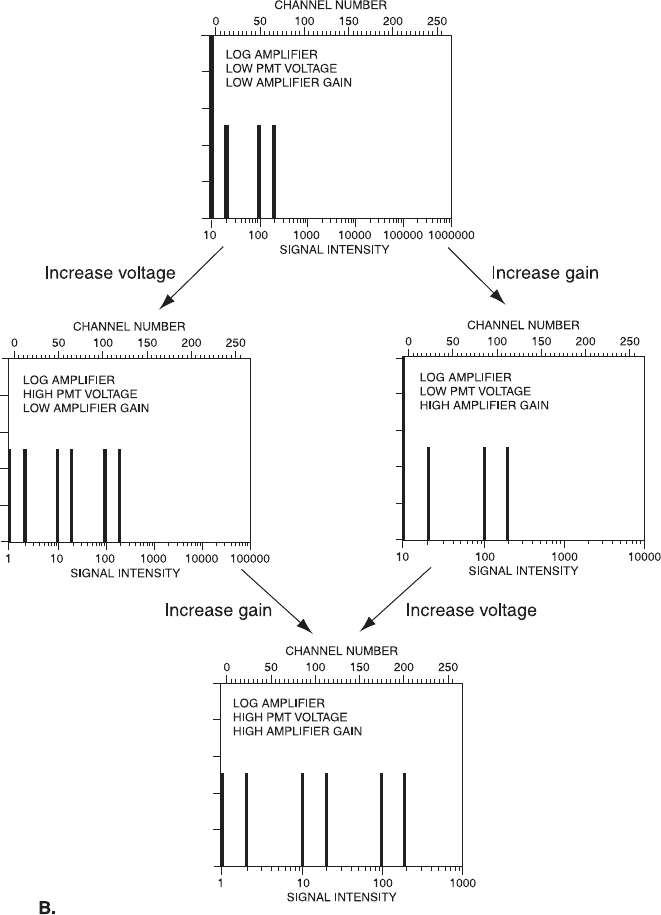
Fig. 3.9. (continued )
Instrumentation 33
control over the ampli®er. Our control of the ampli®er can take the
form of choice of log or linear ampli®cation and also of choice of the
precise gain applied. In addition, logarithmic ampli®ers often allow
an ``o¨set'' control, allowing the selection of the intensity range to be
analyzed without changing the ampli®cation. A comparison with log
and linear graph paper is often helpful here. Figure 3.9 uses the graph
paper analogy to indicate the e¨ect these voltage and gain choices
have on six theoretical signals, with intensities in the relationship of
1:2:10:20:100:200 to each other.
By looking at the ``graph paper'' scale on the lower horizontal
axes, it can be seen that, with a linear ampli®er, the origin is equal to
zero; changing the voltage on the detector or changing the ampli®er
gain alters the range of signals that are displayed on scale. With a
logarithmic ampli®er, as with log graph paper, the origin is never
equal to zero; changing the voltage changes the value assigned to the
origin; changing the ampli®er gain stretches or contracts the range of
signals displayed. The gain setting used with a log ampli®er is often
referred to as, for example, 3 log decades full scale or 4 log decades
full scale. What this means is that the top of the scale represents
an intensity 10
3
or 10
4
times as bright as the bottom of the scale
(think of log graph paper with 3 or 4 cycles). Many cytometers use
log ampli®ers that are ®xed at a scale encompassing nominally 4 log
decades. With other cytometers, the gain on the log ampli®er can be
varied by the operator to give a range of perhaps 2 to 5 log decades
for the full scale. With a log ampli®er, as with log graph paper,
signals that are double in intensity relative to each other will be the
same distance apart no matter where they are on the scale; in addi-
tion, distributions of signals with the same proportional variation
around the mean (coe½cient of variation [CV]) will look the same no
matter where they appear on a log scale. Neither of these things is
true with a linear ampli®er or with linear graph paper.
Log ampli®ers are usually employed to analyze ¯uorescence sig-
nals from cells with stained surface markers, because these cells often
exhibit a great range of ¯uorescence intensities. Linear ampli®ers are
usually employed for analyzing the DNA content of cells, because the
DNA content of cells does not normally vary by more than a factor
of 2 (e.g., during cell division). Linear ampli®ers may be used to
analyze forward and side scatter signals, but practice here is apt to
vary from lab to lab. With either linear or logarithmic ampli®cation,
Flow Cytometry34
the choice of voltage or ampli®er gain will depend on the range of
intensities to be analyzed. The goal is to choose electronic settings so
that the dimmest cells analyzed fall at the low end of the scale and
the brightest cells fall at the top end of the scale.
Once the electrical signal from a photodetector has been ampli®ed,
its intensity is then analyzed and this value will be recorded by means
of an analog-to-digital converter (an ADC). The role of an ADC is to
look at a continuous distribution of signals and group (or bin) them
into discrete rangesÐmuch as you would need to do if you wanted to
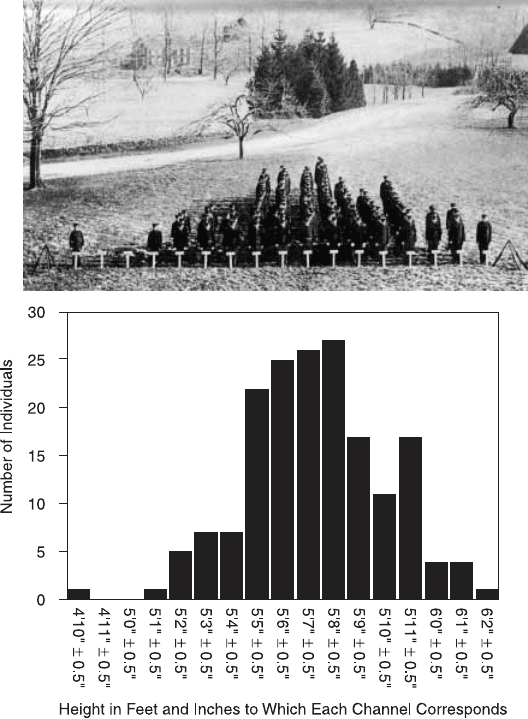
plot the heights of a group of people on a bar graph (histogram). For
a height distribution histogram, the ®rst bar might represent the
number of people with heights (in old-fashioned feet and inches) be-
tween 4
0
9.5
00
and 4
0
10.5
00
(4
0
10
00
G 0:5
00
); the second bar, the number
of people with heights between 4
0
10.5
00
and 4
0
11.5
00
; and so on (Fig.
3.10). Similarly, the ADC of a ¯ow cytometer divides the electrical
signals that it receives from each photodetector into discrete ranges.
Here we run into that term channel that ¯ow cytometrists use so
often. The ADCs on a ¯ow cytometer are divided up into a discrete
number of channels; the number of channels is usually 1024 (but may
be 256 or even 65,536). Each channel represents a certain speci®c
light intensity range (like the 17 channels each with a 1 inch range on
our cadet height example). The signal from a cell is recorded in one
or another channel depending on the intensity of that signal. It is the
combination of photodetector voltage and ampli®er gain that allows
the user to set the intensity range represented by each of those chan-
nels. Using, for our example, a 256 channel ADC, we can now look
back at the upper horizontal axis in each histogram in Figure 3.9.
Having used the graph paper scale on the lower axis to plot intensity,
we have now divided up the whole range of light intensity into 256
channels on the upper axis (numbered from 0 to 255). Varying the
voltage and gain simply assigns a di¨erent intensity to each of the
channels. The goal is to have the full range of channels encompass
the full range of intensities relevant to a particular experiment. When
the voltages and gains have been selected for a given experiment, the
output data are then simply recorded by the cytometer electronics as
light intensity on a scale of 0 to 255 (or 1023).
It is only by knowing something about the ampli®er and voltage
settings that you can know what relationship those values of 0 to 255
or 1023 bear to one another. For example, if we are using an ADC
Instrumentation 35
with 1024 channels and have selected a log ampli®er with a gain that
gives us 2 decades for the full scale, then we would know that a signal
appearing in channel 700 has been given o¨ by a cell that is 10 times
as bright as a cell giving a signal in channel 188 (with a 2 decade full
scale ampli®er, every 512 channels represents a 10-fold increase in
intensity; the entire 1024 channels represent two consecutive 10-fold
increases in intensity 10
2
). If, on the other hand, the gain on the
Fig. 3.10. World War One cadets from Connecticut Agricultural College arranged to
form a height histogram. Photograph from A. Blakeslee (1914).
Flow Cytometry36