
Givan A.L. Flow Cytometry. First Principles
Подождите немного. Документ загружается.

tion crisis will occur (hyperacute rejection), destroying the grafted
organ and threatening the life of the recipient. Therefore, the serum
from a potential recipient is assayed before surgery for cytotoxic
antibodies by mixing it with lymphocytes from the organ donor (in
the presence of rabbit complement). Traditionally, the cytotoxicity of
the serum in this cross-match assay is scored by counting dead lym-
phocytes (cells taking up propidium iodide or trypan blue) under the
microscope. Addition of anti-human globulin can enhance the sensi-
tivity of this assay for bound immunoglobulin.
In the early 1980s, MR Garovoy and his group in California sug-
gested that this cross-match assay might not be sensitive enough.
Some of the cases of slower rejection might result from the presence
in the organ recipient of levels of preformed antibodies that were
too low to be detected by the traditional cytotoxic assay. A ¯ow
cytometric cross-match assay for these preformed antibodies directed
against donor lymphocytes was developed by Garovoy and subse-
quently modi®ed by Talbot in Newcastle and by workers at other
centers to make use of two-color ¯uorescence. The assay involves
the incubation of the organ donor's lymphocytes with serum from
potential recipients followed by the staining of the lymphocytes with
a phycoerythrin-conjugated monoclonal antibody against either T
cells or B cells and a ¯uorescein-conjugated antibody against human
immunoglobulin (Fig. 10.9). In that way, it can be determined
whether the recipient has antibodies that coat the T lymphocytes or
the B lymphocytes of the donor (Fig. 10.10). This two-color tech-
nique (or three-color, if T- and B-cell antibodies are used simulta-
neously) can in fact serve to remind us of a general approach to the
design of ¯ow cytometric assays: One color is used to pinpoint the
cells of interest (in this case, either T cells or B cells), and the second
color is used to ask some question about those cells (in the cross-
match, we are asking whether those T or B cells have become coated
with immunoglobulin from the recipient's serum).
Evidence over the past 15 years has indicated that this assay for
lymphocytes with bound antibody is indeed more sensitive in detect-
ing antibodies directed against donor cells than is the traditional
(microscope) assay for lymphocyte death. The ¯ow assay also de®nes
a group of recipient±donor pairs who are at risk for severe rejection
crises and possibly, but not necessarily, for loss of the grafted organ.
At the present time, donated organs are in short supply. One transplant
Flow Cytometry190
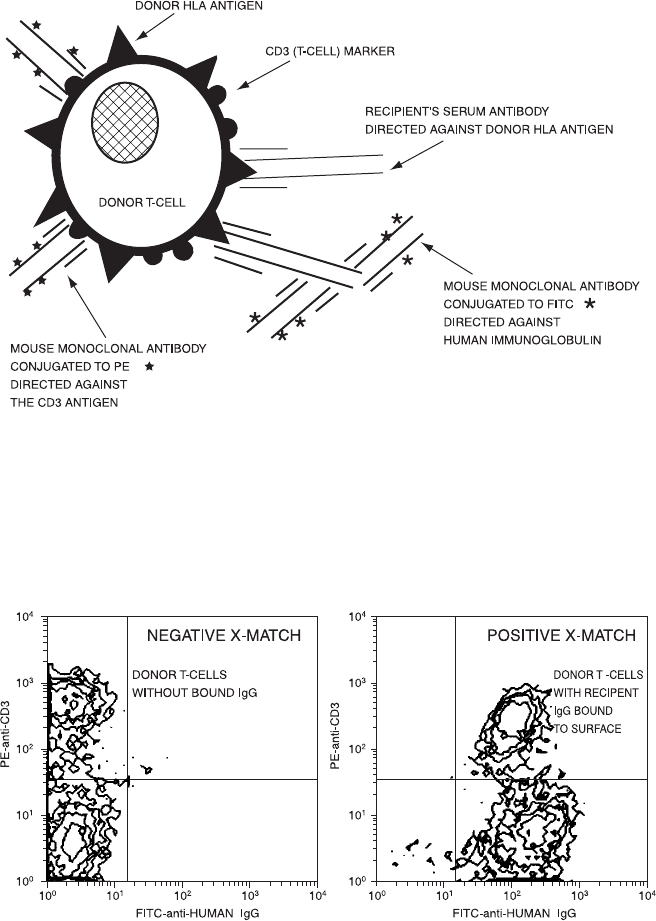
Fig. 10.9. Protocol for the dual-color ¯ow cytometric assay for testing recipient
serum for the presence of antibodies to donor cells before organ transplantation.
Fig. 10.10. Contour plots indicating a cross-match assay for immunoglobulin from
the recipient bound to the surface of the donor's T cells. Data from the Tissue-Typing
Laboratory, Royal Victoria In®rmary, Newcastle upon Tyne.
Disease and Diagnosis 191
surgeon has stated persuasively that, in selecting patients for trans-
plantation, he is most concerned with making sure that the donated
kidney will survive. Although the ¯ow cytometric cross-match assay
may arguably be denying some recipients unnecessarily the opportu-
nity of a successful transplant because it may be too sensitive, it cer-
tainly is helping surgeons to ®nd a group of patients who have the
very best chance of accepting the transplanted organ. Because trans-
plant surgeons have few organs to graft and long waiting lists of
potential recipients and because not enough is yet known about ways
to predict, diagnose, and abrogate rejection, the use of ¯ow cytometry
has been accepted relatively quickly into routine use by some but not
all of the transplant community.
The acceptance of the ¯ow cross-match into the hospital environ-
ment highlights some of the di½culties that occur when any technique
moves from research into service use; in the case of transplantation
surgery, some of these di½culties are particularly acute. The ¯ow
cross-match needs to be implemented in such a way that it can be
performed by people who may be working in the middle of the night
under pressure of time and without specialist support sta¨ available
for easy consultation. Under such conditions, automated software
and stable instrumentation are especially important. In addition, ¯ow
cytometers are relatively expensive instruments; tissue-typing labo-
ratories are concerned with ways to justify the expense of a cytometer
because it needs to be available all the time, but it may only be used
on infrequent occasions. However, the most serious problem in im-
plementing the ¯ow cross-match for routine use has been in de®ning
the position of the dividing line between negative and positive results.
With increasing instrument sensitivity, large numbers of patients will
show some level of serum antibodies directed against donor cells.
De®nition of a ¯uorescence intensity borderline for proceeding with
or denying an organ transplant clearly has to involve some under-
standing of the clinical (and ethical) requirements of patients and of
the supply and demand for organs as well as of the technical capa-
bilities of the cytometer.
COMMENTS
Rational decisions still need to be made about the ®elds in which ¯ow
cytometry can make a positive contribution to patient care, about the
Flow Cytometry192
methods available for quality control, and about the kind and depth
of training required by sta¨. Good channels of communication also
need to be opened between laboratory sta¨ and the clinicians who are
making diagnostic use of ¯ow data, but who may not be aware of its
limitations and conventions. Benchtop cytometers are optically stable
and can be used and maintained with remarkably little human inter-
vention. Software packages for those cytometers can apply algorithms
for automated lymphocyte gating of blood preparationsÐthe com-
puter will draw a lymphocyte gate for you. The future may contain
more sophisticated expert systems employing arti®cial intelligence in
order to avoid the pitfalls associated with human judgement. How
stable these instruments are in practice, whether automated computer
algorithms make reasonable guesses with di½cult samples, and
whether an untrained scientist or clinician can draw reliable con-
clusions from automated print-outs of ¯ow data are open questions.
With ¯ow cytometry, as in any ®eld of science, we need to guard
against conveying a false sense of objectivity to laymen not familiar
with the subjectivity of a technique.
Kenneth Ault, the former president of the International Society for
Analytical Cytology, summed up some of ¯ow cytometry's clinical
growing pains with the following statement:
Flow cytometry is a technology that seems to stand at the threshold of
``clinical relevance.'' Those of us who have been using this technology,
and especially those who are manufacturing and selling the instru-
ments and reagents, are frequently evaluating the status of clinical
¯ow cytometry. Most of us have little doubt that this is going to be
an important technology in clinical medicine for many years to come.
However, from my point of view, and I think for many others, the
movement into the clinic has been unexpectedly slow and painful. . . .
In talking about this in the past I have frequently mentioned the ``grey
area'' between research and clinical practice. I was recently reminded
of a quotation from T.S. Eliot: ``Between the idea and the reality falls
the shadow.'' I believe that ¯ow cytometry is currently traversing that
shadow. KA Ault (1988). Cytometry (Suppl 3):2±6.
That paragraph was written for a talk given in 1986. In the ®rst
edition of this book (1992), I said that clinical cytometry was, at
that time, in what we might call dappled sunlight. Fourteen years
after Ault's talk, in 2000, Bruce Davis, the president of the Clinical
Cytometry Society (Newsletter 5:1±2) said that he remains
Disease and Diagnosis 193
cautiously optimistic regarding the future of diagnostic cytometry in
areas of both image and ¯ow cytometry. Although the applications
of lymphocyte subset counting have seemed to reach a plateau, new
applications using cytometry techniques for disease diagnosis, moni-
toring, and prognostication continue to appear.
Flow cytometry appears fairly comfortable, now, in many hospital
laboratories, and most cytometrists might agree with Davis's cautious
optimism. It may be, however, that ¯ow cytometry has not yet reached
the full glare of total integration into the hospital community.
FURTHER READING
There are many books that cover, in detail, the aspects of clinical
¯ow cytometry that I have mentioned in this chapter and many other
aspects as well. Some of the books that I have found most useful are
listed here.
Bauer KD, Duque RE, Shankey TV, eds. (1993). Clinical Flow Cytometry:
Principles and Applications. Williams & Wilkins, Baltimore.
Keren DF, Hanson CA, Hurtubise PE, eds. (1994). Flow Cytometry and
Clinical Diagnosis. ASCP Press, Chicago.
Laerum OD, Bjerknes R, eds. (1992). Flow Cytometry in Hematology.
Academic Press, London.
Landay AL, Ault KA, Bauer KD, Rabinovitch PS, eds. (1993). Clinical
Flow Cytometry. New York Academy of Sciences, New York.
Owens MA, Loken MR (1995). Flow Cytometry Principles for Clinical
Laboratory Practice. Wiley-Liss, New York.
Riley ME, Mahin EJ, Ross MS, eds. (1993). Clinical Applications of Flow
Cytometry. Igaku-Shoin, New York.
Stewart CC, Nicholson JKA, eds. (2000). Immunophenotyping. Wiley-Liss,
New York.
Flow Cytometry194

11
Out of the Mainstream:
Research Frontiers
In the previous chapters, I have discussed what may be thought of as
mainstream applications of ¯ow technology. Cells stained for surface
and intracellular antigens and nuclei stained for DNA content together
constitute a large majority of the particles that ¯ow through the
world's cytometers. As noted in the Preface, however, ¯ow cytometry
has continued to surprise everyone with its utility in unusual and un-
predicted ®elds of endeavor. By the time this book appears in print,
some new applications will almost certainly have progressed into the
¯ow mainstream and other newer applications will have taken their
place in the tributaries (is it time to kill this metaphor?).
At present, the large number of ``tributary'' applications (highly
varied, often idiosyncratic, and sometimes unsung) precludes any
attempt at making a chapter in an introductory book such as this into
a complete catalogue. Therefore, I will attempt here only to hint at a
few applications that seem to me to be important, or unusual, or to
show promise (it has not escaped my attention that several of the
applications that I said showed promise 10 years ago are still in-
cluded in this chapter as holding potential . . .). Because each reader
will have his or her own personal goals for the use of ¯ow cytometry
according to his or her own interests, I think it is important here
mainly to convey some feeling for the enormous variety and surpris-
ing potential that are found in laboratories using ¯ow cytometry as a
research tool.
195
Flow Cytometry: First Principles, Second Edition. Alice Longobardi Givan
Copyright
2001 by Wiley-Liss, Inc.
ISBNs 0-471-38224-8 (Paper); 0-471-22394-8 (Electronic)
FUNCTIONAL ASSAYS
Activation Markers
Functional analyses can be performed on the ¯ow cytometer by
assaying cells at di¨erent times during the progress of a stimulated
or ongoing change. For example, although leukocytes express cer-
tain proteins on their surface that can be thought of as phenotypic
markers (in other words, these markers are relatively constant in
intensity and are expressed dependably by certain subgroups of cells),
other proteins come and go on the cell surface, depending on the
cell's functional/physiological/activation state. These surface proteins
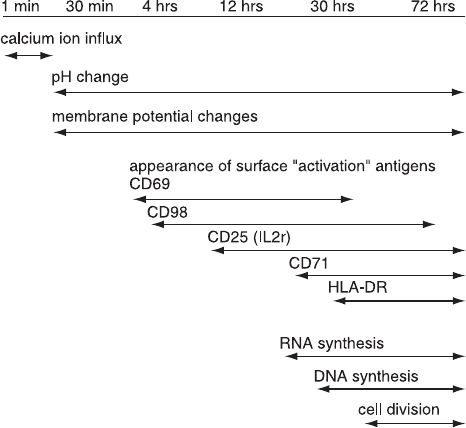
(the interleukin-2 receptor [CD25] or CD69 or CD154 on T cells are
good examples for leukocytes) show characteristic time courses. Time
of appearance after stimulation varies, and expression of some is
long-lasting and of others is relatively transient (Fig. 11.1). In addi-
Fig. 11.1. Lymphocyte responses to stimulation, as measurable by ¯ow cytometry.
The sequence and duration of responses are approximate and will depend on the
nature and strength of the trigger. Adapted from Shapiro (1995).
Flow Cytometry196
tion, there are internal proteins that are synthesized in response to
cell activation: The cytokines discussed in the chapter on intracellular
proteins are in this class, as are the cyclins discussed in the DNA
chapter.
This pattern of progressive and/or transient expression raises cer-
tain problems for a ¯ow cytometrist interested in knowing about the
physiological state of a cell. Obviously, the time at which one assays
the cells is critical, but it should also be clear that any protein that
comes and goes will also, at certain times, be expressed at very low
levels on the cell surface. Therefore it becomes essential to know
something about the sensitivity of the ¯ow cytometer. A cell may
appear to be negative for a certain protein if it is assayed on a certain
cytometer using a certain ¯uorochrome-conjugated antibody, but the
protein might be detectable if a more sensitive cytometer or a brighter
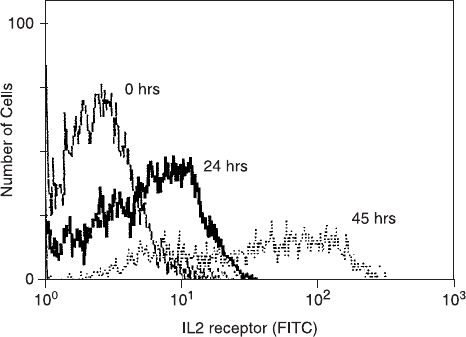
¯uorochrome is used. The other issue with so-called activation
markers is that the level of expression becomes the relevant read out
(Fig. 11.2). We become interested not just in whether a cell is positive
but in how positive it is (the median or mean intensity rather than the
proportion of positive cells). Calibration of the ¯uorescence scale also
becomes more important if we want to compare intensity values from
day to day or from laboratory to laboratory.
Fig. 11.2. The gradual increase in expression of interleukin-2 receptors on the sur-
face of lymphocytes after phytohemagglutinin stimulation.
Research Frontiers 197
Precursor Frequencies
By way of a completely di¨erent type of functional analysis, we can
look at the use of tracking dyes to label and follow cells. Cells can be
stained with lipophilic ¯uorochromes or with ¯uorochromes that bind
nonspeci®cally to all proteins. An example of the lipophilic ¯uoro-
chromes are the so-called PKH dyes that insert themselves into the
bilayer of cell membranes. The dye carboxy¯uorescein succinimidyl
ester (CFSE) binds to the free-amino groups on all cell proteins.
These two types of dyes can be used to stain cells with considerable
stability. The stained cells can then be injected into an animal and
tracked to their homing location.
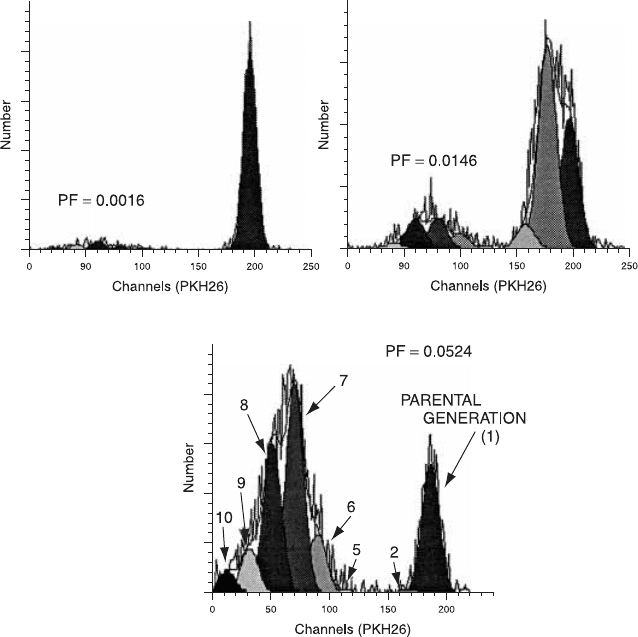
In a di¨erent use of this technique, the proliferation history of a
cell can be followed. Because the dye is passed on from a parent to
each of its daughter cells, a halving dilution of dye content occurs at
each cell division (and a resulting halving of intensity is seen). In this
way, according to their intensity, the cells in a suspension can be
classi®ed as to how many divisions they have undergone since their
labeling at the beginning of the experiment. Those with half the
original intensity have undergone one cell division; those with one
eighth of the original intensity have undergone three cell divisions;
and so forth. By analysis of the intensity histogram of a population of
cells after several days incubation with a stimulus (knowing that a
cell's intensity gives us the number of divisions undergone by that
cell), back-calculation can tell us what proportion of cells in the
original population were stimulated to divide (Fig. 11.3). This meth-
od is therefore a way to look at the precursor frequency of cells re-
sponding to various speci®c stimuli and a way to look at the past
proliferative history of a given cell.
Kinetics
Whereas the applications discussed so far in this book have dealt with
ways to describe cells or nuclei that have been stopped in their tracks
for analysis at a given moment, ¯ow cytometry has also been used to
follow the physiological function of cells in true kinetic analysis. As
an example of this kind of analysis, we can discuss the use of a ¯ow
Flow Cytometry198
cytometer to look at the rapid changes in calcium ion concentration
that occur when cells become physiologically activated.
One of the early responses made by many types of cells to a stim-
ulus is a rapid in¯ux of calcium ions across the plasma membrane
and a resulting increase in the cytoplasmic level of free ionic calcium.
Fig. 11.3. The analysis of a histogram of PKH26 ¯uorescence to categorize cells
according to their generation number (1±10) after 10 days culture. As cells divide,
the PKH dye becomes diluted by half, with each halving of intensity marking cells as
having gone through another division. The precursor frequencies (PF) of the divid-
ing cells can be calculated. Three examples are shown with lymphocytes from donors
with low, medium, and high responses to the tetanus toxoid antigen. Data from Jan
Fisher and Mary Waugh.
Research Frontiers 199