
Givan A.L. Flow Cytometry. First Principles
Подождите немного. Документ загружается.

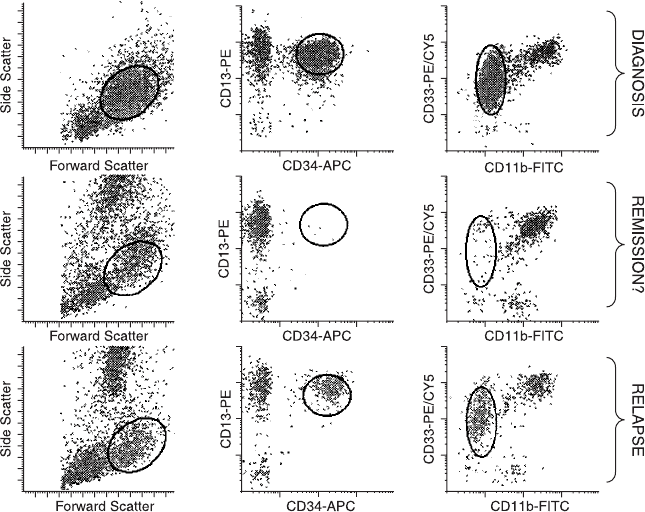
treatment. In addition, the ¯ow phenotype of the malignancy can be
used to look for the emergence of small numbers of these cells should
relapse occur. This, of course, assumes that the relapse phenotype is
identical to the abnormal clone de®ned at the initial diagnosis (Fig.
10.3).
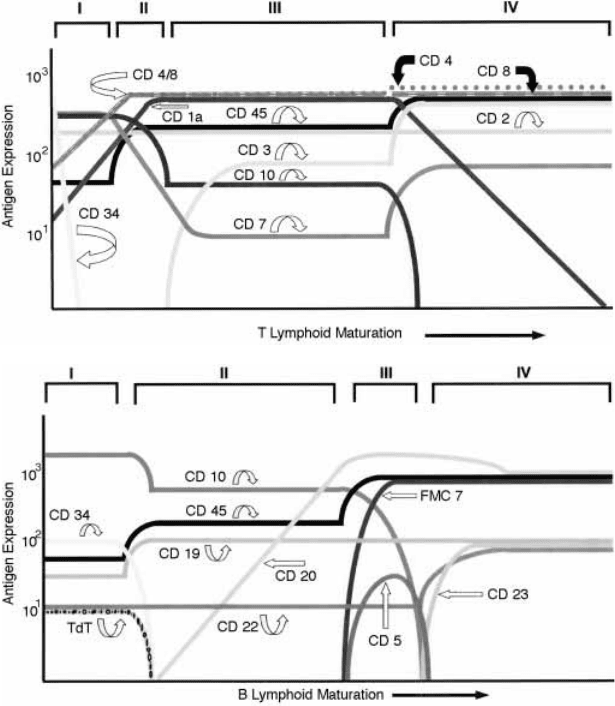
Fig. 10.2. Surface antigen changes during hematopoiesis. The upper plot is of
T-lymphocyte maturation and the lower plot of B cells. From Loken and Wells
(2000).
Flow Cytometry180
HIV/AIDS
Another condition that involves analysis of peripheral blood leuko-
cytes is AIDS. Early in the natural history of the disease (or at least
in the natural history of immunologists' awareness of the disease), it
was discovered that one subpopulation of T lymphocytes in particu-
lar was destroyed by the HIV virus; the cells destroyed are those that
possess the CD4 protein on their surface. It is this CD4 protein that
appears to be a receptor involved in virus targeting. Therefore, much
of the diagnosis and staging of AIDS involves the enumeration of
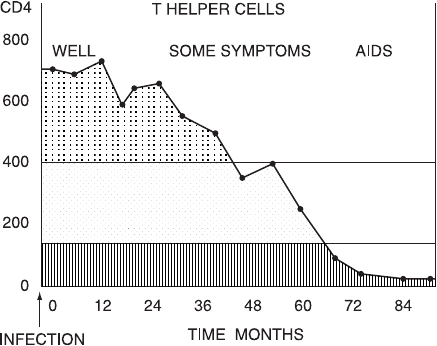
CD4-positive cells in the peripheral blood (Fig. 10.4).
These techniquesÐfor counting CD4-positive cells in connection
with AIDS diagnosis and for phenotyping various populations of
Fig. 10.3. Clusters of cells indicating an abnormal (acute myeloid leukemia) leuke-
mic population, at diagnosis, at remission, and after relapse. The leukemic pheno-
type is CD13, CD34, and CD33 positive and CD11b negative. Courtesy of Carleton
Stewart.
Disease and Diagnosis 181
leukocytes for leukemia/lymphoma diagnosisÐcan be performed in
hematology laboratories by the staining of cells with ¯uorochrome-
conjugated monoclonal antibodies followed by the visual identi®cation
of di¨erent types of white cells and the counting of the ¯uorescent
versus unstained cells under the microscope. Although the microscope
has certain very de®nite advantages over the ¯ow cytometer, two ad-
vantages it does not have are those of speed and statistical reliability.
Particularly as a result of their work load from the growing number of
AIDS patients, hematologists' need for a way to count statistically
reliable numbers of cells from large numbers of patients became in-
creasingly urgent. Flow cytometry was the obvious answer to this
need.
Erythrocytes and Platelets
Although the initial perceived need in the hematology laboratory for
a ¯ow cytometer was to aid in the rapid processing of samples from
leukemic and HIV-positive patients, the presence of the cytometer has
Fig. 10.4. The number of T-helper (CD4-positive) lymphocytes (10
3
=cm
3
)in
peripheral blood of a patient after infection with HIV. Cells <400 are signi®cantly
below the normal range; <100 indicates severe risk of clinical AIDS. Courtesy of
Le
Â
onie Walker.
Flow Cytometry182
stimulated thought about new hematological applications. Although
not yet in routine use for analyzing erythrocytes, ¯ow cytometers
have been shown to be useful for looking at red-cell±bound im-
munoglobulin (as a result of autoimmune disease, sickle cell anemia,
and thalassemia): The bound immunoglobulin on erythrocytes is
detected by the use of ¯uorescent antibodies against human im-
munoglobulin. The staining of red cells for RNA content with a dye
called thiazole orange has made possible the use of ¯ow cytometry to
count the reticulocytes (immature erythrocytes) present in blood
samples from anemic patients.
Hematologists have also extended the use of ¯ow analysis to
plateletsÐthose particles with low forward scatter that usually are
ignored in ¯ow cytometric applications because they fall well below
the standard forward scatter threshold. Immunoglobulin bound to
platelets can be measured with antibodies against human immuno-
globulin (as in the detection of immunoglobulin on erythrocytes).
Platelet-associated immunoglobulin (resulting from autoimmune dis-
ease) is determined by analyzing the patient's platelets in their natural
state. In another clinical situation, antibodies in the serum with
speci®cities for ``foreign'' platelets may develop after pregnancy or
transfusions; these can be monitored by ¯ow cytometry if a patient's
serum is incubated with a donor's platelets. Recently, the activation
state of platelets has also been analyzed. Hyperactive platelets express
P-selectin (CD62) on their surface; they have been primed to facili-
tate coagulation. Although not yet applied in routine diagnosis,
research indicates that expression of CD62 may provide prognostic
information in myocardial infarction and cardiopulmonary bypass
surgery.
HLA-B27 Typing
Human cells express a series of proteins on their surface that are
involved in self-recognition and in antigen presentation to e¨ector
cells for the stimulation of immune reactions. These are called major
histocompatibility (MHC) antigens, and each occurs in a variety of
allelic forms. People, therefore, di¨er from each other in their MHC
genotypes. As well as a¨ecting transplant compatibility, certain gen-
otypes have been implicated in predisposition to autoimmune disease.
Disease and Diagnosis 183
In particular, HLA-B27 (the 27th haplotype at the B locus of the
human leucocyte antigens), has been associated with arthritic con-
ditions (ankylosing spondylitis, juvenile rheumatoid arthritis, and
Reiter's syndrome). While only about 20% of people with the HLA-
B27 genotype have ankylosing spondylitis, for example, a very high
percentage (perhaps 90%) of people with this disease are HLA-B27
positive (compared with 4±8% in the general population). Antibodies
against the HLA-B27 protein are available. Leukocytes can be in-
cubated with ¯uorochrome-conjugated antibodies; positive staining
indicates expression of the HLA-B27 protein. This assay can be
performed with a microscope (using either ¯uorescent antibodies or
complement-®xing antibodies that kill cells). Recently, increasing
numbers of hematology laboratories have begun to use ¯ow cy-
tometers for this assay.
CD34 Stem Cells
After a cancer patient has been treated with irradiation to destroy
malignant cells, normal blood cells will also be depleted and the
patient may require transplantation to regenerate these cells. Hema-
topoietic stem cells (classi®ed by possession of the CD34 antigen on
their surface) are immature, undi¨erentiated cells that have the ability
to di¨erentiate into all classes of blood cells. They exist, normally, in
the bone marrow; detectable numbers can be found in the peripheral
blood if the patient has been treated with blood cell growth factors. If
enough of these stem cells can be harvested from the patient before
irradiation, transplantation of these cells back into the patient after
irradiation can replenish the immune system. The number of these
CD34-positive cells given back after irradiation needs, therefore, to
be assayed in order to ensure that the stem cell transplant is su½cient
to return the patient to normal immune competency. Because these
stem cells are uniquely characterized by the CD34 antigen, ¯ow cy-
tometry can be used to con®rm the presence of su½cient stem cells in
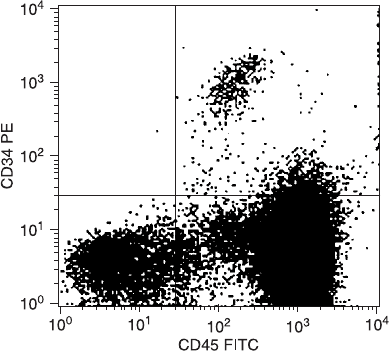
a cell suspension obtained from the patient before irradiation (Fig.
10.5). Because the actual number of these stem cells (rather than just
their proportion in a 10,000 cell data ®le) is important, the volume
¯owing through the ¯ow cytometer can be calibrated by the addition
of known numbers of beads to the sample.
Flow Cytometry184
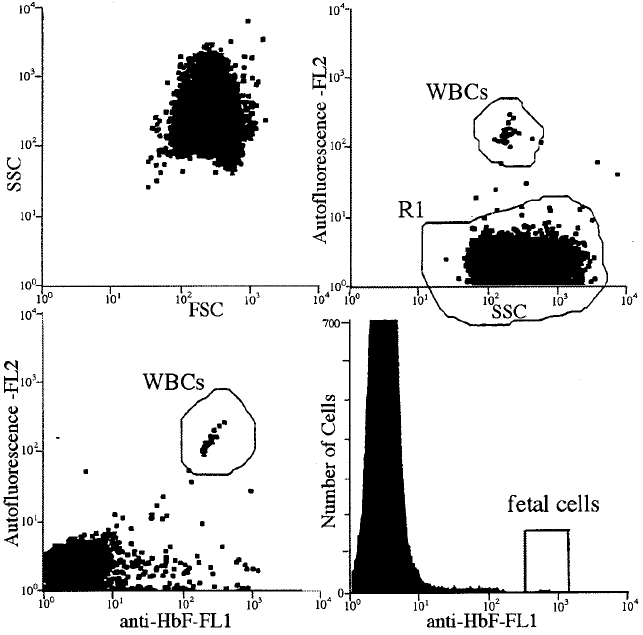
Fetal Hemoglobin
Detection of fetal erythrocytes in the maternal circulation is impor-
tant in diagnosing a cross-placental fetal±maternal hemorrhage that
might have resulted from trauma with suspected maternal injury. In
addition, in the case of Rh-blood group incompatibility between fetus
and mother, rapid detection of fetal cells in the maternal circulation
can allow early intervention and the prevention of Rh-incompatibility
disease (erythroblastosis fetalis) in the newborn. Although detection
of these fetal cells is di½cult because their proportion in the maternal
circulation is low (less than 0.1% in a normal pregnancy; perhaps
0.6% in a pregnancy that needs therapeutic intervention), they can be
assayed by the use of antibodies against the fetal form of hemoglobin
(HbF). This procedure is typical of ¯ow protocols concerned with
rare-event analysis (Fig. 10.6). De®ning the cells of interest (in this
case the HbF-positive cells) by multiple parameters (forward scatter,
side scatter, auto¯uorescence, HbF) reduces the likelihood of false
positivity resulting from background noise.
Fig. 10.5. Stem cells can be assayed by the use of antibodies against the CD34 and
CD45 antigens. From R Sutherland as published in Gee and Lamb (2000).
Disease and Diagnosis 185
THE PATHOLOGY LABORATORY
Tumor Ploidy
In the chapter about DNA analysis, I mentioned the large amount of
work generated for ¯ow laboratories as a result of publication of
the Hedley technique for analyzing the DNA content of para½n-
embedded pathology specimens. After the ®rst headlong rush of
publications correlating DNA ploidy with long-term prognosis in
Fig. 10.6. Detection of rare fetal erythrocytes in the maternal circulation. The fetal
erythrocytes are HbF positive and low in auto¯uorescence. The cells in R1 are dis-
played and enumerated in the bottom right histogram. From Davis (1998).
Flow Cytometry186
various types of cancer, the ®eld has now settled down a bit. As I
have indicated, it would probably be fair to say that most (but not
all) studies on disaggregated solid tumors (fresh, frozen, or ®xed)
have shown some kind of correlation between abnormal DNA con-
tent and unfavorable long-term prognosis.
There is considerable debate in the literature about whether ¯ow
cytometric analysis of ploidy gives any additional prognostic infor-
mation that is independent of other known prognostic indicators, but
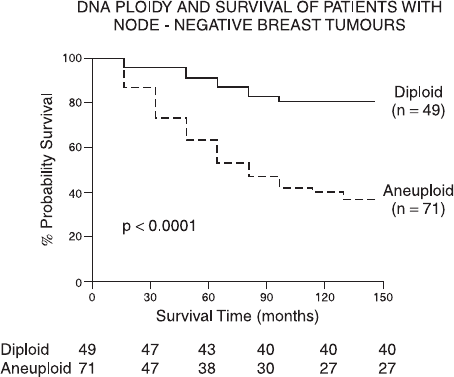
most studies have indicated that it does. It appears to be useful, for
example, in indicating, from all breast cancer patients without lymph
node involvement, a group of women who are at risk for recurrence
of disease (Fig. 10.7). Because any pathological material will be
a mixture of both normal and abnormal cells, there is much cur-
rent e¨ort expended on ways of selecting from among the cells of
a disaggregated specimen those particular cells that are from the
tumor itself. If those tumor cells can be stained selectively (as with a
¯uorescein-conjugated anti-cytokeratin antibody for epithelial cell-
derived tumors within nonepithelial tissue) and then the DNA con-
Fig. 10.7. Survival curves for breast cancer patients without lymph node involve-
ment. Those with DNA aneuploid tumors (as diagnosed by propidium iodide ¯ow
cytometry of 10-year-old para½n-embedded material) survived signi®cantly less long
than those with DNA diploid tumors. Graph from Yuan et al. (1991).
Disease and Diagnosis 187
tent of the ¯uorescein-stained cells determined, we may have a dual
color ¯ow method of much improved sensitivity for detecting
aneuploid cells from within a mixture of both malignant and normal
components.
S-Phase Fraction
There is also evidence, in solid tumors as well as in the bone marrow
plasma cells from patients with multiple myeloma, that determination
of the proliferative potential of malignant cells is a better indicator
of poor prognosis than simply the determination of the presence or
absence of aneuploid cells. As discussed in the chapter on DNA,
proliferation (the proportion of cells in S phase) can be assessed
by using mathematical algorithms to analyze the shape of the DNA
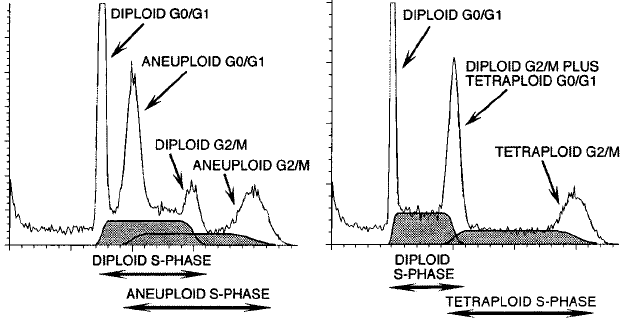
histogram. However, the presence of more than one cell type, with
the G2/M peak from the diploid cell line overlapping the S phase of
the aneuploid cells, makes mathematical analysis even more complex
than with distributions resulting from single euploid cells or clones
(Fig. 10.8). Nevertheless, correlations between high S-phase fraction
and poor clinical prognosis appear relatively strong. Bromodeoxyuri-
dine (BrdU) has been used in the research setting to give information
about proliferation; it has been used both in vitro with fresh excised
tumors and in vivo by infusion into patients at some time before
Fig. 10.8. Analysis of mixed diploid/aneuploid cells for the S-phase fraction of the
aneuploid population.
Flow Cytometry188
excision of the tumor. Estimates of tumor doubling time, based on
the rate of movement of BrdU-pulsed cells through the cell cycle and
on the percentage of cells in the tumor that are dividing, have been
shown to correlate with aggressiveness of the malignancy. There may
in the future be more use of this technique for assaying malignancies
for sensitivity to various cytotoxic drugs.
Ploidy and S-phase fraction determinations are, in most cases, the
only ¯ow analyses that have achieved much routine application in the
®eld of solid tissue oncology. At the present time, it would appear
that ¯ow cytometry has not settled quite so comfortably into the
pathology laboratory as it has into the hematology setting. This may,
I suspect, come from the crucial di¨erence between hematology and
pathologyÐand it is a di¨erence that may remind us of one very
de®nite limitation of ¯ow analysis. Pathological specimens come from
solid tissue; to analyze them with a ¯ow cytometer, the solid tissue
must be disaggregated in some way. This disaggregation process (either
mechanical, with detergent, or with enzymes) not only has a good
chance of compromising the integrity of some or many of the cells we
want to analyze, but ¯ow cytometry will also, necessarily, lose any
information that is contained in the structural orientation or pattern
of the original cells and tissue, as viewed under the microscope.
A response to this dilemma has come, recently, in the development
of laser-scanning cytometry (the LSC by CompuCyte). The LSC uses
a laser to scan cells or tissues on slides and acquires data that can be
presented much as any ¯ow cytometric ¯uorescence or light scatter
information (in histograms or two-color plots). However, the LSC
also acquires extra parameters that record the x/y position of each
cell on the slide. In this way, cells that show aberrant ¯uorescence or
scatter characteristics can be examined individually under the LSC's
microscope to provide high-resolution images and con®rm malignant
or otherwise interesting phenotype. In many ways, the LSC bridges the
technologies of ¯ow cytometry and traditional microscopic pathology.
SOLID ORGAN TRANSPLANTATION
It has been known for many years that transplant recipients may
possess serum antibodies that will react with and destroy cells from a
transplanted organ. If these so-called cytotoxic antibodies are present
at the time of transplantation, then an immediate and violent rejec-
Disease and Diagnosis 189