
Givan A.L. Flow Cytometry. First Principles
Подождите немного. Документ загружается.

Whether at high or low speed, every sort needs to be optimized
according to the particular requirements of the experiment in ques-
tion. Speed, purity, and sorting e½ciency interact and are not, all
three, optimizable under the same conditions. For example, a sort for
a minor subpopulation of cells from a large, easily obtainable cell
suspension may require optimization of speed, without concern about
low sorting e½ciency. On the other hand, a requirement for as many
speci®c cells as possible from among a scarce mixed suspension will
need to maximize recovery without much concern for speed.
ALTERNATIVE METHODS FOR SORTING
There are, of course, other methods for separating cells. Traditional
methods have been based on physical properties (e.g., density gradi-
ent centrifugation) or on biochemical properties (e.g., the adherence
of T cells to sheep erythrocytes or of monocytes to plastic or the resis-
tance of white cells [as opposed to erythrocytes] to lysis by ammonium
chloride). Additional separation methods involve the use of comple-
ment-®xing antibodies, which can be used to stain unwanted cells;
complement lysis will enrich the suspension for the unstained cells.
More recent methods involve the staining of cells with antibodies that
have been bound with magnetic beads; the cells of choice, after being
stained with the antibodies, become magnetic and can be removed
from a mixed suspension by passing the suspension through a mag-
netic ®eld.
All these methods are ``bulk'' or ``batch'' methods; that is, the
amount of time that it takes to perform a separation is not related to
the number of cells that are being separated. For example, if blood
needs to be centrifuged for 20 minutes over a density gradient in
order to separate monocytes and lymphocytes from neutrophils and
erythrocytes, the separation will take 20 minutes whether the original
volume of blood is 1 or 100 ml (assuming enough buckets in the cen-
trifuge). Batch procedures are therefore ideally combined with ¯ow
sorting; they provide an initial rapid pre-separation that can greatly
decrease the amount of time required for the ®nal ¯ow separation
(refer back to Table 9.1).
By way of a practical example, consider CD5-positive B lympho-
cytes. Because CD5-positive B lymphocytes may be 10% of all B
Flow Cytometry170
lymphocytes, B lymphocytes are perhaps 10% of all lymphocytes, and
lymphocytes could be 50% of all mononuclear white cells, if we want
to sort out CD5-positive B cells (0.5%) from a mononuclear cell prep-
aration, they will be ¯owing through our system at a rate of 36,000
per hour if our total particle ¯ow rate is limited to about 2000 per
second. It would therefore take 28 h to collect 1 million CD5-positive
B cells. However, if we remove all nonlymphocytes by adherence to
plastic and then remove all T lymphocytes by rosetting with sheep
erythrocytes (both techniques are rapid batch processes that might
take an immunologist about an hour to perform), we can then send
pure B lymphocytes through the cytometer. The desired CD5-positive
particles (now 10% of the total) will therefore be ¯owing at a rate of
720,000 per hour. As a result, the time it will take to get 1 million
desired cells will go from 28 hours to 1.4 hours. This has obvious
bene®ts both in terms of cost, if you are paying for cytometer time,
and the general health and viability of the sorted cells at the end of the
procedure.
Batch procedures can be useful as pre-¯ow enrichment of the cells
of interest. They can also be used as alternatives to ¯ow sorting if the
cells of interest can be appropriately selected. Flow sorting, although
slow, is generally the only alternative if multiple parameters are re-
quired to de®ne the cells of interest, if antigen density on the cell
surface is low, or if forward or side scattered light is part of the de®-
nition of the desired cells.
In recent years, alternative ¯ow cytometric methods for sorting
have been developed. Instead of sorting cells by applying a charge
to the drops generated by a vibrating stream, one of these methods
involves sorting cells according to their ¯ow signals by ``grabbing''
the cells of interest into a catcher tube that moves into the center of
the stream when a desired cell ¯ows by. Another ¯ow sorting tech-
nology involves the use of a piston that applies pressure to one arm
of a Y-shaped channel downstream from the laser intercept. Cells
normally ¯ow down the waste arm of the ``Y.'' By application of
pressure after a desired cell ¯ows through the analysis point, selected
cells are diverted from the waste arm to the sorting arm of the ``Y.''
While these are cheaper alternatives than traditional, droplet-based,
electronic sorting, speed limitations and the large volume of sheath
¯uid that dilutes the sorted cells make these methods primarily suit-
able for collection of small numbers of cells.
Cell Sorting 171
Another method for ¯ow sorting is currently under development. It
permits extremely rapid selection of cells at speeds beyond those
possible even under very high-speed traditional (drop de¯ection)
conditions. In drop de¯ection sorting, the sort rate is restricted by the
rate of drop formation. This alternative method could be called
reverse sorting or optical zapping and does not involve drop forma-
tion. Cells or chromosomes are stained with a phototoxic dye as well
as with antibodies or a DNA stain. The particles are sent through a
more or less conventional cytometer. Downstream from the analysis
point, a cell or chromosome that does not possess the light scatter or
¯uorescent properties of interest is zapped by a second (killer) laser
that activates the phototoxic dye. All particles end up in the collec-
tion vessel, but only those that have not been zapped survive. The
rate of selection/destruction is limited, therefore, only by the rate at
which the zapping laser can be de¯ected away from the stream. In
proof-of-principle experiments, it appears that sorting rates may be
increased 5-fold over those of the high-speed sorters and 25-fold over
conventional sorters.
THE CONDITION OF CELLS AFTER SORTING
This brings us to a brief discussion of the condition of cells after they
have been sorted. Depending on the purpose for which the sorted
cells will be used, there may be di¨erent requirements for sterility and
viability. If you are sorting cells for subsequent polymerase chain re-
action ampli®cation, for example, then neither sterility nor viability is
important. On the other hand, if you are using a ¯ow sorter because
you want to clone cells expressing a certain characteristic, then both
sterility and viability are necessary. Sterile sorting is possible (with
care and a fair amount of 70% ethanol used to sterilize the ¯ow lines).
Sorted cells can remain sterile through the sort procedure and can
subsequently be cultured for functional analysis or cloning. Given
that cells in a sorting cytometer have been subjected to acceleration,
decompression, illumination, vibration, enclosure, charging, and de-
¯ection toward high voltage plates, it seems reasonable to expect
some trauma and, therefore, to coddle the cells as quickly as possible
after the sort if viability is required. If you remember that the cells
move down the stream in a core that is just a small percentage of the
total volume of the sheath stream, you will realize that each drop is
Flow Cytometry172
mainly sheath ¯uid and that, following drop de¯ection, the cells
are deposited in medium that is partly sample medium, but mainly
sheath ¯uid. Therefore, it is recommended to sort the cells into tubes
that already contain a volume of appropriate culture medium. Some
cells lose viability after sorting; many cells seem to be remarkably
oblivious to the process.
It is also important to remember that most sorting procedures
involve staining of the cells with antibodies conjugated to ¯uoro-
chromes so that the cells can be sorted according to whether or not
they are ¯uorescent. There is always the possibility that the binding
of antibodies to the cell surface might by itself a¨ect the function of
the selected cells. In other words, the sorted cells that are low in
¯uorescence intensity may function di¨erently from the cells that
are bright not because they are essentially di¨erent but simply because
the staining itself has blocked or tweaked surface receptors. By now
you should be able to design a control for this potentially confusing
phenomenon. If the staining is functionally neutral, stained cells
(without any sorting at all) should function identically to unstained
cells with regard to the assay of interest. In addition, it is important
to be sure that the sorting procedure does not a¨ect cell function. The
control for this is to compare unsorted cells with cells that have gone
through the sorter with large sort gates that do not actually exclude
any cells. The sorting procedure should not change the functional
ability of the cells if the proportion of di¨erent kinds of cells is not
changed in this control sort. If the functional ability of the cells is
changed either by sorting or by staining, then this needs to be con-
sidered in the interpretation of the subsequent functional analysis of
the sorted populations.
FURTHER READING
Practical issues in sorting are discussed well in Chapter 4 of Ormerod and in
Section 7 of Diamond and DeMaggio.
Theoretical principles of droplet generation sorting are discussed in Chapter
8inMelamed, in Chapter 6 of Watson, and in Chapter 3 of Van Dilla.
High speed sorting is described in Section 1.7 of Current Protocols in
Cytometry.
Cell Sorting 173
For discussion of chromosome sorting by optical zapping, see Roslaniec
MC, Reynolds RJ, Martin JC, et al. (1996). Advances in ¯ow cytogenetics:
Progress in the development of a high speed optical chromosome sorter
based on photochemical adduct formation between psoralens and chromo-
somal DNA. NATO Advanced Studies Series, Flow and Image Cytometry
95:104±114.
Flow Cytometry174

10
Disease and Diagnosis:
The Clinical Laboratory
Early in this book I stated that one of the areas in which cytometry
has had great impact is in clinical diagnosis. Research work, beginning
with Kamentsky's foray into cytological screening, but particularly
during the last 20 years, has made it clear that the information that
can be obtained by ¯ow cytometry could be of clear use to clinicians.
However, as long as ¯ow cytometers maintained their image of cum-
bersome and ®ddly instruments, di½cult to standardize and requiring
constant attention from a team of unconventional but devoted hackers
(see Figs. 1.3 and 1.4 for an understanding of the origins of this image),
there was little chance that ¯ow cytometry would become integrated
into routine hospital laboratories.
The direct cause of the rapid introduction of ¯ow technology into
many hospitals was the commercial development and marketing
of ``black box'' or ``benchtop'' ¯ow cytometers (in imitation of the
pattern set by blood counters, which were, by the 1980s, standard
equipment in hematology laboratories). Installation of these bench-
top ¯ow instruments involves placing them on a laboratory bench
and plugging them in. They are optically stable and therefore can, in
principle, be maintained with relatively little human intervention;
they can produce clinical printouts that can be read without any re-
quirement for knowledge of the intricacies of ¯ow data analysis; and
they can, we are told, be run by anyone with the ability to push a key
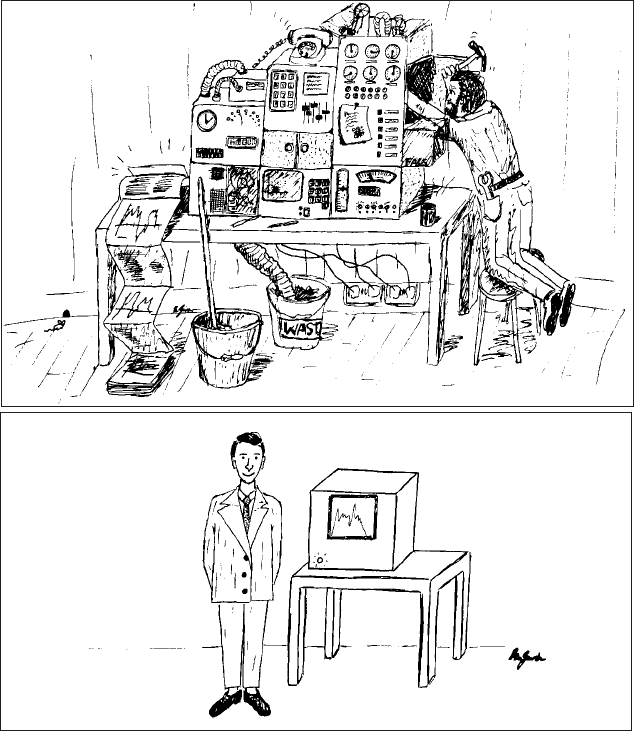
on a computer keyboard (Fig. 10.1). It was only with the develop-
ment and marketing of these friendly machines (starting in the mid to
late 1980s) that provision of ¯ow cytometric information for routine
diagnosis became a practical proposition.
175
Flow Cytometry: First Principles, Second Edition. Alice Longobardi Givan
Copyright
2001 by Wiley-Liss, Inc.
ISBNs 0-471-38224-8 (Paper); 0-471-22394-8 (Electronic)
As a result of the introduction of cytometers into the hospital
setting, three aspects of clinical practice have led to some general
reassessment of the nature of ¯ow analysis. First, clinical laboratories
are, because of the import of their results, overwhelmingly concerned
with so-called quality control. This concern has forced all cyto-
metrists to become more aware of the standardization and calibration
Fig. 10.1. Two opposing fantasies of what ¯ow cytometry is all about. Drawings by
Ben Givan.
Flow Cytometry176
of their instruments. Neither standardization nor calibration comes
naturally to a ¯ow cytometer. In response to this clinical requirement,
beads, ®xed cells, and mock cells have been developed to help in
assessing the stability of conditions from day to day. Instruments can
be set up from stored computer information so that machine param-
eters are constant from run to run. Furthermore, the analysis of data
can be automated so that clinical information can be derived and
reported quickly and in standard format. In addition, quality control
schemes of various sorts have resulted in samples ¯ying around the
world; reports appear in the literature documenting the factors that
lead to variation in results obtained from di¨erent laboratories and
with di¨erent operators. Quality control in ¯ow cytometry is still far
from secure, but progress is being made toward producing technical
recommendations (both for DNA and for leukocyte surface marker
analysis), toward providing schemes for accrediting personnel and
laboratories, and toward monitoring the performance of laboratories
Ðwith comparisons between laboratories and within any one labo-
ratory over the course of time.
The second aspect of clinical practice that has led to a reassessment
of the nature of ¯ow cytometry is the occasional clinical requirement
for ``rare-event analysis.'' Methods have been developed, particularly
with the use of multiparameter gating, to lower background noise in
order to provide increased sensitivity for detection of rare cells. In the
clinic, this increased sensitivity translates, for example, into earlier
diagnosis of relapse in leukemia, more sensitive detection of fetal±
maternal hemorrhage, and better ability to screen leukocyte-reduced
blood transfusion products for residual white blood cells. Outside the
clinic, these methods for rare-event detection have begun to stretch
the limits of research applications as well.
A third aspect of clinical practice that has led to modi®cations in
¯ow technology has been the requirement for safety in the handling
of potentially infectious specimens. The ¯uidic speci®cations of in-
struments have been modi®ed with attention to the control of aero-
sols that might occur around the stream, the prevention of leaks
around the sample manifold, and the collection of the waste ¯uid
after it has been analyzed. However, a more e¨ective means of mini-
mizing biological hazards has been the development of techniques for
killing and ®xing specimens in such a way that cells, viruses, and
bacteria are no longer viable, but the scatter and ¯uorescent proper-
Disease and Diagnosis 177
ties of the cells of interest are relatively unchanged. Formaldehyde
(1.0%) is the ®xative of choice in most ¯ow laboratories. It is used
after cells have been stained. As well as reducing the infectivity of the
hepatitis B and AIDS (HIV) viruses, it ®xes leukocytes in such a way
that their scatter characteristics are virtually una¨ected. Moreover,
the ¯uorescence intensity of their surface stain remains essentially
stable (albeit with slightly raised control auto¯uorescence) for several
days or more. Therefore, routine ®xation of biological specimens has
not only increased the safety of ¯ow procedures but has also made
it possible to ship specimens around the world and to store speci-
mens within a laboratory for convenient structuring of access to the
cytometer (a euphemism for not working in the middle of the night).
It should be said, however, that anyone working with material of
known biological hazard needs to check ®xation procedures to con-
®rm the reduction of infectivity. Even after ®xation, anyone working
with any biological material at all should use standard precautions
for control because any particular ®xation procedure might not be
e¨ective against unknown or undocumented hazards. Furthermore,
whatever ®xation procedure is used should be checked with individ-
ual cell preparations and staining protocols to con®rm the stability of
cytometric parameters over the required period of time.
THE HEMATOLOGY LABORATORY
The ¯ow cytometer has, for several reasons, found a very natural
home in the hospital hematology laboratory. In the ®rst place, be-
cause of the virtually universal use of automated instrumentation for
enumerating erythrocytes and leukocytes, people working in hema-
tology laboratories are quite relaxed about the idea of cells ¯owing in
one end of an instrument and numbers coming out the other end. As
I have said, both historically and technologically there is a close
relationship between ¯ow cytometers and automated hematology
counters. The second reason is the obvious fact that blood exists as a
suspension of individual cellsÐso that red and white cells do not
need to be disaggregated before ¯ow analysis. The third reason for
the hematologist's ease with ¯ow technology is that hematology/
immunology laboratories were among the ®rst to make routine use
Flow Cytometry178
of ¯uorescently tagged monoclonal antibodies. For many years, micro-
scopists have been using panels of monoclonal antibodies for identi-
fying various subpopulations of lymphocytes that are suggestive or
diagnostic of various disease conditions. In particular, because the
leukemias and lymphomas represent a group of diseases that involve
the uncontrolled clonal proliferation of particular groups of leuko-
cytes, various forms of these malignancies can be identi®ed and classi-
®ed according to the phenotype of the increased number of white cells
found in biopsy material or in the patient's peripheral circulation.
Leukemia/Lymphoma Phenotyping
Studies of the staining of surface proteins (CD antigens) to determine
the phenotypes of the abnormal cells in patients with various leuke-
mias or lymphomas have been useful, revealing much about ways
to classify the diseases but also increasing our knowledge of normal
immune cell development. In general, immune cells gain and lose
various surface proteins in the course of their normal development in
the bone marrow until they become the cells (with mature phenotype
and function) that are released from the marrow into the peripheral
circulation (Fig. 10.2). Leukemias and lymphomas often involve a
block in this development so that cells with immature phenotypes
appear in great numbers in the periphery. Alternatively, certain forms
of disease may involve rapid expansion of a clone of mature normal
cells so that one type of cell predominates in the circulation over all
other normal subpopulations. In other cases, cells seem to express
abnormal combinations of CD antigens, a condition referred to as
lineage in®delity or as lineage promiscuity depending on one's inter-
pretation of the data. These variations in surface protein expression
make classi®cation of leukemias and lymphomas a suitable applica-
tion for ¯ow cytometry, albeit a very complex task. Correlation be-
tween classi®cation and predicted clinical course is therefore corre-
spondingly di½cult.
Once the phenotype of a blood cell malignancy in a particular
patient is known, the cytometrist can use the multiparameter ¯ow
description of that phenotype to de®ne the malignant clone and to
look for the absence of these cells in order to diagnose remission after
Disease and Diagnosis 179