
Givan A.L. Flow Cytometry. First Principles
Подождите немного. Документ загружается.

stand sorting is that drops form in a regular pattern so that the dis-
tance between drops is, under all conditions, equal to just about 4.5
times the diameter of the stream. For the usual ¯ow cytometer, if a
nozzle with a 70 mm ori®ce is used, the drops will form with a wave-
length of about 315 mm. In most cytometers, the stream velocity is set
at approximately 10 m/s. Because l (315 mm) and v (10 m/s) are both
now determined, the frequency to achieve drop formation is ®xed as
well. The nozzle needs to be vibrated at
f 10=315 10
ÿ6
31;746 cycles per second
to get drops to form (and this kind of restrictive relationship between
v, f, and l is why drops will form from the garden hose only when
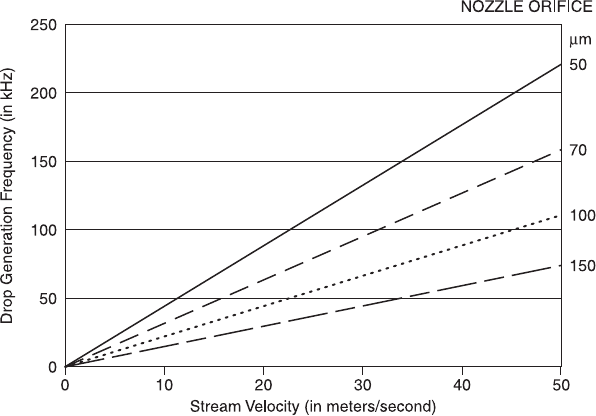
you get it vibrating at a certain frequency). Figure 9.2 illustrates this
relationship between drop generation frequency, stream velocity, and
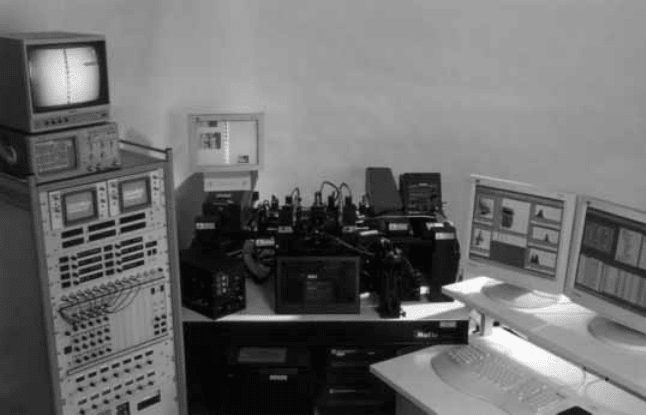
Fig. 9.1. A sorting ¯ow cytometer (MoFlo by Cytomation). The outward complexity
of this instrument compared with benchtop cytometers (see Fig. 1.5) re¯ects the
electronic controls necessary for sorting as well as the adaptability of research
cytometers with regard to multiple lasers and to the ®lters and mirrors in the optical
light path for multiparameter analysis.
Flow Cytometry160
nozzle ori®ce size. With a ¯ow nozzle vibrating at about 30,000 cycles
per second, if the sample is of a concentration such that particles are
moving down that stream at 30,000 particles per second, there will
be, on average, one particle in every drop; if the particles are less
concentrated and ¯owing at 3000 particles per second, there will be,
on average, one particle in every tenth drop.
When a stream vibrates, drops break o¨ from the jet at some
measurable distance from the ®xed point of vibration. Therefore a
particle can be illuminated and its signals detected without inter-
ference as it ¯ows within the core of a stream through a vibrating
nozzleÐas long as the illumination and detection occur close to the
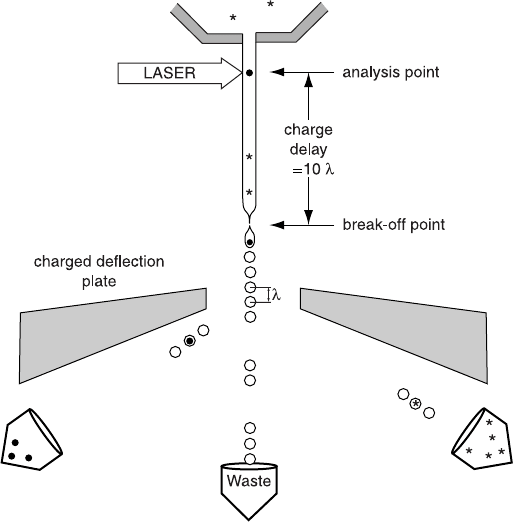
point of vibration (Fig. 9.3). At some distance after the point of
analysis, the stream will begin to break up into drops; particles will
be contained in some of those drops as they break o¨. It remains now
for the cytometer to put a charge on the drops containing particles of
interest. Because the drops will ¯ow past positively and negatively
charged high-voltage plates, any drop carrying a positive or negative
Fig. 9.2. The vibration frequency required to generate drops is determined by the
stream velocity and the nozzle ori®ce diameter. Faster drop generation permits faster
cell ¯ow rate without enclosing signi®cant numbers of multiple cells in single drops.
Cell Sorting 161
charge will be de¯ected out of the main stream and toward one or the
other plate. Once this happens, it is easy to place test tubes, Eppen-
dorf tubes, or wells of a microtiter plate in position to catch the drops
de¯ected to the left or right.
The main trick of ¯ow sorting is, therefore, to apply a charge only
to the correct drops (i.e., the ones containing the desired particles)
and to no others. To do this, we need to know the time that elapses
between the moment a particle is analyzed at the analysis point and
the moment, a bit later, that that particle is just about to be trapped
in a newly formed drop separating from the stream. If the entire
stream is charged (either negatively or positively) by applying a
charge at the nozzle just before the drop is formed with the desired
particle within it, and then the entire stream is grounded at the nozzle
to remove that charge just after the drop in question is formed and
Fig. 9.3. Droplet formation for sorting. A time delay is required between analysis of
a particle and the charging of the stream so that only the drop (or three drops)
surrounding the desired particle will be charged and then de¯ected.
Flow Cytometry162
has detached from the stream, then only the drop with the desired
particle within it will remain charged. Therefore, all we need to do is
determine the time it takes a particle to move from the analysis point
to the point where the drop containing it breaks away from the
stream.
Di¨erent methods are available for determining the time delay be-
tween illumination of (and detecting signals from) the particle and the
trapping of that particle in an isolated drop. In some systems, the
operator does a ``test sort matrix'' of sorted cells or ¯uorescent beads
into puddles on a slide. By changing the timing of the drop charge,
the operator can check (with a microscope) to see which time delay
produces sorted cells or beads in the puddle. In other systems, we can
measure the distance between the analysis point (the laser spot on the
stream) and the drop break o¨ point. Then, to convert that distance
into a time, we count the number of drops that occur in an equal
distance measured further down the stream. Because we can know
the frequency of vibration that is driving the nozzle (in cycles per
second), we therefore also know the number of seconds per cycle. By
counting the number of drops that occur in a distance equal to the
distance between analysis point and drop break-o¨ point, we can
convert the counted number of drops into a time in seconds. It is that
time that is the time delay we want between illumination of the
particle and charging the stream. Fortunately, most cytometers will
do most of these calculations for us. We simply need to count the
number of drops that occur in a distance equivalent to the distance
between analysis point and drop break-o¨ point. The cytometer
electronics then converts that drop number into a time delay, being
the amount of time we need to delay our charging of the stream so
that a particle analyzed at the laser intercept and found to have
desired characteristics has moved in the stream and is about to be
trapped in a forming drop.
Once the charge delay time has been determined (either by count-
ing drops or by a test matrix), the cytometer can then be given sorting
regions delineating the ¯ow cytometric characteristics of the desired
particles. These regions are, like any ¯ow cytometric regions, simply
the numbers (on a scale of 0±1023) that describe the intensity of the
light signals characterizing the particles of interest. They can involve
single ¯ow parameters (e.g., a particular range of green ¯uorescence
intensity), or they can involve multiple parameters and combinations
of regions (e.g., a forward and side scatter region combined with a
Cell Sorting 163
range of green, orange, and red intensities de®ning the phenotype of a
subset of cells). If we are at all unsure about our accuracy in timing
the delay for the drop charge, we can charge the stream for a slightly
longer time (centered around the calculated time delay) so that two or
three drops are charged after a desired particle has been detected at
the analysis point. This should ensure that our desired particle is
de¯ected, even if it should move slightly faster or slightly more slowly
than anticipated.
As discussed earlier, with a nozzle of 70 mm and a stream moving
at 10 m/s, our system is committed to a vibration frequency of about
30,000 cycles per second (30 kHz) in order to get drops to form. If
we prefer a margin of safety, we may want to charge and sort three
drops at a time; in that case, we will want a particle in no more
than every third drop. This means that our total particle ¯ow rate
can be no faster than 10,000 particles per second. Because cells are
not spaced absolutely evenly in the ¯ow stream (they obey a Poisson
distribution), most sorting operators like to have particles separated
by about 10±15 empty drops. With a 70 mm nozzle and a stream
velocity of 10 m/s, this restricts our total particle ¯ow rate to about
2000±3000 particles per second. For sorting cells of very low fre-
quency within a mixed population, this may involve unacceptably
long sorting times.
The startling implications of this restriction on particle ¯ow rate
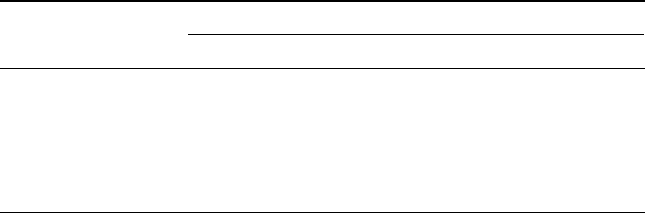
according to the frequency of drop generation can be seen in Table
9.1. If, in order to separate cells by 15 empty drops, the rate of par-
ticles ¯owing is restricted to 2000 per second, then the particles we
TABLE 9.1. Cell Sorting: Time Needed to Sort Required Number of Desired
Particles at Total Particle Flow Rate of 2000 Particles per Second
Desired particles as % of total particles
Required No. of
desired particles 0.1% 1.0% 5.0% 50.0%
10
3
8.3 min 50 s 10 s 1 s
10
4
1.4 h 8.3 min 1.7 min 10 s
10
5
14 h 1.4 h 17 min 1.7 min
10
6
5.8 d 14 h 2.8 h 17 min
10
7
1.9 mo 5.8 d 1.2 d 2.8 h
10
8
1.6 yr 1.9 mo 12 d 1.2 d
Flow Cytometry164
actually desire to purify by the sorting procedure will be ¯owing
at something less than that rate. If the desired particles are 50% of
the total, then they will be ¯owing at a rate of 1000 per second (3.6
million per hour). If, however, the desired particles are only 0.1% of
the total, they will be ¯owing at a rate of 7200 per hour. The time
taken for sorting cells, then, depends ®rst on how fast your cells can
be pushed through the cytometer without unacceptably high rates of
coincidence with multiple cells in drops; second, on what percent the
desired particles are of the total number of particles present; and
third, on how many desired particles are actually required at the end
of the day (or month!). Scientists tend to think logarithmically: It is
easy to say that perhaps 10
6
or 10
7
sorted particles are required for a
given application. But sorting 10
7
particles takes 10 times longer than
sorting 10
6
particles; this can represent a very large investment in
time. One moral of this story is that any preliminary procedure that
can be applied to enrich a cell suspension before ¯ow sorting will save
considerable amounts of time.
Of course, with a little thought it should also be clear that cells
could be run through the sorter more quickly without the risk of
multiple cells in drops if the drops could be generated at a faster rate.
According to our equation, this can be done either by making the
nozzle ori®ce diameter smaller or by running the stream at a higher
velocity. The ®rst solution tends to be impractical, as a clogged
nozzle ends up being very slow in the long run. The second solution
was implemented initially at the Livermore and Los Alamos laborato-
ries, where a high-pressure system (about 100±200 psi) brings about
a stream velocity of about 40±50 m/s and a droplet frequency of
150,000±200,000 drops per second. As a result, particles ¯owing at
rates of 10,000±20,000 particles per second can be sorted without
signi®cant risk of multiple cells in a drop. Total sorting times can be
cut by a factor of 10. High-speed sorting has recently become avail-
able on commercial instruments. Modi®cations of tubing strength,
electronics dead time, and air controls have permitted the pressure on
the sheath tank to be increased from about 10±15 psi to 30±100 psi.
This pressure brings about an increase of the stream velocity from
10 m/s to about 20±40 m/s. Drop drive frequencies need then to be
increased (according to the equation) to 63 to 127 kHz (with a 70 mm
nozzle) to produce drops. Cells can therefore ¯ow at 6000 to 13,000
cells per second and still appear (on average) in only every tenth
Cell Sorting 165
drop. If higher abort rates can be tolerated, then these ¯ow rates can
be tripled (with one cell in, on average, every third drop).
CHARACTERIZATION OF SORTED CELLS
The ®rst matter of concern after a sort is always purity, but purity is
never a straightforward issue ( just like many other aspects of ¯ow
cytometry). Sorting of test beads (as a bench mark) routinely gives
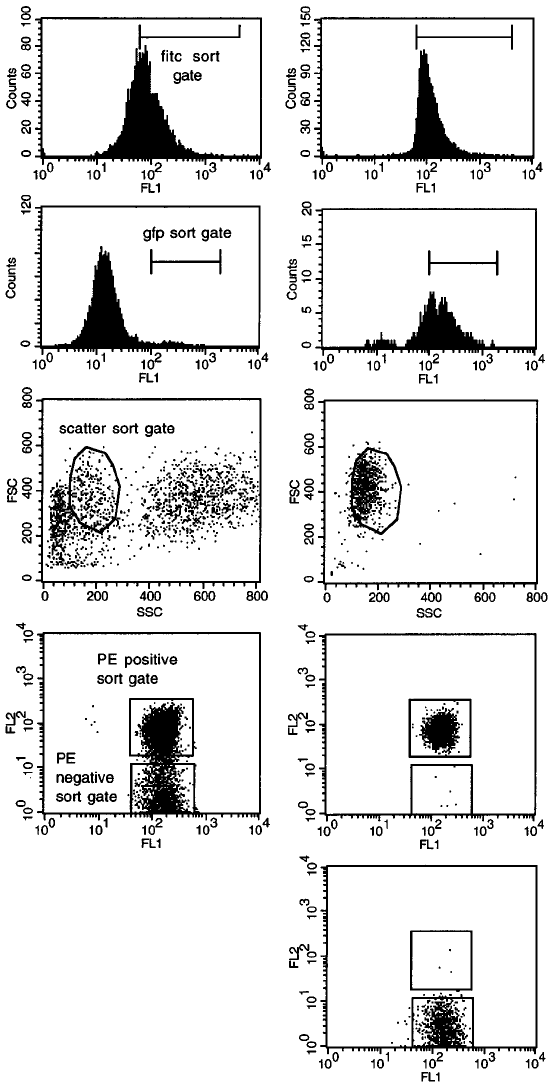
purity of better than 99%. Figure 9.4 shows four real-world examples
of cells before and after sorting. In Figure 9.4, the sort regions on the
plots in the right column (the sorted cells) have not been moved from
where they were set as sort gates before the sort (left column). These
plots illustrate that, at times, the accuracy of the sorter may appear to
be suspect. Our good results with beads should, however, lead us to
conclude that the problem with cells may have nothing to do with the
accuracy of the ¯ow cytometer.
The sort may appear to be inaccurate (and the sorted cells less than
perfectly pure) because the actual intensity of the cells may decrease
between the time a cell is sorted and the time it is run back through
ÐÐÐÐÐÐÐÐÐÐÐÐÐÐÐÐÐÐÐÐÐÐÐÐÐÐÐÐÐÐÐÐÐÐÐÐÐÐÐÐÐÐÐÐÐÐ
f
Fig. 9.4. Four examples of cells sorted by Gary Ward in the Englert Cell Analysis
Laboratory. The plots in the column on the left are from cells before the sort,
indicating the region used to set the sort gate; the column on the right shows the
sorted cells, run back through the cytometer for a ``purity check.'' The top row
shows mouse B lymphocytes that have been transfected with a gene for the human
IgA Fc receptor (a mixed clone cell line from M van Egmond and J van de Winkel;
sort experiment by Mark Lang); the cells have been stained for the IgA Fc receptor
and then sorted for the top 50% expressors. The second row down shows data from a
cell line derived from the tracheal epithelium of a cystic ®brosis patient and invaded
by Staphylococcus aureus bacteria carrying a plasmid promoter library driving the
expression of green ¯uorescent protein (GFP); GFP expression within the eukaryotic
cell (but not in vitro) allows the sorting of cells containing bacteria with promoters
activated by intracellular signals (data courtesy of Niles Donegan). The next row
down shows monocytes sorted on the basis of their forward and side scatter signals
from a preparation of white cells from human peripheral blood (data from Gary
Ward). The bottom two rows illustrate data (from James Gorham) for mouse spleen
cells (pre-puri®ed with anti-CD4 magnetic beads) stained with anti-CD4±FITC and
anti-CD62L±PE (a marker for naõ
È
ve cells); the two-way sort separated naõ
È
ve and
memory CD4±T cells in order to compare their biological activities in vitro.
Flow Cytometry166
the instrument for the purity check. Additionally, the same cell may
show slightly di¨erent ¯uorescence each time it is run through the
cytometer due to ¯uctuations in the optics or ¯uidics of the system.
Another reason for ``impurities'' results from the possibility of ag-
gregates in the original suspension that dissociate after sorting. An
aggregate of a positive and negative cell will be sorted as if it is a
positive cell and then may disaggregate into one of each. For these
reasons, sorting is often a matter of judgment as well as skill.
Aggregates can be avoided in the sort to some extent by using very
tight forward/side scatter regions. For reasons of changing ¯uores-
cence intensity during a long sort, however, the purity of a sort may
often need to be judged by standards that are di¨erent from those
used to drive the sort decisions of the cytometer. Readers should look
at the sorted cells in the right column of Figure 9.4 and guess at what
factors may have contributed to less than perfect purity. In any case,
a sort operator will ascertain the characteristics of the cells that are
desired, set a sort gate that may be considerably tighter than those
desired characteristics, and then check the success of the sort by
comparing the sorted cells with those that were desired. Depending
on the sophistication of the scientist commissioning the sort, all of
this may be explicit or may just be part of the secret communication
between the operator and his or her instrument.
At the end of the day, a ¯ow sort needs to be characterized not
only by the purity of the sorted cells according to the desired criteria
but also by the e½ciency of the sorting of the selected cells from the
original mixed suspension (with low loss) and by the time taken to
obtain the required number of sorted cells. In most cytometers, purity
is good (understanding that apparent failures in purity may have
legitimate reasons, as described above). Purity is well protected by
electronic fail-safe controls that abort drop charging when cells are so
close together at the analysis point that they may be enclosed in the
same drop downstream (or in adjacent drops if two or three drops are
sorted together). In this way, high cell ¯ow rates will lead to lost cells
and will therefore compromise the sorting e½ciency but may not
compromise purity until cells are so close together that they are co-
incident in the laser beam. As cell ¯ow rates are increased by using
more concentrated suspensions, more sort decisions may be aborted
(leading to poorer and poorer e½ciency), but the speed of sorting of
the desired cells will increase until the cell ¯ow rate gets so high and
aborted sorts become so frequent that the actual speed of sorting of
Flow Cytometry168
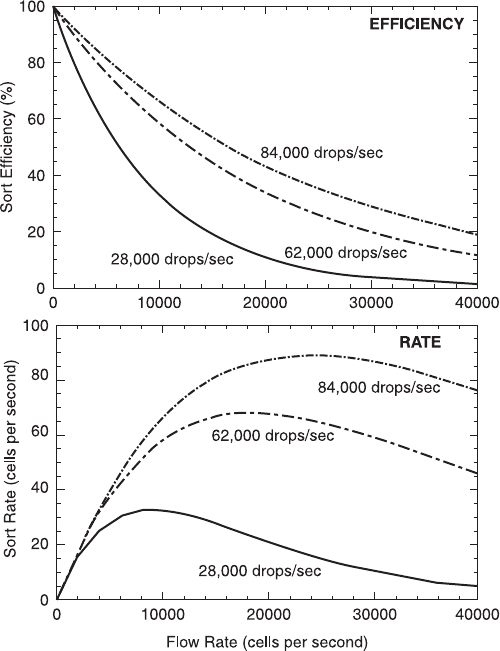
the desired cells starts to drop o¨ (Fig. 9.5). This ®gure also indicates
how bene®cial high drop generation frequencies (high-speed sorting)
can be for both the rate of sorted cell collection and also the e½-
ciency of the sort.
Fig. 9.5. E½ciency and speed of sorting are a¨ected by the ¯ow rate of cells. At high
¯ow rates, more desired cells are lost, but the speed of collecting these desired cells
increases until the loss of e½ciency becomes greater than the increase in speed. High-
speed sorting, with more drops per second, increases the e½ciency and decreases the
time required to obtain the desired number of cells. The model from which these
graphs were generated was derived by Robert Ho¨man: for these data, a three-drop
sort envelope was used, 1% of the cells were ``sorted,'' and the electronic dead time
was set at 6 ms. If one drop is sorted with each sort decision (instead of three), the
theoretical e½ciency of the sorting improves considerably (as does the rate of col-
lecting the sorted cells).
Cell Sorting 169