
Griffiths D.F., Higham D.J. Numerical Methods for Ordinary Differential Equations: Initial Value Problems
Подождите немного. Документ загружается.


166 12. Long-Term Dynamics
Our treatment will necessarily be brief; for further details we recommend the
bo oks by Braun [5, Chapter 4], Stuart and Humphries [65] and Verhulst [68].
12.1 The Continuous Case
Supp ose that x(t) = x
∗
, where x
∗
is a constant, is a solution of (12.1). Clearly
we must have f (x
∗
) = 0, and this motivates a definition.
Definition 12.1 (Fixed Point)
If x
∗
∈ R
m
satisfies f (x
∗
) = 0 then x
∗
is called a fixed point
2
of the system
(12.1).
Supp ose that a solution becomes close to a fixed point. Will this solution
be attracted towards it or be repelled away from it? The following definition
allows us to phrase this mathematically.
Definition 12.2 (Linear Stability)
A fixed point x
∗
of (12.1) is linearly stable (or locally attracting) if there exists
a neighbourhood
3
around x
∗
such that any solution x(t) e ntering this neigh-
bourhood satisfies x(t) → x
∗
as t → ∞.
To investigate linear stability we write a solution of the ODE system in the
form
x(t) = x
∗
+ εu(t), (12.2)
where ε is a “small” real number, and ask whether u(t) grows or decays. We
do this by substituting (12.2) into (12.1) to obtain
εu
0
(t) = f (x
∗
+ εu(t)). (12.3)
Using the Taylor expansion of a function of several variables (see Appendix C)
f(x
∗
+ εu(t)) = f (x
∗
) + ε
∂f
∂x
(x
∗
)u(t) + O(ε
2
)
2
Also known as an equilibrium point, critical point, rest state, or steady state.
3
The phrase “neighbourhood around x
∗
” means the set of points z within a sphere
of radius δ centred at x
∗
, for any positive value of δ. Thus, neighbourhoods can be
arbitrarily small but must contain x
∗
strictly in their interior.

12.1 The Continuous Case 167
and neglecting the O(ε
2
) term, (12.3) becomes, to first order,
u
0
(t) = Au(t), (12.4)
where A is the m × m matrix
A =
∂f
∂x
(x
∗
), (12.5)
known as the Jacobian of the system (12.1) at x
∗
. In two dimensions, where
x = [x, y]
T
∈ R
2
and f = [f, g]
T
, the matrix A has the 2 × 2 form
A =
f
x
f
y
g
x
g
y
.
The system (12.4) is known as the linearization of (12.1) at x
∗
, the idea being
that in the neighbourhood of x
∗
the behaviour of solutions of (12.1) can be
deduced by studying solutions of the linear system (12.4). From (12.2) we see
that u(t) shows us how a small perturbation from x
∗
evolves over time. A
sufficient condition that the s olution x = x
∗
be linearly stable is that u(t) → 0
in (12.4) as t → ∞. The next result follows from Theorem 7.3.
Theorem 12.3 (Linear Stability)
A fixed point x
∗
of the system x
0
(t) = f (x(t)) is linearly stable if <(λ
A
) < 0
for every eigenvalue λ
A
of the Jacobian A =
∂f
∂x
(x
∗
).
Example 12.4
Determine the fixed points of the logistic equation x
0
(t) = 2x(t)
1 − x(t)
and
investigate whether they are linearly stable (see Example 2.2).
In this example we are dealing with scalar quantities (m = 1) with f(x) =
2x(1 − x). The fixed points are given by f(x) = 0, and so x
∗
1
= 0 and x
∗
2
= 1.
The Jacobian is also scalar. It is given by the 1 × 1 matrix
∂f
∂x
(x) = 2 − 4x,
so that
∂f
∂x
(0) = 2 > 0 and
∂f
∂x
(1) = −2 < 0.
Hence, the fixed point x
∗
1
= 0 is locally repelling—solutions starting close to
x = 0 will move further away—while x
∗
2
= 1 will attract nearby solutions. This
is illustrated in Figure 2.3, where a solution starting from x(0) = 0.2 moves
away from x = 0 and is attracted to x = 1 as t → ∞.

168 12. Long-Term Dynamics
Example 12.5
Investigate the nature of the fixed points of the Lotka–Volterra system (see
Example 1.3
4
)
x
0
(t) = 0.05x(t)
1 − 0.01y(t)
,
y
0
(t) = 0.1y(t)
0.005x(t) − 2
.
(12.6)
Now
f(x) =
f(x, y)
g(x, y)
, f (x, y) = 0.05x(1 −0.01y), g(x, y) = 0.1y(0.005x −2).
The fixed points are solutions of the simultaneous nonlinear algebraic equations
f(x, y) = 0 and g(x, y) = 0. These lead to the two fixed points
x
∗
1
=
0
0
and x
∗
2
=
400
100
.
The Jacobian of the system is found to be
∂f
∂x
(x) =
0.05(1 − 0.01y) −0.0005x
0.0005y 0.1(0.005x − 2)
.
At the first fixed point x
∗
1
the Jacobian is
∂f
∂x
(x
∗
1
) =
0.05 0
0 −0.2
,
whose eigenvalues are λ
1
= 0.05 and λ
2
= −0.2. One of these is positive, so
the origin is not an attracting fixed point. At the s ec ond fixed point x
∗
2
the
Jacobian is
∂f
∂x
(x
∗
2
) =
0 −0.2
0.05 0
,
whose eigenvalues are λ
1
= ±0.1i. The real parts of both eigenvalues are zero,
so it is not possible to deduce the precise behaviour of the original system
without taking the nonlinear terms into account. This would take us beyond
the scope of this book (see Braun [5, Section 4.10] or Verhulst [68] for a detailed
study); we observe from Figure 1.3 that the motion is periodic (indicated by
the closed curves) around (400, 100), and this is in keeping with the findings
of Section 7.3, where imaginary eigenvalues were seen to be associated with
oscillatory behaviour.
4
We have used dependent variables x, y here so that u, v can be used for the
linearized system.

12.2 The Discrete Case 169
12.2 The Discrete Case
In this section we study the dynamical behaviour of the discrete map
x
n+1
= F (x
n
), (12.7)
where x
n
∈ R
m
and F (x) is assumed to be a continuously differentiable func-
tion of the m-dimensional vector x. In the context of numerical methods for
solving systems of ODEs such as (12.1), F is parameterized by the step size h:
Euler’s method, for example, leads to
F (x) = x + hf (x). (12.8)
Definition 12.6 (Fixed Point)
If x
∗
∈ R
m
satisfies x
∗
= F (x
∗
) then x
∗
is called a fixed point of the discrete
map (12.7).
Definition 12.7 (Linear Stability)
A fixed point x
∗
of (12.7) is linearly stable (or locally attracting) if there exists
a neighbourhood around x
∗
such that any solution x
n
entering this neighbour-
hoo d satisfies x
n
→ x
∗
as n → ∞.
Mimicking the continuous case, we can investigate linear stability by writing
x
n
= x
∗
+ εu
n
.
Substituting this into (12.7) and using the Taylor expansion
F (x
∗
+ εu
n
) = F (x
∗
) + ε
∂F
∂x
u
n
+ O(ε
2
)
we obtain, on neglecting terms of order O(ε
2
), the linearization of (12.7) at x
∗
:
u
n+1
= Bu
n
, (12.9)
where the m × m matrix
B =
∂F
∂x
(x
∗
)
is the Jacobian of the function F (x) at x
∗
. The following is an analogue of
Theorem 12.3.

170 12. Long-Term Dynamics
Theorem 12.8 (Linear Stability)
A fixed point x
∗
of the system x
n+1
= F (x
n
) is linearly stable if |λ
B
| < 1 for
every eigenvalue λ
B
of the Jacobian B =
∂F
∂x
(x
∗
).
Proof
See, for example, Kelley [41, Theorem 1.3.2 and Chapter 4].
Some insight into Theorem 12.8 can be gleaned (using an argument similar to
that used in Section 8.2) by observing that if λ
B
is an e igenvalue of B with
corresponding eigenvector v then, choosing u
0
= v, the solution of (12.9) is
u
n
= λ
n
B
v. It follows that this u
n
cannot tend to zero as n → ∞ when |λ
B
| ≥ 1.
The next theorem gives an indication of the relationship between the fixed
points of the ODE and those that result when the ODE is solved by Euler’s
method. Its conclusions remain true for all LMMs, but we will not prove this.
Theorem 12.9
Supp ose that Euler’s method is applied to the ODE system (12.1) leading to
the discrete map (12.7) with F (x) defined in (12.8). Then x
∗
is a fixed point
of (12.7) if, and only if, it is a fixed point of (12.1).
Supp ose that x
∗
is a linearly stable fixed point of (12.1) with <(λ
A
) < 0
for every eigenvalue λ
A
of the Jacobian A =
∂f
∂x
(x
∗
). Then it is also a linearly
stable fixed point of (12.7) provided that hλ
A
∈ R, the region of absolute
stability of Euler’s method (Figure 6.6), for every eigenvalue λ
A
of A.
Proof
The proof of the first part is left as Exercise 12.2. For the second part, F (x) is
defined by (12.8) so its Jacobian is given by
∂F
∂x
(x) = I + h
∂f
∂x
(x),
where I is the m × m identity matrix. Therefore, the matrix B in (12.9) is
related to the matrix A in (12.4) through
B = I + hA,
where I is the m ×m identity matrix, and it follows that the eigenvalues λ
A
of
A and λ
B
of B are related by (see Exercise 12.3)
λ
B
= 1 + hλ
A
.

12.2 The Discrete Case 171
We are assuming that x
∗
is a linearly stable fixed point of (12.1) and the
eigenvalues of A satisfy <(λ
A
) < 0. It follows from Theorem 12.8 that x
∗
will
also be a linearly stable fixed point of Euler’s method provided |1 + hλ
A
| < 1,
which is the condition derived in Example 6.7 for
b
h = hλ
A
to lie in the region
of absolute stability.
We will show in Example 12.11 that the first part of the previous theorem
is not true for the modified Euler method. In fact it does not hold for general
explicit RK methods, as they may admit fixed points that are not fixed points
of the ODE system.
Example 12.10
Investigate the linear stability of the fixed points of the map obtained when
Euler’s method is applied to the ODE x
0
(t) = 2x(t)
1−x(t)
that was analysed
in Example 12.4.
The map is given by
x
n+1
= F (x
n
), where F (x) = x + hf(x), (12.10)
and f(x) = 2x(1 − x). It is readily shown that the fixed points are x
∗
= 0, 1.
The Jacobian is the 1 × 1 matrix
∂F
∂x
(x) = 1 + 2h(1 − 2x)
and so
∂F
∂x
(0) = 1 + 2h and
∂F
∂x
(1) = 1 − 2h.
Since
∂F
∂x
(0) > 1 for all h > 0, the fixed point x
∗
= 0 is not linearly stable and
all solutions close to x
n
= 0 are repelled.
At the other fixed point x
∗
= 1 we have
∂F
∂x
(1)
= |1 − 2h| < 1
if, and only if, 0 < h < 1, in which case it is linearly stable.
In this example λ
A
= f
x
(1) = −2 and the interval of absolute stability of
Euler’s method is hλ
A
∈ (−2, 0). This translates to 0 < h < 1, confirming the
relationship between linear stability of true fixed points and absolute stability
of the numerical method identified in Theorem 12.9.
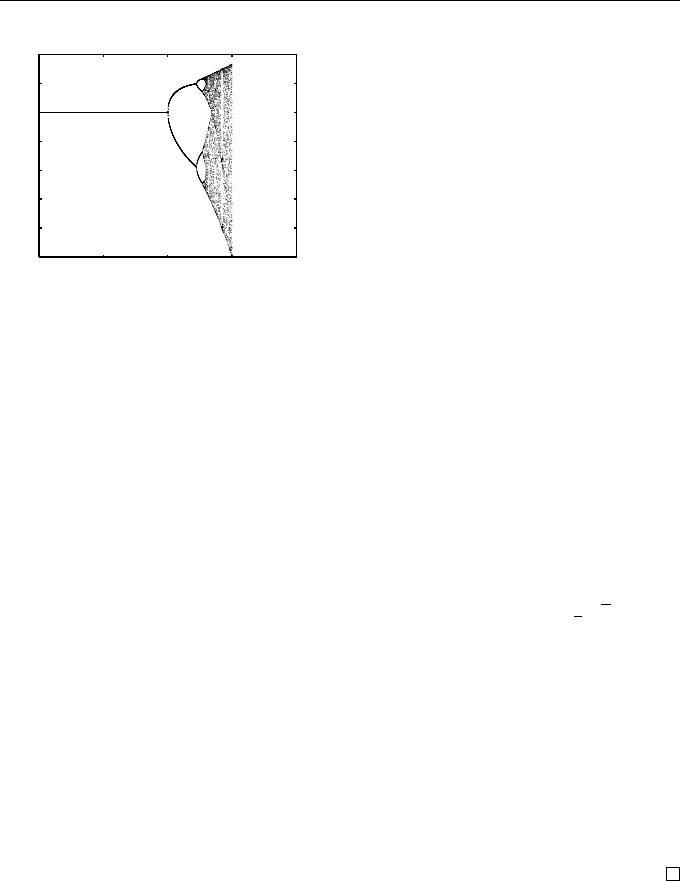
The results of an experiment to test these conclusions are shown in Fig-
ure 12.1. Here, we carried out the iteration (12.10) for 500 steps and then
plotted the p oints (h, x
n
) for the next 20 steps (where, if it possesses one, the
172 12. Long-Term Dynamics
0 0.5 1 1.5 2
0
0.2
0.4
0.6
0.8
1
1.2
1.4
h
x
n
Fig. 12.1 Bifurcation diagram for Eu-
ler’s m ethod applied to the logistic
equation of Example 12.4. The points
(h, x
n
), 500 < n ≤ 520 are plotted for
each h.
sequence would be expected to have reached its stable steady state to within
graphical accuracy). This process was repe ated for many values of h between
0 and 2 and several initial values were used for each value of h.
We see in Figure 12.1 that the sequence x
n
seems to settle down to the
fixed point x
∗
= 1 for 0 < h < 1. The “fixed point” branches to the right of
the value h = 1, x = 1—this is a “period 2” solution, where alternate values of
x
n
take the values a + b and a −b (see Exercise 12.4). This branching is known
as a bifurcation (literally to divide into two branches).
The period 2 solution can be found analytically by studying the fixed points
of the iterated map x
n+1
= F(x
n
), where F(x) = F (F (x)), and its linear stabil-
ity analysed by calculating the Jacobian ∂F/∂x at the fixed points. In this way,
it can be shown that the period 2 solution loses stability at h =
1
2
√
6 ≈ 1.22,
at which a further period-doubling occurs leading to a period 4 solution. Thes e
perio d-doublings continue along with other high-period solutions as h increases.
For certain values of h, the solution becomes “chaotic”—defined loosely as a
sequence that does not repeat itself as n → ∞.
The bifurcation to a period 2 solution occurs when h increases so that hλ
A
leaves the region of absolute stability. This behaviour contrasts with that when
absolute s tability is lost in linear systems, where |x
n
| → ∞ as n → ∞ (see, for
example, Figure 6.2).
For detailed studies of similar quadratic maps see Thompson and Stew-
art [66, Section 9.2].
Our next example contains features common to many RK methods but not
present in the previous example.
Example 12.11
Determine the fixed points of the modified Euler method described in Exam-
ple 9.1 when applied to the scalar equation x
0
(t) = 2x(t)
1−x(t)
and examine
their linear stability.

12.2 The Discrete Case 173
The method is defined by the recurrence
x
n+1
= x
n
+ hf
x
n
+
1
2
hf(x
n
)
,
where f (x) = 2x(1 −x). To find the fixed points we set x
n+1
= x
n
= x so that
they satisfy the equation
5
f
x +
1
2
hf(x)
= 0.
Since f(y) = 0 has the two roots y = 0, 1, the fixed points satisfy
x +
1
2
hf(x) = 0 or 1. (12.11)
These equations then lead to the four fixed points (see Exercise 12.5)
x
∗
1
= 0, x
∗
2
= 1, x
∗
3
= 1/h, and x
∗
4
= 1 + 1/h. (12.12)
With F (x) = x + hf(x +
1
2
hf(x)) the Jacobian is given by
F
0
(x) = 1 + hf
0
(x +
1
2
hf(x))
1 +
1
2
hf
0
(x)
(12.13)
with which it may be verified that
1. x
∗
1
= 0 is not linearly stable for any h > 0;
2. x
∗
2
= 1 is linearly stable for 0 < h < 1;
3. x
∗
3
= 1/h is linearly stable for 1 < h <
1
2
(1 +
√
5) ≈ 1.62;
4. x
∗
4
= 1 + 1/h is linearly stable for 1 < h <
1
2
(−1 +
√
5) ≈ 0.62.
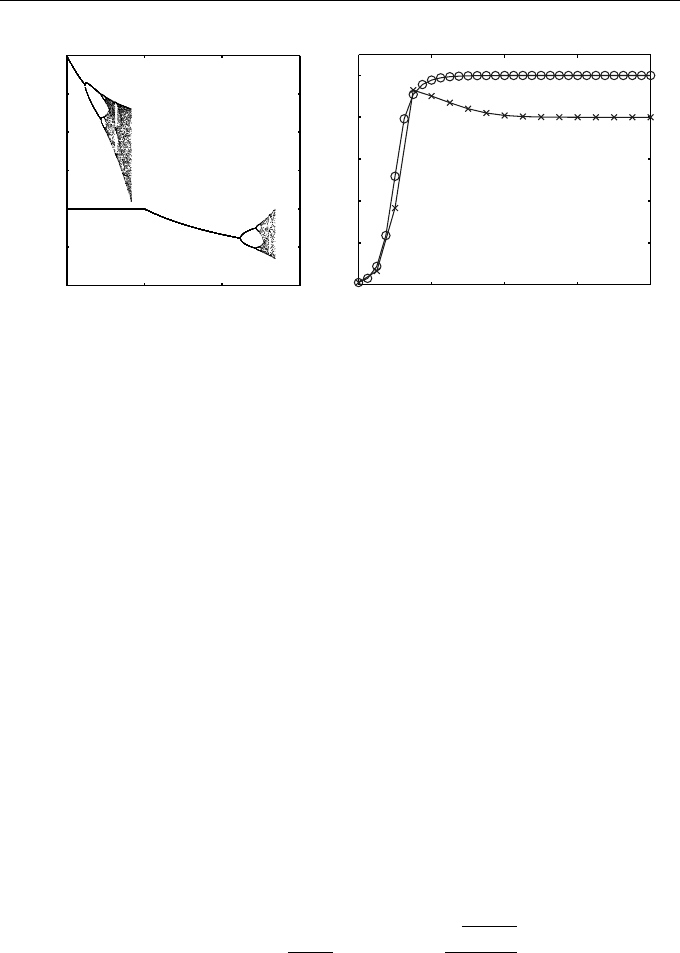
These results are confirmed by the bifurcation diagram shown in Figure 12.2
(left). There is some cause for some concern, since the numerical method has
linearly stable fixed points (x
∗
3
and x
∗
4
) that are not fixed points of the ODE—
they are so-called spurious fixed points—and so numerical experiments could
lead to false conclusions being drawn regarding the dynamical properties of the
system being simulated. However, since these spurious fixed points depend on
h they may be detected by repeating the simulation with a different value of
h—any appreciable change to the fixed point would signal that it is spurious.
The results of such an e xperiment are shown in Figure 12.2 (right) where the
solution reaches the fixed point x
∗
3
= 1/h = 0.8 when h = 1.25, but when h is
reduced to 0.625 it approaches the correct fixed point x
∗
1
= 1.
When the fixed points x
∗
2
and x
∗
1
lose stability as h is increased there ap-
pears to be a sequence of period-doubling bifurcations similar to those observed
in the previous example—the dynamics become to o complicated for us to sum-
marize here. The occurrence of spurious fixed points is not restricted to the
modified Euler method—it is common to all explicit RK methods. A more de-
tailed investigation of the dynamical behaviour of RK methods is presented in
Griffiths et al. [25].
5
When f (x) is a polynomial of degree d in x, then f(x +
1
2
hf(x)) will be a poly-
nomial of degree d
2
.
174 12. Long-Term Dynamics
0.5 1 1.5 2
0
0.5
1
1.5
2
2.5
3
h
x
n
, 500 < n < 520
0 5 10 15 20
0
0.2
0.4
0.6
0.8
1
t
n
x
n
h = 1. 25
h = 0. 625
Fig. 12.2 A bifurcation diagram for the modified Euler method applied to
the logistic equation of Example 12.4 is shown on the left. On the right are
individual solutions from the method with h = 1.25 (×) and h = 0.625 (◦)
EXERCISES
12.1.
??
Show that the system
x
0
(t) = y(t) − y
2
(t),
y
0
(t) = x(t) − x
2
(t)
(12.14)
has four fixed points and investigate their linear stability. (A phase
portrait of solutions to this system is shown in Figure 13.4 (right).)
12.2.
?
Prove the first part of Theorem 12.9. That is, prove that f (x
∗
) = 0
implies that F (x
∗
) = 0 and vice versa when f and F are related via
(12.8).
12.3.
?
If m × m matrices A and B are related via B = I + hA, prove
that they share the same eigenvectors and that the corresponding
eigenvalues are related via λ
B
= 1 + hλ
A
.
12.4.
??
Verify, by substitution, that the difference equation (12.10) has a
solution of the form x
n
= a + (−1)
n
b, where
a =
1 + h
2h
and b =
√
h
2
− 1
2h
,
which is real for h > 1.
12.5.
??
Verify the expressions (12.12) for the fixed points and (12.13) for
the Jacobian in Example 12.11.

Exercises 175
12.6.
??
Repeat the calculations of fixed points and their linear stability
in Example 12.11 for the function f(x) = αx(1 − x), where α is a
positive constant. Check your results with those given in the example
when α = 2.
12.7.
???
Consider the AB (2) method (4.10) applied to the scalar equation
x
0
(t) = f (x(t)). Show that this may be written in the form of the map
(12.7) by defining y
n
= x
n+1
, z
n
= x
n
(which implies z
n+1
= y
n
)
x
n
=
y
n
z
n
, and F (x
n
) =
y
n
+
1
2
h
3f(y
n
) − f(z
n
)
y
n
.
In the case f(x) = 2x(1 − x), show that there are two fixed points
x
∗
= [0, 0]
T
and x
∗
= [1, 1]
T
.
Verify that the Jacobian of the map is given by
∂F
∂x
(x) =
1 +
3
2
hf
0
(y) −
1
2
hf
0
(z)
1 0
and, hence, investigate the linear stability of the fixed points. Do
your results agree with the bifurcation diagram shown in Fig-
ure 12.3?
12.8.
??
Supp ose the separable Hamiltonian problem (see (15.14))
p
0
(t) = −V
0
(q),
q
0
(t) = T
0
(p)
is s uch that V
0
(0) = T
0
(0) = 0, V
00
(0) > 0 and T
00
(0) > 0. Show
that the Jacobian at the equilibrium point p = q = 0 has purely
imaginary eigenvalues.
0 0.2 0.4 0.6 0.8 1
−0.2
0
0.2
0.4
0.6
0.8
1
1.2
1.4
h
x
n
Fig. 12.3 Bifurcation diagram for the
AB(2) method applied to the logistic
equation of Exercise 12.7