
Griffiths D.F., Higham D.J. Numerical Methods for Ordinary Differential Equations: Initial Value Problems
Подождите немного. Документ загружается.


196 14. Geometric Integration Part I—Invariants
14.2 Linear Invariants
A simple chemical reaction known as a reversible isometry may be written
X
1
k
1
X
1
k
2
X
2
X
2
. (14.1)
Here, a molecule of chemical species X
1
may spontaneously convert into a
molecule of chemical species X
2
, and vice versa. The constants k
1
and k
2
re-
flect the rates at which these two reactions occur. If these two species are not
involved in any other reactions, then clearly, the sum of the number of X
1
and
X
2
molecules remains constant.
The mass action ODE for this chemical system has the form
u
0
(t) = −k
1
u(t) + k
2
v(t)
v
0
(t) = k
1
u(t) − k
2
v(t),
)
(14.2)
where u(t) and v(t) represent the concentrations of X
1
and X
2
respectively.
For initial conditions u(0) = A and v(0) = B, this ODE has solution
u(t) =
k
2
(A + B)
k
1
+ k
2
+
A −
k
2
(A + B)
k
1
+ k
2
e
−(k
1
+k
2
)t
,
v(t) =
k
1
(A + B)
k
1
+ k
2
+
B −
k
1
(A + B)
k
1
+ k
2
e
−(k
1
+k
2
)t
;
(14.3)
see Exercise 14.1. Adding gives u(t) + v(t) = A + B, showing that the ODE
system automatically preserves the sum of the concentrations of species X
1
and
X
2
.
Applying Euler’s method to (14.2) gives us
u
n+1
= u
n
− hk
1
u
n
+ hk
2
v
n
,
v
n+1
= v
n
+ hk
1
u
n
− hk
2
v
n
.
Summing these two equations, we find that u
n+1
+ v
n+1
= u
n
+ v
n
. This shows
that Euler’s method preserves the total concentration, matching the property
of the ODE. This is not a coincidence—by developing a little theory, we will
show that a more general result holds.
Instead of solving the system (14.2) and combining the solutions, we could
simply add the two ODEs, noting that the right-hand sides cancel, to give
u
0
(t) + v
0
(t) = 0; that is,
d
dt
(u(t) + v(t)) = 0.
We may deduce immediately that u(t) + v(t) remains constant along any solu-
tion of the ODE. Given a general ODE system x
0
(t) = f(x) with x(t) ∈ R
m

14.2 Linear Invariants 197
and f : R
m
→ R
m
, we say that there is a linear invariant if some linear
combination of the solution components is always preserved:
d
dt
(c
1
x
1
(t) + c
2
x
2
(t) + ··· + c
m
x
m
(t)) = 0,
where c
1
, c
2
, . . . , c
m
are constants. We may write this more compactly as
d
dt
c
T
x(t) = 0,
where c ∈ R
m
. Because each x
0
i
is given by f
i
(x), this is equivalent to
c
1
f
1
(x) + c
2
f
2
(x) + ··· + c
m
f
m
(x) = 0,
which we may write as
c
T
f(x) = 0, for any x ∈ R
m
. (14.4)
The condition (14.4) asks for f to satisfy a specific geometric property: wher-
ever it is evaluated, the result must always be orthogonal to the fixed vector c.
For Euler’s method, x
n+1
= x
n
+ hf (x
n
) and, under the condition (14.4),
we have
c
T
x
n+1
= c
T
x
n
+ hc
T
f (x
n
) = c
T
x
n
, (14.5)
so the corresponding linear combination of the components in the numerical
solution is also preserved. More generally, since they update from step to step
by adding multiples of f values, it is easy to see that any consistent linear
multistep method and any Runge–Kutta method will preserve linear invariants
of an ODE; see Exercise 14.2.
Linear invariants arise naturally in several application areas.
– In chemical kinetics systems like (14.2), it is common for some linear combi-
nation of the individual population counts to remain fixed. (This might not
be as simple as maintaining the overall sum; for example, one molecule of
species X
1
may combine with one molecule of species X
2
to produce a single
molecule of species X
3
.)
– In mechanical models, the overall mass of a system may be conserved.
– In stochastic models where an ODE takes the form of a “master equation”
describing the evolution of discrete probabilities, the total probability must
sum to one.
– In epidemic models where individuals move between susceptible, infected and
recovered states, the overall population size may be fixed.
In all cases, we have shown that standard numerical methods automatically
inherit the same property. Now it is time to move on to nonlinear invariants.

198 14. Geometric Integration Part I—Invariants
14.3 Quadratic Invariants
The angular momentum of a free rigid body with centre of mass at the origin
can be described by the ODE system [26, Example 1.7, Chapter IV]
x
0
1
(t) = a
1
x
2
(t) x
3
(t)
x
0
2
(t) = a
2
x
3
(t) x
1
(t)
x
0
3
(t) = a
3
x
1
(t) x
2
(t)
. (14.6)
Here, a
1
, a
2
, and a
3
are constants that depend on the fixed principal moments
of inertia, I
1
, I
2
, and I
3
, according to
a
1
=
I
2
− I
3
I
2
I
3
, a
2
=
I
3
− I
1
I
3
I
1
, a
3
=
I
1
− I
2
I
1
I
2
.
Note that, by construction,
a
1
+ a
2
+ a
3
= 0. (14.7)
The quantity x
2
1
(t)+x
2
2
(t)+x
2
3
(t) is an invariant for this system; it remains con-
stant ove r time along any solution. We can check this by direct differentiation,
using the form of the ODEs (14.6) and the property (14.7):
d
dt
x
2
1
+ x
2
2
+ x
2
3
= 2 x
1
x
0
1
+ 2 x
2
x
0
2
+ 2 x
3
x
0
3
= 2 x
1
a
1
x
2
x
3
+ 2 x
2
a
2
x
3
x
1
+ 2 x
3
a
3
x
1
x
2
= 2 x
1
x
2
x
3
(a
1
+ a
2
+ a
3
)
= 0. (14.8)
So, every solution of (14.6) lives on a sphere; that is,
x
2
1
(0) + x
2
2
(0) + x
2
3
(0) = R
2
implies that
x
2
1
(t) + x
2
2
(t) + x
2
3
(t) = R
2
for all t > 0. Exercise 14.5 asks you to check that the quantity
x
2
1
I
1
+
x
2
2
I
2
+
x
2
3
I
3
(14.9)
is also an invariant for this system. It follows that solutions are further con-
strained to live on fixed ellipsoids. So, overall, any solution lies on a curve
formed by the intersection of a sphere and an ellipsoid. Examples of such curves
are shown in Figure 14.1, which we will return to soon.

14.3 Quadratic Invariants 199
Generally, we will say that an ODE system x
0
(t) = f (x) has a quadratic
invariant if the function
x
T
C x (14.10)
is preserved, where C ∈ R
m×m
is a symmetric matrix. For the rigid body
example (14.6) we have just seen that there are two quadratic invariants, with
C =
1 0 0
0 1 0
0 0 1
and C =
1/I
1
0 0
0 1/I
2
0
0 0 1/I
3
. (14.11)
By definition, if (14.10) is an invariant then its time derivative is ze ro, giving
0 =
d
dt
x
T
C x
= x
0
T
C x + x
T
C x
0
= 2x
T
C x
0
= 2x
T
C f (x),
where we have used C = C
T
and x
0
(t) = f (x). This shows that x
T
C x is a
quadratic invariant if and only if the function f satisfies
x
T
C f (x) = 0, for any x ∈ R
m
. (14.12)
The implicit mid-point rule is defined by
x
n+1
= x
n
+ hf
x
n
+ x
n+1
2
. (14.13)
This method achieves the commendable feat of preserving quadratic invariants
of the ODE for any choice of stepsize h. To see this, we will simplify the notation
by letting
f
mid
n
:= f
x
n
+ x
n+1
2
.
Then one step of the implicit midpoint rule produces an approximation x
n+1
for which
x
T
n+1
Cx
n+1
=
x
n
+ hf
mid
n
T
C
x
n
+ hf
mid
n
= x
T
n
Cx
n
+ 2hx
T
n
Cf
mid
n
+ h
2
f
mid
n
T
Cf
mid
n
.
From (14.13), we may write
x
n
=
x
n
+ x
n+1
2
−
1
2
hf
mid
n
,
and so
x
T
n+1
Cx
n+1
= x
T
n
Cx
n
+ 2h
x
n
+ x
n+1
2
−
1
2
hf
mid
n
T
Cf
mid
+ h
2
f
mid
n
T
Cf
mid
n
= x
T
n
Cx
n
+ 2h
x
n
+ x
n+1
2
T
Cf
mid
n
.

200 14. Geometric Integration Part I—Invariants
But the last term on the right disappears when we invoke the condition (14.12).
Hence,
x
T
n+1
Cx
n+1
= x
T
n
Cx
n
,
confirming that the numerical method shares the quadratic invariant.
By contrast, applying Euler’s method
x
n+1
= x
n
+ hf
n
, (14.14)
we find, with f
n
denoting f (x
n
), that
x
T
n+1
Cx
n+1
=
x
n
+ hf
T
n
C (x
n
+ hf
n
)
= x
T
n
Cx
n
+ 2hx
T
n
Cf
n
+ h
2
f
T
n
Cf
n
= x
T
n
Cx
n
+ h
2
f
T
n
Cf
n
.
The extra term h
2
f
T
n
Cf
n
will be nonzero in general, and hence Euler’s method
does not preserve quadratic invariants of the ODE. In fact, for the two types of
matrix C in (14.11)
1
we have f
T
n
Cf
n
> 0 for any f
n
6= 0
. So, on the rigid body
problem (14.6) Euler’s method produces an approximation that drifts outwards
onto increasingly large spheres and ellipsoids. This is a more general case of
the behaviour observed in Examples 7.6 and 13.3.
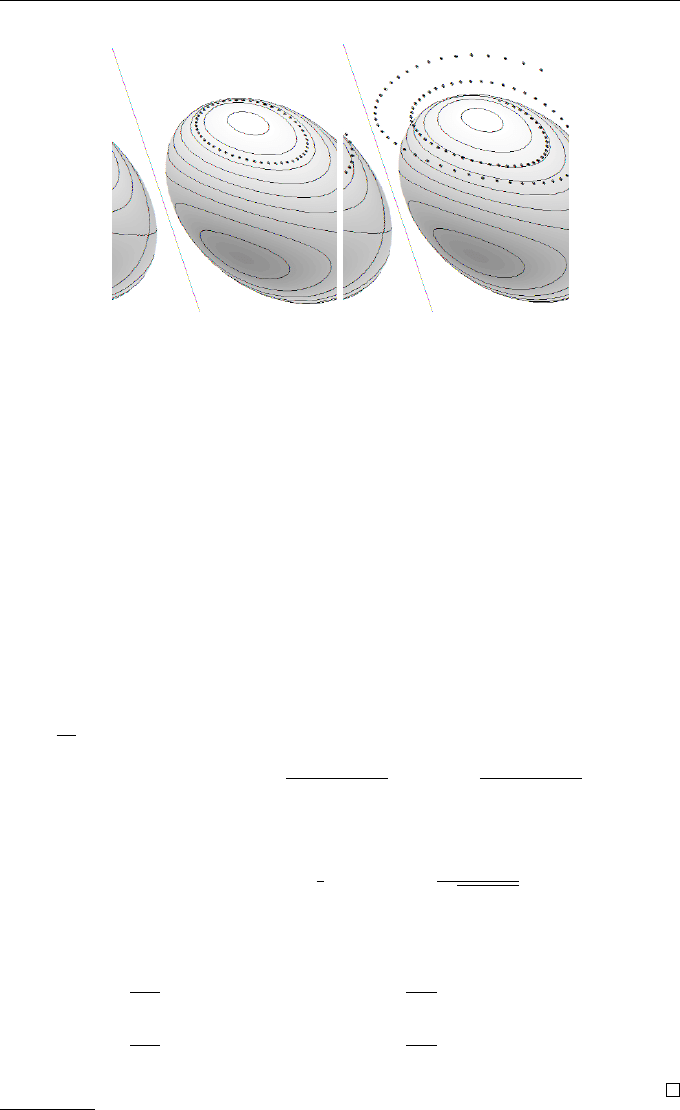
These results are confirmed experimentally in Figure 14.1, which is inspired
by Hairer et al. [26, Figure 1.1, Chapter IV, page 96]. Here, we illustrate the
behaviour of the implicit mid-point rule (left) and Euler’s method (right) on
the rigid body problem (14.6). In each picture, the dots denote the numerical
approximations, plotted in the x
1
, x
2
, x
3
phase space. In this case we have
x
1
(0)
2
+ x
2
(0)
2
+ x
3
(0)
2
= 1, and the corresponding unit spheres are indicated
in the pictures. The solid curves mark the intersection between the sphere and
various ellipsoids of the form (14.9) with I
1
= 2, I
2
= 1 and I
3
= 2/3. Any
exact solution to the ODE remains on such an intersection, and we see that the
numerical solution provided by the implicit mid-point rule shares this property.
The Euler approximation, however, shown on the right, is s ee n to violate thes e
constraints by spiralling away from the surface of the sphere.
Example 14.1 (Kepler Problem)
The Kepler two-body problem describes the motion of two planets. With ap-
propriate normalization, this ODE system takes the form [26, 61]
p
0
1
(t) = −
q
1
(q
2
1
+ q
2
2
)
3/2
, q
0
1
(t) = p
1
,
p
0
2
(t) = −
q
2
(q
2
1
+ q
2
2
)
3/2
, q
0
2
(t) = p
2
,
(14.15)
1
And, more generally, for any symmetric positive definite matrix C.
14.3 Quadratic Invariants 201
Fig. 14.1 Dots show numerical approximations for the implicit mid-point rule
(left) and Euler’s method (right) on the rigid bo dy problem (14.6). Intersections
between the unit sphere and ellipsoids of the form (14.9) are marked as solid
lines. (This figure is based on Figure 1.1 in Chapter IV of the book by Hairer
et al. [26])
where q
1
(t) and q
2
(t) give the position of one planet moving in a plane relative
to the other at time t.
This system has a quadratic invariant of the form
q
1
p
2
− q
2
p
1
, (14.16)
which corresponds to angular momentum. This can be checked by direct dif-
ferentiation:
d
dt
(q
1
p
2
− q
2
p
1
) = q
0
1
p
2
+ q
1
p
0
2
− q
0
2
p
1
− q
2
p
0
1
= p
1
p
2
−
q
1
q
2
(q
2
1
+ q
2
2
)
3/2
− p
2
p
1
+
q
1
q
2
(q
2
1
+ q
2
2
)
3/2
= 0.
However, the system also has a nonlinear invariant given by the Hamiltonian
function
H(p
1
, p
2
, q
1
, q
2
) =
1
2
p
2
1
+ p
2
2
−
1
p
q
2
1
+ q
2
2
, (14.17)
(see Exercise 14.11), so called because the original ODEs (14.15) may be written
in the form
p
0
1
(t) = −
∂
∂q
1
H(p
1
, p
2
, q
1
, q
2
), q
0
1
(t) =
∂
∂p
1
H(p
1
, p
2
, q
1
, q
2
),
p
0
2
(t) = −
∂
∂q
2
H(p
1
, p
2
, q
1
, q
2
), q
0
2
(t) =
∂
∂p
2
H(p
1
, p
2
, q
1
, q
2
).
(14.18)
Hamiltonian ODEs are considered in the next chapter
2
.
2
We will consider problems where H : R
2
→ R, but the same ideas extend to the
more general case of H : R
2d
→ R.

202 14. Geometric Integration Part I—Invariants
14.4 Modified Equations and Invariants
Supp ose now that the ODE system x
0
(t) = f (x), with x(t) ∈ R
m
and f :
R
m
→ R
m
, has a general nonlinear invariant defined by some smooth function
F : R
m
→ R, so that F(x(t)) remains constant along any solution. By the
chain rule, this means that, for any x(t),
0 =
d
dt
F(x(t)) =
m
X
i=1
∂F(x(t))
∂x
i
(f(x(t)))
i
.
We may write this as
(∇F(x))
T
f(x) = 0, for any x ∈ R
m
, (14.19)
where ∇F denotes the vector of partial derivatives of F. This is a direct gen-
eralization of the linear invariant case (14.4) and the quadratic invariant case
(14.12).
Supp ose we have a numerical method of order p that is able to preserve the
same invariant. So, from any initial value x(0), if we take N steps to re ach time
t
f
= Nh then the global error satisfies
x
N
− x(t
f
) = O(h
p
), (14.20)
and, because the invariant is preserved, we have
F(x
N
) = F(x(0)). (14.21)
Now, following the ideas in Chapter 13, we know that it is generally possible
to construct a modified IVP of the form
y
0
(t) = f (y) + h
p
g(y), y(0) = x(0), (14.22)
such that the numerical method approximates the solution y(t) even more
accurately than it approximates the original s olution x(t). In general, by adding
the extra term on the right-hand side in (14.22), we are able to increase the
order by one, so that
x
N
− y(t
f
) = O(h
p+1
). (14.23)
We will show now that this modified equation automatically inherits the in-
variance property of the ODE and numerical method. This can be done through
a contradiction argument. Suppose that the modified equation (14.22) does not
satisfy the invariance property (14.19). Then there must be at least one point
x
?
∈ R
m
where (∇F(x
?
))
T
g(x
?
) 6= 0. By switching from F to −F if
neces-
sary, we may assume that this nonzero value is positive and then, by continuity,
there must be a region B containing x
?
for which
(∇F(x))
T
g(x) > C, for all x ∈ B,

14.5 Discussion 203
where C > 0 is a constant. If we choos e x
?
as our initial condition and let [0, t
f
]
be a time interval over which y(t) remains inside the region B, then,
d
dt
F(y(t)) = h
p
(∇F(y(t)))
T
g(x) > Ch
p
, for t ∈ [0, t
f
].
After integrating both sides with respect to t from 0 to t
f
, we find
|F(y(t
f
)) − F(y(0))| > Ct
f
h
p
. (14.24)
On the other hand, since the method preserves the invariant, we have F(x
N
) =
F(y(0)), so
F(y(t
f
)) − F(y(0)) = F(y(t
f
)) − F(x
N
).
Because F is smooth and we are working in a compact set B, the difference on
the right may be bounded by a multiple of the difference in the arguments
3
.
So, using (14.23), we have
F(y(t
f
)) − F(y(0)) = O(h
p+1
).
However, this contradicts the bound (14.24). So we conclude that the modified
equation must preserve the invariant.
14.5 Discussion
It is natural to ask which standard numerical methods can preserve quadratic
invariants. In the case of Runge–Kutta methods, (9.5)) and (9.6), there is a
very neat result. Cooper [10] proved that the condition
b
i
a
ij
+ b
j
a
ji
= b
i
b
j
, for all i, j = 1, . . . , s, (14.25)
characterizes successful methods. Of course, it is also possible to construct ad
hoc methods that deal with specific classes of ODEs with quadratic, or more
general, invariants.
The result that a modified equation inherits invariants that are shared by
the ODE and the numerical method can be established very generally for one-
step methods, and the same principle applies for other properties, including
reversibility, volume preservation, fixed point preservation and, as we study in
the next chapter, symplecticness. The proof by contradiction argument that we
used was taken from Gonzalez et al. [22], where those other properties are also
considered.
3
More precisely, we may assume that a Lipschitz condition |F(x)−F(y)| ≤ Lkx−
yk holds for x, y ∈ B.

204 14. Geometric Integration Part I—Invariants
The modified equation concept plays a central role in the modern study
of geometric integration. By optimizing over the number of extra terms in the
modified equation, it is possible to show that the difference between a numerical
solution and its closest modified equation can be bounded by C exp(−D/h)
over a time interval 0 ≤ t ≤ E/h, where C, D and E are constants. This is
an exponentially small bound that applies over arbitrarily large time; a very
rare phenomenon in numerical ODEs!
4
Establishing the existence of a modified
equation with the same structure as the original ODE is often a key step in
proving further positive results, such as mild growth of the global error as a
function of time.
Finally, we should add that not all prop e rties of an ODE and numerical
method are automatically inherited by a modified equation; see Exercise 14.12
for an illustration.
EXERCISES
14.1.
??
Confirm that (14.3) satisfies the ODE system (14.2). Also check
that this solution gives u(t) + v(t) ≡ A + B. What happens to this
solution as t → ∞? Explain the result intuitively in terms of the
reaction rate constants k
1
and k
2
.
14.2.
??
By generalizing the analysis for the Euler case in (14.5), show
that any consistent linear multistep method and any Runge–Kutta
method will preserve linear invariants of an ODE. You may assume
that the starting values for a k-step LMM satisfy c
T
η
j
= K, j = 0 :
k − 1, for some constant K when c is any vector such that equation
(14.4) holds.
14.3.
??
Show that the second-order Taylor series method, TS(2), from
Chapter 3, applied to (14.2) takes the form
u
n+1
v
n+1
=
u
n
v
n
+ h
1 −
1
2
h(k
1
+ k
2
)
−k
1
k
2
k
1
−k
2
u
n
v
n
.
Confirm that this method also preserves the linear invariant.
14.4.
??
For the system (14.2) show that u
0
(t) = Au(t), where A may be
written as the outer product
A =
−1
1
k
1
, −k
2
.
4
We should note, however, that the bound does not involve the solution of the
original ODE. Over a long time interval the modified equation might not remain close
to the underlying problem.
Exercises 205
Deduce that A
j
=
−k
1
− k
2
j−1
A (j = 1, 2, 3, . . . ) and hence gen-
eralise the previous exercise to the T S(p) method for p > 2.
14.5.
?
By differentiating directly, as in (14.8), show that the quadratic
expression (14.9) is an invariant for the ODE system (14.6).
14.6.
?
For (14.6) confirm that (14.12) holds for the two choices of matrix
C in (14.11).
14.7.
??
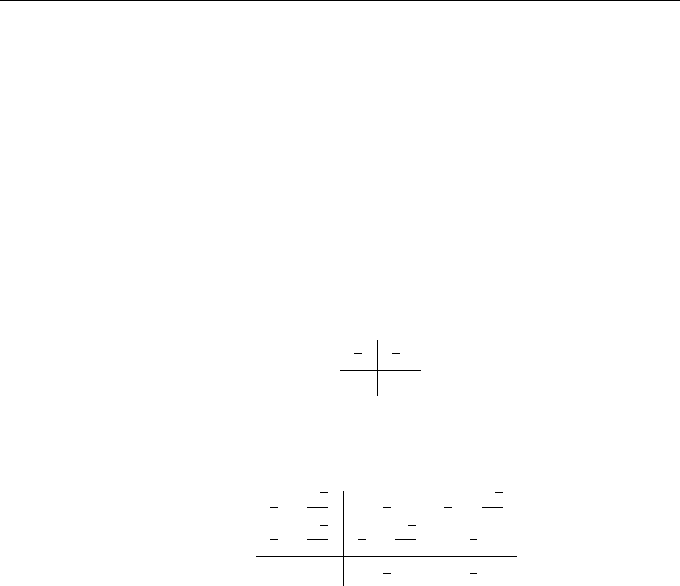
Show that the implicit mid-point rule (14.13) may be regarded as
an implicit Runge–Kutta method with Butcher tableau (as defined
in Section 9.2) given by
1
2
1
2
1
.
14.8.
???
By following the analysis for the implicit mid-point rule, show that
the implicit Runge–Kutta method with Butcher tableau
1
2
−
√
3
6
1
4
1
4
−
√
3
6
1
2
+
√
3
6
1
4
+
√
3
6
1
4
1
2
1
2
called the order 4 Gauss method, als o preserves quadratic invariants
of an ODE system for any step size h.
14.9.
?
The backward Euler method produces x
n+1
= x
n
+ hf (x
n+1
),
instead of (14.14). In this case show that
x
T
n
Cx
n
= x
T
n+1
Cx
n+1
+ h
2
f
T
n
Cf
n
when (14.12) holds for the ODE. Hence, explain how the picture
on the right in Figure 14.1 would change if Euler’s method were
replaced by backward Euler.
14.10.
?
Show that the invariant (14.16) may be written in the form
p
1
p
2
q
1
q
2
C
p
1
p
2
q
1
q
2
,
where C ∈ R
4×4
is symmetric, so that it fits into the format required
in (14.10).