
Griffiths D.F., Higham D.J. Numerical Methods for Ordinary Differential Equations: Initial Value Problems
Подождите немного. Документ загружается.

226 16. Stochastic Differential Equations
an active research topic. Our aim here is to give a nontechnical and accessible
introduction, in the manner of the expository article by Higham [31]. For further
information, in roughly increasing order of technical difficulty, we recommend
Mikosch [51], Cyganowski et al. [13], Mao [49], Milsein and Tretyakov [52] and
Kloeden and Platen [42].
16.2 Random Variables
In this chapter, we deal informally with scalar continuous ra ndom variables,
which take values in the range (−∞, ∞). We may characterize such a random
variable, X, by the probability that X lies in any interval [a, b]:
P (a ≤ X ≤ b) =
Z
b
a
p(y) dy. (16.1)
Here, p is known as the probability density function for X, and the left-hand side
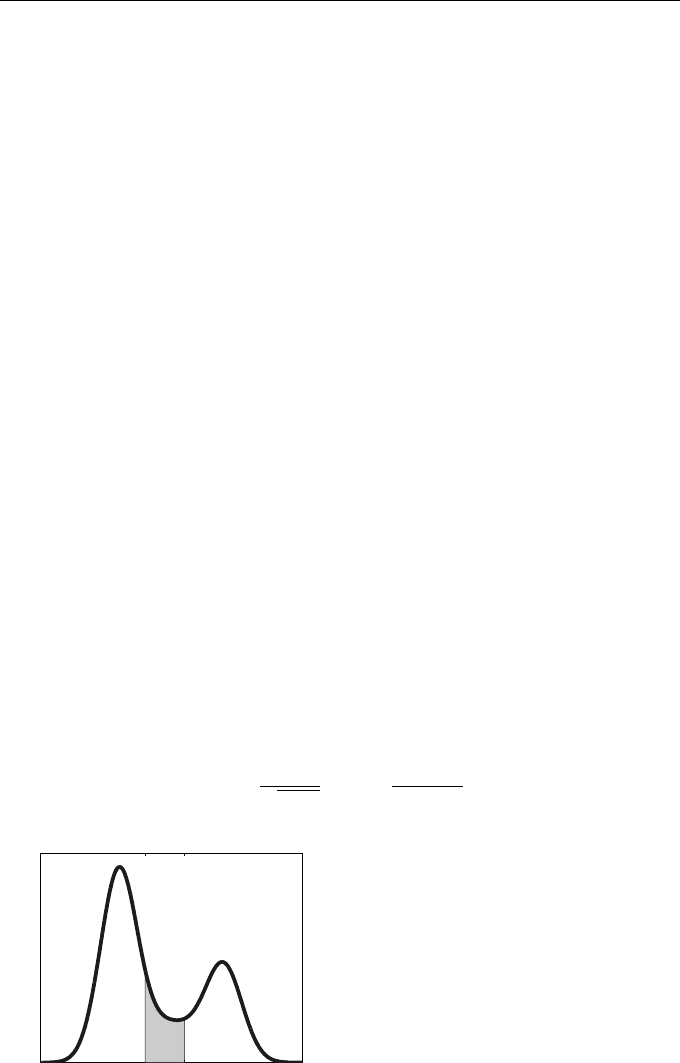
of (16.1) is read as “the probability that X lies between a and b.” Figure 16.1
illustrates this idea: the chance of X taking values between a and b is given
by the corresponding area under the curve. So regions where the density p is
large correspond to likely values. Because probabilities cannot be negative, and
because X must lie somewhere, a density function p must satisfy
(a) p(y) ≥ 0, for all y ∈ R;
(b)
Z
∞
−∞
p(y) dy = 1.
An extremely important case is
p(y) =
1
√
2σ
2
π
exp
−
(y − µ)
2
2σ
2
, (16.2)
a b
p(y)
Fig. 16.1 Illustration of the identity
(16.1). The probability that X lies be-
tween a and b is given by the area un-
der the probability density function for
a ≤ y ≤ b
16.2 Random Variables 227
−10 0 10
0
0.2
0.4
µ = 0, σ = 1
y
p (y )
−10 0 10
0
0.2
0.4
µ = 0, σ = 2
y
p (y )
−10 0 10
0
0.2
0.4
µ = −1, σ = 1
y
p (y )
−10 0 10
0
0.2
0.4
µ = 2, σ = 0. 75
y
p (y )
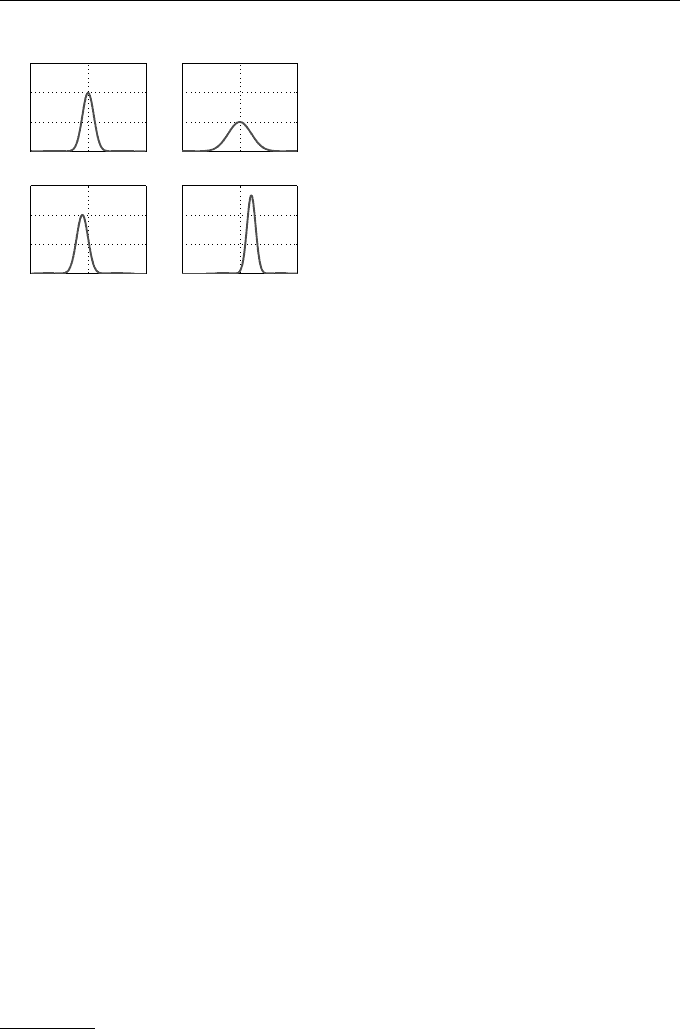
Fig. 16.2 Some density functions
(16.2) corresponding to normally dis-
tributed random variables
where µ and σ ≥ 0 are fixed parameters. Examples with µ = 0 and σ = 1,
µ = 0 and σ = 2, µ = −1 and σ = 1, and µ = 2 and σ = 0.75 are plotted
in Figure 16.2. If X has a probability density function given by (16.2) then we
write X ∼ N(µ, σ
2
) and say that X is a normally distributed random variable.
1
In particular, when X ∼ N(0, 1) we say that X has the standard normal distri-
bution. The bell-shaped nature of p in (16.2) turns out to be ubiquitous—the
celebrated Central Limit Theorem says that, loosely, whenever a large number
of random sources are combined whatever their individual nature, the overall
effect can be well approximated by a single normally distributed random vari-
able.
The parameters µ and σ in (16.2) play well-defined roles. The value y =
µ corresponds to a peak and an axis of symmetry of p, and σ controls the
“spread.” More generally, given a random variable X with probability density
function p, we define the mean, or expected value, to be
2
E[X] :=
Z
∞
−∞
y p(y) dy. (16.3)
It is easy to check that E[X] = µ with the normal density (16.2); see Exer-
cise 16.1. The variance of X may then be defined as the expected value of the
new random variable (X − E[X])
2
; that is,
var[X] := E
h
(X − E[X])
2
i
. (16.4)
Intuitively, the size of the variance captures the extent to which X may vary
about its mean. In the normal case (16.2) we have var[X] = σ
2
; see Exer-
cise 16.3.
1
The word normal here does not imply “common” or “typical”; it stems from the
geometric concept of orthogonality.
2
In this informal treatment, any integral that we write is implicitly assumed to
take a finite value.

228 16. Stochastic Differential Equations
16.3 Computing with Random Variables
A pseudo-random number generator is a computational algorithm that gives us
a new number, or sample, each time we reques t one. En masse, these samples
appear to agree with a specified density function. In other words, recalling
the picture in Figure 16.1, if we call the pseudo-random numbe r generator
lots of times, then the proportion of samples in any interval [a, b] would be
approximately the same as the integral in (16.1). If we think of each sample
coming out of the pseudo-random number generator as be ing the result of
an independent trial, then we can make the intuitively reasonable connection
between the probability of the event a ≤ X ≤ b and the frequency at which
that event is observed over a long sequence of independent trials. For example,
if a and b are chosen such that P (a ≤ X ≤ b) =
1
2
, then, in the long term, we
would expect half of the calls to a suitable pseudo-random number generator
to produce samples lying in the interval [a, b].
In this b ook we will assume that a pseudo-random number generator corre-
sponding to a random variable X ∼ N(0, 1) is available. For example, Matlab
has a built-in function randn, and 10 calls to this function produced the samples
-0.4326
-1.6656
0.1253
0.2877
-1.1465
1.1909
1.1892
-0.0376
0.3273
0.1746
and another ten produced
-0.1867
0.7258
-0.5883
2.1832
-0.1364
0.1139
1.0668
0.0593
-0.0956
-0.8323
16.3 Computing with Random Variables 229
Supp ose we generate M samples from randn. We may divide the y-axis into
bins of length ∆
y
and let N
i
denote the number of samples in each subinterval
[i∆
y
, (i + 1)∆
y
]. Then the integral-based definition of probability (16.1) tells us
that
P (i∆
y
≤ X ≤ (i + 1)∆
y
) =
Z
(i+1)∆
y
i∆
y
p(y) dy ≈ p(i∆
y
)∆
y
. (16.5)
This was obtained by approximating the area under the curve by the area of
a rectangle with height p(i∆
y
) and base ∆
y
; this is valid when ∆
y
is small.
On the other hand, identifying the probability of an event with its long-term
observed frequency, we have
P (i∆
y
≤ X ≤ (i + 1)∆
y
) ≈
N
i
M
. (16.6)
Combining (16.5) and (16.6) gives us
p(i∆
y
) ≈
N
i
∆
y
M
. (16.7)
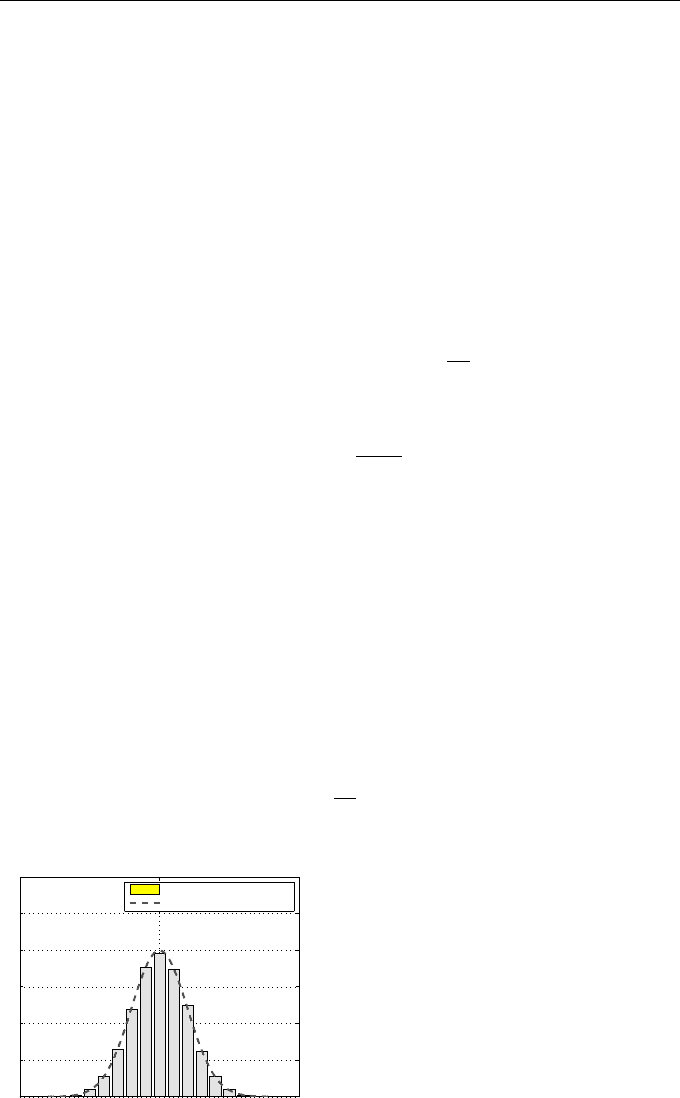
Figure 16.3 makes this concrete. Here, we took M = 10000 samples from Mat-
lab’s randn and used 17 subintervals on the y-axis, with centres at −4, −3.5,
−3, . . . , 3.5, 4. The histogram shows the appropriately scaled proportion of
samples lying in each interval; the height of each rectangle is given by the
right-hand side of (16.7). We have superimposed the probability density func-
tion (16.2) with µ = 0 and σ = 1, which is seen to match the computed data.
In many circumstances, our aim is to find the exp ec ted value of some random
variable, X, and we are able to use a pseudo-random number generator to
compute samples from its distribution. If {ξ
i
}
M
i=1
is a set of such samples, then
it is intuitively reas onable that the sample mean
a
M
:=
1
M
M
X
i=1
ξ
i
(16.8)
−5 0 5
0
0.1
0.2
0.3
0.4
0.5
pseudo -ran d om data
N(0,1) d ensity
Fig. 16.3 Histogram of s amples from
a N(0, 1) pseudo-random number gener-
ator, with probability density function
(16.2) for µ = 0 and σ = 1 superim-
posed. This illustrates the idea that e n
masse the samples appear to come from
the appropriate distribution

230 16. Stochastic Differential Equations
can be used to approximate E[X]. Standard statistical results
3
can be used to
show that in the asymptotic M → ∞ limit, the range
"
a
M
−
1.96
p
var[X]
√
M
, a
M
+
1.96
p
var[X]
√
M
#
(16.9)
is a 95% confidence interval for E[X]. This may be understood as follows: if we
were to repeat the computation of a
M
in (16.8) many times, each time using
fresh samples from our pseudo-random number generator, then the statement
“the exact mean lies in this interval” would be true 95% of the time. In practice,
we typically do not have access to the exact variance, var[X], which is required
in (16.9). From (16.4) we see that the variance is itself a particular case of
an expected value, so the idea in (16.8) can be repe ated to give the sample
variance
b
2
M
:=
1
M
M
X
i=1
(ξ
i
− a
M
)
2
.
Here, the unknown expected value E[X] has been replaced by the sample mean
a
M
.
4
Hence, instead of (16.9) we may use the more practical alternative
"
a
M
−
1.96
p
b
2
M
√
M
, a
M
+
1.96
p
b
2
M
√
M
#
. (16.10)
As an illustration, consider a random variable of the form
X = e
−1+2Y
, where Y ∼ N(0, 1).
In this case, we can com pute samples by calling a standard normal pseudo-
random number generator, scaling the output by 2 and shifting by −1 and
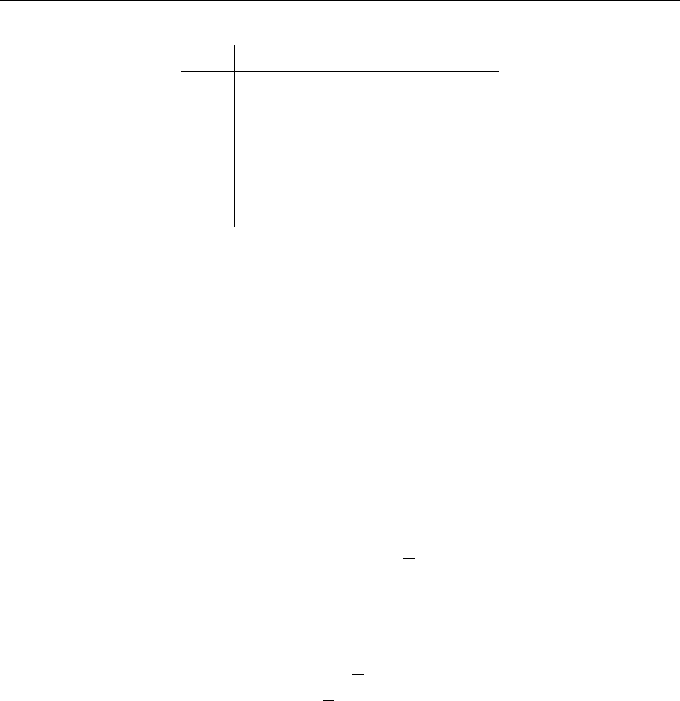
then exponentiating. Table 16.1 s hows the sample means (16.8) and confidence
intervals (16.10) that arose when we used M = 10
2
, 10
3
, . . . , 10
7
. For this simple
example, it can be shown that the exact mean has the value E[X] = 1 (see
Exercise 16.4) so we can judge the accuracy of the results. Of course, this
type of computation, which is known as a Monte Carlo simulation, is useful in
those circumstances where the exact mean cannot be obtained analytically. We
see that the accuracy of the sample mean and the precision of the confidence
interval improve as the number of samples, M , increases. In fact, we can see
directly from the definition (16.10) that the width of the confidence interval
scales with M like 1/
√
M; so, to obtain one more decimal place of accuracy we
need to do 100 times more computation. For this reason, Monte Carlo simulation
is impractical when very high accuracy is required.
3
More precisely, the Strong L aw of Large Numbers and the Central Limit Theo-
rem.
4
There is a well-defined sense in which this version of the sample variance is
improved if we multiply it by the factor M/(M −1). However, a justification for this
is beyond the scope of the book, and the effect is negligible when M is large.
16.4 Stochastic Differential Equations 231
M a
M
confidence interval
10
2
0.9445 [0.4234, 1.4656]
10
3
0.8713 [0.6690, 1.0737]
10
4
1.0982 [0.9593, 1.2371]
10
5
1.0163 [0.9640, 1.0685]
10
6
0.9941 [0.9808, 1.0074]
10
7
1.0015 [0.9964, 1.0066]
Table 16.1 Sample means and confidence intervals for Monte Carlo simula-
tionsof a random variable X for which E[X] = 1
16.4 Stochastic Differential E quations
We know that the Euler iteration
x
n+1
= x
n
+ hf (x
n
)
produces a sequence {x
n
} that converges to a solution of the ODE x
0
(t) =
f(x(t)). To introduce a stochastic e leme nt we will give each x
n+1
a random
“kick,” so that
x
n+1
= x
n
+ hf (x
n
) +
√
h ξ
n
g(x
n
). (16.11)
Here, ξ
n
denotes the result of a call to a standard normal pseudo-random
number generator and g is a given function. So the size of the random kick is
generally state-dependent—it depends upon the current approximation x
n
, via
the value g(x
n
). We also see a factor
√
h in the random term. Why is it not
h, or h
1/4
or h
2
? It turns out that
√
h is the correct scaling when we consider
the limit h → 0. A larger power of h would cause the noise to disappear and
a smaller power of h would cause the noise to swamp out the original ODE
completely.
Given functions f and g and an initial condition x(0), we can think of a
process x(t) that arises when we take the h → 0 limit in (16.11). In other words,
just as in the deterministic case, we can fix t and consider the limit as h → 0
of x
N
where Nh = t. Of course, this construction for x(t) leads to a random
variable—each set of pseudo-random numbers {ξ
n
}
N−1
n=0
gives us a new sample
from the distribution of x(t).
Assuming that this h → 0 limit is valid, we will refer to x(t) as the solution
to a stochastic differential equation (SDE). There are thus three ingredients for
an SDE
– A function f, which plays the same role as the right-hand side of an ODE.
In the SDE context this is called the drift coefficient.
232 16. Stochastic Differential Equations
– A function g, which affects the size of the noise contribution. This is known
as the diffusion coefficient.
– An initial condition, x(0). The initial condition might be deterministic, but
more generally it is allowed to be a random variable—in that case we simply
use a pseudo-random number generator to pick the starting value x
0
for
(16.11).
As an illustration, we will consider the case where f and g are linear; that
is,
f(x) = ax, g(x) = bx, (16.12)
where a and b > 0 are constants, and we fix x(0) = 1. For the dark curve
in Figure 16.4 we take a = 2, b = 1, and x(0) = 1, and show the results of
applying the iteration (16.11) with a step size h = 10
−3
for 0 ≤ t ≤ 1. The
closely spaced, but discrete, points {x
n
} have been joined by straight lines for
clarity. This gives the impression of a continuous but jagged curve. This can
be formalized—the limiting h → 0 solution produces paths that are continuous
but nowhere differentiable. For the lighter curve in Figure 16.4 we repeated the
experiment with different pseudo-random samples ξ
n
and with the diffusion
strength b increased to 2. We see that this gives a more noisy or “volatile”
path.
0 0.2 0.4 0.6 0.8 1
0
2
4
6
8
10
t
x
b = 1
b = 2
Fig. 16.4 Results for the iteration
(16.11) with drift and diffusion coef-
ficients from (16.12) and a step size
h = 10
−3
. Here, for the same drift
strength, a = 2, we show a path with
b = 1 (dark) and b = 2 (light)
We emphasize that the details in Figure 16.4 would change if we repeated
the experiments with fresh pseudo-random numbers. To illustrate this idea, in
the upper picture of Figure 16.5 we show 50 different paths, each computed
as in Figure 16.4, with a = 0.06 and b = 0.75. At the final time, t = 1, each
path produces a single number that, in the h → 0 limit, may be regarded as a
sample from the distribution of the random variable x(1) describing the SDE
solution at t = 1. In the lower picture of Figure 16.5 we produced a histogram
for 10
4
such samples. Overall, the figure illustrates two different ways to think
about an SDE. We can consider individual paths evolving over time, as in the
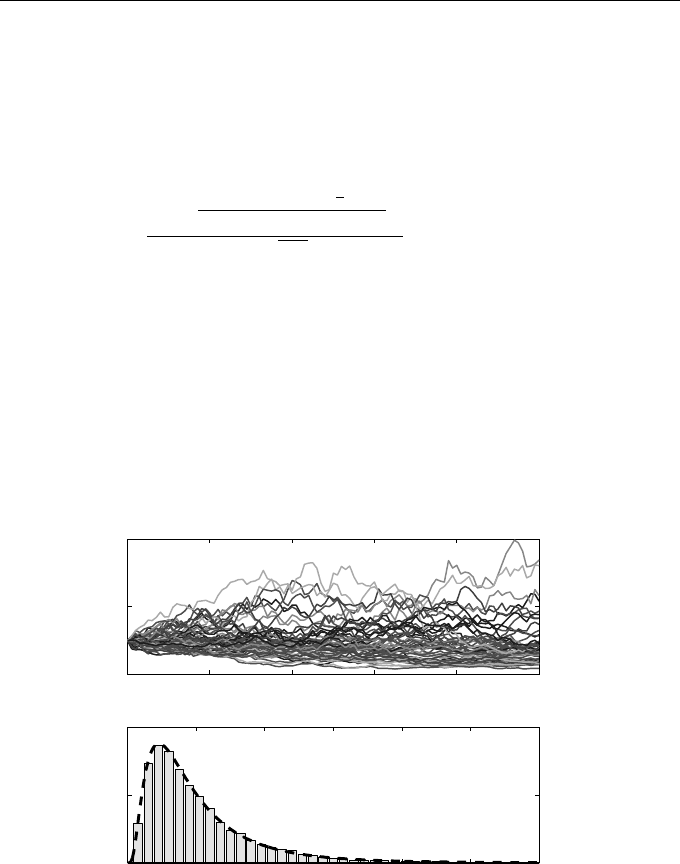
16.4 Stochastic Differential Equations 233
upp e r picture, or we can fix a point in time and consider the distribution of
values at that point, as in the lower picture. From the latter p erspective, by
studying this simple SDE analytically it can be shown, given a deterministic
initial condition, that for the exact solution the random variable x(t) at time t
has a so-called lognormal probability density function given by
p(y) =
exp
−[log(y/x(0))−(a−
1
2
b
2
)t]
2
2b
2
t
yb
√
2πt
, for y > 0, (16.13)
and p(y) = 0 for y ≤ 0. We have superimposed this density function for t = 1
in the lower picture of Figure 16.5, and we see that it matches the histogram
closely. Exercise 16.6 asks you to check that (16.13) defines a valid density
function, and to confirm that the mean and variance take the form
E[x(t)] = x
0
e
at
, (16.14)
var[x(t)] = x
2
0
e
2at
e
b
2
t
− 1
. (16.15)
0 0.2 0.4 0.6 0.8 1
0
2
4
50 paths
x( t)
0 1 2 3 4 5 6
0
0.5
1
10
4
samples from x(t) at t = 1
x( 1)
Fig. 16.5 Upper: In the manner of Figure 16.4, 50 paths using (16.11) for
the linear case (16.12) with a = 0.06 and b = 0.75. Lower: In the manner of
Figure 16.3, binned path values at the final time t = 1 and probability density
function (16.13) superimposed as a dashed curve.

234 16. Stochastic Differential Equations
16.5 Examples of SDEs
In this section we mention a few examples of SDE models that have been
proposed in various application areas.
Example 16.1
In mathematical finance, SDEs are often used to represent quantities whose
future values are uncertain. The linear case (16.12) is by far the most popular
model for assets, such as company share prices, and it forms the basis of the
celebrated Black–Scholes theory of option valuation [32]. If b = 0 then we revert
to the simple deterministic ODE x
0
(t) = ax(t), for which x(t) = e
at
x(0). This
describes the growth of an inves tment that has a guaranteed fixed rate a. The
stochastic term that arises when b 6= 0 reflects the uncertainty in the rate of
retur
n for a typical financial asset.
5
In this context, b is called the volatility.
Example 16.2
A mean-reverting square-root process is an SDE with
f(x) = a (µ − x) , g(x) = b
√
x, (16.16)
where a, µ, and b > 0 are constants. For this SDE
E[x(t)] = µ + e
−at
(E[X(0)] − µ) (16.17)
(see Exercise 16.9) so we see that µ represents the long-term mean value. This
model is often used to represent an interest rate; and in this context it is as -
sociated with the names Cox, Ingersoll and Ross [11]. Given a positive initial
condition, it can be shown that the solution never becomes negative, so the
square root in the diffusion coefficient, g(x), always makes sense. See, for ex-
ample, Kwok [43] and Mao [49] for more details.
Example 16.3
The traditional logistic ODE for population growth can be generalized to allow
for stochastic effects by taking
f(x) = rx (K − x) , g(x) = βx, (16.18)
where r, K and β > 0 are constants. Here, x(t) denotes the population density
of a species at time t, with carrying capacity K and characteristic timescale
1/r [56], and β governs the strength of the environmental noise.
5
Or the authors’ pension funds.

16.5 Examples of SDEs 235
Example 16.4
The case where
f(x) = r (G − x) , g(x) =
p
εx (1 − x), (16.19)
with r, ε > 0 and 0 < G < 1 is suggested by Cobb [9] as a model for the motion
over time of an individual through the liberal–conservative political spectrum.
Here x(t) = 0 denotes an extreme liberal and x(t) = 1 denotes an extreme
conservative. With this choice of diffusion term, g(x), a person with extreme
views is less likely to undergo random fluctuations than one nearer the centre
of the political spectrum.
Example 16.5
The SDE with
f(x) = −µ
x
1 − x
2
, g(x) = σ, (16.20)
with µ and σ > 0, is proposed by Lesmono et al. [46]. Here, in an environ-
ment where two political parties, A and B, are dominant, x(t) represents the
difference P
A
(t) −P
B
(t), where P
A
(t) and P
B
(t) denote the proportions of the
population that intend to vote for parties A and B, respectively, at time t.
Example 16.6
Letting V (x) denote the double-well potential
V (x) = x
2
(x − 2)
2
; (16.21)
as shown in Figure 16.6, we may construct the SDE with
f(x) = −V
0
(x), g(x) = σ. (16.22)
When σ = 0, we see from the chain rule that the resulting ODE x
0
(t) =
−V
0
(x(t)) satisfies
d
dt
V (x(t)) = V
0
(x(t))
d
dt
x(t) = −(V
0
(x(t)))
2
.
So, along any solution curve, x(t), the potential V (·) is nonincreasing. More-
over, it strictly decreases until it reaches a stationary point; with reference to
Figure 16.6, any solution with x(0) 6= 1 slides down a wall of the potential well
and
comes to rest at the appropriate minimum x = 0 or x = 2. In the additive
noise case, σ > 0, it is now possible for a solution to overcome the potential
barrier that se parates the two stable rest states—a path may occasionally jump