
Griffiths D.F., Higham D.J. Numerical Methods for Ordinary Differential Equations: Initial Value Problems
Подождите немного. Документ загружается.


206 14. Geometric Integration Part I—Invariants
14.11.
?
By directly differentiating, show that H in (14.17) is an invariant
for the Kepler problem (14.15).
14.12.
???
(Based on Gonzalez et al. [22, Section 4.6].) Consider the scalar
ODE x
0
(t) = f (x(t)), with f(x) = −x
3
. Letting F(x) = x
4
/4, use
the chain rule to show that
d
dt
F(x(t)) = −(f (x(t)))
2
. (14.26)
Deduce that
lim
t→∞
x(t) = 0, for any x(0).
For this ODE, rather than being an invariant, F is a Lyapunov func-
tion that always decreases along each non-constant trajectory. For
the backward Euler method x
n+1
= x
n
−hx
3
n+1
, by using the Taylor
series with remainder it is possible to prove a discrete analogue of
(14.26),
F(x
n+1
) − F(x
n
)
h
≤ −
x
n+1
− x
n
h
2
.
It follows that, given any h,
lim
n→∞
x
n
= 0, for any x(0).
Show that
y
0
(t) = −y
3
(t) +
3h
2
y
5
(t)
is a modified equation for backward Euler on this ODE, and also
deduce that
lim
t→∞
|y(t)| = ∞, when y(0) >
r
2
3h
.
This gives an example of a qualitative property that is shared by an
ODE and a numerical method for all h, but is not inherited by a
corresponding modified equation.
15
Geometric Integration Part
II—Hamiltonian Dynamics
This chapter continues our study of geometric features of ODEs. We look at
Hamiltonian problems, which possess the important property of symplecticness.
As in the previous chapter our emphasis is on
– showing that methods must be carefully chosen if they are to possess the
correct geometric property, and
– using the idea of modified equations to explain the qualitative behaviour of
numerical methods.
15.1 Symplectic Maps
As a lead-in to the topics of Hamiltonian ODEs and symplectic maps, we be gin
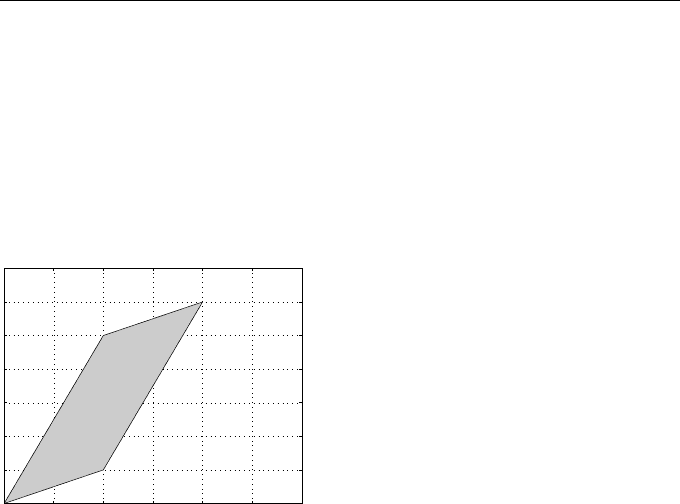
with some key geometric concepts. Figure 15.1 depicts a parallelogram with
vertices at (0, 0), (a, b), (a + c, b + d), and (c, d). The area of the parallelogram
can be written as |ad − bc|; see Exercise 15.1. If we remove the absolute value
sign, then the remaining expression ad − bc is positive if the vertices are listed
in clockwise order, otherwise it is negative. Hence, characterizing the parallel-
ogram in terms of the two vectors
u =
a
b
and v =
c
d
,
Springer Undergraduate Mathematics Series, DOI 10.1007/978-0-85729-148-6_15,
© Springer-Verlag London Limited 2010
D.F. Griffiths, D.J. Higham, Numerical Methods for Ordinary Differential Equations,
208 15. Geometric Integration Part II—Hamiltonian Dynamics
we may define the oriented area, area
o
(u, v), to be ad − bc. Equivalently, we
may write
area
o
(u, v) = u
T
Jv, (15.1)
where J ∈ R
2×2
has the form
J =
0 1
−1 0
.
(a,b)
(a+c,b+d)
(c,d)
Fig. 15.1 Parallelogram
Now, given a matrix A ∈ R
2×2
, we may ask whether the oriented-area is
preserved under the linear mapping u 7→ Au and v 7→ Av. From (15.1), we will
have area
o
(u, v) = area
o
(Au, Av) if and only if u
T
A
T
JAv = u
T
Av. Hence,
the linear mapping guarantees to preserve oriented area if, and only if,
A
T
JA = J. (15.2)
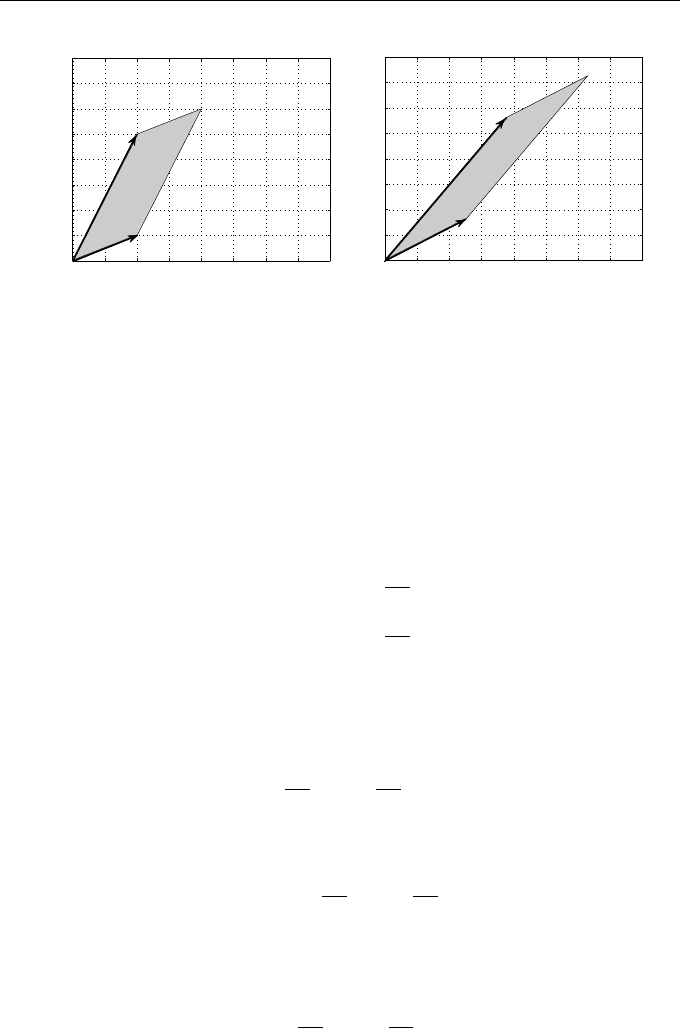
Figure 15.2 illustrates this idea. Here, the parallelogram on the right is found
by applying a linear mapping to u and v, and, since we have chosen a matrix
A for which A
T
JA = J, the oriented area is preserved. We also note that the
condition (15.2) is equivalent to det(A) = 1; see Exercise 15.5. However, we
prefer to use the formulation (15.2) as it is convenient algebraically and, for
our purposes, it extends more naturally to the case of higher dimensions.
Adopting a more general viewpoint, we may consider any smooth nonlinear
mapping g : R
2
→ R
2
. When is g oriented area preserving? In other words,
if we take a two-dimensional region and apply the map g to every point, this
will give us a new region in R
2
. Under what conditions will the two regions
always have the same oriented area? Fixing on a point x ∈ R
2
, we imagine a
small parallelogram formed by the vectors x + ε and x + δ, where ε, δ ∈ R
2
are arbitrary but small, as indicated in the left-hand picture of Figure 15.3.
Placing the origin at x, we know from (15.1) that the oriented area of this
parallelogram is given by
ε
T
Jδ. (15.3)
15.1 Symplectic Maps 209
u
u + v
v
Au
Au + Av
Av
Fig. 15.2 The parallelogram on the right was formed by using a matrix A to
map the vectors u and v that define the edges of the parallelogram on the le ft.
In this case det(A) = 1, so the area is preserved
If we apply the map g to this parallelogram then we get a region in R
2
, as
indicated in the right-hand picture. Because ε and δ are small, the sides of
this region can be approximated by straight lines, and the new region can be
approximated by a parallelogram. Also, by linearizing the map, as explained
in Appendix C, we may approximate the locations of the vertices g(x + ε) and
g(x + δ) using (C.3) to obtain
g(x + ε) ≈ g(x) +
∂g
∂x
(x) ε,
g(x + δ) ≈ g(x) +
∂g
∂x
(x) δ.
Here the Jacobian ∂g/∂x is the matrix of partial derivatives, see (C.4). Placing
the origin at g(x), the oriented area of this region may be approximated by
the oriented area of the parallelogram, to give
ε
T
∂g
∂x
T
J
∂g
∂x
δ. (15.4)
Equating the oriented areas (15.3) and (15.4) gives the relation
ε
T
Jδ = ε
T
∂g
∂x
T
J
∂g
∂x
δ.
Now the directions ε and δ are arbitrary, and we would like this area preser-
vation to hold for any choices. This leads us to the condition
J =
∂g
∂x
T
J
∂g
∂x
. (15.5)
The final step is to argue that any region in R
2
can be approximated to any
desired level of accuracy by a collection of small parallelograms. Hence, this

210 15. Geometric Integration Part II—Hamiltonian Dynamics
x
x + ǫ
x + δ
g(x)
g(x + ε)
g(x + δ)
Fig. 15.3 The region on the right illustrates the effect of applying a smooth
nonlinear map g to the set of points making up the parallelogram on the left.
If the original parallelogram is small, then the map is well approximated by its
linearisation (equivalently, the new region is well approximated by a parallelo-
gram).
condition is enough to guarantee area preservation in general. These arguments
can be made rigorous and a smooth map g satisfying condition (15.5) does
indeed preserve oriented area.
We will use the word symplectic to denote maps that satisfy (15.5).
1
15.2 Hamiltonian ODEs
With a unit mass and unit gravitational constant the motion of a pendulum
can be modelled by the ODE system
p
0
(t) = −sin q(t),
q
0
(t) = p(t).
(15.6)
Here, the position coord inate, q(t), denotes the angle between the rod and the
vertical at time t.
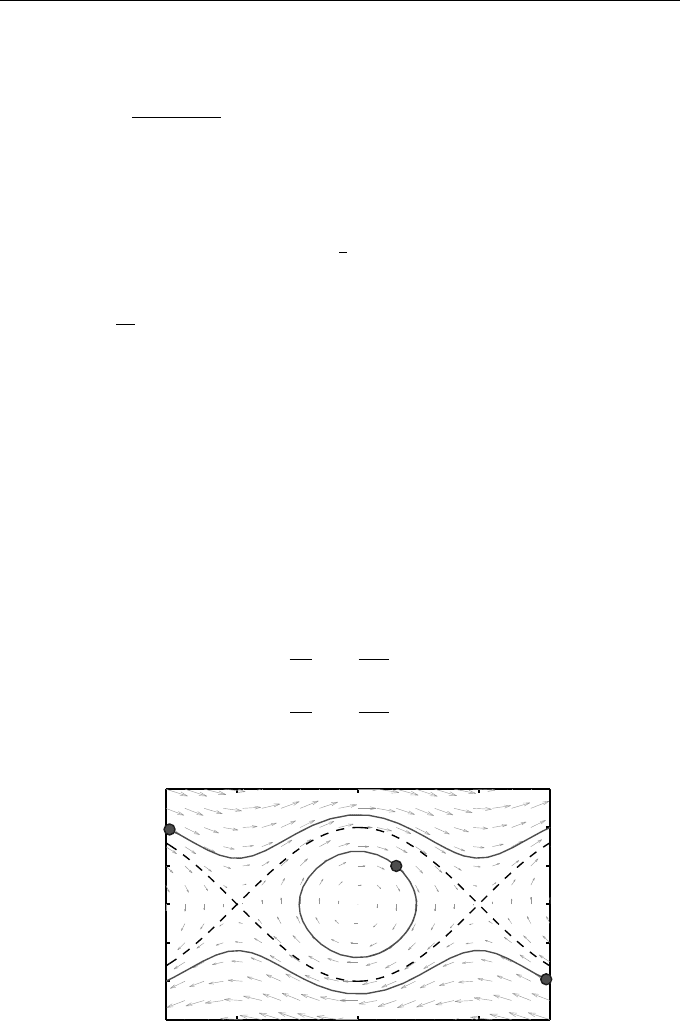
Figure 15.4 shows solutions of this system in the q, p phase space. In each
case, the initial condition is marked with a circle. We have also indicated the
1
For maps in R
2d
where d > 1, the concept of symplecticness is stronger than
simple preservation of volume—it is equivalent to preserving the sum of the oriented
areas of projections on to two-dimensional subspaces. However, the characterization
(15.5) remains valid when the matrix J is generalized appropriately to higher di-
mension, and the algebraic manipulations that we will use can be carried through
automatically.
15.2 Hamiltonian ODEs 211
vector field for this system—an arrow shows the direction and size of the tan-
gent vector for a solution passing through that point. In other words, an arrow
at the point (q, p) has direction given by the vector (p, −sin q) and length pro-
portional to
p
p
2
+ sin
2
q. There is a fixed point at p = q = 0, corresponding
to the pendulum resting in its lowest position, and an unstable fixed point at
q = π, p = 0, c orresponding to the pendulum resting precariously in its highest
position. For any solution, the function
H(p, q) =
1
2
p
2
− cos q (15.7)
satisfies
d
dt
H(p, q) = pp
0
+ (sin q)q
0
= −p sin q + (sin q)p = 0.
Hence, H(p, q) remains constant along each solution. In fact, for −1 < H < 1,
we have the typical “grandfather clock” libration—solutions where the angle
q oscillates between two fixed values ±c. One such solution is shown towards
the centre of Figure 15.4. For H > 1, the angle q varies monotonically; here,
the pendulum continually swings beyond the vertical. Two of these solutions
are shown in the upper and lower regions of the figure. The intermediate case,
H = 1, corresponds to the unstable resting points and the separatrices that
connect them are marked with dashed lines (see Exercise 15.8). We also note
that the problem is 2π periodic in the angle q.
The pendulum system (15.6) may be written in terms of the function H :
R
2
→ R
2
in (15.7) as
dp
dt
= −
∂H
∂q
,
dq
dt
=
∂H
∂p
.
(15.8)
−3
−2
−1
0
1
2
3
q
p
−π
π
Fig. 15.4 Vector field and particular solutions of the pendulum system (15.6).
212 15. Geometric Integration Part II—Hamiltonian Dynamics
It turns out that many other important ODE systems can also be written in
this special form (or higher-dimensional analogues, as in the Kepler example
(14.18)). Hence, this class of problems is worthy of special attention. Generally,
any system of the form (15.8) is called a Hamiltonian ODE and H(p, q) is
referred to as the corresponding Hamiltonian function. The invariance of H
that we saw for the pendulum example carries through, be cause , by the chain
rule,
d
dt
H(p, q) =
∂H
∂p
p
0
+
∂H
∂q
q
0
= −
∂H
∂p
∂H
∂q
+
∂H
∂q
∂H
∂p
= 0.
However, in addition to preserving the Hamiltonian function, these problems
also have a symplectic character. To see this, we need to introduce the time t
flow map, ψ
t
, which takes the initial condition p(0) = p
0
, q(0) = q
0
and maps
it to the solution p(t), q(t); that is,
ψ
t
p
0
q
0
=
p(t)
q(t)
.
Once we have fixed t, this defines a map ψ
t
: R
2
→ R
2
, and we may therefore
investigate whether this map preserves oriented area.
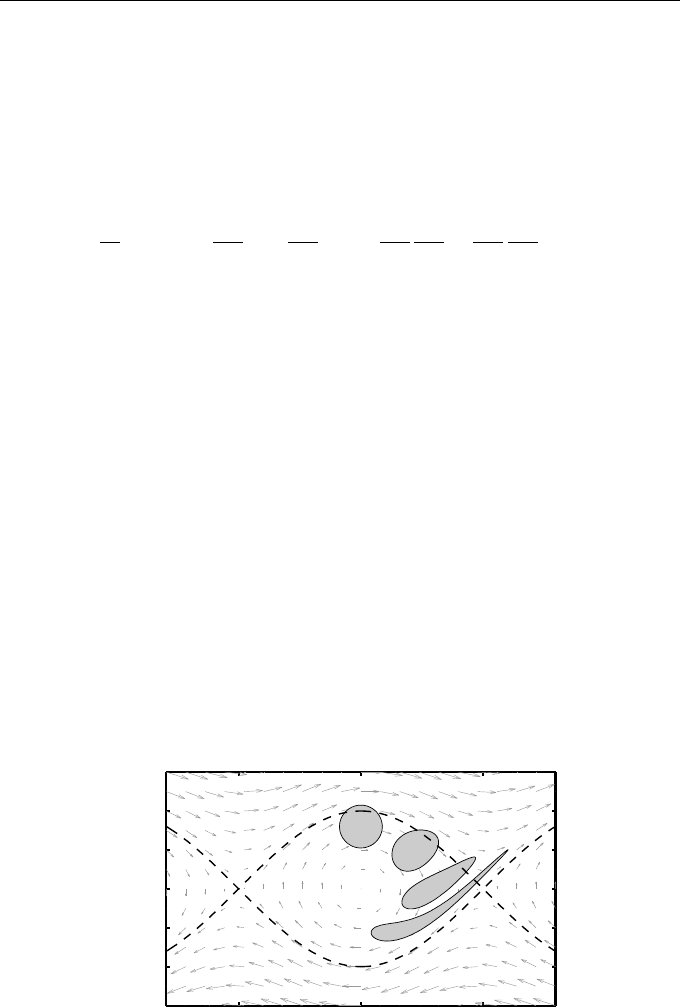
Before carrying this out, the results of a numerical experiment are displayed
in Figure 15.5. The eff ec t of applying ψ
t
to all the points in the shaded circular
disc with centre at q = 0, p = 1.6 and radius 0.55 is shown for t = 1 and t = 2
and t = 3. In other words, taking every point in the disk as an initial value for
the ODE system, we show where the solution lies at times t = 1, 2, 3. At time
t = 1, the disk is rotated clockwise and squashed into a distorted egg shape.
At time t = 2 the region is stretched into a teardrop by the vector field, and
by t = 3 it has taken on a tadpole shape.
−3
−2
−1
0
1
2
3
q
p
−π
π
Fig. 15.5 Illustration of the area-preserving property for the flow of the pen-
dulum system (15.6)

15.2 Hamiltonian ODEs 213
It would be reasonable to conjecture from Figure 15.5 that the time t flow
map ψ
t
is symplectic—the shaded regions app e ar to have equal areas. To pro-
vide a proof we use the approach used in the previous section with g(x) ≡ ψ
t
(x)
and x = [p, q]
T
. We first note that, for t = 0, ψ
t
collapses to the identity map,
so its Jacobian (C.4) is the identity matrix, which trivially satisfies (15.5). Next,
we consider how the right-hand side of (15.5) evolves over time. The Jacobian
matrix (C.7) for (15.6) has the form
0 −cos q
1 0
.
Then, letting
P (t) =
∂ψ
t
∂x
0
denote the matrix of partial derivatives, the variational equation for this matrix
has the form
P
0
(t) =
0 −cos q
1 0
P (t)
(see (C.6)). It follows that
d
dt
P (t)
T
JP (t)
= P
0
(t)
T
JP (t) + P (t)
T
JP
0
(t)
= P (t)
T
0 1
−cos q 0
0 1
−1 0
P (t)
+ P (t)
T
0 1
−1 0
0 −cos q
1 0
P (t)
= P (t)
T
−1 0
0 −cos q
+
1 0
0 cos q
P (t)
= 0. (15.9)
Having first e stablished that (15.5) holds at time t = 0, we have now shown that
the right-hand side of (15.5) does not change over time; hence, the condition
holds for any time t. That is, the time t flow map, ψ
t
, for the pendulum equation
is symplectic for any t.
The general case, where H(p, q) is any Hamiltonian function in (15.8), can
be handled without much more effort. The ODE then has a Jacobian of the
form
−H
pq
−H
qq
H
pp
H
qp
.
Here, we have adopted the compact notation where, for example, H
pq
denotes
∂
2
H /∂p∂q. This Jacobian may be written as J
−1
∇
2
H, where
J
−1
=
0 −1
1 0
and ∇
2
H =
H
pp
H
qp
H
pq
H
qq
.

214 15. Geometric Integration Part II—Hamiltonian Dynamics
Here, the symmetric m atrix ∇
2
H is called the Hessian of H. The computations
leading up to (15.9) then generalise to
d
dt
P (t)
T
JP (t)
= P
0
(t)
T
JP (t) + P (t)
T
JP
0
(t)
= P (t)
T
∇
2
HJ
−T
JP (t) + P (t)
T
∇
2
HP (t) = 0,
since J
−T
J = −I. So the argument used for the pendulum ODE extends to
show that any Hamiltonian ODE has a symplectic time t flow map, ψ
t
.
15.3 Approximating Hamiltonian ODEs
We will describe two examples of approximating systems of Hamiltonian ODEs.
Example 15.1
Show that map generated when Euler’s method is applied the pendulum ODEs
(15.6) is not symplectic.
Euler’s method corresponds to the map
p
n+1
q
n+1
=
p
n
− h sin q
n
q
n
+ hp
n
. (15.10)
We find that
∂p
n+1
∂p
n
∂p
n+1
∂q
n
∂q
n+1
∂p
n
∂q
n+1
∂q
n
=
1 −h cos q
n
h 1
,
and the right-hand side of (15.5) is
0 1 + h
2
cos q
n
−1 − h
2
cos q
n
0
.
Since this is not the identity matrix, the map arising from Euler’s method on
this ODE is not symplectic for any step size h > 0.
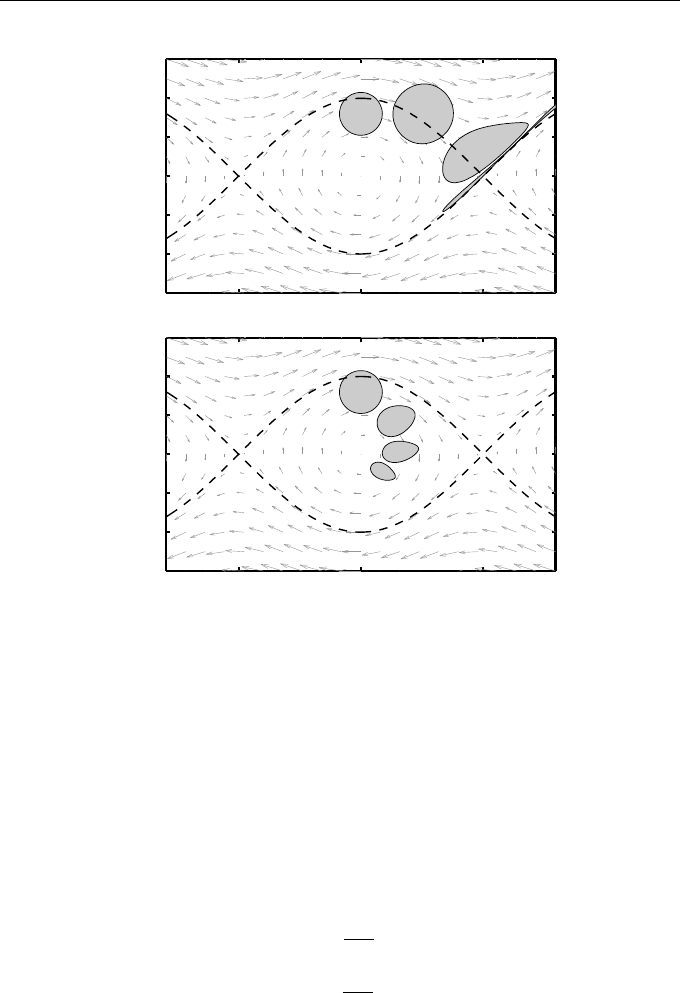
Figure 15.6 (top) shows what happens when the exact flow map in Fig-
ure 15.5 is replaced by the Euler m ap (15.10) with step size h = 1. The disk
of initial values clearly starts to expand its area, before collapsing into a thin
smear. Figure 15.6 (bottom) repeats the experiment, this time using the back-
ward Euler method. Here, the region spirals towards the origin, and the area
appears to shrink. Exercise 15.7 asks you to check that the corresponding map
is not symplectic.
15.3 Approximating Hamiltonian ODEs 215
−3
−2
−1
0
1
2
3
q
p
−π
π
−3
−2
−1
0
1
2
3
q
p
−π
π
Fig. 15.6 Area evolution for the forward Euler method (top) and backward
Euler method (bottom) applied to the pendulum system (15.6)
Example 15.2
Extend the s ymplectic Euler me thod from Example 13.4 to the general Hamil-
tonian system of ODEs (15.8) and verify that the resulting map is symplectic.
The symplectic Euler method can be regarded as a combination of forward
and backward Euler methods where the updates are implicit in the p variable
and explicit in the q variable. When applied to the system (15.8) it leads to
p
n+1
= p
n
− h
∂H
∂q
(p
n+1
, q
n
),
q
n+1
= q
n
+ h
∂H
∂p
(p
n+1
, q
n
).
(15.11)