
Griffiths D.F., Higham D.J. Numerical Methods for Ordinary Differential Equations: Initial Value Problems
Подождите немного. Документ загружается.

236 16. Stochastic Differential Equations
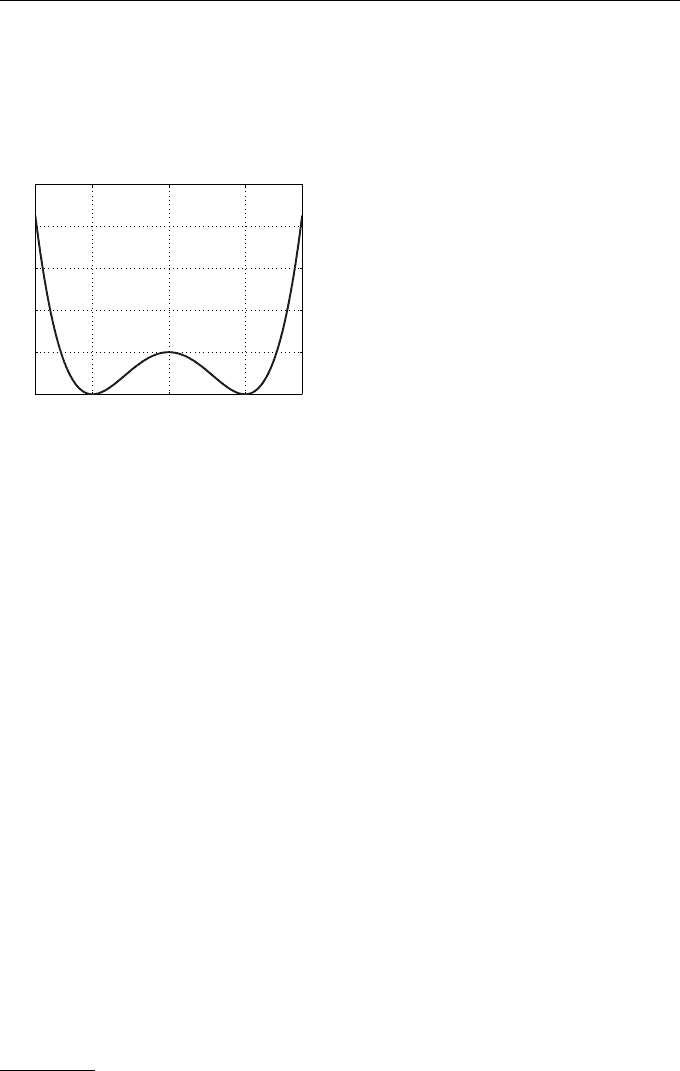
over the central hump and thereby move from the vicinity of one well to the
other. This gives a simple caricature of a bistable switching mechanism that is
important in biology and physics.
0 1 2
0
1
2
3
4
5
x
V (x)
Fig. 16.6 Double–well potential func-
tion V (x) from (16.21)
16.6 Convergence of a Numerical Method
Our informal approach here is to regard an SDE as whatever arises when we
take the h → 0 limit in the iteration (16.11). For any fixed h > 0, we may then
interpret (16.11) as a numerical method that allows us to compute approxima-
tions for this SDE. In fact, this way of extending the basic Euler method gives
what is known as the Euler–Maruyama method. If we focus on the final-time
value, t
f
, then we may ask how accurately the numerical method can approxi-
mate the random variable x(t
f
) from the SDE. For the example in Figure 16.5,
the lower picture shows that the histogram closely matches the correct density
function. Letting t
f
= nh, so that n → ∞ and h → 0 with t
f
fixed, how can we
generalize the concept of order of convergence that we developed for ODEs?
It turns out that there are many, nonequivalent, ways in which to measure
the accuracy of the numerical method. If we let x
n
denote the random variable
corresponding to the numerical approximation at time t
f
, so that the endpoint
of each path in the upper picture of Figure 16.5 gives us a sample for x
n
,
then we could study the difference between the expected values of the random
variables x(t
f
) and x
n
. This quantifies what is known as the weak error of the
method,
6
and it can be shown that this error decays at first order; that is,
E [x(t
f
)] − E [x
n
] = O(h). (16.23)
6
More generally, the weak error can be defined by comparing moments—expected
values of powers of x(t
f
) and x
n
.
16.6 Convergence of a Numerical Method 237
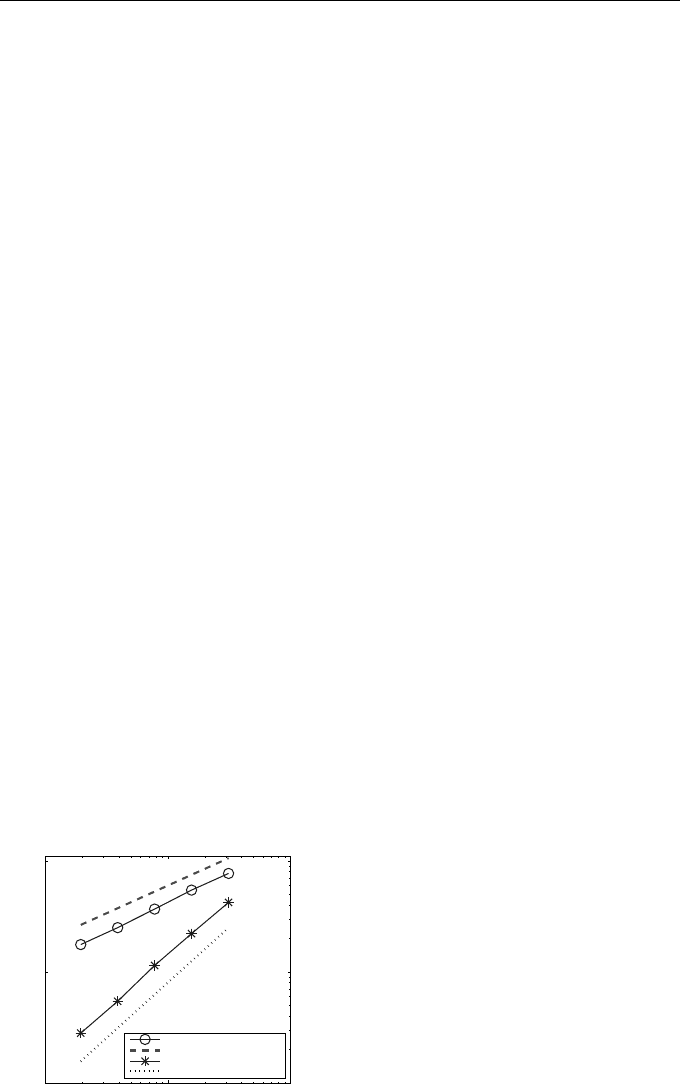
In Figure 16.7 we compute approximations to the weak error, as defined in
the left-hand side of (16.23), for the linear SDE given by (16.12) with a = 2,
b = 1 and x(0) = 1. The asterisks show the weak error values for a range of
step sizes h. In each case, we used the known exact value (16.14) for the mean
of the SDE solution, and to approximate the mean of the numerical method we
computed a large number of paths and used the sample mean (16.8), making
sure that the 95% confidence intervals were negligible relative to the actual
weak errors. Figure 16.7 uses a log-log scale, and the asterisks appear to lie
roughly on a straight line. A reference line with slope equal to one is s hown.
In the least-squares sense, the best straight line approximation to the asterisk
data gives a slope of 0.9858 with a residual of 0.0508. So, overall, the weak
errors are consistent with the first-order behaviour quoted in (16.23).
The first-order rate of weak convergence in (16.23) matches what we know
about the deterministic case—when we switch off the noise, g ≡ 0, the method
reverts to standard Euler, for which convergence of order 1 is attained.
On the other hand, if we are not concerned with “the error of the means”
but rather “the mean of the error,” then it may be more appropriate to look at
the strong error E[|x(t
f
) − x
n
|]. It can be shown that this version of the error
decays at a rate of only one half; that is,
E [|x(t
f
) − x
n
|] = O(h
1/2
). (16.24)
To make this concrete, for the same SDE and step sizes as in the weak tests,
the circles in Figure 16.7 show approximations to the strong error. Samples for
the “exact” SDE solution, x
n
, were obtained by following more highly resolved
paths—see, for example, Higham [31] for more information. The circles in the
figure appear to lie approximately on a straight line that agrees with the ref-
erence line of slope one half, and a least-squares fit to the c ircle data gives a
slope of 0.5384 with residual 0.0266, consistent with (16.24).
We emphasize that this result marks a significant departure from the deter-
ministic ODE case, where the underlying Euler method attains first order. The
10
−3
10
−2
10
−1
10
−2
10
−1
10
0
h
Stron g o r Weak Error
St rong E rr or
Re f e renc e of slope 1/2
We ak E rror
Re f e renc e of slope 1
Fig. 16.7 Asterisks show weak er-
rors (16.23) and circles show strong er-
rors (16.24) for the Euler–Maruyama
method (16.11) applied to the linear
SDE (16.12)

238 16. Stochastic Differential Equations
degradation in approximation p ower when we measure error in the strong sense
of (16.24) is caused by a lack of smoothness that is evident from Figures 16.4
and 16.5; we cannot appeal directly to the type of Taylor series expansion
that s erved us so well in the preceding chapters, and a complete understanding
requires the tools of stochastic calculus.
16.7 Discussion
Although we have focussed here on scalar problems, the concept of SDEs ex-
tends naturally to the case of systems, x(t) ∈ R
m
, with multiple noise terms,
and the Euler–Maruyama method (16.11) carries through straightforwardly,
retaining the same weak and strong order.
For deterministic ODEs, Euler’s metho d would typically be dismissed as
having an order of convergence that is too low to be of practical use. For SDEs,
however, Euler–Maruyama, and certain low order implicit variations, are widely
used in practice. There are two good reasons.
1. Designing higher order methods is much more tricky, especially in the case
of systems, and those that have be en put forward tend to have severe
computational overheads.
2. Souping-up the iteration (16.11) is of limited use if the simulations are part of
a Monte Carlo style computation. In that case the relative ly slow O(1/
√
M)
rate at which the confidence interval shrinks is likely to provide the bottle-
neck.
Following up on point 2, we mention that recent work of Giles [21] makes it
clear that, in a Monte Carlo context, where we wish to compute the expected
value of a quantity involving the solution of an SDE,
– the concepts of weak and strong convergence are both useful, and
– it is worthwhile to study the interaction betwe en the weak and strong dis-
cretization errors arising from the timestepping method and the statistical
sampling error arising from the Monte Carlo method, in order to optimize
the overall efficiency.
Researchers in numerical methods for SDEs are actively pursuing many of
the issues that we have discussed in the ODE context, such as analysis of stabil-
ity, preservation of geometric features, construction of modified equations and
design of adaptive step size algorithms. There are also many new challenges, in-
cluding the development of multiscale methods that mix together deterministic
and stochastic regimes in order to model complex systems.

Exercises 239
EXERCISES
16.1.
?
Using the definition of the mean (16.3), show that E[X] = µ for
X ∼ N(µ, σ
2
). [Hint: you may use without proof the fact that
R
∞
−∞
p(y) dy = 1 for p(y) in (16.2).]
16.2.
?
Given that the expectation operator is linear, so that for any two
random variables X and Y and any α, β ∈ R,
E[αX + βY ] = αE[X] + βE[Y ], (16.25)
show that the variance, defined in (16.4), may also be written
var[X] := E
X
2
− (E[X])
2
. (16.26)
16.3.
??
If the random variable X has probability density function p(y)
then, generally, for any function h, we have
E[h(X)] :=
Z
∞
−∞
h(y) p(y) dy. (16.27)
Following on from Exercises 16.1 and 16.2 show that for X ∼
N(µ, σ
2
) we have E[X
2
] = µ
2
+ σ
2
and hence var[X] = σ
2
.
16.4.
??
Using h(y) = exp(−1 + 2y) in (16.27), show that E[X] = 1 for
X = exp(−1 + 2Y ) with Y ∼ N(0, 1).
16.5.
?
Based on the definition of the confidence interval (16.10), if we did
not already know the exact answer, roughly how many more rows
would be needed in Table 16.1 in order for us to be 95% confident
that we have correctly computed the first five significant digits in
the expected value?
16.6.
??
Show that p(y) in (16.13) satisfies
R
∞
−∞
p(y) dy = 1 and, by eval-
uating
R
∞
−∞
y p(y) dy and
R
∞
−∞
y
2
p(y) dy, confirm the expressions
(16.14) and (16.15).
16.7.
???
For the case where f(x) = ax and g(x) = bx, the Euler–Maruyama
method (16.11) takes the form
x
k+1
= (1 + ha) x
k
+
√
hbZ
k
x
k
, (16.28)
where each Z
k
∼ N(0, 1). Suppose the initial condition x(0) = x
0
is deterministic. By construction, we have E[Z
k
] = 0 and E[Z
2
k
] =

240 16. Stochastic Differential Equations
var[Z
k
] = 1. Because a fresh call to a pseudo-random number genera-
tor is made on each step, we can say that Z
k
and x
k
are independent,
and it follows that
E[x
k
Z
k
] = E[x
k
]E[Z
k
] = 0,
E[x
2
k
Z
k
] = E[x
2
k
]E[Z
k
] = 0,
E[x
2
k
Z
2
k
] = E[x
2
k
]E[Z
2
k
] = E[x
2
k
].
Taking e xpectations in (16.28), and using the linearity property
(16.25), we find that
E [x
k+1
] = E
h
x
k
(1 + ha) +
√
hbx
k
Z
k
i
= (1 + ha) E[x
k
] +
√
hbE[x
k
Z
k
]
= (1 + ha) E[x
k
].
So,
E [x
n
] = (1 + ha)
n
x
0
.
Consider now the limit where h → 0 and n → ∞ with nh = t
f
fixed,
as in the convergence analysis of Theorem 2.4. Show that
E [x
n
] → e
at
f
x
0
, (16.29)
in agreement with the expression (16.14) for the SDE.
Similarly, squaring both sides in (16.28) and then taking expected
values, and using the linearity property (16.25), we have
E
x
2
k+1
= E
h
x
2
k
(1 + ha)
2
+ 2 (1 + ha)
√
hbx
2
k
Z
k
+ hb
2
x
2
k
Z
2
k
i
= (1 + ha)
2
E
x
2
k
+ 2 (1 + ha)
√
hbE
x
2
k
Z
k
+ hb
2
E
x
2
k
Z
2
k
= (1 + ha)
2
E
x
2
k
+ 0 + hb
2
E
x
2
k
=
(1 + ha)
2
+ hb
2
E
x
2
k
.
By taking logarithms, or otherwise, show that in the same limit
h → 0 and n → ∞ with nh = t
f
fixed we have
E
x
2
n
→ e
(2a+b
2
)t
f
x
2
0
,
so that
var[x
n
] = e
2at
f
e
b
2
t
f
− 1
x
2
0
,
in agreement with the expression (16.15) for the SDE.

Exercises 241
16.8.
???
Repeat the steps in Exercise 16.7 to get expressions for the mean
and variance in the additive noise case where f (x) = ax and g(x) =
b. This is an example of an Ornstein–Uhlenbeck process.
16.9.
??
Follow the arguments that led to (16.29) in order to justify the
expression (16.17) for the mean-reverting square root process.
A
Glossary and Notation
AB: Adams–Bashforth—names of a family of explicit LMMs. AB(2) denotes
the two-step, second-order Adams–Bashforth method.
AM: Adams–Moulton—names of a family of implicit LMMs. AM(2) denotes
the two-step, third-order Adams–Moulton method.
BDF: backward differentiation formula.
BE: backward Euler (method).
C
p+1
: error constant of a pth-order LMM.
CF: complementary function—the general solution of a homogeneous linear
difference or differential equation.
4E: difference equation.
E(·) : expected value.
f
n
: the value of f (t, x) at t = t
n
and x = x
n
.
FE: forward Euler (method).
GE: global error—the difference between the exact solution x(t
n
) at t = t
n
and the numerical solution x
n
: e
n
= x(t
n
) − x
n
.
∇: gradient operator. ∇F denotes the vector of partial derivatives of F.
h: step size—numerical solutions are sought at times t
n
= t
0
+ nh for n =
0, 1, 2, . . . .
Springer Undergraduate Mathematics Series, DOI 10.1007/978-0-85729-148-6,
© Springer-Verlag London Limited 2010
D.F. Griffiths, D.J. Higham, Numerical Methods for Ordinary Differential Equations,

244 A. Glossary and Notation
b
h : λh, where λ is the coefficient in the first-order equation x
0
(t) = λx(t) or an
eigenvalue of the matrix A in the system of ODEs x
0
(t) = Ax(t).
I: identity matrix.
=(λ): imaginary part of a complex number λ.
IAS: interval of absolute stability.
IC: initial condition.
IVP: initial value problem—an ODE together with initial condition(s).
j = m : n: for integers m < n this is shorthand for the sequence of consecutive
integers from m to n. That is, j = m, m + 1, m + 2, . . . , n.
L
h
: linear difference operator.
LMM: linear multistep method.
LTE: local truncation error—generally the remainder term R in a Taylor series
expansion.
ODE: ordinary differential equation.
P(a ≤ X ≤ b): probability that X lies in the interval [a, b].
PS: particular solution—any solution of an inhomogeneous linear difference or
differential equation.
ρ(r): first characteristic polynomial of a LMM.
R: region of absolute stability.
R
0
: interval of absolute stability.
<(λ): real part of a complex numbe r λ.
RK: Runge–Kutta. RK(p) (p ≤ 4) is a p–stage, pth order RK method.
RK(p, q) denotes a pair of RK methods for use in adaptive time–stepping.
R(
b
h): stability function of an RK method.
σ(r): se cond characteristic polynomial of a LMM.
SDE: stochastic differential equation.
t
f
: final time at which solution is required.
t
n
: a grid point, generally, t
n
= t
0
+ nh, at which the numerical solution is
computed.
T
n
: local truncation error at time t = t
n
.

A. Glossary and Notati on 245
b
T
n
: In Chapter 11 it denotes an approximation to the local truncation error T
n
,
usually based on the leading term in its Taylor expansion. In Chapter 13
it denotes the local truncation error based on the solution of the modified,
rather than the original, IVP.
TS: Taylor Series. TS(p)—the Taylor Series method with p + 1 terms (up to,
and including, pth derivatives).
var(·) : variance.
x: a scalar-valued quantity while x denotes a vector-valued quantity.
x
0
(t): derivative of x(t) with respect to t.
x
n
, x
0
n
, x
00
n
, . . . : approximations to x(t
n
), x
0
(t
n
), x
00
(t
n
), . . . .
X ∼ N(µ, σ
2
): a normally distributed random variable with mean µ and vari-
ance σ
2
.