
Heidersbach R. Metallurgy and Corrosion Control in Oil and Gas Production
Подождите немного. Документ загружается.


CORROSION CONTROL 159
supplied with prepackaged backfi lls. The most common
magnesium anode, 17 lb (7.7 kg), will weigh about 45 lb
(20 kg) when the weight of the prepackaged backfi ll is
added. This backfi ll is intended to provide a low resistiv-
ity and wet environment to the anode. Most backfi lls are
a combination of a hygroscopic soil (gypsum and/or
bentonite clay) and ionic salts (calcium chloride).
Zinc anodes were used as early as 1824 to protect the
nails holding copper cladding to the bottom of wooden
ships. Alloy additions of aluminum and cadmium
increase the effi ciency of modern zinc anodes and also
produce more uniform corrosion.
The potential of zinc in most soils is assumed to be
− 1.1 V CSE. This voltage is much lower than that for
magnesium, but the effi ciency of zinc anodes is gener-
ally considered to be ∼ 90%, so much more of the elec-
tricity generated by corrosion of the anode is available
for cathodic protection.
Unlike magnesium, zinc will not corrode in many
soils, and the use of zinc in soils has been restricted to
low - resistivity soils ( < 1000 to 2000 Ω - cm depending on
the authority in question).
88
Recent quality control
problems with magnesium anodes have caused many
organizations to use zinc anodes onshore in applications
where they would not have been considered in previous
years. Proponents of the use of zinc anodes for pipeline
cathodic protection argue that both zinc and magne-
sium can produce adequate current to polarize pipelines
having the high - quality coatings that have been intro-
duced in recent years. Magnesium is alleged to corrode
too fast, wasting electricity, whereas zinc will provide
enough current and last longer.
88
The same type of pre-
packaged backfi lls that are used for magnesium are sup-
plied for zinc anodes. The backfi lls produce wet soil
environments having resistivities in the hundreds of
Ω - cm (ohm - cm). This low - resistance environment
should corrode both zinc and magnesium. This practice
of substituting zinc for magnesium is controversial and
should only be used with careful monitoring to insure
that the desired cathodic protection is achieved. Many
operating companies continue to avoid the use of zinc
anodes except in soils with naturally low resistivity
(usually high moisture swampy or coastal soils).
Table 6.18 summarizes the characteristics of zinc
anodes.
Temperatures above 60 ° C (140 ° F) have been found
to cause zinc to be cathodic to carbon steel in some
freshwater environments. This should not be a problem
in seawater and other high - chloride environments.
1
For marine applications, zinc anodes, which last
longer than magnesium, are less effi cient than alumi-
num anodes. Zinc should only be used in brackish water
when the chloride concentration falls below approxi-
mately 6 – 10 ppt (parts per thousand) compared to
approximately 35 ppt for open seawater.
89
Under these
conditions, aluminum may not corrode and produce the
necessary current.
Aluminum anodes have become the standard gal-
vanic anode material for use in offshore applications.
Early aluminum anode alloys used mercury as an “ acti-
vator, ” but environmental concerns have caused these
mercury - activated anodes to be replaced with indium -
activated anodes. Table 6.19 shows the two types of
aluminum anodes most commonly used offshore. These
anodes cannot be used in freshwater applications,
because they will passivate and become inactive if the
salt content (commonly expressed as chloride concen-
tration) is too low. This is also the reason why aluminum
anodes are not used on ships — they passivate in harbors
and will not work once they are back in the ocean.
Aluminum anodes can also be used in oilfi eld process
equipment where produced water has a high salt content.
Special alloying modifi cations are also available from
some suppliers for use in cold water.
90
There have been isolated cases where aluminum did
not work offshore. These instances have been traced
back to freshwater fl ushing from rivers into the ocean.
This has happened as far as 150 km (100 mi) offshore in
the Gulf of Mexico due to the freshwater fl ow from the
Mississippi River. Freshwater is less dense than saltwa-
ter, so the tops of the water column near rivers may be
fresh while the deeper locations ( > 30 m or 100 ft) may
be salty enough for effi cient use of aluminum anodes.
Aluminum anodes for offshore platforms are avail-
able in sizes up to 500 kg (1200 lb) and larger.
Most of them are cast with a steel core which can be
welded to the platform leg or other structure.
TABLE 6.18 Zinc Anode Characteristics
Element
Mil Spec ASTM B - 418 - 01
A - 18001K Type I Type II
Al 0.10 – 0.50% 0.10 – 0.50% 0.005% max
Cd 0.025 – 0.07% 0.025 – 0.07% 0.003% max
Fe 0.005% max 0.005% max 0.0014% max
Pb 0.006% max 0.006% max 0.003% max
Cu 0.005% max 0.005% max 0.002% max
Si 0.0125% max
Zn remainder remainder remainder
Use seawater and brackish water
(T < 50 C) [120 F]
soil and
freshwater
Nominal
potential
− 1.10 V CSE
Effi ciency 90%
Capacity 738 A - h/kg (335 A - h/lb)
Consumption 11.9 kg/A - yr (26.2 lb/A - yr)
c06.indd 159c06.indd 159 10/29/2010 10:35:55 AM10/29/2010 10:35:55 AM

160 METALLURGY AND CORROSION CONTROL IN OIL AND GAS PRODUCTION
TABLE 6.19 Aluminum Anodes for Offshore Use
Chemical Composition
Element Mercury Activated Indium Activated
Zn 0.03 – 0.50 2.8 – 3.5
Si 0.14 – 0.21 0.08 – 0.2
Hg 0.035 – 0.048 —
In — 0.01 – 0.02
Cu
< 0.01 < 0.01
F e
< 0.12 < 0.12
Other each
< 0.02 < 0.02
Al Remainder Remainder
Electrochemical Properties
Use Open Seawater Seawater/mud
Potential (Cu/
CuSO4)
− 1.05 − 1.15
Nominal
effi ciency
95% 85%
Nominal amp
hours/pound
1280 1150
Capacity —
seawater
2830 A - h/kg 2530 A - h/kg
1280 A - h/lb 1150 A - h/lb
Consumption —
seawater
3.10 kg/A - yr 3.48 kg/A - yr
6.83 lb/A - yr 7.83 lb/A - yr
Capacity — mud — 2180 A - h/kg
990 A - h/lb
Consumption —
mud
— 4.02 kg/A - yr
8.87 lb/A - yr
Carbon steel anodes are occasionally used for
cathodic protection of CRAs in process equipment —
heat exchangers with CRA tubing and protective - coated
carbon steel headers and water boxes. Carbon steel gal-
vanic anodes are used to increase the area ratio of
exposed carbon steel and lower the corrosion rates of
the structural members. This is a relatively unusual
application, and most anode suppliers do not carry
carbon steel or iron anodes.
Magnesium works in any soil, but high currents
during the early years of the system may limit total life
and require early replacement. There have been market -
driven quality control problems in recent years that
have caused some users to substitute zinc anodes with
prepackaged backfi lls. Magnesium has also been used
for initial high - current “ kick ” to build up calcareous
deposits early in the life of offshore platforms.
Zinc should only be used on - shore in low - resistivity
soils. While the recommended upper limit of acceptable
resistivity varies with experts and locations, 1500 Ω - cm
is a common maximum.
88
The use of zinc in combination
with low - resistivity prepackaged backfi lls is relatively
new, and many experts question this approach. Zinc is
also used for bracelet anodes on marine pipelines and
on ships and smaller vessels.
Aluminum is used offshore on platforms, risers, and
pipelines, although zinc bracelet anodes are more
common due to concerns that aluminum may passivate
in mud.
All of the anode materials are used in process equip-
ment, depending on the application and the conductiv-
ity of the environment.
Backfi ll materials are commonly used to guarantee
that galvanic anodes will corrode and provide the neces-
sary current to protect the structure. These are usually
supplied in water - permeable cloth bags with enough
prepackaged backfi ll soil to more than double the
weight of the metal anode. Most galvanic anode back-
fi lls contain gypsum, bentonite clay, and an ionic salt
such as calcium chloride or sodium sulfate. The minerals
in the backfi ll are hygroscopic and absorb moisture if it
is available. They are also ionic and have low resistivity
to insure that the backfi ll will be corrosive whenever
wetted. Anodes are sold with prepackaged backfi lls in
cloth bags. Backfi ll is also sold in 50 lb (23 kg) bags for
use with anodes shipped without backfi ll.
Prepackaged anodes are shipped with plastic wrap-
ping to prevent them from becoming moist and corrod-
ing prior to installation. It is unfortunate that many
prepackaged anodes are installed with this plastic intact,
because the installation crews do not understand the
purpose of the various plastic and cloth wraps.
Recent problems with the quality of magnesium
anodes have caused many suppliers to institute quality
control programs to insure that the anodes will perform
as expected.
86,87
NACE International and other organi-
zations provide guidance on quality control test
procedures.
86 – 93
Many organizations develop lists of
quality - approved vendors, but this has not always
worked, as different sources of anode materials come
on the market and shortages in supplies from traditional
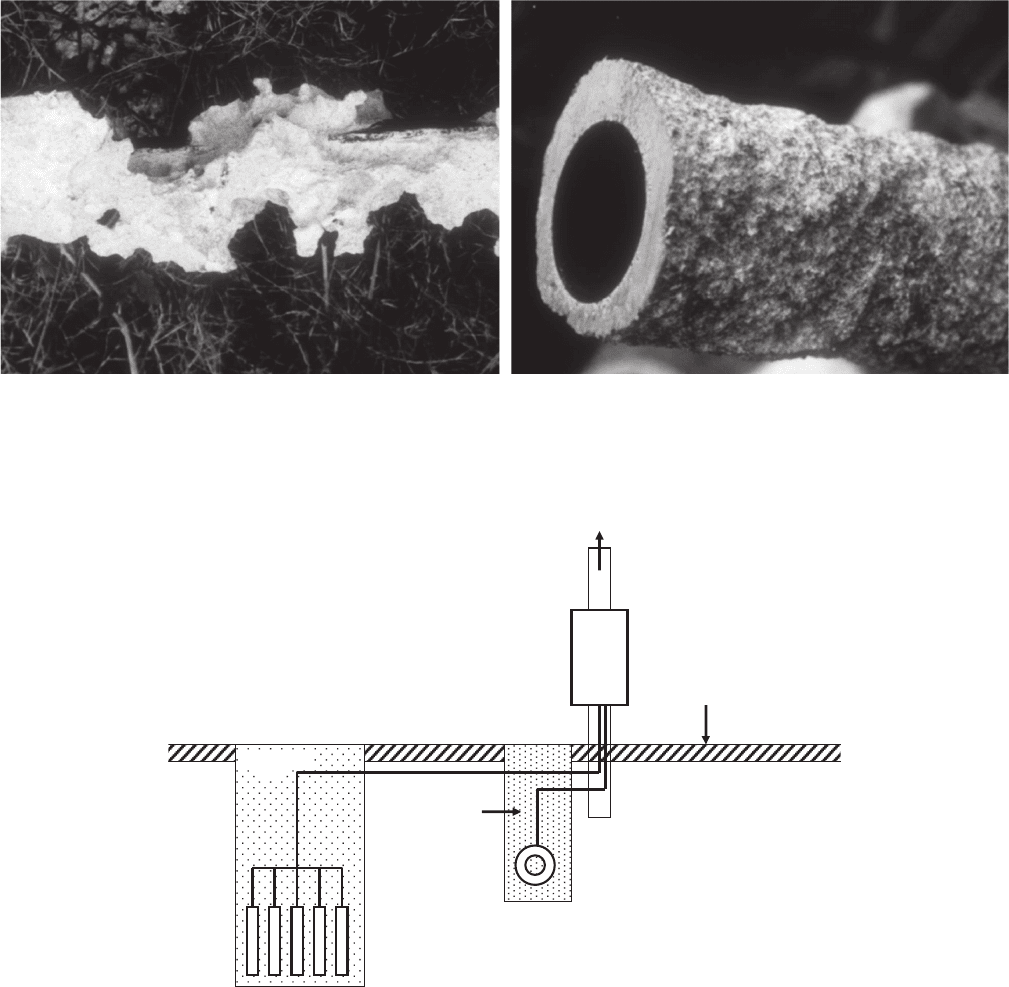
vendors develop. Figure 6.68 a shows the results of
improper and proper foundry practice on the corrosion
of aluminum anodes.
82
Similar patterns have been
reported on other alloy systems.
ICCP When large currents are needed or high elec-
trolyte resistivity prevents the use of galvanic anodes,
the protective current for cathodic protection is
supplied by an ICCP system similar to the one shown
in Figure 6.68 for a buried coated pipeline. The cathodic
connection to the pipeline is identical to that shown
in Figure 6.62 for galvanic anode cathodic protection.
The buried pipeline and the anodes are both connected
to an electrical rectifi er, which converts alternating
current to direct current, and imposes cathodic poten-
c06.indd 160c06.indd 160 10/29/2010 10:35:55 AM10/29/2010 10:35:55 AM
CORROSION CONTROL 161
Figure 6.68 Corrosion of aluminum anodes: (a) Uneven corrosion of aluminum anode due
to improper foundry procedures leading to segregation of alloying elements. (b) Uniform
corrosion of aluminum anode as the result of proper foundry practice.
83
a b
Figure 6.69 Impressed current cathodic protection of a buried pipeline.
Surface soil layer
To AC power supply
Buried coated pipeline
Rectifier
Anode bed
Disturbed
soil
Disturbed
soil
tials on the structure and anodic potentials on the
anode bed.
Unlike galvanic anodes, impressed current anodes
need not be naturally anodic to carbon steel, and they
usually are not. Most impressed current anodes are
made from nonconsumable anode materials that are
naturally cathodic to steel. The anodes are intended to
serve as sites for oxidation of a component of the envi-
ronment, usually oxygen dissolved in water, and are not
intended to oxidize. Even though they are intended to
be nonconsumable, these anodes do degrade with time.
Because they are naturally cathodic to steel, they would
accelerate corrosion if they were directly connected to
the structure they are intended to protect.
Figure 6.69 shows a typicalICCP system for a buried
coated pipeline. The connection to the pipeline is identi-
cal to that shown in Figure 6.62 for galvanic anode
cathodic protection. The buried pipeline and the anodes
c06.indd 161c06.indd 161 10/29/2010 10:35:55 AM10/29/2010 10:35:55 AM
162 METALLURGY AND CORROSION CONTROL IN OIL AND GAS PRODUCTION
Figure 6.70 A typical cathodic protection rectifi er used for
onshore cathodic protection. Photo courtesy of NACE
International Basic Corrosion course.
are both connected to an electrical rectifi er, which sup-
plies direct current (DC) to both. Unlike galvanic
anodes, impressed current anodes need not be naturally
anodic to carbon steel, and they usually are not. Most
impressed current anodes are made from semi - inert
materials that are naturally cathodic (electropositive) to
steel. They are intended to serve as electrodes for the
transfer of DC current to the environment via an oxida-
tion reaction, which in neutral pH waters and soils pro-
duces oxygen. It is intended that these anodes have a
relatively low consumption rate. Because they are natu-
rally cathodic to steel, they would accelerate corrosion
if they were directly connected to the structure they are
intended to protect.
It is important to always attach the leads from the
rectifi er to the proper terminals. The anode ground - bed
leads should always be attached to the positive terminal
of the power supply. The negative terminal is always
connected to the structure to be protected. Confusion
on this point can result inICCP systems being connected
improperly. This causes increased corrosion on the
structure rather than the intended reduction in corro-
sion rates.
The most common oxidation reactions on impressed
current anodes are oxidation of dissolved oxygen in the
water by one of the two following reactions.
In acids:
244
2
HO O H e
2
→+ +
+−
(Eq. 6.6)
In neutral or basic solutions:
424
2
OHOHOe
2
−−
→+ +
(Eq. 6.7)
Note that the above two reactions are merely the reverse
of Equations 6.4 and 6.5 , the most common reduction
reactions on a cathodically protected surface. All oxida-
tion reactions lower the pH (acidify) of the environ-
ment, so Equation 6.6 is the more likely oxidation
reaction.
If any chloride ions are in the water, then chorine
evolution can also happen:
22
2
Cl Cl e
−−
→+
(Eq. 6.8)
All of these reactions produce strong oxidizers which
can bleach or oxidize any organic materials nearby. The
degradation of early impressed current anode lead wire
insulation was once a problem, but modern lead wire
insulation is much more resistant to this oxidation.
Chlorine gas is also poisonous and care must be taken
to vent this gas properly in cases of chlorine evolution.
The anodes used in ICCP are intended to be noncon-
sumable, but oxidation of these materials does occur to
a limited extent, and care must be taken to operate
these anodes at recommended voltages and current
densities to prevent premature degradation.
The wiring and connections of the ICCP system must
totally isolate the system from the environment. Any
exposed metal becomes part of the ICCP circuit and can
lead to premature system failure.
Most ICCP uses electric current from a local power
source connected through a rectifi er, which changes
alternating current (AC) to direct current (DC). In loca-
tions where conventional electric power is not available,
solar cells, batteries, thermoelectric generators, and
other DC power sources have been used. At one time,
windmills were used in isolated locations, but the main-
tenance requirements on these mechanical systems
have caused them to be replaced in most locations by
solar cells.
94
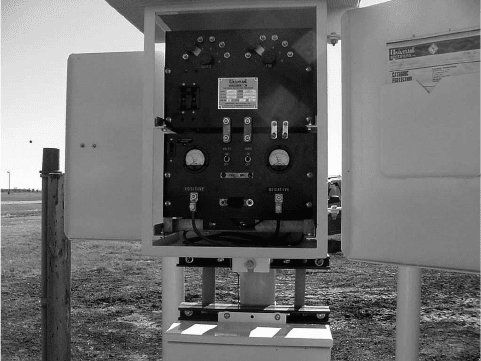
Figure 6.70 shows a typical cathodic protection recti-
fi er. Most rectifi ers will have lead wire connections to
the anode bed and to the protected structure as well as
connections to an AC power source plus controls and
displays to indicate power output, voltages, and current.
They will also have lightning arrest capabilities and
other safety features and be mounted in protective
casings to protect them from the weather, wildlife, and
vandalism. All of this costs money, and a typical rectifi er,
plus installation costs, will run into the thousands of
dollars. For these reasons, ICCP is normally limited to
situations where large amounts of current are needed,
otherwise galvanic anodes would be cheaper.
Most of the cost of rectifi er installation is for labor
and installation; therefore, it is common to use rectifi ers
somewhat larger than the measured or calculated
c06.indd 162c06.indd 162 10/29/2010 10:35:56 AM10/29/2010 10:35:56 AM

CORROSION CONTROL 163
TABLE 6.20 Properties of High - Silicon Cast Iron and
Graphite Anodes
Graphite
High - Silicon
Cast Iron
Nominal Current Density
Soil/freshwater, A/m
2
2 – 10 2 – 5
(A/ft
2
) (0.2 – 1) (0.2 – 0.5)
Soil/freshwater, A/m
2
5 – 10 5 – 10
(A/ft
2
) (0.5 – 1) (0.5 – 1)
Soil/freshwater, A/m
2
5 – 10 10 – 50
(A/ft
2
) (0.5 – 1) (1 – 5)
Consumption Rate
Soil/freshwater, kg/A - yr 0.5 – 0.9 0.1 – 0.5
(lb/A - yr) (1 – 2) (0.2 – 1.2)
Soil/freshwater, kg/A - yr 0.1 – 0.2 0.05 – 0.3
(lb/A - yr) (0.2 – 0.5) (0.1 – 0.7)
Soil/freshwater, kg/A - yr 0.1 – 0.3 0.3 – 0.5
(lb/A - yr) (0.2 – 0.7) (0.7 – 1)
Comments/Limitations
Avoid: Avoid:
Low pH Dry Soils
High Sulfate High pH
T > 50 ° C
High Sulfate
current requirements for the installation would dictate.
It is much cheaper to regulate the output of a rectifi er
than it is to reinstall a larger rectifi er if the current
demands cannot be met by the existing system. The total
cost of installation also leads to the common use of an
“ anode bed ” (also called a “ ground bed ” ) for ICCP
systems. While ICCP anodes are intended to be noncon-
sumable, they have current density limitations. Anode
beds with dozens, even hundreds, of anodes are not
unusual. The purpose of these large anode beds is to
allow for the use of higher - current - output rectifi ers,
which minimizes the cost of cathodic protection by
allowing one rectifi er to supply cathodic protection
current to large cathode surface areas. It is common for
one rectifi er/ground bed to provide cathodic protection
for several miles or kilometers of buried pipeline.
Galvanic anodes, which would need to be placed at
hundreds of meters/yards intervals, would be much
more expensive for this kind of application.
A typical ICCP system for a pipeline would include
an AC powered rectifi er with a maximum rated DC
output of between 10 and 50 amps and 50 V.
There are a number of anode materials used world-
wide for ICCP. In relative order of importance they are:
•
High - silicon cast iron
•
Graphite
•
Mixed - metal oxide (MMO)
•
Precious - metal clad (platinum)
•
Polymer
•
Scrap steel
•
Lead alloy
The above anodes are sometimes classifi ed into massive
anodes:
•
High - silicon cast iron
•
Graphite
•
Scrap steel
•
Lead alloy
and dimensionally stable anodes, which tend to be much
smaller and less robust:
•
MMO
•
Precious metal
•
Polymer
Each of these materials is discussed in separate sections
below.
With the exception of scrap steel, the materials used
for ICCP anodes are naturally cathodic to carbon steel
and would accelerate the corrosion of steel structures if
they were connected directly to the structure. The
purpose of the anodes in ICCP is to serve as a surface
for the oxidation of either oxygen or chlorine gases, the
two intended reaction products at the anode surface.
High - silicon cast iron anodes for cathodic protection
became popular in the 1950s and are still the most com-
monly used impressed current anode materials. The
Duriron Corporation in Dayton, Ohio, developed and
marketed the fi rst widely accepted anodes of this type,
and they also developed a more corrosion - resistant
anode with chromium additions in the 1970s. The patents
on these alloys have expired, and both of these alloys
are available worldwide. The original grade, ASTM
A518 Grade 1 is still specifi ed for some environments,
but the more corrosion - resistant alloy, ASTM A518
Grade 3 with chromium additions, is usually specifi ed,
because it is more widely available and is more corro-
sion resistant.
93,95
The most common shapes for these
anodes are cylindrical tubes or solid rods up to 210 cm
(8 ft) long and weighing up to 127 kg (280 lb).
Buried applications of these anodes usually include
a carbonaceous backfi ll (coke breeze), which increases
effi ciency by shifting most of the oxidation reaction to
the backfi ll. This backfi ll prolongs anode life.
96
Table 6.20 compares the properties of high - silicon
cast iron anodes with those of graphite anodes, the next
most commonly used ICCP anode material for buried
soil applications.
c06.indd 163c06.indd 163 10/29/2010 10:35:56 AM10/29/2010 10:35:56 AM

164 METALLURGY AND CORROSION CONTROL IN OIL AND GAS PRODUCTION
Graphite anodes contain particulate graphite held
together with a light oil impregnation. They were devel-
oped in the 1940s and were the most popular ICCP
anodes until the development of high - silicon cast iron.
Graphite anodes are very fragile, and some users report
up to 50% breakage between shipping and construction
damage. They are, nonetheless, the preferred anode
material for many buried soil applications and, in some
parts of the world, their use is greater than any other
ICCP anode material. The most common size for these
anodes is rods 7.6 cm diameter by 150 cm long (3 in.
diameter by 60 in. long).
Graphite anodes are almost always used with a car-
bonaceous backfi ll which prolongs anode life. The back-
fi ll moves the oxidation reaction to the backfi ll and both
prolongs anode life and increases the relative contact
area of the anode with the soil environment.
Carbonaceous backfi ll is often supplied with embedded
anodes in prepacked perforated steel cylinders that
greatly reduce breakage during shipping and construc-
tion. The perforations allow the release of gaseous oxi-
dation products, and eventual corrosion of the steel
cylinders is acceptable, because they have served their
purpose once the anodes are in place in the ground bed.
Table 6.20 compared the properties of graphite
anodes with high - silicon cast iron, their primary com-
petitor in most buried in soil applications. One limita-
tion on graphite anodes is that they will disintegrate if
the current density is too high. This is caused by a loss
of the binder material due to gas evolution within the
anode.
96
MMO anodes were originally developed and mar-
keted in the 1960s for the chemical process industry.
96
They were quickly adapted to cathodic protection. They
are the third - most commonly used ICCP anode mate-
rial for buried soil applications and, in some markets,
are the leading ICCP anode for marine applications,
although high - silicon cast iron remains competitive.
Their primary advantage in marine applications is their
relatively light weight in comparison to high - silicon cast
iron. The anodes consist of commercially pure niobium
or titanium substrates with proprietary oxide mixtures
on the surface. They are available as discs, tubes, and
wire. For onshore applications, they are often supplied
as tubes with a prepackaged backfi ll, although they can
also be used, for example, in deep well applications
(described later in this chapter) with loose carbona-
ceous backfi lls. They are available as wire, tubing, rod,
strip, and mesh shapes. Life is limited by the oxidation
of the substrate metal, and they are usually limited to
temperatures less than 40 ° C (140 ° F).
MMO anodes have been used for buried applica-
tions, but with limited success. The titanium substrates
do not work in dry soils, and niobium is not much
better.
97
Niobium - substrate MMO anodes do fi nd use
for tank bottom protection, where they are inserted
between the tank bottom and a liner in a 0.3 m (12 in.)
gravel/sand environment, but this is a very limited appli-
cation.
96
While titanium substrates have problems in
many high - resistivity environments, they have become
the standard for use in offshore applications.
98
The
breakdown of MMO substrates seems to be dependent
on the applied current density.
Table 6.21 summarizes some of the properties of
MMO anodes.
While other precious metals can also work as anode
surface materials, virtually all precious metal - clad
anodes use platinum as the surface material. Precious
metal anodes were developed in the 1960s and were
initially used in offshore applications where their weight
advantages over high - silicon cast iron made them eco-
nomically competitive. Platinum has a very high
exchange current density, approximately 10,000 times
higher than high - silicon cast iron.
99
This results in sub-
stantial weight savings for the installation of these
anodes. The major problem with platinum and other
TABLE 6.21 Mixed - Metal Oxide Anode Properties
Carbon Backfi ll
Freshwater Brackish Water Seawater Mud Saline High Current Special
Current Density, A/m
2
(A/ft
2
)
83 – 140
(7.7 – 13)
35 – 40
(3.3 – 3.8)
83 – 170
(7.7 – 16)
83 – 260
(7.7 – 24)
480 – 610
(45 – 57)
83 – 240
(7.7 – 22)
Life, years 20 20 20 15 15 15
Comments: Above ratings do not apply to Expanded Mesh Anodes.
Current densities must be dearated at temperatures below 5 – 10 ° C.
Electrolyte impunities can affect ratings.
Mixed - metal oxide surface is susceptible to abrasion damage.
Attenuation should be considered in long, thin wires and rods.
Data from Slide 101 NACE CP Technologist Chapter 2 , January 2005.
c06.indd 164c06.indd 164 10/29/2010 10:35:56 AM10/29/2010 10:35:56 AM

CORROSION CONTROL 165
precious metals, which all have similarly high exchange
current densities, is their cost. For this reason, most
platinum anodes are made by coating a thin layer of
platinum onto either a titanium or niobium substrate.
Platinum anodes have been used in a wide variety of
applications. Problems with anode breakdown (buildup
of a high - resistance oxide fi lm at the platinum – titanium
interface) have diminished the use of titanium - substrate
anodes in buried applications, and niobium - substrate
anodes have similar, but lesser, problems. Platinum
anodes remain the fourth most popular anode material
for buried onshore applications and they fi nd other
uses in process equipment and marine environments.
For buried applications, they are typically used with
either prepackaged backfi lls or inserted vertically into
deep wells which are then fi lled with carbonaceous
backfi lls.
96
Platinum and other precious metals are very soft, and
these anodes should not be used in fl owing - water situ-
ations where abrasion can remove the very thin and
fragile platinum surface layer.
Polymer anodes have a very limited market in oil and
gas production operations. They are supplied as fl exible
wires with graphite embedded into the wire insulation.
Their use is primarily as distributed anodes in low -
current situations such as the ground side of storage
tank bottoms and buried in parallel along relatively
short well - coated pipelines, for example, in industrial
areas and tank farms where conventional ICCP anodes
would require more expensive deep wells to avoid stray
current problems. They have been in use since the 1980s,
and there are reports of premature anode failure due to
changes in the resistivity of their environments.
97
Most
buried applications call for the anodes to be buried in
carbonaceous backfi lls.
The fi rst applications of ICCP used scrap steel for
anodes. This practice diminished with the development
of graphite and high - silicon cast iron anodes in the
1940s and 1950s. Scrap steel is still used on occasion for
ICCP anodes. The most common situation would be
where an abandoned - in - place structure, usually a pipe-
line, is used as an anode for ICCP of a replacement or
newer pipeline in the same right of way. Scrap steel is
inexpensive but, unlike the materials discussed above,
it is consumed as an anode and has a limited life.
Nonetheless, this approach is still used, especially as the
original uncoated pipelines constructed in the 1930s
through the 1950s are replaced with new parallel pipe-
lines having modern coatings. The small exposed surface
area of the new pipelines means that the average applied
current density on the abandoned pipelines or gathering
lines is very small and the scrap steel anodes should last
for many years.
96
At one time, lead anodes with silver or other precious
metal additions were used as very heavy precious metal
anodes. These anodes were used before precious - metal
cladding techniques were developed. The lead would
corrode, leaving an enriched silver or other precious
metal surface. These enriched surfaces had high
exchange current densities. The heavy weight was useful
in locations such as Cook Inlet in Alaska where high
tidal currents would damage less robust anodes. The
anodes were mounted on sleds that sat on the sea
bottom at remote anode bed locations. Like most anode
sled arrangements, mechanical damage to the lead wires
was a concern. While several NACE and other stan-
dards still list these materials,
100
they have not been
specifi ed in North America for many years and are not
listed by most cathodic protection anode suppliers.
Tables 6.22 and 6.23 summarize information on the
use of ICCP anodes in seawater and underground
service — the two most common ICCP environments.
The advantages of MMO and platinized - titanium
anodes for seawater service are apparent. For onshore
applications, the weight savings realized by the use of
these lighter anodes is much less important, but the
TABLE 6.22 Impressed Current Anode Material Consumption Rates
Impressed Current Anode Material
Typical Anode Current Density
in Saltwater Service A/m
2
(A/ft
2
)
Nominal Consumption
Rateg/A - y (lb/A - y)
Platinum (on titanium, niobium or tantalum
substrate) or titanium mixed - metal oxide
540 to 3320 3.6 to 7.3
(50 to 300) (0.008 to 0.016)
a
Graphite 11 to 43 230 to 450
(1 to 4) (0.5 to 1.0)
Fe - 14.5%Si - 4.5%Cr 11 to 43 230 to 450
(1 to 4) (0.5 to 1.0)
a
This fi gure can increase when current density is extremely high and in low - resistivity waters.
Extracted from table C1, NACE SP0176 - 2007.
c06.indd 165c06.indd 165 10/29/2010 10:35:56 AM10/29/2010 10:35:56 AM

166 METALLURGY AND CORROSION CONTROL IN OIL AND GAS PRODUCTION
TABLE 6.23 Summary of ICCP Anode Properties for Underground Cathodic Protection Systems
95
Graphite Si - Cr Cast Iron
Mixed - Metal
Oxide
Platinum -
Coated Polymeric Scrap Steel
Consumption
rate
0.1 to 1 kg/A - y
(0.2 to
2 lb/A - y)
0.1 to
0.5 kg/A - y
(0.2 to
1 lb/A - y)
Coating/
titanium
bond
determines
anode life
8 to
16 mg/A - y
Projected
20 - year life
requires
installation in
carbonaceous
backfi ll
9 kg/A - y
(20 lb/A - y)
Current
density,
maximum
5 A/m
2
(0.5 A/ft
2
)
10 A/m
2
(1.0 A/ft
2
)
100 A/m
2
(9.3 A/ft
2
)
110 A/m
2
(10 A/ft
2
)
52 mA/m
(16 mA/ft)
(1.3 A/m
2
[0.12 A/ft
2
])
Unknown
Common
shapes
Cylindrical Tubular and
solid
cylindrical
Tubular and
wire
Wire Wire Pipe, rail, and
casing
Handling
precautions
Material is
brittle
Material is
brittle
Oxide can be
damaged by
abrasion
Platinum can
be damaged
by abrasion
Can be
damaged by
abrasion
None: anodes
are heavy
Connections Mechanical
connections
at center or
near end of
anode
Mechanical
connections
at center or
near end of
anode
Mechanical
connections
at center or
end of anode
Brazed or
mechanical
connections
at end of
anode
Brazed or
mechanical
connections
Multiple
connections,
brazed or
bolted
Packaging Sold bare or
in canisters
Sold bare or in
canisters
Sold bare, with
foam
protectors, or
in canisters
Sold bare or
in canisters
Sold bare or
packaged
No packaging
Environmental
hazards
None known None known None known None known None known None known
Date of
fi rst use
1940s 1950s early 1980s 1960s early 1980s 1930s
Other notes Typically fully
impregnated
with oil,
wax, or resin
None Connection
seals for
tubular
anodes tested
by the
manufacturer
None Typically
installed in
shallow,
horizontal
beds
Multiple
sealed
connections
allow full
use of anode
Table A - 1, NACE Publication 10A196 Impressed Current Anodes for Underground Cathodic Protection Systems, NACE 1996.
Data supplied in 2008 by Farwest Corrosion Control for California
including offshore and by Deepwater Corrosion Services (Gulf of
Mexico and worldwide offshore) in 2008.
TABLE 6.24 Relative Market Share of ICCP Anodes
Environment
Soil Freshwater Seawater
High - silicon cast iron Mixed - metal
oxides
Mixed - metal
oxide
Graphite Pt/Nb or Pt/Ti Pt/Nb or Pt/Ti
Mixed - metal oxides
to a limited extent,
but not in dry soil
High silicon
cast iron use
is declining
High - silicon
cast iron
reduced cost of handling and transport of these much
lighter anodes remains one of the reasons for their con-
tinued and increasing popularity, especially in remote
areas where transportation to construction sites is
restricted. The relative market share of the top three
anode materials for onshore and natural water service
is summarized in Table 6.24 .
Most ICCP anode materials used in soil applications
require, or at least benefi t, from the use of backfi ll mate-
rials which surround the anode and provide a more
electrically conductive environment. These backfi lls
make the anode environment more electrically conduc-
tive, which lowers electric power requirements. They
c06.indd 166c06.indd 166 10/29/2010 10:35:56 AM10/29/2010 10:35:56 AM
CORROSION CONTROL 167
Figure 6.71 Typical deep anode bed in normal soil strata.
102
2′ min. or
above
flood plane
100′
min.
10″
Entire 10″
wellbore
cemented
through surface
formations
Coke breeze anode
backfill (fluid or
granular)
To
Rectifier or
J-box
2″ min. annular
cement well seal
around vent pipe
2″ min. sch 40
PVC vent pipe with
perforations in
anode interval
Impressed current
anode (number
and size varies)
Figure 6.72 Dielectric shield fl ush mounted on a hull.
102
also prolong the life of the anode. Carbonaceous materi-
als are almost universally used for this purpose. These
materials, either metallurgical coke (manufactured from
coal) or similar high - carbon particulate materials with
hydrocarbon precursors, extend the life of the anodes
and move most of the oxidation reaction, which will
eventually degrade the anode, to the backfi ll particle
surfaces. Backfi ll materials are provided in prepackaged
format for some anodes or in bags similar to those
provided for galvanic anodes.
96
The relatively low -
conductivity soil backfi lls used for galvanic anodes
should not be used for ICCP anodes.
There have been fewer quality control problems with
ICCP anode suppliers than with galvanic anodes. Most
users rely on preapproved qualifi ed vendors to insure
the quality of ICCP anodes.
Deep anode beds are sometimes used for galvanic
anodes in locations where right of way restrictions or
the lack of shallow groundwater dictate their use. They
are much more common in ICCP systems where the
stray current problems are more severe because of the
relatively large currents normally associated with ICCP
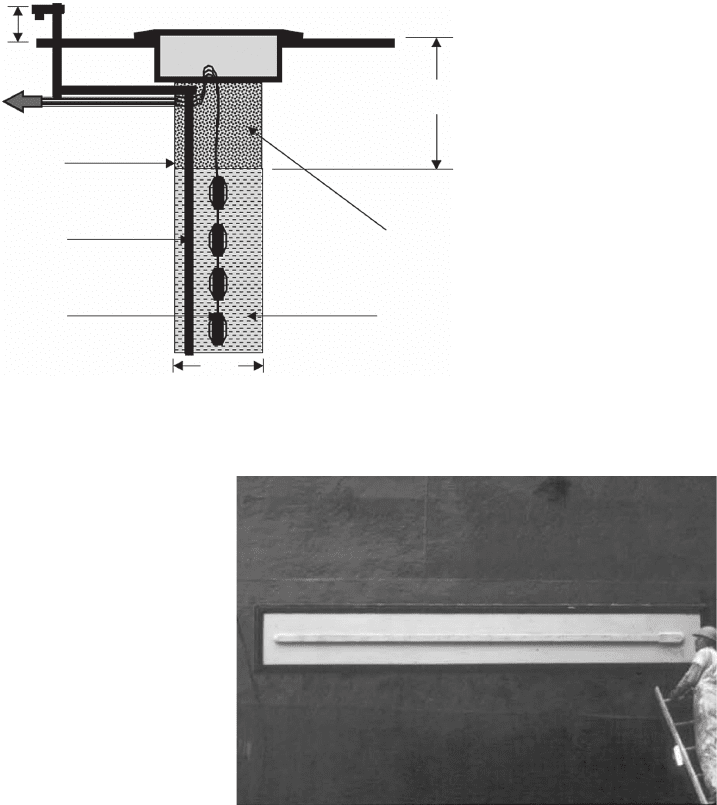
rectifi ers and multiple - anode ground beds. Figure 6.71
shows a typical deep anode ground bed.
Deep wells require casings — liners for the hole that
prevent contamination of groundwater and provide a
means for venting the oxidation product gases. If the
anodes are located in salty water, the chlorine gases that
are liberated will be poisonous, but oxygen is the most
common gas generated by most deep wells. Casings for
deep wells are often made from PVC — a polymer that
is resistant to oxidizing gases. Most cathodic protection
deep wells are drilled using similar equipment to that
which is used for drilling water wells. The drilling uses
water - based drilling muds that must be thinned before
installing the anodes and backfi lls, which are usually
coke breeze or other carbonaceous materials.
102
The most effi cient current distribution is achieved
when anodes are located at electrically remote loca-
tions. If this is impractical, for example, on fl oating hulls,
then the use of fl ush - mounted anodes with dielectric
shields — insulators placed between the anode and the
structure to be protected — becomes necessary. Figure
6.72 shows a dielectric shield fl ush - mounted on a hull.
101
Flush - mounted anodes with dielectric shields are
relatively ineffi cient. They distribute more current than
necessary near the dielectric shield – structure interface
in order to provide adequate current farther away —
usually at the midpoints between two anodes. It is
important to inspect and regulate the current to fl ush -
mounted anodes in order to prevent coating debonding
c06.indd 167c06.indd 167 10/29/2010 10:35:56 AM10/29/2010 10:35:56 AM
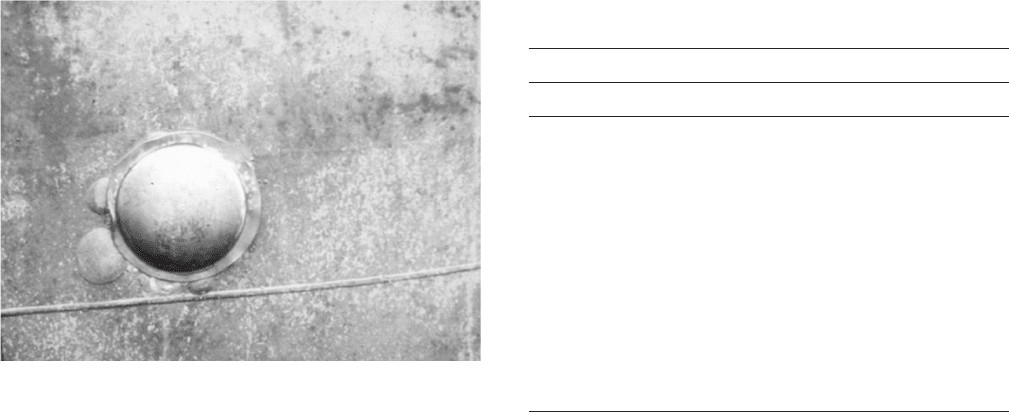
168 METALLURGY AND CORROSION CONTROL IN OIL AND GAS PRODUCTION
caused by excessive cathodic current near the anodes.
Figure 6.73 shows coating debonding caused by
excessive cathodic current on a fl ush - mounted anode.
82
These shields are made from a variety of polymeric
materials.
The advantages of ICCP cathodic protection include
the large electrical current available from one rectifi er/
anode bed installation, the low installation cost com-
pared to galvanic systems requiring many anodes, and
the long life of ICCP anodes if correctly installed and
operated in the correct current density ranges. It is
not unusual to have rectifi ers and associated equipment
in continuous operation for several decades with
only routine maintenance and occasional anode
replacement.
Limitations of ICCP systems include the increased
possibility of hydrogen embrittlement of any high -
strength (high hardness) steel, for example, at improp-
erly welded joints, and the increased likelihood of
causing coating debonding or stray current corrosion on
nearby structures. Highly trained maintenance and
inspection personnel (usually the same people) are also
required because of dangers associated with mainte-
nance on rectifi ers and to prevent reversed polarity con-
nections at rectifi ers. The relatively high maintenance
and trained personnel requirements of ICCP systems
are why most offshore cathodic protection systems use
galvanic anodes.
Comparison of Galvanic Anodes and ICCP Table
6.25 compares galvanic anode and ICCP systems.
The installation of a galvanic anode is fairly inexpen-
sive, and it is possible to install anodes for under $100
per anode if the structure is already exposed. This low
initial cost plus the low maintenance/inspection costs
make galvanic anode cathodic protection the option of
choice for many oilfi eld applications.
Cathodic Protection Criteria
Operators of cathodic protection systems need to be
able to determine if the structures are being adequately
protected. Figures 6.63 and 6.64 showed that the corro-
sion rate is substantially reduced whenever the struc-
ture potential is shifted in a cathodic direction. The
question then becomes how much cathodic protection
is desired or necessary.
Early proponents of cathodic protection discussed
criteria for cathodic protection. Some advocates sug-
gested that cathodic protection needed to approach the
equilibrium potential. Others suggested that a potential
shift of any amount would yield prolonged life and over-
protection was costly.
The fi rst international standard on cathodic protec-
tion, NACE RP 0169 (now termed SP0169), listed the
following means of determining if cathodic protection
had been achieved:
102
•
− 850 mV polarized potential
•
100 mV polarization
•
300 mV shift
•
E log i
•
Net protective current
Recent revisions have eliminated some of these criteria,
and the validity of the remaining criteria remains
controversial.
Figure 6.73 Coating debonding caused by excessive current
from a fl ush - mounted anode.
83
TABLE 6.25 Comparisons between Galvanic Anode and
Impressed Current Cathodic Protection Systems
System
Galvanic Anode Impressed Current
Low initial investment for
small systems
Cheaper for large systems
Fixed voltage Adjustable voltage
Small voltage Small to large voltages
Fixed current Adjustable current
Small current Small to very large currents
Low maintenance Higher maintenance
Stray currents unlikely Stray currents possible
Reversed potentials
impossible
Reversed polarity possible
No power source necessary Requires external power
Excess current unlikely Excess current can cause
coating debonding
c06.indd 168c06.indd 168 10/29/2010 10:35:57 AM10/29/2010 10:35:57 AM