
Hogg S. Essential microbiology
Подождите немного. Документ загружается.


JWBK011-07 JWBK011-Hogg August 12, 2005 16:8 Char Count= 0
158 MICROBIAL DIVERSITY
A few words about classification
In this section, we examine the wide diversity of microbial life. In each of the next four
chapters, we shall discuss major structural and functional characteristics, and outline
the main taxonomic divisions within each group. We shall also consider some specific
examples, particularly with respect to their effect on humans. By way of introduction,
however, we need to say something on the subject of the classification of microorganisms.
In any discussion on biological classification, it is impossible to avoid mentioning Lin-
naeus, the Swedish botanist who attempted to bring order to the naming of living things
by giving each type a Latin name. He even gave himself one – his real name was Carl
von Linn
´
e! It was Linnaeus who was responsible for introducing the binomial system
of nomenclature, by which each organism was assigned a genus and a species. To give
a few familiar examples, you and I are Homo sapiens, the fruit fly that has contributed
so much to our understanding of genetics is Drosophila melanogaster, and, in the mi-
crobial world, the bacterium responsible for causing anthrax is Bacillus anthracis. Note
the following conventions, which apply to the naming of all living things (the naming
of viruses is something of a special case, which we’ll consider in Chapter 10):
r
the generic (genus) name is always given a capital letter
r
the specific (species) name is given a small letter
r
the generic and specific name are italicised, or, if this isn’t possible, underlined
A taxon is a collec-
tion of related organ-
isms grouped together
for purposes of classifica-
tion. Thus, genus, family,
etc. are taxons.
The science of taxonomy involves not just naming or-
ganisms, but grouping them with other organisms that
share common properties. In the early days, classifica-
tion appeared relatively straightforward, with all living
things apparently fitting into one of two kingdoms.To
oversimplify the matter, if it ran around, it was an an-
imal, if it was green and didn’t, it was a plant! As our
awareness of the microbial world developed, however, it
was clear that such a scheme was not satisfactory to accommodate all life forms, and in
the mid-19th century, Ernst Haeckel proposed a third kingdom, the Protista, to include
the bacteria, fungi, protozoans and algae.
In the 20th century, an increased focus on the cellular and molecular similarities
and dissimilarities between organisms led to proposals for further refinements to the
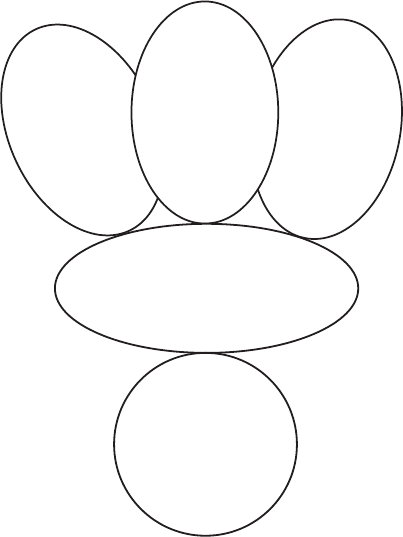
three-kingdom system. One of the most widely accepted of these has been the five-
kingdom system proposed by Robert Whittaker in 1969 (Figure A1). Like some of its
predecessors, this took into account the fundamental difference in cell structure between
procaryotes and eucaryotes (Chapter 3), and so placed procaryotes (bacteria) in their
own kingdom, the Monera, separate from single-celled eucaryotes. Another feature of
Whittaker’s scheme was to assign the Fungi to their own kingdom, largely on account of
their distinctive mode of nutrition. Table A1 shows some of the characteristic features
of each kingdom.
Molecular studies in the 1970s revealed that the Archaea differed from all other bac-
teria in their 16S rRNA sequences, as well as in their cell wall structure, membrane lipids
JWBK011-07 JWBK011-Hogg August 12, 2005 16:8 Char Count= 0
A FEW WORDS ABOUT CLASSIFICATION 159
FUNGIPLANTAE
PROTISTA
MONERA
ANIMALIA
Figure A.1 Whittaker’s five-kingdom system of classification
and aspects of protein synthesis. These differences were seen as sufficiently important
for the recognition of a third basic cell type to add to the procaryotes and eucaryotes.
This led to the proposal of a three-domain scheme of classification, in which procary-
otes are divided into the Archaea and the Bacteria (Figure 3.1). The third domain, the
Eucarya represents all eucaryotic organisms. The domains thus represent a level of clas-
sification that goes even higher than the kingdoms. Although the Archaea (the word
means ‘ancient’) represent a more primitive bacterial form than the Bacteria, they are in
certain respects more closely related to the eucaryotes, causing biologists to revise their
ideas about the evolution of the eucaryotic state.
In hierarchical systems of classification, related species are grouped together in the
same genus, genera sharing common features are placed in the same family, and so on.
Table A2 shows a modern classification scheme for the gut bacterium Escherichia coli.
The boundaries between long-standing divisions such as algae and protozoa have
become considerably blurred in recent years, and alternative classifications based on
molecular data have been proposed. This is very much a developing field, and no defini-
tive alternative classification has yet gained universal acceptance.
In the following chapters, we shall broadly follow the five-kingdom scheme, although
of course the plant and animal kingdoms, having no microbial members, do not concern
us. Thus, both the Archaea and Bacteria are considered in Chapter 7, and multicellular
fungi form the focus of Chapter 8. Chapter 9 examines the Protists in the modern use

JWBK011-07 JWBK011-Hogg August 12, 2005 16:8 Char Count= 0
Table A.1 Characteristics of Whittaker’s five kingdoms
Monera (procaryotae) Protista Fungi Plantae Animalia
Cell type Procaryotic Eucaryotic Eucaryotic Eucaryotic Eucaryotic
Cell organization Unicellular; occasionally
grouped
Unicellular;
occasionally
multicellular
Unicellular or
multicellular
Multicellular Multicellular
Cell wall Present in most Present in some, absent
in others
Present Present Absent
Nutrition Absorption, some
photosynthetic, some
chemosynthetic
Ingestion or absorption,
some photosynthetic
Absorption Absorptive,
photosynthetic
Ingestion; occasionally
in some parasites by
absorption
Reproduction Asexual, usually by
binary fission
Mostly asexual,
occasionally both
sexual and asexual
Both sexual and
asexual, often
involving a complex
life cycle
Both sexual and
asexual
Primarily sexual
160

JWBK011-07 JWBK011-Hogg August 12, 2005 16:8 Char Count= 0
A FEW WORDS ABOUT CLASSIFICATION 161
Table A.2 A modern hierarchical
classification for E. coli; note that in this
classification, there are no kingdoms
Domain Bacteria
Phylum Proteobacteria
Class Zymobacteria
Order Enterobacteriales
Family Enterobacteriaceae
Genus Escherichia
Species coli
of the word, that is, unicellular eucaryotic forms. It retains the traditional distinction
between protozoans, algae and other protists (water moulds and slime moulds), but also
offers an alternative, ‘molecular’ scheme, showing the putative phylogenetic relationship
between the various groups of organisms. Microbiology has traditionally embraced
anomalies such as the giant seaweeds, as it has encompassed all organisms that fall
outside of the plant and animal kingdoms. This book offers only a brief consideration
of such macroscopic forms, and for the most part confines itself to the truly microbial
world.
The viruses, it ought to be clear by now, are special cases, and are considered in
isolation in Chapter 10. Because an understanding of viruses requires an appreciation
of the basics of DNA replication and protein synthesis, it may help to jump ahead and
read the relevant sections of Chapter 11 before embarking on Chapter 10.
JWBK011-07 JWBK011-Hogg August 12, 2005 16:8 Char Count= 0
162

JWBK011-07 JWBK011-Hogg August 12, 2005 16:8 Char Count= 0
7
Procaryote Diversity
The phenotype of an or-
ganism refers to its ob-
servable characteristics.
The genotype of an or-
ganism refers to its ge-
netic make-up.
Ever since bacteria were first identified, microbiologists have attempted to bring order
to the way they are named and classified. The range of morphological features use-
ful in the differentiation of bacteria is fairly limited (compared, say, to animals and
plants), so other characteristics have also been employed. These include metabolic
properties, pathogenicity, nutritional requirements, staining reactions and antigenic
properties. The first edition of Bergey’s Manual of Systematic Bacteriology (henceforth
referred to as ‘Bergey’), published in the mid-1980s, mainly used phenotypic character-
istics such as these to classify bacteria. The result placed bacteria into taxonomic groups
that may or may not reflect their evolutionary rela-
tionship to one another. In the years since the first
edition of Bergey, the remarkable advances made in
molecular genetics have led to a radical reappraisal
of the classification of bacteria. Comparison of nu-
cleic acid sequences, notably those of 16S riboso-
mal RNA genes, has led to a new, phylogenetically
based scheme of classification, that is, one based on
how closely different groups of bacteria are thought
to be related, rather than what morphological or
physiological features they may share. Ribosomal RNA occurs in all organisms, and
serves a similar function, thus to a large extent these sequences are conserved (remain
similar) in all organisms. The nature and extent of any differences that have crept in
during evolution will, therefore, be an indication of the relatedness of different organ-
isms.
The second edition of Bergey aims to reflect this change of approach and reassign
many bacteria according to their phylogenetic relationship, as deduced from molecular
evidence. Due to be issued in five volumes over a number of years, the first volume was
published in 2001. As an example, the genus Pseudomonas previously contained some
70 species on the basis of phenotypic similarities, but in the second edition of Bergey,
taking into account 16S rRNA information, many of these are assigned to newly created
genera.
It must be stressed that Bergey (second edition) does not represent the definitive
final word on the subject, and that the classification of bacteria is very much a de-
veloping science, in a constant process of evolution. Indeed, microbiologists are by
no means unanimous in their acceptance of the ‘molecular’ interpretation of bacte-
rial taxonomy. Some point to perceived inadequacies in the collection of data for the
163
JWBK011-07 JWBK011-Hogg August 12, 2005 16:8 Char Count= 0
164 PROCARYOTE DIVERSITY
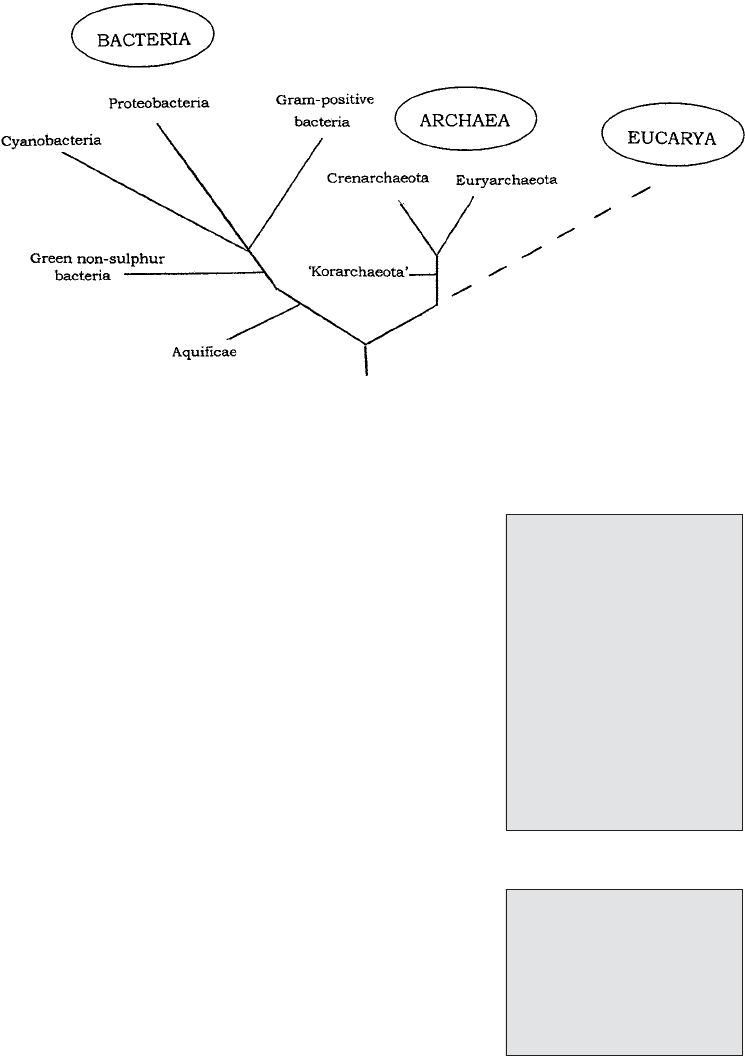
Figure 7.1 Phylogenetic relationships in the Procaryota. A phylogenetic tree based on 16S
ribosomal RNA data, showing the relationships between members of the Archaea and the
Bacteria. The position on the tree of the Eucarya (all eucaryotic organisms) is also indicated
scheme, as well as errors in the data arising from the
sequencing and amplification techniques utilised. Other
critics question the validity of a scheme based on 16S
rRNA data when it seems increasingly likely that lateral
gene transfer played an important role in bacterial evo-
lution.
Bacteria may acquire
genes from other or-
ganisms by a variety of
genetic transfer mecha-
nisms (see Chapter 11).
This is known as horizon-
tal or lateral gene trans-
fer, to distinguish it from
vertical inheritance, in
which the parental gen-
otype is passed to the
offspring.
In the following pages, the major taxonomic group-
ings are discussed according to their arrangement in the
second edition of Bergey. Figure 7.1 shows a phyloge-
netic tree, reflecting current ideas on the relationship be-
tween the major bacterial groups, as determined by 16S
rRNA sequencing.
Archaea are procary-
otes differing from true
bacteria in cell wall and
plasma membrane che-
mistry as well as 16S rRNA
sequences.
Domain: Archaea
Studies on 16S ribosomal RNA sequences by Carl Woese
and colleagues allowed the construction of phylogenetic
trees for the procaryotes, showing their evolutionary re-
latedness. Figure 7.1 shows how the major procaryotic
groups are thought to be related, based on 16S rRNA
data. The work of Woese also revealed that one group of
procaryotes differed from all the others. As described in
Chapter 3, the Archaea are now regarded as being quite
distinct from the Bacteria (sometimes called Eubacteria). Together with the Eucarya,
these form the three domains of life (Figure 3.1). As can be seen in Table 7.1, archaea

JWBK011-07 JWBK011-Hogg August 12, 2005 16:8 Char Count= 0
DOMAIN: ARCHAEA 165
Table 7.1 The three domains of life: Archaea share some features with true bacteria
and others with eucaryotes
Archaea Bacteria Eucarya
Main genetic
material
Single closed circle
of dsDNA
Single closed circle
of dsDNA
True nucleus with
multiple linear
chromosomes
Histones Present Absent Present
Gene structure Introns absent Introns absent Introns present
Plasmids Common Common Rare
Polycistronic
mRNA
Present Present Absent
Ribosomes 70S 70S 80S
Protein synthesis Not sensitive to
streptomycin,
chloramphenicol
Sensitive to
streptomycin,
chloramphenicol
Not sensitive to
streptomycin,
chloramphenicol
Initiator tRNA Methionine N-formyl
methionine
Methionine
Membrane fatty
acids
Ether-linked,
branched
Ester-linked,
straight chain
Ester-linked,
straight chain
Internal organelles Absent Absent Present
Site of energy
generation
Cytoplasmic
membrane
Cytoplasmic
membrane
Mitochondria
Cell wall Muramic acid
absent
Muramic acid
present
Muramic acid
absent
The domain is the high-
est level of taxonomic
grouping.
share some features in common with other bacteria and
some with eucaryotes. Extending nucleic acid analysis to
other genes has shown that members of the Archaea pos-
sess many genes not found in any other type of bacteria.
General features of the Archaea
Members of the Archaea show considerable diversity of both morphology and physiol-
ogy. In view of the fact that the Archaea remained unidentified as a separate group for so
many years, it should come as no surprise that they do not display any obvious morpho-
logical differences from true bacteria, and all the main cell shapes (see Chapter 2) are rep-
resented. More unusual shapes are also encountered in archaea; members of the genus
Haloarcula have flattened square or triangular cells! Both Gram-positive and Gram-
negative forms of archaea are found, but neither possesses true peptidoglycan. Some
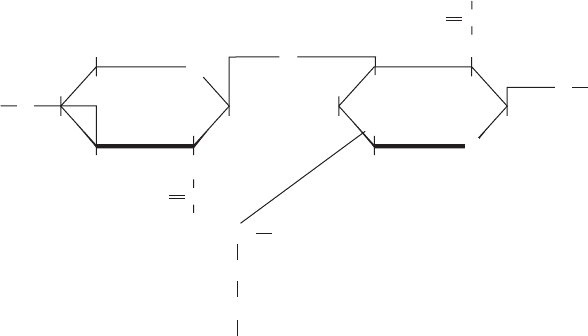
types have a so-called pseudomurein, composed of different substituted polysaccharides
and l-amino acids (Figure 7.2). Most archaea, however, have cell walls composed of
a layer of proteinaceous subunits known as an S-layer, directly associated with the cell
membrane. This difference in cell wall chemistry means that members of the Archaea
are not susceptible to antibacterial agents such as lysozyme and penicillin, whose action
is directed specifically towards peptidoglycan. Differences are also found in the make-up
JWBK011-07 JWBK011-Hogg August 12, 2005 16:8 Char Count= 0
166 PROCARYOTE DIVERSITY
H
H
β 1→ 3
H
O
N-acetylglucosamine
OH
H
H
OH
HH
H
CO
H
H
Glu
Ala
Lys
Glu (NH
2
)
CH
3
C
O
NH
O
O
O
CH
3
CH
2
OH
C
O
NH
N-acetyltalosaminuronic acid
O
Figure 7.2 Pseudomurein, found in the cell walls of certain members of the Archaea,
comprises subunits of N-acetylglucosamine and N-acetyltalosaminuronic acid. The latter
replaces the N-acetylmuramic acid in true peptidoglycan (c.f. Figure 3.6). (Ac represents
the acetyl group). As with peptidoglycan, the amino acids in the peptide chain may vary,
however in pseudomurein they are always of the L-form. The components in parentheses
are not always present.
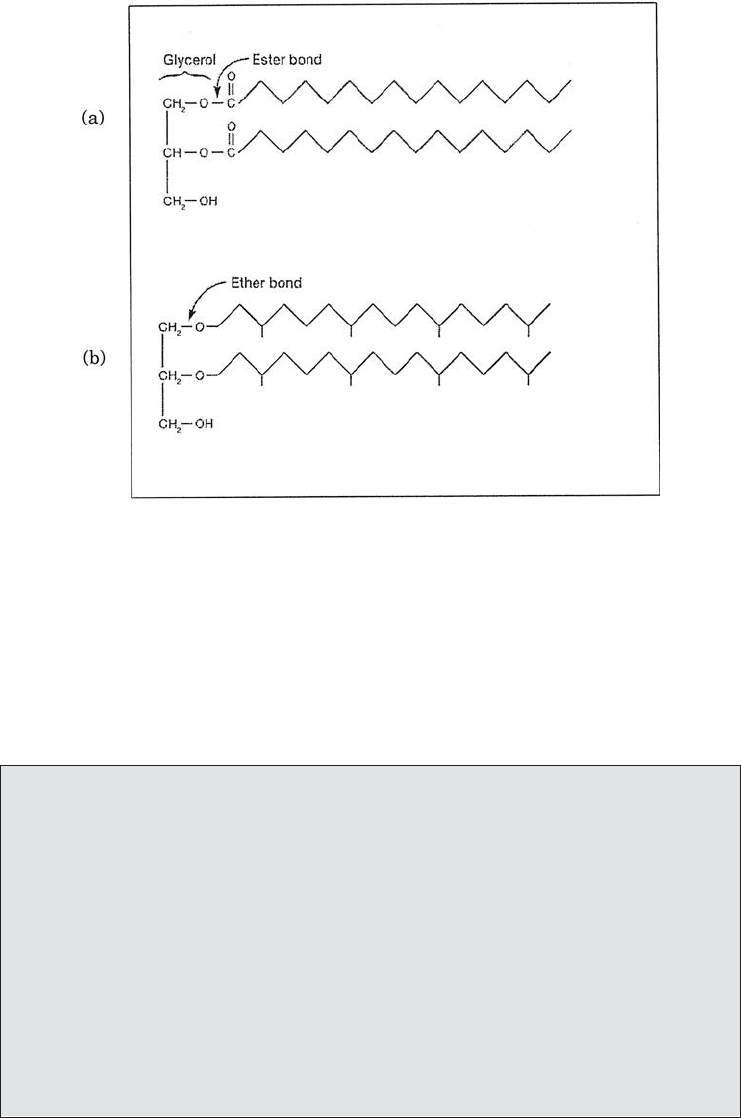
of archaean membranes, where the lipid component of membranes contains branched
isoprenes instead of fatty acids, and these are joined to glycerol by ether-linkages, rather
than the ester-linkages found in true bacteria (Figure 7.3). The diversity of archaea ex-
tends into their adopted means of nutrition and metabolism: aerobic/anaerobic and
autotrophic/heterotrophic forms are known. Many members of the Archaea are found
in extreme environments such as deep-sea thermal vents and salt ponds. Some extreme
thermophiles are able to grow at temperatures well over 100
◦
C, while psychrophilic
forms constitute a substantial proportion of the microbial population of Antarctica.
Similarly, examples are to be found of archaea that are active at extremes of acidity,
alkalinity or salinity. Initially it was felt that archaea were limited to such environments
because there they faced little competition from true bacteria or eucaryotes. Recent stud-
ies have shown however that archaea are more widespread in their distribution, making
up a significant proportion of the bacterial biomass found in the world’s oceans, and
also being found in terrestrial and semiterrestrial niches. The reason that this lay unde-
tected for so long is that these organisms cannot as yet be cultured in the laboratory,
and their presence can only be inferred by the use of modern DNA-based analysis.
Classification of the Archaea
According to the second edition of Bergey, the Archaea are divided into two phyla,
the Euryarchaeota and Crenarchaeota. A third phylum, the Korarchaeota has been
JWBK011-07 JWBK011-Hogg August 12, 2005 16:8 Char Count= 0
DOMAIN: ARCHAEA 167
Figure 7.3 Membrane lipids in Archaea and Bacteria. Compositional differences in mem-
brane lipids between (a) Bacteria and (b) Archaea. Note the ether linkages and branched
fatty acids in (b)
proposed, whose members are known only from molecular studies, while the recent
discovery of Nanoarchaeum equitans has led to the proposal of yet another archaean
phylum (see Box 7.1). Countless more species of archaea are thought to exist, which
like the Korarchaeota, have not yet been successfully cultured in the laboratory.
Box 7.1 A new phylum?
In 2002 a novel microorganism, Nanoarchaeum equitans was isolated from a hy-
drothermal vent deep below the sea off the Icelandic coast. Found at tempera-
tures around boiling point, its tiny spherical cells were attached to the surface of
another archaean, Ignicoccus sp., without which it cannot apparently be cultured.
Ribosomal RNA studies showed N. equitans to be sufficiently unlike other members
of the Archaea to justify the creation of a new archaean phylum, the Nanoar-
chaeota. Now fully sequenced, the genome of N. equitans is one of the smallest liv-
ing things to date (490kb). It appears to belong to a very deeply rooted branch of the
Archaea, leading to speculation that it may resemble the first living cells. At 0.4
µm
in diameter, N. equitans is also among the smallest known living organisms. Although
at present it is the only recognised species of the Nanarchaeota, it seems likely to
be joined by isolates reported from other locations around the world.