
Hogg S. Essential microbiology
Подождите немного. Документ загружается.


JWBK011-06 JWBK011-Hogg August 12, 2005 16:0 Char Count= 0
138 MICROBIAL METABOLISM
Anaerobic respiration
In the process of anaerobic respiration, carbohydrate can be metabolised by a process
that utilises oxidative phosphorylation via an electron transport chain, but instead of
oxygen serving as the terminal electron acceptor a (usually) inorganic molecule such as
nitrate or sulphate is used. These processes are referred to, respectively, as dissimilatory
nitrate or sulphate reduction. Obligate anaerobes carry out this process, as they are
unable to utilise oxygen; in addition, other organisms may turn to this form of res-
piration if oxygen is unavailable (facultative anaerobes). Other examples of inorganic
electron acceptors for anaerobic respiration include Fe
3+
,CO
2
and Mn
4+
. In certain
circumstances, an organic molecule such as fumarate may be used instead.
Anaerobic respiration is not as productive as its aerobic counterpart in terms of ATP
production, because electron acceptors such as nitrate or sulphate have less positive
redox potentials than oxygen. Anaerobic respiration tends to occur in oxygen-depleted
environments such as waterlogged soils.
It must be stressed that anaerobic respiration is not the same as fermentation. The
latter process does not involve the components of the electron transport chain (i.e. there
is no oxidative phosphorylation), and much smaller amounts of energy are generated.
Energy may be generated by the oxidation of inorganic molecules
In the previous pages, we have seen how electrons derived from a variety of organic
sources can be channelled into the glycolytic pathway (or one of its alternatives), and
how energy is generated by either oxygen or an organic/inorganic molecule acting as
an electron acceptor. Certain bacteria, however, are able to derive their energy from the
oxidation of inorganic substrates; these are termed chemolithotrophs (see Chapter 4).
Molecules such as NH
4
+
,NO
2
−
,Fe
2+
and S
0
can be oxidised, with the concomitant
generation of ATP.
NH
4
+
−→ NO
2
−
NO
2
−
−→ NO
3
−
Fe
2+
−→ Fe
3+
S
0
−→ SO
4
2−
The G (change in free energy) for each of these reactions is much smaller than that for
aerobic respiration. The value of G is a measure of how much energy is released by a
The Calvin cycle is a
pathway for the fixa-
tion of carbon dioxide
used by photosynthetic
organisms and some
chemolithotrophs.
reaction. Thus bacteria using this form of metabolism
need to oxidise a larger amount of their substrate in
order to synthesise the same amount of cellular mate-
rial. In most cases, such bacteria are autotrophs, fix-
ing carbon from carbon dioxide via the Calvin cycle.
This is also used by phototrophic organisms, and is de-
scribed at greater length in the section on photosynthe-
sis below. If organic carbon is available, however, some
JWBK011-06 JWBK011-Hogg August 12, 2005 16:0 Char Count= 0
PRINCIPLES OF ENERGY GENERATION 139
organisms are able to act as heterotrophs, deriving their carbon, but not energy, from
such molecules. The overall energy yield from inorganic oxidation is much lower than
that from aerobic respiration.
Photosynthesis
Photosynthetic organisms are differentiated from all other forms of life by their ability
to derive their cellular energy not from chemical nutrients, but from the energy of the
Sun itself. A number of different microbial types are able to carry out photosynthesis,
which we can regard as having two distinct forms:
r
oxygenic photosynthesis, in which oxygen is produced; found in algae,
cyanobacteria (blue-greens) and also green plants
r
anoxygenic photosynthesis, in which oxygen is not generated; found in the
purple and green photosynthetic bacteria.
Both forms of photosynthesis are dependent on a form of the pigment chlorophyll, sim-
ilar, but not identical, to the chlorophyll found in green plants. We might at this point
mention that there is a third method of phototrophic growth, quite distinct from the
other two in that chlorophyll plays no role. This form, which is found in halophilic mem-
bers of the Archaea (see Chapter 7), uses instead a pigment called bacteriorhodopsin,
similar in structure and function to the rhodopsin found in the retina of animals. In
view of the fact that carbon dioxide is not fixed by this mechanism, and no form of
chlorophyll is involved, it does not qualify to be described as photosynthesis by some
definitions.
The reactions that make up photosynthesis fall into two distinct phases: in the ‘light’
reactions, light energy is trapped and some of it conserved as ATP, and in the ‘dark’
reactions the energy in the ATP is used to drive the synthesis of carbohydrate by the
reduction of carbon dioxide.
In the description of photosynthesis that follows, we shall discuss first the reactions
of oxygenic photosynthesis, and then consider how these are modified in the anoxygenic
form.
Oxygenic photosynthesis
The overall process of oxygenic photosynthesis can be summarised by the equation:
6CO
2
+ 6H
2
O
C
6
H
12
O
6
+ 6O
2
You will perhaps have noticed that the equation is in essence the reverse of the one
we saw earlier when discussing aerobic respiration. In fact, the equation above is not

JWBK011-06 JWBK011-Hogg August 12, 2005 16:0 Char Count= 0
140 MICROBIAL METABOLISM
strictly accurate, since it is known that all the oxygen is derived from water. It is therefore
necessary to rebalance the equation thus:
6CO
2
+ 12H
2
O −→ C
6
H
12
O
6
+ 6O
2
+ 6H
2
O
Unlike the metabolic reactions we have encountered so far, this reaction requires an
input of energy, so the value of G is positive rather than negative.
Where does photosynthesis take place?
Thylakoids are photo-
synthetic membranes
found in chloroplasts or
free in the cytoplasm
(in cyanobacteria). They
contain photosynthetic
pigments and compo-
nents of the electron
transport chain.
In photosynthetic eucaryotes, photosynthesis takes place
in specialised organelles, the chloroplasts. The light-
gathering pigments are located on the stacks of flattened
thylakoid membranes, while the dark reactions occur
within the stroma (see Figure 3.15). The light reactions
of cyanobacteria also take place on structures called thy-
lakoids; however, since procaryotic cells do not possess
chloroplasts, these exist free in the cytoplasm. Their sur-
face is studded with knob-like phycobilisomes, which
contain unique accessory pigments called phycobilins.
‘Light’ reactions
The light reactions result in:
r
splitting of water to release O
2
(photolysis)
r
reduction of NADP
+
to NADPH
r
synthesis of ATP.
Over in a flash! A
molecule of chlorophyll
may remain in its excited
state for less than 1 pi-
cosecond (10
–12
s).
This first stage of photosynthesis is dependent on the
ability of chlorophyll to absorb photons of light. Ab-
sorption of light causes a rearrangement of the electrons
in the chlorophyll, so that the molecule attains an ‘ex-
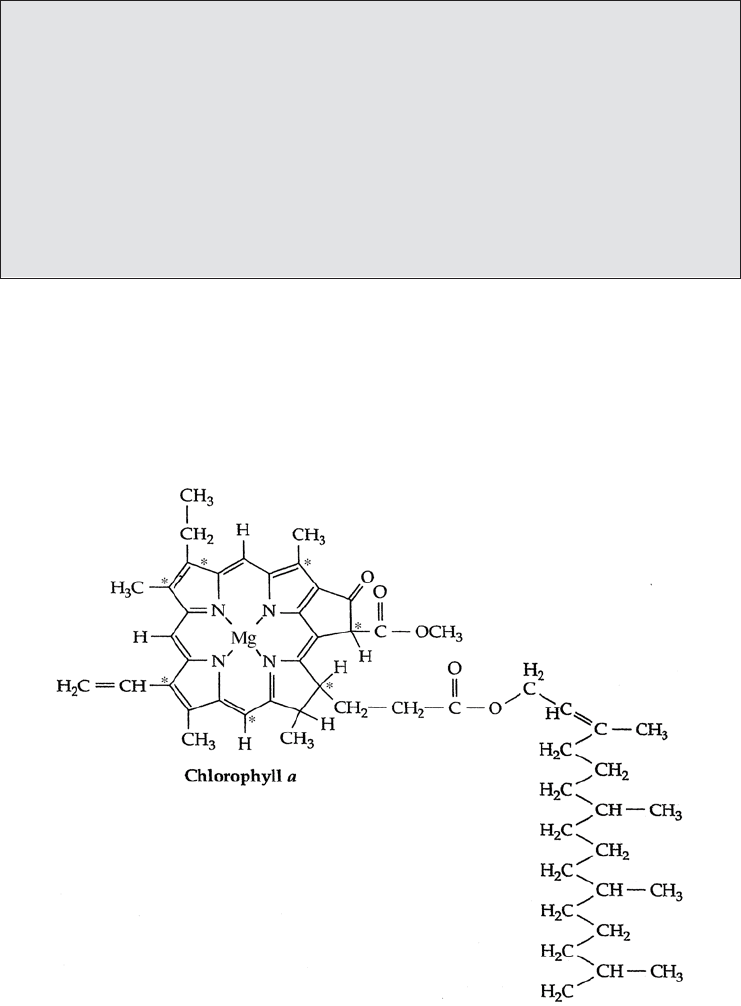
cited’ state (see Box 6.4). Chlorophyll belongs to a class
of organic compounds called tetrapyrroles, centred on
a magnesium atom (Figure 6.25); a hydrophobic side
chain allows the chlorophyll to embed itself in the thylakoid membrane where photo-
synthetic reactions take place. Several variants of the chlorophyll molecule exist, which
differ slightly in their structure and the wavelengths of light they absorb. In organisms
carrying out oxygenic photosynthesis, chlorophyll a and b predominate, while various
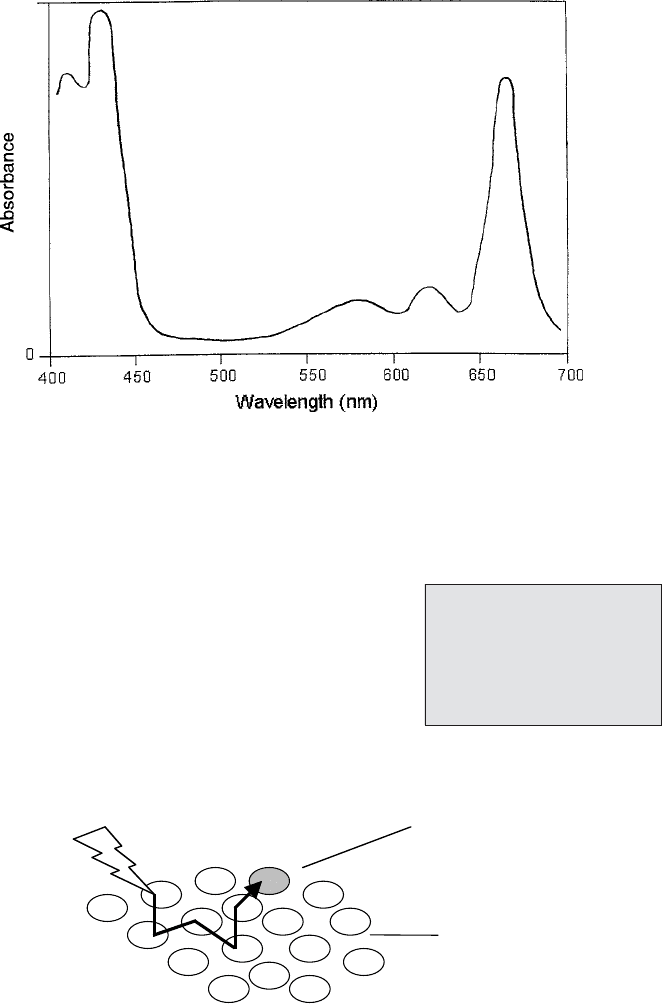
bacteriochlorophylls operate in the anoxygenic phototrophs. Chlorophyll a absorbs
light in the red and blue parts of the spectrum and reflects or transmits the green part
(Figure 6.26) thus cells containing chlorophyll a appear green (unless masked by another
pigment). Although other pigments are capable of absorbing light, only chlorophyll is
able to pass the excited electrons via a series of electron acceptors/donors to convert
NADP
+
to its reduced form, NADPH. Associated with chlorophyll are several acces-
sory pigments such as carotenoids or phycobilins (in cyanobacteria) with their own
absorbance characteristics. They absorb light and transfer the energy to chlorophyll,
enabling the organism to utilise light from a broader range of wavelengths.
JWBK011-06 JWBK011-Hogg August 12, 2005 16:0 Char Count= 0
PRINCIPLES OF ENERGY GENERATION 141
Box 6.4 How does a molecule become excited?
When a photon of light strikes a pigment molecule, it is absorbed, instead of being
reflected or going straight through, and the pigment molecule is raised to an excited
(= higher energy) state. An electron in the pigment molecule moves to a higher
electron shell (i.e. one further out); this is an unstable state, and the energy it has
absorbed is either lost as light (fluorescence) or heat, or is transferred to an acceptor
molecule. The pigment molecule then returns to its ground state. Chlorophyll in a
test tube will re-emit light as fluorescence, but when present in intact chloroplasts or
blue-green cells, it is able to pass on the energy to the next component of one or
other photosystem.
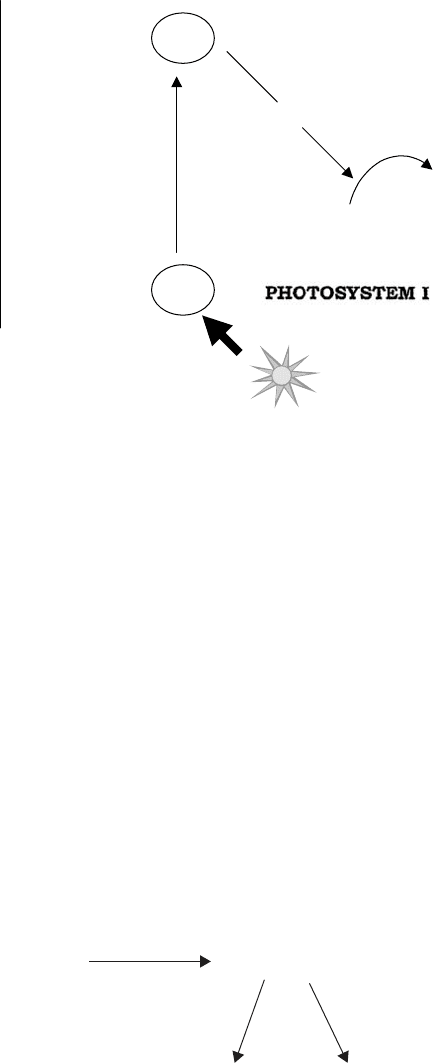
The light-gathering process occurs in collections of hundreds of pigment molecules
known as photosynthetic units. Most of these act as antenna molecules that absorb
photons of radiant light. A large number of antenna molecules ‘funnel’ light towards a
single reaction centre, allowing an organism to operate efficiently even at reduced light
intensities. Following excitation of the chlorophyll molecule by a photon of light, an
Figure 6.25 Chlorophyll structure. All chlorophyll molecules are based on a tetrapyrrole
ring centred on an atom of magnesium. Different types have a variety of side chains around
the molecule, resulting in different light absorbance properties. The side chains at the points
marked
∗
vary between different types of chlorophyll.
JWBK011-06 JWBK011-Hogg August 12, 2005 16:0 Char Count= 0
142 MICROBIAL METABOLISM
Figure 6.26 Absorbance spectrum of chlorophyll a. Chlorophyll a absorbs light maximally
in the blue and red regions of the spectrum. The green and yellow regions are reflected, giving
the characteristic coloration to plants and algae
Wavelengths of light are
measured in nanome-
tres (nm). A nanometre is
a millionth of a millimetre
(10
−9
M).
electron is transferred from one antenna to another,
eventually reaching a specialised chlorophyll molecule
in a pigment/protein complex called a reaction cen-
tre (Figure 6.27). There are two forms of this special
chlorophyll, which absorb light maximally at different
wavelengths, 680 nm and 700 nm. These are the starting
Photon of
light
Antenna
molecules
Reaction
centre
Figure 6.27 The photosynthetic unit. Most of the chlorophyll molecules do not take part
in converting light energy into ATP, but transfer electrons to specialised reaction centre
chlorophylls
JWBK011-06 JWBK011-Hogg August 12, 2005 16:0 Char Count= 0
PRINCIPLES OF ENERGY GENERATION 143
−
P
700
*
Redox
potential
ferrodoxin
(V)
e
−
NADPH
NADP
+
+ H
+
P
700
+
Figure 6.28 Photosystem I. Electrons pass from excited chlorophyll P
700
through a se-
ries of electron acceptors, eventually reducing NADP
+
. Hydrogen ions are provided by the
photolysis of water. The asterisk indicates the excited form of reaction centre chlorophyll
points of two different pathways, known as photosystem I and photosystem II, which
act in sequence together (as we shall see later in this chapter, anoxygenic photosynthe-
sisers only have one of these systems).
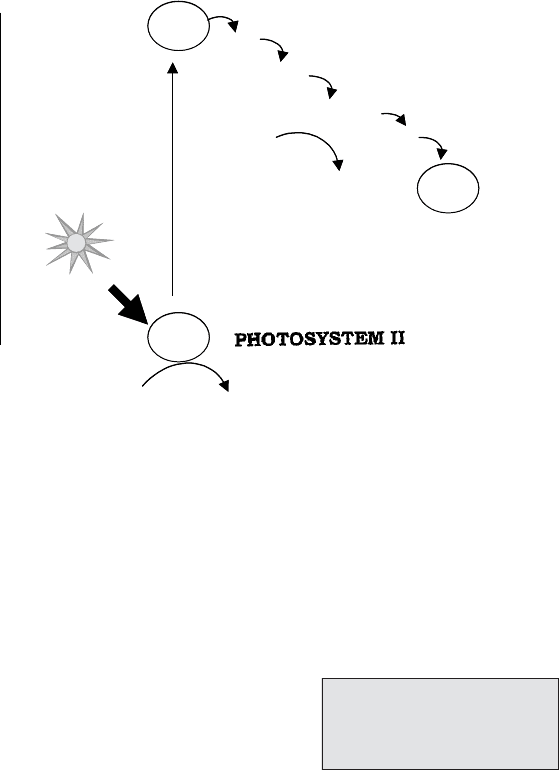
The reactions of photosystem I are responsible for the reduction of NADP
+
(Fig-
ure 6.28). In its excited state, the chlorophyll molecule has a negative redox potential
and sufficient energy to donate an excited electron to an acceptor molecule called ferre-
doxin. This is an electron carrier capable of existing in oxidised and reduced forms, like
those we encountered in the electron transport chain of aerobic respiration. From here,
the electron is passed through a series of successively less electronegative electron carri-
ers until NADP
+
acts as the terminal electron acceptor, becoming reduced to NADPH.
The hydrogen ions necessary for this are derived from the splitting of water (see below).
In order for NADP
+
to become reduced as described above, the chlorophyll P
700
must
receive a constant supply of electrons. There are two ways in which this may be done:
the first involves photosystem II. It is here that water is cleaved to produce oxygen in a
process involving a light-sensitive enzyme:
2H
2
OO
2
+4H
+
4e
–
PS I PS II
JWBK011-06 JWBK011-Hogg August 12, 2005 16:0 Char Count= 0
144 MICROBIAL METABOLISM
−
P
680
*
Q
PQ
Redox
Potential Cyt
b/f
(V)
ADP
PC
+Pi
ATP
P
700
e
−
+
P
680
2H
2
O O
2
+ 4H
+
+ 4e
−
Photolysis
−
P
680
*
Q
PQ
Redox
Potential Cyt
b/f
(V)
ADP
PC
+Pi
ATP
P
700
e
−
+
P
680
2H
2
O O
2
+ 4H
+
+ 4e
−
Photolysis
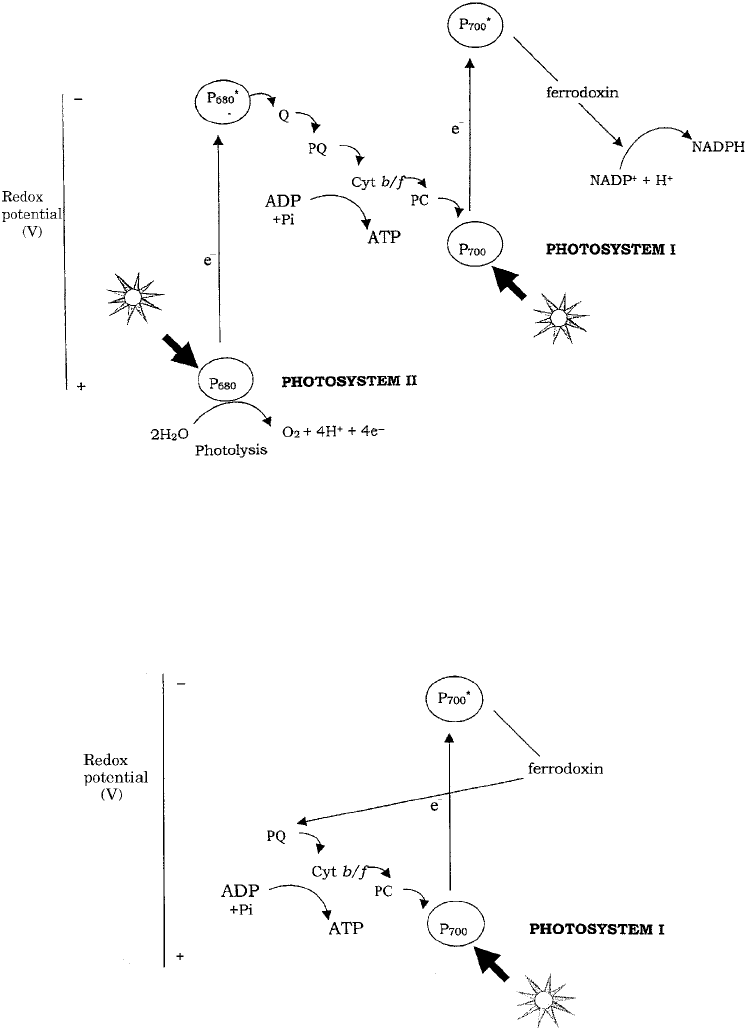
Figure 6.29 Photosystem II. Electrons released from excited molecules of chlorophyll P
680
pass down an electrochemical gradient and replenish the supply for the chlorophyll P
700
of
photosystem I. The electron flow causes protons to be pumped across the photosynthetic
membrane and drive the chemiosmotic synthesis of ATP. Electrons lost by chlorophyll P
680
are replaced by electrons from the photolysis of water
Chlorophyll P
680
of photosystem II absorbs a photon of light, and is raised to an ex-
cited state, causing an electron to be released down an electrochemical gradient via
Photophosphorylation is
the synthesis of ATP using
light energy.
carrier molecules as described above (Figure 6.29). The
terminal electron acceptor for photosystem II is the
chlorophyll P
700
of photosystem I. The electron flow
during this process releases sufficient energy to drive the
synthesis of ATP. This process of photophosphorylation
occurs by means of a chemiosmotic mechanism similar to that involved in the electron
transport chain of aerobic respiration.
When we look at the way the two photosystems combine to produce ATP and
NADPH from light energy and water, it is easy to see why this is sometimes known
as the ‘Z’ scheme (Figure 6.30). Only by having the two photosystems operating in
series and at different energy levels can sufficient energy be generated to extract an
electron from water on the one hand and generate ATP and NADPH on the other.
As indicated above, there is an alternative pathway by which the electron supply of
the chlorophyll P
700
can be replenished. You will recall that in photosystem I, having
reached ferredoxin and reduced it, electrons pass through further carriers before reach-
ing NADP
+
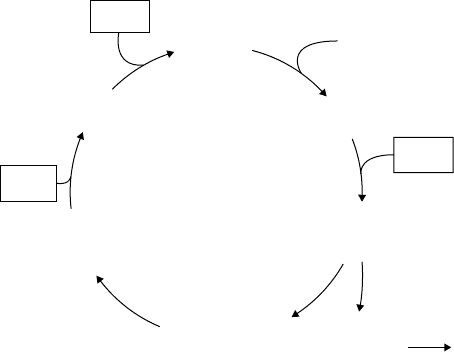
. Sometimes, however, they may take a different route, joining the electron
transport chain at plastoquinone (PQ), and generating further ATP (Figure 6.31). The
electron ends up back at the P
700
, so the pathway is termed cyclic photophosphory-
lation. Note that because no splitting of water is involved in the cyclic pathway, no
JWBK011-06 JWBK011-Hogg August 12, 2005 16:0 Char Count= 0
PRINCIPLES OF ENERGY GENERATION 145
Figure 6.30 Non-cyclic photophosphorylation: the ‘Z’ scheme. Photosystems I and II in-
teract to convert water and light energy into ATP and NADPH. P
680
and P
700
indicate the
wavelength of light maximally absorbed by the two photosystems
Figure 6.31 Cyclic photophosphorylation. Photosystem I electrons may enter the electron
transport chain at plastoquinone and return to reaction centre chlorophyll P
700
, generating
a proton motive force for use in ATP production
JWBK011-06 JWBK011-Hogg August 12, 2005 16:0 Char Count= 0
146 MICROBIAL METABOLISM
6 CO
2
12 3-Phospho-
glycerate
(36C)
6 Ribulose
1, 5-bisphosphate
6 Ribulose
5-phosphate
(30C)
10 Glyceraldehyde
3-phosphate
(30C)
12 Glyceraldehyde
3-phosphate
(36C)
Fructose
6-phosphate
(6C)
12 1, 3-Bisphospho-
glycerate
12 ATP
12
NADPH
6 ATP
Glucose
(6C)
Figure 6.32 The Calvin cycle. Carbon enters the cycle as carbon dioxide and leaves as
glyceraldehyde-3-phosphate, from which hexose sugars are formed. Note that only a small
part of each hexose molecule produced by this pathway derives directly from the carbon
dioxide (only one carbon out of six), thus six complete turns of the cycle would be required
to generate a single glucose molecule. (The numbers in the figure relate to six turns.) Although
used by most autotrophs, the Calvin cycle is not found in members of the Archaea
oxygen is generated. Also, because the electrons follow a different pathway, NADPH is
not produced.
Non-cyclic photophosphorylation: ATP + NADPH + O
2
produced
Cyclic photophosphorylation: only ATP produced
As we shall see below, the biosynthetic reactions of the Calvin cycle that follow the light
reactions require more ATP than NADPH. This additional ATP is provided by cyclic
photophosphorylation.
‘Dark’ reactions
The term ’dark reactions’ is somewhat misleading; while they can take place in the dark,
they are dependent upon the ATP and NADPH produced by the light reaction.
The most widely used mechanism for the incorporation of carbon dioxide into cellular
material is the Calvin cycle (Figure 6.32). This is also the means by which many other,
non-photosynthetic, autotrophs fix CO
2
.
Carbon dioxide entering the Calvin cycle combines with a five-carbon compound
called ribulose-1,5-bisphosphate to form two molecules of 3-phosphoglycerate via a
transient six-carbon intermediate (not shown). The enzyme responsible for this fixa-
tion of CO
2
is called ribulose bisphosphate carboxylase (rubisco), and it is the most
abundant protein in the natural world. The 3-phosphoglycerate is then reduced to give
glyceraldehyde 3-phosphate (G3-P), in a process that uses both ATP and NADPH from
the light reaction. By a series of reactions that are essentially the reverse of the opening
JWBK011-06 JWBK011-Hogg August 12, 2005 16:0 Char Count= 0
PRINCIPLES OF ENERGY GENERATION 147
steps of glycolysis, some of this G3-P is converted to glucose. The remaining steps of
the Calvin cycle are concerned with regenerating the five-carbon ribulose-5-phosphate.
We can summarise the incorporation of CO
2
into glucose as:
6CO
2
+ 18ATP + 12NADPH + 2H
+
+ 12H
2
O → C
6
H
12
O
6
+ 18ADP
+18Pi + 12NADP
+
Anoxygenic photosynthesis
Photosynthesis as carried out in the purple and green bacteria is different to the process
just described in a number of respects. Some of the main differences are summarised
below:
r
no oxygen is generated during this type of photosynthesis, and the bacteria involved
are growing anaerobically
r
bacteriochlophylls absorb light maximally at longer wavelengths than chlorophyll
a and b, allowing them more effectively to utilise the light available in their own
particular habitat
r
purple and green bacteria are not able to utilise water as a donor of electrons, and
must instead use a compound that is oxidised more easily, such as hydrogen sulphide
or succinate
r
only a single photosystem is involved in the light reactions of anoxygenic photosyn-
thesis. In the green bacteria this is similar to photosystem I, while in the purples it
more closely resembles photosystem II
r
thylakoid membranes are not found in the green and purple bacteria; light reactions
take place in lamellar invaginations of the cytoplasmic membrane in the purples and
in vesicles called chlorosomes in the greens.
In the generation of ATP, a form of cyclic photophosporylation is employed; the bac-
teriochlorophyll acts as both donor and acceptor of electrons (Figure 6.33). In order
to generate reducing power in the form of reduced coenzymes, an external electron
source is necessary, since this process is non-cyclic. In the green and purple sulphur
bacteria, this role is served by sulphur or reduced sulphur compounds such as sulphide
or thiosulphate. The non-sulphur bacteria utilise an organic molecule such as succi-
nate as an electron donor. In some cases, the electron donor has a more positive redox
potential than the NADP
+
, so in order to reduce the coenzyme, electrons would have
to flow against the electrochemical gradient. An input of energy in the form of ATP is
needed to make this possible, in a process known as reverse electron flow. This also
happens in many chemolithotrophs such as Acidithiobacillus and Nitrobacter. Table
6.4 compares the different groups of anoxygenic photosynthesisers. A special form of
anoxygenic photosynthesis occurs in the Heliobacteria (see Chapter 7); these carry out
photoheterotrophy using a unique form of bacteriochlorophyll called bacteriochloro-
phyll b. They are unable to use carbon dioxide as a carbon source.