
Hogg S. Essential microbiology
Подождите немного. Документ загружается.

JWBK011-07 JWBK011-Hogg August 12, 2005 16:8 Char Count= 0
178 PROCARYOTE DIVERSITY
Although most species carry out aerobic respiration with oxygen as the terminal
electron acceptor, a few are capable of substituting nitrate (anaerobic respiration, see
Chapter 6).
Representative genera: Pseudomonas, Burkholderia
Acetic acid bacteria
Acetobacter and Gluconobacter are two genera of the α-Proteobacteria that convert
ethanol into acetic acid, a highly significant reaction in the food and drink industries
(see Chapter 17). Both genera are strict aerobes, but unlike Acetobacter, which can
oxidise the acetic acid right through to carbon dioxide and water, Gluconobacter lacks
all the enzymes of the TCA cycle, and cannot oxidise it further.
Acetobacter species also have the ability, rare in bacteria, to synthesise cellulose;
the cells become surrounded by a mass of extracellular fibrils, forming a pellicle at the
surface of an unshaken liquid culture.
Representative genera: Acetobacter, Gluconobacter
Stalked and budding Proteobacteria
The members of this group of aquatic Proteobacteria differ noticeably in their appear-
ance from typical bacteria by their possession of extracellular extensions known as
prosthecae; these take a variety of forms but are always narrower than the cell itself.
They are true extensions of the cell, containing cytoplasm, rather than completely ex-
tracellular appendages.
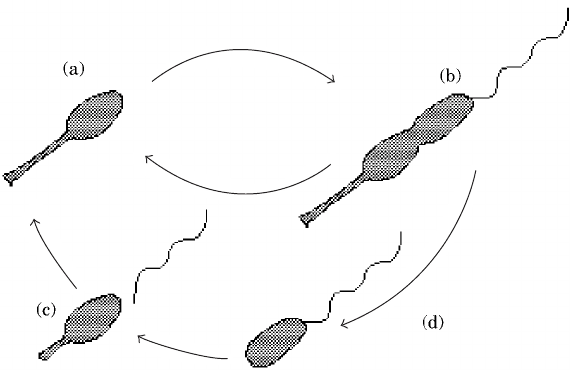
In the stalked bacteria such as Caulobacter (Figure 7.5), the prostheca serves both as
a means of attaching the cell to its substratum, and to enhance nutrient absorption by
Figure 7.5 The life cycle of Caulobacter, a stalked bacterium. The stalked ‘mother’ cell
attaches to a surface by means of a holdfast (a). It grows in length and develops a flagellum
(b), before undergoing binary fission. The flagellated swarmer cell swims away (c), and on
reaching a suitable substratum, loses its flagellum and develops a stalk or prostheca (d).
Reproduced by permission of Dr James Brown, North Carolina State University
JWBK011-07 JWBK011-Hogg August 12, 2005 16:8 Char Count= 0
DOMAIN: BACTERIA 179
increasing the surface area-to-volume ratio of the cell. The latter enables such bacteria
to live in waters containing extremely low levels of nutrient. Caulobacter lives part of
its life cycle as a free-swimming swarmer cell with no prostheca but instead a flagellum
for mobility.
The iron oxidiser Gallionella (see Nitrifying Proteobacteria above) may be regarded
as a stalked bacterium, however it is not truly prosthecate, as its stalk does not contain
cytoplasm.
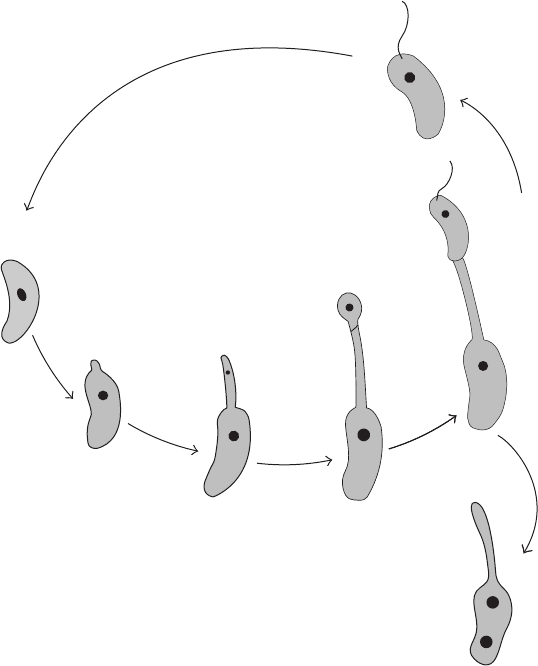
In the budding bacteria, the prostheca is involved in a distinctive form of reproduc-
tion, in which two cells of unequal size are produced (c.f. typical binary fission, which
results in two identical daughter cells). The daughter cell buds off from the mother cell,
either directly, or as Hyphomicrobium spp. at the end of a hypha (stalk) (Figure 7.6).
Once detached, the daughter cell grows to full size and eventually produces its own
buds. Hyphomicrobium is a methanotroph and a methylotroph, so it also belongs to
the methanotrophs described earlier.
Mother cell
undergoes
further DNA
replication
and bud
formation
Terminal
bud becomes
separated by
cross-wall
DNA replication
followed by
migration of
one chromosome
into lengthening
hypha
Hypha
formation
Mother
cell
Daughter
(swarmer)
cell
Flagellum
formation
Figure 7.6 The budding bacteria: reproduction in Hyphomicrobium. Before reproduction
takes place, the vegetative cell develops a stalk or hypha, at the end of which a bud develops.
This produces a flagellum, and separates to form a motile swarmer cell
JWBK011-07 JWBK011-Hogg August 12, 2005 16:8 Char Count= 0
180 PROCARYOTE DIVERSITY
In some bacteria, more than one prostheca is found per cell; these polyprosthecate
forms include the genus Stella, whose name (‘a star’) derives from its six symmetrically
arranged buds.
Representative genera: Caulobacter, Hyphomicrobium
Sheathed Proteobacteria
Some genera of β Proteobacteria exist as chains of cells surrounded by a tube-like sheath,
made up of a carbohydrate/protein/lipid complex. In some cases, the sheath contains
deposits of manganese oxide or ferric hydroxide, which may be the product of chemical
or biological oxidation. Empty sheaths encrusted with oxides may remain long after the
bacterial cells have died off or been released. As with the stalked bacteria (see above)
the sheath helps in the absorption of nutrients, and may also offer protection against
predators.
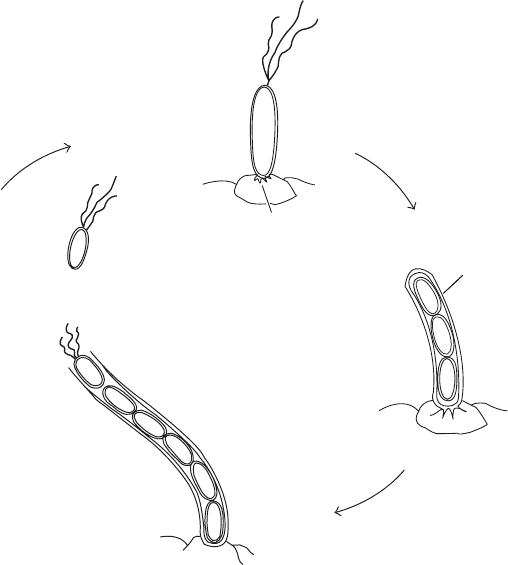
The sheathed bacteria have a relatively complex life cycle. They live in flowing water,
and attach with one end of the chain to, for example, a plant or rock. Free-swimming
single flagellated cells are released from the distal end and settle at another location,
where a new chain and sheath are formed (Figure 7.7).
Free-swimming
swarmer cell
released from
filament
Sheath
surrounding
filament of
cells
Substratum
Cell division
Figure 7.7 The sheathed bacteria. The life cycle of Sphaerotilus. Free-swimming swarmer
cells settle on an appropriate substratum and give rise to long filaments contained within a
sheath. New locations become colonised when flagellated cells are released into the water
to complete the cycle
JWBK011-07 JWBK011-Hogg August 12, 2005 16:8 Char Count= 0
DOMAIN: BACTERIA 181
Sphaerotilus forms thick ‘streamers’ in polluted water, and is a familiar sight around
sewage outlets.
Representative genera: Sphaerotilus, Leptothrix
Predatory Proteobacteria
The recently-sequenced
genome of Bdellovibrio
bacterivorans has been
shown to encode a
huge number of lytic
enzymes. Its ability to
metabolise amino acids,
however, is limited, nec-
essitating its unusual
mode of existence.
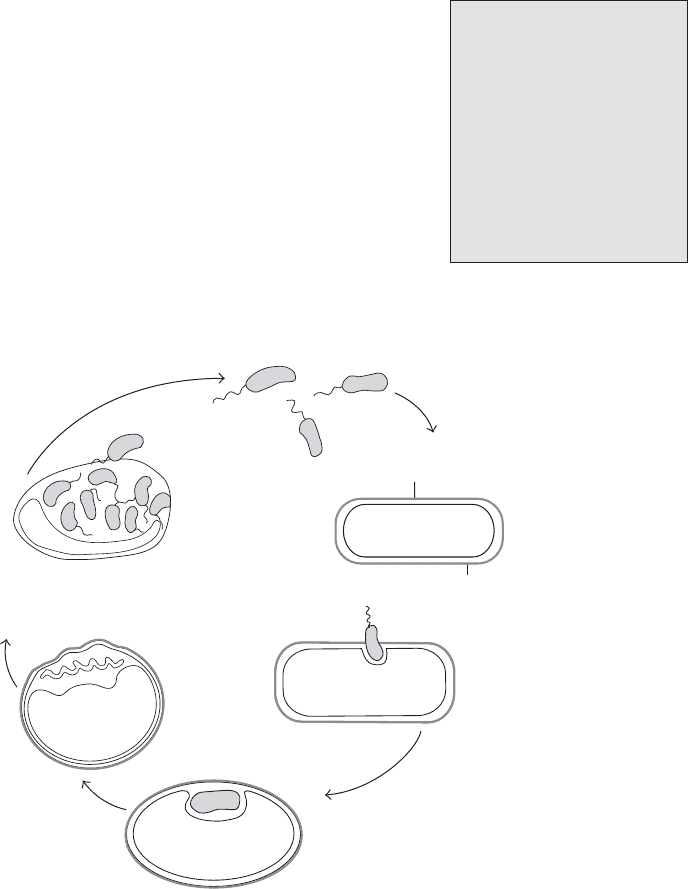
Bdellovibrio is a unique genus belonging to the δ-
Proteobacteria. It is a very small comma-shaped bac-
terium, which actually attacks and lives inside other
Gram-negative bacteria (Figure 7.8). Powered by its flag-
ellum, it collides with its prey at high speed and pene-
trates even thick cell walls by a combination of enzyme
secretion and mechanical boring. It takes up residence
in the periplasmic space, between the plasma membrane
and cell wall. The host’s nucleic acid and protein syn-
thesis cease, and its macromolecules are degraded, pro-
viding nutrients for the invader, which grows into a long
Cell wall
Swarmer
cells
Periplasmic
space
Host
bacterium
e.g Pseudomona
s
Escherichia
Spiral filament undergoes
septation into several flagellated
daughter cells, which are released
when host cell is lysed
Nutrients
from host used
for elongation into
spiral filament
Bdellovibrio loses flagellum
and becomes established in
periplasmic space
'Attack phase' cell
attaches to host.
High-speed rotation
allows penetration
of cell wall.
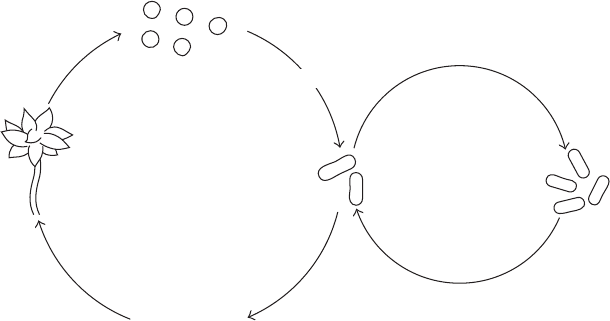
Figure 7.8 The life cycle of Bdellovibrio, a bacterial predator. Once Bdellovibrio has taken
up residence in the periplasmic space of its host, it loses its flagellum and becomes non-motile.
In nutrient-rich environments, Bdellovibrio is also capable of independent growth
JWBK011-07 JWBK011-Hogg August 12, 2005 16:8 Char Count= 0
182 PROCARYOTE DIVERSITY
Myxospores
Germination
Cells form
a
gg
re
g
ates
Vegetative
growth
a)
b)
c)
d)
Fruiting
body
Figure 7.9 The Myxobacteria: a complex bacterial life cycle. When nutrients are in plen-
tiful supply, myxobacteria divide by binary fission (a). On depletion of nutrients, they form
aggregates of cells, which leads to the formation of a fruiting body (b). Within the fruit-
ing body, some cells form myxospores, enclosed within a sporangium (c). Myxospores re-
main dormant until environmental conditions are favourable, then germinate into vegetative
cells (d)
helical cell. This eventually divides into several motile progeny cells, which are then
released.
Representative genus: Bdellovibrio
Another group of bacteria that may be regarded as predatory are the Myxobacteria
(Figure 7.9). These are rod-shaped bacteria lacking flagella, which yet are motile by
gliding along a solid surface, aided by the excretion of extracellular polysaccharides. For
this reason they are sometimes referred to as the gliding bacteria. They are heterotrophs,
typically requiring complex organic nutrients, which they obtain by the lysis of other
types of bacteria. Thus, unlike Bdellovibrio, they digest their prey before they ingest it.
When a rich supply of nutrients is not available, many thousands of cells may aggregate
to form fruiting bodies, inside which myxospores develop. These are able to resist
drought and lack of nutrients for many years. Myxobacteria exhibit the most complex
life cycles of any procaryote so far studied.
Representative genera: Myxococcus, Chondromyces
Spirilla
Collected together under this heading are several genera of aerobic (mostly mi-
croaerophilic) spiral-shaped bacteria with polar flagella. These include free-living, sym-
biotic and parasitic types.
JWBK011-07 JWBK011-Hogg August 12, 2005 16:8 Char Count= 0
DOMAIN: BACTERIA 183
Spirilla such as Aquaspirillum and Magnetospirillum contain magnetosomes, intra-
cellular particles of iron oxide (magnetite, Fe
3
O
4
). Such magnetotactic bacteria have
the remarkable ability to orientate themselves with respect to the earth’s magnetic field
(magnetotaxis).
Two important pathogens of humans are included in the spirilla; Campylobacter
jejuni is responsible for foodborne gastroenteritis, while Helicobacter pylori has in recent
times been identified as the cause of many cases of peptic ulcers.
Representative genera: Magnetospirillum, Campylobacter
Rickettsia
This group comprises arthropod-borne intracellular parasites of vertebrates, and in-
cludes the causative agents of human diseases such as typhus and Rocky Mountain
spotted fever. The bacteria are taken up by host phagocytic cells, where they multiply
and eventually cause lysis.
The Rickettsia are aerobic organotrophs, but some possess an unusual mode of en-
ergy metabolism, only being able to oxidise intermediate metabolites such as glutamate
and succinate, which they obtain from their host. Rickettsia and Coxiella, the two
main genera, are not closely related phylogenetically and are placed in the α- and γ -
Proteobacteria, respectively.
Representative genera: Rickettsia, Coxiella
Neisseria and related Proteobacteria
All members of this loose collection of bacteria are aerobic non-motile cocci, typically
seen as pairs, with flattened sides where they join. Some however only assume this
morphology during stationary growth phase. Many are found in warm-blooded animals,
and some species are pathogenic. The genus Neisseria includes species responsible for
gonorrhoea and meningitis in humans.
Other Gram-negative phyla
The following section considers those Gram-negative bacteria not included in the Pro-
teobacteria. These phyla are not closely related in the phylogenetic sense, either to each
other or to the Proteobacteria.
Phylum Cyanobacteria: the blue-green bacteria
The Cyanobacteria are placed in volume 1 of the second edition of Bergey, along with
the Archaea (see above), the deeply branching bacteria, the ‘Deinococcus–Thermus’
group, and the green sulphur and green non-sulphur bacteria (see below). See also
Box 7.2.
Members of the Cyanobacteria were once known as blue-green algae because
they carry out the same kind of oxygenic photosynthesis as algae and green plants

JWBK011-07 JWBK011-Hogg August 12, 2005 16:8 Char Count= 0
184 PROCARYOTE DIVERSITY
Box 7.2 Prochlorophyta -- a missing link?
It has long been thought that the chloroplasts of eucaryotic cells arose as a result
of incorporating unicellular cyanobacteria into their cytoplasm. The photosynthetic
pigments of plants and green algae, however, are not the same as those of the blue
greens; both contain chlorophyll a, but while the former also have chlorophyll b, the
blue greens have a unique group of pigments called phycobilins. In the mid-1970s
a group of bacteria was discovered which seemed to offer an explanation for this
conundrum. Whilst definitely procaryotic, the Prochlorophyta possess chlorophylls a
and b and lack phycobilins, making them a more likely candidate for the origins of
eucaryotic chloroplasts. Initially, these marine bacteria were placed by taxonomists
in a phylum of their own, but in the second edition of Bergey, they are included
among the Cyanobacteria.
(Chapter 6). They are the only group of procaryotes capable of carrying out this form
of photosynthesis; all the other groups of photosynthetic bacteria to be discussed in this
chapter carry out an anoxygenic form. When it became possible to examine cell struc-
ture in more detail with the electron microscope, it became clear that the cyanobacteria
were in fact procaryotic, and hence quite distinct from the true algae. Old habits die
hard, however, and the term ‘blue-green algae’ is still encountered, particularly in the
popular press. Being procaryotic, cyanobacteria do not possess chloroplasts; however
they contain lamellar membranes called thylakoids, which serve as the site of photo-
synthetic pigments and as the location for both light-gathering and electron transfer
processes.
Early members of the Cyanobacteria evolved when the oxygen content of the earth’s
atmosphere was much lower than it is now, and these organisms are thought to have
been responsible for its gradual increase, since photosynthetic eucaryotes did not arise
until many millions of years later.
Cyanobacteria are Gram-negative bacteria which may be unicellular or filamentous;
in spite of the name by which they were formerly known, they may also appear vari-
ously as red, black or purple, according to the pigments they possess. A characteristic
of many cyanobacteria is the ability to fix atmospheric nitrogen, that is, to reduce it
to ammonium ions (NH
4
+
) for incorporation into cellular constituents (see above).
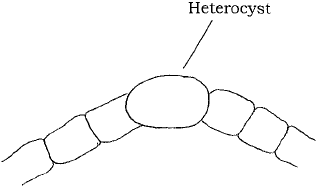
In filamentous forms, this activity is associated with specialised, enlarged cells called
heterocysts (Figure 7.10).
The tiny unicellular cyanobacterium Prochlorococcus is found in oceans throughout
the tropical and temperate regions and is thought to be the most abundant photosyn-
thetic organism on our planet. It has several strains adapted to different light conditions.
Some cyanobacteria are responsible for the production of unsightly (and smelly!) ‘algal’
blooms in waters rich in nutrients such as phosphate. When they die, their decomposition
by other bacteria leads to oxygen depletion and the death of other aquatic life forms.
Bloom-forming species contain gas vacuoles to aid their buoyancy.
Representative genera: Oscillatoria, Anabaena
JWBK011-07 JWBK011-Hogg August 12, 2005 16:8 Char Count= 0
DOMAIN: BACTERIA 185
Figure 7.10 Cyanobacteria. Nitrogen fixation takes place in specialised cells called hetero-
cysts, which develop from ordinary cells when supplies of available nitrogen (e.g. ammonia)
are depleted. The heterocyst loses its ability to photosynthesise and, therefore, to produce
oxygen. This is essential because oxygen is highly inhibitory to the nitrogenase enzyme
complex
Phylum Chlorobi (green sulphur bacteria) and phylum Chloroflexi
(green non-sulphur bacteria)
We have already come across three distinct groups of photosynthetic bacteria in this
chapter: the purple sulphur and purple nonsulphur bacteria and the Cyanobacteria:
here we consider the remaining two groups, the green sulphur and green non-sulphur
bacteria.
The green sulphur bacteria (phylum Chlorobi), like their purple counterparts (see
above), are anaerobic photolithotrophs that utilise reduced sulphur compounds instead
of water as an electron donor, and generate elemental sulphur. They differ, however, in a
number of respects. The sulphur is deposited outside the cell, and CO
2
is assimilated not
by the Calvin cycle, but by a reversal of the steps of the TCA cycle (see Chapter 6). The
photosynthetic pigments in the green sulphur bacteria are contained in sac-like structures
called chlorosomes that are associated with the inside of the plasma membrane.
Most members of the green non-sulphur bacteria (phylum Chloroflexi) are filamen-
tous thermophiles, living in non-acid hot springs, where they form thick bacterial mats.
Like the purple non-sulphur bacteria, they are photoheterotrophs, but can also grow in
the dark as chemoheterotrophs.
Representative genera: Chlorobium (green sulphur), Chloroflexus (green non-sulphur).
Phylum Aquificae and phylum Thermotogae: the deeply
branching bacteria
These two phyla are regarded as the two deepest (= oldest) branches in the evolution
of the Bacteria and both comprise highly thermophilic Gram-negative rods. They are
the only members of the Bacteria that can compare with the Archaea in their ability
to live at high temperatures (optimal growth >80
◦
C). The two phyla differ in their
mode of nutrition: the Aquificae are autotrophs capable of oxidising hydrogen or sul-
phur, while the Thermotogae are anaerobic heterotrophs, fermenting carbohydrates.

JWBK011-07 JWBK011-Hogg August 12, 2005 16:8 Char Count= 0
186 PROCARYOTE DIVERSITY
H H
H
2
N C COOH H
2
N C COOH
| |
CH
2
CH
2
| |
CH
2
CH
2
| |
CH
2
CH
2
| |
H
2
N CH NH
2
|
COOH
(a) Diaminopimelic acid (b) Ornithine
Figure 7.11 Members of the Deinococcus–Thermus group have an unusual form of pep-
tidoglycan. The diaminopimelic acid at position three on the amino acid chain attached to
N-acetylmuramic acid (see Figure 3.6) is replaced by ornithine
Members of the Thermotogae are characteristically surrounded, sometimes in a chain,
by a proteinaceous sheath (or ‘toga’).
Representative genera: Aquifex (phylum Aquificae), Thermotoga (phylum Thermoto-
gae)
Phylum ‘Deinococcus–Thermus’*
Only three genera are included in this phylum, but two of these are of particular inter-
est because of remarkable physiological properties. Thermus species are thermophiles
whose best known member is T. aquaticus; this is the source of the thermostable en-
zyme Taq polymerase, used in the polymerase chain reaction (Chapter 12). Deinococcus
species show an extraordinary degree of resistance to radiation, due, it seems, to an un-
usually powerful DNA repair system. This also enables Deinococcus to resist chemical
mutagens (see Chapter 12). Both Deinococcus and Thermus species have an unusual re-
finement to the structure of their peptidoglycan, with ornithine replacing diaminopimelic
acid (Figure 7.11).
Representative genera: Deinococcus, Thermus
The remaining phyla of Gram-negative bacteria are grouped together in Volume 5 of
the second edition of Bergey.
Phylum Planctomycetes
This very ancient group of bacteria has a number of unusual properties, including cell
division by budding, the lack of any peptidoglycan in their cell walls and the presence
∗
This phylum has not yet been assigned a formal name.
JWBK011-07 JWBK011-Hogg August 12, 2005 16:8 Char Count= 0
DOMAIN: BACTERIA 187
of a degree of internal compartmentalisation. (Recall from Chapter 3 that membrane-
bound compartments are regarded as a quintessentially eucaryotic feature.)
The recently discovered reaction known as anammox (anaerobic ammonium oxida-
tion), whereby ammonium and nitrite are converted to nitrogen gas:
NH
4
+
+ NO
2
−
= N
2
+ 2H
2
O
has been attributed to certain members of the Planctomycetes. It is thought that this
reaction may be responsible for much of the nitrogen cycling in the world’s oceans. The
bacteria concerned have only been identified by means of their rRNA gene sequences,
and have as yet been assigned only provisional generic and specific names. They are
anaerobic chemolithoautotrophs, however this is not typical of the Planctomycetes,
most of which are aerobic chemoorganoheterotrophs.
Recent studies propose that the Planctomycetes should be placed much closer to the
root of any proposed phylogenetic tree than had previously been proposed.
Representative genera: Planctomyces, Pirellula
Phylum Chlamydiae
Formerly grouped with the Rickettsia (see above), these non-motile obligate parasites of
birds and mammals are now assigned a separate phylum comprising only five genera, of
which Chlamydia is the most important. Like the Rickettsia, members of the Chlamydiae
have extremely small cells, and very limited metabolic capacities, and depend on the
host cell for energy generation. Unlike that group, however, they are not dependent on
an arthropod vector for transmission from host to host.
Chlamydia trachomatis is the causative agent of trachoma, a major cause of blindness
in humans. Different strains of this same species are responsible for one of the most
common forms of sexually transmitted disease. C. psittaci causes the avian disease
psittacosis, and C. pneumoniae causes chlamydial pneumonia in humans as well as
being linked to some cases of coronary artery disease.
Representative genus: Chlamydia
Phylum Spirochaetes
The Spirochaetes are distinguished from all other bacteria by their slender helical mor-
phology and corkscrew-like movement. This is made possible by endoflagella (axial
filaments), so-called because they are enclosed in the space between the cell and a flexi-
ble sheath that surrounds it.
Spirochaetes comprise both aerobic and anaerobic bacteria that inhabit a wide range
of habitats, including water and soil as well as the gut and oral cavities of both vertebrate
and invertebrate animals. Some species are important pathogens of humans, including
Treponema pallidum (syphilis) and Leptospira interrogans (leptospirosis).
Representative genera: Treponema, Leptospira