
Hogg S. Essential microbiology
Подождите немного. Документ загружается.

JWBK011-02 JWBK011-Hogg August 12, 2005 19:26 Char Count= 0
28 BIOCHEMICAL PRINCIPLES
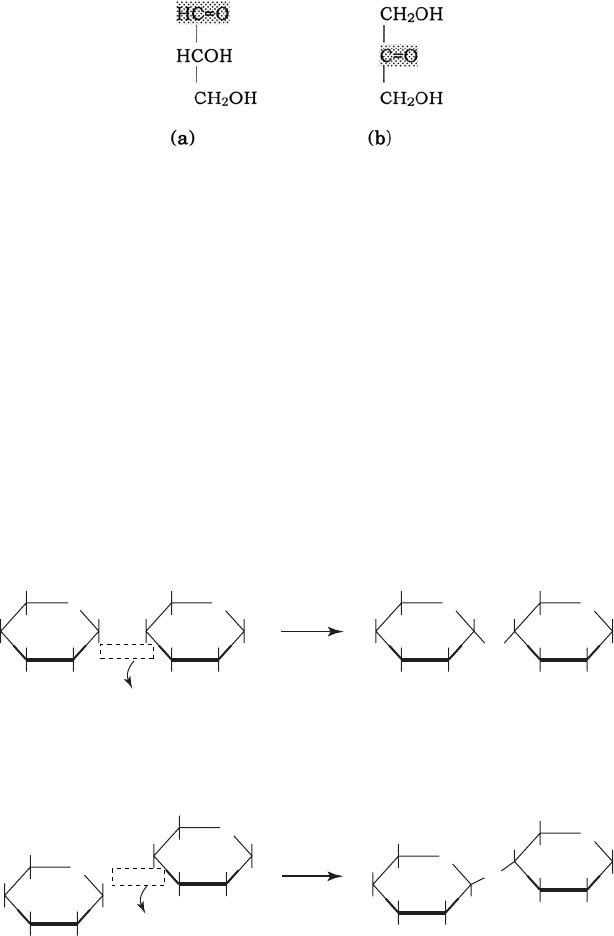
Figure 2.10 Monosaccharides may be aldoses or ketoses. The three carbon sugars (a) glyc-
eraldehyde and (b) dihydroxyacetone share the same molecular formula, but have different
functional groups. The two molecules are isomers (see Box 2.2)
have the general formula (CH
2
O)
n
. They are classed as either aldoses or ketoses, ac-
cording to whether they contain an aldehyde group or a ketone group (Figure 2.10).
Monosaccharides can further be classified on the basis of the number of carbon atoms
they contain. The simplest are trioses (three carbons) and the most important biologi-
cally are hexoses (six carbons) (see Boxes 2.2 and 2.3).
Monosaccharides are generally crystalline solids which are soluble in water and have
a sweet taste. They all reducing sugars, so called because they are able to reduce alkaline
solutions of cupric ions (Cu
2+
) to cuprous ions (Cu
+
).
A disaccharide is formed when two monosaccharides (which may be of the same
type or different), join together with a concomitant loss of a water molecule (Fig-
ure 2.11). Further monosaccharides can be added, giving chains of three, four, five
H
CH
2
OH
H
OH
OH
OH
H
OH
O
HO
H
H
HO
CH
2
OH
H
OH
H
OH
O
H
H
H
H
CH
2
OH
H
OH
OH
H
OH
O
H
H
H
CH
2
OH
H
OH
OH
H
OH
O
H
2
O
H
H
HO
CH
2
OH
H
OH
H
OH
O
H
H
H
H
CH
2
OH
H
OH
OH
H
OH
O
O
H
H
O
H
CH
2
OH
H
OH
H
OH
O
HO
H
H
H
CH
2
OH
H
OH
OH
H
OH
O
H
H
Glucose Glucose Maltose+=
Galactose Glucose Lactose+=
(a)
(b)
OH
HO
H
2
O
Figure 2.11 Monosaccharides such as two glucose molecules can be joined by a glycosidic
linkage to form a disaccharide. The reaction is a condensation reaction, in which a molecule
of water is lost. α- (a) and β-linkages (b) result in different orientations in space
JWBK011-02 JWBK011-Hogg August 12, 2005 19:26 Char Count= 0
BIOMACROMOLECULES 29
Box 2.2 Isomers: same formula, different structure
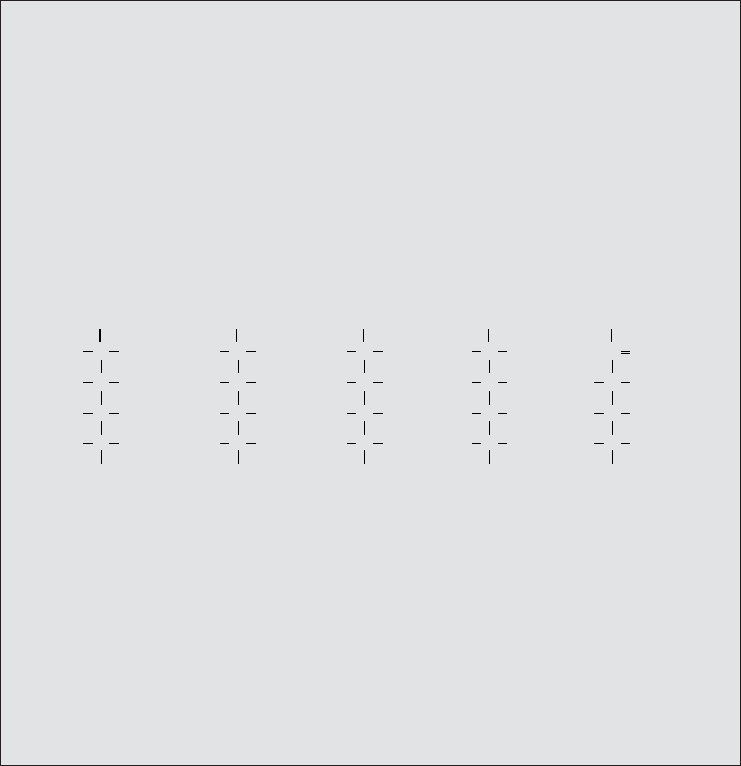
The simplest monosaccharides are the trioses glyceraldehyde and dihydroxyace-
tone (Figure 2.10). Look carefully at the structures, and you will see that although
they both share the same number of carbons (3), hydrogens(6) and oxygens (3), the
way in which these atoms are arranged is different in the two sugars. Molecules such
as these, which have the same chemical formula but different structural formulas,
are said to be structural isomers. The different groupings of atoms lead to structural
isomers having different chemical properties. When we come to look at the hexoses
(six carbon sugars), we see that there are many structural possibilities for the general
formula C
6
H
12
O
6
; some of these are shown below.
CHO
C
H
HO
HOH
HO
HO
H
H
CH
2
OH
C
C
C
D-glucose
CHO
C
OH
H
HO
H
H
H
OH
OH
CH
2
OH
C
C
C
L-glucose
CHO
C
OH
H
HO
H
HO
H
H
OH
CH
2
OH
C
C
C
D-galactose
CHO
C
H
HO
HO
H
H
H
OH
OH
CH
2
OH
C
C
C
D-mannose
C
O
HO
H
H
H
OH
OH
CH
2
OH
C
C
C
D–fructose
CH
2
OH
Note that some of these structures are identical apart from the orientation of groups
around the central axis;
D-glucose and L-glucose for example differ only in the way H
atoms and -OH groups are arranged to the right or left. They are said to be stereoiso-
mers or optical isomers, and are mirror images of each other, just like your right and
left hands. (
D- and L- are short for dextro- and laevo-rotatory, meaning that the plane
of polarised light is turned to the right and left respectively when passed through a
solution of these substances). Generally, living cells will only synthesise one or other
stereoisomer, and not both.
or more units. These are termed oligosaccharides (oligo, a few), and chains with many
units are polysaccharides. The chemical bond joining the monosaccharide units to-
gether is called a glycosidic linkage. The bond between the two glucose molecules that
make up maltose is called an α-glycosidic linkage; in lactose, formed from one glu-
cose and one galactose, we have a β-glycosidic linkage. The two bonds are formed
in the same way, with the elimination of water, but they have a different orienta-
tion in space. Thus disaccharides bound together by α- and β-glycosidic linkages have
a different overall shape and as a result the molecules behave differently in cellular
metabolism.
Biologically important molecules such as starch, cellulose and glycogen are all
polysaccharides. Another is dextran, a sticky substance produced by some bacteria
to aid their adhesion. They differ from monosaccharides in being generally insoluble in
water, not tasting sweet and not being able to reduce cupric ions. Most polysaccharides
JWBK011-02 JWBK011-Hogg August 12, 2005 19:26 Char Count= 0
30 BIOCHEMICAL PRINCIPLES
Box 2.3 Sugars are more accurately shown as ring structures
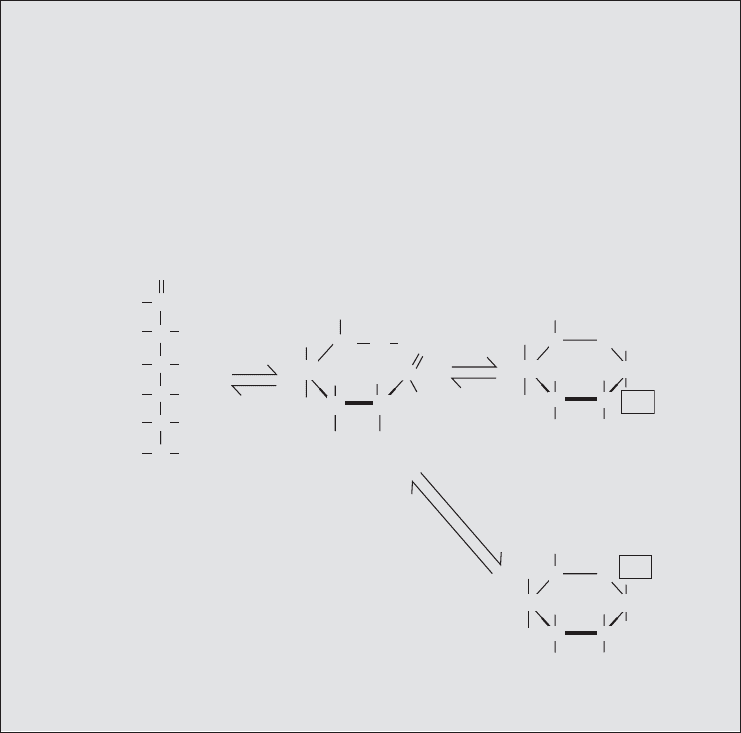
When dissolved in water, the aldehyde or ketone group reacts with a hydroxyl group
on the fifth carbon to give a cyclic form.
D-Glucose is shown in both forms below.
The cyclic form of the molecule is shown below as a Haworth projection. The idea is
that the ring is orientated at 90
◦
to the page, with the edge which is shown thicker
towards you, and the top edge away from you. Notice that there are even two
forms of
D-Glucose! Depending on whether the -OH on carbon-1 is below or above
the plane of the ring, we have α-orβ-
D-Glucose.
O
C
H
H
HO
OH
H
OH
OH
OH
H
H
2
H
C
C
C
C
C
H
HO
OH
OH
α-D-Glucose
(linear form)
α-D-Glucose
6
CH
2
OH
H
O
HO
C
5
O
H
1
H
H
OH
H
OH
C
C
2
C
4
CH
2
OH
OH
H
OH
O
H
H
C
C
C
C
C
H
HO
H
β-D-Glucose
CH
2
OH
OH
OH
O
H
H
C
C
C
C
C
C
3
are made up from either pentose or hexose sugars, and, like di- and oligosaccharides,
can be broken down into their constituent subunits by hydrolysis reactions.
Proteins
Of the macromolecules commonly found in living systems, proteins are the most ver-
satile, having a wide range of biological functions and this fact is reflected in their
structural diversity.
The five elements found in most naturally occurring proteins are carbon, hydrogen,
oxygen, nitrogen and sulphur. In addition, other elements may be essential components
of certain specialised proteins such as haemoglobin (iron) and casein (phosphorus).
JWBK011-02 JWBK011-Hogg August 12, 2005 19:26 Char Count= 0
BIOMACROMOLECULES 31
C
R
H
H
2
N COOH C
H
R
H
3
N
+
COO
−
(a) (b)
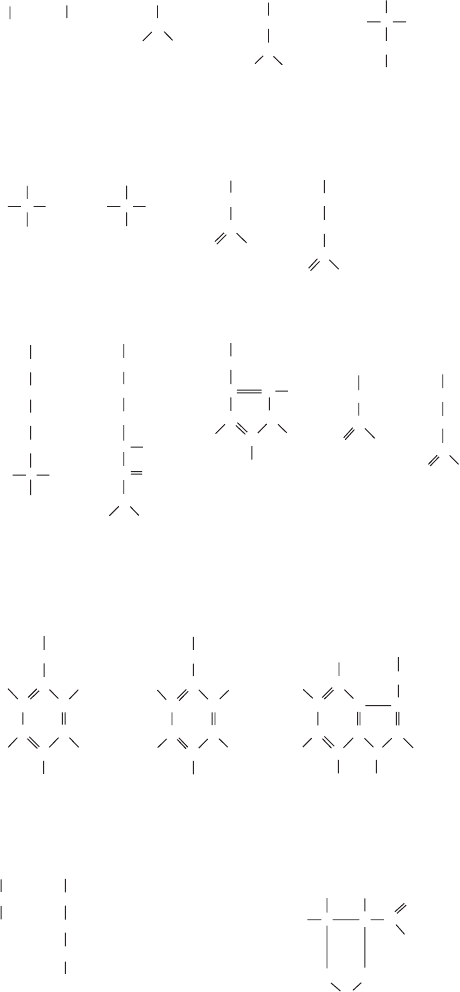
Figure 2.12 Amino acid structure. (a) The basic structure of an amino acid. (b) In solution,
the amino and carboxyl groups become ionised, giving rise to a zwitterion (a molecule with
spatially separated positive and negative charges). All the 20 amino acids commonly found
in proteins are based on a common structure, differing only in the nature of their ‘R’ group
(see Figure 2.13)
Proteins can be very large molecules, with molecular weights of tens or hundreds of
thousands. Whatever their size, and in spite of the diversity referred to above, all proteins
are made up of a collection of ‘building bricks’ called amino acids joined together. Amino
acids are thought to have been among the first organic molecules formed in the early
history of the Earth, and many different types exist in nature. All these, including the
20 commonly found occurring in proteins, are based on a common structure, shown
in Figure 2.12. It comprises a central carbon atom (known as the α-carbon) covalently
bonded to an amino (NH
2
) group, a carboxyl (COOH) group and a hydrogen atom. It
is the group attached to the final valency bond of the α-carbon which varies from one
amino acid to another; this is known as the ‘R’-group.
The 20 amino acids found in proteins can be conveniently divided into five groups, on
the basis of the chemical nature of their ‘R’-group. These range from a single hydrogen
atom to a variety of quite complex side chains (Figure 2.13). It is unlikely nowadays
that you would need to memorise the precise structure of all 20, as the author was
asked to do in days gone by, but it would be advisable to familiarise yourself with the
groupings and examples from each of them. The groups differentiate on the basis of
a polar/non-polar nature and on the presence or absence of an ionisable ‘R’-group.
Box 2.4 shows how we normally refer to proteins in shorthand.
Note that one amino acid, proline, falls outside the main groups. This differs from
the others in that it has one of its N—H linkages replaced by an N—C, which forms
part of a cyclic structure (Figure 2.13). This puts certain conformational constraints
upon proteins containing proline residues.
As can be seen from Figure 2.13, the simplest amino acid is glycine, whose R-group
is simply a hydrogen atom. This means that the glycine molecule is symmetrical, with
a hydrogen atom on opposite valency bonds. All the other amino acids however, are
asymmetrical. The α-carbon acts as what is known as a chiral centre, giving the molecule
right or left ‘handedness’. Thus two stereoisomers known as the d- and l-forms are
possible for each of the amino acids except glycine. All the amino acids found in naturally
occurring proteins have the l-form; the d-form also occurs in nature but only in certain
specific, non-protein contexts.
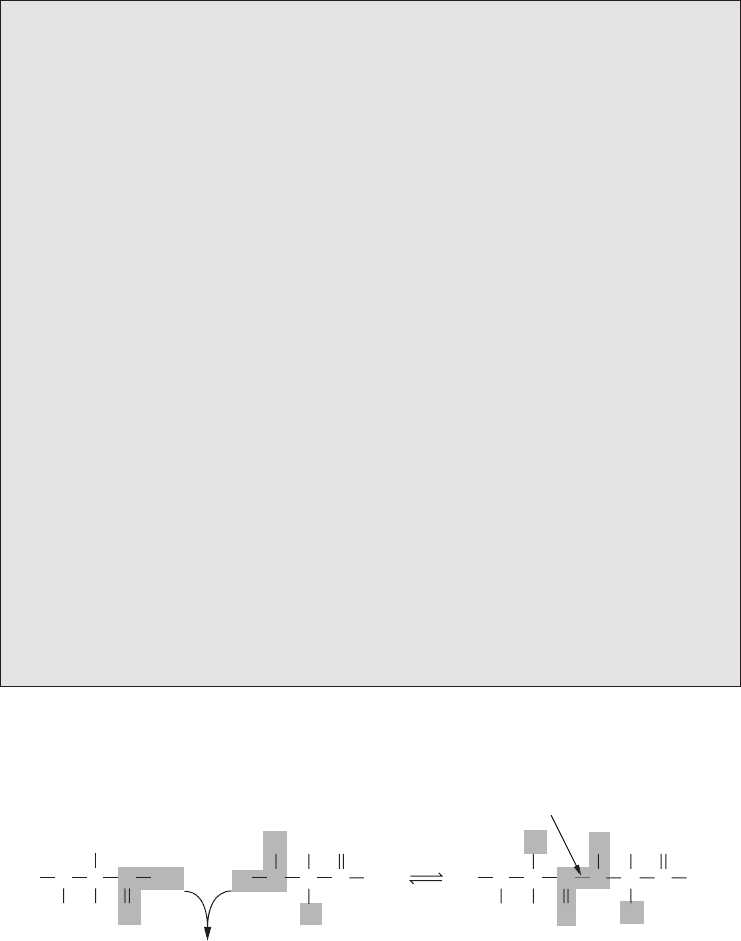
Proteins, as we’ve seen, are polymers of amino acids. Amino acids are joined together
by means of a peptide bond. This involves the -NH
2
group of one amino acid and the
-COOH group of another. The formation of a peptide bind is a form of condensation
reaction in which water is lost (Figure 2.14). The resulting structure of two linked amino
JWBK011-02 JWBK011-Hogg August 12, 2005 19:26 Char Count= 0
32 BIOCHEMICAL PRINCIPLES
H
HC
C
C
C
C
C
C
O
OO
O
CH
C
O
O
H
HH
H
HH
H
HH
N
N
NN
N
H
HH
H
H
H
C
CC
CC
C
HH
H
HH
H
H
OH
C
CC
N
N
CC
C
H
HH
C
CC
CC
C
C
C
CC
O
O
OH H C OH
CH
CH
3
CH
3
CH
3
CH
2
CH
2
NH
2
NH
2
NH
2
CH
3
CH
3
CH
3
CH
2
CH
3
CH
3
CH
2
CH
2
CH
2
CH
2
CH
2
CH
2
CH
2
CH
2
CH
2
CH
2
CH
2
CH
2
CH
2
CH
2
CH
2
CH
2
CH
2
CH
2
CH
2
CH
2
S
H
H
H
CH
3
SH
CH
2
CH
2
CH
HC
Glycine
Alanine
Valine
Leucine
Isoleucine
Serine Threonine
Asparagine
Glutamine
Lysine
Arginine
Histidine
Aspartate
Glutamate
Phenylalanine
Tyrosine Tryptophan
Cysteine
Methionine
Proline
−
+
−
−
+
+
+
(a)
(b)
(c)
(d)
(e) (f )
Simple,
aliphatic
Polar,
uncharged
Charged
Positive
Cyclic
Negative
Aromatic
Sulphur-
containing
Figure 2.13 The 20 amino acids found in proteins. The ‘R’ group of each amino acid is
shown. These range from the simplest, glycine, to more complex representatives such as
tryptophan
JWBK011-02 JWBK011-Hogg August 12, 2005 19:26 Char Count= 0
BIOMACROMOLECULES 33
Box 2.4 Amino acid shorthand
It is sometimes necessary to express in print the sequence of amino acids which
make up the primary structure of a particular protein; clearly it would be desper-
ately tedious to express a sequence of hundreds of bases in the form ’glycine,
phenylalanine, tryptophan, methionine . . . etc’, so a system of abbreviations for
each amino acid has been agreed. Each amino acid can be reduced to a three
letter code, thus you might see something like:
1234567891011
Gly Phe Try Met His Lys Gly Ala His Val Glu. . . .and so on.
Note that each residue has a number; this numbering always begins at the N-
ter minus.
Each amino acid can also be represented by a single letter. The abbreviations
using the two systems are shown below.
A Ala Alanine M Met Methionine
B Asx Asparagine/aspartic N Asn Asparagine
acid
C Cys Cysteine P Pro Proline
D Asp Aspartic acid Q Gln Glutamine
E Glu Glutamic acid R Arg Arginine
F Phe Phenylalanine S Ser Serine
G Gly Glycine T Thr Threonine
H His Histidine V Val Valine
I Ile Isoleucine W Trp Tryptophan
K Lys Lysine Y Tyr Tyrosine
L Leu Leucine Z Glx Glutamine/glutamic acid
H
H
H
HH
HHO
O
NCCNCCOH
HO
HHO
NC
R
1
R
2
R
2
R
1
CCNCOHOH H
Carboxyl
Amino
H
2
O
Amino acid 1 Amino acid 2 A dipeptide
Peptide bond
Figure 2.14 The carboxyl group of one amino acid is joined to the amino group of another.
This is another example of a condensation reaction (c.f. Figure 2.11). No matter how many
amino acids are added, the resulting structure always has a free carboxyl group at one end
and a free amino group at the other

JWBK011-02 JWBK011-Hogg August 12, 2005 19:26 Char Count= 0
34 BIOCHEMICAL PRINCIPLES
acids is called a dipeptide; note that this structure still retains an -NH
2
at one end and a
-COOH at the other. If we were to add on another amino acid to form a tripeptide, this
would still be so, and if we kept on adding them until we had a polypeptide, we would
still have the same two groupings at the extremities of the molecule. These are referred
to as the N-terminus and the C-terminus of the polypeptide. Since a water molecule has
been removed at the formation of each peptide bond, we refer to the chain so formed as
being composed of amino acid residues, rather than amino acids. The actual distinction
between a protein and a polypeptide based on the number of amino acid residues is not
clear-cut; generally, with over 100, we refer to proteins, but some naturally occurring
proteins are a lot smaller than this.
In theory, there are 20
100
or some 10
130
different
ways in which 20 differe-
nt amino acids could co-
mbine to give a protein
100 amino acid residues
in length!
So far, we can think of proteins as long chains of many
amino acid residues, rather like a string of beads. This
is called the primary structure of the protein; it is deter-
mined by the relative proportions of each of the 20 amino
acids, and the order in which they are joined together.
It is the basis of all the remaining levels of structural
complexity, and it ultimately determines the properties
of a particular protein. It is also what makes one pro-
tein different from another. Since the 20 types of amino
acid can be linked together in any order, the number of
possible sequences is astronomical, and it is this great variety of structural possibilities
that gives proteins such diverse structures and functions.
Some parts of the primary sequence are more important than others. If we took
a protein of, say, 200 amino acid residues in length, took it apart and reassembled
the amino acids in a different order, we would almost certainly alter (and probably
lose completely) the properties of that protein. If we look at the primary sequence of
a protein molecule which serves essentially the same function in several species, we
find that nature has allowed slight alterations to occur during evolution, but these are
often conservative substitutions, where an amino acid has been replaced by a similar
one (one from the same group in Figure 2.13), and thus have little effect on the pro-
tein’s properties. In certain parts of the primary sequence, such substitutions are less
well tolerated, for example the few residues that make up the active site of an enzyme
(see Chapter 6). In cases such as the one above, alterations have not been allowed
at these points in the primary sequence, and the sequence is the same, or almost so,
in all species possessing that protein. The sequence in question is said to have been
conserved.
Higher levels of protein structure
The structure of proteins is a good deal more complicated than a just a linear chain of
amino acids. A long thin chain is unlikely to be very stable; proteins therefore undergo
a process of folding which makes the molecule more stable and compact. The results of
this folding are the secondary and tertiary structures of a protein.
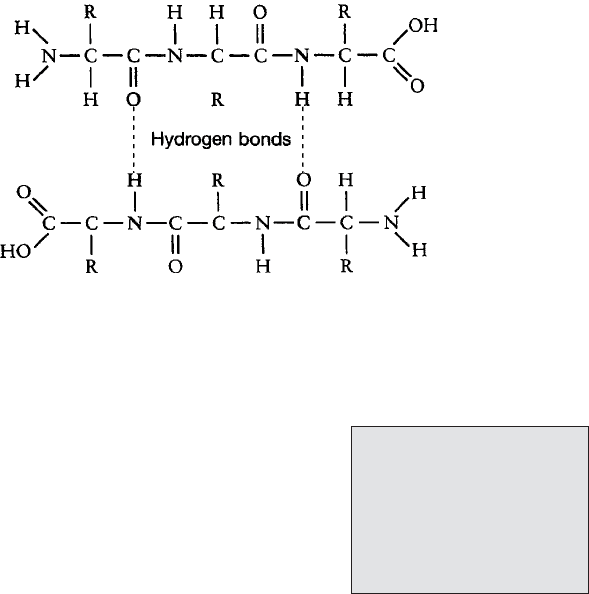
The secondary structure is due to hydrogen bonding between a carbonyl (-CO) group
and an amido (-NH) group of amino acid residues on the peptide backbone (Figure 2.15).
The ‘R’ group plays no part in secondary protein structure. Two regular patterns of
folding result from this; the α-helix and the β-pleated sheet.
JWBK011-02 JWBK011-Hogg August 12, 2005 19:26 Char Count= 0
BIOMACROMOLECULES 35
Figure 2.15 Secondary structure in proteins. Hydrogen bonding occurs between the -CO
and -NH groups of amino acids on the backbone of a polypeptide chain. The two amino
acids may be on the same or different chains
Very small distances
within molecules are me-
asured in Angstrom units
(A). One Angstrom unit is
equal to one tenbillionth
(10
−10
) of a metre.
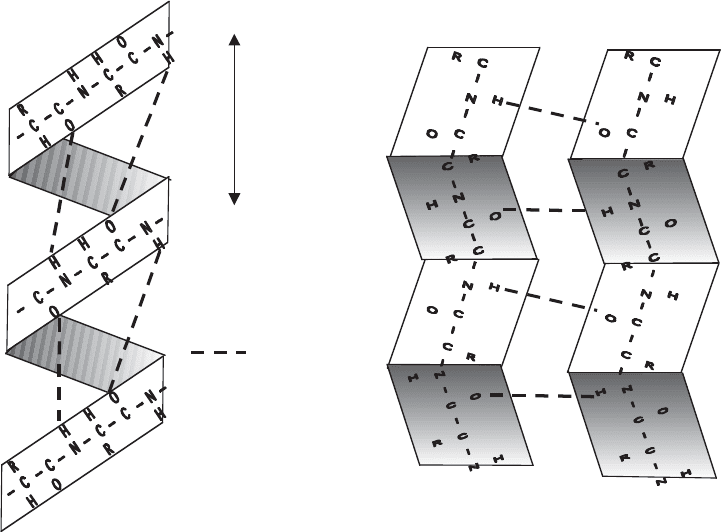
The α -helix occurs when hydrogen bonding takes
place between amino acids close together in the primary
structure. A stable helix is formed by the -NH group of
an amino acid bonding to the -CO group of the amino
acid four residues further along the chain (Figure 2.16a).
This causes the chain to twist into the characteristic he-
lical shape. One turn of the helix occurs every 3.6 amino
acid residues, and results in a rise of 5.4
˚
A (0.54 nm);
this is called the pitch height of the helix. The ability to
form a helix like this is dependent on the component amino acids; if there are too many
with large R-groups, or R-groups carrying the same charge, a stable helix will not be
formed. Because of its rigid structure, proline (Figure 2.13) cannot be accommodated in
an α-helix. Naturally occurring α-helices are always right-handed, that is, the chain of
amino acids coils round the central axis in a clockwise direction. This is a much more
stable configuration than a left-handed helix, due to the fact that there is less steric
hindrance (overlapping of electron clouds) between the R-groups and the C
==
O group
on the peptide backbone. Note that if proteins were made up of the d-form of amino
acids, we would have the reverse situation, with a left-handed form favoured. In the
β-pleated sheet, the hydrogen bonding occurs between amino acids either on separate
polypeptide chains or on residues far apart in the primary structure (Figure 2.16b). The
chains in a β-pleated sheet are fully extended, with 3.5
˚
A (0.35 nm) between adjacent
amino acid residues (c.f. α-helix, 1.5
˚
A). When two or more of these chains lie next to
each other, extensive hydrogen bonding occurs between the chains. Adjacent strands in
a β-pleated sheet can either run in the same direction (e.g. N→C), giving rise to a par-
allel β-pleated sheet, or in opposite directions (antiparallel β-pleated sheet, as shown in
Figure 2.16b).
A common structural element in the secondary structure of proteins is the β-turn.
This occurs when a chain doubles back on itself, such as in an antiparallel β-pleated
sheet. The -CO group of one amino acid is hydrogen bonded to the -NH group of the
JWBK011-02 JWBK011-Hogg August 12, 2005 19:26 Char Count= 0
36 BIOCHEMICAL PRINCIPLES
=5.4Å
´
Hydrogen
bonding
(a) (b)
Pitch height
Figure 2.16 Secondary structure in proteins: the α-helix and β-pleated sheet. (a) Hydrogen
bonding between amino acids four residues apart in the primary sequence results in the
formation of an α-helix. (b) In the β-pleated sheet hydrogen bonding joins adjacent chains.
Note how each chain is more fully extended than in the α-helix. In the example shown, the
chains run in the same direction (parallel)
residue three further along the chain. Frequently, it is called a hairpin turn, for obvious
reasons (Figure 2.17). Numerous changes in direction of the polypeptide chains result
in a compact, globular shape to the molecule.
Typically about 50 per cent of a protein’s secondary structure will have an irregular
form. Although this is often referred to as random coiling, it is only random in the sense
that there is no regular pattern; it still contributes towards the stability of the molecule.
The proportions and combinations in which α-helix, β-pleated sheet and random coiling
occur varies from one protein to another. Keratin, a structural protein found in skin,
horn and feathers, is an example of a protein entirely made up of α-helix, whilst the
lectin (sugar-binding protein) concanavalin A is mostly made up of β-pleated sheets.
The tertiary structure of a protein is due to interactions between side chains, that is,
R-groups of amino acid residues, resulting in the folding of the molecule to produce a
thermodynamically more favourable structure. The structure is formed by a variety of
weak, non-covalent forces; these include hydrogen bonding, ionic bonds, hydrophobic
interactions, and Van der Waals forces. The strength of these forces diminishes with
distance, therefore the formation of a compact structure is encouraged. In addition, the
-SH groups on separate cysteine residues can form a covalent -S—S- linkage. This is
JWBK011-02 JWBK011-Hogg August 12, 2005 19:26 Char Count= 0
BIOMACROMOLECULES 37
Amino acid 1
R
NCC
H NH
HO
HC R Amino acid 2
Hydrogen
b
onding C O
NH
HC R Amino acid 3
OH
H C O
CCN
R
Amino acid
4
Figure 2.17 The β-turn. The compact folding of many globular proteins is achieved by the
polypeptide chain reversing its direction in one or more places. A common way of doing this
is with the β-turn. Hydrogen bonding between amino acid residues on the same polypeptide
stabilizes the structure
known as a disulphide bridge and may have the effect of bringing together two cysteine
residues that were far apart in the primary sequence (Figure 2.18).
In globular proteins, the R-groups are distributed according to their polarities; non-
polar residues such as valine and leucine nearly always occur on the inside, away from
the aqueous phase, while charged, polar residues including glutamic acid and histidine
generally occur at the surface, in contact with the water.
Complex molecules
such as globular prote-
ins become denatured
when their three-dimen-
sional structure is disrup-
ted, leading to a loss of
biological function.
The protein can be denatured by heating or treatment
with certain chemicals; this causes the tertiary structure
to break down and the molecule to unfold, resulting in
a loss of the protein’s biological properties. Cooling, or
removal of the chemical agents, will lead to a restora-
tion of both the tertiary structure and biological activity,
showing that both are entirely dependent on the primary
sequence of amino acids.
Even the tertiary structure is not always the last level
of organisation of a protein, because some are made up of two or more polypeptide
chains, each with its own secondary and tertiary structure, combined together to give the
quaternary structure (Figure 2.19). These chains may be identical or different, depending
on the protein. Like the tertiary structure, non-covalent forces between R-groups are
responsible, the difference being that this time they link amino acid residues on separate
chains rather than on the same one.
Such proteins lose their functional properties if dissociated into their constituent
units; the quaternary joining is essential for their activity. Phosphorylase A, an enzyme
involved in carbohydrate metabolism, is an example of a protein with a quaternary
structure. It has four subunits, which have no catalytic activity unless joined together
as a tetramer.