
Hogg S. Essential microbiology
Подождите немного. Документ загружается.

JWBK011-03 JWBK011-Hogg August 12, 2005 15:52 Char Count= 0
58 CELL STRUCTURE AND ORGANISATION
Endospores
Endospores of pathogens
such as Clostridium bo-
tulinum can resist boiling
for several hours. It is this
resistance that makes
it necessary to auto-
clave at 121
◦
Cinorder
to ensure complete
sterility.
Certain bacteria such as Bacillus and Clostridium pro-
duce endospores. They are dormant forms of the cell
that are highly resistant to extremes of temperature, pH
and other environmental factors, and germinate into new
bacterial cells when conditions become more favourable.
The spore’s resistance is due to the thick coat that sur-
rounds it.
The plasma membrane
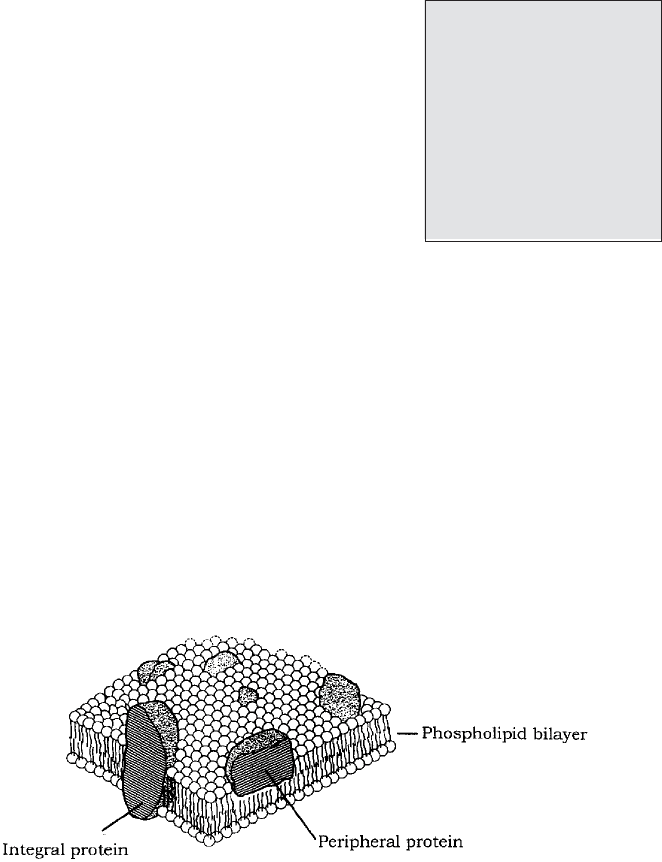
The cytoplasm and its contents are surrounded by a plasma membrane, which can
be thought of as a bilayer of phospholipid arranged like a sandwich, together with
associated proteins (Figure 3.5). The function of the plasma membrane is to keep the
contents in, while at the same time allowing the selective passage of certain substances
in and out of the cell (it is a semipermeable membrane).
Phospholipids comprise a compact, hydrophilic (= water-loving) head and a long
hydrophobic tail region (Figure 2.27); this results in a highly ordered structure when
the membrane is surrounded by water. The tails ‘hide’ from the water to form the inside
of the membrane, while the heads project outwards. Also included in the membrane
are a variety of proteins; these may pass right through the bilayer or be associated with
the inner (cytoplasmic) or outer surface only. These proteins may play structural or
functional roles in the life of the cell. Many enzymes associated with the metabolism
of nutrients and the production of energy are associated with the plasma membrane in
procaryotes. As we will see later in this chapter, this is fundamentally different from
Figure 3.5 The plasma membrane. Phospholipid molecules form a bilayer, with the hy-
drophobic hydrocarbon chains pointing in towards each other, leaving the hydrophilic phos-
phate groups to face outwards. Proteins embedded in the membrane are known as integral
proteins, and may pass part of the way or all of the way through the phospholipid bilayer.
The amino acid composition of such proteins reflects their location; the part actually embed-
ded among the lipid component of the membrane comprises non-polar (hydrophobic) amino
acids, while polar ones are found in the aqueous environment at either side. Singleton, P:
Bacteria in Biology, Biotechnology and Medicine, 5th edn, John Wiley & Sons, 1999. Re-
produced by permission of the publishers

JWBK011-03 JWBK011-Hogg August 12, 2005 15:52 Char Count= 0
THE PROCARYOTIC CELL 59
eucaryotic cells, where these reactions are carried out on specialised internal organelles.
Proteins involved in the active transport of nutrients (see Chapter 4) are also to be found
associated with the plasma membrane. The model of membrane structure as depicted in
Figure 3.5 must not be thought of as static; in the widely accepted fluid mosaic model,
the lipid is seen as a fluid state, in which proteins float around, rather like icebergs in
an ocean.
The majority of bacterial membranes do not contain sterols (c.f. eucaryotes: see
below), however many do contain molecules called hopanoids that are derive from
the same precursors. Like sterols, they are thought to assist in maintaining membrane
stability. A comparison of the lipid components of plasma membranes reveals a distinct
difference between members of the Archaea and the Bacteria.
The bacterial cell wall
Bacteria have a thick, rigid cell wall, which maintains the integrity of the cell, and
determines its characteristic shape. Since the cytoplasm of bacteria contains high
A protoplast is a cell that
has had its cell wall re-
moved.
concentrations of dissolved substances, they generally
live in a hypotonic environment (i.e. one that is more di-
lute than their own cytoplasm). There is therefore a nat-
ural tendency for water to flow into the cell, and without
the cell wall the cell would fill and burst (you can demon-
strate this by using enzymes to strip off the cell wall, leaving the naked protoplast).
Proteases are enzymes
that digest proteins.
The major component of the cell wall, which is re-
sponsible for its rigidity, is a substance unique to bacte-
ria, called peptidoglycan (murein). This is a high molec-
ular weight polymer whose basic subunit is made up of
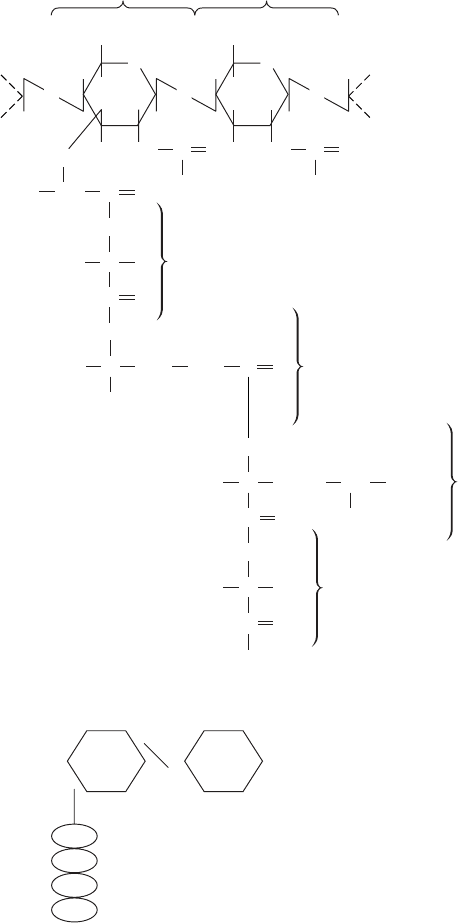
three parts: N-acetylglucosamine, N-acetylmuramic acid and a short peptide chain (Fig-
ure 3.6). The latter comprises the amino acids l-alanine, d-alanine, d-glutamic acid and
either l-lysine or diaminopimelic acid (DAP). DAP is a rare amino acid, only found in
the cell walls of procaryotes. Note that some of the amino acids of peptidoglycan are
found in the d-configuration. This is contrary to the situation in proteins, as you may
recall from Chapter 2, and confers protection against proteases specifically directed
against l-amino acids.
Precursor molecules for peptidoglycan are synthesised inside the cell, and transported
across the plasma membrane by a carrier called bactoprenol phosphate before being in-
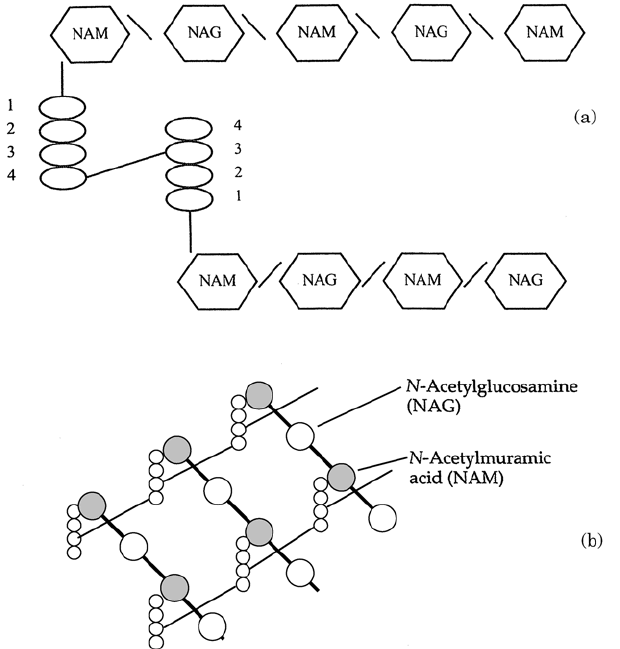
corporated into the cell wall structure. Enzymes called transpeptidases then covalently
bond the tetrapeptide chains to one another, giving rise to a complex network (Figure
3.7); it is this cross-linking that gives the wall its mechanical strength. A number of
antimicrobial agents exert their effect by inhibiting cell wall synthesis; β-lactam an-
tibiotics such as penicillin inhibit the transpeptidases, thereby weakening the cell wall,
whilst bacitracin prevents transport of peptidoglycan precursors out of the cell. The
action of antibiotics will be discussed further in Chapter 14. Although all bacteria (with
a few exceptions) have a cell wall containing peptidoglycan, there are two distinct struc-
tural types. These are known as Gram-positive and Gram-negative. The names derive
from the Danish scientist Christian Gram, who, in the 1880s developed a rapid staining
technique that could differentiate bacteria as belonging to one of two basic types (see
Box 1.2). Although the usefulness of the Gram stain was recognised for many years, it
JWBK011-03 JWBK011-Hogg August 12, 2005 15:52 Char Count= 0
60 CELL STRUCTURE AND ORGANISATION
CH
2
OH
H
H
H
NH
H
H
H
O
O
O
CH
2
OH
H
H
HOH
NH
H
H
O
O
H
O
C
COOH
NH
HCH
2
CH
2
CO
C
C
NH
2
NH
H (CH
2
)
3
CH COOH
C
CO
O
NH
OH
HCH
3
C
C
CO
O
NH
CH
3
C O
CH
3
CH
3
C O
CH
H
3
C
H
N
-acetylmuramic
acid residue
N
-acetylglucosamine
residue
Simplified depiction
–Alanine
–Glutamic acid
meso
–Diaminopimelic acid
D
–AlanineD
L
NAM NAG
1
23
4
5
6
Figure 3.6 Peptidoglycan structure. Peptidoglycan is a polymer made up of alternating
molecules of N-acetylglucosamine (NAG) and N-acetylmuramic acid (NAM). A short pep-
tide chain is linked to the NAM residues (see text for details). This is important in the
cross-linking of the straight chain polymers to form a rigid network (Figure 3.6). The com-
position of E. coli peptidoglycan is shown; the peptide chain may contain different amino
acids in other bacteria. Partly from Hardy, SP: Human Microbiology, Taylor and Francis,
2002. Reproduced by permission of Thomson Publishing Services
JWBK011-03 JWBK011-Hogg August 12, 2005 15:52 Char Count= 0
THE PROCARYOTIC CELL 61
Figure 3.7 Cross-linking of peptidoglycan chains in E. coli. (a) The d-alanine on the short
peptide chain attached to the N-acetylmuramic acid cross-links to a diaminopimelic acid
residue on another chain. In other bacteria, the precise nature of the cross-linking may differ.
From Hardy, SP: Human Microbiology, Taylor and Francis, 2002. Reproduced by permis-
sion of Thomson Publishing Services. (b) Further cross-linking produces a rigid network
of peptidoglycan. The antibiotic penicillin acts by inhibiting the transpeptidase enzymes
responsible for the cross-linking reaction (see Chapter 15)
was only with the age of electron microscopy that the underlying molecular basis of the
test could be explained, in terms of cell wall structure.
Gram-positive cell walls are relatively simple in structure, comprising several layers
of peptidoglycan connected to each other by cross-linkages to form a strong, rigid
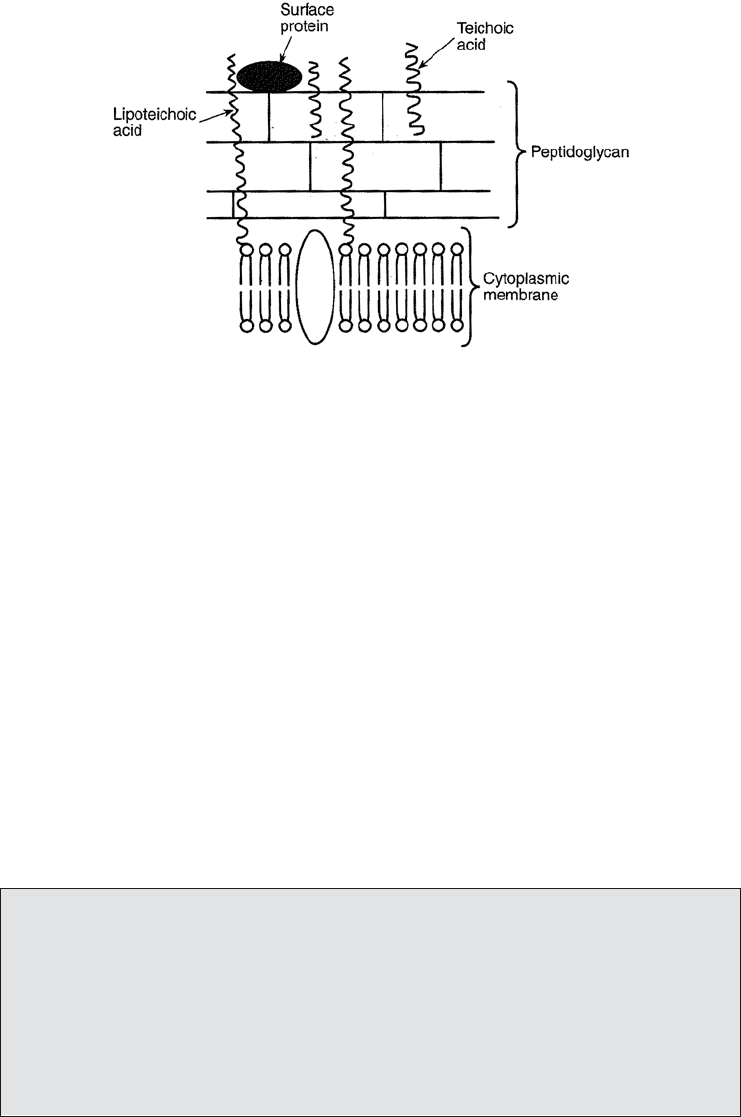
scaffolding. In addition, they contain acidic polysaccharides called teichoic acids; these
contain phosphate groups that impart an overall negative charge to the cell surface. A
diagram of the gram-positive cell wall is shown in Figure 3.8.
Gram-negative cells have a much thinner layer of peptidoglycan, making the wall
less sturdy, however the structure is made more complex by the presence of a
layer of lipoprotein, polysaccharide and phospholipid known as the outer membrane
JWBK011-03 JWBK011-Hogg August 12, 2005 15:52 Char Count= 0
62 CELL STRUCTURE AND ORGANISATION
Figure 3.8 The Gram-positive cell wall. Peptidoglycan is many layers thick in the Gram-
positive cell wall and may account for 30–70% of its dry weight. Teichoic acids are neg-
atively charged polysaccharides; they are polymers of ribitol phosphate and cross-link to
peptidoglycan. Lipoteichoic acids are teichoic acids found in association with glycolipids.
From Henderson, B, Wilson, M, McNab, R & Lax, AJ: Cellular Microbiology: Bacteria-
Host Interactions in Health and Disease, John Wiley & Sons Inc., 1999. Reproduced by
permission of the publishers
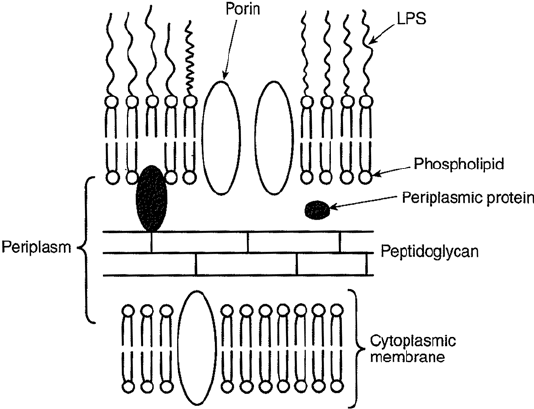
(Figure 3.9). This misleading name derives from the fact that it superficially resembles
the bilayer of the plasma membrane; however, instead of two layers of phospholipid, it
has only one, the outer layer being made up of lipopolysaccharide. This has three parts:
lipid A, core polysaccharide and an O-specific side chain. The lipid A component may
act as an endotoxin, which, if released into the bloodstream, can lead to serious con-
ditions such as fever and toxic shock. The O-specific antigens are carbohydrate chains
whose composition often varies between strains of the same species. Serological meth-
ods can distinguish between these, a valuable tool in the investigation, for example, of
the origin of an outbreak of an infectious disease. Proteins incorporated into the outer
membrane and penetrating its entire thickness form channels that allow the passage of
water and small molecules to enter the cell. Unlike the plasma membrane, the outer
membrane plays no part in cellular respiration.
Box 3.1 Mesosomes − the structures that never were?
When looked at under the electron microscope, Gram-positive bacteria often con-
tained localised in-foldings of the plasma membrane. These were given the name
mesosomes, and were thought by some to act as attachment points for DNA dur-
ing cell division, or to play a role in the formation of cross-walls. Others thought
they were nothing more than artefacts produced by the rather elaborate sample
preparation procedures necessary for electron microscopy. Nowadays, most micro-
biologists support the latter view.
JWBK011-03 JWBK011-Hogg August 12, 2005 15:52 Char Count= 0
THE PROCARYOTIC CELL 63
Figure 3.9 The Gram-negative cell wall. Note the thinner layer of peptidoglycan compared
to the gram-positive cell wall (Figure 3.8). It accounts for <10% of the dry weight. Beyond
this lies the outer membrane, with its high lipopolysaccharide content. Channels made of
porins allow the passage of certain solutes into the cell. From Henderson, B, Wilson, M,
McNab, R & Lax, AJ: Cellular Microbiology: Bacteria-Host Interactions in Health and
Disease, John Wiley & Sons Inc., 1999. Reproduced by permission of the publishers
Members of the Archaea have a cell wall chemistry quite different to that described
above (see Chapter 7). Instead of being based on peptidoglycan, they have other complex
polysaccharides, although a distinction between gram-positive and gram-negative types
still occurs.
Beyond the cell wall
A number of structural features are to be found on the outer surface of the cell wall; these
are mainly involved either with locomotion of the cell or its attachment to a suitable
surface.
Perhaps the most obvious extracellular structures are flagella (sing: flagellum), thin
hair-like structures often much longer than the cell itself, and used for locomotion in
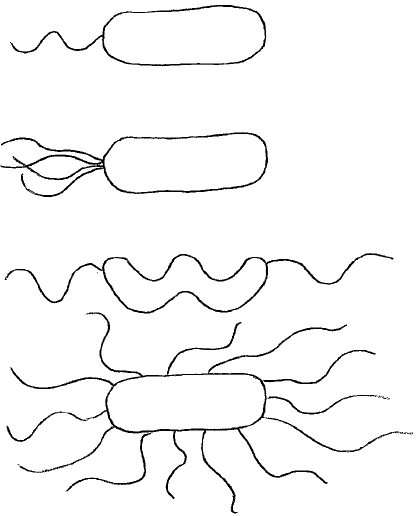
many bacteria. There may be a single flagellum, one at each end, or many, depending
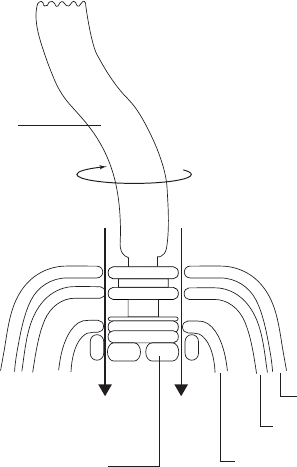
on the bacteria concerned (Figure 3.10). Each flagellum is a hollow but rigid cylindri-
cal filament made of the protein flagellin, attached via a hook to a basal body, which
secures it to the cell wall and plasma membrane (Figure 3.11). The basal body com-
prises a series of rings, and is more complex in Gram-negative than Gram-positive
bacteria. Rotation of the flagellum is an energy-dependent process driven by the basal
body, and the direction of rotation determines the nature of the resulting cellular move-
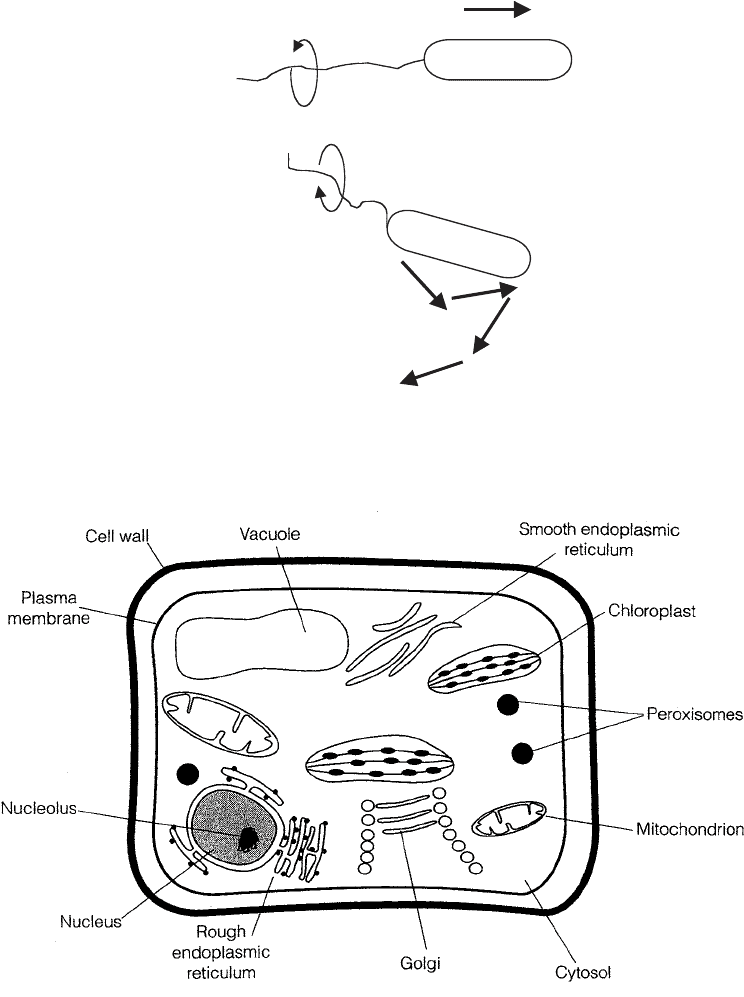
ment. Clockwise rotation of a single flagellum results in a directionless ‘tumbling’,
JWBK011-03 JWBK011-Hogg August 12, 2005 15:52 Char Count= 0
64 CELL STRUCTURE AND ORGANISATION
(a) Polar, monotrichous
(b) Polar, amphitrichous
(c) Bipolar, monotrichous
(d) Peritrichous
Figure 3.10 Flagella may be situated at one end (a & b), at both ends (c) or all over the
cell surface (d)
but if it rotates anticlockwise, the bacterium will ‘run’ in a straight line (Figure
3.12). Likewise, anticlockwise rotation causes bunched flagella to ‘run’ by winding
around each other and acting as a single structure, whilst spinning in the opposite
direction gives rise to multiple independent rotations and tumbling results once more.
Pili (sing: pilus) are structures that superficially resemble short flagella. They differ
from flagella, however, in that they do not penetrate to the plasma membrane, and
they are not associated with motility. Their function, rather, is to anchor the bacterium
to an appropriate surface. Pathogenic (disease-causing) bacteria have proteins called
adhesins on their pili, which adhere to specific receptors on host tissues. Attachment
pili are sometimes called fimbriae, to distinguish them from another distinct type of
pilus, the sex pilus, which as its name suggests, is involved in the transfer of genetic
information by conjugation. This is discussed in more detail in Chapter 12.
Outside the cell wall, most bacteria have a polysaccharide layer called a glycocalyx.
This may be a diffuse and loosely bound slime layer or a better defined, and generally
thicker capsule. The slime layer helps protect against desiccation, and is instrumental in
the attachment of certain bacteria to a substratum (the bacteria that stick to your teeth
are a good example of this). Capsules offer protection to certain pathogenic bacteria
against the phagocytic cells of the immune system. Both capsules and slime layers are
key components of biofilms, which form at liquid/solid interfaces, and can be highly
significant in such varied settings as wastewater treatment systems, indwelling catheters
and the inside of your mouth!
JWBK011-03 JWBK011-Hogg August 12, 2005 15:52 Char Count= 0
THE EUCARYOTIC CELL 65
flagellum
outer membrane
inner membrane
switch complex
cell wall
H
+
H
+
Figure 3.11 Bacterial flagella are anchored in the cell wall and plasma membrane. The
filament of the flagellum is anchored by a basal body. In Gram-positive organisms, this
comprises two rings inserted in the plasma membrane. In Gram-negative organisms (as
shown), there are additional rings associated with the outer membrane and the peptidoglycan
layer. Some modern interpretations of flagellar structure view the M and S rings as a single
structure. Energy for rotation of the flagellum is derived from the proton motive force
generated by the movement of protons across a membrane (see Chapter 6). From Bolsover,
SR, Hyams, JS, Jones, S, Shepherd, EA & White, HA: From Genes to Cells, John Wiley &
Sons, 1997. Reproduced by permission of the publishers
The eucaryotic cell
We have already seen that eucaryotic cells are, for the most part, larger and much more
complex than procaryotes, containing a range of specialised subcellular organelles (Fig-
ure 3.13). Within the microbial world, the major groups of eucaryotes are the fungi and
the protists (protozoans and algae); all of these groups have single-celled representatives,
and there are multicellular forms in the algae and fungi.
Our survey of eucaryotic cell structure begins once more with the genetic material,
and works outwards. However, since many internal structures in eucaryotes are en-
closed in a membrane, it is appropriate to preface our description by briefly considering
eucaryotic membranes. These are, in fact, very similar to the fluid mosaic structure we
described earlier in this chapter, as depicted in Figure 3.5. The main difference is that
eucaryotic membranes contain lipids called sterols, which enhances their rigidity. We
shall consider the significance of this when we discuss the plasma membrane of eucary-
otes below. Cholesterol, which we usually hear about in a very negative context, is a
very important sterol found in the membranes of many eucaryotes.
JWBK011-03 JWBK011-Hogg August 12, 2005 15:52 Char Count= 0
RUN
TUMBLE
Figure 3.12 Running and tumbling. Anticlockwise rotation of the flagellum gives rise to
‘running’ in a set direction. Reversing the direction of rotation causes ‘tumbling’, and allows
the bacterial cell to change direction
Figure 3.13 This example of eucaryotic cell structure shows a plant cell. Other eucaryotic
cells may differ with respect to the cell wall and the possession of choroplasts. Note the
much more elaborate internal structure compared to a typical procaryotic cell (Figure 3.3), in
particular the presence of membrane-bounded organelles such as mitochondria, chloroplasts,
endoplasmic reticulum and a true nucleus. From Nicklin, J, Graeme-Cook, K & Killington,
R: Instant Notes in Microbiology, 2nd edn, Bios Scientific Publishers, 2002. Reproduced by
permission of Thomson Publishing Services
66

JWBK011-03 JWBK011-Hogg August 12, 2005 15:52 Char Count= 0
THE EUCARYOTIC CELL 67
The nucleus
The principal difference between procaryotic and eucaryotic cells, and the one that
gives the two forms their names, lies in the accommodation of their genetic material.
Eucaryotic cells have a true nucleus, surrounded by a nuclear membrane. This is in fact a
double membrane; it contains pores, through which messenger RNA leaves the nucleus
on its way to the ribosomes during protein synthesis (see Chapter 11).
A cell containing only
one copy of each chro-
mosome is said to be
haploid. The term is also
applied to organisms
made up of such cells
The haploid state is of-
ten denoted as N. (c.f.
diploid (2N): contain-
ing two copies of each
chromosome)
The organisation of genetic material in eucaryotes is
very different from that in procaryotes. Instead of ex-
isting as a single closed loop, the DNA of eucaryotes is
organised into one or more pairs of chromosomes. The
fact that they occur in pairs highlights another important
difference from procaryotes: eucaryotes are genetically
diploid in at least some part of their life cycle, while pro-
caryotes are haploid. The DNA of eucaryotic chromo-
somes is linear in the sense that it has free ends; however,
because there is so much of it, it is highly condensed and
wound around proteins called histones. These carry a
strong positive charge and associate with the negatively
charged phosphate groups on the DNA.
As well as the chromosomes, the nucleus also contains
the nucleolus, a discrete structure rich in RNA, where ri-
bosomes are assembled. The ribosomes themselves have
the same function as their procaryotic counterparts;
the differences in size have already been discussed (see
A histone is a basic pro-
tein found associated
with DNA in eucaryotic
chromosomes.
Table 3.3). They may be found free in the cytoplasm or
associated with the endoplasmic reticulum (see below),
depending on the type of protein they synthesise.
Endoplasmic reticulum
Running throughout the cell and taking up much of its volume, the endoplasmic retic-
ulum (ER) is a complex membrane system of tubes and flattened sacs. The presence of
numerous ribosomes on their surface gives those parts of the ER involved in protein syn-
thesis a granular appearance when seen under the electron microscope, giving rise to the
name rough ER. Areas of the ER not associated with ribosomes are known as smooth
ER; this is where the synthesis of membrane lipids takes place. The ER also serves as a
communications network, allowing the transport of materials between different parts
of the cell.
Golgi apparatus
The Golgi apparatus is another membranous organelle, comprising a set of flattened
vesicles, usually arranged in a stack called a dictyosome. The function of the Golgi