
Hogg S. Essential microbiology
Подождите немного. Документ загружается.

JWBK011-02 JWBK011-Hogg August 12, 2005 19:26 Char Count= 0
38 BIOCHEMICAL PRINCIPLES
CN
CH
2
CH
2
SH
SH
HOH
C CN
CH
2
CH
2
S
S
HOH
HOH
C
CN C
HOH
CN C
Disulphide
Bond
Cysteine
Cysteine
(a)
COO
−
H
3
N
+
S
S
S
S
S
S
20
120
10
1
129
30
40
5060
70
80
90
100
110
S
S
S
S
S
S
S
S
S
S
S
(b)
S
S
S
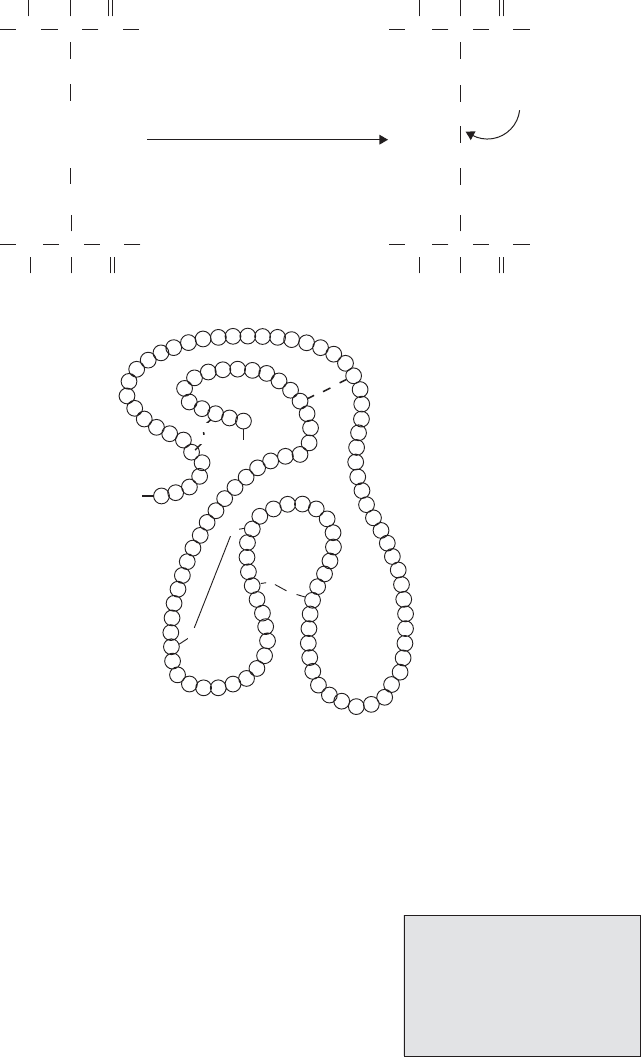
Figure 2.18 Disulphide bond formation. (a) Disulphide bonds formed by the oxidation of
cysteine residues result in cross-linking of a polypeptide chain. (b) This can have the effect of
bringing together residues that lie far apart in the primary amino acid sequence. Disulphide
bonds are often found in proteins that are exported from the cell, but rarely in intracellular
proteins
A prosthetic group is a
non-polypeptide comp-
onent of a protein, such
as a metal ion or a car-
bohydrate
Although all proteins are polymers of amino acids
existing in various levels of structural complexity as we
have seen above, some have additional, non-amino acid
components. They may be organic, such as sugars (gly-
coproteins) or lipids (lipoproteins) or inorganic, includ-
ing metals (metalloproteins) or phosphate groups (phos-
phoproteins). These components, which form an integral
part of the protein’s structure, are called prosthetic groups.
JWBK011-02 JWBK011-Hogg August 12, 2005 19:26 Char Count= 0
BIOMACROMOLECULES 39
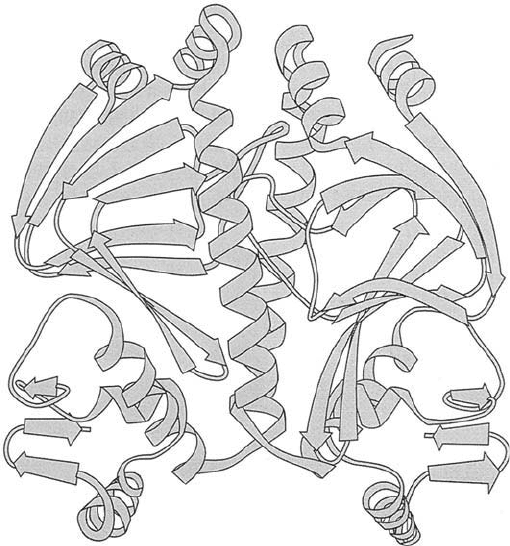
Figure 2.19 Polypeptide chains may join to form quaternary structure. The example shown
comprises two identical polypeptide subunits. Coils indicate α-helical sequences, arrows are
β-pleated sheets. From Bolsover, SR , Hyams, JS, Jones, S, Shepherd, EA & White, HA:
From Genes to Cells, John Wiley & Sons, 1997. Reproduced by permission of the publishers
Nucleic acids
The third class of polymeric macromolecules are the nucleic acids. These are deoxyri-
bonucleic acid (DNA) and ribonucleic acid (RNA), and both are polymers of smaller
molecules called nucleotides. As we shall see, there are important differences both in
the overall structures of RNA and DNA and in the nucleotides they contain, so we shall
consider each of them in turn.
The structure of DNA
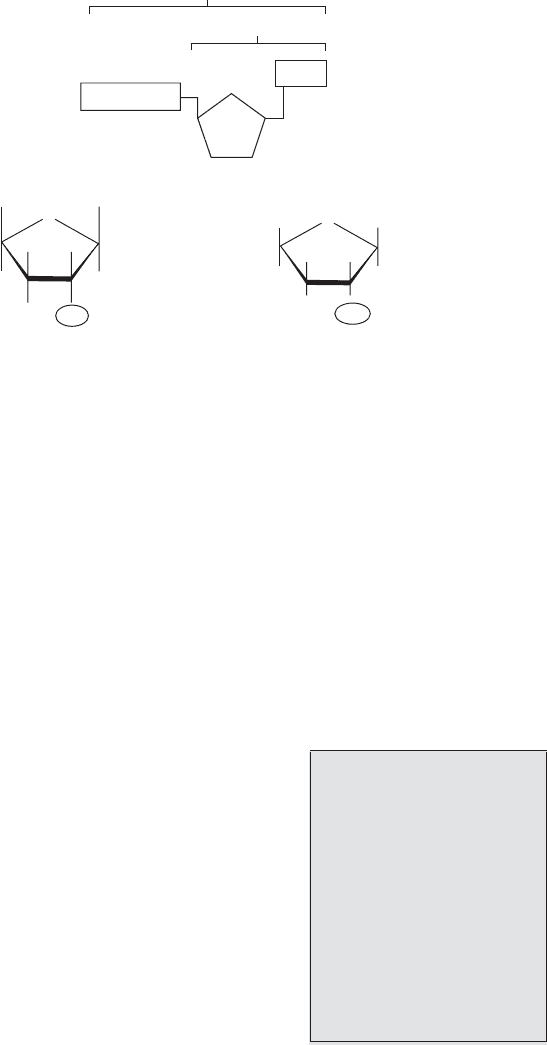
The composition of a DNA nucleotide is shown in Figure 2.20(a). It has three parts, a
five-carbon sugar called deoxyribose, a phosphate group and a base. This base can be
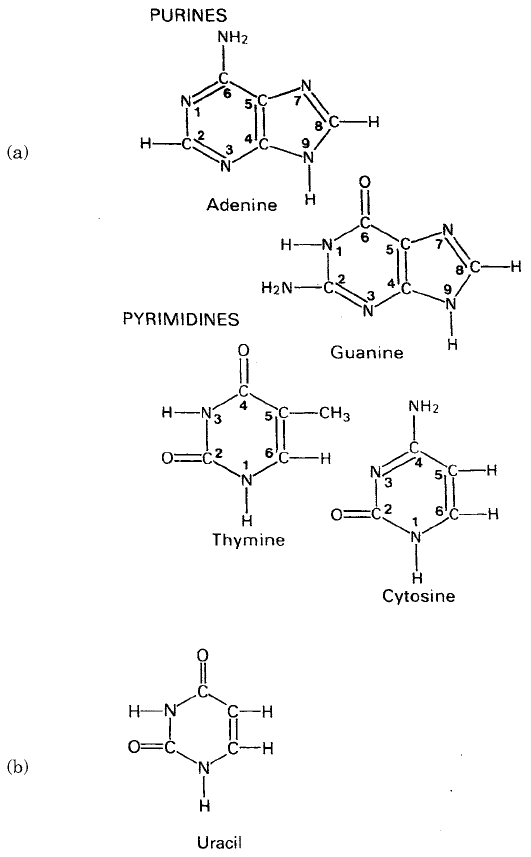
any one of four molecules; as can be seen in Figure 2.21, these are all based on a cyclic
structure containing nitrogen. Two of the bases, cytosine and thymine, have a single
ring and are called pyrimidines. The other two, guanine and adenine, have a double
ring structure; these are the purines. The four bases are often referred to by their initial
letter only, thus we have A, C, G and T.
One nucleotide differs from another by the identity of the base it contains; the rest of
the molecule (sugar and phosphate) is identical. You will recall from the previous section
that the properties of a protein depend on the order in which its constituent amino acids
JWBK011-02 JWBK011-Hogg August 12, 2005 19:26 Char Count= 0
40 BIOCHEMICAL PRINCIPLES
Nucleotide
Nucleoside
PHOSPHATE
SUGAR
BASE
O
OHHOCH
2
H
HH
H
H
HO
4′
5′
1′
2′
3′
O
OH
HOCH
2
H
HH
H
OH
OH
4′
5′
1′
2′3′
(a) Deoxyibo se (b) Ribo se
Figure 2.20 A nucleotide comprises a pentose sugar, a phosphate group and a nitrogenous
base (see Figure 2.21). Note the difference between the sugars (a) deoxyribose (DNA) and
(b) ribose (RNA)
are linked together; we have exactly the same situation with nucleic acids, except that
instead of an ‘alphabet’ of 20 ‘letters’, here we have one of only four. Nevertheless,
because nucleic acid molecules are extremely long, and the bases can occur in almost
any order, an astronomically large number of different sequences is possible.
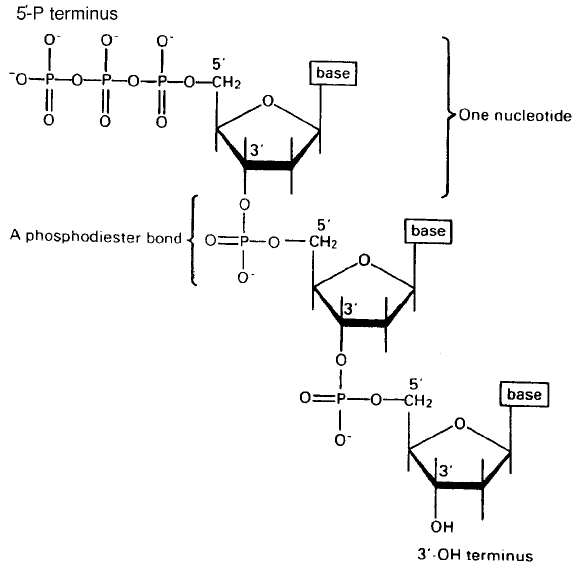
The nucleotides join together by means of a phosphodiester bond. This links the
phosphate group of one base to an -OH group on the 3-carbon of the deoxyribose
sugar of another (Figure 2.22). The chain of nucleotides therefore has a free -OH group
attached to the 3-carbon (the 3
end) and a free phosphate group attached to the 5-
carbon (the 5
end). This remains the case however long the chain becomes.
Erwin Chargaff meas-
ured the proportions of
the different nucleotides
in a range of DNA sam-
ples. He found that T al-
ways = A and C always
= G. Watson and Crick
interpreted this as mean-
ing that the bases al-
ways paired up in this
way.
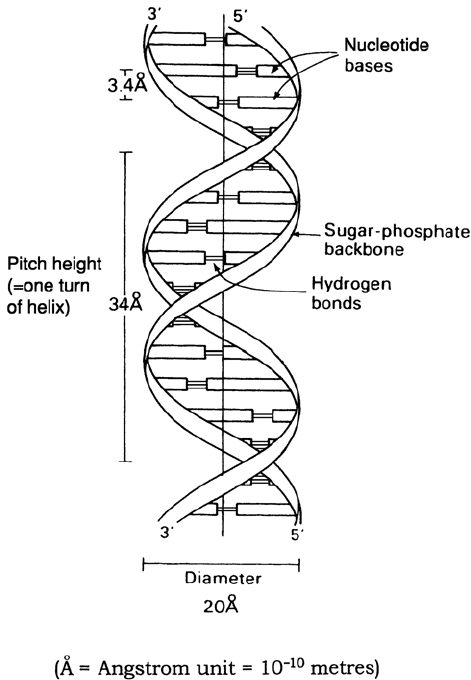
The structure of DNA however is not just a sin-
gle chain of linked nucleotides, but two chains wound
around each other to give the double helix form made
famous by the model of James Watson and Francis Crick
in 1953 (Figure 2.23, see also Chapter 11). If we com-
pare this to an open spiral staircase, alternate sugar and
phosphate groups make up the ‘skeleton’ of the stair-
case, while the inward-facing bases pair up by hydro-
gen bonding to form the steps. Notice that each nu-
cleotide pair always comprises three rings, resulting from
a combination of one purine and one pyrimidine base.
This means that the two strands of the helix are always
evenly spaced. The way in which the bases pair is further
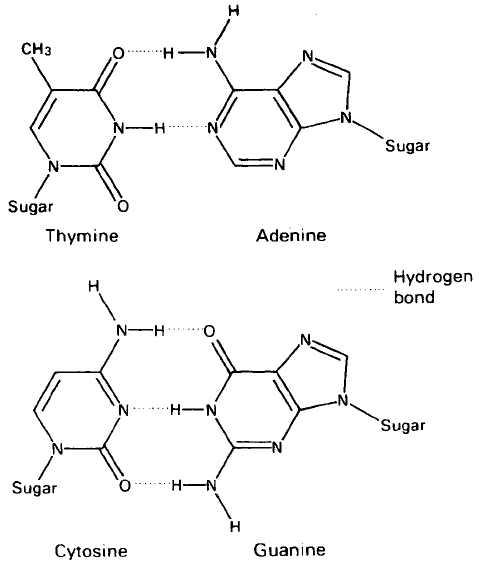
governed by the phenomenon of complementary base
pairing. A nucleotide containing thymine will only pair with one containing adenine,
and likewise guanine always pairs with cytosine (Figure 2.24). Thus, the sequence of
JWBK011-02 JWBK011-Hogg August 12, 2005 19:26 Char Count= 0
BIOMACROMOLECULES 41
Figure 2.21 Bases belong to two classes. Nucleotides differ from each other in the identity
of the nitrogenous base. (a) In DNA these are adenine (A), cytosine (C), guanine (G) or
thymine (T). The purines (A and G) have a two-ring structure, while the pyrimidines (C and T)
have only one ring. (b) In RNA, thymine is replaced by a similar molecule, uracil (U)
nucleotides on one strand of the double helix determines that of the other, as it has a
complementary structure. Figure 2.23 shows how the two strands of the double helix
are antiparallel, that is they run in opposite directions, one 5
→ 3
and the other 3
→5
.
In Chapter 12 we shall look at how this structure was used to propose a mechanism for
the way in which DNA replicates and genetic material is copied.
JWBK011-02 JWBK011-Hogg August 12, 2005 19:26 Char Count= 0
42 BIOCHEMICAL PRINCIPLES
Figure 2.22 The phosphodiester bond. A chain of DNA is made longer by the addition
of nucleotides containing not one but three phosphate groups; on joining the chain, two
of these phosphates are removed. Nucleotides are joined to each other by a phosphodiester
bond, linking the phosphate group on the 5-carbon of one deoxyribose to the -OH group
on the 3-carbon of another. (These carbons are known as 5
and 3
to distinguish them from
the 5- and 3-carbon on the nitrogenous base). Note that the resulting chain, however many
nucleotides it may comprise, always has a 5
(PO
4
) group at one end and a 3
(OH) group at
the other
The structure of RNA
In view of the similarities in the structure of DNA and RNA, we shall confine ourselves
here to a consideration of the major differences. There are two important differences
in the composition of nucleotides of RNA and DNA. The central sugar molecule is not
deoxyribose, but ribose; as shown in Figure 2.20, these differ only in the possession
of an -H atom or an -OH group attached to carbon-2. Second, although RNA shares
three of DNA’s nitrogenous bases (A, C and G), instead of thymine it has uracil. Like
thymine, this pairs specifically with adenine.
The final main difference between RNA and DNA is the fact that RNA generally
comprises only a single polynucleotide chain, although this may be subject to secondary
and tertiary folding as a result of complementary base pairing within the same strand.
The roles of the three different forms of RNA will be discussed in Chapter 11.
JWBK011-02 JWBK011-Hogg August 12, 2005 19:26 Char Count= 0
BIOMACROMOLECULES 43
Figure 2.23 The model of DNA proposed by Watson and Crick has two chains of nu-
cleotides joined together by hydrogen-bonded base pairs pointing inwards towards the cen-
tre of the helix. The rules of complementary base pairing means that the sequence of one
chain can be predicted from the sequence of the other. Note how the chains run in opposite
directions (antiparallel)
Lipids
Although lipids can be large molecules, they are not regarded as macromolecules because
unlike proteins, polysaccharides and nucleic acids, they are not polymers of a basic
subunit. Moreover, lipids do not share any single structural characteristic; they are
a diverse group structurally, but have in common the fact that they are insoluble in
water, but soluble in a range of organic solvents. This non-polar nature is due to the
predominance of covalent bonding, mainly between atoms of carbon and hydrogen.
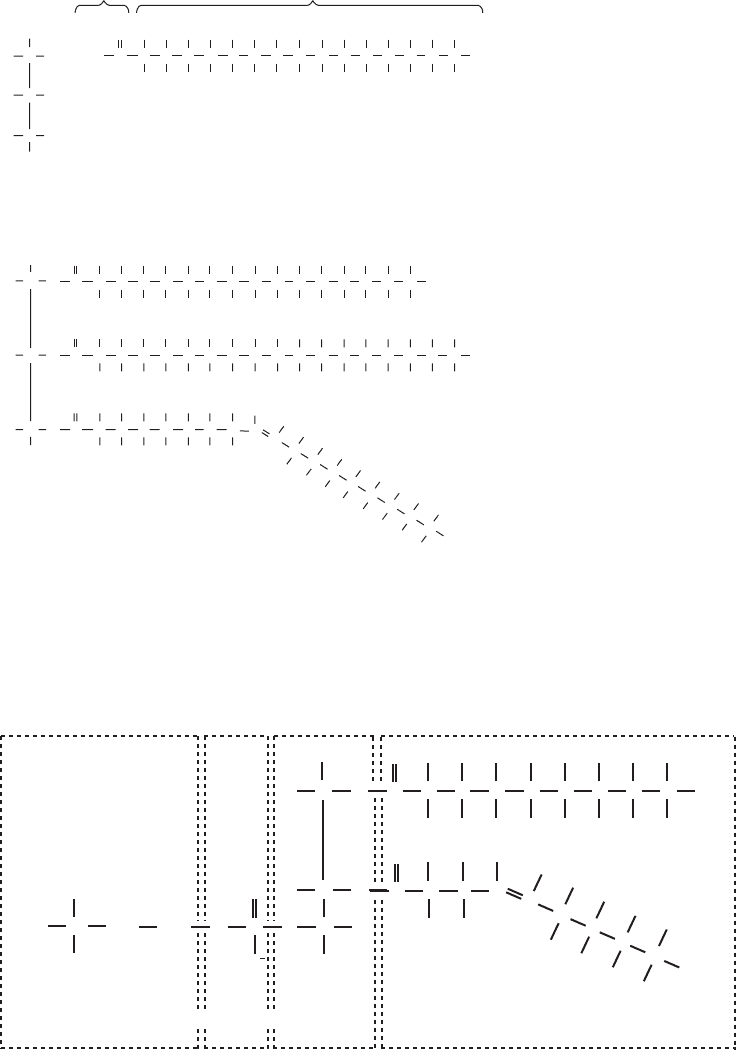
Fats are simple lipids, whose structure is based on fatty acids (see Box 2.5). Fatty
acids are long hydrocarbon chains ending in a carboxyl (-COOH) group. They have the
JWBK011-02 JWBK011-Hogg August 12, 2005 19:26 Char Count= 0
44 BIOCHEMICAL PRINCIPLES
Figure 2.24 Adenine pairs only with thymine, and guanine with cytosine, thus if the se-
quence of bases in one strand of a DNA molecule is known, that of the other can be predicted.
This critical feature of Watson and Crick’s model offers an explanation for how DNA is able
to replicate itself. Note that GC pairs are held together by three hydrogen bonds, while AT
pairs only have two
general formula:
CH
3
—(CH
2
)
n
—COOH
where n is usually an even number. They combine with glycerol according to the basic
reaction:
Alcohol + Acid → Ester
The bond so formed is called an ester linkage, and the result is an acylglycerol (Figure
2.25). One, two or all three of the -OH groups may be esterified with a fatty acid, to give
respectively mono-, di- and triacylglycerols. Natural fats generally contain a mixture
of two or three different fatty acids substituted at the three positions; consequently,
a considerable diversity is possible among fats. Fats serve as energy stores; a higher
proportion of C—C and C—H bonds in comparison with proteins or carbohydrates
results in a higher energy-storing capacity.
JWBK011-02 JWBK011-Hogg August 12, 2005 19:26 Char Count= 0
BIOMACROMOLECULES 45
Box 2.5 Saturated or unsaturated?
You may well have heard of saturated and unsaturated fats in the context of the
sorts of foods we should and shouldn’t be eating. This terminology derives from the
type of fatty acids which make up the different types of fat.
Each carbon atom in the hydrocarbon chain of a saturated fatty acid such as
stearic acid is bonded to the maximum possible number of hydrogen atoms (i.e. it
is saturated with them).
Fatty acids containing one or more double bonds have fewer hydrogen atoms
and are said to be unsaturated.
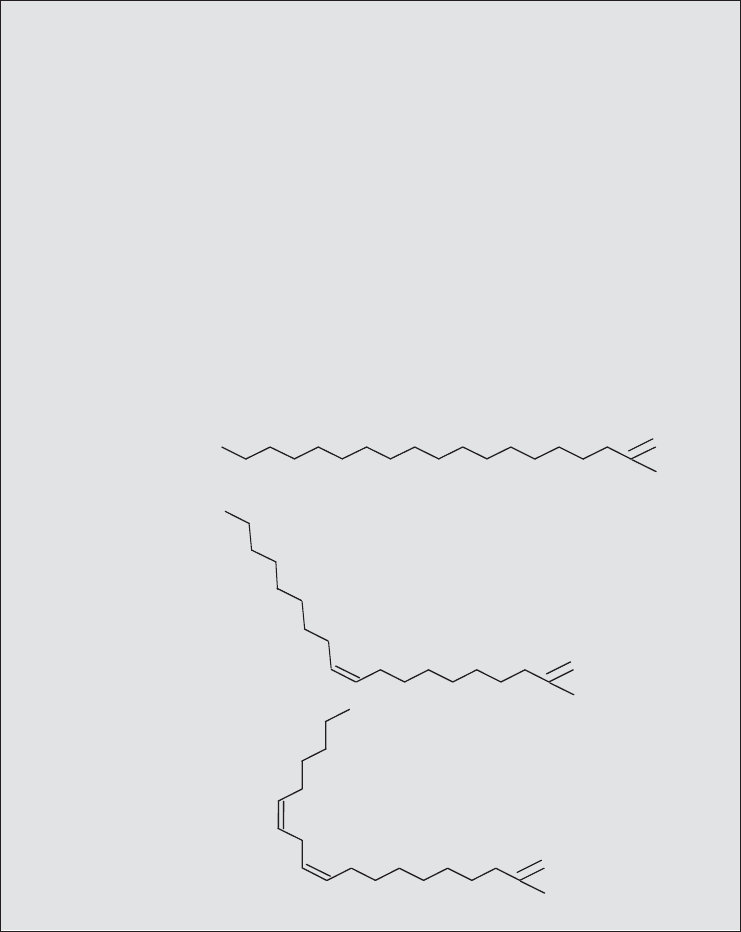
Compare the structures of stearic acid and oleic acid below. Both have identical
structures except that oleic acid has two fewer hydrogen atoms and in their place
aC
==
C double bond. A kink or bend is introduced into the chain at the point of the
double bond; this means that adjacent fatty acids do not pack together so neatly,
leading to a drop in the melting point. The presence of unsaturated fatty acids in
membrane phospholipids makes the membrane more fluid.
O
OH
O
OH
O
OH
Stearic acid (18.0)
(saturated)
Oleic acid (18.1)
(monounsturated)
Linoleic acid (18.2)
(polyunsaturated)
The second main group of lipids to be found in living cells are phospholipids. These
have a similar structure to triacylglycerols, except that instead of a third fatty acid
chain, they have a phosphate group joined to the glycerol (Figure 2.26), introducing
a hydrophilic element to an otherwise hydrophobic molecule. Thus, phospholipids
are an example of an amphipathic molecule, with a polar region at one end of the
JWBK011-02 JWBK011-Hogg August 12, 2005 19:26 Char Count= 0
C
C
C
H
H
H
H
H HHHHHHHHHHHHHHH
H
HHHHHHHHHHHHHHH
OH HO
OH
OH
O
CCCCCCCCCCCCCCCC
H
H
H
HHHHHHHHHHHHHH
H
HHHHHHHHHHHHHHH
O
OCC
HOC
H
H
OC
CCCCCCCCCCCCCCC
HHHHHHHHHHHHHHH
H
HHHHHHHHHHHHHHH
O
CCCCCCCC
HHHHHHH
H
H
H
H
H
H
H
H
H
H
H
H
H
H
H
H
H
H
H
HHHHHHH
O
CCCCCCCC
C
C
C
C
C
C
C
C
C
C
CCCCCCCC
HH
HH
CC
Carboxyl
group
Hydrocarbon
chain
Fatty acid (palmitic acid), C
15
H
31
COOH
Glycerol
Ester linkage
Triacylglycerol
Palmitic acid (C
15
H
31
COOH) + H
2
O
(Saturated)
Stearic acid (C
17
H
35
COOH) + H
2
O
(Saturated)
Oleic acid (C
17
H
33
COOH) + H
2
O
(Unsaturated)
+ H
2
O
Figure 2.25 Fatty acids are linked to glycerol to form an acylglycerol. When all three -OH
groups on the glycerol are esterified, the result is a triacylglycerol or triglyceride. The three
fatty acids may or may not be the same. In the example shown, one of the fatty acids is
unsaturated (see Box 2.5)
CH
3
CH
3
CH
3
CH
3
CH
3
CH
2
CH
2
O
OH
H
HH
H
C
C
C
H
H
O
O
O
O
O
P
N
+
CC
H
H
H
H
HH
C
C
Fatty acidsGlycerolCholine
C
C
C
C
C
C
O
C
H
H
C
H
H
C
H
H
C
H
H
C
H
H
C
H
H
C
H
H
C
H
H
H
H
H
H
H
H
Phosphate
Figure 2.26 Phospholipids introduce a polar element to acylglycerols by substituting a
phosphate at one of the glycerol -OH groups. A second charged group may attach to the
phosphate group; the phospholipid shown is phosphatidylcholine
46
JWBK011-02 JWBK011-Hogg August 12, 2005 19:26 Char Count= 0
BIOMACROMOLECULES 47
H
2
O
H
2
O
Hydrophilic
head groups
Hydrophobic
tail groups
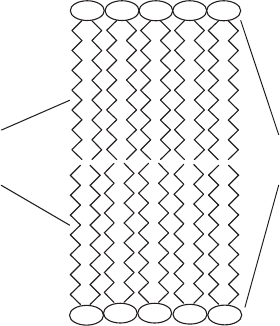
Figure 2.27 Phospholipids can form a bilayer in aqueous surroundings. A ‘sandwich’ ar-
rangement is achieved by the polar phosphate groups facing outwards and burying the fatty
acid chains within. Water is thus excluded from the hydrophobic region, a key property of
biological membranes (see Figure 3.5)
molecule and a non-polar region at the other. This fact is essential for the forma-
tion of a bilayer when the phospholipid is introduced into an aqueous environment;
the hydrophilic phosphate groups point outwards towards the water, while the hy-
drophobic hydrocarbon chains ‘hide’ inside (Figure 2.27, and c.f. Figure 2.8, micelle
formation).
This bilayer structure forms the basis of all biological membranes (see Chapter 3),
forming a barrier around cells and certain organelles. Phospholipids generally have an-
other polar group attached to the phosphate; Figure 2.25 shows the effect of substituting
serine.
The structural diversity of lipids can be illustrated by comparing fats and phospho-
lipids with the final group of lipids we need to consider, the steroids. As can be seen
from Figure 2.28, these have a completely different form, but still share in common the
property of hydrophobicity. The four ring planar structure is common to all steroids,
with the substitution of different side groups producing great differences in function.
Cholesterol is an important component of many membranes.
It would be wrong to gain the impression that living cells contain only molecules
of the four groups outlined above. Smaller organic molecules play important roles as
precursors or intermediates in metabolic pathways (see Chapter 6), and several inorganic
ions such as potassium, sodium and chloride play essential roles in maintaining the
living cell. Finally, some macromolecules comprise elements of more than one group,
for example, lipopolysaccharides (carbohydrate and lipid) and glycoproteins (protein
and carbohydrate).