
Hogg S. Essential microbiology
Подождите немного. Документ загружается.

JWBK011-02 JWBK011-Hogg August 12, 2005 19:26 Char Count= 0
18 BIOCHEMICAL PRINCIPLES
Table 2.1 Biological macromolecules
Proteins Carbohydrates Lipids Nucleic acids
Enzymes Sugars Triacylglycerols DNA
Receptors Cellulose (fats) RNA
Antibodies Starch Phospholipids
Structural Waxes
proteins Sterols
C
6P
6N
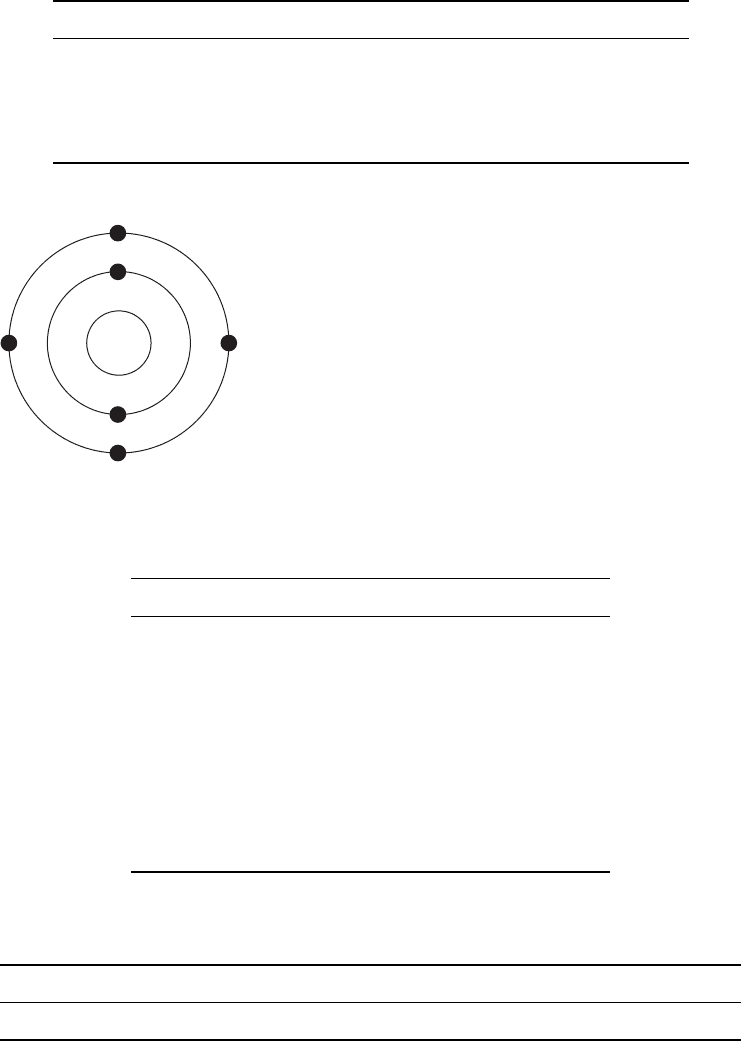
Figure 2.1 Atomic structure. The nucleus of a carbon
atom contains six protons and six neutrons, surrounded by
six electrons. Note how these are distributed between inner
(2) and outer (4) electron shells
Table 2.2 Symbols and atomic numbers of some elements
occurring in living systems
Element Symbol Atomic no.
Hydrogen H 1
Carbon C 6
Nitrogen N 7
Oxygen O 8
Sodium Na 11
Magnesium Mg 12
Phosphorus P 15
Sulphur S 16
Chlorine Cl 17
Potassium K 19
Iron Fe 26
Table 2.3 The vital statistics of carbon
No. of Protons No. of Neutrons Atomic number Mass number Atomic mass
6 6 6 12 12.011
JWBK011-02 JWBK011-Hogg August 12, 2005 19:26 Char Count= 0
ATOMIC STRUCTURE 19
upon this element. The carbon represented can be expressed in the form:
12 (mass number)
C = (Element symbol)
6 (atomic number)
The number of neutrons in an atom can be deduced by subtracting the atomic number
from the mass number. In the case of carbon, this is the same as the number of protons
(6), but this is not always so. Phosphorus for example has 15 protons and 16 neutrons,
giving it an atomic number of 15 and a mass number of 31.
Isotopes
Although the number of protons in the nucleus of a given element is always the same,
the number of neutrons can vary, to give different forms or isotopes of that element.
Carbon-14 (
14
C) is a naturally occurring but rare isotope of carbon that has eight neu-
trons instead of six, hence the atomic mass of 14. Carbon-13 (
13
C) is a rather more com-
mon isotope, making up around 1 per cent of naturally occurring carbon; it has seven
neutrons per atomic nucleus. The atomic mass (or atomic weight) of an element is the
average of the mass numbers of an element’s different isotopes, taking into account
the proportions in which they occur. (Box 2.1 shows how atomic weight is used to
quantify amounts of compounds using moles.) Carbon-12 is by far the predominant
form of the element in nature, but the existence of small amounts of the other forms
means that the atomic mass is 12.011. Some isotopes are stable, while others decay spon-
taneously, with the release of subatomic particles. The latter are called radioisotopes;
14
C
is a radioisotope, while the other two forms of carbon are stable isotopes. Radioisotopes
have been an extremely useful research tool in a number of areas of molecular biology.
The electrons that orbit around the nucleus do not do so randomly, but are arranged
in a series of electron shells, radiating out from the nucleus (Figure 2.1). These layers
correspond to different energy levels, with the highest energy levels being located furthest
away from the nucleus. Each shell can accommodate a maximum number of electrons,
and electrons always fill up the shells starting at the innermost one, that is, the one
with the lowest energy level. In our example, carbon has filled the first shell with two
electrons, and occupied four of the eight available spaces on the second.
The chemical properties of atoms are determined by the number of electrons in the
outermost occupied shell. Neon, one of the ‘noble’ gases, has an atomic number of
10, completely filling the first two shells, and is chemically unreactive or inert. Atoms
that do not achieve a similar configuration are unstable, or reactive. Reactions take
place between atoms that attempt to achieve stability by attaining a full outer shell.
These reactions may involve atoms of the same element or ones of different elements;
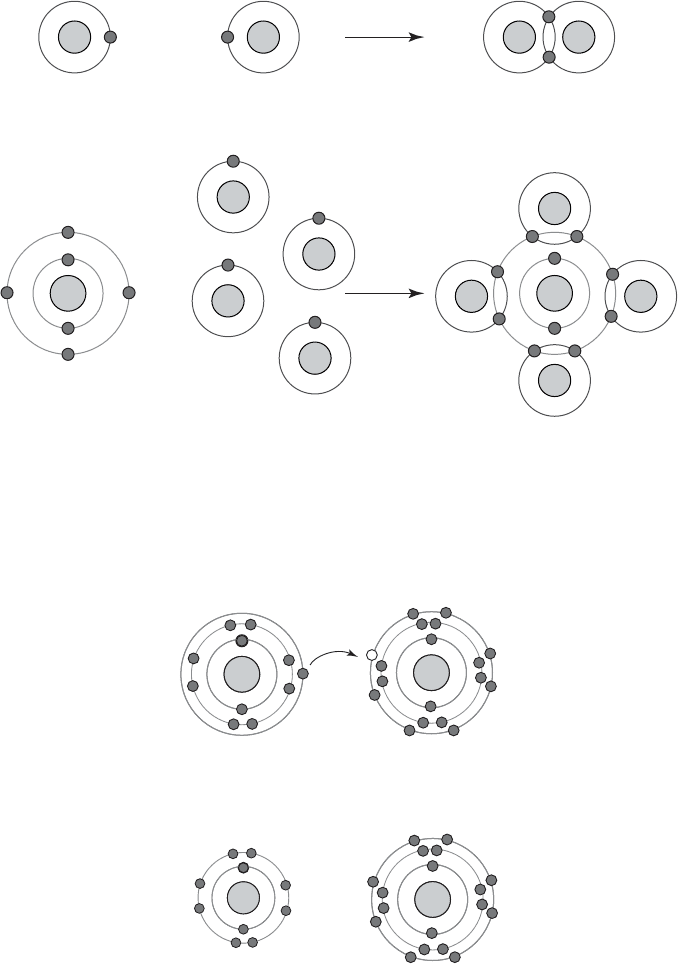
the result in either case is a molecule or ion (see below). Figure 2.2 shows how atoms
combine to form a molecule. A substance made up of molecules containing two or more
different elements is called a compound. In each example, the product of the reaction
has a full outer electron shell; note that some atoms are donating electrons, while others
are accepting them.
The number of unfilled spaces in the outermost electron shell determines the reactivity
of an atom. If most of the spaces in the outermost shell are full, or if most are empty,
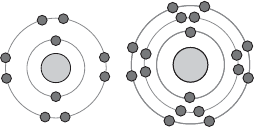
atoms tend to strive for stability by gaining or losing electrons, as shown in Figure 2.3.

JWBK011-02 JWBK011-Hogg August 12, 2005 19:26 Char Count= 0
20 BIOCHEMICAL PRINCIPLES
Box 2.1 How heavy is a mole?
When you work in a laboratory, something you’llneed to come to grips with sooner
or later is the matter of quantifying the amounts and concentrations of substances
used. Central to this is the mole, so before we go any further, let’s define this:
A mole is the molecular mass of a compound expressed in grams.
(The molecular mass is simply the sum of the atomic mass of all the atoms in a
compound.)
So, to take sodium chloride as an example:
Molecular formula = NaCl (one atom each of sodium
and chlorine)
Atomic mass of sodium = 22.99
Atomic mass of chlorine = 35.45
∴ Molecular mass = 58.44
Thus one mole of sodium chloride equals 58.44 grams (58.44 g)
Concentrations are expressed in terms of mass per volume, so here we introduce
the idea of the molar solution. This is a solution containing one mole dissolved in a
final volume of 1 litre of an appropriate solvent (usually water).
Molar solution = one mole per litre
A one molar (1
M) solution of sodium chloride therefore contains 58.44 g dissolved in
water and made up to 1 litre. A 2
M solution would contain 116.88 g in a litre, and so
on.
In biological systems, a molar solution of anything is actually rather concentrated,
so we tend to deal in solutions which are so many millimolar (m
M, one thousandth
of a mole per litre) or micromolar (µ
M, one millionth of a mole per litre).
Why bother with moles?
So far, so good, but why can’t we just deal in grams, or grams per litre? Consider
the following example. You’ve been let loose in the laboratory, and been asked to
compare the effects of supplementing the growth medium of a bacterial culture
with several different amino acids. ‘Easy’,you think. ‘Add X milligrams of each to the
normal growth medium, and see which stimulates growth the most’.The problem is
that although you may be adding the same weight of each amino acid, you’re not
adding the same number of molecules, because each has a different molecular
mass. If you add the same number of moles (or millimoles or micromoles) of each
instead, you would be comparing the effect of the same number of molecules of
each, and thus obtain a much more meaningful comparison. This is because 1 mole
of one compound contains the same number of molecules as a mole of any other
compound. This number is called Avogadro’sNumber, and is 6.023 × 10
23
molecules
per mole.
JWBK011-02 JWBK011-Hogg August 12, 2005 19:26 Char Count= 0
ATOMIC STRUCTURE 21
C
H
H
H
H
HH HH
C
H H
H
H
Hydrogen atom
Carbon atom
Hydrogen atom
Hydrogen atoms Methane molecule
Hydrogen molecule
+
+
(a)
(b)
Figure 2.2 The formation of molecules of (a) hydrogen and (b) methane by covalent bond-
ing. Each atom achieves a full set of electrons in its outer shell by sharing with another atom.
A shared pair of electrons constitutes a covalent bond
NaNa
NaCl
NaCl
Sodium atom
Na
Sodium ion
Na
+
Chloride ion
Cl
−
Chlorine atom
Cl
Na
Na
+−
Figure 2.3 Ion formation. Sodium achieves stability by losing the lone electron from its
outermost shell. The resulting sodium ion Na
+
has 11 protons and 10 electrons, hence it
carries a single positive charge. Chlorine becomes ionised to chloride (Cl
−
) when it gains an
electron to complete its outer shell
JWBK011-02 JWBK011-Hogg August 12, 2005 19:26 Char Count= 0
22 BIOCHEMICAL PRINCIPLES
When this happens, an ion is formed, which carries either a positive or negative charge.
Positively charged ions are called cations and negatively charged ones anions. The
sodium atom for example has 11 electrons, meaning that the inner two electron shells
are filled and a lone electron occupies the third shell. If it were to lose this last electron,
it would have more protons than electrons, and therefore have a net positive charge of
one; if this happened, it would become a sodium ion, Na
+
(Figure 2.3).
Chemical bonds
The force that causes two or more atoms to join together is known as a chemical bond,
and several types are found in biological systems. The interaction between sodium and
chloride ions shown in Figure 2.4 is an example of ionic bonding, where the transfer
of an electron from one party to another means that both achieve a complete outer
electron shell. There is an attractive force between positively and negatively charged
ions, called an ionic bond. Certain elements form ions with more than a single charge,
by gaining or losing two or more electrons in order to achieve a full outer electron shell;
thus calcium ions (Ca
2+
) are formed by the loss of two electrons from a calcium atom.
The goal of stability through a full complement of outer shell electrons may also be
achieved by means of sharing one or more pairs of electrons. Consider the formation of
water (Figure 2.2); an oxygen atom, which has two spaces in its outer shell, can achieve
a full complement by sharing electrons from two separate hydrogen atoms. This type
of bond is a covalent bond.
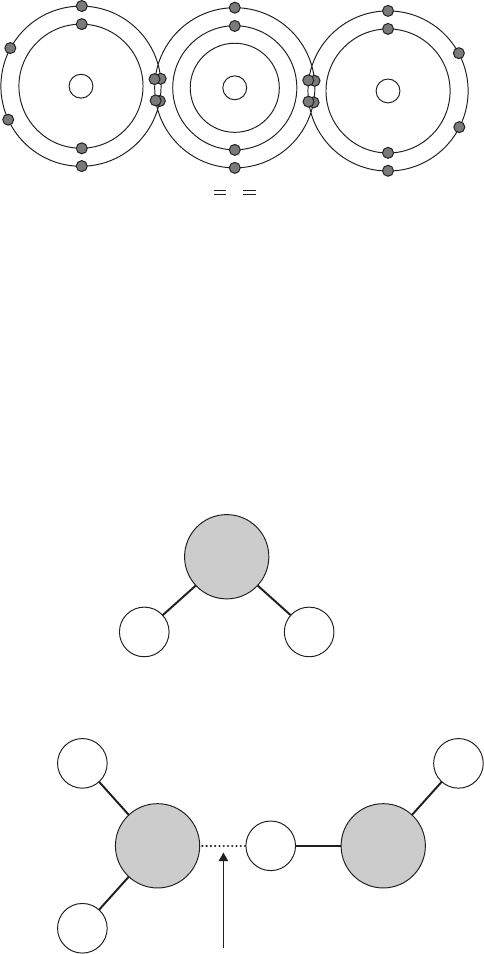
Sometimes, a pair of atoms share not one but two pairs of electrons (see Figure 2.5).
This involves the formation of a double bond. Triple bonding, through the sharing of
three pairs of electrons, is also possible, but rare.
In the examples of covalent bonding we’ve looked at so far, the sharing of the electrons
has been equal, but this is not always the case because sometimes the electrons may be
drawn closer to one atom than another (Figure 2.6a). This has the effect of making one
atom slightly negative and another slightly positive. Molecules like this are called polar
molecules and the bonds are polar bonds. Sometimes a large molecule may have both
polar and non-polar areas.
Polar molecules are attracted to each other, the negative areas of one molecule and
the positive areas of another acting as magnets for one another (Figure 2.6b). In water,
Na
NaCl
Sodium Chlorine
NaCl
Formation of
ionic bond
+
−
Figure 2.4 A positively charged Na
+
and negatively charged Cl
−
attract each other, and
an ionic bond is formed. The result is a molecule of sodium chloride
JWBK011-02 JWBK011-Hogg August 12, 2005 19:26 Char Count= 0
ATOMIC STRUCTURE 23
O C O
(Carbon dioxide)
O
C
O
Figure 2.5 Double bond formation. In the formation of carbon dioxide, the carbon atom
shares two pairs of electrons with each oxygen atom
hydrogen atoms bearing a positive charge are drawn to the negatively charged oxygens.
You only have to look at raindrops on a window pane fusing together to see how this
bonding is reflected in the physical properties of the compound.
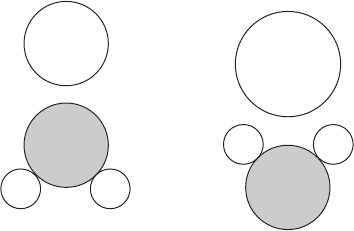
This attraction between polar atoms is called hydrogen bonding, and can take place
between covalently bonded hydrogen and any electronegative atom, most commonly
oxygen or nitrogen. Hydrogen bonds are much weaker than either ionic or covalent
O
O
HH
H
H
H
O
H
δ
2–
δ
2–
δ
2–
δ
+
δ
+
δ
+
δ
+
δ
+
δ
+
(a)
(b)
Hydrogen bond
Figure 2.6 (a) The electrons of the hydrogen atoms are strongly attracted to the oxygen
atom, causing this part of the water molecule to carry a slightly negative charge, and the
hydrogen part a slightly positive one. (b) Because of their polar nature, water molecules are
attracted to each other by hydrogen bonding. Hydrogen bonding is much weaker than ionic
or covalent bonding, but plays an important role in the structure of macromolecules such
as proteins and nucleic acids
JWBK011-02 JWBK011-Hogg August 12, 2005 19:26 Char Count= 0
24 BIOCHEMICAL PRINCIPLES
bonds; however, if sufficient of them form in a compound the overall bonding force can
be appreciable. Each water molecule can form hydrogen bonds with others of its kind
in four places (Figure 2.6b). In order to break all these bonds, a large input of energy is
required, explaining why water has such a relatively high boiling point, and why most
of the water on the planet is in liquid form.
Another weak form of interaction is brought about by Van der Waals forces, which
occur briefly when two non-polar molecules (or parts of molecules) come into very close
contact with one another. Although transient, and generally even weaker than hydrogen
bonds, they occur in great numbers in certain macromolecules and play an important
role in holding proteins together (see below).
Water is essential for living things, both in the composition of their cells and in the
environment surrounding them. Organisms are made up of between 60 and 95 per cent
water by weight, and even inert, dormant forms like spores and seeds have a significant
water component. This dependence on water is a function of its unique properties,
which in turn derive from its polar nature.
Water is the medium in which most biochemical reactions take place; it is a highly
efficient solvent, indeed more substances will dissolve in water than in any other sol-
vent. Substances held together by ionic bonds tend to dissociate into anions and cations
in water, because as individual solute molecules become surrounded by molecules of
water, hydration shells are formed, in which the negatively charged parts of the solute
attract the positive region of the water molecule, and the positive parts the negative
region (Figure 2.7). The attractive forces that allow the solute to dissolve are called hy-
drophilic forces, and substances which are water-soluble are hydrophilic (water-loving).
Other polar substances such as sugars and proteins are also soluble in water by forming
hydrophilic interactions.
O
O
H
H
HH
δ
2–
δ
+
δ
+
Na
+
Cl
–
Figure 2.7 An ionic compound such as sodium chloride dissociates in water to its con-
stituent ions. Water molecules form hydration shells around both Na
+
and Cl
−
ions
Molecules such as oils and fats are non-polar, and because of their non-reactivity
with water are termed hydrophobic (‘water-fearing’). If such a molecule is mixed with
water, it will be excluded, as water molecules ‘stick together’. This very exclusion by
water can act as a cohesive force among hydrophobic molecules (or hydrophobic areas
of large molecules). This is often called hydrophobic bonding, but is not really bonding
as such, rather a shared avoidance of water. All living cells have a hydrophilic interior
surrounded by a hydrophobic membrane, as we will see in Chapter 3.
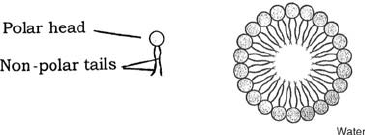
An amphipathic substance is one which is part polar and part non-polar. When
such a substance is mixed with water, micelles are formed (Figure 2.8); the non-polar
JWBK011-02 JWBK011-Hogg August 12, 2005 19:26 Char Count= 0
ACIDS, BASES, AND pH 25
Figure 2.8 In an aqueous environment, amphipathic substances align their molecules so
that the non-polar parts are hidden away from the water. From Black, JG: Microbiology:
Principles and Explorations, 4th edn, John Wiley & Sons Inc., 1999. Reproduced by per-
mission of the publishers
parts are excluded by the water and group together as described above, leaving the
polar groups pointing outwards into the water, where they are attracted by hydrophilic
forces. Detergents exert their action by trapping insoluble grease inside the centre of a
micelle, while interaction with water allows them to be rinsed away.
Water takes part in many essential metabolic reactions, and its polar nature allows
for the breakdown to hydrogen and hydroxyl ions (H
+
and OH
−
), and re-synthesis as
water. Water acts as a reactant in hydrolysis reactions such as:
A—B + H
2
O → A—H + B—OH
and as a product in certain synthetic reactions, such as:
A—H + B—OH → A—B + H
2
O
Acids, bases, and pH
Only a minute proportion of water molecules, something like one in every 5 × 10
8
,is
present in its dissociated form, but as we have already seen, the H
+
and OH
−
ions play
an important part in cellular reactions. A solution becomes acid or alkaline if there is an
imbalance in the amount of these ions present. If there is an excess of H
+
, the solution
becomes acid, whilst if OH
−
predominates, it becomes alkaline. The pH of a solution
is an expression of the molar concentration of hydrogen ions:
pH =−log
10
[H
+
]
In pure water, hydrogen ions are present at a concentration of 10
−7
m, thus the pH is
7.0. This is called neutrality, where the solution is neither acid or alkaline. At higher
concentrations of H
+
, such as 10
−3
m (1 millimolar), the pH value is lower, in this
case 3.0, so acid solutions have a value below 7. Conversely, alkaline solutions have a
pH above 7. You will see from this example that an increase of 10
4
(10 000)-fold in
the [H
+
] leads to a change of only four points on the pH scale. This is because it is a
logarithmic scale; thus a solution of pH 10 is 10 times more alkaline than one of pH 9,
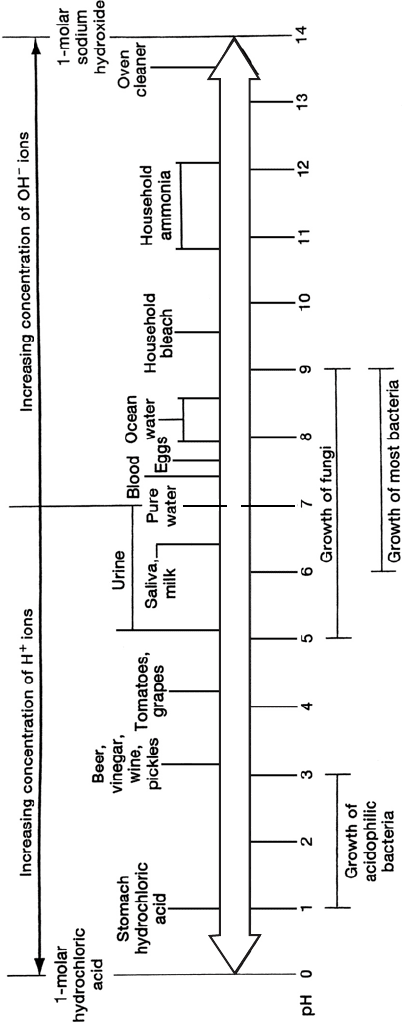
and 100 times more than one of pH 8. Figure 2.9 shows the pH value of a number of
familiar substances.
Most microorganisms live in an aqueous environment, and the pH of this is very
important. Most will only tolerate a small range of pH, and the majority occupy a
range around neutrality, although as we shall see later on in this book, there are some
JWBK011-02 JWBK011-Hogg August 12, 2005 19:26 Char Count= 0
Extremely
acidic
Extremely
alkaline
Neutral
Figure 2.9 The pH value of some common substances. Most microorganisms exist at pH values around neutrality, but representatives
are found at extremes of both acidity and alkality. From Black, JG: Microbiology: Principles and Explorations, 4th edn, John Wiley &
Sons Inc., 1999. Reproduced by permission of the publishers
26
JWBK011-02 JWBK011-Hogg August 12, 2005 19:26 Char Count= 0
BIOMACROMOLECULES 27
Table 2.4 Occurrence and characteristics of some functional groups
Functional Type of
Group Formula molecule Found in: Remarks
Hydroxyl -OH Alcohols Sugars Polar group, making
organic molecules
more water soluble
Carbonyl Aldehydes Sugars Carbonyl at end of
chain
Ketones Sugars Carbonyl elsewhere in
chain
Carboxyl -COOH Carboxylic acids Sugars, fats,
amino acids
Amino -NH
2
Amines Amino acids,
proteins
Can gain H
+
to become
NH
+
3
Sulphhydryl -SH Thiols Amino acids,
proteins
Oxidises to give
S=S bonds
Phosphate Phospholipids
nucleic acids
Involved in energy
transfer
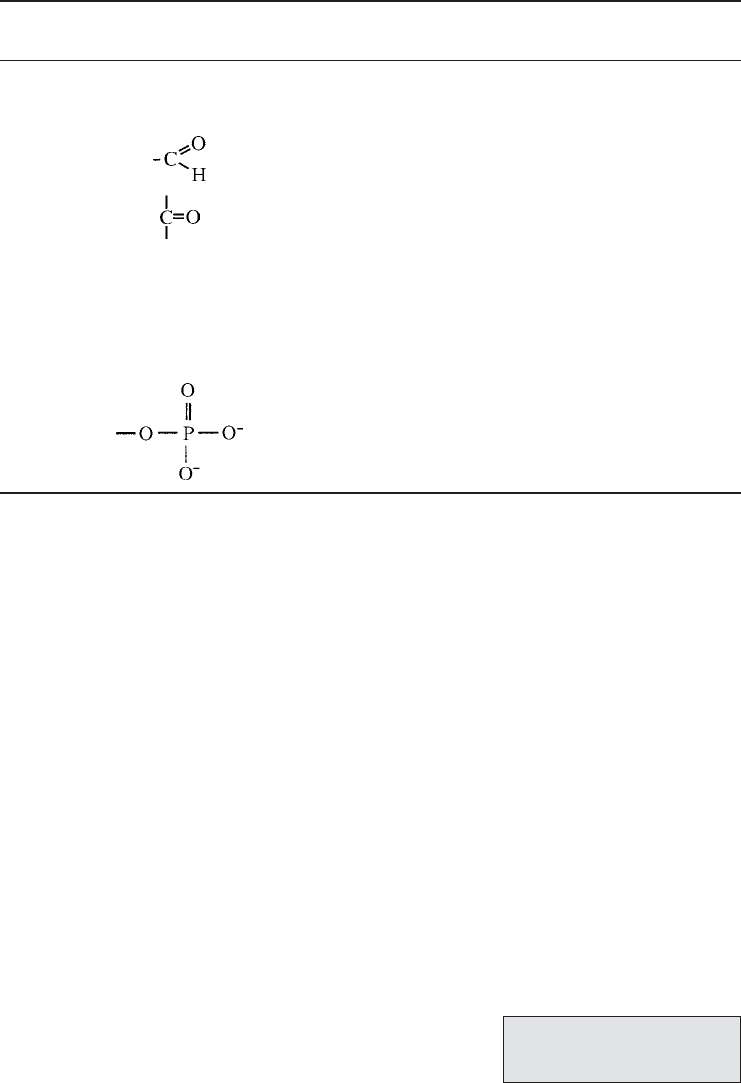
startling exceptions to this. Most of the important molecules involved in the chemistry
of living cells are organic, that is, they are based on a skeleton of covalently linked
carbon atoms. Biological molecules have one or more functional groups attached to
this skeleton; these are groupings of atoms with distinctive reactive properties, and are
responsible for many of the chemical properties of the organic molecule. The possession
of a functional group(s) frequently makes an organic molecule more polar and therefore
more soluble in water.
Some of the most common functional groups are shown in Table 2.4. It can be
seen that the functional groups occur in simpler organic molecules as well as in the
macromolecules we consider below.
Biomacromolecules
Many of the most important molecules in biological systems are polymers, that is, large
molecules made up of smaller subunits joined together by covalent bonds, and in some
cases in a specific order.
Carbohydrates
The suffix -ose always de-
notes a carbohydrate.
Carbohydrates are made up of just three different ele-
ments, carbon, hydrogen and oxygen. The simplest car-
bohydrates are monosaccharides, or simple sugars; these