
Hogg S. Essential microbiology
Подождите немного. Документ загружается.


JWBK011-01 JWBK011-Hogg August 12, 2005 15:39 Char Count= 0
8 MICROBIOLOGY: WHAT, WHY AND HOW?
Table 1.1 The discovery of some major human pathogens
Year Disease Causative agent Discoverer
1876 Anthrax Bacillus anthracis Koch
1879 Gonorrhoea Neisseria gonorrhoeae Neisser
1880 Typhoid fever Salmonella typhi Gaffky
1880 Malaria Plasmodium sp Laveran
1882 Tuberculosis Mycobacterium tuberculosis Koch
1883 Cholera Vibrio cholerae Koch
1883/4 Diphtheria Corynebacterium diphtheriae Klebs & Loeffler
1885 Tetanus Clostridium tetani Nicoaier & Kitasato
1886 Pneumonia (bacterial) Streptococcus pneumoniae Fraenkel
1892 Gas gangrene Clostridium perfringens Welch & Nuttall
1894 Plague Yersinia pestis Kitasato & Yersin
1896 Botulism Clostridium botulinum Van Ermengem
1898 Dysentery Shigella dysenteriae Shiga
1901 Yellow fever Flavivirus Reed
1905 Syphilis Treponema pallidum Schaudinn & Hoffman
1906 Whooping cough Bordetella pertussis Bordet & Gengou
1909 Rocky Mountain spotted fever Rickettsia rickettsii Ricketts
a laboratory animal, can we be sure it won’t in humans? Furthermore, some diseases
are caused by more than one organism, and some organisms are responsible for more
than one disease. On the other hand, the value of Koch’s postulates goes beyond just
defining the causative agent of a particular disease, and allows us to ascribe a specific
effect (of whatever kind) to a given microorganism.
A pure or axenic culture
contains one type of or-
ganism only, and is com-
pletely free from con-
taminants.
Critical to the development of Koch’s postulates was
the advance in culturing techniques, enabling the isola-
tion and pure culture of specific microorganisms. These
are discussed in more detail in Chapter 4. The develop-
ment of pure cultures revolutionised microbiology, and
within the next 30 years or so, the pathogens responsi-
ble for the majority of common human bacterial diseases
had been isolated and identified. Not without just cause
is this period known as the ‘golden age’ of microbiol-
ogy! Table 1.1 summarises the discovery of some major
human pathogens.
At around the same
time, Charles Chamber-
land, a pupil of Pasteur’s,
invented the autoclave,
contributing greatly to
the development of
pure cultures.
Koch’s greatest achievement was in using the ad-
vances in methodology and the principles of his own
postulates to demonstrate the identity of the causative
agent of tuberculosis, which at the time was responsible
for around one in every seven human deaths in Europe.
Although it was believed by many to have a microbial cause, the causative agent had
never been observed, either in culture or in the affected tissues. We now know that
Mycobacterium tuberculosis (the tubercle bacillus) is very difficult to stain by conven-
tional methods due to the high lipid content of the cell wall surface. Koch developed
a staining technique that enabled it to be seen, but realised that in order to satisfy his
own postulates, he must isolate the organism and grow it in culture. Again, there were

JWBK011-01 JWBK011-Hogg August 12, 2005 15:39 Char Count= 0
HOW DO WE KNOW? MICROBIOLOGY IN PERSPECTIVE 9
technical difficulties, since even under favourable conditions, M. tuberculosis grows
slowly, but eventually Koch was able to demonstrate the infectivity of the cultured
organisms towards guinea pigs. He was then able to isolate them again from the dis-
eased animal and use them to cause disease in uninfected animals, thus satisfying the
remainder of his postulates.
Aetiology is the cause or
origin of a disease.
Although most bacterial diseases of humans and their
aetiological agents have now been identified, important
variants continue to evolve and emerge. Notable exam-
ples in recent times include Legionnaires’ disease, an
acute respiratory infection caused by the previously unrecognised genus, Legionella,
and Lyme disease, a tickborne infection first described in Connecticut, USA in the mid-
1970s. Also, a newly recognised pathogen, Helicobacter pylori, has been shown to play
an important (and previously unsuspected) role in the development of peptic ulcers.
There still remain a few diseases that some investigators suspect are caused by bacteria,
but for which no pathogen has been identified.
Following the discovery of viruses during the last decade of the 19th century (see
Chapter 10), it was soon established that many diseases of plants, animals and humans
were caused by these minute, non-cellular agents.
The major achievement of the first half of the 20th century was the development of
antibiotics and other antimicrobial agents, a topic discussed in some detail in Chapter 14.
Infectious diseases that previously accounted for millions of deaths became treatable by
a simple course of therapy, at least in the affluent West, where such medications were
readily available.
The Human Genome
Project is an interna-
tional effort to map and
sequence all the DNA in
the human genome. The
project has also involved
sequencing the geno-
mes of several other or-
ganisms.
If the decades either side of 1900 have become known
as the golden age of microbiology, the second half of
the twentieth century will surely be remembered as the
golden age of molecular genetics. Following on from
the achievements of others such as Griffith and Avery, the
publication of Watson and Crick’s structure for DNA in
1953 heralded an extraordinary 50 years of achievement
in this area, culminating at the turn of the 21st century
in the completion of the Human Genome Project.
What, you might ask, has this genetic revolution to
do with microbiology? Well, all the early work in molec-
ular genetics was carried out on bacteria and viruses, as
you’ll learn in Chapter 11, and microbial systems have also been absolutely central to
the development of genetic engineering over the last three decades (Chapter 12). Also, as
part of the Human Genome Project, the genomes of several microorganisms have been
decoded, and it will become increasingly easy to do the same for others in the future,
thanks to methodological advances made during the project. Having this information
will help us to understand in greater detail the disease strategies of microorganisms, and
to devise ways of countering them.
As we have seen, a recurring theme in the history of microbiology has been the way
that advances in knowledge have followed on from methodological or technological
developments, and we shall refer to a number of such developments during the course
of this book. To conclude this introduction to microbiology, we shall return to the
instrument that, in some respects, started it all. In any microbiology course, you are sure
to spend some time looking down a microscope, and to get the most out of the instrument
JWBK011-01 JWBK011-Hogg August 12, 2005 15:39 Char Count= 0
10 MICROBIOLOGY: WHAT, WHY AND HOW?
it is essential that you understand the principles of how it works. The following pages
attempt to explain these principles.
The refractive index of
a substance is the ra-
tio between the veloc-
ity of light as it passes
through that substance
and its velocity in a
vacuum. It is a mea-
sure of how much the
substance slows down
and therefore refracts
the light.
Light microscopy
Try this simple experiment. Fill a glass with water, then
partly immerse a pencil and observe from one side; what
do you see? The apparent ‘bending’ of the pencil is due to
rays of light being slowed down as they enter the water,
because air and water have different refractive indices.
Light rays are similarly retarded as they enter glass and
all optical instruments are based on this phenomenon.
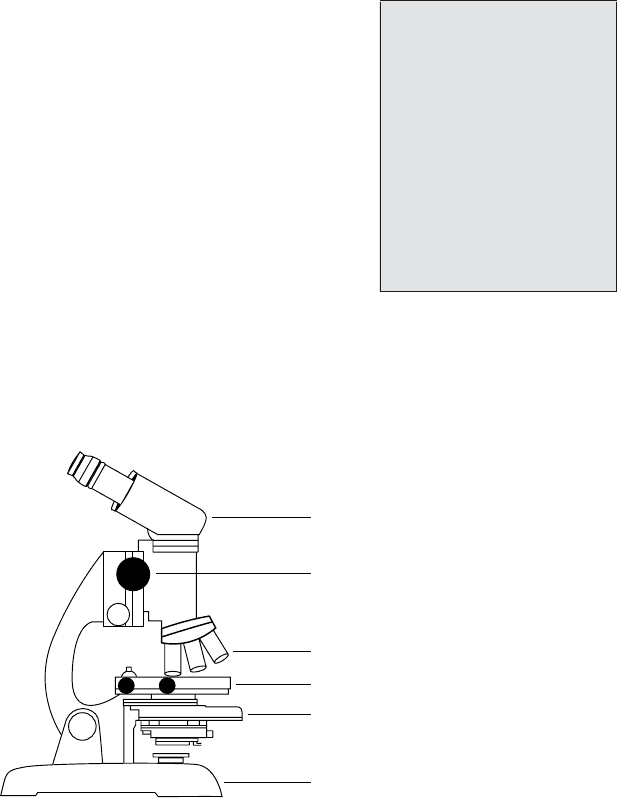
The compound light microscope consists of three sets of
lenses (Figure 1.3):
r
the condenser focuses light onto the specimen to give
optimum illumination
r
the objective provides a magnified and inverted image
of the specimen
r
the eyepiece adds further magnification
EYEPIECE TUBE
MAIN FOCUS KNOB
OBJECTIVES
STAGE
BASE WITH BUILT-IN
ILLUMINATION
SUBSTAGE CONDENSER
Figure 1.3 The compound light microscope. Modern microscopes have a built-in light
source. The light is focused onto the specimen by the condenser lens, and then passes into
the body of the microscope via the objective lens. Rotating the objective nosepiece allows
different magnifications to be selected. The amount of light entering the microscope is con-
trolled by an iris diaphragm. Light microscopy allows meaningful magnification of up to
around 1000×
JWBK011-01 JWBK011-Hogg August 12, 2005 15:39 Char Count= 0
LIGHT MICROSCOPY 11
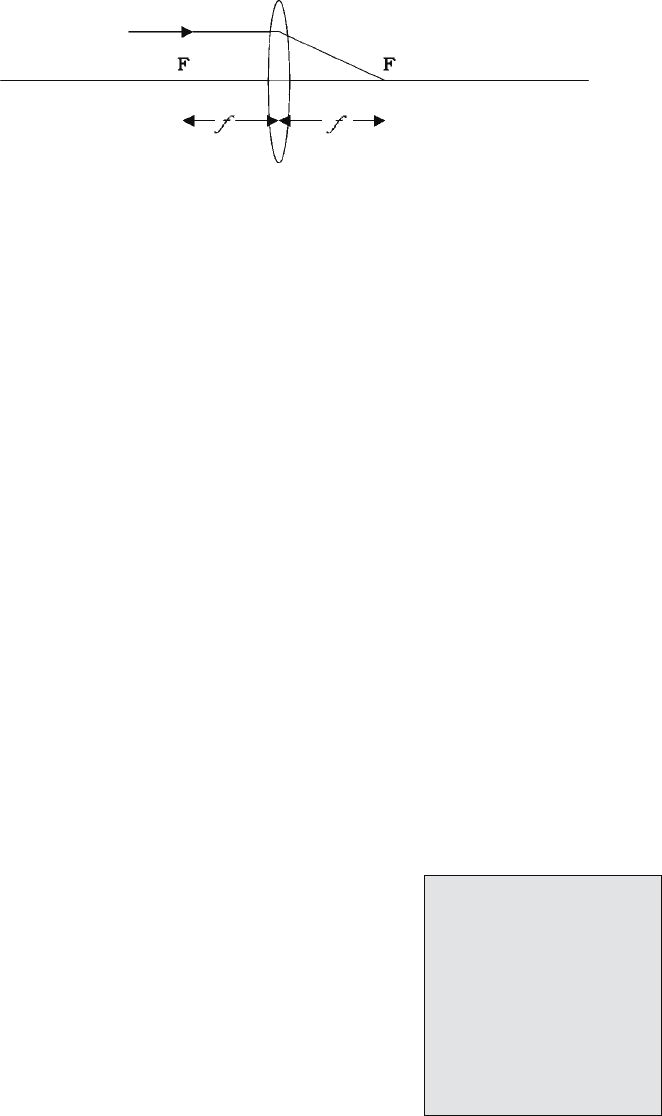
Figure 1.4 Light rays parallel to the axis of a convex lens pass through the focal point.
The distance from the centre of the lens to the focal point is called the focal length (f) of the
lens
Most microscopes have three or four different objectives, giving a range of magnifica-
tions, typically from 10× to 100×. The total magnification is obtained by multiply-
ing this by the eyepiece value (usually 10×), thus giving a maximum magnification of
1000×.
In order to appreciate how this magnification is achieved, we need to understand the
behaviour of light passing through a convex lens:
r
rays parallel to the axis of the lens are brought to a focus at the focal point of
the lens (Figure 1.4)
r
similarly, rays entering the lens from the focal point emerge parallel to the axis
r
rays passing through the centre of the lens from any angle are undeviated.
Because the condenser is not involved in magnification, it need not concern us here.
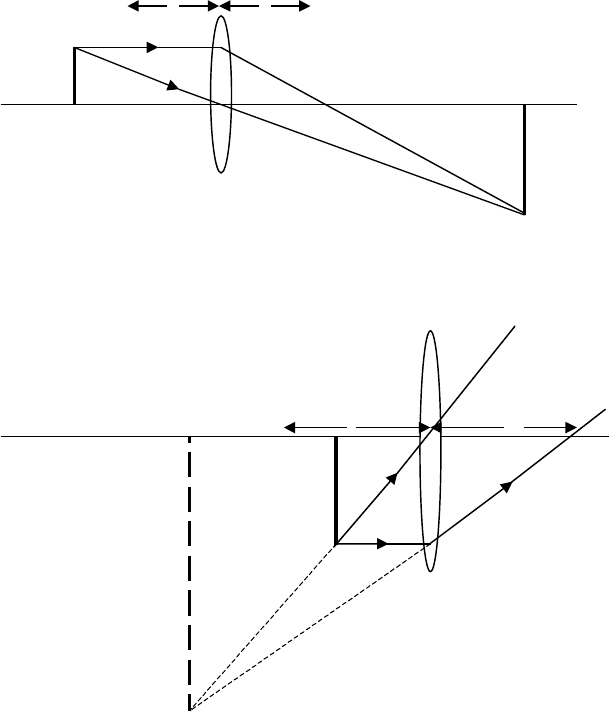
Consider now what happens when light passes through an objective lens from an object
AB situated slightly beyond its focal point (Figure 1.5a). Starting at the tip of the object,
a ray parallel to the axis will leave the lens and pass through the focal point; a ray
leaving the same point and passing through the centre of the lens will be undeviated.
The point at which the two rays converge is an image of the original point formed by the
lens. The same thing happens at an infinite number of points along the object’s length,
resulting in a primary image of the specimen, A
B
. What can we say about this image,
compared to the original specimen AB? It is magnified and it is inverted (i.e. it appears
upside down).
A real image is one that
can be projected onto
a flat surface such as
a screen. A virtual im-
age does not exist in
space and cannot be
projected in this way. A
familiar example is the
image seen in a mirror.
The primary image now serves as an object for a sec-
ond lens, the eyepiece, and is magnified further (Fig-
ure 1.5b); this time the object is situated within the focal
length. Using the same principles as before, we can con-
struct a ray diagram, but this time we find that the two
lines drawn from a point do not converge on the other
side of the lens, but actually get further apart. The point
at which the lines do eventually converge is actually ‘fur-
ther back’ than the original object! What does this mean?
The secondary image only appears to be coming from
A
B
, and isn’t actually there. An image such as this is
JWBK011-01 JWBK011-Hogg August 12, 2005 15:39 Char Count= 0
12 MICROBIOLOGY: WHAT, WHY AND HOW?
(a) f f
A
F
F
BB'
Real
Image
A'B'
A'
(b)
F
f f
F
B''
B'
A'
Virtual
Image
A''B''
A''
Figure 1.5 The objective lens and eyepiece lens combine to produce a magnified image of
the specimen. (a) Light rays from the specimen AB pass through the objective lens to give a
magnified, inverted and real primary image. (b) The eyepiece lens magnifies this further to
produce a virtual image of the specimen
called a virtual image. Today’s reader, familiar with the concept of virtual reality, will
probably find it easier to come to terms with this than have students of earlier genera-
tions! The primary image A
B
, on the other hand, is a real image; if a screen was placed
at that position, the image would be projected onto it. If we compare A
B
with A
B
,
we can see that it has been further magnified, but not further inverted, so it is still upside
down compared with the original. One of the most difficult things to get used to when
you first use a microscope is that everything appears ‘wrong way around’. The rays of
light emerging from the eyepiece lens are focussed by the lens of the observer’s eye to
form a real image on the retina of the viewer’s eye.

JWBK011-01 JWBK011-Hogg August 12, 2005 15:39 Char Count= 0
LIGHT MICROSCOPY 13
(a)
(b)
(c)
Figure 1.6 Magnification must be accompanied by improved resolution. Compared to
(a), the image in (b) is magnified, but also provides improved detail; there are two objects,
not just one. Further magnification, as seen in (c), provides no further information (empty
magnification)
Immersion oil is used to
improve the resolution of
a light microscope at
high power. It has the
same refractive index as
glass and is placed be-
tween the high power
objective and the glass
slide. With no layer of air,
more light from the spec-
imen enters the objec-
tive lens instead of be-
ing refracted outside of
it, resulting in a sharper
image.
So, a combination of two lens systems allows us to
see a considerably magnified image of our specimen. To
continue magnifying an image beyond a certain point,
however, serves little purpose, if it is not accompanied
by an increase in detail (Figure 1.6). This is termed empty
magnification. The resolution (resolving power, d) of a
microscope is its capacity for discerning detail. More
specifically, it is the ability to distinguish between two
points a short distance apart, and is determined by the
equation:
d =
0.61λ
n sin θ
where λ is the wavelength of the light source, n is the
refractive index of the air or liquid between the objec-
tive lens and the specimen and θ is the aperture angle (a
measure of the light-gathering ability of the lens).
The expression n sinθ is called the numerical aperture and for high quality lenses
has a value of around 1.4. The lowest wavelength of light visible to the human eye
is approximately 400 nm, so the maximum resolving power for a light microscope is
approximately
d =
0.61 × 400
1.4
= 0.17µm

JWBK011-01 JWBK011-Hogg August 12, 2005 15:39 Char Count= 0
14 MICROBIOLOGY: WHAT, WHY AND HOW?
that is, it cannot distinguish between two points closer
together than about 0.2 µm. For comparison, the naked
eye is unable to resolve two points more than about
0.2 mm apart.
A nanometre (nm) is 1
millionth of a millimetre.
There are 1000 nm in
one micron (µm), which
is therefore one thou-
sandth of a millimetre.
1mm=10
−3
m
1 µm=10
−6
m
1nm=10
−9
m
For us to be able to discern detail in a specimen, it
must have contrast; most biological specimens, however,
are more or less colourless, so unless a structure is ap-
preciably denser than its surroundings, it will not stand
out. This is why preparations are commonly subjected
to staining procedures prior to viewing. The introduc-
tion of coloured dyes, which bind to certain structures,
enables the viewer to discern more detail.
Since staining procedures involve the addition and washing off of liquid stains, the
sample must clearly be immobilised or fixed to the slide if it is not to end up down the
sink. The commonest way of doing this is to make a heat-fixed smear; this kills and
attaches the cells to the glass microscope slide. A thin aqueous suspension of the cells is
spread across the slide, allowed to dry, then passed (sample side up!) through a flame a
few times. Excessive heating must be avoided, as it would distort the natural structure
of the cells.
Using simple stains, such as methylene blue, we can see the size and shape of bacterial
cells, for example, and their arrangement, while the binding properties of differential
stains react with specific structures, helping us to differentiate between bacterial types.
Probably the most widely used bacterial stain is the Gram stain (see Box 1.2), which for
more than 100 years has been an invaluable first step in the identification of unknown
bacteria.
Box 1.2 The Gram stain
The Gram stain involves the sequential use of two stains (see below). The critical
stage is step 3; some cells will resist the alcohol treatment and retain the crystal
violet, while others become decolorised. The counterstain (safranin or neutral red)
is weaker than the crystal violet, and will only be apparent in those cells that have
been decolorised.

JWBK011-01 JWBK011-Hogg August 12, 2005 15:39 Char Count= 0
ELECTRON MICROSCOPY 15
Phase contrast micro-
scopy exploits differ-
ences in thickness and
refractive index of trans-
parent objects such as
living cells to give im-
proved contrast.
Dark field microscopy
employs a modified
condenser. It works by
blocking out direct light,
and viewing the ob-
ject only by the light it
diffracts.
The Gram stain is a differential stain, which only takes
a few minutes to carry out, and which enables us to
place a bacterial specimen into one of two groups, Gram-
positive or Gram-negative. The reason for this differen-
tial reaction to the stain was not understood for many
years, but is now seen to be a reflection of differences in
cell wall structure, discussed in more detail in Chapter 3.
Specialised forms of microscopy have been developed
to allow the viewer to discern detail in living, unstained
specimens; these include phase contrast and dark-field
microscopy. We can also gain an estimate of the number
of microorganisms in a sample by directly counting them
under the microscope. This is discussed along with other
enumeration methods in Chapter 5.
Electron microscopy
From the equation shown above, you can see that if it were possible to use a shorter wave-
length of light, we could improve the resolving power of a microscope. However, because
we are limited by the wavelength of light visible to the human eye, we are not able to
do this with the light microscope. The electron microscope is able to achieve greater
magnification and resolution because it uses a high voltage beam of electrons, whose
wavelength is very much shorter than that of visible light. Consequently we are able to
resolve points that are much closer together than is possible even with the very best light
microscope. The resolving power of an electron microscope may be as low as 1–2 nm,
enabling us to see viruses, for example, and the internal structure of cells. The greatly im-
proved resolution means that specimens can be meaningfully magnified over 100 000×.
Electron microscopes, which were first developed in the 1930s and 1940s, use ring-
shaped electromagnets as ‘lenses’ to focus the beam of electrons onto the specimen.
Because the electrons would collide with, and be deflected by, molecules in the air,
electron microscopes require a pump to maintain a vacuum in the column of the instru-
ment. There are two principal types of electron microscope, the transmission electron
microscope (TEM) and the scanning electron microscope (SEM).
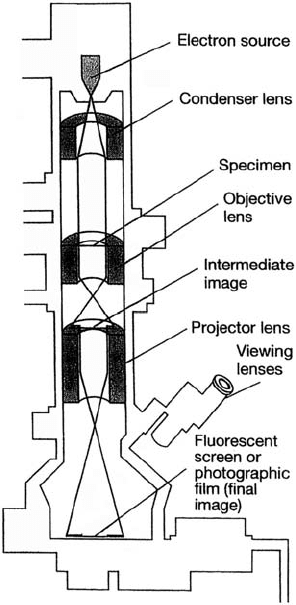
Figure 1.7 shows the main features of a TEM. As the name suggests, the electron beam
passes through the specimen and is scattered according to the density of the different
parts. Due to the limited penetrating power of the electrons, extremely thin sections
(<100 nm, or less than one-tenth of the diameter of a bacterial cell) must be cut, using
a diamond knife. To allow this, the specimen must be fixed and dehydrated, a process
that can introduce shrinkage and distortion to its structure if not correctly performed.
After being magnified by an objective ‘lens’, an image of the specimen is projected
onto a fluorescent screen or photographic plate. More dense areas, which scatter the
beam, appear dark, and those where it has passed through are light. It is often necessary
to enhance contrast artificially, by means of ‘staining’ techniques that involve coating
the specimen with a thin layer of a compound containing a heavy metal, such as osmium
or palladium. It will be evident from the foregoing description of sample preparation
and use of a vacuum that electron microscopy cannot be used to study living specimens.
JWBK011-01 JWBK011-Hogg August 12, 2005 15:39 Char Count= 0
16 MICROBIOLOGY: WHAT, WHY AND HOW?
Figure 1.7 The transmission electron microscope. Electrons from a tungsten filament pass
through a vacuum chamber and are focused by powerful electromagnets. Passage through
the specimen causes a scattering of the electrons to form an image that is captured on a
fluorescent screen. From Black, JG: Microbiology: Principles and Explorations, 4th edn,
John Wiley & Sons Inc., 1999. Reproduced by permission of the publishers
The TEM has been invaluable in advancing our knowledge of the fine structure of
cells, microbial or otherwise. The resulting image is, however, a flat, two-dimensional
one, and of limited use if we wish to learn about the surface of a cell or a virus. For
this, we turn to SEM. The scanning electron microscope was developed in the 1960s
and provides vivid, sometimes startling, three-dimensional images of surface structure.
Samples are dehydrated and coated with gold to give a layer a few nanometres thick.
A fine beam of electrons probes back and forth across the surface of the specimen
and causes secondary electrons to be given off. The number of these, and the angle
at which they are emitted, depends on the topography of the specimen’s surface. SEM
does not have quite the resolving power of the TEM, and therefore does not operate at
such high magnifications. Between them, SEM and TEM have opened up a whole new
world to microbiologists, allowing us to put advances in our knowledge of microbial
biochemistry and genetics into a structural context.
JWBK011-02 JWBK011-Hogg August 12, 2005 19:26 Char Count= 0
2
Biochemical Principles
All matter, whether living or non-living, is made up of atoms; the atom is the smallest
unit of matter capable of entering into a chemical reaction. Atoms can combine together
by bonding, to form molecules, which range from the small and simple to the large and
complex. The latter are known as macromolecules; major cellular constituents such as
carbohydrates and proteins belong to this group and it is with these that this chapter is
mainly concerned (Table 2.1). In order to appreciate how these macromolecules operate
in the structure and function of microbial cells however, we need to review the basic
principles of how atoms are constructed and how they interact with one other.
Atomic structure
All atoms have a central, positively charged nucleus, which is very dense, and makes
up most of the mass of the atom. The nucleus is made up of two types of particle,
protons and neutrons. Protons carry a positive charge, and neutrons are uncharged,
hence the nucleus overall is positively charged. It is surrounded by much lighter, and
rapidly orbiting, electrons (Figure 2.1). These are negatively charged, the charge being
equal (but of course opposite) to that of the protons, but they have only 1/1840 of the
mass of either protons or neutrons. The attractive force between the positively charged
protons and the negatively charged electrons holds the atom together.
The number of protons in the nucleus is called the atomic number, and ranges from 1
to over 100. The combined total of protons and neutrons is known as the mass number.
All atoms have an equal number of protons and electrons, so regardless of the atomic
number, the overall charge on the atom will always be zero.
Atoms having the same atomic number have the same chemical properties; such
atoms all belong to the same element. An element is made up of one type of atom only
and cannot be chemically broken down into simpler substances; thus pure copper for
example is made up entirely of copper atoms. There are 92 of these elements occurring
naturally, 26 of which commonly occur in living things. Each element has been given
a universally agreed symbol; examples which we shall encounter in biological macro-
molecules include carbon (C), hydrogen (H) and oxygen (O). The atomic numbers of
selected elements are shown in Table 2.2.
The relationship between neutrons, protons, atomic number, and mass number is
illustrated in Table 2.3, using carbon as an example, since all living matter is based
17