
Hogg S. Essential microbiology
Подождите немного. Документ загружается.

JWBK011-02 JWBK011-Hogg August 12, 2005 19:26 Char Count= 0
48 BIOCHEMICAL PRINCIPLES
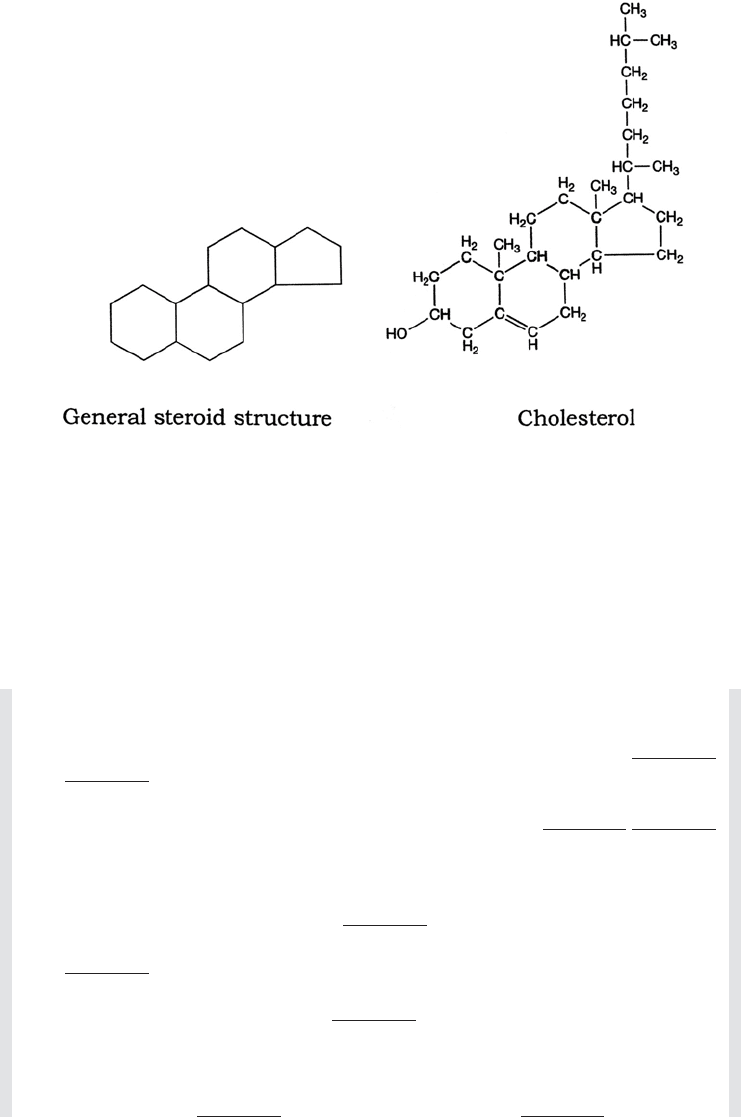
Figure 2.28 All steroids are based on a four-ringed structure. The presence of an –OH
group on the lower left ring makes the molecule a sterol. Cholesterol plays an important
role in the fluidity of animal membranes by interposing itself among the fatty acid tails of
phospholipids. The only bacterial group to contain sterols are the mycoplasma; however
some other groups contain hopanoids, which have a similar structure and are thought to
play a comparable role in membrane stability
Test yourself
1 The number of protons in an atom of an element is called the
of that element.
2 The sum of the protons and neutrons in an atom is the
of the element.
3 The transfer of an electron from one atom to another so that both achieve a
full outer electron shell is called
bonding.
4
bonding involves the sharing of one or more pairs of electrons.
5 A solution with a pH of 3.0 is
times more acidic than one with a
pH of 6.0.
6 Possession of a functional group such as phosphate or aldehyde makes a
molecule more
and therefore more readily in water.

JWBK011-02 JWBK011-Hogg August 12, 2005 19:26 Char Count= 0
TEST YOURSELF 49
7 Simple carbohydrates may be classed on the basis of whether they have a
or group, or according to how many atoms
they possess.
8 Sugars are joined together by
linkages.
9 No matter how long a peptide chain grows, it always has an
group
at one end and a
group at the other.
10 An example of a negatively charged amino acid is
.
11 Disulphide bonds are formed between residues of the amino acid
.
12 Secondary protein structure is brought about by the formation of
bonds between a group and a group.
13 Naturally occurring amino acids are all the
-isomer. This results in
an α-helix taking on a
configuration for maximum stability.
14 Heating or treatment with certain chemicals cause proteins to lose their three-
dimensional structure and become
.
15 A short stretch of double stranded DNA has 52 adenine residues and 61
guanine residues. There are therefore
cytosine residues and a total
of
hydrogen bonds joining the two strands.
16 The arrangement of the two strands of a DNA molecule is described as
.
17 The nucleotides of RNA contain
instead of thymine.
18 Lipids are a diverse group of molecules, sharing the common property of
in .
19 Phospholipids are described as
because their molecules have both
polar and non-polar regions.
20 In fats, fatty acids are joined to glycerol via
linkages.
JWBK011-02 JWBK011-Hogg August 12, 2005 19:26 Char Count= 0
50

JWBK011-03 JWBK011-Hogg August 12, 2005 15:52 Char Count= 0
3
Cell Structure and Organisation
The basic unit of all living things is the cell. The cell theory is one of the fundamental
concepts of biology; it states that:
r
all organisms are made up of cells,
and that
r
all cells derive from other, pre-existing cells.
As we shall see in this chapter, there may exist within a cell many smaller, subcellular
structures, each with its own characteristics and function, but these are not capable of
independent life.
An organism may comprise just a single cell (unicellular), a collection of cells
that are not morphologically or functionally differentiated (colonial), or several dis-
tinct cell types with specialised functions (multicellular). Among microorganisms, all
The names given to the
two cell types derive
from Greek words:
Procaryotic = ‘before
nucleus’
Eucaryotic = ‘true
nucleus’
bacteria and protozoans are unicellular; fungi may be
unicellular or multicellular, while algae may exist in all
three forms. There is, however, one way that organisms
can be differentiated from each other that is even more
fundamental than whether they are uni- or multicellular.
It is a difference that is greater than that between a lion
and a mushroom or between an earthworm and an oak
tree, and it exists at the level of the individual cell. All or-
ganisms are made up of one or other (definitely not both!)
of two very distinct cell types, which we call procaryotic
and eucaryotic cells, both of which exist in the microbial world. These differ from each
other in many ways, including size, structural complexity and organisation of genetic
material (Table 3.1).
The most fundamental difference between procaryotic and eucaryotic cells is reflected
in their names; eucaryotic cells possess a true nucleus, and several other distinct subcel-
lular organelles that are bounded by a membrane. Procaryotes have no such organelles.
Most of these differences only became apparent after the development of electron mi-
croscopy techniques.
As can be seen from Table 3.2, the procaryotes comprise the simpler and more prim-
itive types of microorganisms; they are generally single celled, and arose much earlier
in evolutionary history than the eucaryotes. Indeed, as discussed later in this chapter, it
51

JWBK011-03 JWBK011-Hogg August 12, 2005 15:52 Char Count= 0
52 CELL STRUCTURE AND ORGANISATION
Table 3.1 Similarities and differences between procaryotic and eucaryotic cell structure
Similarities
Cell contents bounded by a plasma
membrane
Genetic information encoded on DNA
Ribosomes act as site of protein synthesis
Differences
Procaryotic Eucaryotic
Size
Typically 1–5 µm Typically 10–100 µm
Genetic material
Free in cytoplasm Contained within a membrane-bound
nucleus
Single circular chromosome or
nucleoid
Multiple chromosomes, generally in pairs
Histones absent. DNA complexed with histone proteins
Internal features
Membrane-bound organelles absent Several membrane-bound organelles
present, including mitochondria, Golgi
body, endoplasmic reticulum and (in
plants & algae) chloroplasts
Ribosomes smaller (70S), free in
cytoplasm
Ribosomes larger (80S), free in cytoplasm
or attached to membranes
Respiratory enzymes bound to plasma
membrane
Respiratory enzymes located in
mitochondria
Cell wall
Usually based on peptidoglycan (not
Archaea)
When present, based on cellulose or chitin
External features
Cilia absent Cilia may be present
Flagella, if present, composed of
flagellin. Provide rotating motility
Flagella, if present, have complex (9 + 2)
structure. Provide ‘whiplash’ motility
Pili may be present Pili absent
Outside layer (slime layer, capsule,
glycocalyx) present in some types
Pellicle or test present in some types
is widely accepted that eucaryotic cells actually arose from their more primitive coun-
terparts. Note that the viruses do not appear in Table 3.2, because they do not have a
cellular structure at all, and are not therefore considered to be living organisms. (See
Chapter 10 for further discussion of the viruses).
Phylogenetic: pertaining
to the evolutionary rela-
tionship between organ-
isms.
The use of DNA sequencing methods to determine
phylogenetic relationships between organisms has re-
vealed that within the procaryotes there is another fun-
damental division. One group of bacteria were shown to
differ greatly from all the others; we now call these the
Archaea, to differentiate them from the true Bacteria.
JWBK011-03 JWBK011-Hogg August 12, 2005 15:52 Char Count= 0
CELL STRUCTURE AND ORGANISATION 53
Table 3.2 Principal groups of procaryotic and
eucaryotic organisms
Procaryotes Eucaryotes
Bacteria Fungi
Blue-green ‘algae’
∗
Algae
Protozoa
Plants
Animals
∗
An old-fashioned term: this group are in fact a
specialized form of bacteria, and are known more
correctly as the Cyanobacteria, or simply the blue-greens.
They are discussed in more detail in Chapter 7. Animals
and plants fall outside the scope of this book.
Despite their differences,
Archaea and Bacteria
are both procaryotes.
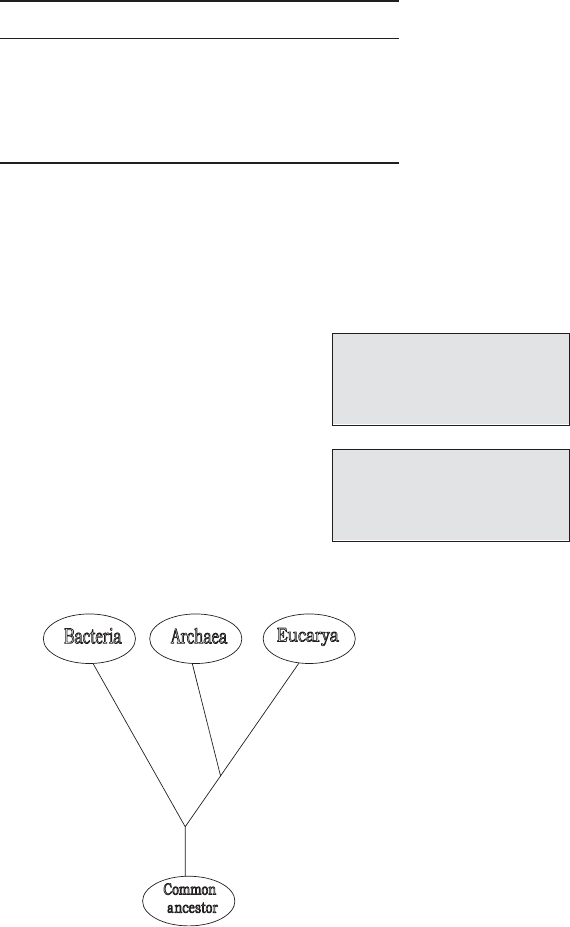
These two groups, together with the eucaryotes, are
thought to have evolved from a common ancestor, and
represent the three domains of life (Figure 3.1). The
Archaea comprise a wide range of mostly anaerobic bac-
teria, including many of those that inhabit extreme en-
vironments such as hot springs. In this book we shall
largely confine our discussions to the Bacteria, however
in Chapter 7 there is a discussion of the principal features
of the Archaea and their main taxonomic groupings.
Taxonomy is the science
of classifying living (and
once-living) organisms.
Figure 3.1 The three domains of life. All life forms can be assigned to one of three domains
on the basis of their ribosomal RNA sequences. The Archaea are quite distinct from the true
bacteria and are thought to have diverged from a common ancestral line at a very early
stage, before the evolution of eucaryotic organisms. The scheme above is the one most
widely accepted by microbiologists, but alternative models have been proposed
JWBK011-03 JWBK011-Hogg August 12, 2005 15:52 Char Count= 0
54 CELL STRUCTURE AND ORGANISATION
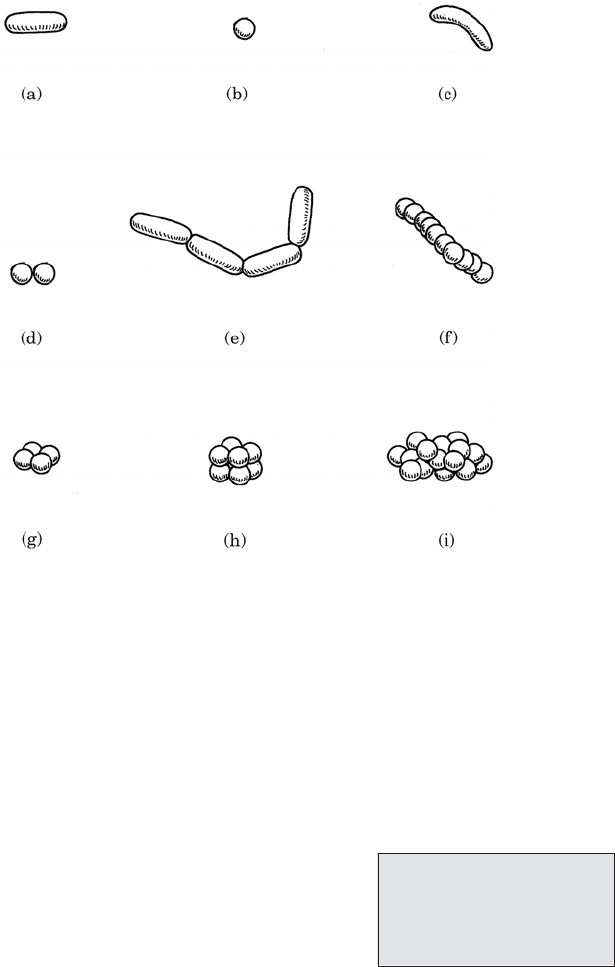
Figure 3.2 Bacterial shapes. Most bacteria are (a) rod shaped, (b) spherical or (c) curved.
These basic shapes may join to form (d) pairs, (e and f) chains, (g) sheets, (h) packets or (i)
irregular aggregates
The procaryotic cell
Bacteria are much smaller than eucaryotic cells; most fall into a size range of about
1–5µm, although some may be larger than this. Some of the smallest bacteria, such as
the mycoplasma measure less than 1µm, and are too small to be resolved clearly by an
ordinary light microscope.
In recent years, square,
triangular and star-
shaped bacteria have
all been discovered!
Because of their extremely small size, it was only with
the advent of the electron microscope that we were able to
learn about the detailed structure of bacterial cells. Using
the light microscope however, it is possible to recognise
differences in the shape and arrangement of bacteria. Al-
though a good deal of variation is possible, most have
one of three basic shapes (Figure 3.2):
r
rod shaped (bacillus)
r
spherical (coccus)
r
curved: these range from comma-shaped (vibrio) to corkscrew-shaped
(spirochaete)

JWBK011-03 JWBK011-Hogg August 12, 2005 15:52 Char Count= 0
THE PROCARYOTIC CELL 55
All these shapes confer certain advantages to their owners; rods, with a large surface
area are better able to take up nutrients from the environment, while the cocci are less
prone to drying out. The spiral forms are usually motile; their shape aids their movement
through an aqueous medium.
As well as these characteristic cell shapes, bacteria may also be found grouped to-
gether in particular formations. When they divide, they may remain attached to one
another, and the shape the groups of cells assume reflects the way the cell divides. Cocci,
for example, are frequently found as chains of cells, a reflection of repeated division in
one plane (Figure 3.2(f)). Other cocci may form regular sheets or packets of cells, as a
result of division in two or three planes. Yet others, such as the staphylococci, divide
in several planes, producing the irregular and characteristic ‘bunch of grapes’ appear-
ance. Rod-shaped bacteria only divide in a single plane and may therefore be found
in chains, while spiral forms also divide in one plane, but tend not to stick together.
Blue–greens form filaments; these are regarded as truly multicellular rather than as a
loose association of individuals.
Procaryotic cell structure
When compared with the profusion of elaborate organelles encountered inside a typical
eucaryotic cell, the interior of a typical bacterium looks rather empty. The only internal
structural features are:
r
a bacterial chromosome or nucleoid, comprising a closed loop of double stranded,
supercoiled DNA. In addition, there may be additional DNA in the form of a plasmid
r
thousands of granular ribosomes
r
a variety of granular inclusions associated with nutrient storage.
All of these are contained in a thick aqueous soup of carbohydrates, proteins, lipids and
inorganic salts known as the cytoplasm, which is surrounded by a plasma membrane.
This in turn is wrapped in a cell wall, whose rigidity gives the bacterial cell its charac-
teristic shape. Depending on the type of bacterium, there may be a further surrounding
layer such as a capsule or slime layer and/or structures external to the cell associated
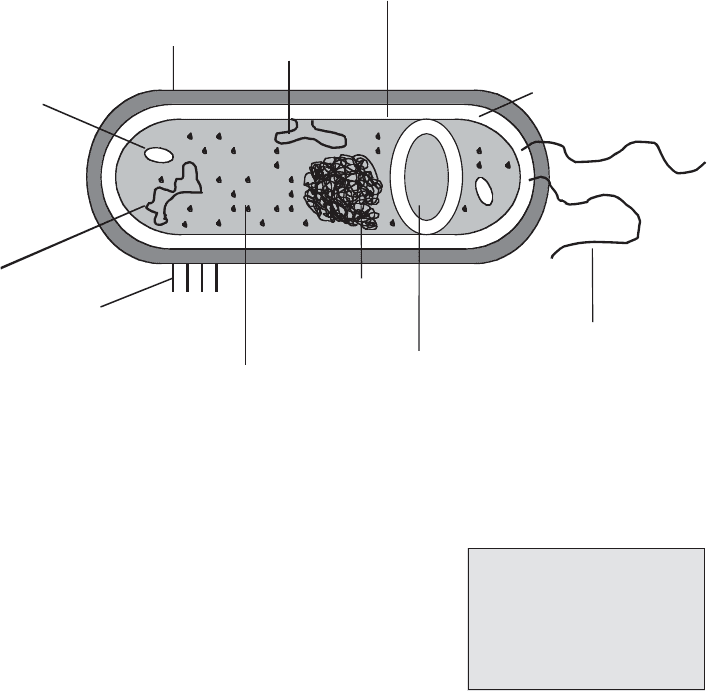
with motility (flagella) or attachment (pili/fimbriae). Figure 3.3 shows these features
in a generalised bacterial cell. In the following pages we shall examine these features
Not all bacteria con-
form to the model of a
single circular chromo-
some; some have been
shown to possess two
with genes shared be-
tween them, while ex-
amples of linear chromo-
somes are also known.
in a little more detail, noting how each has a crucial role
to play in the survival or reproduction of the cell.
Genetic material
Although it occupies a well defined area within the cell,
the genetic material of procaryotes is not present as a
true nucleus, as it lacks a surrounding nuclear membrane
(c.f. the eucaryotic nucleus, Figure 3.12). The nucleoid or
bacterial chromosome comprises a closed circle of dou-
ble stranded DNA, many times the length of the cell and
highly folded and compacted. (The common laboratory
JWBK011-03 JWBK011-Hogg August 12, 2005 15:52 Char Count= 0
56 CELL STRUCTURE AND ORGANISATION
Plasma membrane
Outer membrane
Mesosome
Inclusion body
Cell wall
Plasmid
Nucleoid
Pili
Flagellum
Endospore
Ribosome
Figure 3.3 Structure of a generalised procaryotic cell. Note the lack of complex internal
organelles (c.f. Figure 3.12). Gram-positive and Gram-negative bacteria differ in the details
of their cell wall structure (see Figures 3.7 & 3.8)
Plasmids are small loops
of DNA independent of
the chromosome. They
are capable of directing
their own replication.
bacterium Escherichia coli is around 3–4 µm in length,
but contains a DNA molecule some 1400 µm in length!)
The DNA may be associated with certain bacterial pro-
teins, but these are not the same as the histones found
in eucaryotic chromosomes. Some bacteria contain ad-
ditional DNA in the form of small, self-replicating ex-
trachromosomal elements called plasmids. These do not
carry any genes essential for growth and reproduction,
and thus the cell may survive without them. They can be very important however, as
they may include genes encoding toxins or resistance to antibiotics, and can be passed
from cell to cell (see Chapter 12).
Ribosomes
Apart from the nucleoid, the principal internal structures of procaryotic cells are the
ribosomes. These are the site of protein synthesis, and there may be many thousands of
these in an active cell, lending a speckled appearance to the cytoplasm. Ribosomes are
composed of a complex of protein and RNA, and are the site of protein synthesis in the
cell.
Although they carry out a similar function, the ribosomes of procaryotic cells
are smaller and lighter than their eucaryotic counterparts. Ribosomes are mea-
sured in Svedberg units (S), a function of their size and shape, and determined by
their rate of sedimentation in a centrifuge; procaryotic ribosomes are 70S, while
those of eucaryotes are 80S. Some types of antibiotic exploit this difference by

JWBK011-03 JWBK011-Hogg August 12, 2005 15:52 Char Count= 0
THE PROCARYOTIC CELL 57
Table 3.3 Comparison of procaryotic and eucaryotic ribosomes
Procaryotic Eucaryotic
Overall size 70S 80S
Large subunit size 50S 60S
Large subunit RNA 23S & 5S 28S, 5.8S & 5S
Small subunit size 30S 40S
Small subunit RNA 16S 18S
targeting the procaryotic form and selectively disrupting bacterial protein synthesis (see
Chapter 14).
A polyribosome (poly-
some) is a chain of ri-
bosomes attached to
the same molecule of
mRNA.
All ribosomes comprise two unequal subunits (in pro-
caryotes, these are 50S and 30S, in eucaryotes 60S and
40S: Table 3.3)). Each subunit contains its own RNA and
a number of proteins (Figure 3.4). Many ribosomes may
simultaneously be attached to a single mRNA molecule,
forming a threadlike polysome. The role of ribosomes in
bacterial protein synthesis is discussed in Chapter 11.
Inclusion bodies
Within the cytoplasm of certain bacteria may be found granular structures known as
inclusion bodies. These act as food reserves, and may contain organic compounds such
as starch, glycogen or lipid. In addition, sulphur and polyphosphate can be stored as
inclusion bodies, the latter being known as volutin or metachromatic granules. Two
special types of inclusion body are worthy of mention. Magnetosomes, which contain
a form of iron oxide, help some types of bacteria to orientate themselves downwards
into favourable conditions, whilst gas vacuoles maintain bouyancy of the cell in blue
greens and some halobacteria.
70 S
Ribosome
30S
Subunit
50S
subunit
16S rRNA
21 proteins
5S rRNA
23S rRNA
34 proteins
Figure 3.4 The bacterial ribosome. Each subunit comprises rRNA and proteins. The nu-
cleotide sequence of small subunit (16S) rRNA is widely used in determining the phylogenetic
(evolutionary) relationship between bacteria (see Chapter 7)