
Hogg S. Essential microbiology
Подождите немного. Документ загружается.

JWBK011-08 JWBK011-Hogg August 12, 2005 16:11 Char Count= 0
198 THE FUNGI
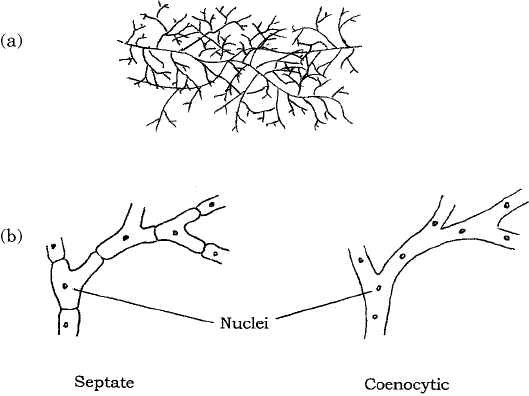
Figure 8.1 Hyphae and mycelia. (a) Individual hyphae branch and aggregate to form a
mycelium. (b) Hyphae may or may not contain cross-walls (septa)
General biology of the Fungi
Morphology
Fungi range in form and size from unicellular yeasts to large mushrooms and puffballs.
Yeasts are unicellular, do not have flagella and reproduce asexually by budding or trans-
verse fission, or sexually by spore formation. Multicellular forms such as moulds have
long, branched, threadlike filaments called hyphae, which aggregate together to form
a tangled mycelium (Figure 8.1a). In some fungi the hyphae have crosswalls or septa
(sing: septum) separating cells, which may nevertheless be joined by one or more pores,
which permit cytoplasmic streaming, a form of internal transport. Such hyphae are said
to be septate; others have no crosswalls and are therefore coenocytic (i.e. many nuclei
within a single plasma membrane, Figure 8.1b).
Many fungi are dimorphic, that is, they exist in two distinct forms. Some fungi that
cause human infections can change from the yeast form in the human to a mycelial form
in the environment in response to changes in nutrients, and environmental factors such
as CO
2
concentration and temperature. This change in body form is known as the YM
shift; in fungi associated with plants, the shift often occurs the other way round, i.e. the
mycelial form exists in the plant and the yeast form in the environment.
One of the features that caused taxonomists finally to remove fungi from the plant
kingdom was the distinctive chemical nature of the fungal cell wall. Whereas plant and
algal cells have walls composed of cellulose, the cell wall of fungi is made up principally
of chitin (Figure 3.17b), a strong but flexible polysaccharide that is also found in the
exoskeleton of insects. It is a polymer whose repeating subunit is N-acetylglucosamine,
a compound we encountered when discussing peptidoglycan structure (Chapter 3).

JWBK011-08 JWBK011-Hogg August 12, 2005 16:11 Char Count= 0
CLASSIFICATION OF THE FUNGI 199
Nutrition
The term saprobe de-
scribes an organism that
feeds on dead and de-
caying organic materi-
als. The older term sapro-
phyte is no longer used,
since the name perpet-
uates the idea of fungi
being plants (phyton =
a plant). Saprobes con-
tribute greatly to the re-
cycling of carbon and
other elements.
Most fungi are saprobic (although some have other
modes of nutrition), that is, they obtain their nu-
trients from decaying matter, which they grow over
and through, frequently secreting enzymes extracellu-
larly to break down complex molecules to simpler
forms that can then be absorbed by the hyphae. Most
fungi are able to synthesise their own amino acids
and proteins from carbohydrates and simple nitroge-
nous compounds. Although fungi are unable to move,
they can swiftly colonise new territory as a result of
the rapid rate at which their hyphae grow. All energy
is concentrated on adding length rather than thick-
ness; this growth pattern leads to an increase in sur-
face area and is an adaptation to an absorptive way
of life. Carbohydrates are stored mainly in the form
of glycogen (c.f. starch in higher plants, green al-
gae). Metabolism is generally aerobic, but some yeasts can function as facultative
anaerobes.
Reproduction
Although, as we will see, there is a good deal of variety among the patterns of reproduc-
tion among the fungi, all share in common the feature of reproducing by spores; these
are non-motile reproductive cells that rely on being carried by animals or the wind for
their dispersal. The hyphae that bear the spores usually project up into the air, aiding
their dispersal. One of the main reasons that we have to practise aseptic techniques in
the laboratory is that fungal spores are pretty well ubiquitous, and will germinate and
grow if they find a suitable growth medium. Spores of the common black bread mould,
Rhizopus, (see below) have been found in the air over the North Pole, and hundreds of
miles out to sea. In some fungi the aerial spore-bearing hyphae are developed into large
complex structures called fruiting bodies. The most familiar example of a fruiting body
is the mushroom. Many people think that the mushroom itself is the whole fungus but
it only represents a part of it; most is buried away out of sight below the surface of the
soil or rotting material, a network of nearly invisible hyphae.
Classification of the Fungi
The Fungi are arranged into four major phyla on the basis of differences in their sexual
reproduction. These are:
Zygomycota
Chytridiomycota
‘Lower Fungi’

JWBK011-08 JWBK011-Hogg August 12, 2005 16:11 Char Count= 0
200 THE FUNGI
Ascomycota
Basidiomycota
‘Higher Fungi’
Members of the different
fungal phyla are given
the suffix -cetes, e.g. as-
comycetes.
The designation ‘higher’ and ‘lower’ Fungi, is an unof-
ficial distinction based on the fact that the latter two
(much larger) groups possess septate hyphae. In some
books, you may come across references to a group called
the Deuteromycota or Fungi Imperfecti. This is not a
taxonomic grouping, but a ‘holding area’ for species in
which only an asexual stage has been recognised, and which cannot therefore be as-
signed to any of the above groups. It is now possible, however, by means of DNA
analysis, to place such species with their nearest relatives, mostly in the Ascomycota or
Basidiomycota.
In the following pages, we shall look at each of the phyla in turn, concentrating
particularly on their life cycles.
Zygomycota
The Zygomycota is a relatively small phylum, comprising less than a thousand species.
Its members are typically found in soil, or on decaying organic matter, including animal
droppings. Some members of the group are of great importance in the formation of a
mutualistic association with plant roots known as a mycorrhiza. This will be discussed
in more detail in Chapter 15.
Members of the Zygomycota are characterised by the formation of a dormant form,
the zygospore, which is resistant to unfavourable environmental conditions. Hyphae
are coenocytic, with numerous haploid nuclei, but few dividing walls or septa.
A sporangium is a struc-
ture inside which spo-
res develop. It is held
aloft on an aerial hy-
pha called a sporango-
phore.
Familiar examples of this group are Mucor and the
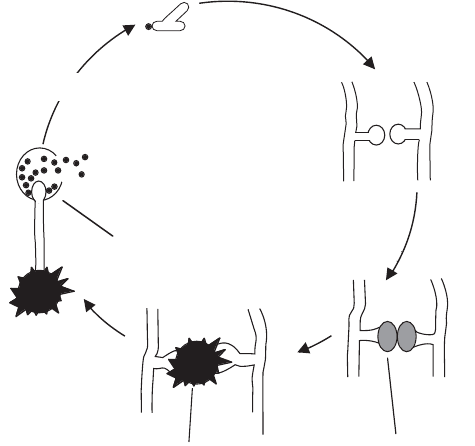
black bread mould Rhizopus. The life cycle of Rhizopus
is shown in Figure 8.2. Hyphae spread rapidly over the
surface of the substrate (bread, fruit etc.) and penetrate
it, absorbing soluble nutrients such as sugars. Upright
hyphae develop, carrying at their tip sporangia, full of
black haploid spores. The spores give the characteristic
colour to the mould; they are the asexual reproductive
structures, and are released when the thin wall of the sporangium ruptures. When
conditions are favourable, Rhizopus reproduces in this way; each spore, upon find-
ing a suitable substratum for growth, is capable of germinating and initiating a new
mycelium.
A dicaryon is a struc-
ture formed by two cells
whose contents, but not
nuclei, have fused.
Sexual reproduction occurs when environmental con-
ditions are unfavourable. Most species of Rhizopus are
heterothallic; that is, there exist two distinct mating
strains known as + and −. Sexual reproduction is only
possible between a member of the + -strain and a mem-
ber of the − -strain. Although reproductively distinct,
JWBK011-08 JWBK011-Hogg August 12, 2005 16:11 Char Count= 0
CLASSIFICATION OF THE FUNGI 201
Meiosis
Spores
(n)
+ strain - strain
Zygospore
(2n)
Sporangium
Adult
mycelium
(n)
Gametangia
Germination
Figure 8.2 Zygomycota: the life cycle of Rhizopus. Both sexual and asexual cycles in-
volve the production of sporangiospores. In sexual reproduction, hyphae from different
mating strains fuse to form a diploid zygospore, via a short-lived dicaryotic intermediate.
Germination of the zygospore gives rise to an aerial sporangium; this contains many haploid
sporangiospores, which give rise to another vegetative mycelium
these two types are morphologically identical; because of this it is not appropriate to
refer to them as ‘male’ and ‘female’. When hyphae of opposite mating types come into
contact, a cross-wall develops a short distance behind each tip, and the regions thus
isolated swell to produce gametangia (Figure 8.2). These fuse to form a single large
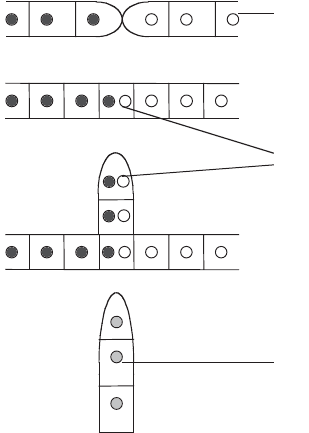
multinucleate cell. Note that at this stage, the nuclei from each parent have paired up
but not fused, forming a dicaryon. Dicaryon formation is found in all fungal phyla apart
from the chytrids, and may be regarded as an intermediate stage between the haploid
and diploid conditions (Figure 8.3). The proportion of the life cycle it occupies varies
considerably. A thick protective covering develops around the dicaryon in Rhizopus,
forming the zygospore, which can survive extremes of draught and temperature and
may remain dormant for months. When conditions are favourable again, the nuclei
from each strain fuse in pairs, to give a fully diploid zygote. Just before germination,
meiosis occurs, then an aerial sporangiophore emerges, terminating in a sporangium.
Production and dispersal of haploid spores then occur as in the asexual life cycle and a
new mycelium forms when a spore germinates.
JWBK011-08 JWBK011-Hogg August 12, 2005 16:11 Char Count= 0
202 THE FUNGI
n
n+ n
Dicaryon
2n
Figure 8.3 Dicaryon formation. The dicaryon (n + n) represents an intermediate stage
between the haploid (n) and diploid (2n) states. The participating cells have undergone
plasmogamy (fusion of cytoplasm) but not caryogamy (fusion of nuclei). Each dicaryotic
cell contains one nucleus from each parent cell. Fusion of nuclei leads to the formation of a
true diploid
In Rhizopus, therefore, we have a life cycle in which the haploid form predominates
(the zygospore is the only diploid stage), and we have sexual reproduction without the
involvement of motile gametes.
Chytridiomycota
The chytrids are believed to have been the first of the fungal groups to diverge from a
common ancestor many millions of years ago. They differ from all other fungal groups
by possessing flagellated zoospores. At one time, the Fungi were defined by their lack
of flagella, so the chytrids were assigned to the Protista (see Chapter 9). However,
molecular evidence, including the possession of a chitinous cell wall, suggests that it
would be more appropriate to place them among the Fungi.
Some members of the chytrids may live saprobically on decaying plant and animal
matter, while others are parasites of plants and algae. Another group live anaerobically
in the rumen of animals such as sheep and cattle. In recent years there has been evidence
that a parasitic species of chytrid is at least partially responsible for the dramatic decline
in frog populations in certain parts of the world. Some chytrids are unicellular, while
others form mycelia of coenocytic hyphae. Reproduction may be asexual by means
of motile zoospores or sexual. The latter may involve fusion of gametes to produce a
diploid zygote, but there is no dicaryotic stage in the life cycle.
JWBK011-08 JWBK011-Hogg August 12, 2005 16:11 Char Count= 0
CLASSIFICATION OF THE FUNGI 203
Ascomycota
A lichen is formed by the
symbiotic association of
a fungus (usually an as-
comycete) and an alga
or cyanophyte.
The Ascomycota are characterised by the production of
haploid ascospores through the meiosis of a diploid nu-
cleus in a small sac called an ascus. For this reason they
are sometimes called the sac fungi or cap fungi. Many of
the fungi that cause serious plant diseases such as Dutch
elm disease and powdery mildew belong to this group.
They include some 30 000 species, among them yeasts,
food spoilage moulds, brown fruit rotting fungi and truffles. Note that the latter, of-
ten regarded as the most prized type of mushrooms by gourmets, are assigned to a
completely different group to the true mushrooms, which belong to the Basidiomycota.
Around half of ascomycote species exist in associations with algae to form lichens; these
will be discussed more fully in Chapter 15. Most ascomycetes produce mycelia that su-
perficially resemble those of zygomycetes, but differ in that they have distinct, albeit
perforated cross walls (septa) separating each cell.
Asexual reproduction in most ascomycetes involves the production of airborne spores
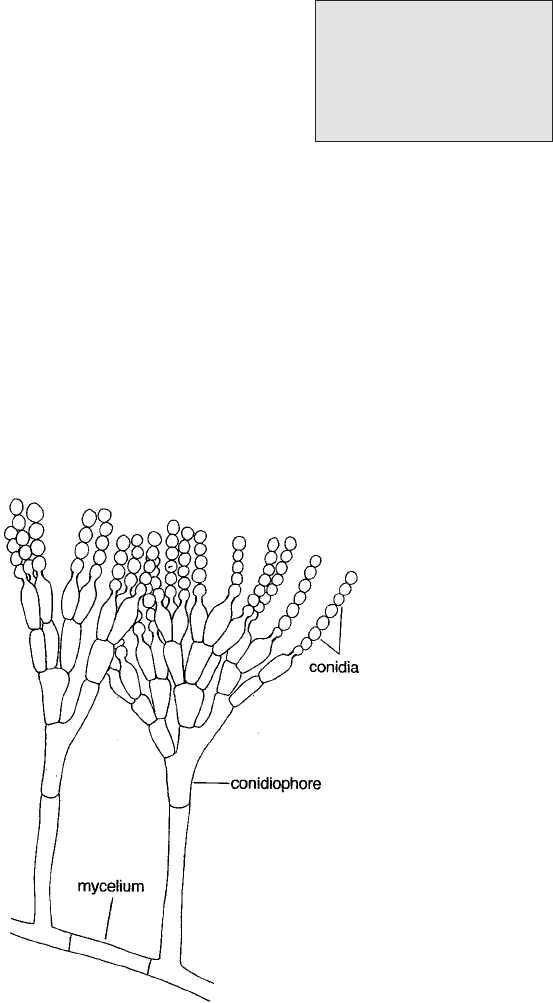
called conidia. These are carried on the ends of specialised hyphae called conidiophores,
where they may be pinched off as chains or clusters (Figure 8.4). Note that the conidia
are not contained within sporangia; they may be naked or protected by a flask-like
structure called the pycnidium. Asexual reproduction by conidia formation is a means
of rapid propagation for the fungus in favourable conditions. The characteristic green,
Figure 8.4 Asexual reproduction in the Ascomycota. Chains of conidia develop at the end
of specialised hyphae called conidiophores
JWBK011-08 JWBK011-Hogg August 12, 2005 16:11 Char Count= 0
204 THE FUNGI
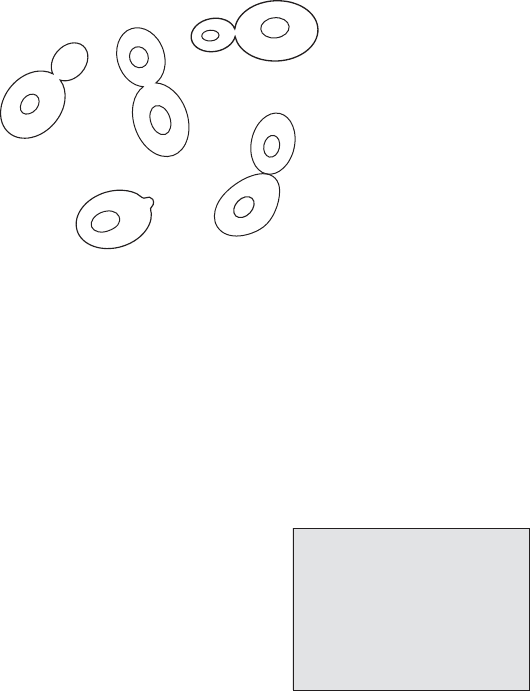
Figure 8.5 Yeast cells in various stages of budding. A protuberance or bud develops on the
parent yeast; the nucleus undergoes division and one copy passes into the bud. Eventually
the bud is walled off and separated to form a new cell
pink or brown colour of many moulds is due to the pigmentation of the conidia, which
are produced in huge numbers and dispersed by air currents. The conidia germinate to
form another mycelium (haploid).
In the case of the unicellular yeasts, asexual reproduction occurs as the result of
budding, a pinching off of a protuberance from the cell, which eventually grows to full
size (Figure 8.5).
Plasmogamy is the fu-
sion of the cytoplasmic
content of two cells.
Caryogamy is the fu-
sion of nuclei from two
different cells.
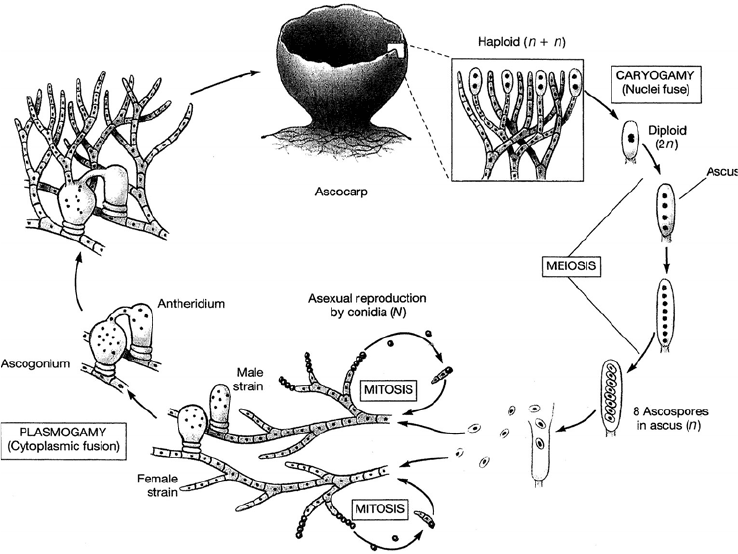
Sexual reproduction in some ascomycetes involves
separate + and − mating strains similar to those seen in
zygomycetes, whilst in other cases an individual will be
self-fertile, and thus able to mate with itself.When there
are separate strains, the hyphae involved in reproduction
are termed the ascogonium (− -strain) and antheridium
(+ -strain). In either case, two hyphae grow together and
there is a fusion of their cytoplasm (Figure 8.6). Within
this fused structure, rather like the zygospore of Rhizopus, nuclei pair, but do not fuse;
thus the resulting structure is a dicaryon. Following cytoplasmic fusion (plasmogamy),
branching hyphae develop. These hyphae are septate, i.e. partitioned off into separate
cells, but each cell is dicaryotic, having a nucleus from each parental type.
As we have seen, a key characteristic of ascomycetes is the production of sexual spores
in sac-like structures called asci. These develop in distinct macroscopic fruiting bodies
called ascocarps, which arise from the aggregation of dicaryotic hyphae (Figure 8.6).
At the tip of each dicaryotic hypha, pairs of nuclei fuse to give a diploid zygote; this is
followed by one meiotic and one mitotic division, giving rise to eight haploid ascospores.
An ascocarp may contain thousands of asci, each with eight ascospores. Tetrad analysis
of ascospores has proved a valuable technique in genetic mapping.
When the ascus is mature, it splits open at its tip and the ascospores are released.
They are dispersed, often over long distances, by air currents. If a mature ascocarp
is disturbed, it may release smoke-like puffs containing thousands of ascospores. The
germinating ascospore forms a new mycelium. Frequently there are many rounds of
asexual reproduction between successive rounds of sexual reproduction by ascospore
production.
JWBK011-08 JWBK011-Hogg August 12, 2005 16:11 Char Count= 0
CLASSIFICATION OF THE FUNGI 205
Figure 8.6 Sexual reproduction in the Ascomycota. Nuclei in the cells at the tips of the
ascogenous hyphae fuse to give a diploid zygote. Meiotic and mitotic divisions result in the
formation of eight haploid ascospores inside a tubular ascus. On germination, each ascospore
is capable of giving rise to a new mycelium. From Black, JG: Microbiology: Principles and
Explorations, 4th edn, John Wiley & Sons Inc., 1999. Reproduced by permission of the
publishers
As with the zygomycetes, the diploid stage in ascomycetes is very brief. The life cycles
of the two groups differ, however, in the greater role played by the dicaryotic form in
ascomycetes.
Basidiomycota
This large group of some 25 000 species contains the true mushrooms and toadstools
as well as other familiar fungi such as puffballs and bracket fungi. In fact the great
majority of the fungi that we see in fields and woodlands belong to the Basidiomycota.
They are of great economic importance in the breakdown of wood and other plant
material (Chapter 16). The group derives its common name of the club fungi from the
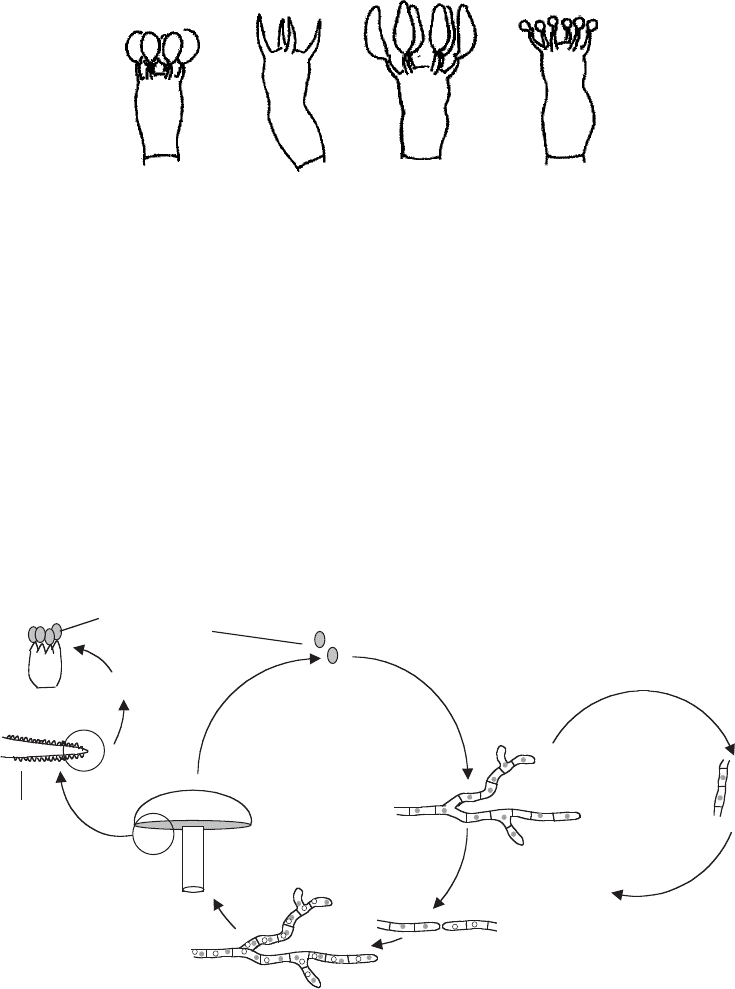
way that the spore-bearing hyphae involved in reproduction are swollen at the tips,
resembling clubs (the basidia: Figure 8.7).
JWBK011-08 JWBK011-Hogg August 12, 2005 16:11 Char Count= 0
206 THE FUNGI
Figure 8.7 Different forms of basidia. The club-like appearance of basidia gives the Basid-
iomycota their common name of ‘club Fungi’. From Langer, E: Die Gattung Botryobasidium
DONK (Corticiaceae, Basidiomycetes). Bibl Mycol 158, 1–459. Reproduced by permission
of Schweizerbart Science Publishers (http://schweizerbart.de)
Asexual reproduction occurs much less frequently in basidiomycetes than in the other
types of fungi. When it does occur, it is generally by means of conidia, although some
types are capable of fragmenting their hyphae into individual cells, each of which then
acts like a spore and germinates to form a new mycelium.
Sexual reproduction in a typical mushroom involves the fusion of haploid hyphae
belonging to two compatible mating types to produce a dicaryotic mycelium in which
each cell has two haploid nuclei (Figure 8.8). The most striking feature of this secondary
mycelium is the clamp connection; this is unique to the Basidiomycota and is a device
for ensuring that as growth continues, each new cell has one nucleus from each of the
Asexual
reproduction by
fragmentation
Dicaryotic
mycelium
Haploid
mycelium
Fusion of
hyphae from
compatible
mating types
n
n+n
2n
Meiosis
Germination
Haploid
b
asidiospores
Basidia
on gills
n
Figure 8.8 Life cycle of the Basidiomycota. Most of the fungus exists as a mycelial mass
underground. The mushroom is an aerial fruiting body that facilitates the dispersal of spores

JWBK011-08 JWBK011-Hogg August 12, 2005 16:11 Char Count= 0
CLASSIFICATION OF THE FUNGI 207
Box 8.1 Clamp connections
Imagine the situation in a dicaryotic cell when mitosis took place. The most likely
outcome would be that as the two nuclei divided, both of one type would end
up in one daughter cell and both of the other type in the other. As growth and
cell division proceeds in the secondary mycelium, it is therefore necessary to ensure
that the dicaryotic state is maintained, i.e. that each new cell inherits one nucleus
of each type from its parent. This is achieved by means of clamp connections.
d)
c)
b)
a)
e)
As the terminal hyphal cell elongates (b), a tube-like clamp connection grows out
backwards (c). As this happens, one nucleus enters the clamp and mitosis occurs
simultaneously in both parental nuclei. A septum is formed to separate the first pair
of nuclei (d), then, as the loop of the clamp connection is completed, a second
septum separates the second pair (e). The result is two new daughter cells, each
with one copy of each nuclear type.
parent mating strains (see Box 8.1). This dicaryotic secondary mycelium continues to
grow, overwhelming any remaining haploid hyphae from the parent fungi.
When the secondary mycelium has been developing for some time, it forms a dense
compact ball or button, which pushes up just above the surface and expands into a
basidiocarp; this is the mushroom itself. Stalk formation and upward growth is ex-
tremely rapid; a stalk or stipe of 10 cm can be formed in only about 6–9 hours. The
growth is initially towards light (positive phototropism) and then upward (negative
geotropism). As the cap expands, fleshy flaps radiating from the centre of its underside
open up. These are the gills, made up of compacted hyphae with numerous basidia
arranged at right angles. As each basidium matures, its two nuclei finally fuse, and then
undergo meiosis to produce four haploid basidiospores. A single large mushroom can
produce millions of basidiospores in the space of a few days. They are discharged from
the end of the basidia and then fall by gravity from the gills. Air currents then carry
them away for dispersal. Upon finding a suitable substratum, the spores germinate into
a haploid mycelium just below the surface of the soil, thus completing the life cycle.