
Hogg S. Essential microbiology
Подождите немного. Документ загружается.


JWBK011-08 JWBK011-Hogg August 12, 2005 16:11 Char Count= 0
208 THE FUNGI
Table 8.1 Some fungal diseases of humans
Disease Fungus
Histoplasmosis Histoplasma capsulatum
Blastoplasmosis Blastomyces dermatitidis
Cryptococcosis Cryptococcus neoformans
Cutaneous mycoses Trichophyton spp.
Pneumocystis pneumonia Pneumocystis carinii
Candidiasis (‘thrush’) Candida albicans
Aspergillosis Aspergillus fumigatus
Fungi and disease
A limited number of fungi are pathogenic to humans (Table 8.1). Mycoses (sing: mycosis)
in humans may be cutaneous, or systemic; in the latter, spores generally enter the body
by inhalation, but subsequently spread to other organ systems via the blood, causing
serious, even fatal disease.
Cutaneous mycoses are the most common fungal infections found in humans, and
are caused by fungi known as dermatophytes, which are able to utilise the keratin of
skin, hair or nails by secreting the enzyme keratinase. Popular names for such infections
include ringworm and athletes’ foot. They are highly contagious, but not usually serious
conditions.
Systemic mycoses can be much more serious, and include conditions such as histo-
plasmosis and blastomycosis. The former is caused by Histoplasma capsulatum, and
is associated with areas where there is contamination by bat or bird excrement. It is
thought that the number of people displaying clinical symptoms of histoplasmosis rep-
resents only a small proportion of the total number infected. If confined to the lungs,
the condition is generally self-limiting, but if disseminated to other parts of the body
such as the heart or central nervous system, it can be fatal. The causative agents of both
diseases exhibit dimorphism; they exist in the environment as mycelia but convert to
yeast at the higher temperature of their human host.
Aspergillus fumigatus is an example of an opportunistic pathogen, that is, an or-
ganism which, although usually harmless, can act as a pathogen in individuals whose
resistance to infection has been lowered. Other opportunistic mycoses include candidi-
asis (‘thrush’) and Pneumocystis pneumonia. The latter is found in a high percentage of
acquired immune deficiency syndrome (AIDS) patients, whose immune defences have
been compromised. The causative organism, Pneumocystis carinii, was previously con-
sidered to be a protozoan, and has only been classed as a fungus in the last decade, as a
result of DNA/RNA sequence evidence. It lives as a commensal in a variety of mammals,
and is probably transmitted to humans through contact with dogs.
The incidence of opportunistic mycoses has increased greatly since the introduction
of antibiotics, immunosuppressants and cytotoxic drugs. Each of these either suppresses
the individual’s natural defences, or eliminates harmless microbial competitors, allowing
the fungal species to flourish.

JWBK011-08 JWBK011-Hogg August 12, 2005 16:11 Char Count= 0
TEST YOURSELF 209
Box 8.2 Ergot
Members of the genus Claviceps may infect a variety of grains, particularly rye,
when they come into flower, giving rise to the condition called ergot. No great
damage is caused to the crop, but as the fungus develops in the maturing grain,
powerful hallucinatory compounds are produced, which cause ergotism in those
who consume bread made from the affected grain. This was relatively common in
the Middle Ages, when it was known as St Anthony’s Fire. The hallucinatory effects
of ergotism have been put forward by some as an explanation for outbreaks of
mass hysteria such as witch hunts and also for the cause of the abandonment of
the ship, the Mary Celeste. The effects can go beyond the psychological causing
convulsions and even death. In small controlled amounts, the drugs derived from
ergot can be medically useful in certain situations such as the induction of childbirth
and the relief of migraine headaches.
Secondary metabolites
are produced by a
microorganism after the
phase of active growth
has ceased. Such sub-
stances are usually
not required for essen-
tial metabolic or cell
maintenance purposes.
Examples include toxins
pigments and most an-
tibiotics. Carcinogenic
means cancer-causing.
Many fungi produce natural mycotoxins; these are
secondary metabolites, which, if consumed by humans,
can cause food poisoning that can sometimes be fatal.
Certain species of mushrooms (‘toadstools’) including
the genus Amanita contain substances that are highly
poisonous to humans. Other examples of mycotoxin ill-
nesses include ergotism (see Box 8.2) and aflatoxin poi-
soning. Aflatoxins are carcinogenic toxins produced by
Aspergillus flavus that grows on stored peanuts. In the
early 1960s, the turkey industry in the UK was almost
crippled by ‘Turkey X disease’, caused by the consump-
tion of feed contaminated by A. flavus.
It is thought likely that all animals are parasitised
by one fungus or another. Extraordinary though it may
seem, there are even fungi that act as predators on small
soil animals such as nematode worms, producing constrictive hyphal loops that tighten,
immobilising the prey.
Fungi also cause disease in plants, and can have a devastating effect on crops of
economic importance, either on the living plant or in storage subsequent to harvest-
ing. Rusts, smuts and mildews are all examples of common plant diseases caused by
fungi. The effects of fungi on materials such as wood and textiles will be considered in
Chapter 16.
Test yourself
1 Categorised according to their carbon and energy sources, all fungi are
.
2 Fungi whose cells are separated by cross-walls are described as
.

JWBK011-08 JWBK011-Hogg August 12, 2005 16:11 Char Count= 0
210 THE FUNGI
3 Fungi whose cells lack cross-walls are described as .
4 The YM shift describes an alternation between
and .
5 The principal component of cell walls is
.
6 The
(or Deuteromycota) is a term used to describe those
species in which no sexual reproductive stage has been observed.
7 The Chytridiomycota and the Zygomycota are sometimes termed the
fungi.
8 The Ascomycota and the Basidiomycota are sometimes termed the
fungi.
9 A resistant form, the
, enables members of the Zygomycota to over-
come adverse environmental conditions.
10 An aerial hypha that gives rise to spore formation is termed a
.
11 The chytrids are thought to be the most primitive fungal group. Unlike other
fungi, they possess
.
12 Members of the Ascomycota reproduce asexually by means of spores called
.
13 Unicellular yeasts reproduce asexually by the process of
.
14 In sexual reproduction in the Ascomycota, haploid ascospores develop in
fruiting bodies called
.
15
cells contain two nuclei, one inherited from each parent.
16 The appearance of spore-bearing hyphae called basidia gives the Basidiomy-
cota their common name: the
.
17 The
connection is a morphological feature unique to basid-
iomycetes.
18 A mushroom is a fruiting body of a member of the Basidiomycota; its scientific
name is a
.
19 A
is a fungal disease of humans. It may be or .
20 Aspergillus flavus produces carcinogenic toxins called
.

JWBK011-09 JWBK011-Hogg August 12, 2005 19:58 Char Count= 0
9
The Protista
Although not such an all-embracing a term as originally envisaged by Haeckel, the
Protista represents a very diverse group of organisms, united by their possession of
eucaryotic characteristics, and failure to fit satisfactorily into the animal, plant or fungal
kingdoms. Some scientists limit use of the name to unicellular organisms, while others
also include organisms such as the macroscopic algae, which are not accommodated
conveniently elsewhere.
The Protista is a grouping
of convenience, con-
taining organisms not
easily accommodated
elsewhere. It includes all
unicellular and colonial
eucaryotic organisms,
but is often expanded
to include multicellular
algae.
It has become clear from molecular studies that
some members of the Protista bear only a very dis-
tant relationship to each other, making it an unsatis-
factory grouping in many respects. In an introductory
text such as this, however, it is convenient and, it is
hoped, less confusing, to retain the name Protista as
a chapter heading, as long as the student understands
that it does not represent a coherent taxonomic group-
ing of phylogenetically related organisms. At the end
of the chapter, we shall look at how members of the
Protista are placed in modern, phylogenetic taxonomic
schemes.
It has been found helpful in the past to think of Protists as being divided into
those with characteristics that are plant–like (the Algae), animal-like (the Protozoa) and
fungus-like (the water moulds and slime moulds). We shall discuss each of these groups
in turn in the following pages. It should be borne in mind, however, that molecular evi-
dence suggests such a division to be artificial; on the basis of molecular and cytological
comparison, the ‘animal-like’ protozoan Trypanosoma, for example, is closely related
to the photosynthetic (and therefore ‘plant-like’) Euglena.
‘The Algae’
The Algae is a collective name traditionally given to several phyla of primitive, and
mostly aquatic plants, making up a highly diverse group of over 30 000 species. They
display a wide variety of structure, habitat and life-cycle, ranging from single-celled
forms to massive seaweeds tens of metres in length. Most algae share a number of
common features which caused them to be grouped together. Among these are:
211

JWBK011-09 JWBK011-Hogg August 12, 2005 19:58 Char Count= 0
212 THE PROTISTA
r
possession of the pigment chlorophyll
r
deriving energy from the sun by means of oxygenic photosynthesis
r
fixing carbon from CO
2
or dissolved bicarbonate (see Chapter 6).
Modern taxonomy attempts to reflect more accurately the relationship between organ-
isms with an assumed common ancestor. Thus, in the following pages, the unicellular
‘algae’ are discussed in relation to other unicellular eucaryotes. Multicellular forms,
including the Phaeophyta (brown algae) and Rhodophyta (red algae), are not discussed
at great length and are included for the sake of completeness.
Structural characteristics of algal protists
All algal types are eucaryotic, and therefore contain the internal organelles we encoun-
tered in Chapter 3, that is, nuclei, mitochondria, endoplasmic reticulum, ribosomes,
Golgi body, and in most instances, chloroplasts. With the exception of one group (the
Euglenophyta), all have a cellulose cell wall, which is frequently modified with other
polysaccharides, including pectin and alginic acids. In some cases, the cell wall may
be fortified with deposits of calcium carbonate or silica. This is permeable to small
molecules and ions, but impermeable to macromolecules. To the exterior of the cell
may be one or two flagella, with the typical eucaryotic 9 + 2 microstructure (see Figure
3.18), which may allow unicellular types to move through the water; cilia are not
found in any algae.
The characteristics used to place algal protists into different taxa include the type
of chlorophyll present, the form in which carbohydrate is stored, and the structure of
the cell wall (Table 9.1). A group not considered here are the cyanophytes, previously
known as the blue-green algae; although they carry out oxygenic photosynthesis, they
are procaryotes, and as such are more closely related to certain bacteria. They are
therefore discussed in Chapter 7.
Euglenophyta
A pellicle is a semi-rigid
structure composed of
protein strips found sur-
rounding the cell of
many unicellular proto-
zoans and algae
This is a group of unicellular flagellated organisms,
which probably represent the most ancient group of al-
gal protists. Individuals range in size from 10−500 µm.
Euglenophytes are commonly found in fresh water, par-
ticularly that with a high organic content, and to a lesser
extent, in soil, brackish water and salt water. Members
of this group have a well-defined nucleus, and chloro-
plasts containing chlorophylls a and b (Figure 9.1). The
storage product of photosynthesis is a β-1,3-linked glucan called paramylon, found al-
most exclusively in this group. Euglenophytes lack a cellulose cell wall but have instead,
situated within the plasma membrane, a flexible pellicle made up of interlocking protein
strips, a characteristic which links them to certain protozoan species. A further similarity
is the way in which locomotion is achieved by the undulation of a terminal flagellum.
Movement towards a light source is facilitated in many euglenids by two structures
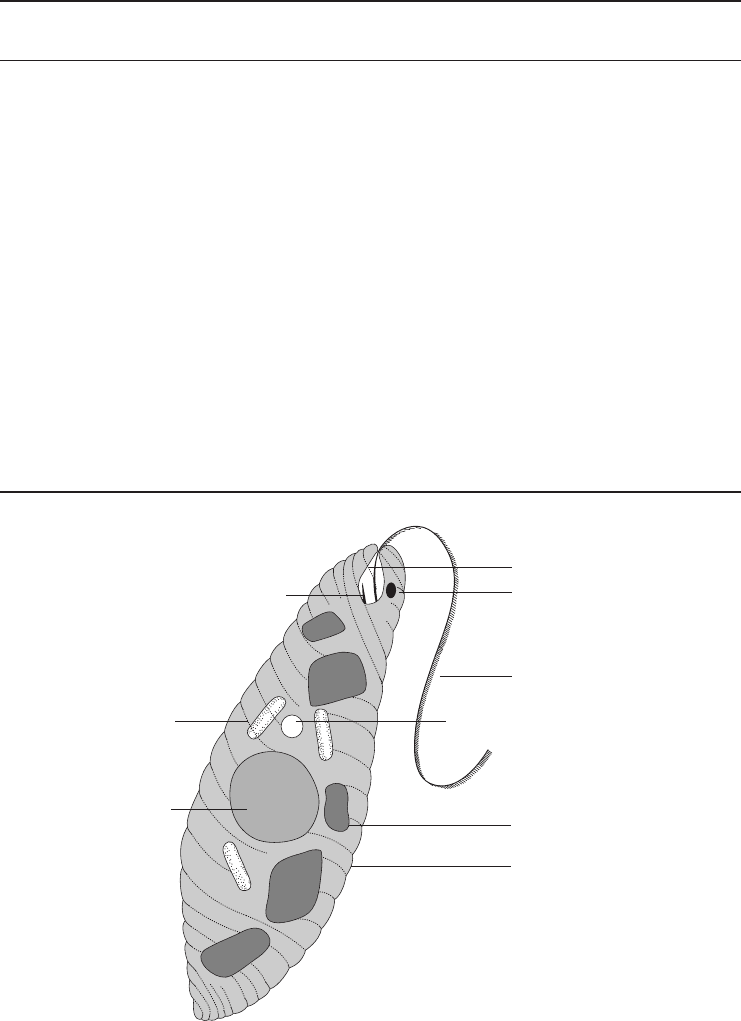
JWBK011-09 JWBK011-Hogg August 12, 2005 19:58 Char Count= 0
‘THE ALGAE’ 213
Table 9.1 Characteristics of major algal groups
Common Storage
name Morphology Pigments compound Cell wall
Euglenophyta Euglenids Unicellular Chlorophyll
a & b
Paramylon None
Pyrrophyta Dinoflagellates Unicellular Chlorophyll
a & c,
xanthophylls
Starch Cellulose/
none
Chrysophyta Golden-brown
algae,
diatoms
Unicellular Chlorophyll
a & c
Lipids Cellulose,
silica,
CaCO3,
etc.
Chlorophyta Green algae Unicellular to
multicellular
Chlorophyll
a & b
Starch Cellulose
Phaeophyta Brown algae Multicellular Chlorophyll
a & c,
xanthophylls
Laminarin Cellulose
Rhodophyta Red algae Mostly
multicellular
Chlorophyll
a & d,
phycocyanin,
phycoery-
thrin
Starch Cellulose
reservoir
Non-emergent
flagellum
eyespot
nucleus
chloroplast
pellicle
paramylon
body
emergent flagellum
contractile
vacuole
Figure 9.1 Euglena. Euglena has a number of features in common with the zooflagellates
(see Figure 9.11), but its possession of chloroplasts has meant that it has traditionally been
classified among the algae
JWBK011-09 JWBK011-Hogg August 12, 2005 19:58 Char Count= 0
214 THE PROTISTA
situated near the base of the flagellum; these are the paraflagellar body and the stigma
or eyespot. The latter is particularly conspicuous, as it is typically an orange-red colour,
and relatively large.
Reproduction is by binary fission (i.e. by asexual means only). Division starts at
the anterior end, and proceeds longitudinally down the length of the cell, giving the
cell a characteristic ‘two-headed’ appearance. During mitosis, the chromosomes within
the nucleus replicate, forming pairs that split longitudinally. Since the euglenophyte is
usually haploid, it thus becomes diploid for a short period. As fission proceeds, one
daughter cell retains the old flagellum, while the other one generates a new one later.
As in the binary fission of bacteria, the progeny are genetically identical, i.e. clones.
When conditions are unfavourable for survival due to failing nutrient supplies, the cells
round up to form cysts surrounded by a gelatinous covering; these have an increased
complement of paramylon granules, but no flagella. An important respect in which
euglenids may be at variance with the notion of ‘plant-like protists’ is their ability
to exist as heterotrophs under certain conditions. When this happens, they lose their
photosynthetic pigments and feed saprobically on dead organic material in the water.
Dinoflagellata
The dinoflagellates (also known variously as Pyrrophyta, or ‘fire algae’) are chiefly ma-
rine planktonic types, comprising some 2000 species. This is another unicellular group,
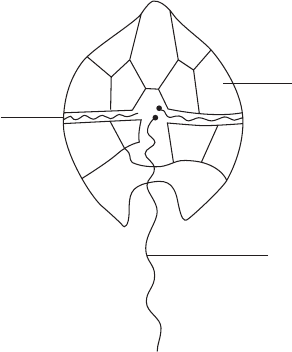
but one whose cells are often covered with armoured plates known as thecae (sing:
theca). They are generally biflagellate, with the two dissimilar flagella lying in part within
the longitudinal and lateral grooves that run around the cell (Figure 9.2). The beating
of the flagella causes the cell to spin like a top as it moves through the water (the group
takes its name from the Greek word ‘to whirl’). Although many non-photosynthetic
(chemoheterotrophic) types exist, most dinoflagellates are photosynthetic, containing
Theca
Longitudinal
flagellum
Transverse
flagellum
Figure 9.2 A dinoflagellate. Note the two flagella in perpendicular grooves. Each plays its
part in the organism’s locomotion

JWBK011-09 JWBK011-Hogg August 12, 2005 19:58 Char Count= 0
‘THE ALGAE’ 215
Box 9.1 Why would an alga want to glow in the dark?
The production of bioluminescence by several dinoflagellate species is thought to
have a protective function. Such algae are the natural prey of copepods, tiny crus-
taceans found in astronomical numbers as part of the zooplankton. The biolumines-
cence could have an effect directly, by acting as a warning signal to the copepods,
or indirectly, by making those crustaceans which had consumed glowing algae
much more conspicuous to their own predators.
chlorophyll a and c plus certain carotenoids and xanthophylls, which give them a
red/golden appearance. As a group, they are second only to the diatoms (see below)
as the primary photosynthetic producers in the marine environment. Some dinoflag-
ellates form endosymbiotic relationships with marine animals such as corals and sea
anemones; these are termed zooxanthellae. An unusual feature of dinoflagellate ultra-
structure is that the chromosomes contain little, if any, histone protein, and exist almost
permanently in the condensed form.
Some tropical species of dinoflagellate emit light, the only algae to do so (see Box 9.1).
Due to an enzyme–substrate (luciferin–luciferase) interaction, this can cause a spectac-
ular glow in the water at night, especially when the water is disturbed, for example by
a ship. Bioluminescence of this kind has proved to be a useful ‘tagging’ system for cells
in biological research. Other marine dinoflagellates can produce metabolites that act as
nerve toxins to higher animals. Shellfish such as mussels and oysters can concentrate
these with no harm to themselves, but they can be fatal to humans who consume them.
Sometimes, when conditions are highly favourable, an explosion of growth results in
the development of huge ‘red tides’ of dinoflagellates in coastal waters. This produces a
build-up of toxins, and may lead to the death of massive numbers of fish and other ma-
rine life. The greatly increased incidence of these blooms in recent decades is probably
due to pollution by fertilisers containing nitrates and phosphates.
Reproduction by asexual means involves binary fission. In armoured forms, the theca
may be shed before cell division, or split along suture lines; in either case, daughter cells
must regenerate the missing sections. Sexual reproduction is known to occur in some
dinoflagellates, and is probably more widespread. Gametes produced by mitosis fuse to
produce a diploid zygote; this undergoes meiosis to reinstate the haploid condition in the
offspring. In some species we see isogamy, the fusion of identical, motile gametes, while
in others, anisogamy occurs, in which gametes of dissimilar size fuse. Fusion may occur
between genetically identical gametes, or only when the gametes come from genetically
distinct populations.
Diatoms
The diatoms, which belong to the division Chrysophyta (the golden-brown algae), make
up the majority of phytoplankton in marine food chains, and as such are the most
important group of algal protists in terms of photosynthetic production. Over 10 000
species of diatom are recognised, but some experts feel that the real number is many
times greater than this.
JWBK011-09 JWBK011-Hogg August 12, 2005 19:58 Char Count= 0
216 THE PROTISTA
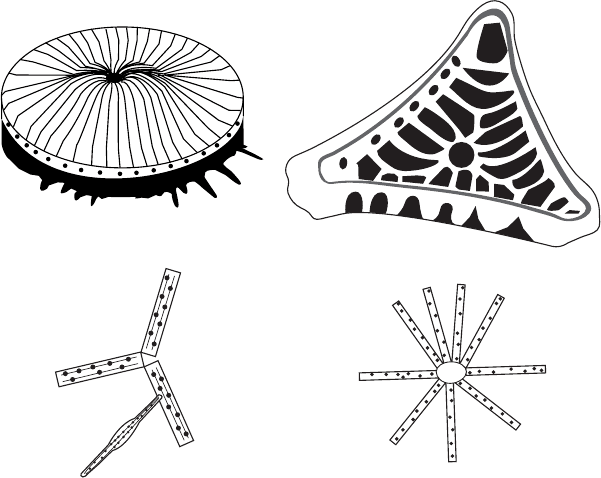
Figure 9.3 Diatoms are covered by an intricate two-part silicaceous shell called a frustule,
whose often highly striking appearance make them among the most beautiful of microor-
ganisms
As with the dinoflagellates, chlorophylls a and c are present, but not chlorophyll b.
Their colour is due to carotenoids and xanthophylls (particularly fucoxanthin) masking
the chlorophyll.
Diatoms have their cells surrounded by a silica-based shell known as a frustule,
composed of two overlapping halves (the epitheca and the hypotheca). Microbiologists
are rarely able to resist the temptation to liken this structure to that of a petri dish,
and with good reason. With the electron microscope it can be seen that the frustule is
perforated with numerous tiny pores that connect the protoplast of the cell with the
outside environment. Diatom classification is based almost entirely on the shape and
pattern of these shells, which are uniform for a particular species, and often have a
very striking appearance (Figure 9.3). When diatoms die, their shells fall to the bottom
of the sea, and can accumulate in thick layers where they represent a valuable mineral
resource. This fine, light material (diatomaceous earth) has a number of applications,
for example in filtration systems, and also as a light abrasive in products such as silver
polish or toothpaste.
Reproduction is usually asexual by binary fission, but a sexual phase with the produc-
tion of haploid gametes can occur. Chrysophytes are unusual among the three primitive
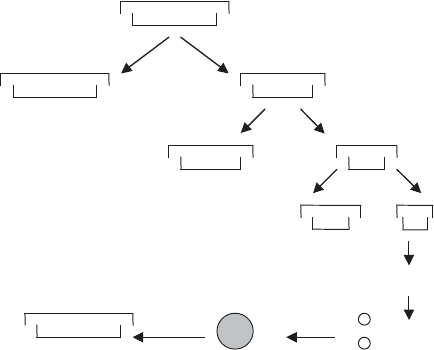
groups of algae in that they are diploid. In diatoms, asexual reproduction involves mi-
totic cell division, with each daughter cell receiving one half of the parental frustule, and
synthesizing a new one to complement it. The newly formed half, however, always acts
as the hypotheca (lower half) of the new cell; consequently, one in two daughter cells
will be slightly smaller than the parent, an effect which is heightened over a number
JWBK011-09 JWBK011-Hogg August 12, 2005 19:58 Char Count= 0
‘THE ALGAE’ 217
Meiosis
Gametes
Cells become
progressively
smaller
Cells remain
same size
Zygote
Figure 9.4 Asexual reproduction in diatoms. Two halves of the parent cell separate follow-
ing mitosis, and a new half develops to fit inside it. Thus, the parental shell always forms the
upper (larger half) of the new individual. For half of the population, this means a gradual
diminution of size over a number of generations. Eventually, a minimum size is reached,
and a sexual cycle is entered. Gametes are produced and the resulting zygote develops into
a full-size cell
of generations (Figure 9.4). This process continues until a critical size is reached, and
the diatoms undergo a phase of sexual reproduction, which re-establishes the normal
frustule size. In species whose frustules have a degree of elasticity, the daughter cells are
able to expand, and the problem of cell diminution does not arise. In bilaterally sym-
metrical (long, thin) diatoms, meiosis in parental cells produces identical, non-motile
gametes, which fuse to form a zygote. The radially symmetrical (round) forms provide
an example of the third pattern of gamete fusion found in the algae: oogamy. Here,
there is a clear distinction between the small, motile sperm cell and the larger, immobile
egg cell. Both are produced by meiosis in the parental cell, followed, in the case of the
male, by several rounds of mitosis, to give a large number of sperm cells.
Chlorophyta
The green algae have always attracted a lot of interest because, as a group, they share
a good deal in common with the higher plants in terms of ultrastructure, metabolism
and photosynthetic pigments, pointing to the likelihood of a common ancestor. They
possess both chlorophyll a and b and certain carotenoids, store carbohydrate in the
form of starch, and generally have a rigid cell wall containing cellulose. The starch is
stored in structures called pyrenoids, which are found within chloroplasts. There are
two phylogenetically distinct lines of green algae, the Charophyta and the Chlorophyta;
the latter are much the bigger group, but the charophytes seem to be more closely related
to green plants (see Figure 9.18).