
Hogg S. Essential microbiology
Подождите немного. Документ загружается.

JWBK011-09 JWBK011-Hogg August 12, 2005 19:58 Char Count= 0
218 THE PROTISTA
MEIOSIS
MITOSIS
Haploid (2n) adult vegetative
Chlamydomonas
Zoospores
(2n)
Zoospores
(2n)
Adult cell undergoes
repeated mitosis to
produce gametes
(+)strain gamete
(2n)
(−)strain
gamete
(2n)
SEXUAL
REPRODUCTION
ASEXUAL
REPRODUCTION
Fusion
of
gametes
Thick-walled
zygote (2n)
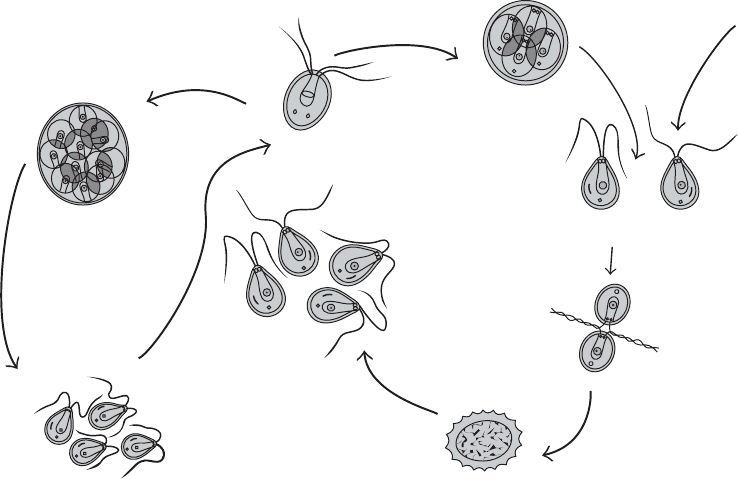
Figure 9.5 Chlamydomonas, a unicellular green alga. Sexual reproduction only occurs
under adverse conditions, resulting in the production of a resistant zygote. When conditions
are favourable, asexual reproduction by means of zoospores predominates
Chlorophytes demonstrate a wide variety of body forms, ranging from unicellular
types to colonial, filamentous, membranous and tubular forms. The vast majority of
species are freshwater aquatic, but a few marine and pseudoterrestrial representatives
exist.
The genus usually chosen to illustrate the unicellular condition in chlorophytes is
Chlamydomonas (Figure 9.5). This has a single chloroplast, similar in structure and
shape to that of a higher plant, and containing a pyrenoid. Situated together at the
anterior end is a pair of smooth or whiplash flagella, whose regular, ordered contractions
propel it through the water. A further structural feature found in Chlamydomonas and
other motile forms of green algae is the stigma or eye-spot; this is made up of granules
of a carotenoid pigment and is at least partially responsible for orienting the cell with
respect to light.
Reproduction in Chlamydomonas and other unicellular types under favourable con-
ditions of light, temperature and nutrients, occurs asexually by the production of
zoospores. A single haploid adult loses its flagella and undergoes mitosis to produce
several daughter cells, which then secrete cell walls and flagella and take up an in-
dependent existence of their own. This can result in a tremendous increase in num-
bers; a single cell can divide as many as eight times in one day. Sexual reproduc-
tion in Chlamydomonas, which occurs when conditions are less favourable, differs
JWBK011-09 JWBK011-Hogg August 12, 2005 19:58 Char Count= 0
‘THE ALGAE’ 219
Daughter colon
y
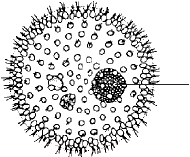
Figure 9.6 Volvox, a colonial green alga. The colony comprises thousands of biflagellated
cells embedded in mucilage. Note the presence of daughter colonies, produced by asexual
reproduction; these are eventually liberated and assume an independent existence
in detail according to the species (Figure 9.5). Any one of the three variants of ga-
mete production seen in the algae may be seen: isogamy, anisogamy and oogamy. In
all cases, two haploid gametes undergo a fusion of both cytoplasm and nuclei to give a
diploid zygote. The gametes may simply be unmodified haploid adult cells, or they may
arise through mitotic cleavage of the adult, depending on the species. The process of
isogamy, where the two gametes are morphologically alike and cannot be differentiated
visually, only occurs in relatively lowly organisms such as Chlamydomonas. In some
species we see the beginnings of sexual differentiation – there are two mating strains,
designated + and −, and fusion will only take place between individuals of opposite
strains. The diploid zygote, once formed, often develops into a tough-walled protective
spore called a zygospore, which tides the organism over conditions of cold or drought.
At an appropriate time the zygospore is stimulated to recommence the life-cycle, and
meiosis occurs, to produce haploid cells, which then mature into adult individuals.
In C. braunii, sexual reproduction is anisogamous; a + strain produces eight mi-
crogametes and a − strain produces four macrogametes. In C. coccifera, simple oogamy
occurs, in which a vegetative cell loses its flagella, rounds off and enlarges; this acts as
the female gamete or ovum, and is fertilised by male gametes formed by other cells.
The next level of organization in the green algae is seen in the colonial types, typified
by Volvox. These, like the unicellular types, are motile by means of flagella, and exist
as a number of cells embedded in a jelly-like matrix (Figure 9.6). Both the number of
cells and the way they are arranged is fixed and characteristic of a particular species.
During growth, the number of cells does not increase. In simpler types, all cells seem to
be identical but in more complex forms there are distinct anterior and posterior ends,
with the stigma more prominent at the anterior, and the posterior cells becoming larger.
Reproduction can occur asexually or sexually.
The diversity of body forms in multicellular chlorophytes referred to earlier is
matched by that of their life cycles. Two examples are described here.
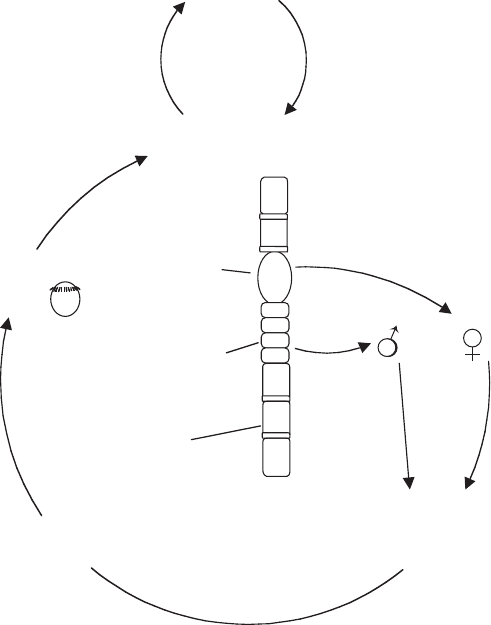
Oedogonium is a filamentous type. When young it attaches to the substratum by
a basal holdfast, but unless it lives in flowing water the adult form is free-floating.
Asexual reproduction occurs by means of motile zoospores, which swim free for around
an hour before becoming fixed to a substratum and developing into a new filament. In
sexual reproduction, the process of sexual differentiation is carried a step further than
we have seen so far, with two separate filaments producing gametes from specialised
cells called gametangia (Figure 9.7). These are morphologically distinct, with the male
being termed an antheridium and the female an oogonium. Gametes (morphologically
JWBK011-09 JWBK011-Hogg August 12, 2005 19:58 Char Count= 0
220 THE PROTISTA
Zoospore
(n)
Fusion
Adult
filament
(n)
Gamete
formation
(n)
Oospore
(zygote)
(2n)
Meiosis
Zoospore
(n)
Antheridia
Oogonium
Vegetative
cells
Figure 9.7 The life cycle of Oedogonium, a filamentous green alga. In the example shown,
gametangia of both sexes are present on the same filament. The oospore (zygote) that re-
sults from the fusion of gametes is the only diploid part of the life cycle. Some species of
Oedogonium have male and female gametangia on separate filaments
distinct: anisogamy) fuse to form a resistant zygote or oospore, which, when conditions
are favourable, undergoes meiosis to produce four haploid zoospores, each of which can
germinate into a young haploid filament. The oospore is thus the only diploid phase in
the life cycle. In Oedogonium there are species with separate male and female filaments
(dioecious) as well as ones with both sexes on the same filament (monoecious).
A second main form of multicellularity in green algae is the parenchymatous state, by
which we mean that the cells divide in more than one plane, giving the plant thickness
as well as length and width. An example of this is Ulva, the sea lettuce, a familiar
sight at the seaside in shallow water, attached to rocks or other objects. Ulva has a flat,
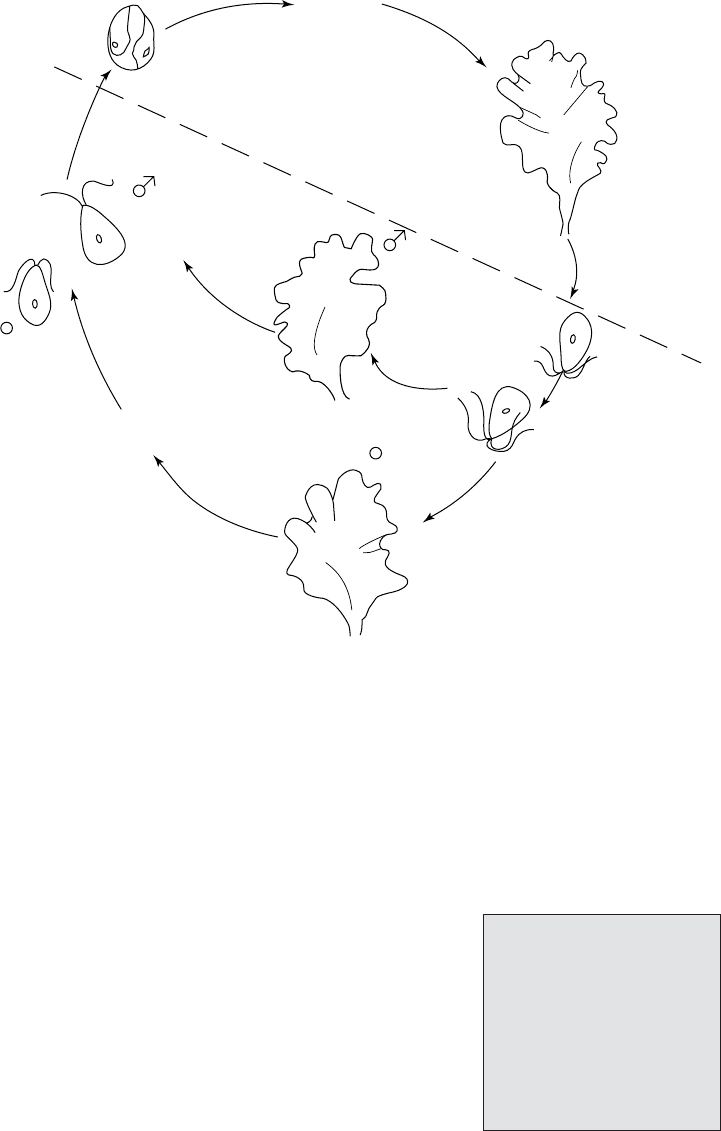
membranous structure, comprising two layers of cells. Reproductively it is of interest
because it features alternation of generations, a feature of all the higher green plants.
This means that both haploid and diploid mature individuals exist in the life cycle.
Gametes are released from one haploid adult and fuse with gametes similarly released
from another to form a zygote (Figure 9.8). In most species of Ulva, the male and
JWBK011-09 JWBK011-Hogg August 12, 2005 19:58 Char Count= 0
‘THE ALGAE’ 221
HAPLOID
GENERATION
DIPLOID
GENERATION
Haploid
Spores
Gametophytes
(2n)
Zygote
(2n)
Sporophyte
(2n)
MITOSIS
MEIOSIS
MITOSIS
Gametes
(2n)
+
+
Figure 9.8 Isomorphic alternation of generations: Ulva. The life cycle of Ulva involves
morphologically identical haploid and diploid plants. Fusion of gametes forms a zygote,
which grows into the mature diploid plant. Meiosis produces haploid zoospores, which give
rise to separate male and female haploid plants
female gametes are morphologically identical (isogamy). The zygote germinates to form
a diploid plant, indistinguishable from the plant that produced the gametes, except for
its complement of chromosomes. When the diploid plant
The sporophyte is the
diploid, spore-forming
stage in a life cycle with
alternation of genera-
tions.
The haploid, gamete-
forming stage is called
the gametophyte
is mature, it produces haploid zoospores by meiosis,
which settle on an appropriate substratum and develop
into haploid Ulva plants. This form of alternation of
generations is called isomorphic, because both haploid
and diploid forms look alike and each assumes an equal
dominance in the life cycle. It is, however, more usual
for alternation of generations to be heteromorphic, with
the sporophyte and the gametophyte being physically
dissimilar, and with one form or other dominating.

JWBK011-09 JWBK011-Hogg August 12, 2005 19:58 Char Count= 0
222 THE PROTISTA
Phaeophyta
The brown algae are multicellular, large and complex seaweeds, which dominate rocky
shores in temperate and polar regions. Apart from one or two freshwater types, they
are all marine. The presence of fucoxanthin masks the presence of chlorophylls a and
c. (In this context it must be stated here that not all ‘brown’ seaweeds look brown, nor
indeed do all the ‘red’ ones look red). Unlike the higher plants and green algae, which
use starch as a food reserve, the phaeophytes use an unusual polysaccharide called
laminarin (β-1,3-glucan).
Thallus is the word used
to describe a simple
vegetative plant body
showing no differentia-
tion into root, stem and
leaf.
The level of tissue organisation in the brown algae is
greatly in advance of any of the types we’ve discussed so
far. The simplest thallus of a brown alga resembles the
most complex found in the greens.
The phaeophytes also represent an advance in terms
of sexual reproduction; here oogamy is the usual state of
affairs and alternation of generations has developed to
such an extent that diploid and haploid stages frequently
assume separate morphological forms. Again, we shall use two examples to illustrate
life cycle diversity in the brown algae.
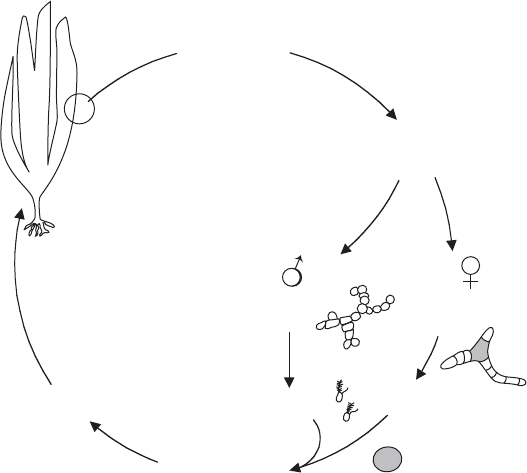
Laminaria is one of the kelps, the largest group of brown algae. It grows attached
to underwater rocks or other objects by means of holdfasts, root-like structures which
anchor the plant. The thallus is further subdivided into a stalk-like stipe and a broader,
blade-like lamina. Reproduction in Laminaria involves sporophyte and gametophyte
plants that are morphologically quite distinct; (heteromorphic alternation of genera-
tions). Reproductive areas called sori develop on the blade of the diploid sporophyte at
certain times of year (Figure 9.9). These consist of many sporangia, interspersed with
thick protective hairs called paraphyses. As the sori develop, meiosis occurs, leading to
the production of haploid zoospores. These in turn develop into haploid filamentous
gametophyte plants, much smaller and quite different in morphology from the more
highly organised sporophyte. Indeed, in contrast to the large sporophyte the gameto-
phyte is a microscopic structure. The gametophytes are dioecious, that is the male and
female reproductive structures are borne on separate individuals. The female plant bears
a number of oogonia, each of which produces a single egg, which escapes through a
pore at the apex of the oogonium, but remains attached in a sort of cup, formed by the
surrounds of the pore. In similar fashion the male plant bears several antheridia, each
liberating a single antherozoid; this however is motile by means of flagella and fertilises
the egg. The diploid zygote so produced grows immediately into a new sporophyte
plant.
In our second example of a phaeophyte life cycle, there is no alternation of generations
at all, the gametophyte generation having been completely lost. The wracks are familiar
seaweeds found in the intertidal zone, and Fucus vesiculosus, known commonly as the
bladder wrack, is one of the best known (Figure 9.10). It gets its name from the air
bladders distributed on its surface, which assist buoyancy.
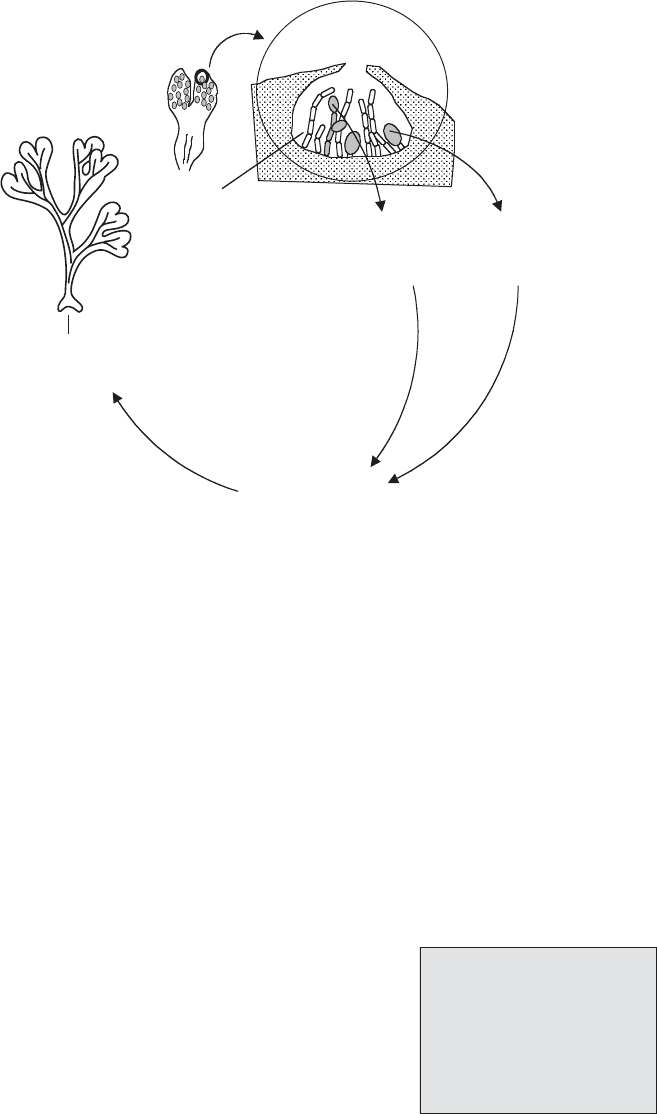
The adult has reproductive structures called receptacles, slight swellings situated at
the tip of the thallus; within these are flask-like invaginations called conceptacles which
contain the male or female gametangia, again interspersed with sterile paraphyses. F.
vesiculosus is monoecious but some other Fucus species are dioecious. Each antheridium
JWBK011-09 JWBK011-Hogg August 12, 2005 19:58 Char Count= 0
‘THE ALGAE’ 223
Sporophyte
(2n)
Zoospores
(n)
Meiosis
Gametophyte
(n)
Gametophyte
(n)
Antherozoid
Egg
Zygote
(2n)
Fertilisation
Figure 9.9 Heteromorphic alternation of generations: Laminaria. The haploid and diploid
generations are morphologically quite distinct: in contrast to the large robust sporophyte,
the gametophyte is a tiny filamentous structure
undergoes meiosis, followed by mitosis to produce 64 antherozoids or sperm, while by
the same means eight eggs are produced in the oogonium. At high tide these gametes are
released into the open water. Fertilisation results in a diploid zygote, which continues to
drift quite free, while secreting a mucilaginous covering. It eventually settles, becoming
anchored by the mucilage, and germinates into an adult individual. Here then, we have
a life cycle in which there is no gametophyte generation, and no specialised asexual
reproduction (although in certain conditions fragments may regenerate to form adults).
Rhodophyta
The red coloration of the rhodophytes is due to the pigments phycoerythrin and phy-
cocyanin, which mask the chlorophylls present, in this case a and d. The biggest single
difference between the red algae and the other groups we have looked at so far is that
they lack flagella at any stage of their life cycle. Thus they are completely lacking in
any motile forms, even in the reproductive stages; the gametes rely on being passively
dispersed. Almost all the red algae are multicellular marine species, inhabiting habitats
ranging from shallow rock pools to the ocean’s deeps.
Life cycles vary considerably, and may be quite complex, with variations on the alter-
nation of generations theme. Several species of the more primitive red algae reproduce
JWBK011-09 JWBK011-Hogg August 12, 2005 19:58 Char Count= 0
224 THE PROTISTA
Antherozoids
(n)
Zygote (2n)
Eggs
(n)
Adult
Fucus
(2n)
Conceptacle
containing
antheridia
and oogoni
a
Receptacle
covered with
conceptacles
Holdfast
Paraphyses
Meiosis
Figure 9.10 Fucus: a life cycle with no haploid plant. The only representatives of the
haploid state in the life cycle of Fucus are the gametes produced by meiosis within the male
and female gametangia
asexually by releasing spores into the water. These attach to an appropriate substrate
and mature into an adult.
Red algae are the source of several complex polysaccharides of commercial value.
Agar and agarose are used in the laboratory in microbial growth media and electrophore-
sis gels respectively, whilst carrageenan is an important thickening agent in the food
industry. In addition, Porphyra species are cultivated in Japan for use in sushi dishes.
‘The Protozoa’
The name Protozoa comes from the Greek, meaning ‘first animal’, and was origi-
nally applied to single-celled organisms regarded as having animal-like characteristics
A commensal lives in
or on another organ-
ism, deriving some ben-
efit from the associa-
tion but not harming the
other party.
(multicellular animals were termed Metazoa). Proto-
zoans as a group have evolved an amazing range of vari-
ations on the single-celled form, particularly with respect
to the different means of achieving movement. They are
a morphologically diverse group of well over 50 000
species; although the majority are free-living, the group
also includes commensal forms and some extremely im-
portant parasites of animals and humans.

JWBK011-09 JWBK011-Hogg August 12, 2005 19:58 Char Count= 0
‘THE PROTOZOA’ 225
Plankton are the float-
ing microscopic organ-
isms of aquatic systems.
Most protozoans are found in freshwater or marine
habitats, where they form a significant component of
plankton, and represent an important link in the food
chain. Although water is essential for the survival of
protozoans, many are terrestrial, living saprobically in
moist soil.
Remember that a protozoan needs to pack all the functions of an entire eucaryotic
organism into a single cell; consequently a protozoan cell may be much more complex
than a single animal cell, which is dedicated to a single function. Thus, protozoans
display most of the typical features of a eucaryotic cell discussed in Chapter 3, but
they may also have evolved certain specialised features. The single cell is bounded by
the typical bilayer membrane discussed earlier, but depending on the type in question,
this may in turn be covered by a variety of organic or inorganic substances to form an
envelope or shell.
The contractile vacuole
is a fluid-filled vacuole in-
volved in the osmoregu-
lation of certain protists.
One of the most characteristic structural features of
protozoans is the contractile vacuole, whose role is to
pump out excess amounts of water that enter the cell by
osmosis. The activity of the contractile vacuole is directly
related to the osmotic potential differential between the
cell and its surroundings. This is vitally important for
freshwater protozoans, since the hypotonic nature of their environment means that
water is continually entering the cell. The contractile vacuole often has a star-shaped
appearance, the radiating arms being canals that drain water from the cytoplasm into
the vacuole.
Most protozoans have a heterotrophic mode of nutrition, typically ingesting par-
ticulate food such as bacteria, and digesting them in phagocytic vacuoles. Since they
actively ‘hunt’ their food rather than simply absorbing it across the cell surface, it is
not surprising that the majority of protozoans are capable of movement. The structural
features used to achieve locomotion (e.g. cilia, flagella) are among the characteristics
used to classify the protozoans.
We shall now examine the characteristics of the principal groupings into which the
protozoans have traditionally been divided. It should be repeated, however, that the Pro-
tozoa do not represent a coherent taxonomic grouping with a common ancestor, but
rather a phylogenetically diverse collection of species with certain features in common.
Indeed, each of the four groups is now regarded as having a closer evolutionary rela-
tionship with certain ‘algal’ groups than with each other. See Figure 9.18 for a modern
view of how the various taxonomic groupings of protozoans are related.
The zooflagellates (Mastigophora)
Members of this, the biggest and most primitive group of protozoans, are characterised
by the long flagellum (mastigos = ‘a whip’), by which they propel themselves around.
Although typical zooflagellates have a single flagellum, some types possess several. The
prefix ‘zoo-’ distinguishes them from plant-like flagellates such as Euglena, but as we
have already mentioned, such a distinction is not necessarily warranted on molecular
and structural grounds (see the end of this chapter).
JWBK011-09 JWBK011-Hogg August 12, 2005 19:58 Char Count= 0
226 THE PROTISTA
Kinetoplast
Nucleus
Undulating membrane
Flagellum
Figure 9.11 Trypanosoma, a zooflagellate. The kinetoplast is contained within a single
large mitochondrion that runs almost the entire length of the cell (not shown). The flagellum
is continuous with the undulating membrane. From Baron, EJ, Chang, RS, Howard, DH,
Miller, JN & Turner, JA: Medical Microbiology: A Short Course, John Wiley & Sons Inc.,
1994. Reproduced by permission of the publishers
A kinetoplast is a spe-
cialised structure within
the mitochondria of cer-
tain flagellated proto-
zoans, and is the site of
their mitochondrial DNA.
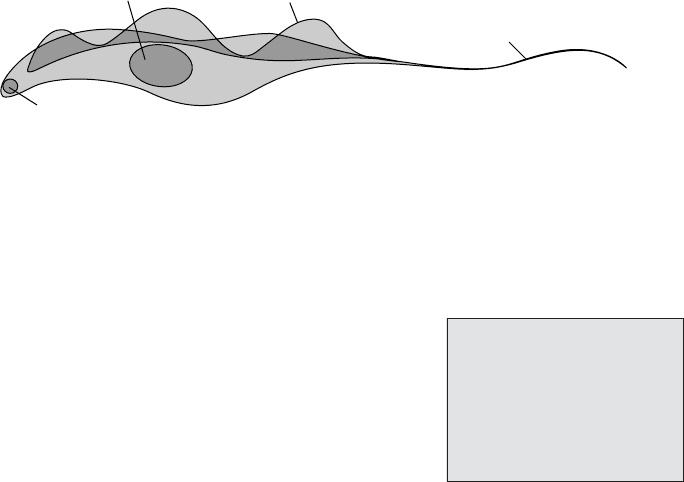
Zooflagellates may be free-living, symbiotic or para-
sitic. An example of the latter is the causative agent of
African sleeping sickness in humans, Trypanosoma bru-
cei (Figure 9.11). This belongs to the kinetoplastids, a
group characterised by the possession of a unique or-
ganelle called the kinetoplast, found within the cell’s
single, large, tubular mitochondrion, and containing its
own DNA. The flagellum extends back to form the edge
of a long, undulating membrane that gives Trypanosoma its characteristic locomotion.
The infectious form of T. brucei develops in the salivary glands of the intermediate
host, the tsetse fly, and is passed to the human host when a bite punctures the skin.
Here, it eventually reaches the central nervous system by way of the blood or lymphatic
systems. Inflammation of the brain and spinal cord results in the characteristic lethargy,
coma and eventual death of the patient.
Reproduction in the zooflagellates is generally by binary fission. In the case of T.
brucei, this occurs both in the human host and in the gut of the tsetse fly, from which it
migrates to the salivary glands to complete its life-cycle.
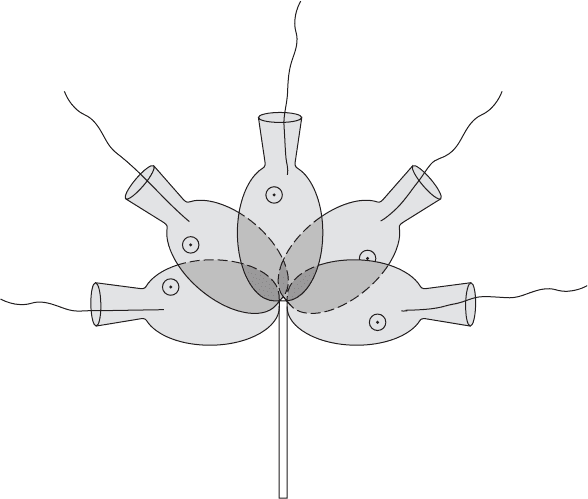
The choanoflagellates (Figure 9.12) are a group of zooflagellates of particular in-
terest, as it is thought that they represent the closest single-celled relatives of animals.
They possess a ‘collar’ of microvilli that surrounds the base of a single flagellum, an
arrangement that is also seen in the simplest multicellular animals, the sponges. This
connection is made even more apparent in colonial forms of choanoflagellates, and is
supported by molecular evidence. Also, both choanoflagellates and animals share the
flat, lamellar type of cristae in their mitochondria.
A third group of zooflagellates worthy of note are the diplomonads. These have two
nuclei per cell and multiple flagella, but their most remarkable feature is that they do not
apparently possess any mitochondria (but see Chapter 3). Giardia lamblia, the causative
agent of the intestinal disease giardiasis, is a member of this group. Unlike Trypanosoma,
Giardia does not have a secondary host, but survives outside the body as a resistant cyst,
before it is taken up again in infected water. The diplomonads occupy a very distant
branch of suggested phylogenetic trees from the kinetoplastids and choanoflagellates
(see Figure 9.18). The parabasalians are another group of amitochondriate flagellates,
whose best-known member is Trichomonas vaginalis, a cause of infections of the female
urogenital tract.
JWBK011-09 JWBK011-Hogg August 12, 2005 19:58 Char Count= 0
‘THE PROTOZOA’ 227
Figure 9.12 Choanoflagellates are free-living zooflagellates characterised by a collar of ten-
tacles or microvilli that surround the single flagellum. Choanoflagellates are often colonial,
as in the example shown
The ciliates (Ciliophora)
The largest group of protozoans, the ciliates, are also the most complex, showing the
highest level of internal organisation in any single-celled organism. Most are free-living
types such as Paramecium (Figure 9.13), and as the name suggests, they are characterised
by the possession of cilia, which may be present all over the cell surface or arranged in
rows or bands. They beat in a co-ordinated fashion to propel the organism, or assist in
the ingestion of food particles.
A unique feature of the ciliates is that they possess two distinct types of nuclei
(Box 9.3):
r
macronuclei are concerned with encoding the enzymes and other proteins required
for the cell’s essential metabolic processes. They are polyploid, containing many
copies of the genome.
r
micronuclei, of which there may be as many as 80 per cell, are involved solely in
sexual reproduction by conjugation.
As might be expected, removal of the macronucleus leads quickly to the death of the
cell; however, cells lacking micronuclei can continue to live, and reproduce asexually
by binary fission.