
Hogg S. Essential microbiology
Подождите немного. Документ загружается.

JWBK011-10 JWBK011-Hogg August 12, 2005 19:20 Char Count= 0
248 VIRUSES
Bacterial
division
Prophage replicated
along with bacterial
DNA
Phage DNA injected
into host cell
LYSOGENIC
PATHWAY
Phage DNA integrates
into host
chromosome as
prophage
LYTIC
PATHWAY
Phage DNA replicates
Lysis of host cell
Synthesis of
new phage
p
articles
INDUCTION:
excision of
p
rophage
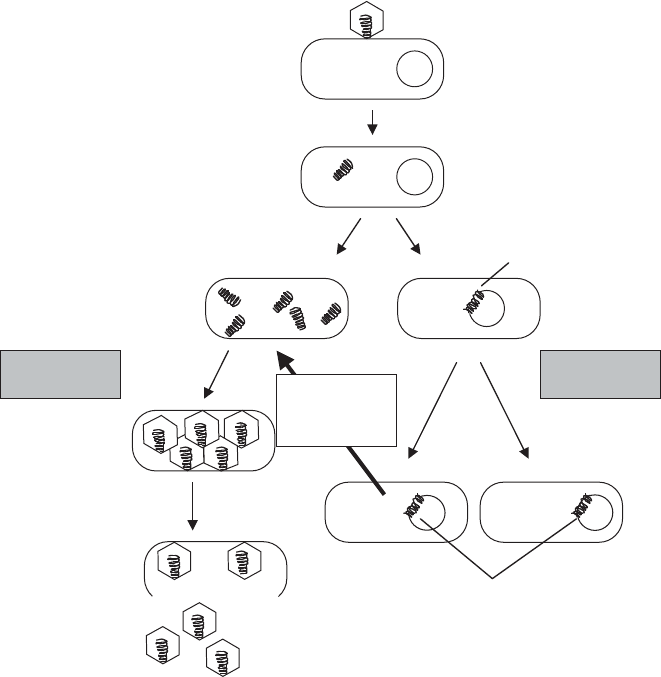
Figure 10.11 Replication cycle of a temperate phage. In the lysogenic pathway, the phage
DNA is integrated as a prophage into the host genome, and replicated along with it. Upon
induction by an appropriate stimulus, the phage DNA is removed and enters a lytic cycle
Lysogenic replication cycle
Phages such as T4, which cause the lysis of their cells, are termed virulent phages.
Temperate phages, in addition to following a lytic cycle as outlined above, are able to
undergo an alternative form of growth cycle. Here, the phage DNA actually becomes
incorporated into the host’s genome as a prophage (Figure 10.11). In this condition of
lysogeny, the host cell suffers no harm. This is because the action of repressor proteins,
encoded by the phage, prevents most of the other phage genes being transcribed. These
genes are, however, replicated along with the bacterial chromosome, so all the bacterial
offspring contain the incorporated prophage. The lysogenic state is ended when the
survival of the host cell is threatened, usually by an environmental factor such as UV
light or a chemical mutagen. Inactivation of the repressor protein allows the phage DNA
to be excised, and adopt a circular form in the cytoplasm. In this form, it initiates a
JWBK011-10 JWBK011-Hogg August 12, 2005 19:20 Char Count= 0
VIRAL REPLICATION CYCLES 249
lytic cycle, resulting in destruction of the host cell. An example of a temperate phage is
bacteriophage λ (Lambda), which infects certain strains of E. coli. Bacterial strains that
can incorporate phage DNA in this way are termed lysogens.
Replication cycles in animal viruses
Viruses that infect multicellular organisms such as animals may be specific not only to
a particular organism, but also to a particular cell or tissue type. This is known as the
tissue tropism of the virus, and is due to the fact that attachment occurs via specific
receptors on the host cell surface.
The growth cycles of animal viruses have the same main stages as described for
bacteriophages (Figure 10.7), but may differ a good deal in some of the details. Most of
these variations are a reflection of differences in structure between bacterial and animal
host cells.
Adsorption and penetration
Animal viruses do not have the head and tail structure of phages, so it follows that
their method of attachment is different. The specific interaction with a host receptor is
made via some component of the capsid, or, in the case of enveloped viruses, by special
structures such as spikes (peplomers). Viral attachment sites can frequently be blocked
by host antibody molecules; however some viruses (e.g. the rhinoviruses) have overcome
this by having their sites situated in deep depressions, inaccessible to the antibodies.
Whereas bacteriophages inject their nucleic acid component from the outside, the
process in animal viruses is more complex, a fact reflected in the time taken for com-
pletion of the process. Animal viruses do not have to cope with a thick cell wall, and
in many such cases the entire virion is internalised. This necessitates the extra step of
uncoating, a process carried out by host enzymes. Many animal viruses possess an en-
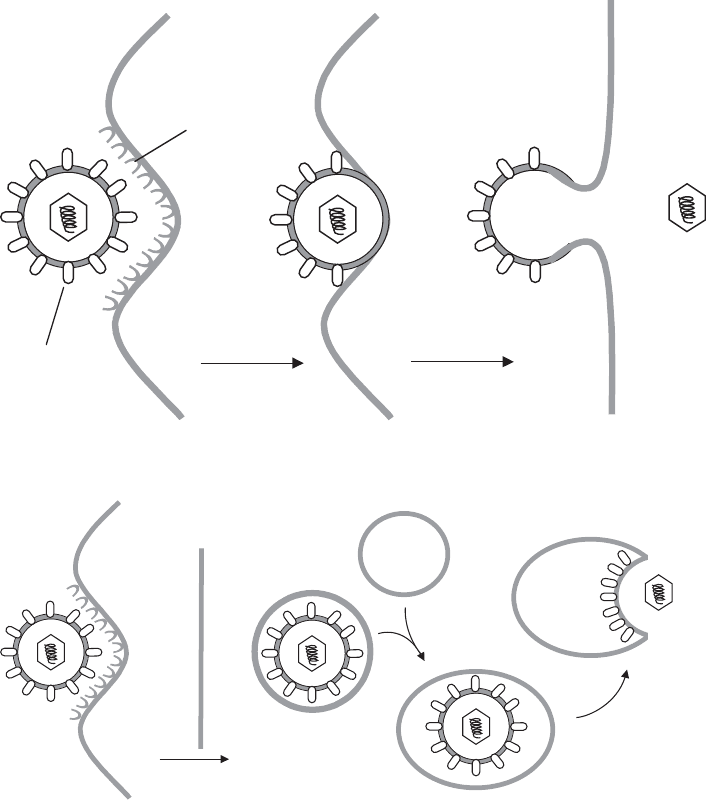
velope; such viruses are taken into the cell either by fusion with the cell membrane, or
by endocytosis (Figure 10.12). While some non-enveloped types release only their nu-
cleic acid component into the cytoplasm, others require additionally that virus-encoded
enzymes be introduced to ensure successful replication.
Replication (DNA viruses)
The DNA of animal cells, unlike that of bacteria, is compartmentalised within a nucleus,
and it is here that replication and transcription of viral DNA generally occur
∗
. Messenger
RNA then passes to ribosomes in the cytoplasm for translation (Figure 10.13). In the
case of viruses with a ssDNA genome, a double-stranded intermediate is formed, which
serves as a template for mRNA synthesis.
Assembly
Translation products are finally returned to the nucleus for assembly into new virus
particles.
∗
Poxviruses are an exception. Both replication and assembly occur in the cytoplasm.
JWBK011-10 JWBK011-Hogg August 12, 2005 19:20 Char Count= 0
250 VIRUSES
Receptors
on host
membrane
Spikes
Fusion of envelope
with host membrane
Release of nucleocapsid
into cell
a)
Endosome
Fusion with endosome
Low pH in
endosome
causes fusion o
f
viral envelope
with endosomal
membrane and
release of
nucleocapsid
Virus taken up and
surrounded by cell
membrane to form
an endocytic vesicle
b)
Figure 10.12 Enveloped viruses enter the host cell by fusion or endocytosis. (a) Fusion
between viral envelope and host membrane results in release of nucleocapsid into the cell.
Fusion depends on the interaction between spikes in the envelope and specific surface re-
ceptors. (b) Viral particles bound to the plasma membrane are internalised by endocytosis.
Acidification within the endosome allows the release of the nucleocapsid into the cell
JWBK011-10 JWBK011-Hogg August 12, 2005 19:20 Char Count= 0
VIRAL REPLICATION CYCLES 251
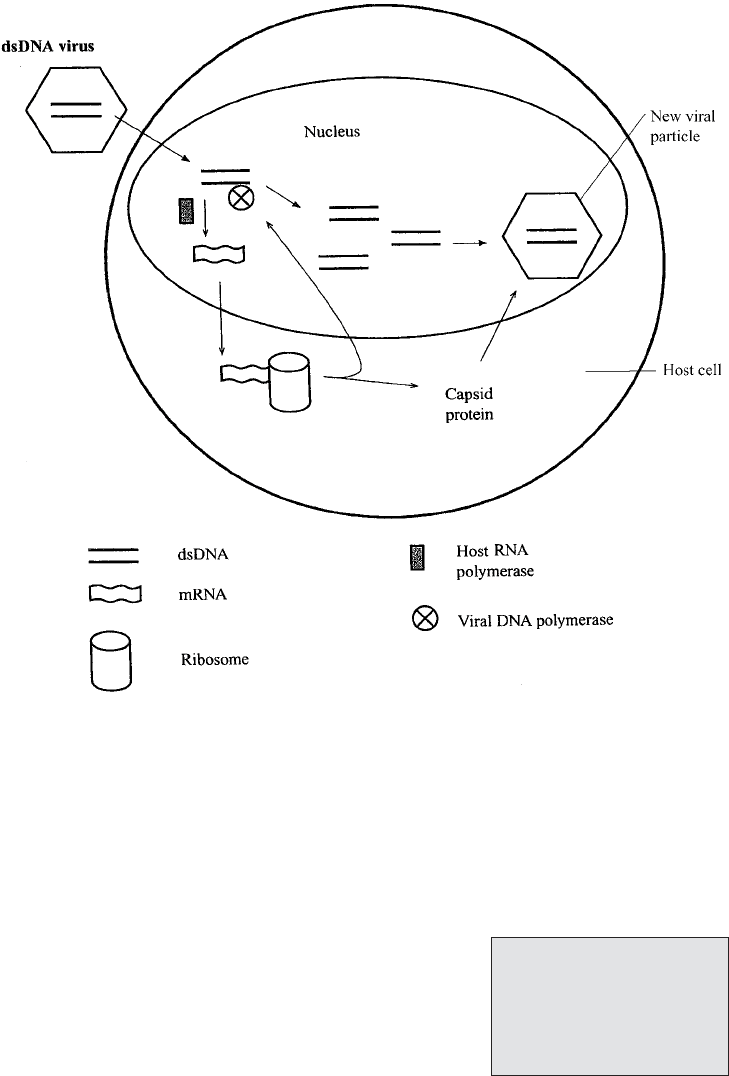
Figure 10.13 Replication in dsDNA viruses. Replication of viral DNA and transcription
to mRNA take place in the nucleus of the host cell. The mRNA then passes out into the
cytoplasm, where protein synthesis occurs on ribosomes. The capsid protein so produced
returns to the nucleus for assembly into new viral particles. Newly synthesised DNA poly-
merase also returns to the nucleus, for further DNA replication. From Hardy, SP: Human
Microbiology, Taylor and Francis, 2002. Reproduced by permission of Thomson Publishing
Services
Release
Herpesviruses are un-
usual in deriving their en-
velope from the nuclear,
rather than cytoplasmic
membrane.
Naked (non-enveloped) viruses are generally released by
lysis of the host cell. In the case of enveloped forms,
release is more gradual. The host’s plasma membrane
is modified by the insertion of virus-encoded proteins,
before engulfing the virus particle and releasing it by a
process of budding. This can be seen as essentially the
reverse of the process of internalisation by fusion (Figure
10.12a).
JWBK011-10 JWBK011-Hogg August 12, 2005 19:20 Char Count= 0
252 VIRUSES
Replication of RNA viruses
The phage and animal virus growth cycles we have described so far have all involved
double-stranded DNA genomes. As you will remember from the start of this chapter,
however, many viruses contain RNA instead of DNA as their genetic material, and we
now need to consider briefly how these viruses complete their replication cycles.
Replication of RNA viruses occurs in the cytoplasm of the host; depending on
whether the RNA is single- or double-stranded, and (+)or(−) sense, the details differ.
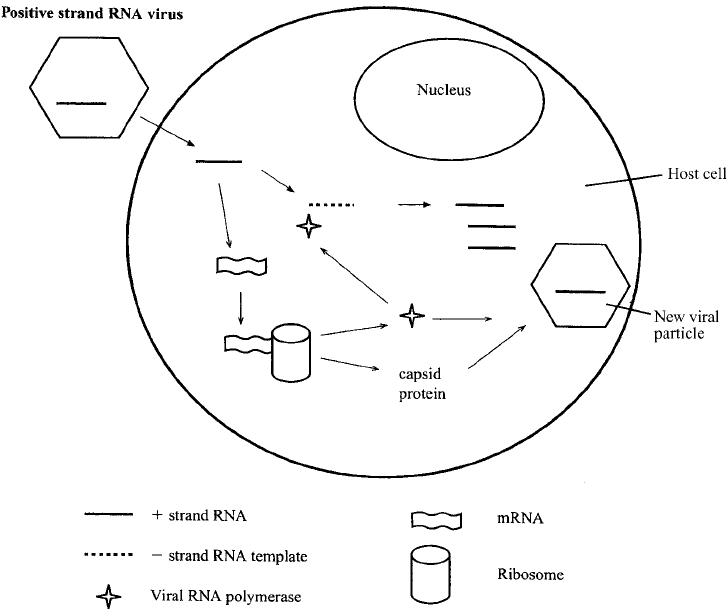
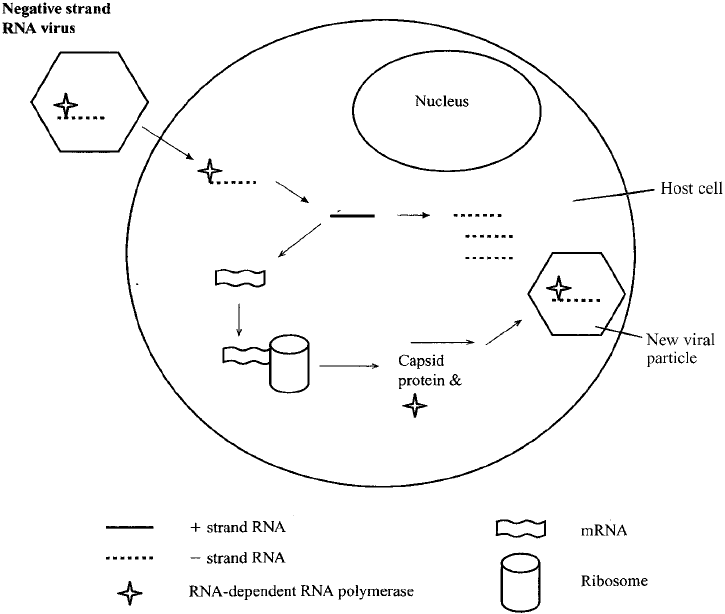
The genome of a (+) sense single stranded RNA virus functions directly as an mRNA
molecule, producing a giant polyprotein, which is then cleaved into the various struc-
tural and functional proteins of the virus. In order for the (+) sense RNA to be replicated,
a complementary (−) sense strand must be made, which acts as a template for the pro-
duction of more (+) sense RNA (Figure 10.14). The RNA of a (−) sense RNA virus
must first act as a template for the formation of its complementary sequence by a virally
encoded RNA polymerase. The (+) sense RNA so formed has two functions: (i) to act
Figure 10.14 Replication in (+) sense single-stranded RNA viruses. On entering the cell,
the (+) sense ssRNA genome is able to act directly as mRNA, directing the synthesis of capsid
protein and RNA polymerase. In addition, it replicates itself, being converted firstly into a
(−) sense ssRNA intermediate. All steps take place outside of the nucleus. From Hardy, SP:
Human Microbiology, Taylor and Francis, 2002. Reproduced by permission of Thomson
Publishing Services
JWBK011-10 JWBK011-Hogg August 12, 2005 19:20 Char Count= 0
VIRAL REPLICATION CYCLES 253
as mRNA and undergo translation into the virus’s various proteins, and (ii) to act as
template for the production of more genomic (−) sense RNA (Figure 10.15).
Double-stranded RNA viruses are all segmented. They form separate mRNAs for
each of their proteins by transcription of the (−) strand of their genome. These are each
translated, and later form an aggregate (subviral particle) with specific proteins, where
they act as templates for the synthesis of a double-stranded RNA genome, ready for
incorporation into a new viral particle.
Two final, rather complicated, variations on the viral replication cycles involve the
enzyme reverse transcriptase, first discovered in 1970 (see Box 10.3)
Retroviruses
These viruses, which include some important human pathogens, have a genome that
exists as RNA and DNA at different part of their replication cycle. Retroviruses have
a(+) sense ss-RNA genome which is unique among viruses in being diploid. The two
copies of the genome serve as templates for the enzyme reverse transcriptase to produce
Figure 10.15 Replication in (−) sense single-stranded RNA viruses. Before it can function
as mRNA, the (−) sense ssRNA must be converted to its complementary (+) sense sequence.
This serves both as mRNA and as template for the production of new (−) sense ssRNA
genomes. From Hardy, SP: Human Microbiology, Taylor and Francis, 2002. Reproduced by
permission of Thomson Publishing Services
JWBK011-10 JWBK011-Hogg August 12, 2005 19:20 Char Count= 0
254 VIRUSES
Box 10.3 The enzyme that breaks the rules
The discovery in 1970 of an enzyme that could convert an RNA template into DNA
caused great surprise in the scientific world. The action of this reverse transcriptase
or RNA-dependent DNA polymerase is a startling exception to the ‘central dogma’
of molecular biology, that the flow of genetic information is unidirectional, from DNA
to RNA to protein (see Chapter 11). This in its revised form can be represented:
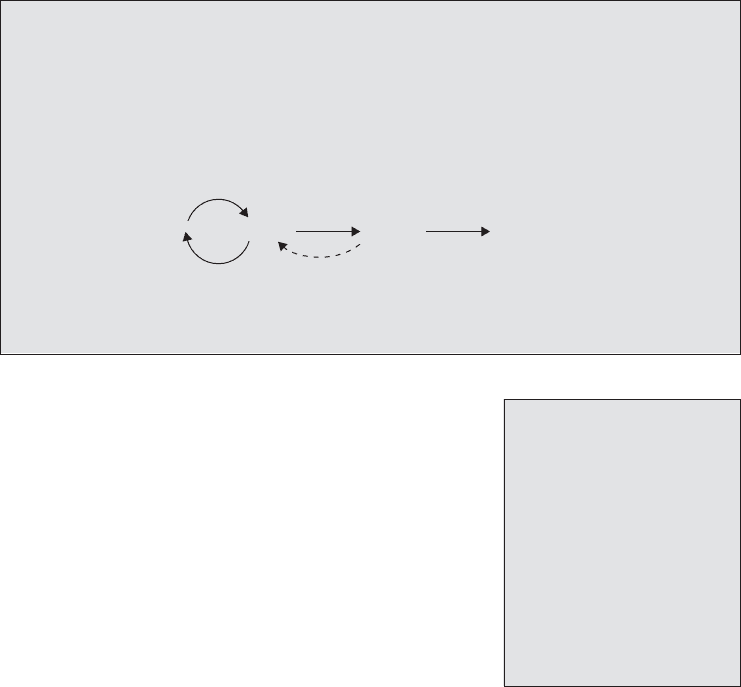
DNA RNA Protein
(The circular arrow to the left denotes DNA’s ability to be replicated; the dotted
arrow represents the action of reverse transcriptase.)
Incorporation of retrovi-
ral DNA into the host
genome parallels the
integration seen in lyso-
genic phage growth
cycles. Unlike the pro-
phage, however, the
provirus is not capable
of a separate existence
away from the host chro-
mosome.
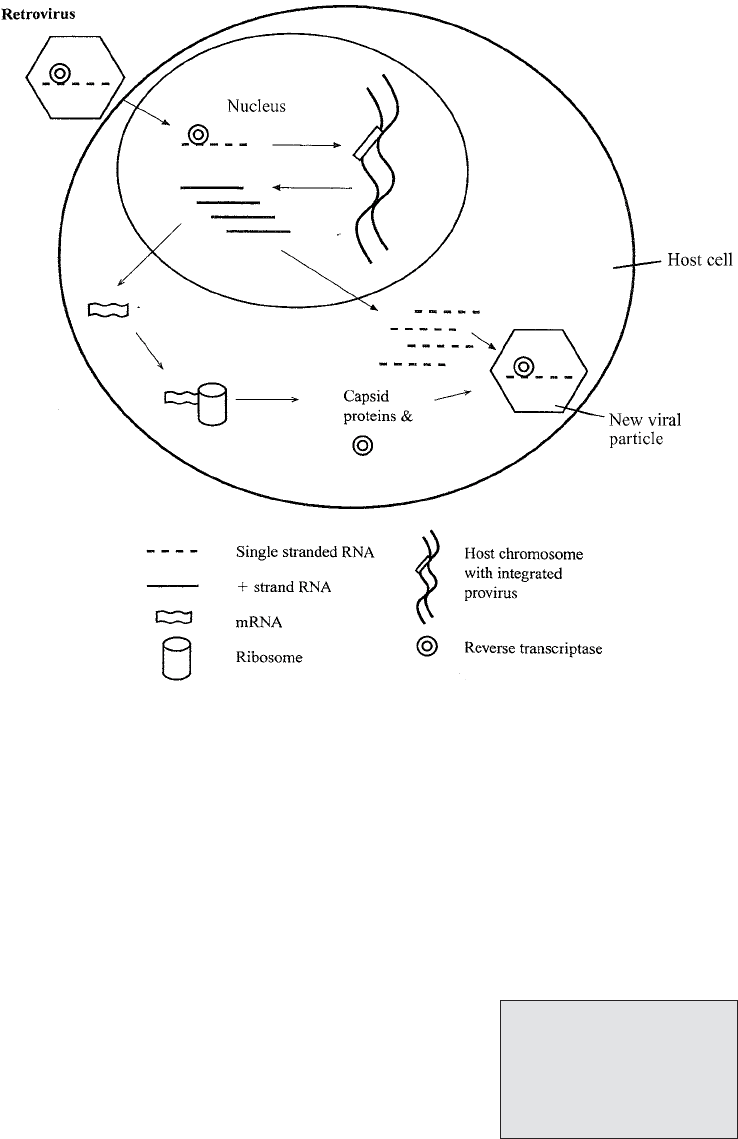
a complementary strand of DNA. The RNA component
of this hybrid is then degraded, allowing the synthesis
of a second strand of DNA. This proviral DNA passes
to the nucleus, where it is incorporated into the host’s
genome (Figure 10.16). Transcription by means of a host
RNA polymerase results in mRNA, which is translated
into viral proteins and also serves as genomic material
for the new retrovirus particles. The human immunod-
eficiency virus (HIV), the causative agent of acquired
immune deficiency syndrome, is an important example
of a retrovirus.
Hepadnaviruses
In two families of viruses (hepadnaviruses and caulimoviruses), DNA and RNA phases
again alternate, but their order of appearance is reversed, so that a dsDNA genome
is produced. This is made possible by reverse transcriptase occurring at a later stage,
during the maturation of the virus particle.
Replication cycles in plant viruses
Viral infections of plants can be spread by one of two principal pathways. Horizontal
transmission is the introduction of a virus from the outside, and typically involves insect
vectors, which use their mouthparts to penetrate the cell wall and introduce the virus.
This form of transmission can also occur by means of inanimate objects such as garden
tools. In vertical transmission, the virus is passed from a plant to its offspring, either by
asexual propagation or through infected seeds.
The majority of plant viruses discovered so far have an RNA genome, although DNA
forms such as the caulimoviruses (see above) are also known. Replication is similar
to that of animal viruses, depending on the nature of the viral genome. An infection
only becomes significant if it spreads throughout the plant (a systemic infection). Viral
JWBK011-10 JWBK011-Hogg August 12, 2005 19:20 Char Count= 0
VIROIDS 255
Figure 10.16 Replication in retroviruses. Reverse transcriptase makes a DNA copy of
the single-stranded RNA retroviral genome. This is integrated into the host genome and is
transcribed by the cellular machinery. Messenger RNA passes out to the ribosomes, where
translation into viral coat proteins and more reverse transcriptase occurs. Retrovirus pack-
aging takes place outside the nucleus. From Hardy, SP: Human Microbiology, Taylor and
Francis, 2002. Reproduced by permission of Thomson Publishing Services
particles do this by moving through the plasmodesmata, naturally occurring cytoplasmic
strands linking adjacent plant cells.
Viroids
A viroid is a plant patho-
gen that comprises only
ssRNA and does not
code for a protein prod-
uct.
In 1971, Theodor Diener proposed the name viroid
to describe a newly discovered pathogen of potatoes.
Viroids are many times smaller than the smallest virus,
and consist solely of a small circle of ssRNA containing

JWBK011-10 JWBK011-Hogg August 12, 2005 19:20 Char Count= 0
256 VIRUSES
some 300–400 nucleotide bases and no protein coat. Enzymes in the host’s nucleus are
used to replicate the RNA, which does not appear to be translated into protein. Ap-
preciable sequence homology suggests that viroids arose from transposable elements
(see Chapter 11), segments of DNA capable of movement within or between DNA
molecules. To date, viroids have only been found in plants, where they cause a variety
of diseases.
Prions
A prion (=proteinaceous
infectious particle) is a
self-replicating protein
responsible for a range
of neurodegenerative
disorders in humans and
mammals.
A decade after the discovery of viroids, Stanley Prusiner
made the startling claim that scrapie, a neurodegener-
ative disease of sheep, was caused by a self-replicating
agent composed solely of protein. He called this type of
entity a prion, and in the years which followed, other,
related, diseases of humans and animals were shown to
have a similar cause. These include bovine spongiform
encephalopathy (BSE, ‘mad cow disease’) and its human
equivalent, Creutzfeldt–Jakob disease.
How could something that contains no nucleic acid be capable of replicating itself? –
Prusiner’s idea seemed to go against the basic rules of biology. It appears that prions may
be altered versions of normal animal proteins, and somehow have the ability to cause
the normal version to refold itself into the mutant form. Thus the prion propagates itself.
All prion diseases described thus far are similar conditions, involving a degeneration of
brain tissue.
Cultivating viruses
Whilst the growth of bacteria in the laboratory generally demands only a supply of
the relevant nutrients and appropriate environmental conditions, maintaining viruses
presents special challenges. Think back to the start of this chapter, and you will realise
why this is so; all viruses are obligate intracellular parasites, and therefore need an
appropriate host cell if they are to replicate.
Bacteriophages, for example, are grown in culture with their bacterial hosts. Stock
cultures of phages are prepared by allowing them to infect a broth culture of the appro-
priate bacterium. Successful propagation of phages results in a clearing of the culture’s
turbidity; centrifugation removes any remaining bacteria, leaving the phage particles in
the supernatant. A quantitative measure of phages, known as the titre, can be obtained
by mixing them with a much greater number of bacteria and immobilising them in agar.
Due to their numbers, the bacteria grow as a confluent lawn. Some become infected
by phage, and when new viral particles are released following lysis of their host, they
infect more host cells. Because they are immobilised in agar, the phages are only able to
infect cells in the immediate vicinity. As more and more cells in the same area are lysed,
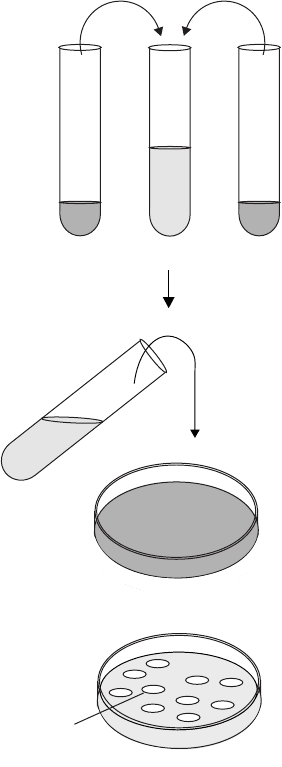
an area of clearing called a plaque appears in the lawn of bacteria (Figure 10.17).
Quantification is based on the assumption that each visible plaque arises from
JWBK011-10 JWBK011-Hogg August 12, 2005 19:20 Char Count= 0
CULTIVATING VIRUSES 257
Top agar
Bacteria
plaques
Mix
Pour onto
agar plate
Bacteriophage
suspension
Figure 10.17 The plaque assay for bacteriophages. The number of particles in a phage
preparation can be estimated by means of a plaque assay. Phages and bacteria are mixed
in a soft agar then poured onto the surface of an agar plate. Bacteria grow to develop a
confluent lawn, and the presence of phage is indicated by areas of clearing (plaques) where
bacteria have been lysed. From Reece, RJ: Analysis of Genes and Genomes, John Wiley &
Sons, 2003. Reproduced by permission of the publishers
infection by a single phage particle. Thus, we speak of plaque-forming units (pfu: see
Box 10.4).
Animal viruses used to be propagated in the host animal; clearly there are limitations
to this, not least when the host is human! One of the major breakthroughs in the field of
virus cultivation was made in 1931 when it was shown by Alice Woodruff and Ernest
Goodpasture that fertilised chicken’s eggs could serve as a host for a number of animal