
Kallen A. Understanding Biostatistics
Подождите немного. Документ загружается.

THE STUDY, OR PLACEBO, EFFECT 69
What is involved with the placebo effect can be, and is, disputed.
•
If you are medically inclined you may say that by taking care, you start physiological
and psychological effects in the patient which improve the condition. Patient expectation
may, for example, trigger the production of certain painkillers (endorphins, enkephalins)
in the brain.
•
If you are less medically, and instead more statistically, inclined you may say that what
is observed is largely the natural course of the disease; that what is involved is the
general phenomenon of regression to the mean, which we will discuss in more detail
in Section 7.5. With a fluctuating condition, if you assess it when it is in a bad state,
you expect it to improve. On the other hand, if you assess it in a good state, you expect
a deterioration to follow. Patients more often seek medical advice when in the former
state than when in the latter.
In a clinical study there is a protocol which defines which patients to include, and in many
cases these inclusion criteria are such that patients are enrolled into the study when they are
symptomatic. Once in the study, the study procedures and the interest the patients generate
with the doctors and nurses may make them improve. As a consequence of participating in a
study they may also, at least for a while, change their lifestyle in a way that has a beneficial
effect on their underlying condition. Each study protocol therefore implies some kind of study
effect. This is why it is usually not appropriate to assess the benefit of a particular treatment by
comparing the pre-treatment state to the post-treatment state alone. It is, however, appropriate
to compare the change in the outcome variable from pre-treatment to post-treatment between
the two groups. But there must be something in the design that provides information on the
non-treatment related effects of participation in the particular study. This is typically achieved
by having a control group, and such studies are said to be controlled studies.
If we want to assess the absolute efficacy of a drug, the control arm should only contain a
placebo treatment, where placebo refers to an inert substance, a ‘dummy pill’, that is intended
to be indistinguishable from the active drug. To be fully successful it should be identical
in all aspects, except for the active ingredient. A study which investigates the effect of a
drug can often accomplish a placebo treatment, whereas other treatments such as counseling,
physiotherapy, or acupuncture may well struggle to do so, with consequential uncertainty
about the interpretation of the results.
That a study is placebo-controlled does not necessarily mean that there is a group that gets
no treatment other than a sugar pill. What it means is that there is a group which receives a
placebo corresponding to the drug given in the other treatment group. All patients in the study
may be on some other background medication, either protocol specified or the treatment the
patient had at enrollment. However, formally, the meaning of the drug’s absolute effect is
what the drug accomplishes compared to a situation when no drug is given. In the presence
of a background medication in the study, what is measured is not the full effect of the drug,
but the add-on effect over and above this background medication.
Blinding and placebo control can be more or less complicated, and it may be that the
only way to accomplish this will in some ways compromise the ultimate purpose of the
study. On occasion a drug developer may want to compare a formulation of a drug that can
be given once daily to one that needs to be given twice daily. The main argument for why
a once daily formulation may be better is that it may improve compliance, since the patient
may miss fewer doses. However, if we design a blind placebo controlled study to study this,

70 STUDY DESIGN AND THE BIAS ISSUE
Box 3.7 Quality scoring of clinical trials: the Jadad scale
The Jadad scale is a (not uncontroversial) procedure to independently assess the method-
ological quality of a clinical trial. The system was designed by the Colombian physician
Alejandro Jadad-Bechara with the aim of assigning a score between 0 (very poor) and
5 (rigorous) to how well potential methodological errors have been take account of.
To form the Jadad score for a given paper one answers the following three questions
on its content:
1. Was the study described as randomized? If yes, score 1 point. If, in addition, the
method of randomization was described in the paper, subtract 1 point if the method
was inappropriate, but add 1 point if it was appropriate.
2. Was the study described as double-blind? If yes, score 1 point. If, in addition, the
method of blinding was described in the paper and it was appropriate you add
1 point; if it was inappropriate you subtract 1 point instead.
3. Was there a description of withdrawals and dropouts? If yes, score 1 point.
The result is a score between 0 and 5.
we need the patients randomized to the once daily arm to also receive a placebo at the other
occasion when the twice daily arm should take medicine. That would take away (some of) the
advantage of the once daily administration. One remedy for this would be to introduce two
placebo groups, one with a once daily treatment and one with a twice daily treatment. The
patients are then randomized to one of four treatments, but they are only pairwise blinded: the
once daily to its placebo and the twice daily to its placebo. The comparison between the once
daily and the twice daily administration then goes via comparison of active to its placebo.
In this context we should also mention the double-dummy technique. If we want to compare
two drugs, which come in forms that are distinguishable, for example tablets that look or taste
differently, we need to produce a placebo for each of them. In order to be blinded each patient
needs to take two tablets, one of which contains an active ingredient and the other does not.
In summary, the state-of-the-art clinical study design is the controlled, double-blind, ran-
domized study. In fact, one way to assess the quality of a report of a clinical trial is to score
how these key elements are described in the publication, as exemplified by the Jadad scale
described in Box 3.7. Such scoring may be useful when one wants to perform meta-analysis
of many small trials in order to provide ‘evidence-based medical proof’. But they have many
weaknesses as well; the Jadad scale says nothing about the quality of the conduct or the
statistical analysis of the study. It is primarily about the design elements.
3.7 The curse of missing values
The state-of-the-art clinical study design is the controlled, double-blind, randomized study.
But even the best-designed study will need to face reality, and in real life, as any military
commander will tell you, the best laid plans will fail to some extent.
THE CURSE OF MISSING VALUES 71
Ideally, all participants in a trial should follow the protocol, complete the study, and
provide data at all time-points they are measured on all the outcomes of interest. In reality,
we are likely to end up with some missing data in the data sets that form the basis for the
statistical analysis. Data can be missing because patients withdraw early from the study for
one reason or another, or because some assessments were simply missed, either deliberately
or accidentally. Alternatively, measurements may have failed for some, possibly technical,
reason. The actual reason why a particular piece of data is missing has consequences for what
bias its omission may entail. In this section we will focus primarily on data that are missing
because patients prematurely discontinued the study. This means that data are missing after
the last observed data value. No other data are missing.
There are many reasons why patients may choose to withdraw from a study they have
agreed to participate in. Some of the reasons may be unrelated to the treatment: the patient
may have a new job in another town, or have been offered a last-minute trip to some holiday
resort. It may even be that the patient dislikes the investigator. But more commonly, patients
discontinue either because they experience some adverse event during the study, or because
they do not feel the treatment is making them any better and therefore want to return to standard
care. On occasion they may discontinue because they actually have recovered. Whatever the
reason for discontinuing the study, the data the patient should have produced after the point
of discontinuation are missing.
In most clinical studies the data analysis is done on the outcomes recorded at the end of the
treatment period. Randomization guarantees that we have comparable groups when we start
the experiment, but as patients withdraw the groups shrink to subgroups of the groups that
started the study. This means that there has been a selection process operating on the patients
during the course of the study. This selection mechanism can differ between the groups, as a
result of which they may no longer be comparable at the end of the study – when we analyze
the data.
To take a simple example, assume the new drug is effective in improving some symptoms
of a disease, and that when patients feel that their condition is worsening, they tend to withdraw
from the study. Assume that the disease we study varies in severity between patients, and that
patients with severe symptoms are more likely to withdraw from the study. At the end of the
study we then find an over-representation of patients with a more severe disease (as measured
at baseline) in the active group than in the placebo group. The effect we measure may therefore
be affected by selection bias. Perhaps we have comparable groups in terms of disease severity
at the end of the treatment period, taking treatment effect into account, but that is not what
we are interested in.
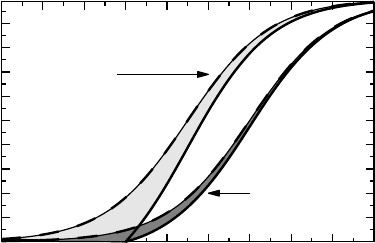
To illustrate this graphically, consider Figure 3.1 which is a simplified version of the
discussion. There are two curves for the placebo group and two curves for the active group.
One curve is dashed, one is solid. The two dashed curves show the true distributions of the
response (change from baseline in some outcome variable) for the groups. The difference
between the dashed curves is therefore the true effect of the drug, which corresponds to a
one-unit horizontal shift.
The solid curves are what we actually see, given some assumptions that we now specify.
We assume that, sometime during the course of the study, patients for whom the end result
would have been a decrease of one unit experienced symptoms to such a degree that they
decided to withdraw. As a result we have no end-of-treatment measurement for them. The
response distributions for the patients who completed the study (solid curves) show what an
analysis confined to completers will estimate. The solid curves differ less between the groups
72 STUDY DESIGN AND THE BIAS ISSUE
0
0.1
0.2
0.3
0.4
0.5
0.6
0.7
0.8
0.9
Proportion of patients
−4 −3 −2 −1 543210
Change from baseline
Placebo
Active drug
Figure 3.1 Illustration of how the distribution of an effect (dashed lines) changes because
of differential drop-out (solid lines).
than the dashed curves do. In fact, the shaded areas illustrate the difference within group
between all patients (dashed curves) and completers only (solid curves). This area is larger in
the placebo group than in the active group, so the bias within group is larger in the placebo
group. In other words, we overestimate the effect more in the placebo group, and the group
comparison will therefore be biased toward no effect.
If there are differential withdrawal rates in the treatment groups as above, the final analysis
will most likely be biased in some way. At least if a proportion of these discontinuations
occurred because of lack of efficacy (or because of recovery). The differential withdrawal rate
is in such a case an important finding in itself and a marker for the efficacy of the drug. It may
be of interest in such a situation to compare baseline data on completers, in order to see how
the randomization has been broken during the study.
When patients withdraw for reasons unrelated to the study (how we know this to be
the case is another question) they do not introduce this kind of bias. We can see this from
a data perspective: at randomization we have defined two groups for which we are to col-
lect data. When we look at the groups at the end of treatment we find some of these data
missing. If missing data occur in a completely random way, it does not introduce any bias,
it only decreases the volume of data to analyze – and hence the power of the study. How-
ever, if there is a pattern in this, detectable or not, there is bias. We say that such missing
data is informative, though we might not necessarily understand what it is trying to inform
us about.
How do we handle the missing data in our analysis, in order to avoid the bias we expect
from analyzing the subgroup of completers? We need to obtain data for all patients in the study,
which may mean that we need to impute data where they are missing. There are two basic
ways we can do this, each of which means that we need to redefine our objective (or claim).
1. The first is to continue to collect data also from patients who discontinue treatment
with the product under investigation. This way we get data for all patients, but some
data are not on the randomized treatment, and some data may be obtained with ad-
ditional treatment. What we then measure at the end of the study is the response of
patients whom we intended to treat for a specified period of time with the drug, but
THE CURSE OF MISSING VALUES 73
permitting other treatments if it failed. This may mean that we are not doing the study
we want, but instead one that permits some background therapy to be used under certain
circumstances. Such background medication can be expected to narrow the efficacy
‘gap’ between an active drug and placebo.
2. The alternative is to redefine the effect variable (and therefore the objective of the
study) so that we measure the effect at the end of treatment, whether it is at the end of
the study or, for discontinued patients, at the time of the withdrawal. We then build into
the protocol that if a patient discontinues the study, a final effect measurement should
be taken. Alternatively, we take serial measurements during the course of the study,
and use the last one obtained before discontinuation as the outcome measurement for
such a patient.
The first of these suggestions is called the ‘intention-to-treat’ (ITT) approach to analysis
in a pharmaco-statistical environment. As a measure of absolute effect it will introduce bias
that is expected to operate in the no-effect direction. It is conservative in the sense that the
bias will not increase the risk of spurious findings. It is, however, doubtful how relevant the
principle is for a placebo-treated group, since it is never our intention to treat the patient with
a placebo drug if there are useful alternatives available. Some people refer to the result of the
ITT analysis as the effectiveness of the treatment, in contrast to what the second suggestion
would measure, which is then called efficacy. Whether this is a helpful terminology or not is
left to the reader to judge.
The alternative has the drawback that if we interpret the difference as the difference at the
end of the study, we have actually made a data imputation for the subjects who discontinued
the study in that we use the last observation recorded. Considered as an imputation method
it is referred to as the ‘last observation carried forward’ (LOCF) approach. It is simple but
makes the strong assumption that the effect is unchanged after the last observation was made,
which is most often not a realistic assumption. If we assume that withdrawn patients should
continue to get worse, it is reasonable to assume that the true effect is underestimated. It may
therefore be useful for many trials, but not for non-inferiority trials, or equivalence trials, in
which we look for short confidence intervals around a zero mean difference. For such studies
the bias of this imputation method is not conservative.
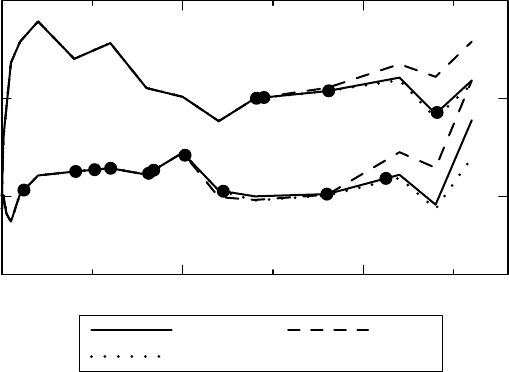
Example 3.1 Figure 3.2 shows the means of FEV
1
in a crossover study in which a bron-
chodilator treatment was compared to a placebo treatment. FEV
1
was followed for 26 hours
after a single dose administration and the solid curve connects the observed means for the two
groups (active above, placebo below). The dots show occasions when a patient took rescue
medication (a bronchodilator). As expected, there is more rescue medication taken on placebo
treatment than on active treatment.
The placebo curve is a reflection of what the diurnal variation in lung function looks like,
intertwined with the effect of the study procedures, such as food intake and sleeping pattern.
The effect of the bronchodilator must be assessed by comparison with the placebo treatment.
In this case the objective was to see if we can still claim an effect after 24 hours for the
drug. The solid curves represent the data as provided, which means that for some patients
some of these measurement are influenced not only by the product under investigation, but
also by rescue medication. Since there is more rescue taken when on placebo, we expect the
assessment at 24 hours to be biased in favor of placebo.
74 STUDY DESIGN AND THE BIAS ISSUE
3
3.25
3.5
Mean FEV
1
(L)
20100
Missing
As provided
Missing+LOCF
Figure 3.2 The effect of different methods of handling lung function measurements that are
influenced by earlier rescue medication. For details, see Example 3.1.
However, it is much less biased than to argue that data after the first intake of rescue
should be considered invalid. This would imply that after intake of rescue medication
we consider all measurements to be missing and compute the means on what remains;
a diminishing number of subjects when we consider later and later time points. This
approach is illustrated as the dashed curves in the graph, and we see how they increase at
the end of the observation period, when means are computed on a selection of patients.
An alternative strategy keeps groups intact by imputing values for patients who took
rescue medication. If we do this using the LOCF principle, we get the dotted curves in
the graph. It is a non-trivial task to decide which result most accurately describes what
it is we want to know: the dashed lines are affected by selection bias, the solid lines by
concomitant medication, and the dotted lines by assuming no further change after first
rescue medication.
There are other imputation methods for missing data available, one of which is based
on applying a linear mixed effects model. We will not discuss such methods here, but wish
to mention an old alternative by Larry Gould from 1980, which assumes that we are doing
a non-parametric statistical analysis. In non-parametric statistics we rank observations, and
Gould’s suggestion is to rank missing data according to why they are missing:
•
First, remove all discontinued patients from the data set if the reason for withdrawal is
unrelated to the effect of the drug.
•
Then rank the remaining discontinued patients according to how long they stayed in
the study.
•
Finally, rank the completers according to their values, but give them all higher ranks
than the discontinued patients.
APPROACHES TO DATA ANALYSIS: AVOIDING SELF-INFLICTED BIAS 75
The drawback with this is that, although it provides us with a way to carry out hypothesis
testing, it is less helpful in estimating treatment effects (in terms of location measures).
3.8 Approaches to data analysis: avoiding self-inflicted bias
Not only may missing data provide us with biased results, but there are many instances when
the analyst manages to introduce bias all by himself, by manipulating collected data in such
a way that bias is introduced. The overriding reason why people do this is an obsession with
analyzing only valid data. However, if you do not have valid data, the alternative to using
non-valid data is to consider such data missing, and we already know that missing data have
effects on the comparability of the groups. The following example illustrates this.
Example 3.2 One part of the investigation into the pharmacokinetic properties of a drug is to
compute its clearance, which is proportional to the inverse of the area under the curve (AUC)
of the plasma concentration profile (provided we control the dose that enters the bloodstream,
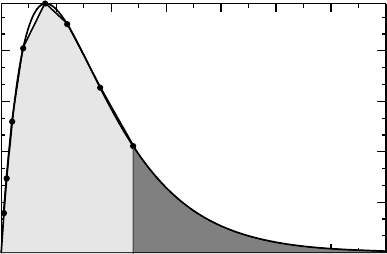
which we can do by giving the drug intravenously). To estimate this area, we take serial
measurements of plasma concentration for some time, say 24 hours, and use a mathematical
formula, such as the trapeze formula. This is illustrated in Figure 3.3 as the light gray area.
However, we also need to estimate the residual area, the area under the curve from the last
measurement onwards, all along to infinity. This we do by fitting a mono-exponential function
to the concentration data during the later part of the 24-hour surveillance period, and assume
that this provides a good approximation to the plasma concentration thereafter. We compute
the residual area using this function (dark gray in the graph) and add it to the previous AUC,
in order to get the total AUC.
If the residual area is a large fraction of the total area, many pharmacokineticists consider
the estimate of the area under the curve to be poor, and therefore not a valid estimate. For
argument’s sake, assume they set the limit at 30%. If, in a study with 12 subjects, four have
0
0.3
0.6
0.9
1.2
Plasma concentration (nmol/L)
706050403020100
Time (hrs) since administration
Figure 3.3 How to estimate areas in pharmacokinetics. The darker shaded area is estimated
from a mono-exponential function whose rate is determined toward the end of the period that
defines the lighter shaded area.
76 STUDY DESIGN AND THE BIAS ISSUE
their residual area larger than 30%, how do we handle these? Some take the view that they
should be ignored. However, the consequence of that is most likely bias. A large residual
area can be the consequence of a high exposure, which means that you discard from the
analysis patients with large AUCs, underestimating the true mean AUC, and subsequently
overestimating the clearance.
If you instead use these non-valid measurements (i.e., poorly estimated AUCs), you include
data that are less precise, but there is no inherent bias. This means that your group averages
should be unbiased. The effect of the poor estimates of some individual AUC values is a more
uncertain estimate of the mean, but not bias.
As the example tells us, it may be better to use data without the proper quality stamp,
because the alternative is to consider such data as missing, and missingness has its own
problems with bias. Of course, there may be situations when this is not the case, but when a
measurement is of such poor quality, it should have been discarded from the start and never
entered into the database. If you measure blood pressure to be 12/8 mmHg in an alive subject,
this measurement is better considered due to a faulty machine (or data entry) and should be
considered missing from the database. But subjective judgement of data quality should be
avoided as far as possible; only cases beyond any reasonable doubt should be rejected.
A common feature of many measurements that statisticians and others want to consider
non-valid, is that they are measured in a situation when there is poor compliance. Compliance
is the term used for how well the patient, or investigator, follows the protocol that defines
the study. It is about taking the drug as prescribed and about taking the measurements as
stipulated by the protocol. Deviance from the protocol implies loss of compliance, and it
leads to questions about the validity of data (and the results).
The reluctance to analyze data that do not have a proper quality stamp has led statisticians
in the pharmaceutical industry to introduce the concept of the per protocol (PP) analysis.
This approach to the analysis of data means that one first examines the validity of the data,
and the statistical analysis is done only on the subset of what is considered valid data. There
is a serious risk of selection bias in this procedure if appropriate care is not taken to avoid
it. In an intervention study there is no problem in selecting only a subset of patients to
analyze, if the selection is made only on data obtained before randomization. Such selection
will not introduce bias, but will decrease the power of the study, since fewer subjects are
included in the analysis. The serious problem with PP analysis is when the selection of data
is based also on information obtained after randomization. We have already discussed one
such problem, namely how to handle rescue medication that affects the outcome measures.
In that case, whichever way we choose to make the analysis, there is probably bias. This will
be an example of a compliance problem, if the protocol stipulated that the rescue medication
should not be taken in a certain time window prior to the pain scoring. This illustrates how
hard it may be to follow a protocol to the letter in real life.
The following example is a case story of self-inflicted bias. It is not from a pharmaceutical
company study, and thus illustrates how widespread the problem is. It can serve as an
illustration of how the best of intentions may go awry, if you do not carefully consider what
the procedure you implement would lead to in the absence of any effect of the intervention.
Example 3.3 In some countries, including Sweden, there is routine ultrasound scanning
during pregnancy in order to ensure that it is progressing well and that the baby does not have
any serious malformation. To address a concern that ultrasound may damage human tissue, in

APPROACHES TO DATA ANALYSIS: AVOIDING SELF-INFLICTED BIAS 77
particular brain tissue, a randomized clinical study was designed in which the prevalence of
left-handedness (actually non-right-handedness) among boys was studied. The idea was that
in some of these children, the cause of the left-handedness would be damage to the left brain
brought about by the scan.
The study was performed in 1985–1987 and invited all women who booked for antenatal
care in 19 clinics in Sweden to participate. In all 4997 women were randomized into two
groups of which one was to have a routine ultrasound scan about 15 weeks into the pregnancy,
and the other group was not. A decade later the mothers were sent a questionnaire asking
about the handedness of their child. Based on this the children were classified as right-handed
or left-handed. Because of a number of factors (miscarriages, failure to fill in the form, etc.)
only a subset of all mothers who were randomized actually provided data for analysis. The
table for boys only was as follows:
Right-handed Non-right-handed
Screened group 636 156
Non-screened group 648 134
The odds ratio for this table is 1.19 with 95% confidence interval (0.92, 1.53) and the p-value
is 0.19. There is therefore not sufficient evidence to conclude that an ultrasound scan affects
the handedness of the boy.
However, the investigators noted the following. In the non-screened group there were
103 cases where an ultrasound examination had actually been done before week 19
of the pregnancy. Out of these, 30 were included in the table above. These data are
obviously invalid in some sense. How should that be handled? If we move them to
the other group, and relabel the groups to capture the difference in tables, we get the
following table:
Right-handed Non-right-handed
Exposed group 655 167
Non-exposed group 629 123
For this table the odds ratio is estimated at 1.30 with 95% confidence interval (1.01, 1.69) and
the p-value is 0.04. It therefore appears that we have sufficient evidence to claim that the true
odds ratio is larger than one. But is this a basis for claiming that ultrasound screening affects
the handedness of the baby? Those who answer yes to this question argue that if we want to
draw the conclusion that exposure to something has an effect, we must compare the exposed
group with the non-exposed group. Elementary, but is it correct?
The analysis comprises 1284 randomized women and within this group of pregnan-
cies there will be a subgroup for whom there is some kind of problem with the preg-
nancy such as growth retardation, which medically indicates a closer look, which in most
cases means an ultrasound scan. This group of risk pregnancies is expected to be evenly
distributed between the two original groups, because of the randomization. When we con-
struct our new groups we move some of these risk pregnancies from the non-screened group
to the screened group. The two groups are therefore no longer comparable since the risk
78 STUDY DESIGN AND THE BIAS ISSUE
pregnancies are not equally distributed between them. It was to ensure an even distribution of
the risk pregnancies that we performed the randomization in the first place, but now we have
broken it.
In short, by comparing exposed to non-exposed instead of randomized groups, we also
expect to find a difference if ultrasound scanning is completely harmless. But, given this, why
do we not deal with the 30 boys by just removing them from the analysis? Would that not
help? No, it would not, because the basic imbalance that we have between the exposed and
non-exposed groups will prevail, though only to half the magnitude.
We next consider a related example, applicable to drug intervention studies. In an
open clinical study the patients may not accept the randomized treatment. They may
simply refuse it, and demand the alternative. If the investigator yields, because he wants
to fill his quota of patients, this will mean that some patients who were randomized
to one treatment will actually receive the alternative. How should we handle this in
the analysis?
1. If we analyze the data as per the treatment the patients actually received, we have no
method to ensure comparable groups at the start of treatment, and whatever conclusion
we draw about the treatment could therefore be open to debate.
2. We will get comparable groups at baseline if we instead analyze the data accord-
ing to the treatment the patient was randomized to. That is hard to swallow for
many because then the B group will contain a number of patients treated by A,
and why should we want to compare those with other patients who are also treated
with A? The answer is, in order to ensure group comparability on all confounders.
The price is that we must change the formulation of the claim somewhat. Instead of
saying something about a comparison of treatments A and B, you must say some-
thing about what happens when you intend to treat with A and B, respectively. Which
brings us back to the intention-to-treat concept, which may be particularly relevant in
these situations.
Another problem related to the present discussion is that of outliers. Outliers are
observations that have a different pattern from the majority of the observations in the data set.
In its simplest form we may have a single observation which is very large when the majority
of observations are confined to another region of the measurement scale. Such data cannot be
ignored, but they do pose a problem for many statistical procedures, in particular those that are
based on means and standard deviations, since these parameters are rather sensitive to outliers.
This fact is often used to promote non-parametric methods. The question is what problem that
solves, since a major purpose of a study often is to quantify effects. If there are outliers, the
first thing one should ask is what is the appropriate scale for measurement. Perhaps we should
log-transform the data (see Box 6.3). Also it is important to note that outliers may try to tell us
something. New discoveries are sometimes the result of unexpected observations in data. But
that does not take away the basic problem that they sometimes make statistical analysis less
precise. It is a judgement call how to handle outlier data, but it is important not to hide them. If
it can be proved that they are faulty measurements, they can be ignored, but that presupposes
one can have agreed standards for such conclusions. Ultimately it becomes a question
of credibility.