
Kazuaki Taira. Boundary Value Problems and Markov Processes
Подождите немного. Документ загружается.

2.1 Analytic Semigroups 25
e
−α log(−λ)
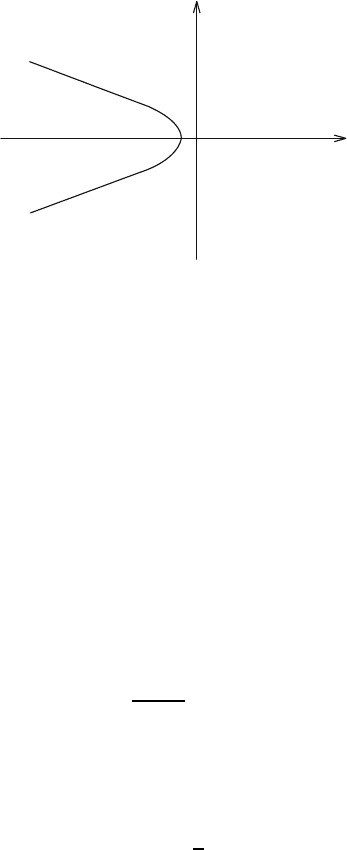
, we choose the branch whose argument lies between −απ and απ;
it is analytic in the region obtained by omitting the positive real axis.
The integral (2.22) converges in the uniform operator topology of the Ba-
nach space L(E,E) for all α>0, and thus defines a bounded linear operator
on E.
Γ
0
Fig. 2.9.
Some basic properties of the fractional power (−A)
−α
are summarized in
the following:
Proposition 2.3. (i) We have, for all α, β>0,
(−A)
−α
(−A)
−β
=(−A)
−(α+β)
.
(ii) If α is a positive integer n, then we have the formula
(−A)
−α
=
(−A)
−1
n
.
(iii) The fractional power (−A)
−α
is invertible for all α>0.
If 0 <α<1, we have the following useful formula for the fractional power
(−A)
−α
:
Theorem 2.4. We have, for all 0 <α<1,
(−A)
−α
= −
sin απ
π
∞
0
s
−α
R(s)ds. (2.23)
By Remark 2.1, we may assume that there exist positive constants M
0
,
M
1
and a such that
U(t)≤M
0
e
−at
for all t>0.
AU(t)≤M
1
e
−at
1
t
for all t>0.
Then we can prove still another useful formula for the fractional power (−A)
−α
for all 0 <α<1.

26 2 Semigroup Theory
Theorem 2.5. We have, for all 0 <α<1,
(−A)
−α
=
1
Γ (α)
∞
0
t
α−1
U(t) dt.
In view of part (iii) of Proposition 2.3, we can define the fractional power
(−A)
α
for all α>0 as follows:
(−A)
α
=theinverseof(−A)
−α
,α>0.
The next theorem states that the domain D((−A)
α
)of(−A)
α
is bigger
than the domain D(A)ofA when 0 <α<1.
Theorem 2.6. We have, for all 0 <α<1,
D(A) ⊂D((−A)
α
) .
We can give an explicit formula for the fractional power (−A)
α
(0 <α<1)
on the domain D(A):
Theorem 2.7. Let 0 <α<1. Then we have, for any x ∈D(A),
(−A)
α
x =
sin απ
π
∞
0
s
α−1
R(s)Ax ds.
2.1.3 The Semilinear Cauchy Problem
This subsection is devoted to the semigroup approach to a class of initial-
boundary value problems for semilinear parabolic differential equations. By
making good use of fractional powers of analytic semigroups, we formulate a
local existence and uniqueness theorem for semilinear initial-boundary value
problems (Theorem 2.8). Our semigroup approach can be traced back to the
pioneering work of Fujita–Kato [FK] for the Navier–Stokes equation in fluid
dynamics.
Assume that the operator A satisfies condition (2.21). Then we can de-
fine the fractional power (−A)
α
for all 0 <α<1 (see Subsection 2.1.2).
The operator (−A)
α
is a closed linear, invertible operator with domain
D((−A)
α
) ⊃D(A). We let
E
α
=thespaceD((−A)
α
) endowed with the graph norm ·
α
of (−A)
α
,
where
x
α
=
x
2
+ (−A)
α
x
2
1/2
,x∈D((−A)
α
).
Then we have the following three assertions:
(i) The space E
α
is a Banach space.

2.2 Markov Processes and Feller Semigroups 27
(ii) The graph norm x
α
is equivalent to the norm (−A)
α
x.
(iii) If 0 <α<β<1, then we have E
β
⊂ E
α
with continuous injection.
Now we consider the following semilinear Cauchy problem:
du
dt
= Au(t)+f(t, u(t)),t
0
<t<t
1
,
u(t
0
)=x
0
.
(2.24)
Here f (t, x) is a function defined on an open subset U of [0, ∞)×E
α
(0 <α<
1), taking values in E. We assume that f(t, x) is locally H¨older continuous in
t and locally Lipschitz continuous in x. That is, for each point (t, x)ofU there
exist a neighborhood V ⊂ U, constants L = L(t, x, V ) > 0and0<γ≤ 1
such that
f(s
1
,y
1
) − f (s
2
,y
2
)≤L (|s
1
− s
2
|
γ
+ y
1
− y
2
α
) ,
(s
1
,y
1
), (s
2
,y
2
) ∈ V.
A function u(t):[t
0
,t
1
) → E is called a solution of problem (2.24) if it
satisfies the following three conditions:
(1) u(t) ∈ C([t
0
,t
1
); E) ∩ C
1
((t
0
,t
1
); E)andu(t
0
)=x
0
.
(2) u(t) ∈D(A)and(t, u(t)) ∈ U for all t
0
<t<t
1
.
(3)
du
dt
= Au(t)+f (t, u(t)) for all t
0
<t<t
1
.
Here C([t
0
,t
1
); E) denotes the space of continuous functions on [t
0
,t
1
)taking
values in E,andC
1
((t
0
,t
1
); E) denotes the space of continuously differentiable
functions on (t
0
,t
1
) taking values in E, respectively.
Our main result is the following local existence and uniqueness theorem
for problem (2.24):
Theorem 2.8. Let f(t, x) beafunctiondefinedonanopensubsetU of
[0, ∞) × E
α
(0 <α<1), taking values in E. Assume that f (t, x) is lo-
cally H¨older continuous in t and locally Lipschitz continuous in x.Then,
for every (t
0
,x
0
) ∈ U , problem (2.24) has a unique local solution u(t) ∈
C([t
0
,t
1
]; E) ∩ C
1
((t
0
,t
1
); E) where t
1
= t
1
(t
0
,x
0
) >t
0
.
For a proof of Theorem 2.8, the reader is referred to [He, Theorem 3.3.3],
Pazy [Pa, Chapter 6, Theorem 3.1] and also Taira [Ta4, Theorem 1.18].
2.2 Markov Processes and Feller Semigroups
This section provides a brief description of basic definitions and results about
Markov processes and a class of semigroups (Feller semigroups) associated
with Markov processes. In Subsection 2.2.6 we prove various generation the-
orems of Feller semigroups by using the Hille–Yosida theory of semigroups
(Theorems 2.16 and 2.18) which form a functional analytic background for
the proof of Theorem 1.4. The results discussed here are adapted from

28 2 Semigroup Theory
Blumenthal–Getoor [BG], Dynkin [Dy2], Lamperti [La], Revuz–Yor [RY] and
also Taira [Ta2, Chapter 9]. The semigroup approach to Markov processes can
be traced back to the pioneering work of Feller [Fe1] and [Fe2] in early 1950s
(cf. [BCP], [SU], [Ta3]).
2.2.1 Markov Processes
In 1828 the English botanist R. Brown observed that pollen grains suspended
in water move chaotically, incessantly changing their direction of motion. The
physical explanation of this phenomenon is that a single grain suffers innumer-
able collisions with the randomly moving molecules of the surrounding water.
A mathematical theory for Brownian motion was put forward by A. Einstein
in 1905 (cf. [Ei]). Let p(t, x, y) be the probability density function that a one-
dimensional Brownian particle starting at position x will be found at position
y at time t. Einstein derived the following formula from statistical mechanical
considerations:
p(t, x, y)=
1
√
2πDt
exp
−
(y − x)
2
2Dt
.
Here D is a positive constant determined by the radius of the particle, the
interaction of the particle with surrounding molecules, temperature and the
Boltzmann constant. This gives an accurate method of measuring Avogadro’s
number by observing particles. Einstein’s theory was experimentally tested
by J. Perrin between 1906 and 1909.
Brownian motion was put on a firm mathematical foundation for the first
time by N. Wiener in 1923 ([Wi]). Let Ω be the space of continuous functions
ω :[0, ∞) → R with coordinates x
t
(ω)=ω(t)andletF be the smallest
σ-algebra in Ω which contains all sets of the form {ω ∈ Ω : a ≤ x
t
(ω) <b},
t ≥ 0, a<b. Wiener constructed probability measures P
x
, x ∈ R,onF for
which the following formula holds:
P
x
{ω ∈ Ω : a
1
≤ x
t
1
(ω) <b
1
,a
2
≤ x
t
2
(ω) <b
2
,...,a
n
≤ x
t
n
(ω) <b
n
}
=
b
1
a
1
b
2
a
2
...
b
n
a
n
p(t
1
,x,y
1
)p(t
2
− t
1
,y
1
,y
2
) ...
p(t
n
− t
n−1
,y
n−1
,y
n
) dy
1
dy
2
... dy
n
,
0 <t
1
<t
2
<... <t
n
< ∞.
This formula expresses the “starting afresh” property of Brownian motion
that if a Brownian particle reaches a position, then it behaves subsequently
as though that position had been its initial position. The measure P
x
is called
the Wiener measure starting at x.
P. L´evy found another construction of Brownian motion, and gave a pro-
found description of qualitative properties of the individual Brownian path in
his book: Processus stochastiques et mouvement brownien (1948).
Markov processes are an abstraction of the idea of Brownian motion. Let
K be a locally compact, separable metric space and let B be the σ-algebra

2.2 Markov Processes and Feller Semigroups 29
of all Borel sets in K, that is, the smallest σ-algebra containing all open sets
in K.Let(Ω, F,P) be a probability space. A function X(ω) defined on Ω
taking values in K is called a random variable if it satisfies the condition
X
−1
(E)={ω ∈ Ω : X(ω) ∈ E}∈F for all E ∈B.
We express this by saying that X is F/B-measurable. A family {x
t
}
t≥0
of
random variables is called a stochastic process, and it may be thought of as
the motion in time of a physical particle. The space K is called the state space
and Ω the sample space.Forafixedω ∈ Ω, the function x
t
(ω), t ≥ 0, defines
in the state space K a trajectory or path of the process corresponding to the
sample point ω.
In this generality the notion of a stochastic process is of course not so
interesting. The most important class of stochastic processes is the class of
Markov processes which is characterized by the Markov property. Intuitively,
this is the principle of the lack of any “memory” in the system. More precisely,
(temporally homogeneous) Markov property is that the prediction of subse-
quent motion of a particle, knowing its position at time t, depends neither on
the value of t nor on what has been observed during the time interval [0,t);
that is, a particle “starts afresh”.
Now we introduce a class of Markov processes which we will deal with in
this book (cf. [Dy2], [BG], [RY]).
Assume that we are given the following:
(1) A locally compact, separable metric space K and the σ-algebra B of all
Borel sets in K.Apoint∂ is adjoined to K as the point at infinity if K is
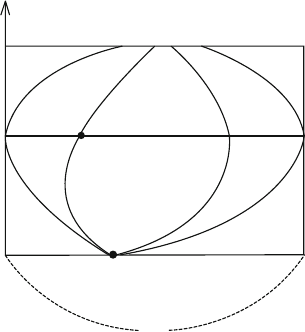
not compact, and as an isolated point if K is compact (see Figure 2.10).
We let
K
∂
= K ∪{∂},
B
∂
=theσ-algebra in K
∂
generated by B.
K
∂
K
∂
Fig. 2.10.
(2) The space Ω of all mappings ω :[0, ∞] → K
∂
such that ω(∞)=∂ and
that if ω(t)=∂ then ω(s)=∂ for all s ≥ t.Letω
∂
be the constant map
ω
∂
(t)=∂ for all t ∈ [0, ∞].
30 2 Semigroup Theory
(3) For each t ∈ [0, ∞], the coordinate map x
t
defined by x
t
(ω)=ω(t), ω ∈ Ω.
(4) For each t ∈ [0, ∞], a mapping ϕ
t
: Ω → Ω defined by (ϕ
t
ω)(s)=ω(t+s),
ω ∈ Ω.Notethatϕ
∞
ω = ω
∂
and x
t
◦ ϕ
s
= x
t+s
for all t, s ∈ [0, ∞].
(5) A σ-algebra F in Ω and an increasing family {F
t
}
0≤t≤∞
of sub-σ-algebras
of F.
(6) For each x ∈ K
∂
, a probability measure P
x
on (Ω,F).
We say that these elements define a (temporally homogeneous) Markov process
X =(x
t
, F, F
t
,P
x
) if the following four conditions are satisfied:
(i) For each 0 ≤ t<∞, the function x
t
is F
t
/B
∂
-measurable, that is,
{x
t
∈ E} = {ω ∈ Ω : x
t
(ω) ∈ E}∈F
t
for all E ∈B
∂
.
(ii) For all 0 ≤ t<∞ and E ∈B, the function
p
t
(x, E)=P
x
{x
t
∈ E} (2.25)
is a Borel measurable function of x ∈ K.
(iii) P
x
{ω ∈ Ω : x
0
(ω)=x} =1foreachx ∈ K
∂
.
(iv) For all t, h ∈ [0, ∞], x ∈ K
∂
and E ∈B
∂
, we have the formula
P
x
{x
t+h
∈ E |F
t
} = p
h
(x
t
,E)a. e.,
or equivalently,
P
x
(A ∩{x
t+h
∈ E})=
A
p
h
(x
t
(ω),E) dP
x
(ω) for all A ∈F
t
.
Here is an intuitive way of thinking about the above definition of a Markov
process. The sub-σ-algebra F
t
may be interpreted as the collection of events
which are observed during the time interval [0,t]. The value P
x
(A), A ∈F,
may be interpreted as the probability of the event A under the condition that
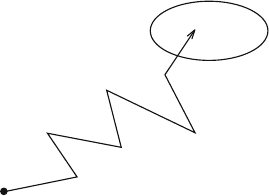
a particle starts at position x; hence the value p
t
(x, E) expresses the transition
probability that a particle starting at position x will be found in the set E at
time t (see Figure 2.11). The function p
t
(x, ·) is called the transition function
of the process X. The transition function p
t
(x, ·) specifies the probability
structure of the process. The intuitive meaning of the crucial condition (iv) is
that the future behavior of a particle, knowing its history up to time t,isthe
same as the behavior of a particle starting at x
t
(ω), that is, a particle starts
afresh. A particle moves in the space K until it “dies” at the time when it
reaches the point ∂; hence the point ∂ is called the terminal point.
With this interpretation in mind, we let
ζ(ω)=inf{t ∈ [0, ∞]:x
t
(ω)=∂}.
The random variable ζ is called the lifetime of the process X.
2.2 Markov Processes and Feller Semigroups 31
E
x
t
Fig. 2.11.
2.2.2 Markov Transition Functions
In the first works devoted to Markov processes, the most fundamental was
A. N. Kolmogorov’s work ([Ko]) where the general concept of a Markov tran-
sition function was introduced for the first time and an analytic method of
describing Markov transition functions was proposed. From the point of view
of analysis, the transition function is something more convenient than the
Markov process itself. In fact, it can be shown that the transition functions
of Markov processes generate solutions of certain parabolic partial differential
equations such as the classical diffusion equation; and, conversely, these differ-
ential equations can be used to construct and study the transition functions
and the Markov processes themselves.
In the 1950s, the theory of Markov processes entered a new period of inten-
sive development. We can associate with each transition function in a natural
way a family of bounded linear operators acting on the space of continuous
functions on the state space, and the Markov property implies that this fam-
ily forms a semigroup. The Hille–Yosida theory of semigroups in functional
analysis made possible further progress in the study of Markov processes, as
will be shown in Subsection 2.2.5.
Our first job is thus to give the precise definition of a transition function
adapted to the theory of semigroups:
Definition 2.1. Let (K, ρ) be a locally compact, separable metric space and
let B be the σ-algebra of all Borel sets in K. A function p
t
(x, E), defined for
all t ≥ 0, x ∈ K and E ∈B, is called a (temporally homogeneous) Markov
transition function on K if it satisfies the following four conditions:
(a) p
t
(x, ·) is a non-negative measure on B and p
t
(x, K) ≤ 1 for all t ≥ 0and
x ∈ K.
(b) p
t
(·,E) is a Borel measurable function for all t ≥ 0andE ∈B.
(c) p
0
(x, {x}) = 1 for all x ∈ K.
32 2 Semigroup Theory
(d) (The Chapman–Kolmogorov equation) For all t, s ≥ 0, x ∈ K and E ∈B,
we have the equation
p
t+s
(x, E)=
K
p
t
(x, dy)p
s
(y,E). (2.26)
K
0
t
t
+
s
y
E
x
Fig. 2.12.
Here is an intuitive way of thinking about the above definition of a Markov
transition function. The value p
t
(x, E) expresses the transition probability
that a physical particle starting at position x will be found in the set E
at time t. The Chapman–Kolmogorov equation (2.26) expresses the idea that
a transition from the position x to the set E in time t + s is composed of a
transition from x to some position y in time t, followed by a transition from
y to the set E in the remaining time s; the latter transition has probability
p
s
(y,E) which depends only on y (see Figure 2.12). Thus a particle “starts
afresh”; this property is called the Markov property.
The Chapman–Kolmogorov equation (2.26) asserts that p
t
(x, K) is mono-
tonically increasing as t ↓ 0, so that the limit
p
+0
(x, K) = lim
t↓0
p
t
(x, K)
exists.
A transition function p
t
(x, ·)issaidtobenormal if it satisfies the condition
p
+0
(x, K) = 1 for all x ∈ K.
The next theorem, due to Dynkin [Dy1, Chapter 4, Section 2], justifies the
definition of a transition function, and hence it will be fundamental for our
further study of Markov processes:
2.2 Markov Processes and Feller Semigroups 33
Theorem 2.9. For every Markov process, the function p
t
(x, ·), defined by
formula (2.25), is a Markov transition function. Conversely, every normal
Markov transition function corresponds to some Markov process.
Here are some important examples of normal transition functions on the
line R =(−∞, ∞):
Example 2.1 (Uniform motion). If t ≥ 0, x ∈ R and E ∈B,welet
p
t
(x, E)=χ
E
(x + vt),
where v is a constant, and χ
E
(y)=1ify ∈ E and = 0 if y ∈ E.
This process, starting at x, moves deterministically with constant veloc-
ity v.
Example 2.2 (Poisson process). If t ≥ 0, x ∈ R and E ∈B,welet
p
t
(x, E)=e
−λt
∞
n=0
(λt)
n
n!
χ
E
(x + n),
where λ is a positive constant.
This process, starting at x, advances one unit by jumps, and the probability
of n jumps during the time 0 and t is equal to e
−λt
(λt)
n
/n!.
Example 2.3 (Brownian motion). If t>0, x ∈ R and E ∈B,welet
p
t
(x, E)=
1
√
2πt
E
exp
−
(y − x)
2
2t
dy,
and
p
0
(x, E)=χ
E
(x).
This is a mathematical model of one-dimensional Brownian motion. Its
character is quite different from that of the Poisson process; the transition
function p
t
(x, E) satisfies the condition
p
t
(x, [x − ε, x + ε]) = 1 − o(t)ast ↓ 0,
for all ε>0andx ∈ R. This means that the process never stands still, as does
the Poisson process. Indeed, this process changes state not by jumps but by
continuous motion. A Markov process with this property is called a diffusion
process.
Example 2.4 (Brownian motion with constant drift). If t>0, x ∈ R and
E ∈B,welet
p
t
(x, E)=
1
√
2πt
E
exp
−
(y − mt − x)
2
2t
dy,
and
p
0
(x, E)=χ
E
(x),
where m is a constant.

34 2 Semigroup Theory
This represents Brownian motion with a constant drift of magnitude m
superimposed; the process can be represented as {x
t
+ mt},where{x
t
} is
Brownian motion on R.
Example 2.5 (Cauchy process). If t>0, x ∈ R and E ∈B,welet
p
t
(x, E)=
1
π
E
t
t
2
+(y − x)
2
dy,
and
p
0
(x, E)=χ
E
(x).
This process can be thought of as the “trace” on the real line of trajec-
tories of two-dimensional Brownian motion, and it moves by jumps (see [Kn,
Lemma 2.12]). More precisely, if B
1
(t)andB
2
(t) are two independent Brow-
nian motions and if T is the first passage time of B
1
(t)tox,thenB
2
(T )has
the Cauchy density
1
π
|x|
x
2
+ y
2
, −∞ <y<∞.
Here are two more examples of diffusion processes on the half line
R
+
=
[0, ∞) in which we must take account of the effect of the boundary point 0:
Example 2.6 (Reflecting barrier Brownian motion). If t>0, x ∈
R
+
and
E ∈B,welet
p
t
(x, E)=
1
√
2πt
E
exp
−
(y − x)
2
2t
dy +
E
exp
−
(y + x)
2
2t
dy
,
and
p
0
(x, E)=χ
E
(x).
This represents Brownian motion with a reflecting barrier at x =0;the
process may be represented as {|x
t
|},where{x
t
} is Brownian motion on R.
Indeed, since {|x
t
|} goes from x to y if {x
t
} goes from x to ±y due to the
symmetry of the transition function in Example 2.3 about x = 0, it follows
that
p
t
(x, E)=P
x
{|x
t
|∈E}
=
1
√
2πt
E
exp
−
(y − x)
2
2t
dy +
E
exp
−
(y + x)
2
2t
dy
.
Example 2.7 (Sticking barrier Brownian motion). If t>0, x ∈
R
+
and E ∈B,
we let
p
t
(x, E)=
1
√
2πt
E
exp
−
(y − x)
2
2t
dy −
E
exp
−
(y + x)
2
2t
dy
+
1 −
1
√
2πt
x
−x
exp
−
z
2
2t
dz
χ
E
(0),