
Kazuaki Taira. Boundary Value Problems and Markov Processes
Подождите немного. Документ загружается.

2.1 Analytic Semigroups 15
converges in the uniform operator topology of the Banach space L(E,E)for
all t>0, and thus defines a bounded linear operator on E.HereL(E,E)
denotes the space of bounded linear operators on E.
Furthermore, we have the following:
Proposition 2.1. The operators U(t), defined by formula (2.2), form a semi-
group on E, that is, they enjoy the semigroup property
U(t + s)=U (t) · U (s) for all t, s>0.
Proof. By Cauchy’s theorem, we may assume that
U(s)=−
1
2πi
Γ
e
μs
R(μ) dμ, s > 0.
Here Γ
is a path obtained from the path Γ by translating each point of Γ to
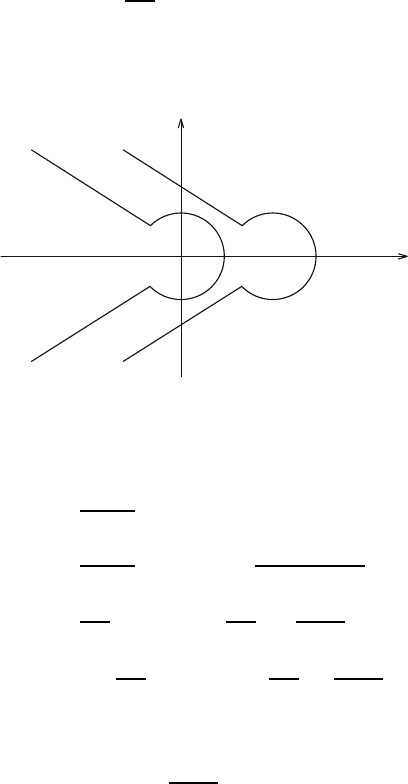
the right by a fixed small positive distance (see Figure 2.3).
Γ
Γ
0
Fig. 2.3.
Then we have, by Fubini’s theorem,
U(t) · U(s)=
1
(2πi)
2
Γ
Γ
e
λt
e
μs
R(λ) R(μ) dλ dμ
=
1
(2πi)
2
Γ
Γ
e
λt
e
μs
R(λ) − R(μ)
λ − μ
dλ dμ
=
1
2πi
Γ
e
λt
R(λ)
1
2πi
Γ
e
μs
λ − μ
dμ
dλ
−
1
2πi
Γ
e
μs
R(μ)
1
2πi
Γ
e
λt
λ − μ
dλ
dμ.
We calculate the two terms in the last part.
(a) We let
f(μ)=
e
μs
λ − μ
,μ∈ C.
16 2 Semigroup Theory
|¹|= r
¸
0
Fig. 2.4.
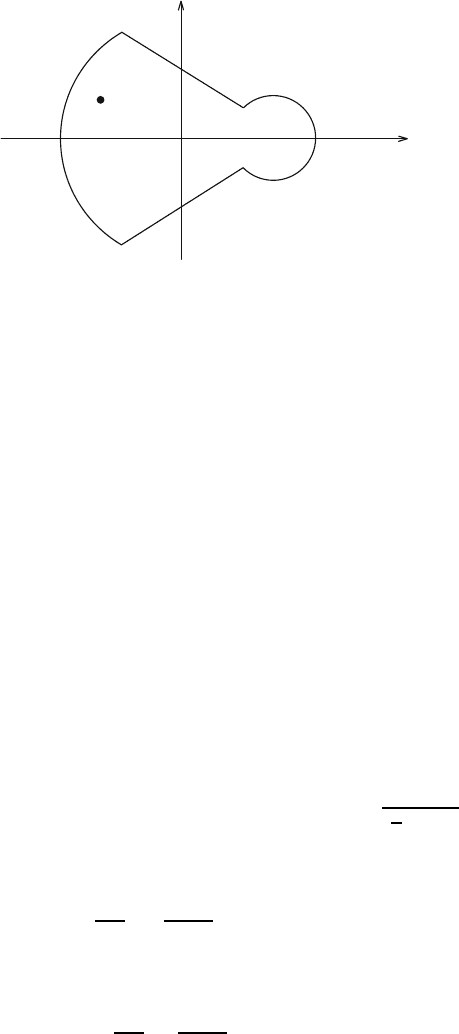
Then, by applying the residue theorem we obtain that (see Figure 2.4)
Γ
(1)
∩{|μ|≤r}
f(μ) dμ +
Γ
(2)
f(μ) dμ +
Γ
(3)
∩{|μ|≤r}
f(μ) dμ
+
π/2+ω−ε
−(π/2+ω−ε)
f(re
iθ
)rie
iθ
dθ
=2πi Res [f(μ)]
μ=λ
= −2πie
λs
.
However, we have, as r →∞,
Γ
(1)
∩{|μ|≤r}
f(μ) dμ −→
Γ
(1)
f(μ) dμ,
Γ
(3)
∩{|μ|≤r}
f(μ) dμ −→
Γ
(3)
f(μ) dμ,
and
π/2+ω−ε
−(π/2+ω−ε)
f(re
iθ
)rie
iθ
dθ
≤ e
−rs·sin(ω−ε)
π/2+ω−ε
−(π/2+ω−ε)
dθ
λ
r
− e
iθ
−→ 0.
Therefore, we find that
1
2πi
Γ
e
μs
λ − μ
dμ = −e
λs
.
(b) Similarly, since the path Γ lies to the left of the path Γ
, we find that
1
2πi
Γ
e
λt
λ − μ
dλ =0.

2.1 Analytic Semigroups 17
Summing up, we obtain that
U(t) · U(s)=−
1
2πi
Γ
e
λ(t+s)
R(λ) dλ = U(t + s) for all t, s>0.
The proof of Proposition 2.1 is complete.
The next theorem states that the semigroup U(t) can be extended to an
analytic semigroup in some sector containing the positive real axis.
Theorem 2.2. The semigroup U (t), defined by formula (2.2), can be extended
toasemigroupU(z) which is analytic in the sector
Δ
ω
= {z = t + is : z =0, |arg z| <ω},
and enjoys the following properties:
(a) The operators AU (z) and
dU
dz
(z) are bounded operators on E for each z ∈
Δ
ω
, and satisfy the relation
dU
dz
(z)=AU(z) for all z ∈ Δ
ω
. (2.3)
(b) For each 0 <ε<ω/2, there exist positive constants
M
0
(ε) and
M
1
(ε)
such that
U(z)≤
M
0
(ε) for all z ∈ Δ
2ε
ω
, (2.4)
AU(z)≤
M
1
(ε)
|z|
for all z ∈ Δ
2ε
ω
, (2.5)
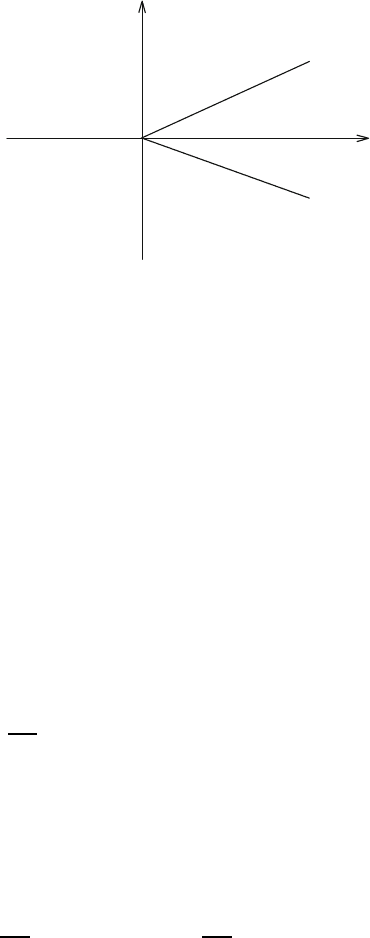
where(seeFigure2.5)
Δ
2ε
ω
= {z ∈ C : z =0, |arg z|≤ω − 2ε}.
(c) For each x ∈ E, we have, as z → 0, z ∈ Δ
2ε
ω
,
U(z)x −→ x in E.
Proof. (i) The analyticity of U (z): If λ ∈ Γ
(3)
and z ∈ Δ
2ε
ω
, that is, if we have
the formulas
λ = |λ|e
iθ
,θ= π/2+ω − ε,
z = |z|e
iϕ
, |ϕ|≤ω − 2ε,
then it follows that
λz = |λ||z|e
i(θ+ϕ)
,
with
π/2+ε ≤ θ + ϕ ≤ π/2+2ω − 3ε<3π/2 − 3ε.
18 2 Semigroup Theory
Δ
2ε
ω
0
Fig. 2.5.
Note that
cos(θ + ϕ) ≤ cos(π/2+ε)=−sin ε.
Hence we have the inequality
|e
λz
|≤e
−|λ||z| sin ε
for all λ ∈ Γ
(3)
and z ∈ Δ
2ε
ω
. (2.6)
Similarly, we have the inequality
|e
λz
|≤e
−|λ||z| sin ε
for all λ ∈ Γ
(1)
and z ∈ Δ
2ε
ω
. (2.7)
For each small ε>0, we let
K
ε
ω
=Δ
2ε
ω
{z ∈ C : |z|≥ε} = {z ∈ C : |z|≥ε, |arg z|≤ω − 2ε}.
Then, by combining estimates (2.1), (2.6) and (2.7) we obtain that
e
λz
R(λ)
≤
M
ε
|λ|
e
−ε sin ε·|λ|
for all λ ∈ Γ
(1)
Γ
(3)
and z ∈ K
ε
ω
. (2.8)
On the other hand, we have the estimate
e
λz
R(λ)
≤ M
ε
e
|z|
for all λ ∈ Γ
(2)
and z ∈ K
ε
ω
. (2.9)
Therefore, we find that the integral
U(z)=−
1
2πi
Γ
e
λz
R(λ) dλ = −
1
2πi
3
k=1
Γ
(k)
e
λz
R(λ) dλ (2.10)
converges in the Banach space L(E, E), uniformly in z ∈ K
ε
ω
, for every ε>0.
This proves that the operator U(z) is analytic in the domain Δ
ω
=
ε>0
K
ε
ω
.
By the analyticity of U(z), it follows that the operators U(z)alsoenjoy
the semigroup property
2.1 Analytic Semigroups 19
U(z + w)=U(z) · U(w) for all z, w ∈ Δ
ω
.
(ii) We prove that the operators U(z) enjoy properties (a), (b) and (c).
(b) First, by using Cauchy’s theorem we obtain that
U(z)=−
1
2πi
Γ
e
λz
R(λ) dλ = −
1
2πi
Γ
|z|
e
λz
R(λ) dλ,
where Γ
|z|
is a path consisting of the following three curves (see Figure 2.6):
Γ
(1)
|z|
=
re
−i(π/2+ω−ε)
:
1
|z|
≤ r<∞
,
Γ
(2)
|z|
=
1
|z|
e
iθ
: −(π/2+ω − ε) ≤ θ ≤ π/2+ω − ε
,
Γ
(3)
|z|
=
re
i(π/2+ω−ε)
:
1
|z|
≤ r<∞
.
0
Γ
(1)
Γ
(2)
Γ
(3)
|
z
|
|z|
|z|
Fig. 2.6.
However, by estimates (2.1), (2.6) and (2.7), it follows that
e
λz
R(λ)
≤
M
ε
|λ|
e
−|λ ||z| sin ε
for all λ ∈ Γ
(1)
|z|
Γ
(3)
|z|
and z ∈ Δ
2ε
ω
.
Hence we have, for k =1,3,
Γ
(k)
|z|
e
λz
R(λ)
|dλ|≤M
ε
∞
1
|z|
e
−ρ|z| sin ε
ρ
−1
dρ
= M
ε
∞
1
e
− sin ε·s
s
−1
ds.

20 2 Semigroup Theory
We have also, for k =2,
Γ
(2)
|z|
e
λz
R(λ)
|dλ|≤M
ε
π/2+ω−ε
−(π/2+ω−ε)
edθ
=2eM
ε
(π/2+ω − ε)
≤ 2πeM
ε
.
Summing up, we obtain the following estimate:
U(z)≤
1
2π
3
k=1
Γ
(k)
|z|
e
λz
R(λ)
|dλ|
≤
1
2π
2M
ε
∞
1
s
−1
e
− sin ε·s
ds +2πeM
ε
=
M
ε
π
∞
1
s
−1
e
− sin ε·s
ds + πe
.
This proves the desired estimate (2.4), with
M
0
(ε)=
M
ε
π
∞
1
s
−1
e
− sin ε·s
ds + πe
.
To prove estimate (2.5), note that
AR(λ)=(A − λI + λI)R(λ)=I + λR(λ),
so that
AR(λ)≤1+M
ε
for all λ ∈ Σ
ε
ω
.
Hence, by arguing just as in the proof of estimate (2.4) we obtain that
Γ
e
λz
AR(λ) dλ
≤ 2
∞
1
|z|
e
−ρ|z| sin ε
(1 + M
ε
) dρ
+
π/2+ω−ε
−(π/2+ω−ε)
(1 + M
ε
) e
1
|z|
dθ
≤ 2(1+M
ε
)
∞
1
e
− sin ε·s
ds + πe
1
|z|
for all z ∈ Δ
2ε
ω
. (2.11)
This proves that the integral
Γ
e
λz
AR(λ) dλ
is convergent in the Banach space L(E,E), for every z ∈ Δ
2ε
ω
. By the closed-
ness of A, it follows that
U(z) ∈D(A) for all z ∈ Δ
2ε
ω
,

2.1 Analytic Semigroups 21
and
AU(z)=−
1
2πi
Γ
e
λz
AR(λ) dλ for all z ∈ Δ
2ε
ω
. (2.12)
Therefore, the desired estimate (2.5) follows from estimate (2.11), with
M
1
(ε)=
1+M
ε
π
∞
1
e
− sin ε·s
ds + πe
.
We remark that formula (2.12) remains valid for all z ∈ Δ
ω
,sinceΔ
ω
=
ε>0
Δ
2ε
ω
.
(a) By estimates (2.8) and (2.9), we can differentiate formula (2.10) under
theintegralsigntoobtainthat
dU
dz
(z)=−
1
2πi
Γ
e
λz
λR(λ) dλ for all z ∈ Δ
ω
. (2.13)
On the other hand, it follows from formula (2.12) that
AU(z)=−
1
2πi
Γ
e
λz
AR(λ) dλ
= −
1
2πi
Γ
e
λz
(I + λR(λ)) dλ
= −
1
2πi
Γ
e
λz
λR(λ) dλ for all z ∈ Δ
ω
, (2.14)
sincewehave,byCauchy’stheorem,
Γ
e
λz
dλ =0.
Therefore, the desired formula (2.3) follows immediately from formulas
(2.13) and (2.14).
(c) Now let x
0
be an arbitrary element of D(A). By the residue theorem,
it follows that
x
0
=
1
2πi
Γ
e
λz
λ
x
0
dλ.
Hence we have the formula
U(z)x
0
− x
0
= −
1
2πi
Γ
e
λz
R(λ)+
1
λ
x
0
dλ
= −
1
2πi
Γ
e
λz
λ
R(λ)Ax
0
dλ.
Here we remark that
1
λ
R(λ)
≤
M
ε
|λ|
2
for all λ ∈ Γ,
e
λz
≤ 2e
−|λ||z| sin ε
+ e
|z|
for all z ∈ Δ
2ε
ω
and λ ∈ Γ.
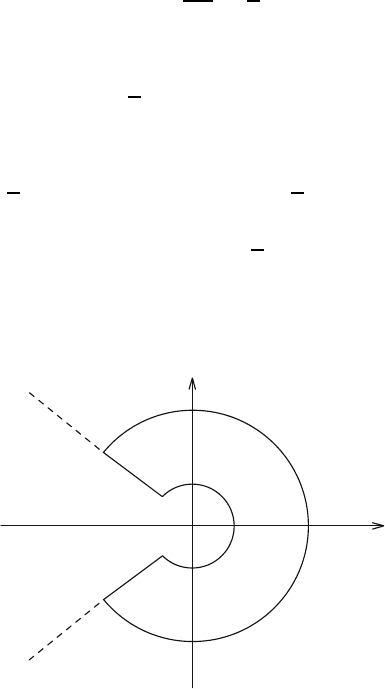
22 2 Semigroup Theory
Thus it follows from an application of the Lebesgue dominated convergence
theorem that, as z → 0, z ∈ Δ
2ε
ω
,
U(z)x
0
− x
0
−→ −
1
2πi
Γ
1
λ
R(λ)Ax
0
dλ.
However, we have the assertion
Γ
1
λ
R(λ)Ax
0
dλ =0.
Indeed, by Cauchy’s theorem it follows that
Γ
1
λ
R(λ)Ax
0
dλ = lim
r→∞
Γ ∩{|λ|≤r}
1
λ
R(λ)Ax
0
dλ
= − lim
r→∞
C
r
1
λ
R(λ)Ax
0
dλ
=0,
where C
r
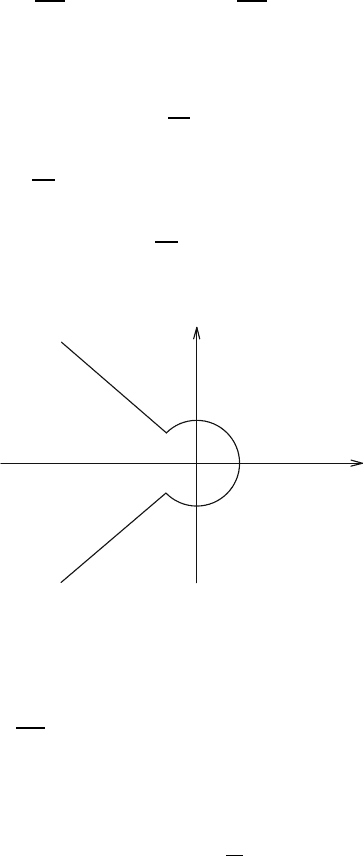
is a closed path shown in Figure 2.7.
0
Γ
C
r
Fig. 2.7.
Summing up, we have proved that
U(z)x
0
−→ x
0
as z → 0, z ∈ Δ
2ε
ω
,
for each x
0
∈D(A).
Since the domain D(A)isdenseinE and U (z)≤
M
0
(ε) for all z ∈ Δ
2ε
ω
,
it follows that, for each x ∈ E,
U(z)x −→ x as z → 0, z ∈ Δ
2ε
ω
.
The proof of Theorem 2.2 is now complete.

2.1 Analytic Semigroups 23
Remark 2.1. Assume that the operator A satisfies a stronger condition than
condition (2.1):
R(λ)≤
M
ε
|λ| +1
for all λ ∈ Σ
ε
ω
. (2.15)
Then we have the estimates
U(z)≤
M
0
(ε)e
−δ·Re z
for all z ∈ Δ
2ε
ω
, (2.16)
AU(z)≤
M
1
(ε)
|z|
e
−δ·Re z
for all z ∈ Δ
2ε
ω
, (2.17)
with some positive constant δ.
Proof. Take a real number δ such that
0 <δ<
1
M
ε
.
Then we have, by estimate (2.15),
δ
(A −λI)
−1
≤
δM
ε
|λ| +1
≤ δM
ε
< 1 for all λ ∈ Σ
ε
ω
.
Hence it follows that the operator (A + δI) − λI has the inverse
((A + δI) − λI)
−1
=(I + δ(A − λI)
−1
)
−1
(A −λI)
−1
,
and
((A + δI) − λI)
−1
≤(I + δ(A − λI)
−1
)
−1
·(A − λI)
−1
≤
M
ε
|λ| +1
1
1 −δ(A − λI)
−1
≤
M
ε
|λ| +1
1
1 − δM
ε
≤
M
ε
1 − δM
ε
1
|λ|
.
This proves that the operator A+δI satisfies condition (2.1), so that estimates
(2.4) and (2.5) remain valid for the operator A + δI:
V (z)≤
M
0
(ε) for all z ∈ Δ
2ε
ω
, (2.18)
(A + δI)V (z)≤
M
1
(ε)
|z|
for all z ∈ Δ
2ε
ω
, (2.19)
where
V (z)=−
1
2πi
Γ
e
λz
(A + δI −λI)
−1
dλ.

24 2 Semigroup Theory
However, we have, by Cauchy’s theorem,
V (z)=−
1
2πi
Γ
e
λz
(A + δI − λI)
−1
dλ
= −
1
2πi
Γ +δ
e
λz
(A + δI −λI)
−1
dλ
= −
1
2πi
Γ
e
μz
e
δz
(A −μI)
−1
dμ = e
δz
U(z)
for all z ∈ Δ
2ε
ω
. (2.20)
In view of formula (2.16), the desired estimates (2.16) and (2.17) follow from
estimates (2.18) and (2.19).
2.1.2 Fractional Powers
Assume that the operator A satisfies a stronger condition than condition (2.1):
(1) The resolvent set of A contains the region Σ as in Figure 2.8.
0
Σ
Fig. 2.8.
(2) There exists a positive constant M such that the resolvent R(λ)=(A −
λI)
−1
satisfies the estimate
R(λ)≤
M
(1 + |λ|)
for all λ ∈ Σ. (2.21)
If α>0, we can define the fractional power (−A)
−α
of −A by the following
formula:
(−A)
−α
= −
1
2πi
Γ
(−λ)
−α
R(λ) dλ. (2.22)
Here the path Γ runs in the set Σ from ∞e
−iω
to ∞e
iω
, avoiding the positive
real axis and the origin (see Figure 2.9), and for the function (−λ)
−α
=