
Kazuaki Taira. Boundary Value Problems and Markov Processes
Подождите немного. Документ загружается.


3
L
p
Theory of Pseudo-Differential Operators
In this chapter we present a brief description of the basic concepts and results
of the L
p
theory of pseudo-differential operators which may be considered as a
modern theory of the classical potential theory. In particular, we formulate the
Besov space boundedness theorem due to Bourdaud [Bo] (Theorem 3.15) and
a useful criterion for hypoellipticity due to H¨ormander [Ho2] (Theorem 3.16)
which play an essential role in the proof of our main results. For detailed
studies of pseudo-differential operators, the reader is referred to Chazarain–
Piriou [CP], H¨ormander [Ho3], Kumano-go [Ku] and Taylor [Ty].
3.1 Function Spaces
Let Ω be a bounded domain of Euclidean space R
n
with smooth boundary
Γ = ∂Ω.Itsclosure
Ω = Ω ∪Γ is an n-dimensional, compact smooth manifold
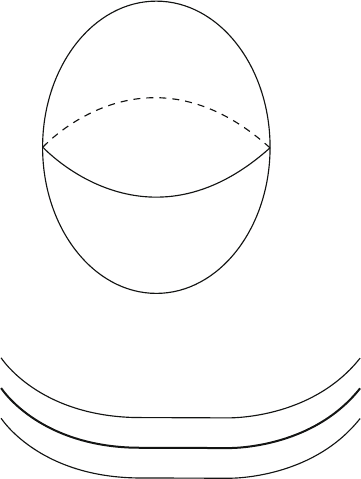
with boundary. We may assume the following (see Figures 3.1 and 3.2):
(a) The domain Ω is a relatively compact open subset of an n-dimensional,
compact smooth manifold M without boundary in which Ω has a smooth
boundary Γ .
(b) In a neighborhood W of Γ in M a normal coordinate t is chosen so that
the points of W are represented as (x
,t), x
∈ Γ , −1 <t<1; t>0inΩ,
t<0inM \
Ω and t = 0 only on Γ .
(c) The manifold M is equipped with a strictly positive density μ which, on
W , is the product of a strictly positive density ω on Γ and the Lebesgue
measure dt on (−1, 1). This manifold M is called the double of Ω.
The function spaces we shall treat are the following (cf. [AF], [BL], [Ca],
[Fr1], [Tb], [Tr]):
(i) The generalized Sobolev spaces H
s,p
(Ω)andH
s,p
(M), consisting of all
potentials of order s of L
p
functions. When s is integral, these spaces co-
incide with the usual Sobolev spaces W
s,p
(Ω)andW
s,p
(M), respectively.
K. Taira, Boundary Value Problems and Markov Processes,55
Lecture Notes in Mathematics 1499, DOI 10.1007/978-3-642-01677-6
3,
c
Springer-Verlag Berlin Heidelberg 2009
56 3 L
p
Theory of Pseudo-Differential Operators
M
Ω=
{t>0}
Γ=∂Ω={t=0}
Fig. 3.1.
W
Γ={t=0}
{0<t<1}
{−1<t<0}
Fig. 3.2.
(ii) The Besov spaces B
s,p
(Γ ). These are functions spaces defined in terms
of the L
p
modulus of continuity, and enter naturally in connection with
boundary value problems.
First, if 1 ≤ p<∞,welet
L
p
(Ω) = the space of (equivalence classes of) Lebesgue
measurable functions u(x)onΩ such that |u(x)|
p
is integrable on Ω.
The space L
p
(Ω) is a Banach space with the norm
u
p
=
Ω
|u(x)|
p
dx
1/p
.
For p = ∞,welet
L
∞
(Ω) = the space of (equivalence classes of) essentially bounded,
Lebesgue measurable functions u(x)onΩ.
The space L
∞
(Ω) is a Banach space with the norm
u
∞
= ess sup
x∈Ω
|u(x)|.

3.1 Function Spaces 57
We recall the basic definitions and facts about the Fourier transform. If
f ∈ L
1
(R
n
), we define its (direct) Fourier transform Ff (ξ) by the formula
Ff(ξ)=
R
n
e
−ix·ξ
f(x)dx, ξ =(ξ
1
,ξ
2
,...,ξ
n
),
where i =
√
−1andx · ξ = x
1
ξ
1
+ x
2
ξ
2
+ ...+ x
n
ξ
n
.WealsodenoteFf (ξ)
by
"
f(ξ).
Similarly, if g ∈ L
1
(R
n
), we define its inverse Fourier transform F
∗
g(x)
by the formula
F
∗
g(x)=
1
(2π)
n
R
n
e
ix·ξ
g(ξ) dξ.
We also denote F
∗
g(x)byˇg(x).
We introduce a subspace of L
1
(R
n
) which is invariant under the Fourier
transform. We define the Schwartz space
S(R
n
) = the space of smooth functions ϕ(x) rapidly decreasing at infinity
on R
n
such that we have, for any non-negative integer j,
p
j
(ϕ)= sup
x∈R
n
|α|≤j
(1 + |x|
2
)
j/2
|∂
α
ϕ(x)|
< ∞.
We equip the space S(R
n
) with the topology defined by the countable family
{p
j
} of seminorms. The space S(R
n
)isaFr´echet space. The transforms F
and F
∗
map S(R
n
) continuously into itself, and FF
∗
= F
∗
F = I on S(R
n
).
Example 3.1. For a>0, we have the assertion
ϕ(x)=e
−a|x|
2
∈S(R
n
).
Furthermore, it is easy to verify the following formulas:
Fϕ(ξ)=
R
n
e
−ix·ξ
e
−a|x|
2
dx =
π
a
n/2
e
−
|x|
2
4a
,
F
∗
(Fϕ)(x)=
1
(2π)
n
R
n
e
ix·ξ
"ϕ(ξ) dξ = ϕ(x).
Since the injection of C
∞
0
(R
n
)intoS(R
n
) is continuous, it follows that
the dual space S
(R
n
)ofS(R
n
) consists of those distributions T ∈D
(R
n
)
that have continuous extensions to S(R
n
). The elements of S
(R
n
) are called
tempered distributions on R
n
.
Roughly speaking, the tempered distributions are those which grow at
most polynomially at infinity, since the functions in S(R
n
)dieoutfasterthan
any power of x at infinity. More precisely, we have the following examples of
tempered distributions:
(1) The functions in L
p
(R
n
), 1 ≤ p ≤∞, are tempered distributions.
58 3 L
p
Theory of Pseudo-Differential Operators
(2) A locally integrable function on R
n
is a tempered distribution if it grows
at most polynomially at infinity.
(3) If u ∈S
(R
n
)andf(x) is a smooth function on R
n
all of whose derivatives
grow at most polynomially at infinity, then the product f (x)u(x)isa
tempered distribution.
(4) Any derivative of a tempered distribution is also a tempered distribution.
Now we give some concrete and important examples of distributions in the
space S
(R
n
):
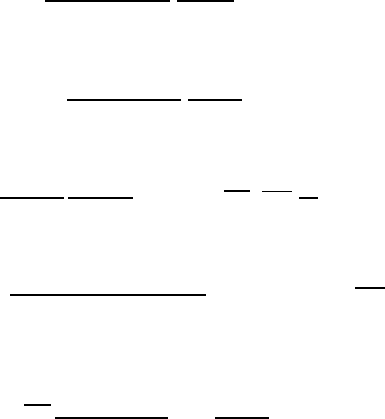
Example 3.2. (a) The Dirac measure: δ(x).
(b) Riesz potentials:
R
α
(x)=
Γ ((n − α)/2)
2
α
π
n/2
Γ (α/2)
1
|x|
n−α
, 0 <α<n.
(c) Newtonian potentials:
N(x)=
Γ ((n − 2)/2)
4π
n/2
1
|x|
n−2
,n≥ 3.
(d) Bessel potentials:
G
α
(x)=
1
Γ (α/2)
1
(4π)
n/2
∞
0
e
−t−
|x|
2
4t
t
α−n
2
dt
t
,α>0.
It is known (see [AS]) that the function G
α
(x) is represented as follows:
G
α
(x)=
1
2
(n+α−2)/2
π
n/2
Γ (α/2)
K
(n−α)/2
(|x|) |x|
α−n
2
,
where K
(n−α)/2
(z) is the modified Bessel function of the third kind (cf. [Wt]).
(e) Riesz kernels:
R
j
(x)=
√
−1
Γ ((n +1)/2)
π
(n+1)/2
v. p.
x
j
|x|
n+1
, 1 ≤ j ≤ n.
The distribution v. p. (x
j
/|x|
n+1
) is an extension of v. p. (1/x)tothen-
dimensional case.
The importance of tempered distributions lies in the fact that they have
Fourier transforms.
The direct and inverse Fourier transforms can be extended to the space
S
(R
n
) by the following formulas:
Fu, ϕ = u, Fϕ,u∈S
(R
n
),ϕ∈S(R
n
).
F
∗
v, ϕ = v, F
∗
ϕ,v∈S
(R
n
),ϕ∈S(R
n
).
Once again, the transforms F and F
∗
map S
(R
n
) continuously into itself,
and FF
∗
= F
∗
F = I on S
(R
n
).
We can calculate explicitly the Fourier transform of the tempered distri-
butions in Example 3.2 as follows:

3.1 Function Spaces 59
Example 3.3. (a) The Dirac measure: (Fδ)(ξ)=1.
(b) Riesz potentials:
(FR
α
)(ξ)=
1
|ξ|
α
, 0 <α<n.
(c) Newtonian potentials:
(FN)(ξ)=
1
|ξ|
2
,n≥ 3.
(d) Bessel potentials:
(FG
α
)(ξ)=
1
(1 + |ξ|
2
)
α/2
,α>0.
(e) Riesz kernels:
(FR
j
)(ξ)=
ξ
j
|ξ|
, 1 ≤ j ≤ n.
If s ∈ R, we define a linear map
J
s
: S
(R
n
) −→ S
(R
n
)
by the formula
J
s
u = F
∗
(1 + |ξ|
2
)
−s/2
Fu
,u∈S
(R
n
).
This can be visualized as follows:
u ∈S
(R
n
)
J
s
−−−−→S
(R
n
) J
s
u
F
⏐
⏐
$
%
⏐
⏐
F
∗
Fu ∈S
(R
n
) −−−−−−−−→
(1+|ξ|
2
)
−s/2
S
(R
n
) (1 + |ξ|
2
)
−s/2
Fu
Then it is easy to see that the map J
s
is an isomorphism of S
(R
n
)ontoitself
and that its inverse is the map J
−s
. The function J
s
u is called the Bessel
potential of order s of u.
(I) Now, if s ∈ R and 1 <p<∞,welet
H
s,p
(R
n
) = the image of L
p
(R
n
) under the mapping J
s
.
We equip H
s,p
(R
n
) with the norm u
s,p
= J
−s
u
p
for u ∈ H
s,p
(R
n
). The
space H
s,p
(R
n
) is called the (generalized) Sobolev space of order s.
We list some basic topological properties of H
s,p
(R
n
):
(1) The Schwartz space S(R
n
) is dense in each H
s,p
(R
n
).

60 3 L
p
Theory of Pseudo-Differential Operators
(2) The space H
−s,p
(R
n
) is the dual space of H
s,p
(R
n
), where p
= p/(p−1)
is the exponent conjugate to p.
(3) If s>t, then we have the inclusions
S(R
n
) ⊂ H
s,p
(R
n
) ⊂ H
t,p
(R
n
) ⊂S
(R
n
),
with continuous injections.
(4) If s is a non-negative integer, then the space H
s,p
(R
n
) is isomorphic to
the usual Sobolev space W
s,p
(R
n
), that is, the space H
s,p
(R
n
)coincides
with the space of functions u ∈ L
p
(R
n
) such that D
α
u ∈ L
p
(R
n
)for
|α|≤s,andthenorm·
s,p
is equivalent to the norm
⎛
⎝
|α|≤s
R
n
|D
α
u(x)|
p
dx
⎞
⎠
1/p
.
(II) Next, if 1 <p<∞,welet
B
1,p
(R
n−1
) = the space of (equivalence classes of) functions
ϕ(x
) ∈ L
p
(R
n−1
) for which the integral
R
n−1
×R
n−1
|ϕ(x
+ y
) − 2ϕ(x
)+ϕ(x
− y
)|
p
|y
|
n−1+p
dy
dx
is finite.
The space B
1,p
(R
n−1
) is a Banach space with respect to the norm
|ϕ|
1,p
=
R
n−1
|ϕ(x
)|
p
dx
+
R
n−1
×R
n−1
|ϕ(x
+ y
) − 2ϕ(x
)+ϕ(x
− y
)|
p
|y
|
n−1+p
dy
dx
1/p
.
If p = ∞,welet
B
1,∞
(R
n−1
) = the space of (equivalence classes of) functions
ϕ(x
) ∈ L
∞
(R
n−1
) for which the quantity
sup
|y
|>0
ϕ(· + y
) − 2ϕ(·)+ϕ(·−y
)
∞
|y
|
is finite.
The space B
1,∞
(R
n−1
) is a Banach space with respect to the norm
|ϕ|
1,∞
= ϕ
∞
+sup
|y
|>0
ϕ(·+ y
) − 2ϕ(·)+ϕ(·−y
)
∞
|y
|
.
If s ∈ R,welet

3.1 Function Spaces 61
B
s,p
(R
n−1
) = the image of B
1,p
(R
n−1
) under the mapping J
s−1
,where
J
s−1
is the Bessel potential of order s − 1onR
n−1
.
We equip the space B
s,p
(R
n−1
) with the norm |ϕ|
s,p
=
J
−s+1
ϕ
1,p
for
ϕ(x
) ∈ B
s,p
(R
n−1
). The space B
s,p
(R
n−1
) is called the Besov space of or-
der s.
We list some basic topological properties of B
s,p
(R
n−1
):
(1) The Schwartz space S(R
n−1
) is dense in each B
s,p
(R
n−1
).
(2) The space B
−s,p
(R
n−1
) is the dual space of B
s,p
(R
n−1
), where p
=
p/(p − 1) is the exponent conjugate to p.
(3) If s>t, then we have the inclusions
S(R
n−1
) ⊂ B
s,p
(R
n−1
) ⊂ B
t,p
(R
n−1
) ⊂S
(R
n−1
),
with continuous injections.
(4) If s = m + σ where m is a non-negative integer and 0 <σ<1, then
the Besov space B
s,p
(R
n−1
) coincides with the space of functions ϕ(x
) ∈
H
m,p
(R
n−1
) such that, for |α| = m, the integral (Slobodecki˘ıseminorm)
R
n−1
×R
n−1
|D
α
ϕ(x
) − D
α
ϕ(y
)|
p
|x
− y
|
n−1+pσ
dx
dy
< ∞.
Furthermore, the norm |ϕ|
s,p
is equivalent to the norm
|α|≤m
R
n−1
|D
α
ϕ(x
)|
p
dx
+
|α|=m
R
n−1
×R
n−1
|D
α
ϕ(x
) − D
α
ϕ(y
)|
p
|x
− y
|
n−1+pσ
dx
dy
1/p
.
Now we define the generalized Sobolev spaces H
s,p
(Ω), H
s,p
(M)andthe
Besov spaces B
s,p
(Γ ) for arbitrary values of s.
For each s ∈ R, we define
H
s,p
(Ω) = the space of distributions u ∈D
(Ω) such that
there exists a function U ∈ H
s,p
(R
n
)withU |
Ω
= u,
and equip the space H
s,p
(Ω) with the norm
u
s,p
=infU
s,p
,
where the infimum is taken over all such U .ThespaceH
s,p
(Ω)isaBanach
space with respect to the norm ·
s,p
.Weremarkthat
H
0,p
(Ω)=L
p
(Ω); ·
0,p
= ·
p
.
62 3 L
p
Theory of Pseudo-Differential Operators
The spaces H
s,p
(M) are defined to be locally the spaces H
s,p
(R
n
), upon
using local coordinate systems flattening out M, together with a partition of
unity. The spaces B
s,p
(Γ ) are defined similarly, with H
s,p
(R
n
) replaced by
B
s,p
(R
n−1
). The norms of H
s,p
(M)andB
s,p
(Γ ) will be denoted by ·
s,p
and |·|
s,p
, respectively.
We state two important theorems that will be used in the study of bound-
ary value problems in the framework of Sobolev spaces of L
p
type (see [AF],
[BL], [St1], [Tr]):
(I) (The trace theorem)Let1<p<∞. Then the trace map
ρ : H
s,p
(Ω) −→ B
s−1/p,p
(∂Ω)
u −→ u|
∂Ω
is continuous for all s>1/p, and is surjective.
(II) (The Rellich–Kondrachov theorem)Ifs>t, then the injections
H
s,p
(M) −→ H
t,p
(M),
B
s,p
(∂Ω) −→ B
t,p
(∂Ω)
are both compact (or completely continuous).
Finally, we introduce a space of distributions on Ω which behave locally
just like the distributions in H
s,p
(R
n
):
H
s,p
loc
(Ω) = the space of distributions u ∈D
(Ω) such that
ϕu ∈ H
s,p
(R
n
) for all ϕ ∈ C
∞
0
(Ω).
We equip the localized Sobolev space H
s,p
loc
(Ω) with the topology defined by
the seminorms u →ϕu
s,p
as ϕ ranges over C
∞
0
(Ω). It is easy to verify that
H
s,p
loc
(Ω)isaFr´echet space. The localized Besov space B
s,p
loc
(∂Ω) is defined
similarly, with H
s,p
(R
n
) replaced by B
s,p
(R
n−1
).
3.2 Fourier Integral Operators
In this section, we present a brief description of basic concepts and results of
the theory of Fourier integral operators.
3.2.1 Symbol Classes
Let Ω be an open subset of R
n
.Ifm ∈ R and 0 ≤ δ<ρ≤ 1, we let
S
m
ρ,δ
(Ω × R
N
) = the set of all functions a(x, θ) ∈ C
∞
(Ω × R
N
)
with the property that, for any compact K ⊂ Ω and
any multi-indices α, β, there exists a positive constant
C
K,α,β
such that we have, for all x ∈ K and θ ∈ R
N
,
∂
α
θ
∂
β
x
a(x, θ)
≤ C
K,α,β
(1 + |θ|)
m−ρ|α|+δ|β|
.

3.2 Fourier Integral Operators 63
The elements of S
m
ρ,δ
(Ω × R
N
) are called symbols of order m.Wedropthe
Ω × R
N
and use S
m
ρ,δ
when the context is clear.
Example 3.4. (1) A polynomial p(x, ξ)=
&
|α|≤m
a
α
(x)ξ
α
of order m with
coefficients in C
∞
(Ω)isinS
m
1,0
(Ω × R
n
).
(2) If m ∈ R, the function
Ω × R
n
(x, ξ) −→
1+|ξ|
2
m/2
is in S
m
1,0
(Ω × R
n
).
(3) A function a(x, θ) ∈ C
∞
(Ω × (R
N
\{0})issaidtobepositively homoge-
neous of degree m in θ if it satisfies the condition
a(x, tθ)=t
m
a(x, θ) for all t>0andθ ∈ R
N
\{0}.
If a(x, θ) is positively homogeneous of degree m in θ and if ϕ(θ)isasmooth
function such that ϕ(θ)=0for|θ|≤1/2andϕ(θ)=1for|θ|≥1, then the
function ϕ(θ)a(x, θ)isinS
m
1,0
(Ω × R
N
).
If K is a compact subset of Ω and if j is a non-negative integer, we define
aseminormp
K,j,m
on S
m
ρ,δ
(Ω × R
N
) by the formula
S
m
ρ,δ
(Ω × R
N
) a −→ p
K,j,m
(a)= sup
x∈K, θ∈R
N
|α|≤j
∂
α
θ
∂
β
x
a(x, θ)
(1 + |θ|)
m−ρ|α|+δ|β|
.
We equip the space S
m
ρ,δ
(Ω × R
N
) with the topology defined by the family
{p
K,j,m
} of seminorms where K ranges over all compact subsets of Ω and
j =0,1,....ThespaceS
m
ρ,δ
(Ω × R
N
)isaFr´echet space.
We set
S
−∞
(Ω × R
N
)=
m∈R
S
m
ρ,δ
(Ω × R
N
).
The next theorem gives a meaning to a formal sum of symbols of decreasing
order:
Theorem 3.1. Let a
j
(x, θ) ∈ S
m
j
ρ,δ
(Ω × R
N
), m
j
↓−∞, j =0, 1, ....Then
there exists a symbol a(x, θ) ∈ S
m
0
ρ,δ
(Ω ×R
N
),uniquemoduloS
−∞
(Ω ×R
N
),
such that we have, for all positive integer k,
a(x, θ) −
k−1
j=0
a
j
(x, θ) ∈ S
m
k
ρ,δ
(Ω × R
N
). (3.1)
If formula (3.1) holds true, we write
a(x, θ) ∼
∞
j=0
a
j
(x, θ).

64 3 L
p
Theory of Pseudo-Differential Operators
The formal sum
&
∞
j=0
a
j
(x, θ) is called an asymptotic expansion of a(x, θ).
Asymbola(x, θ) ∈ S
m
1,0
(Ω × R
N
)issaidtobeclassical if there exist
smooth functions a
j
(x, θ), positively homogeneous of degree m − j in θ for
|θ|≥1, such that we have, for all positive integer k,
a(x, θ) −
k−1
j=0
a
j
(x, θ) ∈ S
m−k
1,0
(Ω × R
N
).
The homogeneous function a
0
(x, θ)ofdegreem is called the principal part of
a(x, θ).
We let
S
m
cl
(Ω × R
N
) = the set of all classical symbols of order m.
For example, the symbols in Example 3.4 are all classical, and they have
respectively as principal part the following functions:
(1) p
m
(x, ξ)=
&
|α|=m
a
α
(x)ξ
α
.
(2) |ξ|
m
.
(3) a(x, θ).
Asymbola(x, θ)inS
m
ρ,δ
(Ω × R
N
)issaidtobeelliptic of order m if, for
any compact K ⊂ Ω, there exists a positive constant C
K
such that
|a(x, θ)|≥C
K
(1 + |θ|)
m
for all x ∈ K and |θ|≥
1
C
K
.
There is a simple criterion in the case of classical symbols.
Theorem 3.2. Let a(x, θ) be in S
m
cl
(Ω × R
N
) with principal part a
0
(x, θ).
Then a(x, θ) is elliptic if and only if it satisfies the condition
a
0
(x, θ) =0 for all x ∈ Ω and |θ| =1.
3.2.2 Phase Functions
Let Ω be an open subset of R
n
. A function ϕ(x, θ)inC
∞
Ω ×
R
N
\{0}
is called a phase function on Ω ×(R
N
\{0}) if it satisfies the following three
conditions:
(a) ϕ(x, θ) is real-valued.
(b) ϕ(x, θ) is positively homogeneous of degree one in the variable θ.
(c) The differential dϕ(x, θ) does not vanish on Ω ×
R
N
\{0}
.
Example 3.5. Let U be an open subset of R
p
and Ω = U ×U. The function
ϕ(x, y, ξ)=(x − y) · ξ
is a phase function on the space Ω × (R
p
\{0})withn =2p and N = p.