
Kazuaki Taira. Boundary Value Problems and Markov Processes
Подождите немного. Документ загружается.

2.2 Markov Processes and Feller Semigroups 35
and
p
0
(x, E)=χ
E
(x).
This represents Brownian motion with a sticking barrier at x =0.When
a Brownian particle reaches the boundary point 0 for the first time, instead
of reflecting it sticks there forever; in this case the state 0 is called a trap.
2.2.3 Path Functions of Markov Processes
It is naturally interesting and important to ask the following problem:
Problem. Given a Markov transition function p
t
(x, ·), under which condi-
tions on p
t
(x, ·) does there exist a Markov process with transition function
p
t
(x, ·) whose paths are almost surely continuous?
A Markov process X =(x
t
, F, F
t
,P
x
)issaidtoberight continuous pro-
vided that we have, for each x ∈ K,
P
x
{ω ∈ Ω : the mapping t → x
t
(ω) is a right continuous function
from [0, ∞)intoK
∂
} =1.
Furthermore, we say that X is continuous provided that we have, for each
x ∈ K,
P
x
{ω ∈ Ω : the mapping t → x
t
(ω) is a continuous function
from [0,ζ(ω)) into K
∂
} =1,
where ζ is the lifetime of the process X.
Nowwegivesomeusefulcriteriaforpathcontinuityintermsof
Markov transition functions (see Dynkin [Dy1, Chapter 6], [Dy2, Chapter 3,
Section 2]):
Theorem 2.10. Let (K, ρ) be a locally compact, separable metric space and
let p
t
(x, ·) be a normal Markov transition function on K.
(i) Assume that the following two conditions are satisfied:
(L) For each s>0 and each compact E ⊂ K, we have the condition
lim
x→∂
sup
0≤t≤s
p
t
(x, E)=0.
(M) For each ε>0 and each compact E ⊂ K, we have the condition
lim
t↓0
sup
x∈E
p
t
(x, K \ U
ε
(x)) = 0,
where U
ε
(x)={y ∈ K : ρ(y, x) <ε} is an ε-neighborhood of x.

36 2 Semigroup Theory
Then there exists a Markov process X with transition function p
t
(x, ·)
whose paths are right continuous on [0, ∞) and have left-hand limits on [0,ζ)
almost surely.
(ii) Assume that condition (L) and the following condition (N) (replacing
condition (M)) are satisfied:
(N) For each ε>0 and each compact E ⊂ K, we have the condition
lim
t↓0
1
t
sup
x∈E
p
t
(x, K \U
ε
(x)) = 0,
or equivalently
sup
x∈E
p
t
(x, K \U
ε
(x)) = o(t) as t ↓ 0.
Then there exists a Markov process X with transition function p
t
(x, ·)
whose paths are almost surely continuous on [0,ζ).
Remark 2.2. It is known (see Dynkin [Dy1, Lemma 6.2]) that if the paths of
a Markov process are right continuous, then the transition function p
t
(x, ·)
satisfies the condition
lim
t↓0
p
t
(x, U
ε
(x)) = 1 for all x ∈ K.
2.2.4 Strong Markov Processes and Transition Functions
A Markov process is called a strong Markov process if the “starting afresh”
property holds not only for every fixed moment but also for suitable random
times.
We shall formulate precisely this “strong” Markov property. Let X =
(x
t
, F, F
t
,P
x
) be a Markov process. A mapping τ: Ω → [0, ∞] is called a
stopping time or Markov time with respect to {F
t
} if it satisfies the condition
{τ ≤ t} = {ω ∈ Ω : τ(ω) ≤ t}∈F
t
for all t ∈ [0, ∞).
Intuitively, this means that the events {τ ≤ t} depend on the process only up
to time t, but not on the “future” after time t. It should be noticed that any
non-negative constant mapping is a stopping time.
If τ is a stopping time with respect to {F
t
},welet
F
τ
= {A ∈F: A ∩{τ ≤ t}∈F
t
for all t ∈ [0, ∞)}.
Intuitively, we may think of F
τ
as the “past” up to the random time τ.Itis
easy to verify that F
τ
is a σ-algebra. If τ ≡ t
0
for some constant t
0
≥ 0, then
F
τ
reduces to F
t
0
.
For each t ∈ [0, ∞], we define a mapping
Φ
t
:[0,t] × Ω −→ K
∂
2.2 Markov Processes and Feller Semigroups 37
by the formula
Φ
t
(s, ω)=x
s
(ω).
A Markov process X =(x
t
, F, F
t
,P
x
)issaidtobeprogressively measurable
with respect to {F
t
} if the mapping Φ
t
is B
[0,t]
×F
t
/B
∂
-measurable for each
t ∈ [0, ∞], that is, if we have the condition
Φ
−1
t
(E)={Φ
t
∈ E}∈B
[0,t]
×F
t
for all E ∈B
∂
.
Here B
[0,t]
is the σ-algebra of all Borel sets in the interval [0,t]andB
∂
is the
σ-algebra in K
∂
generated by B. It should be noticed that if X is progressively
measurable and if τ is a stopping time, then the mapping x
τ
: ω → x
τ (ω)
(ω)is
F
τ
/B
∂
-measurable.
The next definition expresses the idea of “starting afresh” at random times:
Definition 2.2. We say that a progressively measurable Markov process X =
(x
t
, F, F
t
,P
x
)hasthestrong Markov property with respect to {F
t
} if the
following condition is satisfied: For all h ≥ 0, x ∈ K
∂
, E ∈B
∂
and all stopping
times τ,wehavetheformula
P
x
{x
τ +h
∈ E |F
τ
} = p
h
(x
τ
,E),
or equivalently,
P
x
(A ∩{x
τ +h
∈ E})=
A
p
h
(x
τ (ω)
(ω),E) dP
x
(ω) for all A ∈F
τ
.
We shall state a simple criterion for the strong Markov property in terms
of transition functions.
Let (K, ρ) be a locally compact, separable metric space. We add a point
∂ to the metric space K as the point at infinity if K is not compact, and as
an isolated point if K is compact; so the space K
∂
= K ∪{∂} is compact
(see Figure 2.10). Let C(K) be the space of real-valued, bounded continuous
functions f (x)onK;thespaceC(K) is a Banach space with the supremum
norm
f
∞
=sup
x∈K
|f(x)|.
We say that a function f ∈ C(K) converges to zero as x → ∂ if, for each
ε>0, there exists a compact subset E of K such that
|f(x)| <ε for all x ∈ K \E,
and we then write lim
x→∂
f(x)=0.Welet
C
0
(K)=
f ∈ C(K) : lim
x→∂
f(x)=0
.
The space C
0
(K) is a closed subspace of C(K); hence it is a Banach space.
Note that C
0
(K) may be identified with C(K)ifK is compact.
38 2 Semigroup Theory
Now we introduce a useful convention as follows:
Any real-valued function f (x) on K is extended to
the space K
∂
= K ∪{∂}by setting f (∂)=0.
From this point of view, the space C
0
(K) is identified with the subspace of
C(K
∂
) which consists of all functions f(x) satisfying the condition f(∂)=0:
C
0
(K)={f ∈ C(K
∂
):f(∂)=0}.
Furthermore, we can extend a Markov transition function p
t
(x, ·)onK to a
Markov transition function p
t
(x, ·)onK
∂
by the formulas:
⎧
⎨
⎩
p
t
(x, E)=p
t
(x, E) for all x ∈ K and E ∈B,
p
t
(x, {∂})=1−p
t
(x, K) for all x ∈ K,
p
t
(∂,K)=0,p
t
(∂,{∂})=1.
Intuitively this means that a Markovian particle moves in the space K until
it “dies” at the time when it reaches the point ∂; hence the point ∂ is called
the terminal point.
Now we introduce some conditions on the measures p
t
(x, ·) related to con-
tinuity in x ∈ K,forfixedt ≥ 0:
Definition 2.3. (i) A Markov transition function p
t
(x, ·) is called a Fel ler
function if the function
T
t
f(x)=
K
p
t
(x, dy)f(y)
is a continuous function of x ∈ K whenever f is in C(K), that is, if we have
the condition
f ∈ C(K)=⇒ T
t
f ∈ C(K).
(ii) We say that p
t
(x, ·)isaC
0
-function if the space C
0
(K) is an invariant
subspace of C(K) for the operators T
t
:
f ∈ C
0
(K)=⇒ T
t
f ∈ C
0
(K).
Remark 2.3. The Feller property is equivalent to saying that the measures
p
t
(x, ·) depend continuously on x ∈ K in the usual weak topology, for every
fixed t ≥ 0.
The next theorem gives a useful criterion for the strong Markov property
(see [Dy1, Theorem 5.10]):
Theorem 2.11. If the transition function p
t
(x, ·) of a right continuous Mar-
kov process X has the C
0
-property, then X is a strong Markov process.
2.2 Markov Processes and Feller Semigroups 39
Furthermore, we state a simple criterion for the strong Markov property in
terms of Markov transition functions. To do this, we introduce the following
definition:
Definition 2.4. A Markov transition function p
t
(x, ·)onK is said to be uni-
formly stochastically continuous on K if the following condition is satisfied:
For each ε>0 and each compact E ⊂ K, we have the condition
lim
t↓0
sup
x∈E
[1 − p
t
(x, U
ε
(x))] = 0, (2.27)
where U
ε
(x)={y ∈ K : ρ(y, x) <ε} is an ε-neighborhood of x.
It should be emphasized that every uniformly stochastically continuous
transition function is normal and satisfies condition (M) in Theorem 2.10. By
combining part (i) of Theorem 2.10 and Theorem 2.11, we obtain the following
result (see [Dy1, Theorem 6.3]):
Theorem 2.12. Assume that a uniformly stochastically continuous, C
0
-
transition function p
t
(x, ·) satisfies condition (L). Then it is the transition
function of some strong Markov process X whose paths are right continuous
and have no discontinuities other than jumps.
A continuous strong Markov process is called a diffusion process.
The next theorem states a sufficient condition for the existence of a diffu-
sion process with a prescribed Markov transition function:
Theorem 2.13. Assume that a uniformly stochastically continuous, C
0
-
transition function p
t
(x, ·) satisfies conditions (L) and (N). Then it is the
transition function of some diffusion process X.
This is an immediate consequence of part (ii) of Theorem 2.10 and
Theorem 2.12.
2.2.5 Markov Transition Functions and Feller Semigroups
The Feller or C
0
-property deals with continuity of a Markov transition func-
tion p
t
(x, E)inx, and does not, by itself, have no concern with continuity
in t. We give a necessary and sufficient condition on p
t
(x, E)inorderthatits
associated operators {T
t
}
t≥0
, defined by the formula
T
t
f(x)=
K
p
t
(x, dy)f(y),f∈ C
0
(K), (2.28)
is strongly continuous in t on the space C
0
(K):
lim
s↓0
T
t+s
f − T
t
f
∞
=0,f∈ C
0
(K). (2.29)
40 2 Semigroup Theory
Then we have the following (cf. [Ta2, Theorem 9.2.3]):
Theorem 2.14. Let p
t
(x, ·) be a C
0
-transition function on K. Then the as-
sociated operators {T
t
}
t≥0
, defined by formula (2.28) is strongly continuous
in t on C
0
(K) if and only if p
t
(x, ·) is uniformly stochastically continuous on
K and satisfies condition (L).
Proof. (i) The “if” part: Since continuous functions with compact support are
dense in C
0
(K), it suffices to prove the strong continuity of {T
t
} at t =0:
lim
t↓0
T
t
f − f
∞
= 0 (2.30)
for all such functions f .
For any compact subset E of K containing the support supp f of f,we
have the inequality
T
t
f − f
∞
≤ sup
x∈E
|T
t
f(x) − f(x)| +sup
x∈K\E
|T
t
f(x)|
≤ sup
x∈E
|T
t
f(x) − f(x)| + f
∞
· sup
x∈K\E
p
t
(x, supp f). (2.31)
However, condition (L) implies that, for each ε>0, we can find a compact
subset E of K such that, for all sufficiently small t>0,
sup
x∈K\E
p
t
(x, supp f) <ε. (2.32)
On the other hand, we have, for each δ>0,
T
t
f(x) − f(x)=
U
δ
(x)
p
t
(x, dy)(f (y) − f(x))
+
K\U
δ
(x)
p
t
(x, dy)(f (y) − f(x)) − f(x)(1 − p
t
(x, K)),
and hence
sup
x∈E
|T
t
f(x) − f(x)|
≤ sup
ρ(x,y)<δ
|f(y) − f(x)|+3f
∞
· sup
x∈E
[1 − p
t
(x, U
δ
(x))] .
Since the function f(x) is uniformly continuous, we can choose a positive
constant δ such that
sup
ρ(x,y)<δ
|f(y) − f(x)| <ε.
Furthermore, it follows from condition (2.27) with ε := δ (the uniform stochas-
tic continuity of p
t
(x, ·)) that, for all sufficiently small t>0,
2.2 Markov Processes and Feller Semigroups 41
sup
x∈E
[1 − p
t
(x, U
δ
(x))] <ε.
Hence we have, for all sufficiently small t>0,
sup
x∈E
|T
t
f(x) − f(x)| <ε(1 + 3f
∞
). (2.33)
Therefore, by carrying inequalities (2.32) and (2.33) into inequality (2.31)
we obtain that, for all sufficiently small t>0,
T
t
f − f
∞
<ε(1 + 4f
∞
).
This proves the desired formula (2.30), that is, the strong continuity (2.29) of
{T
t
}.
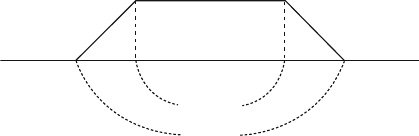
(ii) The “only if” part: For any x ∈ K and ε>0, we define a continuous
function f
x
(y) by the formula (see Figure 2.13)
f
x
(y)=
1 −
1
ε
ρ(x, y)ifρ(x, y) ≤ ε,
0ifρ(x, y) >ε.
(2.34)
f
x
x
εε
Fig. 2.13.
Let E be an arbitrary compact subset of K. Then, for all sufficiently small
ε>0, the functions f
x
, x ∈ E,areinC
0
(K) and satisfy the condition
f
x
− f
z
∞
≤
1
ε
ρ(x, z) for all x, z ∈ E. (2.35)
However, for any δ>0, by the compactness of E we can find a finite number
of points x
1
, x
2
, ..., x
n
of E such that
E =
n
k=1
U
δε/4
(x
k
),
and hence
min
1≤k≤n
ρ(x, x
k
) ≤
δε
4
for all x ∈ E.
Thus, by combining this inequality with inequality (2.35) with z := x
k
we
obtain that

42 2 Semigroup Theory
min
1≤k≤n
f
x
− f
x
k
∞
≤
δ
4
for all x ∈ E. (2.36)
Now we have, by formula (2.34),
0 ≤ 1 − p
t
(x, U
ε
(x)) ≤ 1 −
K
∂
p
t
(x, dy)f
x
(y)
= f
x
(x) − T
t
f
x
(x)
≤f
x
− T
t
f
x
∞
≤f
x
− f
x
k
∞
+ f
x
k
− T
t
f
x
k
∞
+T
t
f
x
k
− T
t
f
x
∞
≤ 2f
x
− f
x
k
∞
+ f
x
k
− T
t
f
x
k
∞
for all x ∈ E.
In view of inequality (2.36), the first term on the last inequality is bounded by
δ/2 for the right choice of k. Furthermore, it follows from the strong continuity
(2.30) of {T
t
} that the second term tends to zero as t ↓ 0foreachk =1,2,
..., n.
Consequently, we have, for all sufficiently small t>0,
sup
x∈E
[1 − p
t
(x, U
ε
(x))] ≤ δ.
This proves the desired condition (2.27), that is, the uniform stochastic con-
tinuity of p
t
(x, ·).
Finally, it remains to verify condition (L). Assume, to the contrary, that:
For some s>0 and some compact E ⊂ K, there exist a positive constant
ε
0
, a sequence { t
k
}, t
k
↓ t (0 ≤ t ≤ s) and a sequence {x
k
}, x
k
→ ∂,such
that
p
t
k
(x
k
,E) ≥ ε
0
. (2.37)
NowwetakearelativelycompactsubsetU of K containing E,andlet
(see Figure 2.14)
f(x)=
ρ(x, K \ U)
ρ(x, E)+ρ(x, K \ U )
.
Then it follows that the function f(x)isinC
0
(K) and satisfies the condi-
tion
T
t
f(x)=
K
p
t
(x, dy)f(y) ≥ p
t
(x, E) ≥ 0.
Therefore, by combining this inequality with inequality (2.37) we obtain that
T
t
k
f(x
k
) ≥ p
t
k
(x
k
,E) ≥ ε
0
. (2.38)
However, we have the inequality
T
t
k
f(x
k
) ≤T
t
k
f − T
t
f
∞
+ T
t
f(x
k
). (2.39)
2.2 Markov Processes and Feller Semigroups 43
E
U
f
Fig. 2.14.
Since the semigroup {T
t
} is strongly continuous and since we have the asser-
tion
lim
k→∞
T
t
f(x
k
)=T
t
f(∂)=0,
we can let k →∞in inequality (2.39) to obtain that
lim sup
k→∞
T
t
k
f(x
k
)=0.
This contradicts inequality (2.38).
The proof of Theorem 2.14 is now complete.
A family {T
t
}
t≥0
of bounded linear operators acting on the space C
0
(K)is
called a Feller semigroup on K if it satisfies the following three conditions:
(i) T
t+s
= T
t
· T
s
, t, s ≥ 0 (the semigroup property); T
0
= I.
(ii) The family {T
t
} is strongly continuous in t for all t ≥ 0:
lim
s↓0
T
t+s
f − T
t
f
∞
=0,f∈ C
0
(K).
(iii) The family {T
t
} is non-negative and contractive on C
0
(K):
f ∈ C
0
(K), 0 ≤ f(x) ≤ 1onK =⇒ 0 ≤ T
t
f(x) ≤ 1onK.
Rephrased, Theorem 2.14 gives a characterization of Feller semigroups in
terms of Markov transition functions:
Theorem 2.15. If p
t
(x, ·) is a uniformly stochastically continuous C
0
-
transition function on K and satisfies condition (L), then its associated
operators {T
t
}
t≥0
, defined by formula (2.28), form a Feller semigroup on K.
Conversely, if {T
t
}
t≥0
is a Feller semigroup on K, then there exists a uni-
formly stochastically continuous C
0
-transition p
t
(x, ·) on K, satisfying condi-
tion (L), such that formula (2.28) holds.
The most important applications of Theorem 2.15 are of course in the
second statement.
44 2 Semigroup Theory
2.2.6 Generation Theorems of Feller Semigroups
In this subsection we prove various generation theorems of Feller semigroups
by using the Hille–Yosida theory of semigroups.
If {T
t
}
t≥0
is a Feller semigroup on K, we define its infinitesimal generator
A by the formula
Au = lim
t↓0
T
t
u − u
t
,u∈ C
0
(K), (2.40)
provided that the limit (2.40) exists in the space C
0
(K). More precisely, the
generator A is a linear operator from C
0
(K) into itself defined as follows:
(1) The domain D(A)ofA is the set
D(A)={u ∈ C
0
(K) : the limit (2.40) exists}.
(2) Au = lim
t↓0
T
t
u−u
t
, u ∈D(A).
The next theorem is a version of the Hille–Yosida theorem adapted to the
present context (cf. [Ta2, Theorem 9.3.1 and Corollary 9.3.2]):
Theorem 2.16 (Hille–Yosida). (i) Let {T
t
}
t≥0
be a Feller semigroup on
K and let A be its infinitesimal generator. Then we have the following four
assertions:
(a) The domain D(A) is dense in the space C
0
(K).
(b) For each α>0, the equation (αI − A)u = f has a unique solution u
in D(A) for any f ∈ C
0
(K). Hence, for each α>0 the Green operator
(αI −A)
−1
: C
0
(K) → C
0
(K) can be defined by the formula
u =(αI −A)
−1
f, f ∈ C
0
(K).
(c) For each α>0, the operator (αI − A)
−1
is non-negative on C
0
(K):
f ∈ C
0
(K),f(x) ≥ 0 on K =⇒ (αI − A)
−1
f(x) ≥ 0 on K.
(d) For each α>0, the operator (αI −A)
−1
is bounded on C
0
(K) with norm
(αI −A)
−1
≤
1
α
.
(ii) Conversely, if A is a linear operator from C
0
(K) into itself satisfying
condition (a) and if there is a non-negative constant α
0
such that, for all
α>α
0
, conditions (b) through (d) are satisfied, then A is the infinitesimal
generator of some Feller semigroup {T
t
}
t≥0
on K.
Proof. In view of the Hille–Yosida theory (see [Yo, Chapter IX, Section 7]), it
suffices to show that the semigroup {T
t
}
t≥0
is non-negative if and only if its
resolvents (Green operators) {(αI −A)
−1
}
α>α
0
are non-negative.