
Kazuaki Taira. Boundary Value Problems and Markov Processes
Подождите немного. Документ загружается.


9.1 General Existence Theorem for Feller Semigroups 139
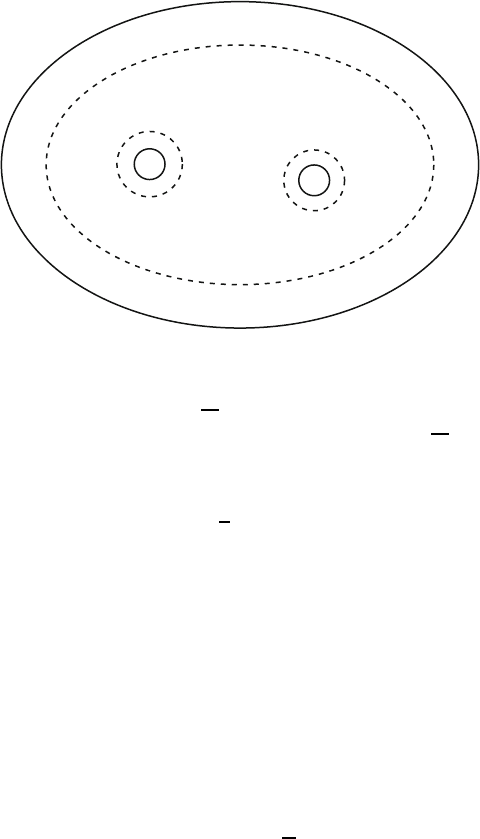
D
@D
Fig. 9.1.
Lemma 9.13. The right-hand side of formula (9.18) depends only on u,not
on the choice of expression (9.13).
Proof. Assume that
u = G
0
α
αI −
A
u
+ H
α
(u|
∂D
)
= G
0
β
βI −
A
u
+ H
β
(u|
∂D
) ,
where α, β>0. Then it follows from formula (9.14) with f :=
αI −
A
u
and formula (9.18) with ψ := u|
∂D
that
LG
0
α
αI −
A
u
+ LH
α
(u|
∂D
)
=
LG
0
β
αI −
A
u
− (α − β)LG
0
α
G
0
β
αI −
A
u
+
LH
β
(u|
∂D
) − (α − β)LG
0
α
H
β
(u|
∂D
)
=
LG
0
β
((βI − A)u)+LH
β
(u|
∂D
)
+(α − β)
LG
0
β
u − LG
0
α
G
0
β
αI −
A
u − LG
0
α
H
β
(u|
∂D
)
. (9.19)
However, the last term of formula (9.19) vanishes. Indeed, it follows from
formula (9.13) with α := β and formula (9.14) with f := u that
LG
0
β
u − LG
0
α
G
0
β
αI −
A
u
− LG
0
α
H
β
(u|
∂D
)
=
LG
0
β
u − LG
0
α
G
0
β
βI −
A
u + H
β
(u|
∂D
)+(α − β)G
0
β
u
=
LG
0
β
u − LG
0
α
u − (α − β)LG
0
α
G
0
β
u
=0.
Therefore, we obtain from formula (9.19) that
LG
0
α
αI −
A
u
+ LH
α
(u|
∂D
)=LG
0
β
βI −
A
u
+ LH
β
(u|
∂D
) .
The proof of Lemma 9.13 is complete.

140 9 Proof of Theorem 1.3, Part (ii)
9.2 Feller Semigroups with Reflecting Barrier
Now we consider the Neumann boundary condition
L
N
u ≡
∂u
∂n
∂D
.
We recall that the boundary condition L
N
is supposed to correspond to the
reflection phenomenon.
The next theorem (formula (9.21)) asserts that we can “piece together” a
Markov process on ∂D with A-diffusion in D to construct a Markov process
on
D = D ∪ ∂D with reflecting barrier (cf. [BCP, Th´eor`eme XIX]):
Theorem 9.14. We define a linear operator
A
N
: C(D) −→ C(D)
as follows.
(a) The domain D(A
N
) of A
N
is the space
D(A
N
)=
u ∈D(A):u|
∂D
∈D
N
,L
N
u =0
, (9.20)
where D
N
is the common domain of the operators L
N
H
α
for all α>0.
(b) A
N
u = Au, u ∈D(A
N
).
Then the operator A
N
is the infinitesimal generator of some Feller semi-
group on
D, and the Green operator G
N
α
=(αI −A
N
)
−1
, α>0, is given by
the following formula:
G
N
α
f = G
0
α
f − H
α
L
N
H
α
−1
L
N
G
0
α
f
,f∈ C(D). (9.21)
Proof. We apply part (ii) of Theorem 2.16 to the operator A
N
defined by
formula (9.20). The proof is divided into eight steps.
Step 1:First,weprovethat:
The operator
L
N
H
α
is the generator of some Feller semigroup on ∂D,
for any sufficiently large α>0.
We introduce a linear operator
T
N
(α):B
2−1/p,p
(∂D) −→ B
2−1/p,p
(∂D)
as follows.
(a) The domain D(T
N
(α)) of T
N
(α)isthespace
D(T
N
(α)) =
ϕ ∈ B
2−1/p,p
(∂D):L
N
H
α
ϕ ∈ B
2−1/p,p
(∂D)
.

9.2 Feller Semigroups with Reflecting Barrier 141
(b) T
N
(α)ϕ = L
N
H
α
ϕ, ϕ ∈D(T
N
(α)).
Here it should be emphasized that the harmonic operator H
α
is essentially
the same as the Poisson operator P (α) introduced in Chapter 5.
Then, by arguing just as in the proof of Theorem 7.1 with μ(x
):=1and
γ(x
):=0on∂D we obtain that
The operator T
N
(α)isbijective for any sufficiently large α>0.
Furthermore, it maps the space C
∞
(∂D)ontoitself. (9.22)
Since we have the assertion
L
N
H
α
= T
N
(α)onC
∞
(∂D),
it follows from assertion (9.22) that the operator L
N
H
α
also maps C
∞
(∂D)
onto itself, for any sufficiently large α>0. This implies that the range
R(L
N
H
α
)isadense subset of C(∂D). Hence, by applying part (ii) of
Theorem 9.12 we obtain that the operator
L
N
H
α
generates a Feller semi-
group on ∂D, for any sufficiently large α>0.
Step 2:Nextweprovethat:
The operator
L
N
H
β
generates a Feller semigroup on ∂D,
for any β>0.
We take a positive constant α so large that the operator
L
N
H
α
generates
a Feller semigroup on ∂D. We apply Corollary 2.19 with K := ∂D to the
operator
L
N
H
β
for β>0. By formula (9.16), it follows that the operator
L
N
H
β
can be written as
L
N
H
β
= L
N
H
α
+ N
αβ
,
where N
αβ
=(α − β)L
N
G
0
α
H
β
is a bounded linear operator on C(∂D)into
itself. Furthermore, assertion (9.16) implies that the operator
L
N
H
β
satisfies
condition (β
) of Theorem 2.18. Therefore, it follows from an application of
Corollary 2.19 that the operator
L
N
H
β
also generates a Feller semigroup
on ∂D.
Step 3: Now we prove that:
The equation
L
N
H
α
ψ = ϕ
has a unique solution ψ in D(
L
N
H
α
) for any ϕ ∈ C(∂D); hence the
inverse
L
N
H
α
−1
of L
N
H
α
can be defined on the whole space C(∂D).
Furthermore, the operator −
L
N
H
α
−1
is non-negative and bounded
on the space C(∂D). (9.23)

142 9 Proof of Theorem 1.3, Part (ii)
Since the function H
α
1(x) takes its positive maximum 1 only on the boundary
∂D, we can apply the boundary point lemma (Lemma A.3) to obtain that
∂
∂n
(H
α
1) < 0on∂D. (9.24)
Hence the Neumann boundary condition implies that
L
N
H
α
1=
∂
∂n
(H
α
1) < 0on∂D,
and so
α
=min
x
∈∂D
(−L
N
H
α
1)(x
)=− max
x
∈∂D
L
N
H
α
1(x
) > 0.
Furthermore, by using Corollary 2.17 with K := ∂D, A :=
L
N
H
α
and c :=
α
we obtain that the operator L
N
H
α
+
α
I is the infinitesimal generator of some
Feller semigroup on ∂D. Therefore, since
α
> 0, it follows from an application
of part (i) of Theorem 2.16 with A :=
L
N
H
α
+
α
I that the equation
−
L
N
H
α
ψ =
α
I −(L
N
H
α
+
α
I)
ψ = ϕ
has a unique solution ψ ∈D(
L
N
H
α
) for any ϕ ∈ C(∂D), and further that the
operator −
L
N
H
α
−1
=
α
I − (L
N
H
α
+
α
I)
−1
is non-negative and bounded
on the space C(∂D)withnorm
−
L
N
H
α
−1
=
α
I −(L
N
H
α
+
α
I)
−1
≤
1
α
.
Step 4: By assertion (9.23), we can define the right-hand side of formula
(9.21) for all α>0. We prove that:
G
N
α
=(αI − A
N
)
−1
,α>0. (9.25)
In view of Lemmas 9.6 and 9.13 with L := L
N
, it follows that we have, for
all f ∈ C(
D),
⎧
⎪
⎪
⎪
⎨
⎪
⎪
⎪
⎩
G
N
α
f = G
0
α
f − H
α
L
N
H
α
−1
L
N
G
0
α
f
∈D(A),
G
N
α
f|
∂D
= −L
N
H
α
−1
L
N
G
0
α
f
∈D
L
N
H
α
= D
N
,
L
N
(G
N
α
f)=L
N
G
0
α
f − L
N
H
α
L
N
H
α
−1
L
N
G
0
α
f
=0,
and
(αI −
A)(G
N
α
f)=f.
Hence we have proved that, for all f ∈ C(
D),
G
N
α
f ∈D(A
N
) ,
(αI − A
N
) G
N
α
f = f.

9.2 Feller Semigroups with Reflecting Barrier 143
This proves that
(αI − A
N
) G
N
α
= I on C(D).
Therefore, in order to prove formula (9.25) it suffices to show the injectivity
of the operator αI −A
N
for α>0.
Assume that:
u ∈D(A
N
)and(αI − A
N
) u =0.
Then, by Corollary 9.7 it follows that the function u can be written as
u = H
α
(u|
∂D
) ,u|
∂D
∈D
N
= D
L
N
H
α
.
Thus we have the assertion
L
N
H
α
(u|
∂D
)=L
N
u =0.
In view of assertion (9.23), this implies that
u|
∂D
=0,
so that
u = H
α
(u|
∂D
)=0 inD.
This proves the injectivity of αI − A
N
for α>0.
Step 5: The non-negativity of G
N
α
, α>0, follows immediately from for-
mula (9.21), since the operators G
0
α
, H
α
, −L
N
H
α
−1
and L
N
G
0
α
are all non-
negative.
Step 6: We prove that the operator G
N
α
is bounded on the space C(D)
with norm
G
N
α
≤
1
α
for all α>0. (9.26)
To do this, it suffices to show that, for all α>0,
G
N
α
1 ≤
1
α
on
D. (9.27)
since G
N
α
is non-negative on C(D).
First, it follows from the uniqueness property of solutions of problem (9.2)
that
αG
0
α
1+H
α
1=1+G
0
α
(c(x)) on D. (9.28)
Indeed, the both sides satisfy the same equation (α −A)u = α in D and have
the same boundary value 1 on ∂D.
By applying the boundary operator L
N
to the both hand sides of equality
(9.28), we obtain that
−L
N
H
α
1=−L
N
1 − L
N
G
0
α
(c(x)) + αL
N
G
0
α
1
= −
∂
∂n
G
0
α
(c(x))
∂D
+ αL
N
G
0
α
1
≥ αL
N
G
0
α
1on∂D,

144 9 Proof of Theorem 1.3, Part (ii)
since G
0
α
(c(x)) = 0 on ∂D and G
0
α
(c(x)) ≤ 0onD. Hence we have, by the
non-negativity of −
L
N
H
α
−1
,
−
L
N
H
α
−1
L
N
G
0
α
1
≤
1
α
on ∂D. (9.29)
By using formula (9.21) with f := 1, inequality (9.29) and equality (9.28), we
obtain that
G
N
α
1=G
0
α
1+H
α
−
L
N
H
α
−1
L
N
G
0
α
1
≤ G
0
α
1+
1
α
H
α
1
=
1
α
+
1
α
G
0
α
(c(x))
≤
1
α
on
D,
since the operators H
α
and G
0
α
are non-negative and since G
0
α
(c(x)) ≤ 0onD.
Therefore, we have proved the desired assertion (9.27) for all α>0.
Step 7: Finally, we prove that:
The domain D(A
N
)isdense in the space C(D). (9.30)
Step 7-1: Before the proof, we need some lemmas on the behavior of G
0
α
,
H
α
and −L
N
H
α
−1
as α → +∞:
Lemma 9.15. For al l f ∈ C(
D), we have the assertion
lim
α→+∞
3
αG
0
α
f + H
α
(f|
∂D
)
4
= f in C(D). (9.31)
Proof. Choose a positive constant β and let
g := f − H
β
(f|
∂D
).
Then, by using formula (9.9) with ϕ := f|
∂D
we obtain that
αG
0
α
g − g =
3
αG
0
α
f + H
α
(f|
∂D
) − f
4
− βG
0
α
H
β
(f|
∂D
). (9.32)
However, we have, by estimate (9.5),
lim
α→+∞
G
0
α
H
β
(f|
∂D
)=0 inC(D),
and, by assertion (9.8),
lim
α→+∞
αG
0
α
g = g in C(D),
since g|
∂D
=0.
Therefore, the desired formula (9.31) follows by letting α → +∞in formula
(9.32).
The proof of Lemma 9.15 is complete.

9.2 Feller Semigroups with Reflecting Barrier 145
Lemma 9.16. The function
∂
∂n
(H
α
1)
∂D
diverges to −∞ uniformly and monotonically as α → +∞.
Proof. First, formula (9.9) with ϕ := 1 gives that
H
α
1=H
β
1 − (α − β)G
0
α
H
β
1.
Thus, in view of the non-negativity of G
0
α
and H
α
it follows that
α ≥ β =⇒ H
α
1 ≤ H
β
1onD.
Since H
α
1|
∂D
= H
β
1|
∂D
= 1, this implies that the functions
∂
∂n
(H
α
1)
∂D
are monotonically non-increasing in α. Furthermore, by using formula (9.7)
with f := H
β
1 we find that the function
H
α
1(x)=H
β
1(x) −
1 −
β
α
αG
0
α
H
β
1(x)
converges to zero monotonically as α → +∞, for each interior point x of D.
Now, for any given positive constant K we can construct a function u ∈
C
2
(D) such that
u =1 on∂D, (9.33a)
∂u
∂n
≤−K on ∂D. (9.33b)
Indeed, it follows from an application of Theorem 9.1 that, for any integer
m>0, the function
u =(H
α
0
1)
m
belongs to C
2+θ
(D) and satisfies condition (9.33a). Furthermore, we have the
assertion
∂u
∂n
∂D
= m
∂
∂n
(H
α
0
1)
∂D
≤ m max
x
∈∂D
∂
∂n
(H
α
0
1) (x
)
.
In view of inequality (9.24) with α := α
0
, this implies that the function
u =(H
α
0
u)
m
satisfies condition (9.33b) for m sufficiently large.
146 9 Proof of Theorem 1.3, Part (ii)
U
U
U
@D
@D
@D
Fig. 9.2.
We take a function u ∈ C
2
(D) which satisfies conditions (9.33a) and
(9.33b), and choose a neighborhood U of ∂D,relativeto
D,withsmooth
boundary ∂U such that (see Figure 9.2)
u ≥
1
2
on U. (9.34)
Recall that the function H
α
1 converges to zero in the interior D monoton-
ically as α → +∞.Sinceu = H
α
1 = 1 on the boundary ∂D, by using Dini’s
theorem we can find a positive constant α (depending on u and hence on K)
such that
H
α
1 ≤ u on ∂U \ ∂D, (9.35a)
α>2Au
∞
. (9.35b)
It follows from inequalities (9.34) and (9.35b) that
(A −α)(H
α
1 − u)=αu − Au
≥
α
2
−Au
∞
> 0inU.
Thus, by applying the weak maximum principle (Theorem A.1) with A :=
A −α to the function H
α
1 −u we obtain that the function H
α
1 −u may take
its positive maximum only on the boundary ∂U. However, conditions (9.33a)
and (9.35a) imply that
H
α
1 − u ≤ 0on∂U =(∂U \ ∂D) ∪ ∂D.
Therefore, we have the assertion
9.2 Feller Semigroups with Reflecting Barrier 147
H
α
1 ≤ u on U = U ∪ ∂U,
and hence
∂
∂n
(H
α
1) ≤
∂u
∂n
≤−K on ∂D,
since u|
∂D
= H
α
1|
∂D
=1.
The proof of Lemma 9.16 is complete.
In the following we shall use the notation
ϕ
∞
=max
x
∈∂D
|ϕ(x
)|
for a function ϕ(x
) defined on the boundary ∂D.
Now we can study the behavior of the operator norm −
L
N
H
α
−1
as
α → +∞:
Corollary 9.17. lim
α→+∞
−L
N
H
α
−1
=0.
Proof. By Lemma 9.16, it follows that the function
L
N
H
α
1(x
)=
∂
∂n
(H
α
1) (x
),x
∈ ∂D,
diverges to −∞ monotonically as α → +∞. By Dini’s theorem, this conver-
gence is uniform in x
∈ ∂D. Hence the function
1
L
N
H
α
1(x
)
converges to zero uniformly in x
∈ ∂D as α → +∞. This implies that
−
L
N
H
α
−1
=
−
L
N
H
α
−1
1
∞
≤
1
L
N
H
α
1
∞
−→ 0asα → +∞.
Indeed, it suffices to note that
1=
−L
N
H
α
1(x
)
|L
N
H
α
1(x
)|
≤
1
L
N
H
α
1
∞
(−L
N
H
α
1(x
)) for all x
∈ ∂D.
The proof of Corollary 9.17 is complete.
Step 7-2: Proof of Assertion (9.30)
In view of formula (9.25) and inequality (9.26), it suffices to prove that
lim
α→+∞
αG
N
α
f − f
∞
=0,f∈ C
∞
(D), (9.36)
since the space C
∞
(D)isdenseinC(D).

148 9 Proof of Theorem 1.3, Part (ii)
First, we remark that
αG
N
α
f − f
∞
=
αG
0
α
f − αH
α
L
N
H
α
−1
L
N
G
0
α
f
− f
∞
≤
αG
0
α
f + H
α
(f|
∂D
) − f
∞
+
−αH
α
L
N
H
α
−1
L
N
G
0
α
f
− H
α
(f|
∂D
)
∞
≤
αG
0
α
f + H
α
(f|
∂D
) − f
∞
+
−α
L
N
H
α
−1
L
N
G
0
α
f
− f |
∂D
∞
.
Thus, in view of assertion (9.31) it suffices to show that
lim
α→+∞
*
−α
L
N
H
α
−1
L
N
G
0
α
f
− f |
∂D
+
=0 inC(∂D). (9.37)
We take a constant β such that 0 <β<α,andwrite
f = G
0
β
g + H
β
ϕ,
where (cf. formula (9.13)):
g =(β − A)f ∈ C
θ
(D),
ϕ = f|
∂D
∈ C
2+θ
(∂D).
Then, by using equations (9.6) (with f := g) and (9.9) we obtain that
G
0
α
f = G
0
α
G
0
β
g + G
0
α
H
β
ϕ
=
1
α − β
G
0
β
g − G
0
α
g + H
β
ϕ − H
α
ϕ
.
Hence we have the assertion
−α
L
N
H
α
−1
L
N
G
0
α
f
− f |
∂D
∞
=
α
α − β
−
L
N
H
α
−1
L
N
G
0
β
g − L
N
G
0
α
g + L
N
H
β
ϕ
+
α
α − β
ϕ − ϕ
∞
≤
α
α − β
−
L
N
H
α
−1
·
L
N
G
0
β
g + L
N
H
β
ϕ
∞
+
α
α − β
−
L
N
H
α
−1
·
L
N
G
0
α
·g
∞
+
β
α − β
ϕ
∞
.
By Corollary 9.17, it follows that the first term on the last inequality converges
to zero as α → +∞:
α
α − β
−
L
N
H
α
−1
·
L
N
G
0
β
g + L
N
H
β
ϕ
∞
−→ 0asα → +∞.
For the second term, by using formula (9.6) with f := 1 and the non-negativity
of G
0
β
and L
N
G
0
α
we find that